








Executive Summary
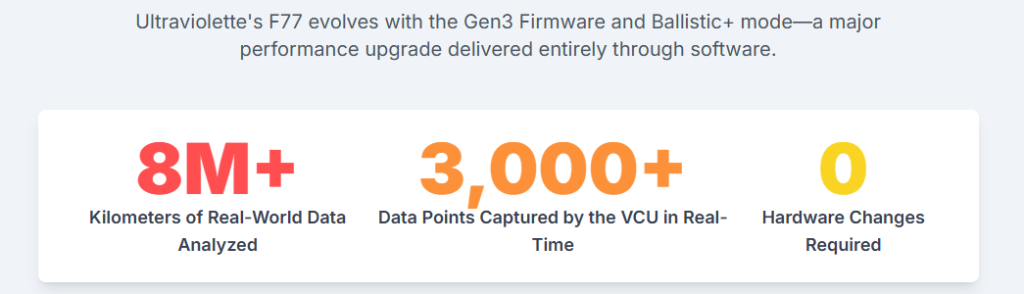
Ultraviolette Automotive has released a significant performance enhancement for its flagship F77 electric motorcycle, introducing the Gen3 Powertrain Firmware and a new high-performance riding mode, Ballistic+. This update represents a pivotal moment in electric two-wheeler development, as it delivers substantial performance improvements purely through software, without altering any hardware components.1 The core of this innovation lies in Ultraviolette’s data-backed development process, which leverages over 8 million kilometers of real-world ride data analyzed through its in-house intelligence system, Violette AI.3
The Ballistic+ mode refines the F77’s throttle response and power delivery, offering a sharper and more immediate initial surge of power, resulting in a more engaging ride experience.1 While peak power and torque figures remain consistent with previous specifications, the qualitative characteristics of power delivery have been optimized for greater linearity and control.2 Strategically, this upgrade is provided free of charge to all existing F77 customers and is fully backward-compatible across all variants.3
This approach aligns with Ultraviolette’s stated philosophy of continuous product evolution, directly challenging traditional product lifecycles characterized by planned obsolescence and positioning the company as a pioneer in software-defined electric mobility.3 The ability of an electric vehicle to continuously improve post-purchase, delivering ongoing value to its owners, sets a new benchmark in the industry.
1. Introduction: Ultraviolette’s Vision for Evolving Mobility
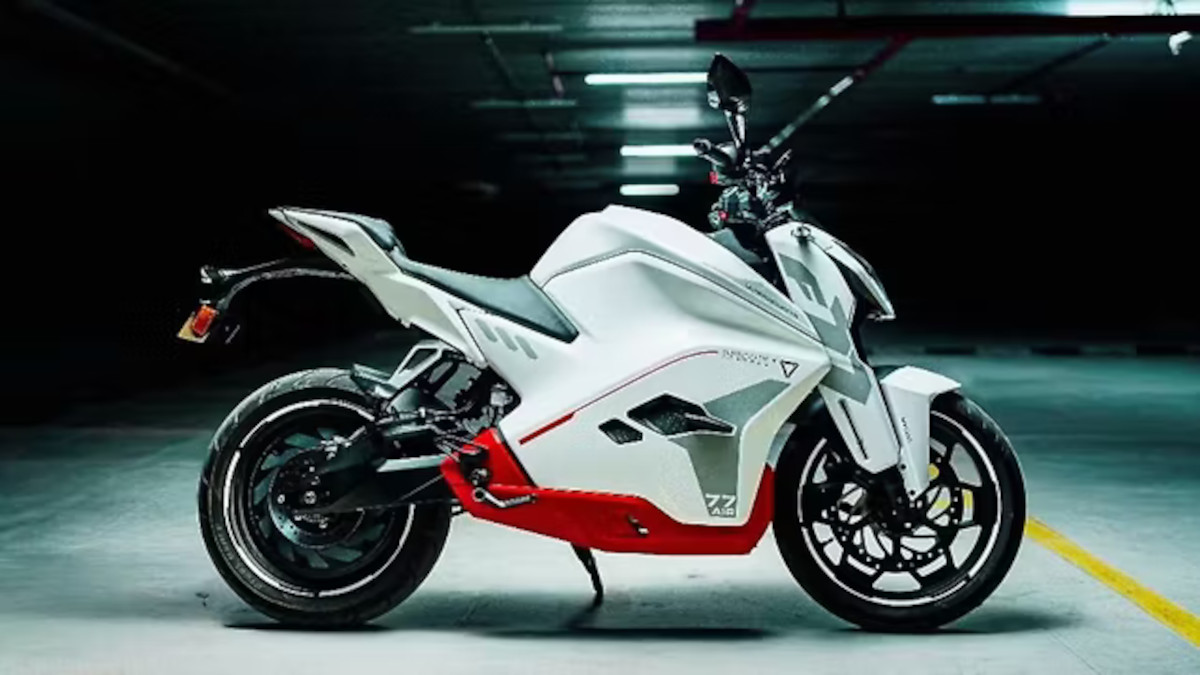
Ultraviolette Automotive, established in 2016, embarked on a mission to create an urban performance motorcycle, culminating in the launch of its flagship F77 in October 2022.3 The F77 quickly distinguished itself in the Indian market by featuring the largest battery pack for an electric two-wheeler at 10.3 kWh, offering an IDC range of 307 km, and claiming the title of the fastest electric two-wheeler produced in India at the time.7 The motorcycle’s design, notably aviation-inspired, reflects Ultraviolette’s commitment to high-performance engineering and aesthetics.7
Since its debut, Ultraviolette has consistently expanded and refined its F77 portfolio. This includes the limited-edition F77 Space Edition, crafted with aerospace-grade materials, and the F77 MACH 2, launched in April 2024, which brought improvements in IDC range (to 323 km), top speed, and torque figures.7 The MACH 2 also introduced advanced safety and smart technology features, such as multi-level Dynamic Regenerative Braking, Traction Control, and Dynamic Stability Control.7
Further demonstrating its commitment to product evolution, Ultraviolette launched the F77 SuperStreet in January 2025, a variant designed for enhanced comfort with an upright riding posture, while maintaining the high-performance specifications of its predecessors.5 It is important to note that many of the new features introduced with the F77 MACH 2 were proactively made reverse-compatible and offered free of cost to existing first-generation F77 owners, establishing a precedent for the current Gen3 firmware update strategy.7
Ultraviolette’s approach is rooted in a core philosophy that technology should evolve and improve over time, directly contrasting the common industry trajectory where products often degrade or become obsolete.3 The company articulates a vision for a machine that learns from its user, adapts, and unlocks greater capabilities the longer it is owned.3 This strategic commitment to software-driven enhancements and sustained customer value is a defining characteristic of Ultraviolette’s market presence.
This strategy positions Ultraviolette not merely as a motorcycle manufacturer but as a technology company that builds an evolving product platform. This approach has the potential to foster long-term customer loyalty and enhance brand perception, providing a significant differentiator in a competitive market. The consistent pattern of product refinement and commitment to software-driven enhancements, as en with the F77’s evolution and previous free updates, sets the stage for the strategic importance of the Gen3 firmware.Furthermore, by basing updates on extensive real-world data from early adopters, Ultraviolette leverages customer usage to mature its product post-launch. This agile, data-driven development cycle allows for rapid iteration and optimization, potentially leading to a superior user experience compared to competitors who might rely solely on pre-launch research and development. It effectively transforms every customer into a valuable contributor to the continuous improvement of the product.
2. Technical Deep Dive: Gen3 Powertrain Firmware and Violette AI
The Gen3 Powertrain Firmware represents a substantial performance upgrade for the F77, primarily focused on refining the motorcycle’s throttle response and power delivery.1 This update involves a comprehensive “re-tuning of components across the control and drive systems,” with specific adjustments made at the motor, motor controller, and vehicle intelligence levels.1 A critical aspect of this enhancement is its software-only nature; the update extracts further capabilities from the existing drivetrain and battery system without requiring any alterations to the physical hardware.1 This capability underscores the robust initial engineering of the F77’s hardware, which possessed inherent performance headroom that software can now exploit.
At the heart of this continuous evolution is Violette AI, Ultraviolette’s proprietary connected intelligence platform.3 The Gen3 update is a direct outcome of Ultraviolette’s data-backed development process, which has meticulously analyzed over 8 million kilometers of real-world riding data collected from F77 motorcycles globally.1 This extensive dataset provides Violette AI with comprehensive insights into diverse riding patterns, throttle inputs, braking behaviors, cornering loads, and various terrain conditions.1 The collection of data from international testing, particularly on European roads characterized by less congestion and higher average speeds, has been instrumental in identifying thermal gradients across the battery pack and control modules. This detailed thermal mapping has enabled Ultraviolette to implement changes that result in more uniform heat management and consistent performance of components, including better temperature control for the motor’s magnets.6 Violette AI continuously interprets and optimizes this vast stream of data, ensuring that any added performance is intelligently managed and remains usable, even in challenging or “edge-case scenarios”.1
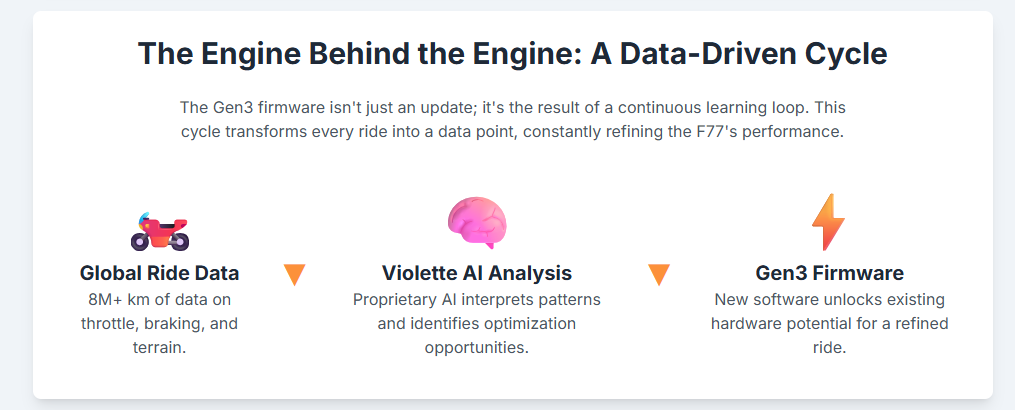
The Vehicle Control Unit (VCU) serves as the F77’s powerful onboard intelligence system, acting as the primary interface for this data-driven optimization.3 The VCU is capable of capturing more than 3,000 data points in real-time during operation.1 These real-time data points are then continuously analyzed by Violette AI, which interprets, learns, and evolves to optimize performance and deliver smarter, more responsive system updates.3 The rigorous fine-tuning, extending from the VCU to the motor and its controller, exemplifies a deep and seamless integration of hardware and intelligence.3 This sophisticated closed-loop system, where massive real-world data feeds into AI analysis via the VCU, directly leads to refined firmware and enhanced performance characteristics without necessitating any physical hardware changes, showcasing a truly data-driven and iterative development cycle.
The capability to deliver a “major performance upgrade” purely through software, without altering hardware components, is a compelling validation of the software-defined vehicle (SDV) paradigm, particularly within the two-wheeler segment. This demonstrates that the initial hardware design possessed significant performance headroom, which advanced software and AI can now unlock. This sets a significant precedent, potentially shifting consumer expectations towards vehicles that continuously improve over time and influencing competitors to invest more heavily in their software and AI capabilities. The ability to achieve consistent and sustained performance through data-driven thermal management further underscores this.
By optimizing heat management through software, Ultraviolette can maintain higher power output for longer durations, prevent performance throttling due to overheating, and potentially extend the lifespan of critical components like the battery and motor. This enhances both the immediate performance and the long-term reliability of the vehicle. This “learning machine” approach, where the vehicle adapts to individual rider styles and diverse environmental conditions, optimizes performance for specific usage patterns. This level of personalization and adaptive intelligence can be a significant competitive advantage, leading to higher customer satisfaction and a stronger brand reputation for innovation.
Table 2: Key Technical Enablers of Gen3 Firmware
| Technology/Component | Description/Role | Key Metric/Scale | Impact |
| Violette AI | Proprietary connected intelligence platform; analyzes real-world ride data; continuously learns and optimizes performance. | Over 8 million km of real-world data analyzed.1 | Enables data-backed development, adaptive performance, and intelligent system updates. |
| Vehicle Control Unit (VCU) | Powerful onboard intelligence system; captures real-time data points from the motorcycle. | Captures over 3,000 data points in real time.3 | Feeds data to Violette AI for interpretation and optimization; central to software-hardware integration. |
| Gen3 Powertrain Firmware | Software update; re-tunes motor, motor controller, and vehicle intelligence. | Software-only upgrade, no hardware changes.2 | Unlocks greater performance from existing drivetrain and battery system; introduces Ballistic+ mode. |
This table provides a concise, structured overview of the technological backbone of the Gen3 update. For an industry analyst or investor, it immediately highlights the key innovations and their scale (e.g., 8 million km of data, 3,000 data points per second). It visually reinforces the “software-defined” nature of the upgrade and the interconnectedness of Violette AI, the VCU, and the firmware itself, demonstrating a sophisticated engineering approach. This serves as a quick reference for the technical foundation discussed in this section.
3. Performance Enhancements: The Ballistic+ Mode Experience
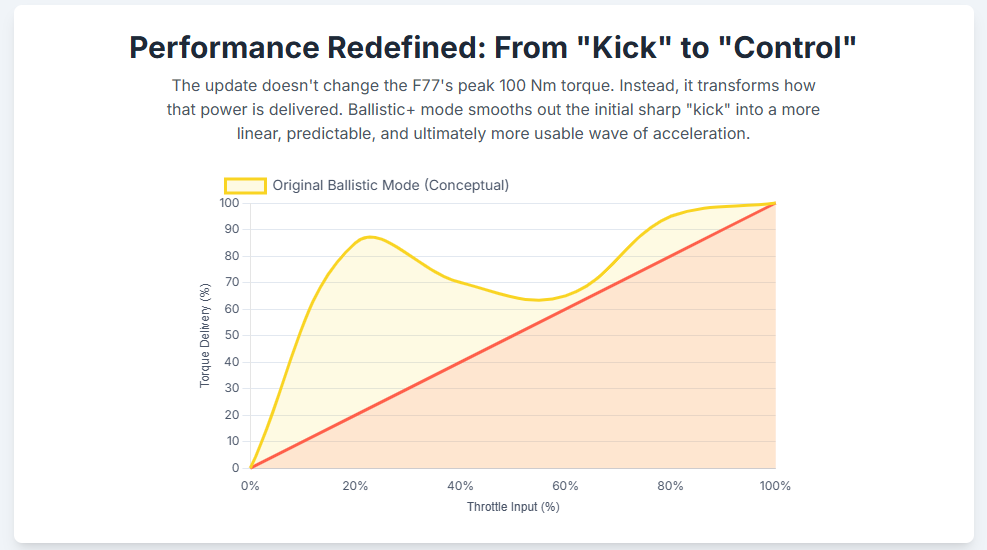
The introduction of Ballistic+ mode marks a significant enhancement to the F77’s riding dynamics, designed as a high-performance, adrenaline-focused setting.8 This new mode promises a “sharper and more immediate performance” 1, notably enhancing the “initial surge of power” and contributing to a more engaging ride experience.3 The core of this improvement lies in a “revised throttle map” engineered for “better torque delivery”.5 This aggressive tuning is intended to provide “more power and torque as compared to the earlier” settings 14, specifically improving the motorcycle’s acceleration.5
While Ultraviolette states that the F77’s peak output figures, such as 40 hp and 100 Nm of torque for the Recon variant, remain unchanged 2, the emphasis of the Gen3 update is on the
quality and delivery of this power. The update specifically addresses a previous characteristic of the F77 where “torque delivery under 30kmph was not the most engaging,” now making the bike feel “more engaging with a better initial pickup”.5 However, subjective feedback from reviewers offers a nuanced perspective on this change. Some observations indicate that while there might be “a little more torque,” the delivery is “more linear,” leading to a sensation where the rider “don’t feel it as much” in terms of an abrupt “kick” that the previous motorcycle might have had.15 This suggests a deliberate shift from a sharp, sudden power surge to a smoother, more consistent, and linear power delivery across the range.6 The updated algorithm has “smoothened out” the torque mapping, resulting in an “improved torque curve which is wide and a bit linear,” making the power and torque engagement “smoother and better manageable”.6
This refinement in power delivery significantly impacts overall rideability and consistency. The F77’s rideability has “notably improved,” making it more enjoyable even in demanding environments like a go-kart circuit.6 In real-world conditions, these changes are expected to translate into “improved rolling acceleration and top speed runs with consistent performance throughout”.6 A key factor contributing to this consistency is the enhanced thermal management. Through detailed data analysis, particularly from riding conditions on European roads, Ultraviolette identified and addressed thermal gradients across the battery pack and control modules. This has led to more uniform heat management and consistent performance of components, along with better temperature control for the motor’s magnets.6
Regarding other riding modes, the Gen3 update primarily focuses on the Ballistic mode’s evolution into Ballistic+. Minor tweaks have been applied to modes like “Glide,” and the “Combat” mode has been adjusted to offer power and torque access closer to the original “Ballistic” mode.6 The F77 Mach 2 already incorporated features like multi-level regenerative braking and traction control 7, and Ballistic+ intelligently leverages Violette AI to ensure the enhanced power remains usable across various scenarios.1
The distinction between perceived “performance” and optimized power delivery is a crucial aspect of this update. While company statements emphasize a “sharper” and “adrenaline-focused” feel, the nuanced feedback from riders indicates a shift towards a more linear, usable, and consistent torque curve. This suggests that Ultraviolette is prioritizing refined and predictable power delivery over a potentially jarring initial “kick,” which might be less efficient or harder to control in diverse riding conditions.
For a performance electric motorcycle, consistent and predictable power delivery across the entire operating range is often more valuable for rider confidence and overall control than a sudden, peaky surge. This signifies a maturation in their performance tuning, moving beyond mere raw numbers to a focus on the holistic rider experience. The data-driven refinement, particularly from the analysis of European riding conditions, directly informed improvements in thermal management and torque mapping. This illustrates how diverse real-world usage data directly translates into specific engineering optimizations, leading to more uniform heat management and better temperature control for the motor’s rotor, which in turn allows for the improved and more linear torque curve.
Table 1: Ultraviolette F77 Performance Characteristics (Pre- vs. Post-Gen3 Firmware)
| Characteristic | Pre-Gen3 Firmware (Original/Mach 2) | Post-Gen3 Firmware (Ballistic+ Mode) | Notes |
| Throttle Response | Engaging, but “torque delivery under 30kmph was not the most engaging”.5 | Sharper, more immediate, increased urgency, better initial pickup.1 | Improved primarily through software re-tuning. |
| Power Delivery | Described by some as having a distinct “kick”.15 | More linear, smoother, better manageable, wider torque band, consistent performance throughout.6 | Peak output figures (e.g., 40 hp, 100 Nm) remain unchanged; enhancement is in delivery characteristics.2 |
| Overall Rideability | Good, but with areas for refinement in specific speed ranges. | Notably improved, more enjoyable, enhanced rolling acceleration and top speed runs.6 | Benefits from optimized thermal management and refined algorithms. |
This table directly addresses the core performance claims of the update by presenting a “before and after” comparison. It clarifies the specific areas of improvement, emphasizing that these are qualitative enhancements in delivery and feel rather than quantitative increases in peak power, which is a key distinction for a software-only update. The inclusion of nuanced reviewer feedback provides a more balanced view of the actual rider experience, helping the reader understand precisely how the ride has transformed.
4. Strategic Implications and Market Impact
Ultraviolette’s decision to offer the Gen3 Powertrain Firmware and Ballistic+ mode as a free upgrade to all existing F77 customers, coupled with its full backward compatibility across all variants, is a highly strategic move.1 This approach is not unprecedented for the company, as similar free, backward-compatible updates were provided when features from the F77 MACH 2 were extended to earlier models.7 This consistent policy directly challenges the traditional automotive industry model, which often relies on planned obsolescence, where products degrade or become outdated over time, compelling consumers to purchase newer models for enhanced features or performance.3
By contrast, Ultraviolette’s philosophy centers on building machines that “evolve and improve” with every ride, continuously unlocking more power and capabilities the longer they are owned.3 This commitment to continuous improvement and free, value-adding upgrades fosters strong customer loyalty and significantly enhances the long-term value proposition of the F77. While many sources imply an Over-The-Air (OTA) “download and install” process for the update 2, it is noteworthy that one report explicitly states that existing customers “will have to take their motorcycles to the dealership” to receive the update.6 This discrepancy could indicate a regional difference, a phased rollout, or a requirement for a dealership visit for critical firmware flashing or final validation, even if the software is primarily delivered OTA. Clarification from Ultraviolette on the exact update mechanism would be beneficial for consumers.
This strategy positions Ultraviolette as a leader in the realm of software-defined vehicles (SDVs) within the two-wheeler segment. By demonstrating the ability to deliver significant performance enhancements purely through software, leveraging extensive real-world data and advanced AI, Ultraviolette showcases its engineering prowess and its capacity to extract maximum potential from existing hardware through intelligent software optimization.3 This sets a new benchmark for how performance upgrades can be delivered in the EV space.
The broader implications for the electric two-wheeler market are substantial. This move could pressure competitors to adopt similar software-centric development philosophies and customer-centric upgrade policies. It reinforces the idea that an electric vehicle’s capabilities are not static at the point of sale but can dynamically improve over its lifespan, enhancing its appeal and challenging traditional ownership models. The significant investment in data collection and AI, as evidenced by Violette AI’s analysis of 8 million kilometers of data and the VCU’s capture of 3,000 real-time data points, demonstrates a scalable model for continuous product improvement that can be applied to future models and potentially influence industry-wide practices.3
This approach significantly enhances the long-term value proposition and impacts the Total Cost of Ownership (TCO) for F77 owners. Unlike internal combustion engine vehicles that typically depreciate and may require expensive hardware upgrades for performance improvements, the F77’s capabilities improve over time without additional cost to the owner. This makes the F77 a more future-proof investment and can attract buyers who prioritize ongoing value and technological evolution.
Furthermore, the 8 million kilometers of real-world data collected and analyzed by Violette AI represents a substantial proprietary dataset. This data provides Ultraviolette with a unique understanding of real-world usage patterns, allowing them to optimize their vehicles in ways that competitors without similar data access cannot easily replicate. This continuous data capture ensures that this “data moat” continues to grow, creating a powerful feedback loop for product development. As more F77s are sold and ridden, the AI becomes smarter, leading to even more refined and impactful updates. This could lead to a form of “ecosystem lock-in,” where the continuous improvement cycle makes switching to another brand less appealing, thereby strengthening Ultraviolette’s market position.
Finally, the free, backward-compatible update is a powerful differentiator in the customer experience. In an industry often criticized for planned obsolescence and costly upgrades, Ultraviolette is actively improving its product for existing customers at no additional charge. This move could redefine customer expectations for EV ownership, positioning Ultraviolette as a customer-centric innovator. This positive word-of-mouth and enhanced brand reputation can be invaluable in a competitive market, potentially driving higher sales and market share without solely relying on aggressive marketing campaigns.

5. Conclusion and Future Outlook
The Gen3 Powertrain Firmware and Ballistic+ mode update represent a significant achievement for Ultraviolette Automotive, underscoring the transformative potential of software-defined enhancements in electric vehicle performance. By meticulously leveraging extensive real-world data and advanced AI through its Violette AI platform and the F77’s Vehicle Control Unit, Ultraviolette has successfully refined the motorcycle’s power delivery. This has resulted in a sharper initial response and a more linear, manageable torque curve, all achieved without any physical hardware modifications. This strategic decision to provide a free, backward-compatible update reinforces Ultraviolette’s distinctive philosophy of continuous product evolution, setting a new benchmark for customer value and challenging entrenched notions of vehicle ownership.
Looking ahead, the underlying architecture, characterized by its robust VCU and the learning capabilities of Violette AI, provides a strong foundation for ongoing software-driven innovations. It is reasonable to anticipate further refinements in performance, improvements in energy efficiency, and enhancements to existing safety features such as traction control, dynamic stability control, and hill hold.7 New riding modes or adaptive functionalities, tailored to evolving rider needs and diverse environmental conditions, are also likely to emerge from this continuous development cycle. Ultraviolette’s unwavering commitment to data-driven development, coupled with its expanding international footprint 3, positions the company strategically to become a leading innovator in intelligent, evolving electric mobility solutions. The company’s demonstrated willingness to incorporate real-world feedback, as evidenced by the refinement of initial torque delivery and linearity, suggests a responsive development cycle that will continue to enhance the F77 and its future models, solidifying its reputation as a technology company redefining vehicle ownership and performance.
Our Social Media Handles
- Instagram : LivingWithGravity
- Medium : Akash Dolas
- YouTube Channel : Gear and Shutter