






The Honda EV Outlier Concept: A Precursor to the Software-Defined Motorcycle of the 2030s
I. Executive Summary: The Thesis of the “Outlier”
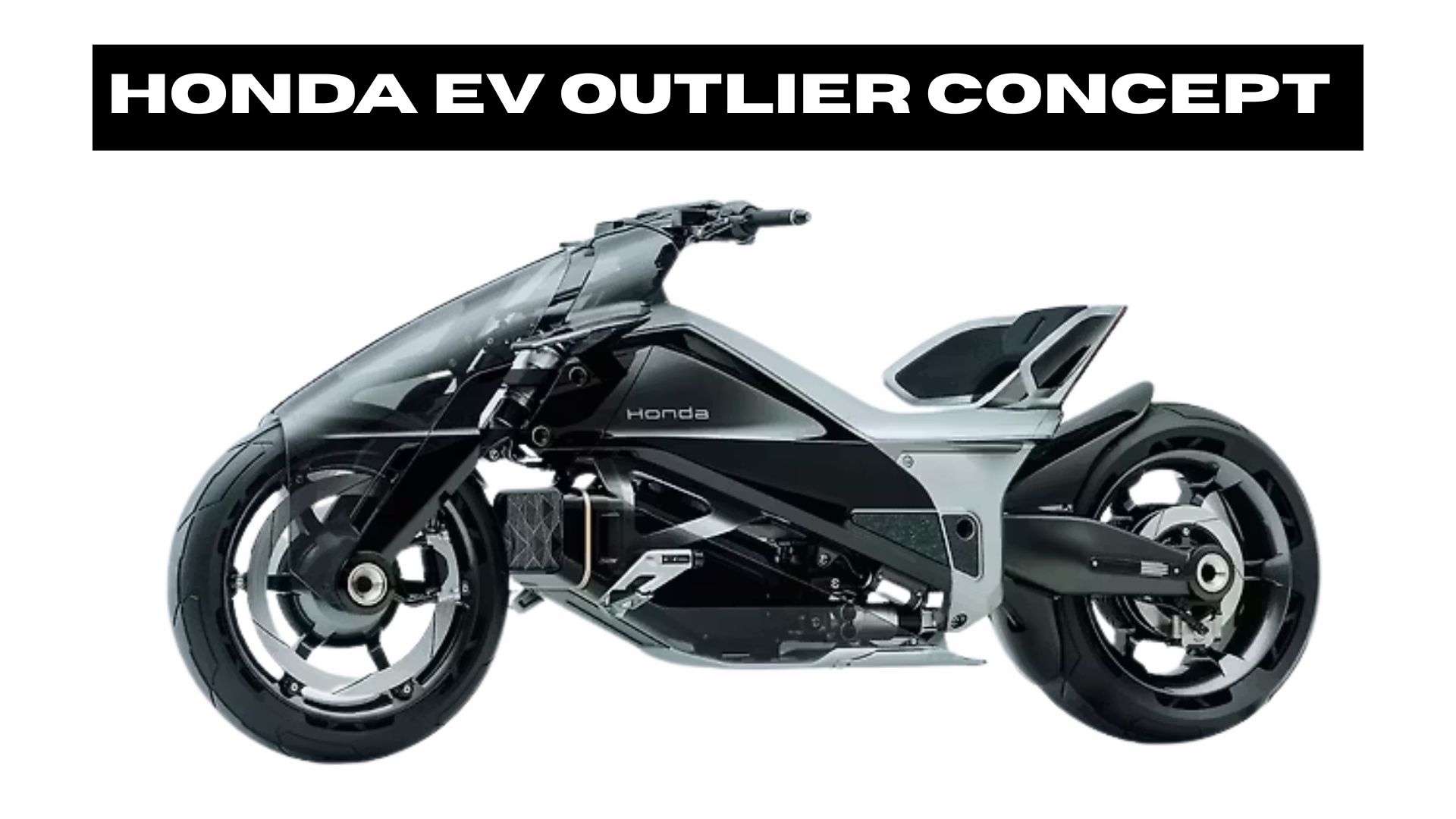
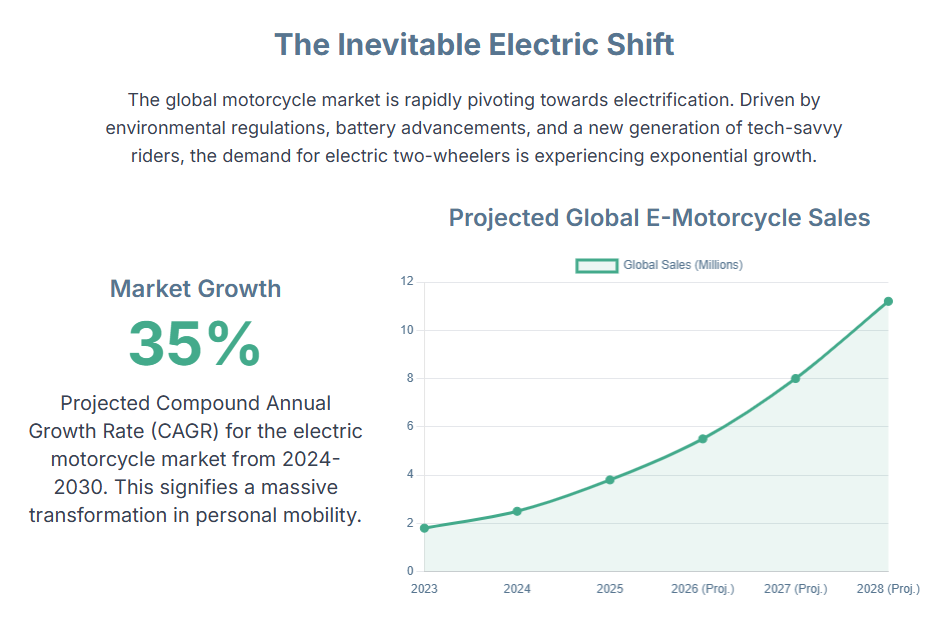
The Honda EV Outlier Concept, unveiled at the Japan Mobility Show 2025, represents a fundamental shift in Honda Motor Co., Ltd.’s long-term vision for two-wheeled mobility.1 Explicitly designed to propose a “new vision for motorcycles beyond 2030,” the Outlier is not merely an evolution of existing internal combustion engine (ICE) platforms but a conceptual declaration that the electric motorcycle of the future must be a category-defining machine.1
The core value proposition of the EV Outlier is founded on three integrated technological pillars. First, the pioneering Dual In-Wheel Motor 2WD system provides unprecedented packaging freedom and dynamic control.4 Second, an unconventional architectural geometry, including a low-slung chassis and specialized Hossack-style girder fork, is engineered to manage the unique challenges posed by the in-wheel powertrain.5 Third, the entire platform is unified by the ASIMO OS, Honda’s original vehicle operating system, transforming the motorcycle into a Software-Defined Vehicle (SDV) capable of continuous functional advancement.1 The resultant design challenges conventional motorcycle proportions, adopting an elongated, low aero profile that signals a complete departure from the heritage of current motorcycles.4 This strategic marker demonstrates Honda’s commitment to delivering both environmental sustainability and a new form of riding enjoyment.4
II. Strategic Context and Positioning
A. The Japan Mobility Show 2025: A Staging Ground for the 2030s Vision
The EV Outlier Concept made its world premiere at the Japan Mobility Show in Tokyo on October 29, 2025.1 The event served as a critical platform for Honda to articulate its mobility future, which includes integrating intelligent technologies to create new value.1 Honda has positioned the Outlier as a long-range strategic marker, a model “not just an extension of existing motorcycles,” but one that defines the trajectory of design and engineering for the period post-2030.1
Although detailed technical data—such as battery capacity, operational range, and performance output—have been intentionally withheld, the company confirmed the concept serves as an advanced design and engineering testbed rather than a near-term production prototype.7 This long-term focus allows Honda to explore high-risk, high-reward technologies without the immediate constraints of mass-market feasibility, underlining the manufacturer’s commitment to innovation and sustainable design principles.4
B. Honda’s EV Roadmap: Intermediate Steps to the Outlier
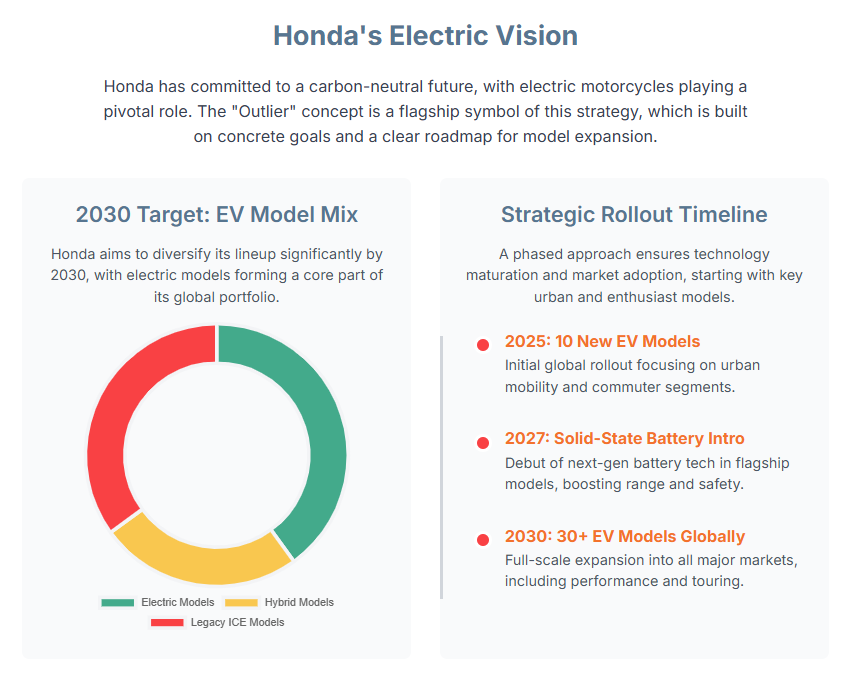
The EV Outlier Concept is conceptually intertwined with Honda’s broader electric mobility portfolio. It aligns structurally and philosophically with the newly introduced Honda 0 Series (which includes the 0 Alpha SUV concept), adopting the development approach encapsulated by the philosophy “Thin, Light, and Wise”.1 This synergy suggests a corporate imperative to standardize critical intellectual property, specifically the underlying ASIMO OS software architecture, across both four-wheeled and two-wheeled EV platforms.10 Standardizing the next-generation vehicle operating system across product lines is crucial, as it streamlines development costs and accelerates the technological maturity of two-wheeled SDVs.
The development of the Outlier is understood to build on lessons learned from earlier, more proximate EV concepts. The project was explicitly conceived by Yuya Tsutsumi, the project leader, to advance the themes explored in the EV FUN Concept and EV Urban Concept, which were initially showcased at EICMA 2024.3 This establishes a clear technology ladder. Notably, the EV FUN Concept has already transitioned into the production-ready WN7 model, scheduled for commercial release in the UK in early 2026.6 This dual-track strategy confirms that Honda is simultaneously validating its foundational electric powertrain and battery packaging in the near term (with WN7) while reserving the Outlier platform to rigorously test the advanced, high-complexity systems—such as the dual in-wheel motors, 2WD control, and full specialized motorcycle integration of the ASIMO OS—that are projected for mass deployment post-2030.3
III. Electromechanical Innovation: The Dual In-Wheel Powertrain and Dynamics Control
A. Architecture Deep Dive: The 2WD Dual In-Wheel Motor System
The most definitive engineering feature of the EV Outlier is its innovative powertrain architecture: the adoption of two electric motors integrated directly into the hubs of both the front and rear wheels.4 This configuration enables an all-wheel drive (2WD) capability for the motorcycle.
This layout fundamentally reconfigures the vehicle’s mechanics. Integrating the motors into the wheels liberates the entire central chassis area of the motorcycle.11 This architectural freedom allows Honda engineers to incorporate maximum battery volume and place other sophisticated components lower and more centrally within the frame.4 This dictates the low-slung, elongated, and highly stable low aero profile of the machine.4
From a performance standpoint, the 2WD system offers a significant advantage over conventional single-wheel drive motorcycles, especially those managing the instantaneous, high-peak torque characteristic of electric motors.12 The ability to precisely distribute torque to both wheels in real-time is managed by digital control systems.4 This enhances ride stability, improves overall traction, and ensures more stable power delivery, particularly under demanding acceleration.4 Visual examination of the display panel suggests that the front motor primarily assists the rear under conditions requiring maximum acceleration, providing supplementary traction and dynamic control.5
B. Addressing the Unsprung Mass Challenge through Structural Innovation
The dual in-wheel motor design introduces a significant engineering challenge: the substantial increase in unsprung mass. Unsprung mass, which comprises the weight of the wheels, tires, brakes, and axles—or in this case, the added weight of the integrated hub motors—is not supported by the vehicle’s suspension.13 High unsprung mass typically compromises dynamic behavior, potentially leading to reduced road grip, compromised handling, and a ‘bouncy’ or uncontrolled sensation when encountering road imperfections.13 Successfully managing this kinematic obstacle is paramount to the commercial viability of IWM technology in high-performance motorcycles.
Honda addresses this challenge through a multi-faceted approach involving advanced mechanical structure and active control:
- Hossack-Style Girder Fork: The front suspension employs a Hossack-style girder fork, which is suspended on dual wishbones.5 This design choice is critical because the Hossack geometry physically separates the functions of steering from those of shock absorption and load management. It provides a level of rigidity and precise vertical control far superior to traditional telescopic forks, which would likely struggle to handle the high rotational inertia and mass of the front IWM. This enhanced structural control ensures that the wheel maintains optimal contact with the road surface, neutralizing the destabilizing effects of high unsprung weight.13
- Low Center of Gravity: The battery pack is strategically situated low in the chassis, roughly at the level of the rider’s footpegs.5 Maximizing the sprung weight at the lowest point of the machine lowers the overall center of gravity, a design element that partially counteracts the negative effects of high unsprung mass on handling agility during cornering and transitions.
- Active Digital Management: Beyond mechanical intervention, the control systems are tasked with actively managing dynamic stability.4 Industry analysis confirms that effective IWM implementation relies heavily on sophisticated high-bandwidth torque control to actively manage the unsprung mass dynamics.14 By using digital systems to instantly adjust torque distribution and damping forces, the EV Outlier intends to electronically mitigate the inherent mechanical drawbacks, aiming for responsiveness and stability comparable to any contemporary vehicle.4
IV. The Software-Defined Motorcycle (SDM): Integrating ASIMO OS
A. ASIMO OS as the SDV Foundation
The EV Outlier Concept is positioned as a truly Software-Defined Vehicle (SDV), underpinned by ASIMO OS, Honda’s proprietary vehicle operating system.1 ASIMO OS represents fundamental software designed to manage the vehicle’s integrated computers and electronic control units (ECUs), operating similarly to how iOS or Android manages a smartphone.10
This system is central to Honda’s commitment to longevity and continuous improvement. By linking the motorcycle to the cloud, ASIMO OS enables Over-The-Air (OTA) software updates, allowing the vehicle’s functions and performance to continuously advance even after the customer has purchased it.1 The OS provides the necessary infrastructure for digital user experience, integrated dynamics control, and the deployment of advanced driver assistance systems.10
B. The Promise of Ultra-Personal Optimization (UPO)
A definitive capability promised by the integration of ASIMO OS is “ultra-personal optimization” (UPO). This feature is designed to allow the vehicle to learn the specific preferences, riding habits, and usage patterns of each individual customer.1
This capability moves beyond traditional, static selectable ride modes. Instead of simply selecting ‘Sport’ or ‘Rain,’ the UPO system will continuously and subtly fine-tune all variable parameters—including throttle response curves, the intensity and feel of regenerative braking 12, the precise intervention thresholds of stability control, and the real-time torque split delivered by the 2WD system—to subconsciously match the rider’s style.15 This constant, adaptive calibration realizes a highly customized mobility experience, fulfilling Honda’s long-standing philosophical commitment to the “joy of driving”.1
C. Connectivity and Advanced Safety Integration
The technical lineage of ASIMO OS is crucial to its future safety potential. The OS is the foundation for Automated Driving/Advanced Driver Assistance Systems (AD/ADAS) and leverages technology derived from Honda’s experience in Level 3 automated driving, which the company was the first in the world to commercialize.10
While the EV Outlier remains a rider-controlled machine, this infrastructure implies the potential for a new generation of sophisticated safety features. The advanced sensor and software architecture could enable L2+ rider assistance functions, such as highly accurate predictive traction control or dynamic cruise control tailored specifically for the unique stability dynamics of a two-wheeled vehicle.15 Furthermore, the cloud connectivity enabled by ASIMO OS facilitates linkage to external information, laying the groundwork for vehicle-to-everything (V2X) communication, enhancing situational awareness and accident prevention in the 2030s riding environment.10
V. Design Philosophy, Aesthetics, and Ergonomic Vision
A. Form Follows Electric Function
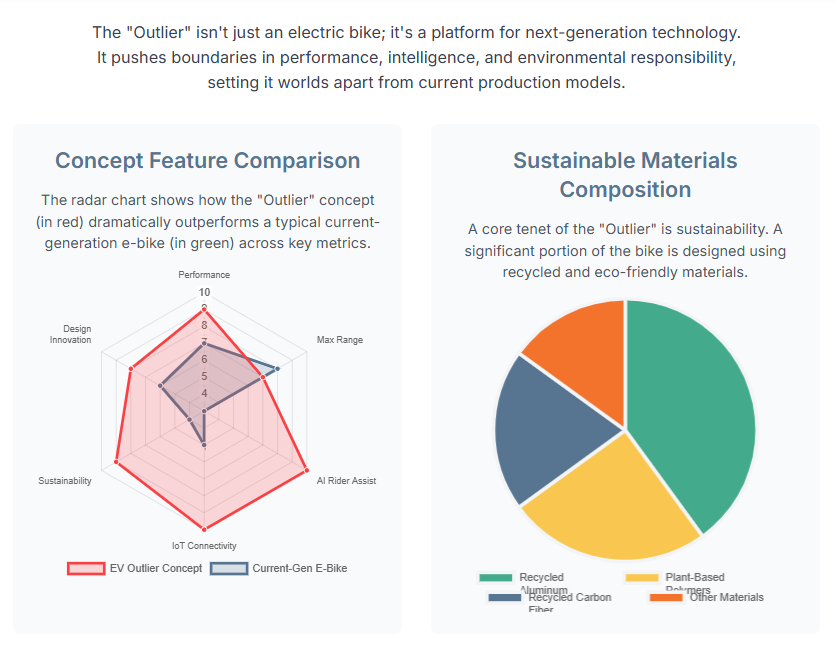
The aesthetic quality of the EV Outlier is a direct manifestation of its electromechanical structure. The placement of the motors in the wheel hubs allows for the low aero profile and futuristic stance that clearly distinguishes it from current motorcycle designs.4 The design philosophy sought to express a “gliding, light image” through smooth surfaces, while simultaneously exposing the unique mechanical components that are exclusive to the electric architecture.16
The motorcycle possesses a distinctive visual tension, juxtaposing a seamless, lustrous static expression with a highly mechanical, functional expression.16 This contrast is highlighted by the exposed Hossack fork structure and the highly unconventional mounting of the suspension, which is positioned horizontally toward the lower mid-chassis.8 This intentional focus on the unique packaging of EV components helps the machine achieve an appeal distinct from that of ICE motorcycles.16
B. The Electric Power Cruiser Category
The ergonomic layout of the EV Outlier clearly suggests a focus on comfortable, high-torque cruising. The riding position is characterized by high handlebars and a feet-forward stance.5 Analysts have readily identified this configuration as defining an electric cruiser or “power cruiser” segment.6
The seat is designed as a pure single-seater with an armchair-like perch featuring wraparound sides, confirming its intention as a focused touring or commuting machine rather than a performance sport bike where “hanging off” the seat is required.5 The low, elongated posture aligns the Outlier with broader corporate goals for the 0 Series, which targets consumers prioritizing a smart lifestyle and potentially attracting younger generations or first-time EV purchasers who lack conventional expectations about motorcycle design.9 The ample “real estate” provided by the elongated shape also accommodates multiple display interfaces, with two separate screens providing rider information.8
C. Cultural Resonance and Design Mythology
The EV Outlier’s futuristic silhouette and sleek, enclosed forms have garnered significant attention for their cultural referentiality. Specifically, the design strongly channels the visual identity of Kaneda’s bike from the seminal 1988 anime Akira.18
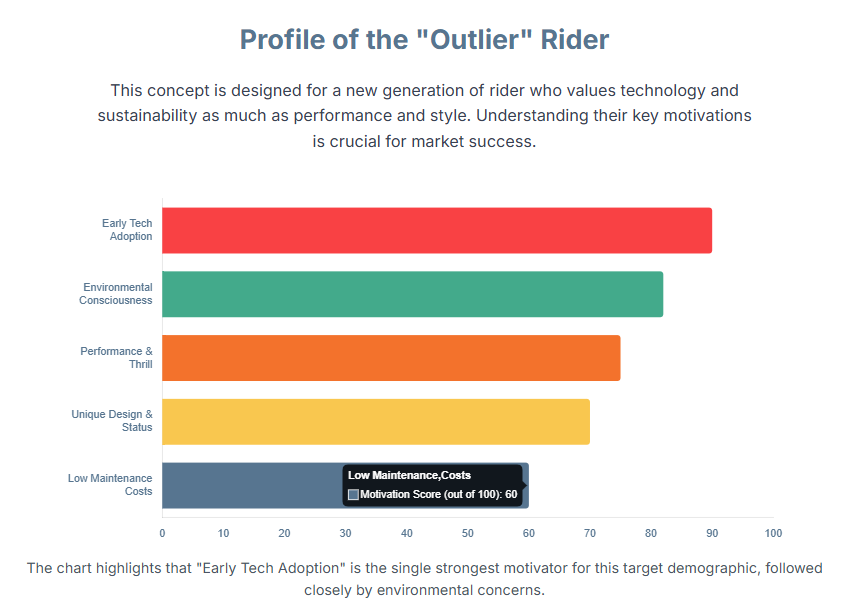
This intentional channeling of cyberpunk aesthetics is a sophisticated strategic move. By referencing Akira, Honda immediately imbues the Outlier with aspirational, forward-looking significance, bypassing the need for traditional sensory cues like engine sound.12 This approach positions the concept as a definitive cultural artifact of future mobility. It leverages strong, recognizable design mythology to appeal to a demographic that values technological innovation and a distinctive aesthetic identity.18 The design intent is to deliver “surprise and excitement” by proposing a value that can only be realized through electrification, creating a vehicle that is unconstrained by traditional boundaries, justifying the “Outlier” moniker.3
VI. Competitive Landscape and Strategic Feasibility (2030s)
A. Comparison to Emerging Electric Architectures
The dual in-wheel motor architecture of the EV Outlier distinguishes it sharply from key players in the emerging high-performance electric motorcycle market. Established platforms like LiveWire typically utilize a conventional mid-mounted motor and chain/belt drive.12 More progressive designs, such as the Verge TS Ultra, utilize a highly innovative single hubless rim motor, which maximizes central chassis space for the battery pack but remains a single-wheel drive machine.19
The Outlier’s strategic choice to incorporate 2WD via dual in-wheel hub motors places it in a specialized, high-complexity category.
Comparison of Motorcycle Powertrain Architectures: Central vs. In-Wheel Motor Systems
| Feature | Conventional Central Motor (e.g., LiveWire) | Single Hubless Rim Motor (e.g., Verge) | Honda EV Outlier (Dual In-Wheel Hub) |
| Power Transmission | Chain/Belt/Shaft Drive | Direct Drive (Rear Rim) | Direct Drive (Front & Rear Hubs) |
| Drive System | RWD (Rear-Wheel Drive) | RWD | 2WD (All-Wheel Drive) |
| Design Flexibility | Limited by transmission/motor placement | High (central cavity for battery) | Highest (full liberation of chassis) 4 |
| Unsprung Mass Impact | Lowest | High (Rear only) 19 | Very High (Front & Rear) |
| Primary Dynamics Solution | Conventional Suspension Tuning | Suspension Tuning, Low CG | Hossack Fork, Low CG, Active Digital Control [4, 5] |
| Traction Control | Single-wheel electronic management | Single-wheel electronic management | Precision Torque Vectoring (2WD) 4 |
The Outlier’s competitive advantage lies in its superior traction management.4 While single-motor electric bikes are inherently powerful, the 2WD system allows for finer digital torque vectoring, offering enhanced control and safety on varied surfaces, including sand, snow, or mud, a major performance differentiator.5
B. Manufacturing and Feasibility Hurdles
As an early concept explicitly targeting the post-2030 era, the EV Outlier faces considerable engineering and economic challenges before any potential commercialization. Currently, no production timeline or detailed technical specifications have been disclosed.7
The foremost technological hurdle is the scalability and cost management of the dual in-wheel motor system. Although the increase in unsprung mass is manageable through sophisticated suspension tuning and active control systems 13, the simultaneous deployment of high-specification components—such as two proprietary IWMs, the Hossack-style girder fork, and dual single disc brakes 11—represents a significant manufacturing complexity and cost premium.13
Furthermore, the integration of ASIMO OS requires extensive two-wheeled specific validation. The system must adapt the sophisticated algorithms derived from Level 3 autonomous driving systems to the highly dynamic and inherently unstable environment of a motorcycle.15 Validating the full extent of “Ultra-Personal Optimization” in real-world motorcycle riding scenarios presents a substantial software validation burden that must be cleared before the concept can transition to a production architecture.
C. Long-Term Forecast (2030-2035)
The EV Outlier Concept serves as a strong indicator that the premium electric motorcycle market of the 2030s will be defined by two overarching capabilities: software intelligence and integrated drive performance. Honda’s commitment to this complex, radical architecture suggests a fundamental corporate belief that to achieve optimal electric packaging and superior rider dynamics, a complete structural departure from ICE norms is necessary.3
The ASIMO OS, through its foundation in Software-Defined Vehicle principles, provides the necessary intelligence layer for this complex mechanical system.
Core Capabilities of Honda’s ASIMO OS in Two-Wheeled Mobility
| Capability Domain | ASIMO OS Feature | Impact on Rider Experience |
| Personalization | Ultra-Personal Optimization (UPO) | Real-time, continuous adjustment of vehicle dynamics and UX based on learned behavior and environment.1 |
| Dynamics Control | Integrated Dynamics Management | Precision control over 2WD torque distribution, regenerative braking, and electronic stability, utilizing high-bandwidth data.[4, 10] |
| Longevity/Value | Over-The-Air (OTA) Updates & Cloud Linkage | Continuous functional advancement and performance improvement post-purchase, ensuring the vehicle remains current.1 |
| Safety Integration | AD/ADAS Foundation | Enables sophisticated rider assistance and safety features derived from automated driving technologies.15 |
For the EV Outlier platform to establish leadership in the post-2030 market, the performance benefits derived from its unique 2WD traction control and the personalized riding experience offered by ASIMO OS must demonstrably justify the technical complexity and likely higher production cost associated with managing the dual IWM unsprung mass.
VII. Conclusions
The Honda EV Outlier Concept is more than a design study; it is a declaration of strategic intent, illustrating Honda’s readiness to disrupt traditional motorcycle categorization by exploiting the architectural freedom offered by electric power. The integration of the dual in-wheel motor 2WD system provides demonstrable superiority in traction control, which, combined with the structural intervention of the Hossack-style fork, addresses the inherent engineering challenges of increased unsprung mass.
The true differentiator, however, is the wholesale commitment to the Software-Defined Vehicle paradigm through the ASIMO OS. This operating system transforms the motorcycle from a fixed mechanical product into an adaptive, personalized mobility device, leveraging concepts like Ultra-Personal Optimization to continuously enhance the riding experience. By aligning its aesthetic with cultural symbols of futuristic mobility (the Akira motif), Honda is successfully positioning the Outlier not merely as transportation, but as a technological and cultural icon designed to define the electric power cruiser segment of the 2030s. The feasibility of this vision hinges on successfully transitioning these advanced, high-cost control systems from the concept phase to mass production while maintaining a competitive balance of performance, safety, and price against single-motor architectures.
Source
- News Release – Honda Global, accessed October 31, 2025, https://global.honda/content/dam/site/global-en/newsroom-new/cq_img/news/2025/10/c251029eng/c251029eng.pdf
- Honda EV Outlier Concept Unveiled – Shows Future Bike Designs – RushLane, accessed October 31, 2025, https://www.rushlane.com/amp/honda-ev-outlier-concept-unveiled-shows-future-bike-designs-12532941.html
- EV Outlier Concept: Racing into the Unknown Shaping Surprise and Excitement, accessed October 31, 2025, https://global.honda/en/design/interview/202510japanmobilityshow_evoutlierconcept/
- Honda EV Outlier Concept is a Glimpse in Future Motorcycling …, accessed October 31, 2025, https://www.bikewale.com/news/honda-ev-outlier-concept-is-a-glimpse-in-future-motorcycling/
- Honda EV Outlier Predicts the Motorcycles of the 2030s | Cycle World, accessed October 31, 2025, https://www.cycleworld.com/motorcycle-news/honda-ev-outlier-predicts-new-motorcyles/
- Honda previews motorcycles of the future with new EV Outlier Concept | Visordown, accessed October 31, 2025, https://www.visordown.com/news/honda-previews-motorcycles-future-new-ev-outlier-concept
- Honda EV Outlier Concept Revealed At Japan Mobility Show – The Future Of Motorcycling?, accessed October 31, 2025, https://www.drivespark.com/two-wheelers/2025/honda-ev-outlier-concept-unveiled-at-japan-mobility-show-078183.html
- Honda EV Outlier Concept Defines the Brand’s Vision Beyond 2030 – InsightEV, accessed October 31, 2025, https://insightev.com/honda-ev-outlier-concept-defines-the-brands-vision-beyond-2030/
- Honda 0 α Prototype: Aiming for Minimal and Refined Aesthetic, accessed October 31, 2025, https://global.honda/en/design/interview/202510japanmobilityshow_honda0alpha/?from=newslink_image
- Honda Vision for Software-Defined Vehicles (SDV) - Creating vehicles tailored to each and every user through “ultra-personal optimization” with ASIMO OS at the core, accessed October 31, 2025, https://global.honda/en/tech/Honda_SDV_ASIMO_OS/
- Honda EV Outlier Concept Unveiled – Shows Future Bike Designs – RushLane, accessed October 31, 2025, https://www.rushlane.com/honda-ev-outlier-concept-unveiled-shows-future-bike-designs-12532941.html
- Key differences of electric vs gas motorcycles | LiveWire, accessed October 31, 2025, https://www.livewire.com/the-pulse/learn/key-differences-electric-vs-gas-motorcycles
- In Wheel Motors And Unsprung Mass. Does It Matter? – Protean Electric, accessed October 31, 2025, https://www.proteanelectric.com/resource-centre/in-wheel-motors-and-unsprung-mass/
- Unsprung Mass in In-Wheel Motors: A Solved Challenge – YouTube, accessed October 31, 2025, https://www.youtube.com/watch?v=uqh0Aq7nJss
- Honda Presents World Premiere of Honda 0 Saloon and Honda 0 SUV Prototypes at CES 2025 | Honda Global Corporate Website, accessed October 31, 2025, https://global.honda/en/newsroom/news/2025/c250108aeng.html
- EV Outlier Concept: Racing into the Unknown Shaping Surprise and Excitement, accessed October 31, 2025, https://global.honda/en/design/interview/202510japanmobilityshow_evoutlierconcept/?from=global_JMS2025
- Honda EV Outlier Concept Revealed: Future of Electric Bikes in 2025 | Autos MaxAbout, accessed October 31, 2025, https://autos.maxabout.com/news/honda-ev-outlier-concept-unveiled-future-bike-designs
- Honda’s Futuristic, Anime-Esque Motorcycle Is Actually an Unexpected Callback to the ’80s, accessed October 31, 2025, https://currently.att.yahoo.com/att/honda-futuristic-anime-esque-motorcycle-184639095.html
- 2024 Verge TS, TS Pro, and TS Ultra Electrics To Hit US – Cycle World, accessed October 31, 2025, https://www.cycleworld.com/bikes/verge-ts-pro-and-ts-ultra-electrics-arriving-us-market/
- The Pros and Cons of a Dual Motor Ebike System – ENGWE, accessed October 31, 2025, https://engwe.com/blogs/news/the-pros-and-cons-of-a-dual-motor-ebike-system
Our Social Media Handles
- Instagram : LivingWithGravity
- Medium : Akash Dolas
- YouTube Channel : Gear and Shutter
- Facebook : LivingWithGravity