








Executive Summary
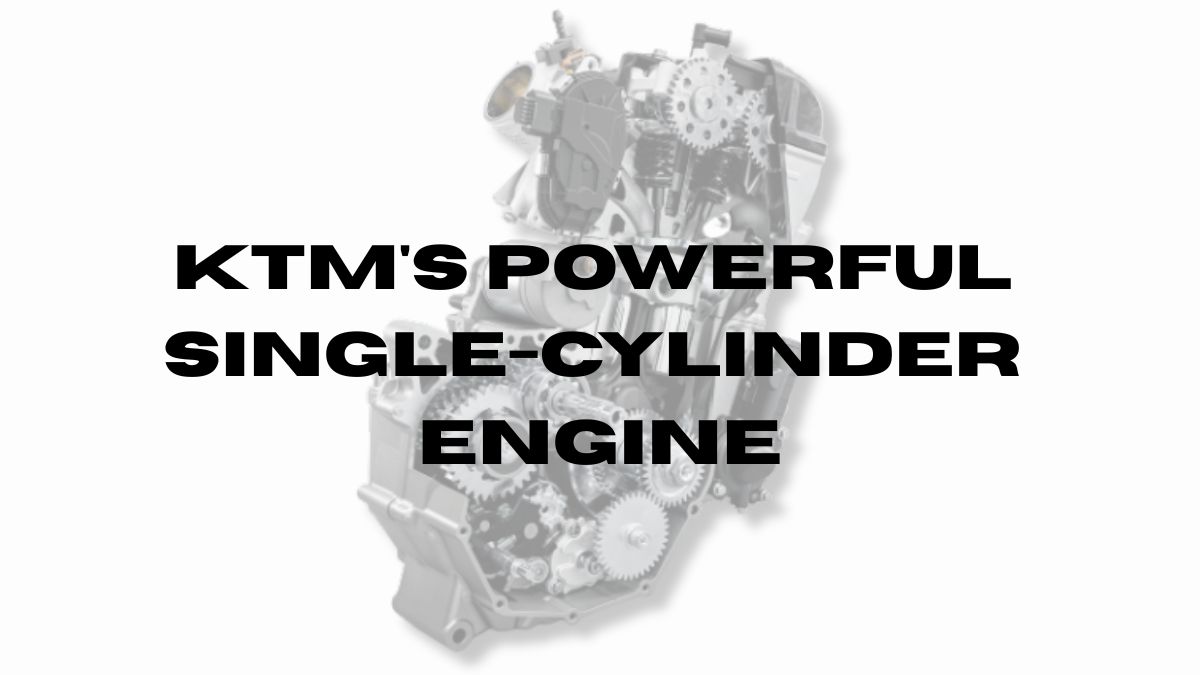
This report provides a comprehensive analysis of KTM’s latest internal combustion engine (ICE) developments, focusing on its new single-cylinder platforms. The analysis confirms that KTM has successfully reclaimed the title of the “world’s most powerful” single-cylinder engine for a road-legal motorcycle with its revised LC4 motor. This achievement is not merely a marginal gain but a strategic declaration that ICE technology continues to evolve and push performance boundaries. The engineering advancements, including a simplified oil delivery system and enhanced durability measures, demonstrate a concerted effort to refine and optimize traditional powertrain design.
The report further reveals that KTM’s strategy is more nuanced than a simple commitment to combustion engines. The company is pursuing a dual-pronged approach: relentlessly innovating its ICE portfolio to maintain market dominance while simultaneously pioneering forward-looking solutions in hybrid and electric technologies. This is evidenced by patents for a hybrid electromechanical supercharger and a clip-on EV range extender. This strategy positions KTM to navigate the complex and shifting landscape of the global motorcycle market by catering to both traditional enthusiasts and future-conscious consumers, securing its competitive advantage in a period of unprecedented technological transition.

1. Introduction: The New Benchmark in Single-Cylinder Performance
1.1 Statement of Purpose
The motorcycle industry is at a pivotal juncture, grappling with the twin demands of high performance and environmental sustainability. In this context, KTM has announced significant developments in its single-cylinder engine lineup, making a bold claim to have created the world’s most powerful road-legal engine of its kind. This report provides a detailed, expert-level analysis of these innovations. Its primary purpose is to substantiate the claim regarding the new engine’s performance metrics and to situate this achievement within the broader competitive and strategic framework of the global motorcycle industry. By examining the engineering specifics, market dynamics, and corporate strategy, this analysis offers a deeper understanding of what this development signifies for the future of motorcycle powertrains.
1.2 The Single-Cylinder Renaissance
Traditionally, the single-cylinder engine, or “thumper,” has been a workhorse of the industry, widely associated with affordability, simplicity, and low-end torque.1 These attributes have made it the engine of choice for entry-level, commuter, and off-road motorcycles, especially in developing economies.2 However, recent years have witnessed a paradigm shift, with manufacturers like Ducati and KTM pushing the boundaries of what is possible with this classic engine design. This shift has elevated the single-cylinder from a utility platform to a legitimate foundation for high-performance, road-legal machines. The technical rivalry between these two European giants is driving a renaissance, proving that a single piston can deliver exciting performance and technological sophistication previously reserved for multi-cylinder engines.3

2. The New KTM Single-Cylinder Powerhouses: Engineering and Performance Analysis
2.1 The LC4 690cc Engine: Reclaiming the Crown
The new LC4 engine is the centerpiece of KTM’s latest engineering offensive. With a revised displacement of 692.7 cc, this motor has been meticulously updated to deliver a claimed 77.9 bhp and 53.9 lb-ft of torque.3 This power output is a direct, calculated maneuver to surpass its rival, the Ducati Superquadro Mono, which had briefly held the performance crown.3 A KTM Product Manager confirmed that the company’s engineers made late-stage adjustments to the engine when Ducati announced its specifications, highlighting the intense competition driving this segment.3
Approximately half of the engine’s components are new, with a primary focus on improving oil delivery paths.3 The previous dual-pump oil system has been streamlined into a single unit, a design choice intended to reduce friction losses and increase overall efficiency.3 These changes, along with new engine casings, are also claimed to improve long-distance durability and reduce mechanical drag.3 To comply with the stringent Euro5+ emissions requirements, KTM redesigned the airbox to reduce intake noise and fitted a larger exhaust that houses a new catalyst in the downpipe.3 A second lambda sensor has also been added to the exhaust system.3 The inherent vibrations of a large single-cylinder engine are addressed through the retention of a twin balancer shaft arrangement, first introduced in 2019, supplemented by new rubber engine mounts and triple clamp bushings to improve rider comfort.3 Despite these measures, the engine is noted to retain a characteristically “lumpy nature” that will be familiar to enthusiasts.3
2.2 The LC4c 390cc Engine: A Refined Platform for the Masses
In parallel with the LC4 690cc flagship, KTM has also introduced a new LC4c 390cc engine platform. This engine, with a displacement of 398.7 cm³, produces 45 PS (44.4 hp) and 39 Nm (28.8 lb-ft) of torque.6 This powertrain is a versatile core for a new generation of motorcycles, including the 390 Enduro R, 390 SMC R, and 390 Adventure R.6 A test rider described the engine as being “super quick revving” with a “super punchy hip straight off the mid-range”.8 While some bottom-end performance was found lacking at high elevation, the engine demonstrated significantly better low-end response at sea level, confirming its design as a potent mid-to-top-end power plant.8
The co-development and simultaneous release of these two distinct new engine platforms, the high-performance LC4 and the more accessible LC4c, illustrate a deliberate and comprehensive product strategy. While the LC4 is positioned to win the performance race and generate marketing supremacy, the LC4c is a more versatile, mass-market engine designed for broader market share and volume.2 This tiered approach allows KTM to claim the performance crown at the top end of the market while solidifying its value proposition in the accessible, high-volume segment. This strategy demonstrates a holistic approach to dominating multiple single-cylinder segments simultaneously.
Furthermore, the engineering of these new engines challenges the traditional “simple thumper” stereotype. Both the LC4 and LC4c are equipped with sophisticated features like ride-by-wire throttles, adjustable traction control, and cornering ABS.6 The use of twin balancing countershafts, magnesium alloy covers, and advanced emissions systems demonstrates a significant investment in research and development.3 This technological complexity is necessary to push the boundaries of performance and meet contemporary regulatory standards, revealing that the “simplicity” advantage of single-cylinders is diminishing in the high-performance sector, but it is a necessary trade-off for staying competitive.

3. The Competitive Landscape: KTM vs. Ducati
3.1 The Ducati Superquadro Mono: A Technical Standard
For a brief period, Ducati set a new technical benchmark with its Superquadro Mono engine. Displacing 659 cc, the engine produces a potent 77.5 hp at 9,750 rpm, with a racing exhaust option pushing output to 84.5 hp.4 The engine’s name, “Superquadro,” derives from its extreme bore-to-stroke ratio of 1.86, achieved with a record 116 mm bore and an ultra-short 62.4 mm stroke.4
The Superquadro Mono is a showcase of Ducati’s racing heritage, inheriting its thermal components from the 1299 Panigale Superbike.4 Key features include a Desmodromic distribution system, large titanium intake valves to reduce mass and inertia, and two balancing countershafts to minimize vibrations to a level comparable to a 90° V-twin.4 The rev limiter is set at 10,250 rpm, a speed claimed to be unmatched by any other production single-cylinder engine.4 This engine’s arrival set a new standard for high-revving, high-performance singles and instigated the direct competition with KTM.
3.2 A Head-to-Head Comparison: Power Metrics and Context
The competition between KTM and Ducati in the high-performance single-cylinder segment is a clear example of one-upmanship driving rapid innovation. The new KTM LC4 motor’s claimed 77.9 bhp gives it a marginal but meaningful lead over the Ducati Superquadro Mono’s 77.5 hp.3 This narrow victory demonstrates KTM’s strategic response to the competitive threat, as the company’s engineers admitted to making late-stage power adjustments after Ducati’s announcement.3 The table below provides a direct comparison of the key specifications, highlighting the different engineering philosophies of each brand.
Table 1: Comparative Specifications: KTM LC4 vs. Ducati Superquadro Mono
| Specification | KTM LC4 (2026 690 SMC R) | Ducati Superquadro Mono (Hypermotard 698 Mono) |
| Displacement | 692.7 cm³ 3 | 659 cm³ 4 |
| Power | 77.9 bhp 3 | 77.5 hp (84.5 hp w/ racing exhaust) 4 |
| Torque | 53.9 lb-ft 3 | 46.5 lb-ft 4 |
| Bore x Stroke | Not specified | 116 mm x 62.4 mm 4 |
| Valvetrain | 4-valve 6 | Desmodromic 4 |
| Balancer Shafts | Twin 3 | Twin 4 |
| Primary Engineering Focus | Simplified oil paths, reduced friction, emissions compliance 3 | Racing heritage, extreme bore-to-stroke ratio, lightweight materials 4 |
4. Strategic and Market Context
4.1 The Single-Cylinder Market in the Era of Electrification
The global single-cylinder motorcycle market, valued at $41.06 billion in 2025, is projected to see steady growth, primarily due to sustained demand for affordable and fuel-efficient transportation in developing economies.2 However, the segment faces headwinds from the rise of electric motorcycles and increasingly stringent global emissions regulations.2 The traditional advantages of singles—affordability, robust low-end torque, and low maintenance costs—remain compelling.1 By pushing the performance envelope at the top end of this market, KTM is not only competing with Ducati but also strategically positioning its ICE products to be more desirable to a performance-oriented rider, thereby countering the threat of electrification by demonstrating that combustion engines can still offer unmatched power and character.11

4.2 KTM’s Dual Strategy: Investing in ICE and Pioneering Hybrids
KTM’s approach to the future of powertrains is a complex one. The company’s CEO has publicly expressed skepticism about the feasibility of high-end electric motorcycles, citing the immense weight of batteries required to match the energy density of gasoline.12 This viewpoint underpins the company’s continued investment in ICE development. However, this perspective does not mean KTM is ignoring electric technology; rather, it is pursuing a strategy of “augmented ICE” by filing patents for two distinct technologies that blend combustion and electric power.
The first is a hybrid electromechanical supercharger.13 This system combines a mechanical supercharger, driven by the engine’s crankshaft, with an electric motor.13 At low engine speeds, an electronic clutch decouples the supercharger from the crankshaft, allowing the electric motor to provide instant, lag-free boost.13 As engine revs increase, the clutch engages, and the supercharger is driven mechanically, conserving battery power.13 This system can also act as a generator to recharge the battery.13
The second technology is an EV range extender, a clip-on box that can be attached to an electric bike.14 The patent describes three distinct variations: a small gasoline-powered generator, a hydrogen fuel cell, or a case filled with additional battery cells.14 This solution addresses the “thorny issue of range” for electric motorcycles, demonstrating a forward-looking approach to mitigating a core weakness of EVs.14
This strategic pattern reveals that KTM is not simply choosing between ICE and EV. Instead, it is developing technologies that can bridge the gap, prolong the life of combustion engines, and create a new “hybrid-augmented” market segment. This approach is a strategic hedge against a purely electric future, allowing the company to leverage its core expertise in combustion engines while simultaneously incorporating electric components to address performance gaps and range anxiety.
4.3 Engine Reliability and Brand Perception
KTM’s high-performance engines have a reputation for being “high-strung” and more maintenance-intensive than their Japanese counterparts.15 Discussions among owners reveal that while some older models had issues, modern LC4 engines are widely considered reliable, provided they are properly maintained.16 A common observation is that while some Japanese bikes may last 80,000 to 100,000 km before a rebuild, some high-performance KTMs may require a rebuild around 40,000 to 60,000 km, though owners often accept this as a trade-off for the bikes’ outright performance.15 KTM appears to be addressing this perception directly with the new LC4 engine. The simplified single-oil pump system and revised engine casings are directly linked to improving long-distance durability and reducing mechanical drag.3
The new LC4c and LC4 engines are the heart of a comprehensive product portfolio, as shown in the table below. This expansion demonstrates that the new engine platforms are not isolated achievements but are foundational to KTM’s future model lineup.
Table 2: KTM Single-Cylinder Road-Legal Portfolio (New Engine Platforms)
| Model Name | Engine Type | Displacement | Power | Target Market/Application | Key Features |
| 690 SMC R | LC4 | 692.7 cm³ 3 | 77.9 bhp 3 | Supermoto, high-performance street 17 | Updated electronics, color TFT display, Cornering ABS 3 |
| 690 Enduro R | LC4 | 692.7 cm³ 3 | 77.9 bhp 3 | Dual-sport, off-road & street 3 | Updated electronics, color TFT display, Dynamic Slip Adjust 3 |
| 390 SMC R | LC4c | 398.7 cm³ 7 | 45 PS (44.4 hp) 7 | Supermoto, urban performance 7 | Ride-by-wire, adjustable suspension, Supermoto ABS 8 |
| 390 Enduro R | LC4c | 398.7 cm³ 6 | 45 PS (44.4 hp) 6 | Dual-sport, off-road & street 6 | Adjustable suspension, rider aids, TFT display 6 |
| 390 Adventure R | LC4c | 398.7 cm³ 9 | 45 PS (44.4 hp) 8 | Adventure, off-road focused 9 | Rally-inspired design, 21″/18″ wheel split, Cruise Control 9 |

5. Conclusion and Strategic Recommendations
5.1 Synthesis of Findings
The evidence confirms that KTM has, through targeted and significant engineering refinements, produced the new LC4 engine, which now holds the performance crown for road-legal single-cylinder motorcycles. This achievement is a testament to the company’s relentless pursuit of performance and its strategic agility in a highly competitive market. The LC4’s victory over the Ducati Superquadro Mono is a symbolic moment, demonstrating that the internal combustion engine, far from being a relic, can still be a platform for compelling innovation. This analysis has also revealed that KTM is not content to simply improve existing technology; it is also laying the groundwork for the future by developing solutions that blend combustion and electric power.
5.2 Strategic Implications
KTM’s two-pronged strategy of refining ICE while developing augmented electric solutions positions it uniquely in the evolving market. This approach allows the company to cater to the traditional enthusiast who values the “vibrations, the thump, the sound” of a combustion engine while also future-proofing its technology portfolio.11 By focusing on systems like the hybrid supercharger and range extender, KTM can leverage its existing manufacturing expertise and brand identity while simultaneously addressing the key limitations of both ICE (emissions, low-end torque) and EVs (range, practicality). This represents a sophisticated and calculated hedge against a single-technology future, creating a new product category that could redefine the motorcycling experience.
5.3 Recommendations
Based on this analysis, the following strategic recommendations are proposed:
- For Product Development: Continued investment in hybrid powertrains that leverage KTM’s existing ICE expertise is critical. The hybrid supercharger is a viable pathway to a new market segment that offers the best of both worlds: the character of a combustion engine with the instant torque and responsiveness of an electric motor.
- For Marketing and Communications: The LC4 engine’s victory should be framed as a testament to relentless innovation and a proof of concept for the enduring relevance of ICE technology. This narrative can appeal to the core enthusiast base. Simultaneously, KTM must clearly communicate its long-term strategic vision that includes hybrid and electric solutions to reassure a broader consumer base and investors about the company’s future readiness.
- For Industry Analysts: The motorcycle industry should pay close attention to KTM’s forthcoming patents and R&D announcements that align with the “augmented ICE” and “range extension” models. KTM’s strategy is a case study in how to navigate the transition from combustion to electric power without a costly and abrupt pivot, providing a blueprint for other manufacturers seeking to maintain their heritage while embracing new technologies.
Sources
- Single Vs Twin Cylinder Engines: All The Pros And Cons – TVS Motor, accessed on September 20, 2025, https://www.tvsmotor.com/media/blog/single-vs-twin-cylinder-engines-all-the-pros-and-cons
- Single-cylinder Motorcycle Market Expansion: Growth Outlook 2025-2033, accessed on September 20, 2025, https://www.marketreportanalytics.com/reports/single-cylinder-motorcycle-133092
- Here’s how KTM built the most-powerful road single ever!, accessed on September 20, 2025, https://www.motorcyclenews.com/news/new-tech/2025/september/ktm-690-smc-r-engine-tech/
- Ducati Superquadro Mono: the most powerful single-cylinder in the …, accessed on September 20, 2025, https://www.ducati.com/ww/en/company/innovation/engines/superquadro-mono
- KTM Has Zero Chill With Its Big Single, Wants That Ducati Crown Back – RideApart.com, accessed on September 20, 2025, https://www.rideapart.com/news/750822/ktm-lc4-engine-horsepower-upgrade/
- 2025 KTM 390 ENDURO R – FOR WHEN MOTHER NATURE SAYS NO | KTM United States, accessed on September 20, 2025, https://www.ktm.com/en-us/models/dual-sport/2025-ktm-390-enduror.html
- 2025 KTM 390 SMC R – BEHAVE SOMEWHERE ELSE | KTM United States, accessed on September 20, 2025, https://www.ktm.com/en-us/models/supermoto/2025-ktm-390-smcr.html
- Supermoto Fun at $5,500 | 2025 KTM 390 SMC R Review – video Dailymotion, accessed on September 20, 2025, https://www.dailymotion.com/video/x9qgbf2
- 2025 KTM 390 ADVENTURE R – SUPREMELY CAPABLE | KTM United States, accessed on September 20, 2025, https://www.ktm.com/en-us/models/adventure/2025-ktm-390-adventurer.html
- Ducati Motorcycles Superquadro Mono | Single-Cylinder, Maximum Thrill, accessed on September 20, 2025, https://www.ducati.com/us/en/company/product-innovation/engines/superquadro-mono
- EV vs ICE motorcycles ft @SrinivasGanesh – YouTube, accessed on September 20, 2025, https://www.youtube.com/watch?v=C6NgFux64dY&vl=es
- KTM boss says scope of electric mobility ‘highly overrated’ – The Economic Times, accessed on September 20, 2025, https://m.economictimes.com/industry/renewables/ktm-boss-says-scope-of-electric-mobility-highly-overrated/articleshow/97223411.cms
- KTM’s Hybrid Electric Supercharger | Cycle World, accessed on September 20, 2025, https://www.cycleworld.com/motorcycle-news/ktm-hybrid-electric-supercharger/
- KTM Developing EV Range Extender | Cycle World, accessed on September 20, 2025, https://www.cycleworld.com/motorcycle-news/ktm-developing-ev-range-extender/
- Are KTM engines actually unreliable?” : r/indianbikes – Reddit, accessed on September 20, 2025, https://www.reddit.com/r/indianbikes/comments/1m2f595/are_ktm_engines_actually_unreliable/
- Should I stay away from the 690 LC4? : r/KTM – Reddit, accessed on September 20, 2025, https://www.reddit.com/r/KTM/comments/1nhwt5f/should_i_stay_away_from_the_690_lc4/
- 2026 KTM 690 SMC R – STOP GROWING UP, accessed on September 20, 2025, https://www.ktm.com/en-us/models/supermoto/2026-ktm-690-smcr.html
Our Social Media Handles
- Instagram : LivingWithGravity
- Medium : Akash Dolas
- YouTube Channel : Gear and Shutter
- Facebook : LivingWithGravity