








Executive Summary: The GP26 — A Pinnacle of Iterative Evolution
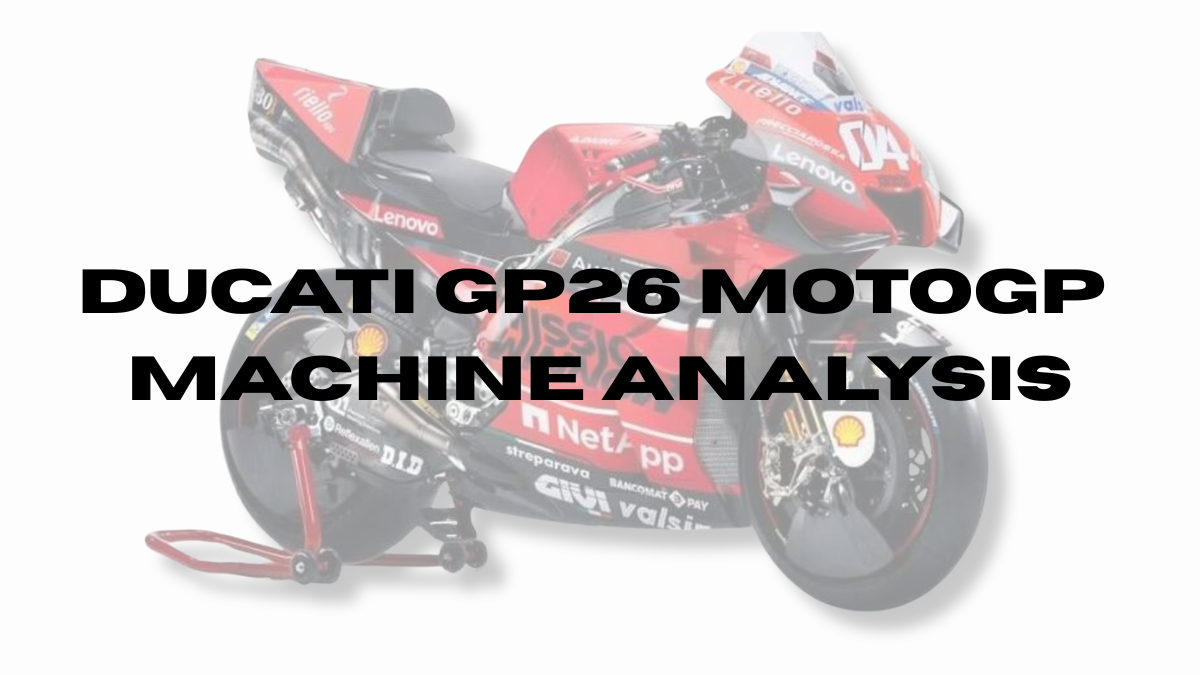
The Ducati Desmosedici GP26 is poised to define the final season of the 1000cc MotoGP era, not through radical reinvention but through a masterful process of iterative refinement. This machine is the culmination of years of targeted engineering, serving as a powerful demonstration of Ducati’s ability to leverage a unique regulatory landscape to its strategic advantage. With engine specifications frozen for 2026, Ducati’s development efforts have been redirected to perfecting the non-homologated components: the chassis, aerodynamics, and electronics. The GP26 is fundamentally a highly optimized evolution of the GP25, incorporating crucial lessons from the previous season’s successes and rider feedback.

The core of this strategy rests on three primary pillars. First, the engine, a direct descendant of the championship-winning Desmosedici V4, will undergo no fundamental changes but will be paired with meticulously tuned ancillary systems to enhance its already formidable power delivery and efficiency. Second, the chassis and suspension will receive targeted updates, particularly in response to rider comments, to improve feel and confidence. A key innovation in this area is a refined swingarm mass damper, a subtle yet critical component designed to address rear-end stability issues. Finally, the aerodynamic package will continue its forward march, with refinements to ground-effect fairings and winglets that further increase downforce and reduce reliance on electronic aids.
This technical program is underpinned by an aggressive and unprecedented strategic decision: for the first time, Ducati will field four factory-spec machines. This move is a clear statement of competitive intent, transforming two satellite squads into de facto “junior factory teams” and providing a massive data advantage that could prove insurmountable for rivals. The GP26 is more than just a race bike; it is a meticulously engineered force multiplier and a sophisticated testbed for the impending 2027 regulations, solidifying Ducati’s position as the dominant force in the sport.
The 2026 Season: A Strategic Crossroads and Regulatory Battleground
The 2026 MotoGP season holds a unique place in the sport’s history, serving as the final year of the 1000cc engine formula before a seismic regulatory shift in 2027. This major overhaul will introduce new 850cc engines and mandate a switch to Pirelli as the series-specified tire supplier.1 For manufacturers, this context creates a strategic dilemma: should they focus their resources on the immediate goal of winning in 2026 or on the long-term objective of a successful transition to the new era? For Ducati, the answer is to do both, and the GP26 is the physical embodiment of this dual-pronged approach.
The cornerstone of the 2026 regulations is the engine specification freeze for all manufacturers in Concession Rank A, a group that includes Ducati.1 This rule prevents the Bologna-based factory from making any developmental changes to its engine, a measure that was ostensibly designed to rein in its competitive advantage. However, this engine freeze has a subtle yet profound consequence that works in Ducati’s favor. With the most powerful and well-sorted engine already homologated, Ducati can dedicate its entire research and development budget and engineering talent to refining other critical areas of the bike: the chassis, aerodynamics, and electronics. This singular focus creates a significant advantage over competitors like Honda and Yamaha, who are in Concession Rank D and must divide their attention between building a race-winning machine for 2026 and developing an entirely new 850cc engine from the ground up for 2027.2
The identity of the GP26 is a direct reflection of this regulatory environment. It is not a revolutionary “new prototype,” but rather a refined version of the GP25, equipped with the latest chassis and aero upgrades.4 This approach is consistent with Ducati’s long-standing “modular” development philosophy, which allows for continuous, incremental upgrades to be tested and deployed throughout a season.6 The decision to pursue this path was heavily influenced by the performance of Marc Márquez on the GP25 during the 2025 season. His success and competitiveness on the latest Desmosedici convinced Ducati leadership that the GP25 platform possessed the fundamental potential to be the benchmark machine, effectively “erasing any doubts” and leading them to discard the idea of unifying all riders on a single prototype based on the older GP24.5 This causal link between a single rider’s on-track results and a multi-million-dollar corporate strategy underscores the deep and interconnected nature of Ducati’s racing program. The GP26, therefore, represents the full realization of the GP25’s potential, now enhanced by a season’s worth of crucial data and rider feedback.

The Heart of the Machine: Engine and Power Unit
At the core of the Desmosedici GP26 lies the same potent 1000cc, four-stroke 90° V4 engine that powered its predecessors to championship glory.7 This engine configuration is not a coincidence; it is a meticulously engineered solution that represents the pinnacle of Ducati’s racing philosophy. The 90° V4 layout, a design choice first conceived in 2001 and unveiled in 2002, was born from the conclusion that a V-twin, while a Ducati trademark, would not be able to produce the necessary power for MotoGP without excessively high revolutions.7 This fundamental decision to embrace the V4 platform has provided a powerful foundation for all subsequent Desmosedici models and is directly reflected in Ducati’s high-performance road bikes, such as the Panigale V4.8
Three key technical cornerstones of the Desmosedici engine are instrumental to its success, and all are inherited by the GP26 platform:
- Desmodromic Valve System: Ducati’s signature Desmodromic system is an engineering marvel. Unlike conventional engines that use springs to close the valves, the Desmo system uses a cam-and-lever mechanism to both open and actively close the valves.8 This allows the engine to achieve much higher RPMs without the risk of “valve float,” where the valve springs cannot keep up with the cam profile at high speeds. The result is a more direct, precise, and powerful engine that reaches a level of sophistication rarely seen outside of a racing prototype.8
- Counter-Rotating Crankshaft: In most road bikes, the crankshaft rotates in the same direction as the wheels. The Desmosedici, however, employs a counter-rotating crankshaft that spins in the opposite direction.8 This technical solution serves a dual purpose. First, it compensates for the gyroscopic effect produced by the spinning wheels, making the bike significantly more agile and precise when changing direction.8 Second, the inertial torque it generates helps to reduce the
wheelie phenomenon under hard acceleration by pushing the front end down, a critical function that reduces the need for intrusive electronic rider aids.8 - “Twin Pulse” Firing Order: The crank pins of the Desmosedici GP engine are offset by 70°, which produces a “Big Bang” effect with a distinctive Twin Pulse firing order.8 This firing order groups the engine’s power pulses into a tight sequence, generating power that is easier to handle and improves traction when exiting corners. The resulting sound is a unique and defining characteristic of the Desmosedici.8
This suite of technologies illustrates Ducati’s long-term engine philosophy: to build a power unit that is not only powerful but also mechanically sound and inherently ridable. The counter-rotating crankshaft and “Twin Pulse” firing order are not merely about maximizing horsepower; they are foundational to the bike’s chassis dynamics. By engineering the bike to mechanically resist wheelies and optimize traction, Ducati reduces the work required from its electronic systems. This allows the rider to open the throttle earlier and more aggressively, knowing the bike’s mechanical design will help manage the forces at play, thereby minimizing the need for electronic power cuts and giving the rider a more direct and intuitive feel.9
The GP26, as the final evolution of this current engine concept, is positioned to be the most refined and optimized version to date. While the core engine is frozen, engineers can spend the season tuning every ancillary system and electronic map to perfectly complement its characteristics, ensuring every last fractional gain is extracted before the 2027 rule change. The GP26 is therefore a testament to decades of methodical and focused V4 research and development.
| Year | Engine Specs | Key Innovation | Notable Rider/Championship |
| 2003 | 989cc V4 | Inaugural MotoGP V4 | Loris Capirossi |
| 2005 | 989cc V4 | Collaboration with Bridgestone | Loris Capirossi (2 wins) |
| 2006 | 989cc V4 | Lighter, more powerful GP5 variant | Loris Capirossi, Sete Gibernau |
| 2007 | 800cc V4 | Early 800cc development | Casey Stoner (First MotoGP Title) |
| 2008 | 800cc V4 | Improved midrange and top-end | Casey Stoner |
| 2016 | 1000cc V4 | Peak aero development (GP16) | Andrea Dovizioso |
| 2022 | 1000cc V4 | Championship-winning platform | Francesco Bagnaia (Riders’ Champion) |
| 2025 | 1000cc V4 | Updated chassis, aero (GP25) | Marc Márquez (Riders’ Champion) |
| 2026 | 1000cc V4 | Refined GP25 with 2026 upgrades | Bagnaia, M. Márquez, A. Márquez, Di Giannantonio |
Chassis and Ergonomics: The Rider-Machine Interface
The chassis of a MotoGP machine is the link between the rider and the tire, and for the GP26, it is the primary area of developmental focus. The GP25 season provided Ducati with invaluable, and at times contradictory, data. While Marc Márquez successfully adapted to the new bike’s “DNA” and delivered a championship-winning performance, his teammate, Francesco Bagnaia, publicly struggled, citing a lack of “support from the rear” and a constant battle to adapt to the new package.11 Some analysts even referred to the GP25 as a “Frankenstein bike,” suggesting that while it had a theoretical advantage, its components were not yet seamlessly integrated.13 This acknowledged imperfection for a dominant team provides a rare glimpse into the high-stakes world of performance R&D.
The contrasting rider feedback from the GP25 has become the driving force behind the GP26’s chassis development. The GP26 is not about a radical overhaul but a meticulous effort to solve the issues that plagued riders like Bagnaia. A key innovation visible during testing and now integrated into the GP26 platform is a mini swingarm mass damper.14 This
anti-vibration system is a small, specialized resonator designed to address rear wheel chatter, a common problem for a machine at its absolute limit.16 By removing unwanted resonant frequencies in the rear swingarm, the device improves traction, braking, and overall stability, providing the rider with a more consistent feel.16 While this may seem like a minor detail, it is a crucial piece of the puzzle. It is a direct, mechanical solution to a problem that previously might have required more intrusive electronic interventions or a compromise in setup.
The developmental pathway for the GP26 is a textbook example of a data-driven feedback loop. The GP25 was an aggressive step forward. The data collected from the divergent experiences of Bagnaia (struggling) and Márquez (succeeding) will be meticulously analyzed to ensure the GP26 is a more universally competitive and ridable machine. The mass damper and other subtle chassis changes are a direct consequence of this real-world feedback, aiming to create a bike that is not just fast but also gives every rider the confidence to push for that “extra inch” on the racetrack.17 In this way, the GP26 is set to be the “monster” that the GP25’s teething problems will help create, a testament to Ducati’s commitment to continuous improvement.13

Aerodynamics: The Unseen Force of Downforce
Ducati’s dominance in MotoGP is deeply intertwined with its pioneering role in motorcycle aerodynamics. The manufacturer was the first to introduce prominent winglets in 2010 and escalated the “aero war” with its GP16 in 2016, which featured a radical biplane configuration.18 Although regulations were changed in 2017 to ban these standalone wings, Ducati continued to innovate, introducing
side-pods and triplane fairings that complied with the new rules.18 This relentless pursuit of aerodynamic efficiency is a hallmark of the company’s engineering philosophy.
The GP26’s aero package will be a refinement of the current design, as the regulations for 2026 are largely unchanged and limit teams to a single fairing update per season.21 The most significant innovation in recent years has been the development of
ground-effect fairings, a concept pioneered by Aprilia but now adopted and refined by Ducati.22 This technology utilizes strategically placed “ground-effect bulges” on the fairing that, at a high lean angle, create a
venturi effect between the bike and the track surface.22 This accelerated airflow reduces local pressure, effectively “sucking the vehicle downward” and generating downforce in corners where it is most critical.22 The result is enhanced tire grip and the ability to carry higher corner speeds, a subtle but decisive advantage.22
For Ducati, aerodynamics is not merely about increasing top speed by reducing drag. As explained by Ducati’s Aerodynamic Development Manager, the primary purpose of downforce is to act as an intelligent, speed-sensitive aid that reduces the need for electronic interventions like anti-wheelie systems.9 By generating mechanical downforce that pushes the front wheel to the ground, the bike’s electronic brain can be tuned to be less intrusive, allowing the engine to deliver more of its full torque without power cuts. This translates into more brutal and immediate acceleration, ultimately leading to a faster lap time.9 This symbiotic relationship between mechanical design and electronic tuning is a core principle of Ducati’s engineering philosophy. The success of this approach is so profound that the GP16 aero package was later transferred to the road-going Superleggera V4, a testament to the cultural and technological transfer from the racetrack to production bikes.9 This makes the GP26 a crucial testbed, with every aero refinement potentially serving as a blueprint for the next generation of Ducati’s consumer products.
Electronics and Rider Aids: The Digital Brain
The GP26’s electronics are an integral part of its performance, but in a way that is distinctly Ducati. While every modern MotoGP bike is equipped with sophisticated electronic rider aids, Ducati’s philosophy is to use its mechanical and aerodynamic design to minimize the need for electronic intervention.9 Key systems such as
Ducati Traction Control (DTC), Engine Brake Control, anti-wheelie, and launch control work in concert with the bike’s physical characteristics to optimize performance.24 The
counter-rotating crankshaft and aggressive aerodynamics, for example, are designed to mechanically mitigate wheelies, thereby reducing the need for the anti-wheelie system to cut power.8 This allows the rider to experience a more direct and uninhibited connection with the bike’s prodigious power output.
The most significant competitive advantage in this area is not a new piece of hardware but a strategic decision: the fielding of four factory-spec GP26 machines.4 This unprecedented lineup creates an unparalleled
data feedback loop. Data from four top-tier riders with distinct riding styles—Marc Márquez’s aggressive corner entry, Francesco Bagnaia’s smooth finesse, Alex Márquez’s adaptability, and Fabio Di Giannantonio’s raw speed—can be collected and analyzed in real-time.4 This allows Ducati to rapidly refine its electronic maps and strategies to be more effective across a wider range of conditions and rider inputs. This iterative process allows for a “smart” system that can be optimized faster than any rival can, a clear and decisive competitive advantage that is directly tied to the strategic decision to run a four-bike factory lineup.
Strategic Implications: The Four-Rider Factory Advantage
Ducati’s decision to field four full factory-spec GP26 machines for Francesco Bagnaia, Marc Márquez, Alex Márquez, and Fabio Di Giannantonio is a strategic masterstroke that fundamentally changes the competitive landscape.1 This move transforms Gresini and VR46, historically
satellite teams, into what are effectively “junior factory teams,” and represents a clear escalation of Ducati’s competitive intent.25
The rationale behind this move is multifaceted and powerful. First and foremost is the data overload. With four of the fastest riders on the grid piloting identical, latest-spec machines, Ducati will collect an unprecedented volume of data from every practice session, qualifying lap, and race. This allows for a deeper and more accurate analysis of bike performance, tire wear, and track conditions than any other manufacturer can achieve. This data can be rapidly processed and used to provide real-time setup suggestions and electronic map adjustments, giving Ducati an almost insurmountable information advantage.
Second, the strategic grid presence created by the “Power of Four” is a formidable force. Having four top-tier bikes capable of fighting for pole position and the podium allows Ducati to “lock out” the front of the grid and the top results in a race, making it incredibly difficult for rivals like KTM, Aprilia, and Yamaha to consistently challenge for wins or constructors’ points.25 This also provides a psychological advantage, as rivals are forced to race against a wall of red machines.
Finally, the lineup serves as a clear and powerful rider development pipeline. The promotion of Alex Márquez to a factory-spec bike is a “fair reward for the extraordinary season he is starring” and sends a clear message to all privateer riders that on-track performance will be rewarded with the best available machinery.26 This system ensures that Ducati will continue to attract and retain the most talented riders on the grid.
The decision to field this lineup creates a profound domino effect across the MotoGP paddock. Manufacturers who might have planned to treat 2026 as a low-investment transitional year now face a four-pronged assault that forces them to accelerate their own development programs.3 The consequence is a highly competitive season where the GP26 is the clear benchmark, and every other team is scrambling to close the gap.
| Rider | Team | Bike Model | Key Notes |
| Francesco Bagnaia | Ducati Lenovo Team | Desmosedici GP26 | Factory-spec |
| Marc Márquez | Ducati Lenovo Team | Desmosedici GP26 | Factory-spec |
| Alex Márquez | BK8 Gresini Racing MotoGP | Desmosedici GP26 | Factory-spec |
| Fabio Di Giannantonio | Pertamina Enduro VR46 Racing Team | Desmosedici GP26 | Factory-spec |
| Franco Morbidelli | Pertamina Enduro VR46 Racing Team | Desmosedici GP25 | Satellite-spec |
| Fermín Aldeguer | BK8 Gresini Racing MotoGP | Desmosedici GP25 | Satellite-spec |

Competitive Landscape: GP26 vs. The Field
While the Ducati Desmosedici GP26 is a formidable machine, it does not exist in a vacuum. The competitive landscape of 2026 is defined by a determined effort from rivals to close the gap, exploiting any perceived weaknesses in the Italian powerhouse’s armor. Aprilia, in particular, has emerged as the most direct threat, with its RS-GP bike now widely considered the “second fastest” on the grid.28 Aprilia has made a “huge jump in recent months” by addressing a historical weakness in braking performance.29 Through improved machine balance and refined engine-brake electronics, Aprilia has enhanced its ability to use the rear tire to assist the front during braking, a key factor in improving corner entry speed.29 This directly challenges a traditional area of Ducati’s strength and signals a nuanced and strategic approach from the Noale factory.
KTM, with its RC16, is also making significant strides, showing signs of closing the gap and consistently challenging for podiums.29 Meanwhile, the Japanese manufacturers are at a critical juncture. Yamaha, the last holdout with an inline-four engine, is at a distinct disadvantage against the dominant V4s on the grid.2 The inline-four’s longer crankshaft provides stability but lacks the raw acceleration of the V4’s shorter, stiffer design.2 To address this fundamental deficit, Yamaha is actively developing a V4 prototype, a major project that will be a key storyline of the 2026 season.2
The GP26’s success will ultimately be measured not by its raw pace alone, but by its ability to maintain a performance gap to these increasingly sophisticated rivals. The struggles of riders like Francesco Bagnaia with the GP25 serve as a cautionary tale, demonstrating that Ducati’s relentless technical progression is not without risk.11 The GP26 must therefore be a step forward not just in pure performance, but in ridability and adaptability, ensuring that its technology can be harnessed by all its riders to maintain the competitive edge.
| Manufacturer | Engine Configuration | Perceived Strengths | Perceived Weaknesses | Key Technical Innovation |
| Ducati | 90° V4 | Straight-line speed, acceleration, braking stability, aero | Potential for rider-specific adaptation issues | Counter-rotating crankshaft, advanced aerodynamics, mass damper |
| Aprilia | 90° V4 | Corner speed, high-speed stability, improved braking | Historical braking weakness, inconsistent at certain tracks | Ground-effect fairings, refined electronics |
| KTM | 90° V4 | Strong chassis, progressive development | Rear grip issues, mid-corner stability | Upper-fairing updates, chassis refinements |
| Yamaha | Inline-4 (developing V4) | Cornering stability, high corner speed | Lacks acceleration and top speed of V4 rivals | Development of new V4 engine prototype |
| Honda | 90° V4 | Rider-machine integration, “next-level” chassis development | Overall performance deficit, struggles with rideability | New chassis prototype |
The GP26 as a Blueprint for the Future
The Ducati Desmosedici GP26 is not merely a machine for the present; it is a critical testbed for the future of the company and the sport. Every component, from the refined chassis to the advanced electronics, is being developed with an eye toward the monumental 2027 regulation change. The GP26 provides an opportunity to test and validate crucial concepts without the distraction of a new engine program. The lessons learned from the GP25’s “Frankenstein” development are being applied directly to the GP26, and in turn, the GP26 will serve as the ultimate blueprint for the design of the next-generation 850cc GP27 prototype.13
This strategic approach extends beyond MotoGP to Ducati’s broader engineering philosophy. The racing program, including its participation in the MotoE championship, serves as an “advanced research laboratory” where the most sophisticated materials and innovative design methods are tested.32 For instance, Ducati is actively developing
solid-state battery technology in its MotoE program, with the long-term goal of transferring this knowledge to future road-going electric superbikes.33 Similarly, weight-saving innovations like
magnesium engine covers and the “Twin Pulse” firing order, which originated in MotoGP, have already made their way to production bikes, fulfilling Ducati’s core philosophy of continuous technological transfer from the racetrack to the road.8 The GP26, as the final and most refined iteration of the 1000cc era, is the purest expression of this principle.
Conclusion: Unmatched Dominance Through Refined Excellence
The Ducati Desmosedici GP26 is an embodiment of strategic foresight and engineering dominance. Its existence is a direct consequence of a unique regulatory landscape that has allowed Ducati to double down on its strengths in chassis, aerodynamics, and electronics. The bike itself, an optimized evolution of its championship-winning predecessors, is set to be the benchmark for the final season of the 1000cc era.
The “Power of Four” rider lineup is the ultimate expression of this strategy, providing an unparalleled data advantage that will be used to refine and tune every aspect of the machine. This technical program, combined with a relentless on-track assault, is designed to overwhelm the competition. While rivals are closing the gap, the GP26 is a testament to Ducati’s ability to turn a regulatory constraint into a decisive competitive advantage. It is a machine born from an unwavering commitment to excellence, serving not only to win races today but also to lay the groundwork for a continued reign in the years to come.
Sources
- 2026 MotoGP World Championship – Wikipedia, accessed on September 20, 2025, https://en.wikipedia.org/wiki/2026_MotoGP_World_Championship
- The Ultimate Guide to MotoGP Engines: Everything You Need to Know, accessed on September 20, 2025, https://www.intentsgp.com/ultimate-guide-motogp-engines/
- Why 2026 is the right time for Ducati to field six identical MotoGP bikes – Motorsport.com, accessed on September 20, 2025, https://www.motorsport.com/motogp/news/why-2026-is-the-right-time-for-ducati-to-field-six-identical-motogp-bikes/10749131/
- Ducati confirms VR46 status after Alex Marquez’s factory upgrade …, accessed on September 20, 2025, https://www.crash.net/motogp/news/1082006/1/ducati-confirms-vr46-status-after-alex-marquezs-2026-motogp-upgrade
- Alex Marquez to ride factory-spec Ducati in MotoGP 2026 – Motorsport.com, accessed on September 20, 2025, https://www.motorsport.com/motogp/news/alex-marquez-to-ride-identical-ducati-to-marc-and-bagnaia-in-2026/10760336/
- For last few GPs Ducati has not been fastest, Marc has been. Aprilia and KTM are catching Ducati quick. So what do you think Ducati would do for 2026? Will they run 6 GP26 or something else? : r/motogp – Reddit, accessed on September 20, 2025, https://www.reddit.com/r/motogp/comments/1muj4z6/for_last_few_gps_ducati_has_not_been_fastest_marc/
- Ducati Desmosedici – Wikipedia, accessed on September 20, 2025, https://en.wikipedia.org/wiki/Ducati_Desmosedici
- Desmosedici Stradale: the heart of Ducati’s supersport bikes, accessed on September 20, 2025, https://www.ducati.com/ww/en/company/innovation/engines/desmosedici-stradale
- Superleggera V4 Aerodynamics | Track-Born Speed from Ducati Motorcycles, accessed on September 20, 2025, https://www.ducati.com/us/en/bikes/panigale/superleggera-v4/aerodynamics
- Riding the MotoGP Motorcycles: Ducati Desmosedici, Honda RC211V, Kawasaki ZX-RR & Yamaha YZF-M1 – Motorcyclist, accessed on September 20, 2025, https://www.motorcyclistonline.com/riding-motogp-motorcycles-ducati-desmosedici-honda-rc211v-kawasaki-zx-rr-yamaha-yzf-m1/
- Francesco Bagnaia maintains he is ‘unable to adapt to DNA’ of Ducati’s MotoGP bike, accessed on September 20, 2025, https://www.motorsport.com/motogp/news/bagnaia-maintains-he-is-unable-to-adapt-to-dna-of-ducatis-2025-motogp-bike/10758490/
- Bagnaia Looks Ahead as 2025 Is a Year To Forget | Cycle World, accessed on September 20, 2025, https://www.cycleworld.com/motorcycle-racing/francesco-bagnaia-2025-motogp-season-interview/
- On the technical differences between the Ducati GP24 and GP25 : r/motogp – Reddit, accessed on September 20, 2025, https://www.reddit.com/r/motogp/comments/1kxm24o/on_the_technical_differences_between_the_ducati/
- Marc Marquez NEW Swingarm Damper Ducati Lenovo MotoGP – YouTube, accessed on September 20, 2025, https://www.youtube.com/shorts/BbpDv5XAsB4
- Enea Bastianini tries “anti-vibration system” at Misano MotoGP test | Crash.net, accessed on September 20, 2025, https://www.crash.net/motogp/news/1081912/1/enea-bastianini-tries-anti-vibration-system-misano-motogp-test
- Supreme Technology Oversuspension Mass Damper – Ducati Panigale V4 / S / R / RS – OVS-STB/DucV4S – Superbike Unlimited, accessed on September 20, 2025, https://www.superbikeunlimited.com/supreme-technology-oversuspension-mass-damper-ducati-panigale-v4-s-r-rs
- Gigi Dall’Igna That’s My Goal For The Future | Motogp News 2025 – YouTube, accessed on September 20, 2025, https://www.youtube.com/watch?v=XiwvruR3Jik
- The Anatomy of Speed – Ducati Museum Factory events, accessed on September 20, 2025, https://www.ducati.com/ww/en/experience/museum-factory-events/the-anatomy-of-speed
- MotoGP Winglets | Motorcyclist, accessed on September 20, 2025, https://www.motorcyclistonline.com/motogp-winglets/
- MotoGP: Ducati roll out radical aero fairing – Motorcycle News, accessed on September 20, 2025, https://www.motorcyclenews.com/sport/motogp/2017/march/motogp-ducati-roll-out-hammerhead-aero-fairing/
- Aerodynamics and Winglets in MotoGP – What You Need To Know – intentsGP, accessed on September 20, 2025, https://www.intentsgp.com/aerodynamics-and-winglets-in-motogp-what-you-need-to-know/
- More Aprilia Aero Secrets Explained – Cycle World, accessed on September 20, 2025, https://www.cycleworld.com/motorcycle-news/aprilia-aerodynamics-secrets-explained/
- MotoGP Analysis: Ducati’s MotoGP Secret, In The March Issue – Roadracing World, accessed on September 20, 2025, https://www.roadracingworld.com/news/motogp-analysis-ducatis-motogp-secret-in-the-march-issue/
- Desmo450 MX 2026 | Unleash Pure Power with Ducati Motorcycles, accessed on September 20, 2025, https://www.ducati.com/us/en/bikes/offroad/desmo450-mx
- Ducati CONFIRMS 4 GP26 Riders for 2026! | Alex Márquez Gets Factory Bike! – YouTube, accessed on September 20, 2025, https://www.youtube.com/watch?v=AouwJd-KGFA
- ALEX MÁRQUEZ WILL HAVE A DUCATI IDENTICAL TO MARC AND BAGNAIA’S NEXT SEASON : r/motogp – Reddit, accessed on September 20, 2025, https://www.reddit.com/r/motogp/comments/1nk8f78/alex_m%C3%A1rquez_will_have_a_ducati_identical_to_marc/
- Official: Alex Marquez gets factory Ducati for MotoGP 2026 | Crash.net, accessed on September 20, 2025, https://www.crash.net/motogp/news/1081983/1/official-alex-marquez-gets-factory-ducati-motogp-2026
- Is the Aprilia as fast as Ducati now ? : r/motogp – Reddit, accessed on September 20, 2025, https://www.reddit.com/r/motogp/comments/1m08fu8/is_the_aprilia_as_fast_as_ducati_now/
- Why Aprilia is getting close to challenging Ducati in MotoGP – Motor …, accessed on September 20, 2025, https://www.motorsportmagazine.com/articles/motorcycles/motogp/why-aprilia-is-getting-close-to-challenging-ducati-in-motogp/
- Inline 4 vs V4 Yamaha M1 outline [@mgp1official on Instagram] : r …, accessed on September 20, 2025, https://www.reddit.com/r/motogp/comments/1neblzt/inline_4_vs_v4_yamaha_m1_outline_mgp1official_on/
- Yamaha vs Ducati? Our MotoGP test one verdict – YouTube, accessed on September 20, 2025, https://www.youtube.com/watch?v=1H0cOZJV_Zk
- Ducati in MotoGP until 2026, accessed on September 20, 2025, https://www.ducati.com/ww/en/news/ducati-in-motogp-until-2026
- MotoE Goes On Hiatus But Ducati Continues Research on Electric Tech – Motorcycle.com, accessed on September 20, 2025, https://www.motorcycle.com/bikes/news/motoe-goes-on-hiatus-but-ducati-continues-research-on-electric-tech-44648815
Our Social Media Handles
- Instagram : LivingWithGravity
- Medium : Akash Dolas
- YouTube Channel : Gear and Shutter
- Facebook : LivingWithGravity