









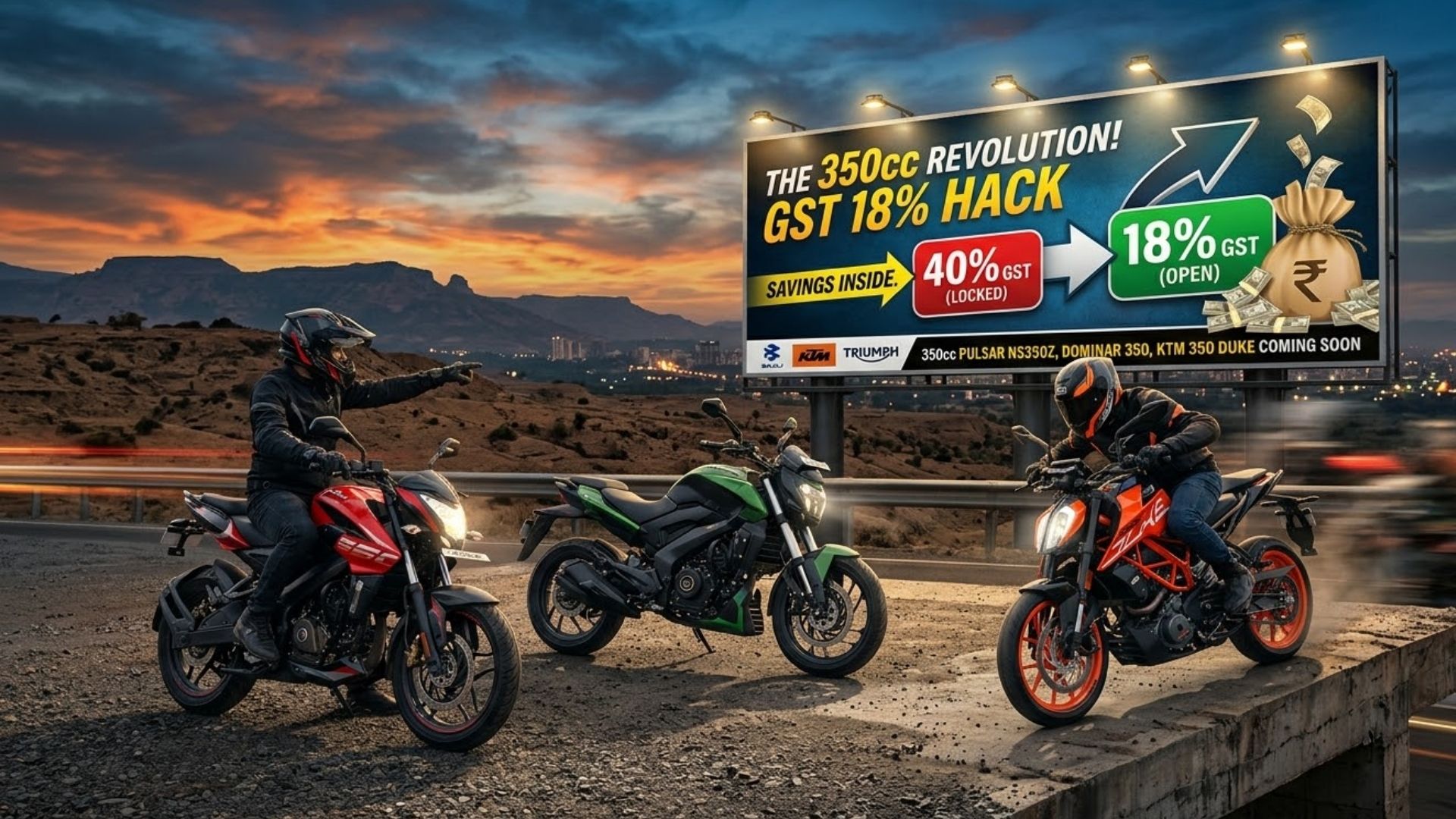
The Indian motorcycling scene just got hit with a plot twist straight out of a financial thriller. While everyone was busy arguing over horsepower and exhaust notes, Bajaj and KTM decided to play the ultimate “reverse-card” on the taxman.
Here is the breakdown of the 350cc revolution that’s about to make your “big bike” dreams much lighter on the wallet.
The Great Displacement Downsize
Forget the “bigger is better” mantra. In 2026, 350 is the new 400.
Following the massive success of their partnership with Triumph, Bajaj is reportedly prepping a surgical strike on the 373cc–399cc segment. Why? Because the government’s new GST 2.0 rules have turned the 350cc mark into a literal “line in the sand.”
The “Sin Tax” Math
In a move that caught the industry off guard, motorcycles are now split into two very different worlds:
- The “Luxury” Zone (>350cc): Taxed at a staggering 40% GST.
- The “Mass” Zone (≤350cc): Taxed at a refreshing 18% GST.
By shaving off just 25cc to 50cc, manufacturers can dodge a massive tax bullet, potentially slashing on-road prices by ₹25,000 to ₹35,000.
The “Spied” Hit List: Coming Soon
The streets of Pune are buzzing with test mules that look suspiciously like our favorites, but with “slimmer” hearts.
| Model | Current Engine | The “Tax-Saver” Version | Why it Matters |
| Bajaj Pulsar NS400Z | 373cc | NS350Z | Making the “Biggest Pulsar” even more insanely affordable. |
| Bajaj Dominar 400 | 373cc | Dominar 350 | The ultimate tourer, now at a price that kills the 250cc competition. |
| KTM 390 Series | 399cc | KTM 350 Duke / ADV | Keeping the “Orange” performance without the “Red” tax premium. |
| Triumph 400 Range | 398cc | Speed 350 / Scrambler 350 | Directly taking on Royal Enfield’s 350cc throne. |
Impact: The “Royal” Rumble
This isn’t just about saving a few bucks; it’s a declaration of war. By entering the 350cc bracket, Bajaj, KTM, and Triumph are parking their high-tech, liquid-cooled engines right in the backyard of the Royal Enfield Classic 350.
Imagine getting 4-valve DOHC performance and liquid cooling for the price of a retro-cruiser. The “Sin Tax” was meant to penalize luxury, but it might have accidentally started the most competitive price war in Indian history.
The Bottom Line: Your favorite “400cc” bikes are getting a haircut, but their bank accounts (and yours) are going to look a lot fuller.
The 350cc tax-dodge isn’t just a rumor—it’s a calculated move to keep these machines accessible. The new GST slabs have created a massive gap: 18% GST for bikes $\le$ 350cc versus a brutal 40% GST for anything above.
Here is how your favorite “400s” are likely to transform into “350s” and what it costs you in terms of raw performance.
The Performance “Haircut”: 400cc vs. 350cc
Based on leaked specs and industry benchmarks (like the Zontes 350 and the upcoming Triumph 350 range), here is the estimated impact on the spec sheet:
| Feature | The 400 Series (Current) | The 350 Series (Expected) | The “Loss” |
| Engine Displacement | 373cc – 399 cc | 348 cc -350 cc | -25 cc to -50 cc |
| Peak Power | 40 – 45 PS | 38 – 39 PS | -2 to -6 PS |
| Peak Torque | 35 – 39 Nm | 32 – 33 Nm | -3 to -6 Nm |
| Top Speed | 155 – 165 km/h | 145 – 150 km/h | -10 km/h |
| Tax Bracket | 40% GST | 18% GST | -22 % Tax Drop |
Deep Dive: What’s Changing?
1. KTM 390 Duke ➡️ KTM 350 Duke
The current 398cc “Corner Rocket” is a masterpiece of 45 PS aggression. To hit the 350cc mark, KTM will likely use a bored-down version of the new LC4c engine.
- The Sacrifice: You’ll lose that manic top-end rush. Expect the power to settle around 39 PS.
- The Silver Lining: KTM’s 350cc units (like the ones used in their global enduro bikes) are incredibly light. A “350 Duke” could be even more flickable in the twisties.
2. Bajaj Pulsar NS400Z ➡️ NS350Z
Bajaj has already priced the NS400Z aggressively, but the 40% tax is a ticking time bomb for their margins.
- The Strategy: By moving to a 350cc liquid-cooled 4V unit, they can maintain a 39 PS output—which is still significantly higher than the Royal Enfield 350 range—while dropping the price even further.
3. Triumph Speed 400 ➡️ Speed 350
Triumph is already testing the “350” range. While the 400cc version is famous for its 37.5 Nm of “everywhere torque,” the 350cc version will likely focus on refinement and city usability.
- The Trade-off: Expect a slightly more relaxed engine character, perfect for those who found the 400 a bit too “zippy” for daily commutes.
The Final Verdict: Is it worth it?
You are essentially trading about 10% of your peak power for a 20%+ reduction in tax burden.
For most riders in cities like Pune, where top speeds are rarely hit but initial acceleration and price-to-performance are king, the 350cc versions will likely become the “sensible” choice. You get nearly the same “big bike” feel, the same premium USD forks and electronics, but for a price tag that feels like a 250cc bike from two years ago.
This is the ultimate biker’s dilemma: Do you pay the “Premium” for those extra cubic centimeters, or do you take the “Tax Discount” and keep the change?
Here is the cold, hard breakdown of the 400cc Powerhouse vs. the 350cc Tax-Hacker.
The Face-Off: 400cc vs. 350cc
The 400cc Powerhouse (The “OG” Series)
- The Pros:
- Unrestricted DNA: These bikes were designed to be 400s from day one. You get the full intended power curve and top-end rush.
- Bragging Rights: There is a psychological win in saying you ride a “400.”
- Highway Dominance: That extra 5 PS makes a difference when you’re trying to overtake a semi-truck at 120 km/h.
- The Cons:
- The “Sin Tax”: You are paying a 40% GST penalty. You’re essentially buying a bike for the government too.
- Higher Entry Point: Expect to pay ₹30,000 to ₹45,000 more on-road for very similar hardware.
The 350cc Tax-Hacker (The “New Gen”)
- The Pros:
- Massive Savings: By falling into the 18% GST bracket, the price-to-performance ratio is unbeatable.
- Same “Big Bike” Feel: You still get the USD forks, the trellis frames, the LED tech, and the wide tires of the 400s.
- City Friendly: These engines are often retuned for better low-end torque, making them punchier in Pune’s stop-and-go traffic.
- The Cons:
- Top-End “Wall”: You might feel the engine struggle slightly past 140 km/h compared to the 400s.
- The “Downsize” Stigma: Purists might call it a “lite” version (even if it’s practically just as fast in the real world).
The “Wallet vs. Wallop” Comparison
| Feature | 400cc (Current) | 350cc (Upcoming) | Impact |
| On-Road Price (Est.) | ₹3.10 – 3.50 Lakh | ₹2.65 – 2.85 Lakh | ₹45k Savings |
| 0-100 km/h | ~6.5 Seconds | ~7.2 Seconds | Negligible in traffic |
| Fuel Efficiency | 26-28 kmpl | 32-35 kmpl | Better Daily Driver |
| Annual Tax/Insurance | Higher | Lower | Long-term savings |
Which one should you buy?
Choose the 400cc if: You live for weekend tours, track days, and that high-RPM scream. You don’t mind paying a premium for absolute performance.
Choose the 350cc if: You want a premium, high-tech machine for daily commuting and occasional trips, but you refuse to pay an extra ₹40,000 just because of a tax bracket.
Source
Autocar India: How GST 2.0 is slashing prices for 350cc bikes
BikeDekho: Triumph Speed T4 350cc spied testing for April 2026 launch
AutoCar Professional: Bajaj, KTM, and Triumph co-developing sub-350cc platforms
RushLane: New Triumph 350 spied ahead of next month’s launch
BikeWale: Bajaj to launch Pulsar 350 and Dominar 350 soon
Our Social Media Handles
- Instagram : LivingWithGravity
- Medium : Akash Dolas
- YouTube Channel : Gear and Shutter
- Facebook : LivingWithGravity