



1. Executive Summary
The Brno Grand Prix provided critical insights into the evolving competitive landscape of MotoGP, particularly highlighting Marc Márquez’s multifaceted dominance, which extended beyond raw speed to encompass strategic race management and technical adaptability. The contentious narrative surrounding a “Ducati advantage” requires a nuanced perspective; while Ducati machines possess inherent strengths, empirical evidence from Brno indicates a narrowing competitive gap. This is further underscored by the specific struggles faced by other Ducati riders, notably Francesco Bagnaia, whose performance issues challenge the notion of the bike being an inherently “unfair” weapon.
In stark contrast, Aprilia and KTM demonstrated significant advancements, positioning themselves as formidable and increasingly consistent threats with multiple riders achieving top-tier results. Yamaha, however, continues to grapple with persistent fundamental technical challenges that impede its competitiveness in the current racing paradigm. Márquez’s recent success is best understood as a testament to his exceptional synergy with the Ducati package, rather than the bike itself conferring an insurmountable lead. This dynamic sets the stage for an intensified development race among manufacturers heading into the summer break and in anticipation of future regulatory changes.
2. Márquez’s Masterclass: Strategy and Execution at Brno
Dominance Through “Smoothness” and Margin
Marc Márquez’s post-race declaration, “I was riding smoothly and had some margin to go even quicker,” serves as a profound indicator of his exceptional control and untapped performance potential at Brno . The definition of “smoothly” in this context implies not having to push hard enough for inconsistency to compromise his riding, suggesting a level of efficiency and precision that minimizes stress on both rider and machine . This approach leads to superior tire preservation and the ability to sustain peak performance consistently throughout the race.
The ability to achieve and sustain a winning pace with such apparent ease, or “smoothness,” represents a significant competitive characteristic. In high-performance racing, this often signifies a profound mastery of vehicle dynamics, where rider inputs are perfectly synchronized with the bike’s behavior. This synchronization minimizes unnecessary slip, harsh transitions, and wasted energy, allowing the tires to operate within their ideal temperature and grip windows for extended durations.
Furthermore, it reduces physical fatigue for the rider, enabling sustained high performance. If Márquez can achieve and sustain a dominant pace in this manner, it suggests that either the Ducati Desmosedici inherently allows for such efficient operation when piloted by a master, or Márquez possesses an unparalleled ability to adapt any machine to his highly efficient, yet aggressively fast, riding style. This stands in contrast to riders who must constantly exert maximum effort and risk inconsistency or accelerated tire degradation to maintain pace. This suggests that the ultimate competitive advantage in MotoGP might not solely reside in raw power or mechanical grip, but increasingly in the rider’s capacity to extract and sustain performance with minimal effort and maximum efficiency, a characteristic that requires a finely tuned rider-machine interface.
Strategic Patience and Decisive Overtaking
Márquez’s tactical acumen was prominently displayed through his strategic patience during the race. He closely observed Marco Bezzecchi’s aggressive early race strategy, noting, “I saw that in the early laps Marco was pushing hard and taking some risks, so I decided to wait as the race was a really long one”. This calculated approach was corroborated by Bezzecchi himself, who acknowledged, “At the same time I knew that Marc was managing the race (i.e., not pushing) and that he had something up his sleeve”. Márquez’s decision to wait for a specific technical trigger—Bezzecchi’s tire degradation—before executing a decisive overtake underscores his exceptional race craft. He stated, “As soon as I noticed the first drop in terms of grip I overtook him and then controlled the race” .
This level of race management extends beyond mere reactive riding; it signifies a predictive capability. Márquez’s capacity to detect subtle changes in a competitor’s tire performance indicates an acute sensory feedback loop from his own machine, allowing him to infer the state of others. This “feel” enables him to anticipate the precise moment of vulnerability in his opponent’s setup and tire life, rather than simply reacting to a loss of pace. Given the “unusual tire behavior” due to new asphalt and the lack of dry practice, this predictive capability is particularly noteworthy, as it implies he could interpret complex, non-standard tire data in real-time . His strategy ensures that when he makes his move, he retains sufficient tire life to then control the remainder of the race. This skill set is a significant competitive differentiator in modern MotoGP, where tire management is paramount and races are frequently decided in the final laps. It highlights that while the bike provides the platform, the rider’s cognitive and sensory abilities to interpret and act upon dynamic technical data are crucial for championship contention.
Unpacking Unique High-Speed Laps
Márquez’s race pace at Brno was exceptional, evidenced by his ability to complete “four laps in the 1:53 high range—something achieved by no other rider in the race” . This demonstrates a unique capacity to sustain a blistering pace over the race distance, a critical factor for victory. While he pushed the limits in qualifying, resulting in a crash at Turn 13 while attempting to respond to Francesco Bagnaia’s pole lap of 1:52.303, he still secured second starting position with a 1:52.522 . This illustrates the fundamental difference between a single-lap qualifying push, where tire conservation and fuel load are not factors, and sustained race performance.
The following table provides a clear comparison of these key lap times, quantifying Márquez’s race dominance and illustrating the distinct dynamics between qualifying and race conditions:
| Metric | Lap Time (s) | Notes |
| Márquez (Fastest Race Laps) | 1:53 high range | Achieved on four laps; no other rider in the race matched this pace. This indicates exceptional sustained speed and efficiency, aligning with his “smoothness” statement. |
| Márquez (Qualifying) | 1:52.522 | Secured second starting position. This is a single-lap push, not constrained by tire conservation or full fuel load, hence faster than race pace. |
| Bagnaia (Pole Qualifying) | 1:52.303 | Fastest single qualifying lap. This highlights raw speed but does not guarantee race performance, as evidenced by Bagnaia’s subsequent struggles. |
| Other Riders (General Race Pace) | 1:54s (low to high) | Bagnaia’s initial pace was mid-to-high 1:54s, improving to consistent low 54s later. The fact that “no other rider achieved” Márquez’s 1:53 high range underscores his unparalleled sustained speed in race conditions. |
This table visually reinforces Márquez’s unparalleled sustained speed compared to the rest of the field. It clearly differentiates the raw, single-lap speed of qualifying from the more conservative, endurance-focused race pace, providing context for why race laps are generally slower due to factors like tire conservation and full fuel loads. It also contextualizes Bagnaia’s initial raw qualifying speed, setting up the subsequent discussion about his struggles in the race despite this initial pace. The empirical data in this table provides tangible evidence for Márquez’s exceptional efficiency and control, rather than just raw effort, supporting his claim of riding “smoothly” and with “margin.”
Adaptability to Tire Pressure Rules
Márquez’s strategic maneuver in the Saturday sprint to “duck behind Acosta for three laps” to manage tire pressure was a testament to his tactical brilliance and technical understanding . He explained, “Our front tire pressure was slightly low, which is why I let Acosta through and stayed close to him to raise the tire temperature and, as a result, the pressure”. This critical, real-time adjustment was necessitated by “unusual tire behavior” stemming from the new asphalt and the lack of dry practice, which made optimal tire pressure selection particularly challenging for engineers . This highlights the increasing complexity of modern MotoGP, where riders must actively engage with technical parameters to stay compliant and competitive.
This action goes beyond simple tire management; it represents a sophisticated, real-time feedback and control loop. Márquez detected a critical technical deviation (the “slightly low” pressure), understood the causal relationship between drafting and tire temperature/pressure, and executed a tactical maneuver (temporarily ceding position) to correct it. This elevates the rider to an active control system, capable of manipulating micro-environmental factors, such as airflow and drafting, to optimize a critical technical parameter for both performance and regulatory compliance. This is particularly challenging given the unpredictable “unusual tire behavior” caused by the new asphalt and limited dry practice, which would have made pre-race setup and prediction difficult even for engineers. This demonstrates that success in modern MotoGP is not just about raw speed or mechanical setup, but also about the rider’s cognitive ability to diagnose technical issues on the fly and implement strategic solutions. It underscores the increasing demand for riders to possess an “engineer’s mind” alongside their exceptional riding talent.
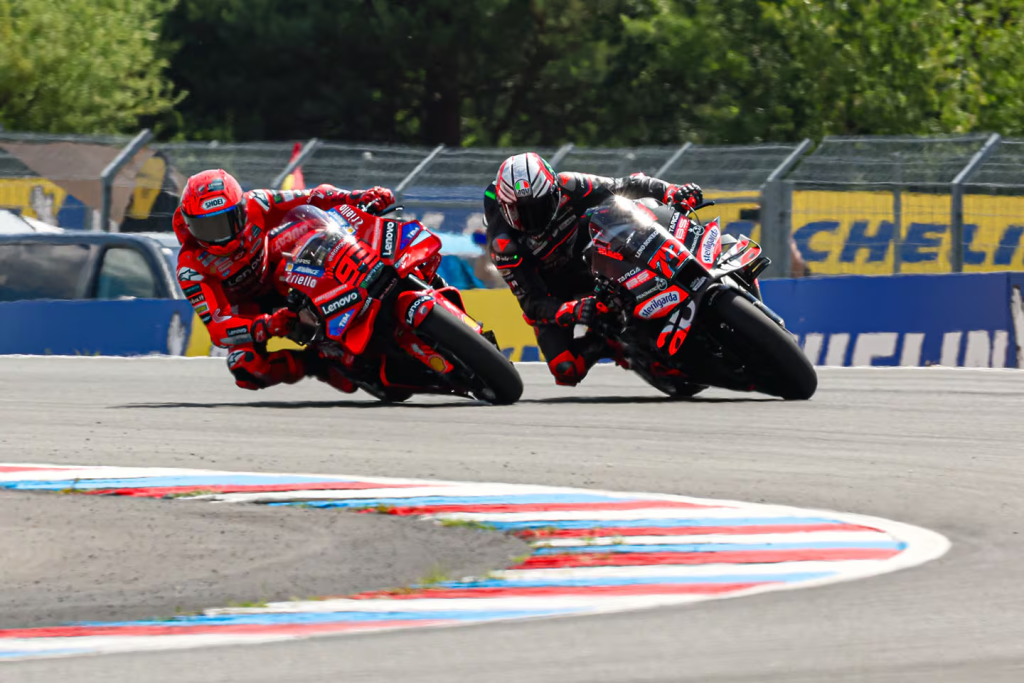
3. The Ducati Advantage: A Nuanced Perspective
Dall’Igna’s Assessment of Shrinking Advantage
Luigi Dall’Igna, Ducati’s racing chief, directly addressed the “advantage” narrative, stating, “The advantage we had over our rivals at the start of the season has shrunk, so I think it’s time to get back to studying during this summer break” . This candid admission from Ducati’s technical head immediately challenges the perception of an insurmountable lead. Empirical evidence from the Brno top 10 further supports this: “Dall’Igna at Brno sees only two Ducatis in the top 10: the two team bikes of Márquez and Bagnaia, first and fourth. Aprilia put three of theirs into the top 10… KTM also put three of theirs into the 10… And Yamaha, with Quartararo in sixth and Jack Miller in 10th” . This distribution clearly indicates that Aprilia and KTM, in particular, are fielding a broader array of competitive bikes than Ducati, suggesting a more balanced competitive field.
A “shrinking advantage” implies that competitive superiority in MotoGP is a dynamic, not static, state. It is not sufficient to merely build a fast bike; continuous innovation and adaptation are essential because rivals are constantly developing and closing gaps. The fact that Aprilia and KTM have more bikes in the top 10 suggests that their development programs are effectively broadening the performance window of their machines, allowing more riders to extract competitive results. This shifts the narrative from Ducati possessing a “super-weapon” to a highly refined, but increasingly challenged, platform whose performance is heavily reliant on specific rider synergy, as exemplified by Márquez, rather than universal dominance. This sets the stage for an intensified “arms race” in development, particularly during the summer break. It also suggests that future success will depend less on a single dominant platform and more on the ability to consistently innovate, optimize for diverse rider characteristics, and adapt to evolving competitive pressures.
Bagnaia’s Struggles with Braking and Front-End Feel: Is it the Bike or the Rider’s Adaptation?
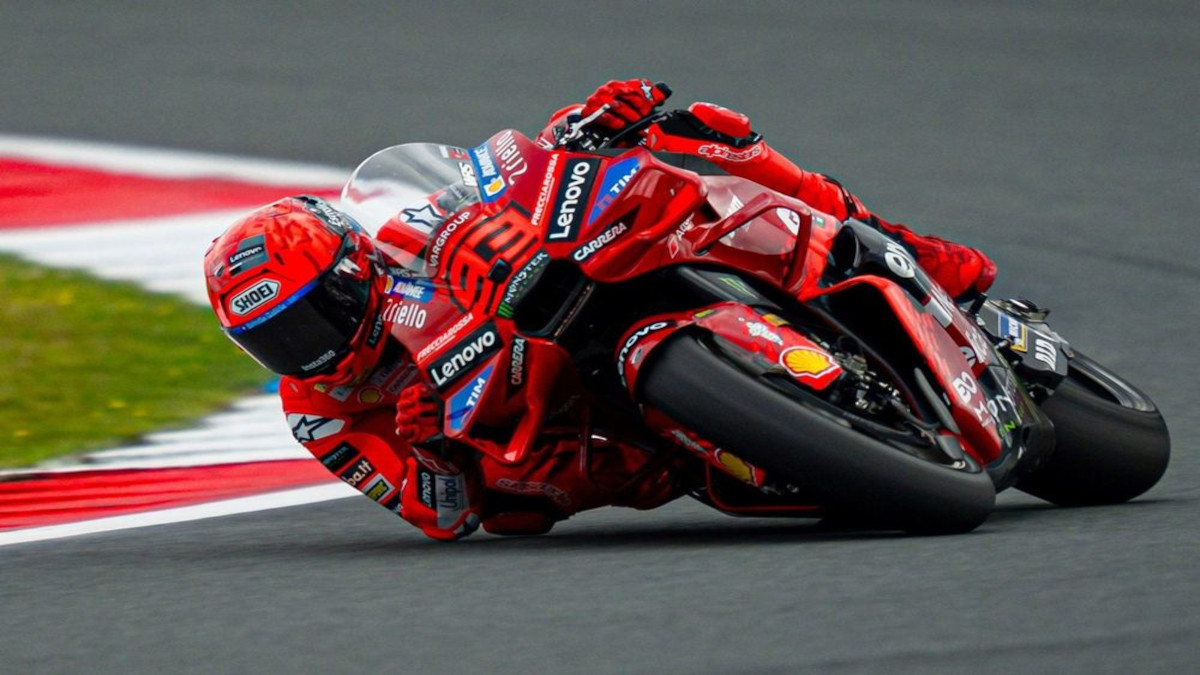
Francesco Bagnaia’s performance at Brno provides a crucial counterpoint to the “Ducati advantage” narrative. Despite securing pole position, which “gave hope for a win from Pecco,” he “finished off the podium on Sunday” . This is particularly telling given the assertion that “If the Ducati were truly a super-weapon, Bagnaia would be in close contention” . His core issue, as he describes, is persistent: “Since Thailand my problem has been braking and corner entry. I used to be very competitive…now I’m the weakest” . He elaborates, “everyone overtakes me because in braking I either go straight or go long” . This is directly linked to his consistent complaint that “the front of his bike… lacks feel. Without reliable information from the front, during braking and corner entry he must either guess or be conservative” . Additionally, his initial race pace was hampered by “too much traction-control intervention” due to the lack of dry practice, though he improved to “consistent low 54s” from “mid-to-high 1:54s” later in the race after dialing it back .
“Front feel” is the rider’s primary tactile connection to the tire’s grip limits, slip angles, and overall stability, particularly under the immense loads of braking and cornering. It is the intuitive feedback that allows a rider to push to the absolute edge of adhesion without crashing. Without reliable “feel,” a rider is operating with limited information at the most critical phase of corner entry, forcing a binary choice: either “guess” (carrying a high risk of a crash) or “be conservative” (resulting in a significant loss of pace). For Bagnaia, who was previously defined by his braking prowess (“one of the hardest riders to pass [on braking]”), this loss of feel is devastating, directly translating to lost time and track positions. It suggests that even if the bike possesses the theoretical performance, the rider’s inability to confidently extract it due to a compromised human-machine interface becomes the ultimate limiting factor. This highlights that raw mechanical capability is insufficient; the subjective “feel” and confidence a bike inspires in its rider are equally, if not more, crucial for maximizing performance at the elite level. It raises critical questions about whether Ducati’s development path might be inadvertently compromising this vital feedback for other performance gains, or if it is a specific adaptation challenge for Bagnaia.
Speculation on 2025 Chassis Development and Márquez’s Influence
A significant, albeit speculative, point links directly to Bagnaia’s issues: “A person of devious mind might think that Ducati’s 2025 chassis has had its front end stiffened a bit to better suit Marc Márquez’s late and hard braking style. Bikes with quite stiff front ends… tend to be short of front feel. This is pure speculation” . This directly posits a potential engineering decision that could explain Bagnaia’s “lack of feel.”
This speculation points to a fundamental dilemma in top-tier motorsports: whether to pursue a “universal” bike that many riders can adapt to, or to tailor the machine to the specific, often outlier, strengths of a marquee rider. If Ducati is indeed stiffening the front end to accommodate Márquez’s aggressive braking loads, it could inadvertently be reducing the crucial “feel” that riders like Bagnaia rely on for their own braking style. This creates an internal performance paradox: optimizing for one rider’s peak performance might inadvertently degrade another’s. It suggests that the “Ducati advantage” is not a monolithic, universally accessible characteristic but a complex interplay of bike design, rider style, and specific setup, with potential internal trade-offs. Such a development strategy could lead to internal team dynamics issues if one rider’s path to optimization inadvertently compromises another’s. It also underscores the immense engineering challenge of balancing peak performance for an outlier talent with broader rider compatibility across a multi-rider team, especially when vying for a championship.
4. The Evolving Competitive Landscape
Aprilia’s Ascent
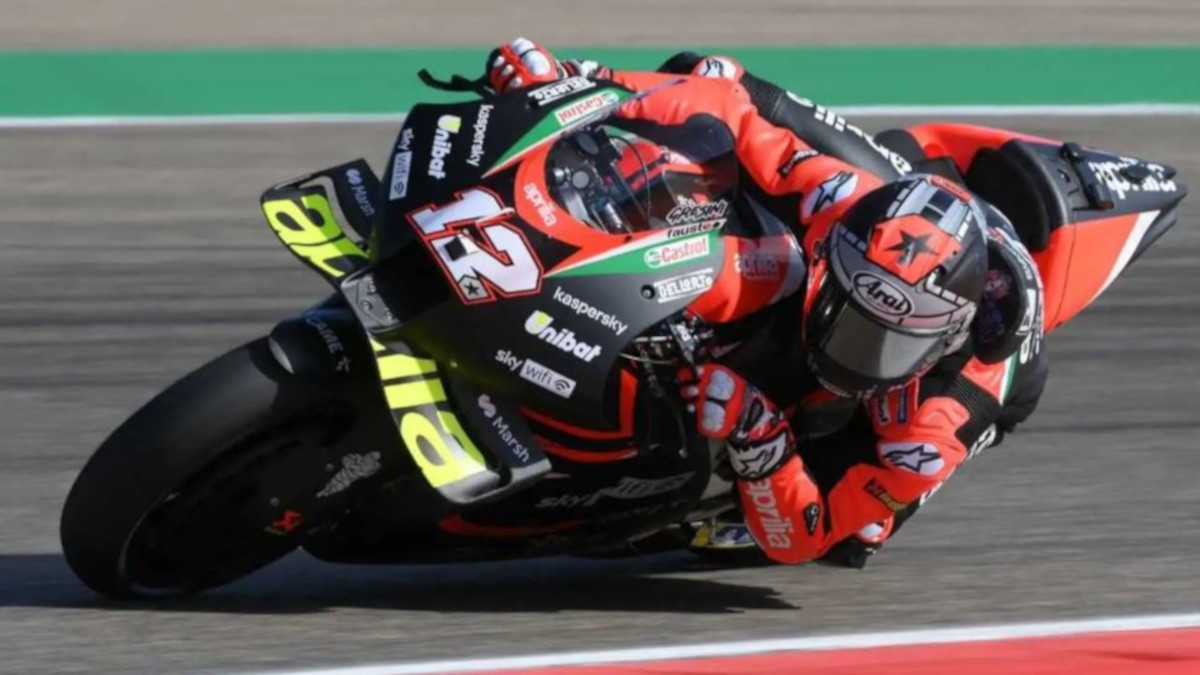
Aprilia is clearly establishing itself as a consistent front-runner. Marco Bezzecchi, on a factory Aprilia, finished an impressive second, just 1.753 seconds behind Márquez, having led the race for six laps . This demonstrates Aprilia’s raw pace and ability to contend for victory. Furthermore, Raúl Fernández on a Trackhouse Aprilia secured fifth place, 10 seconds out of first, and Jorge Martín, the reigning MotoGP champion, showed “Good progress for one weekend,” finishing seventh on Sunday, 15.82 seconds out . Martín’s subsequent commitment to Aprilia for 2026, after previously wanting to leave, is a strong vote of confidence in their long-term trajectory and competitive potential . Crucially, “Aprilia put three of theirs into the top 10: Bezz in second, Raúl Fernández in fifth, and Jorge Martín seventh” .
The presence of three Aprilias in the top 10, including a satellite team rider and a future factory rider, indicates a robust and well-distributed development program. It suggests that Aprilia’s RS-GP is not just suited to one specific riding style but offers a broader performance window, allowing various riders to extract competitive results. This multi-rider presence makes Aprilia a far more formidable competitor than a team relying solely on a single star. Martín’s early commitment for 2026 further validates Aprilia’s technical direction and perceived future competitiveness, potentially attracting more talent and resources to their ecosystem. This collective strength provides more data for development and creates a more distributed challenge for rivals. This shifts the competitive dynamic in MotoGP. Instead of primarily contending with one or two dominant Ducati riders, rivals now face a more distributed and consistent challenge from Aprilia, forcing them to consider a wider range of competitive strategies and making the championship battle more complex and unpredictable.
KTM’s Consistent Threat
KTM continues to impress, largely driven by the immediate impact of rookie Pedro Acosta. He secured third place in the Sunday GP, 3.4 seconds out of first, and was second in the Saturday sprint, just 8/10 of a second behind Márquez . This consistent podium presence from a rookie is exceptional. Furthermore, “KTM also put three of theirs into the top 10: Acosta in third, Brad Binder in eighth, and Pol Espargaró ninth” . This demonstrates a strong collective performance across their rider lineup, solidifying KTM’s position as a consistent top-tier manufacturer.
A rookie’s ability to immediately contend for podiums suggests that the KTM RC16 is not only fast but also relatively accessible and adaptable, allowing a new rider to quickly extract its performance potential without a prolonged learning curve. This contrasts with bikes that might demand years of adaptation or a very specific riding style to be competitive. Acosta’s success, alongside the continued strong performances from experienced riders like Brad Binder and Pol Espargaró also in the top 10, indicates a robust and versatile platform. It sets a high benchmark for the bike’s inherent capabilities, demonstrating that its performance is not solely dependent on a single, highly specialized rider. KTM’s success in bringing a rookie to such immediate and consistent results is a powerful statement about their development program and could significantly attract future talent. It signals to competitors that KTM’s technical trajectory is highly effective, making them a consistent and growing challenge that cannot be overlooked.
Yamaha’s Persistent Challenges
Fabio Quartararo’s candid assessment highlights Yamaha’s deep-seated technical issues. He articulated a fundamental problem with the “stubbornly one-lap Yamaha”: “When you’re behind the others, they brake with both wheels. We only brake with the front. So, when I’m behind someone I have to brake 20 meters earlier” . This inability to effectively utilize the rear brake under hard braking is a major competitive disadvantage in close racing. Furthermore, Quartararo alluded to a strategic problem of “corner line interference” between his “corner-speed” style and the dominant “point-and-shootists”: “…when I’m alone I can ride well and reach my race pace; in the group, we lose a lot” . This echoes historical precedents, such as the 1997 Honda 500 V-twin, which “Lacking the power of the V-4s, it had to be ridden in corner-speed style… The corner-speed line could only be used if the rider on the twin blitzed the start and could stay in front. That didn’t happen” .
The inability to effectively use the rear brake under hard braking is not merely a braking performance issue; it is a profound tactical handicap. It prevents Yamaha riders from making aggressive overtakes under braking, from effectively defending positions, and forces them to adopt a defensive riding style. This creates a “bottleneck” effect in group racing, as Quartararo’s preferred corner-speed line, which requires maintaining momentum through the turn, is easily disrupted by “point-and-shoot” riders who brake later, turn sharply, and accelerate powerfully. The historical parallel with the 1997 Honda V-twin reinforces that a corner-speed philosophy is only viable if the bike has the power to maintain position or can get clear at the start, which the current Yamaha clearly cannot. This is not just a bike problem, but a strategic misalignment of Yamaha’s engineering philosophy with the current demands of the sport. Yamaha faces a deep-seated engineering challenge that demands a fundamental re-evaluation of its bike concept, rather than incremental improvements. Without addressing these core braking and power delivery issues, they will continue to struggle in the pack, regardless of the talent of their riders. The sport has evolved, and Yamaha’s design philosophy must evolve with it.
Jorge Martín’s Return to Form and Commitment
Jorge Martín, the reigning MotoGP champion, demonstrated “Good progress for one weekend,” qualifying 12th, finishing 11th in the sprint, and securing seventh place on Sunday, 15.82 seconds out . While not yet podium-contending, this upward trend signals a positive trajectory after a challenging period. Crucially, his decision to “pledge allegiance” to Aprilia for 2026, after previously wanting to leave, is a significant development . This public commitment from a reigning champion is a powerful endorsement of Aprilia’s long-term potential and their ability to provide a championship-winning package, marking a major strategic coup for the Italian manufacturer.
5. Technical Deep Dive: Unpacking Performance Determinants
Tire Dynamics and Pressure Management
The Brno GP highlighted the critical and complex role of tire management, not just for optimal grip and longevity, but also for regulatory compliance. Márquez noted, “The fact that we weren’t able to ride in the dry yesterday, combined with the new asphalt, led to unusual tire behavior and made things trickier for the engineers [in choosing tire pressure as a best compromise between front grip and staying ‘legal’]” . This created a highly unpredictable environment, forcing engineers into educated guesses. Márquez’s proactive in-race adjustment—ducking behind Acosta to raise front tire pressure—demonstrates the rider’s active and sophisticated role in managing these complex, dynamic variables .
Tire pressure is a dynamic variable, constantly changing with temperature, load, and speed. When conditions are “unusual,” the optimal pressure window shrinks, and the risk of being outside the legal or performance envelope increases dramatically. Engineers are forced into a “best compromise” scenario. Márquez’s action reveals that tire pressure is not merely a pre-race setup; it is a live, on-track variable that can be strategically manipulated by rider tactics. This transforms a technical regulation into a strategic tool. A rider’s ability to understand, monitor, and influence this parameter, as Márquez did, provides a distinct competitive edge, allowing them to optimize performance while staying legal, whereas others might struggle with sub-optimal grip or face penalties. This points to the increasing sophistication required for both engineers and riders in modern MotoGP. Success is not just about raw power or grip, but about managing complex, interconnected variables under dynamic race conditions and regulatory constraints. The ability to master these dynamic variables can be as crucial as outright speed.
Braking Performance and Front-End Feel
Braking remains a critical performance differentiator, with both Francesco Bagnaia and Fabio Quartararo facing significant, albeit distinct, challenges. Bagnaia’s struggles with braking and “lack of front feel,” leading to him going “straight or go long,” highlight a fundamental feedback problem, potentially exacerbated by chassis characteristics . Conversely, Quartararo’s issue stems from a structural limitation: his inability to use the rear brake effectively, forcing him to “brake 20 meters earlier” . The speculation regarding Ducati’s 2025 chassis being stiffened to suit Márquez’s aggressive braking style, and the known consequence of stiffer front ends reducing feel, provides a potential technical explanation for Bagnaia’s specific predicament .
This analysis reveals that braking is not a singular skill but a complex interplay of rider input, chassis dynamics, tire characteristics, and fundamental bike design. Bagnaia’s “lack of feel” underscores the critical importance of tactile feedback for pushing limits. It suggests that a chassis might be optimized for ultimate stiffness, perhaps to handle Márquez’s extreme braking loads, but at the cost of crucial rider confidence and feedback. Quartararo’s problem, conversely, is a fundamental limitation in load transfer and rear brake efficacy, likely due to a lack of advanced technologies like variable ride height or highly effective aerodynamics that can maintain rear wheel load under extreme deceleration. This forces him into a compromise in corner entry speed and tactical positioning.
These issues represent divergent engineering philosophies: Ducati potentially optimizing for a specific, aggressive braking style, and Yamaha struggling with fundamental load management that prevents effective two-wheel braking. The ability to brake late, hard, and with confidence and control is fundamental to modern MotoGP success. Manufacturers that can deliver superior braking performance across these multiple dimensions—balancing stiffness with feel, and optimizing load transfer for two-wheel braking—will hold a significant competitive edge. This also suggests that a “perfect” braking system is a complex balance, and optimizing for one aspect, such as stiffness for raw power, can inadvertently compromise another, such as rider feel.
Aerodynamics and Ride Height: The “Stoppie Point” and Its Implications for Braking
A “thought experiment” elucidates the technical challenge of maximizing braking by overcoming the “stoppie point”—where the rear wheel lifts under hard braking, rendering the rear brake useless. This phenomenon limits the total braking force that can be applied. To circumvent this, solutions proposed include creating “serious aero downforce at the rear” or lowering “the bike’s ride height until the front brake can no longer lift the rear off the pavement, forcing the rider to use the rear brake as well” . This provides crucial technical context for understanding why modern MotoGP bikes employ advanced aerodynamics and variable ride height devices. These technologies are indispensable for keeping the rear wheel loaded under extreme braking, thereby enabling two-wheel braking and maximizing deceleration.
The ability to maintain load on the rear wheel during heavy braking is paramount. Without it, the rear brake becomes ineffective, and the bike’s stability is compromised, leading to a longer braking distance and reduced control. Aerodynamic elements, such as winglets and revised bodywork, are designed to generate downforce, particularly at the rear, to counteract the forward weight transfer under braking. Similarly, variable ride height devices, which lower the bike’s center of gravity and alter its rake and trail dynamically, help to distribute braking forces more effectively across both wheels. These innovations allow riders to brake later and harder, making them critical components of competitive performance in modern MotoGP. The contrast with bikes that lack these capabilities, like Yamaha, highlights a fundamental technological gap that directly impacts a rider’s ability to compete in the highly aggressive braking zones of contemporary racing.
Conclusions
The Brno Grand Prix unequivocally demonstrates that the notion of the Ducati being an “unfair advantage” is an oversimplification. While Ducati’s engineering prowess is undeniable, the competitive landscape is far from monolithic. Marc Márquez’s dominant performance is attributable to an exceptional synergy between his unique riding style—characterized by strategic smoothness, precise tire management, and tactical acumen—and the capabilities of the Ducati Desmosedici. His ability to extract and sustain performance with a perceived “margin” suggests a mastery of the machine that transcends mere raw power.
Conversely, the struggles of Francesco Bagnaia, a reigning champion on a factory Ducati, particularly with front-end feel and braking, underscore that the bike’s performance is not universally accessible. This suggests potential trade-offs in Ducati’s development path, possibly optimizing for specific rider characteristics (like Márquez’s aggressive braking) at the expense of others. Luigi Dall’Igna’s acknowledgment of a “shrinking advantage” further validates that Ducati’s lead is dynamic and constantly being challenged.
The significant advancements of Aprilia and KTM are evident in their consistent presence in the top 10, with multiple riders demonstrating strong performances. Aprilia’s ability to field three bikes in the top 10, coupled with Jorge Martín’s long-term commitment, signals a robust and broadly adaptable platform. KTM’s immediate success with rookie Pedro Acosta highlights a user-friendly and highly competitive machine. These manufacturers are effectively closing the performance gap, making the championship increasingly multi-faceted.
In stark contrast, Yamaha continues to face deep-seated technical limitations, particularly in braking and power delivery, which fundamentally disadvantage its riders in group racing and against the prevailing “point-and-shoot” philosophy. Their inability to effectively utilize the rear brake and their reliance on a corner-speed style that is easily disrupted in traffic necessitates a fundamental re-evaluation of their engineering philosophy.
In conclusion, while Ducati remains a benchmark, the competitive edge in MotoGP is increasingly defined by the complex interplay of rider adaptability, advanced technical management (e.g., tire pressure, braking dynamics), and continuous, targeted engineering development. The summer break will undoubtedly see intensified efforts from all manufacturers as they strive to optimize their packages for the evolving demands of the sport, with the 2027 regulatory changes looming as a significant inflection point.
Our Social Media Handles
- Instagram : LivingWithGravity
- Medium : Akash Dolas
- YouTube Channel : Gear and Shutter