






Executive Summary
The Indian two-wheeler market is undergoing a profound transformation, marked by a pronounced shift towards premium motorcycles. This segment, defined by engine capacities greater than 150cc, has demonstrated robust growth, contrasting sharply with the struggles of the economy segment. This surge is primarily propelled by rising disposable incomes, a burgeoning aspirational consumer base seeking lifestyle upgrades, an expanded array of technologically advanced and feature-rich models from manufacturers, and an evolving ecosystem encompassing improved infrastructure and more accessible financing. This trend is projected to continue, with premium motorcycles expected to capture a larger market share, signaling a fundamental change in Indian consumer preferences from utilitarian transport to vehicles symbolizing passion, freedom, and status.
Introduction: A Paradigm Shift in Indian Two-Wheeler Consumption
India, globally recognized as the largest two-wheeler market by volume, has historically been dominated by economy and commuter motorcycles. These vehicles traditionally served as essential utilitarian transport, facilitating daily commutes and basic mobility for a vast population. However, recent trends indicate a significant reorientation of consumer preferences. While the overall two-wheeler market has faced headwinds, including a decline in sales in early 2025 and a struggle to recover to pre-pandemic levels, the premium motorcycle segment is defying this downturn and exhibiting remarkable resilience and growth.1
This report delves into the multifaceted factors contributing to this paradigm shift, exploring the economic, social, and market-specific dynamics that are compelling more Indian consumers to choose premium motorcycles over their economy counterparts. It aims to provide a comprehensive understanding of this evolving landscape and its implications for the industry.
Section 1: Market Dynamics: Growth and Divergence
This section analyzes the quantitative shifts within the Indian two-wheeler market, highlighting the robust growth of the premium segment and its stark contrast with the declining economy segment.
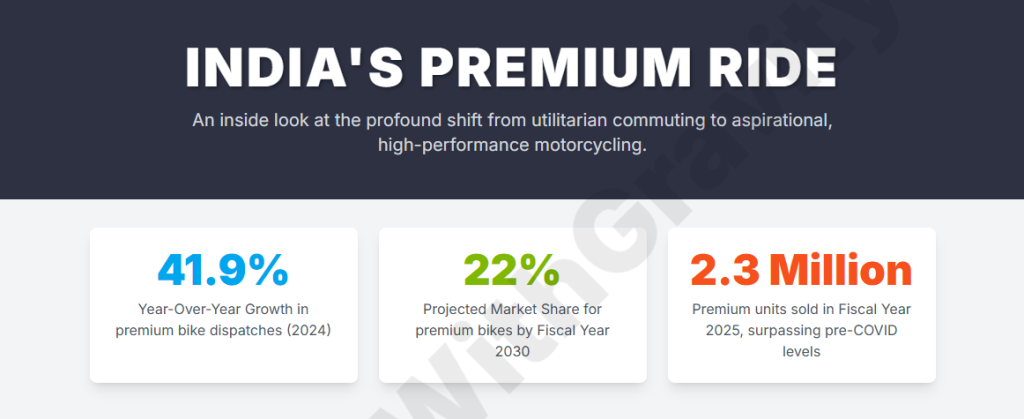
The premium motorcycle segment in India is experiencing significant expansion. In 2024, 4,697 premium motorcycles were dispatched, marking a substantial 41.9% increase compared to 2023.5 This growth is particularly noteworthy as it occurred despite a general slowdown in the broader two-wheeler market in early 2025.1 Crisil Intelligence reports that the market share of premium motorcycles (engine capacity > 150cc) rose from 14% in fiscal 2019 to 19% in the last fiscal year (FY25), with projections indicating it will reach 22% by fiscal 2030.2 Volume sales in the premium segment increased from 1.9 million units in FY19 to 2.3 million units in FY25.2
Premium motorcycle sales surpassed pre-COVID levels by 22% in the last fiscal year, demonstrating strong recovery and sustained demand. This contrasts sharply with the overall two-wheeler market, which stood at 94% of pre-pandemic levels, and total motorcycle sales, which reached only 90%.2 Specific sub-segments within premium motorcycles are also showing strong growth: the 200-250cc category grew 8%, and the 250-350cc category posted the highest growth of 13% in Q1 FY26.3 Kawasaki, with its Z900, ZX-6R, and ZX-10R, dominated the premium segment in 2024, retaining over 50% market share. Triumph and Suzuki also hold significant shares, driven by models like the Street Triple and Hayabusa, respectively.5
Table 1: Premium Motorcycle Sales Volume & Growth (2023-2024)
| Year | Dispatches (Units) | Year-over-Year Growth (%) | |
| 2023 | ~3310 (Calculated) | – | |
| 2024 | 4697 | 41.9% | |
| Source: 5 |
Table 2: Premium Motorcycle Market Share Projections (2019-2030)
| Fiscal Year | Premium Motorcycle Market Share (%) | Economy Motorcycle Market Share (%) | Premium Motorcycle Volume (Lakh units) | Economy Motorcycle Volume (Lakh units) | |
| 2019 | 14% | 62% | 19 | 84 | |
| FY25 | 19% | 46% | 23 | 56 | |
| 2030 (Proj.) | 22% | – | – | – | |
| Source: 2 |
Table 3: Top-Selling Premium Motorcycle Models in India (2024)
| Rank | Model Name | Brand | Dispatches (Units) | Key Feature/Segment | |
| 1 | Kawasaki Z900 | Kawasaki | 1035 | Sports Naked | |
| 2 | Kawasaki ZX-6R | Kawasaki | 465 | Supersport | |
| 3 | Suzuki Hayabusa | Suzuki | 419 | Hyperbike | |
| 4 | Triumph Street Triple 765 | Triumph | 376 | Sports Naked | |
| 5 | Kawasaki ZX-10R | Kawasaki | 288 | Litre Class Supersport | |
| – | Triumph Tiger 900 | Triumph | 276 | Adventure Bike (Most Popular) | |
| – | Kawasaki Versys 650 | Kawasaki | 183 | Adventure Touring | |
| – | Triumph Daytona 660 | Triumph | 133 | Sports Bike | |
| – | Kawasaki ZX-4R | Kawasaki | > Ninja 650 | Mini Supersport | |
| Source: 5 |
Conversely, the market share of economy motorcycles (below 150cc) significantly declined from 62% in fiscal 2019 to 46% in the last fiscal year.2 Volume in this segment shrank from 8.4 million units to 5.6 million units during the same period.2 This decline is largely attributed to weak rural demand and a steep 65-70% hike in prices due to regulatory transitions (Bharat Stage IV to Bharat Stage VI standards), implementation of safety norms, and the commodity super cycle.2 Sales of economy motorcycles recovered to only 67% of pre-pandemic levels.2 The 125-150cc category, which bridges commuter and entry-level sporty offerings, saw the steepest contraction of 37% in Q1 FY26.3
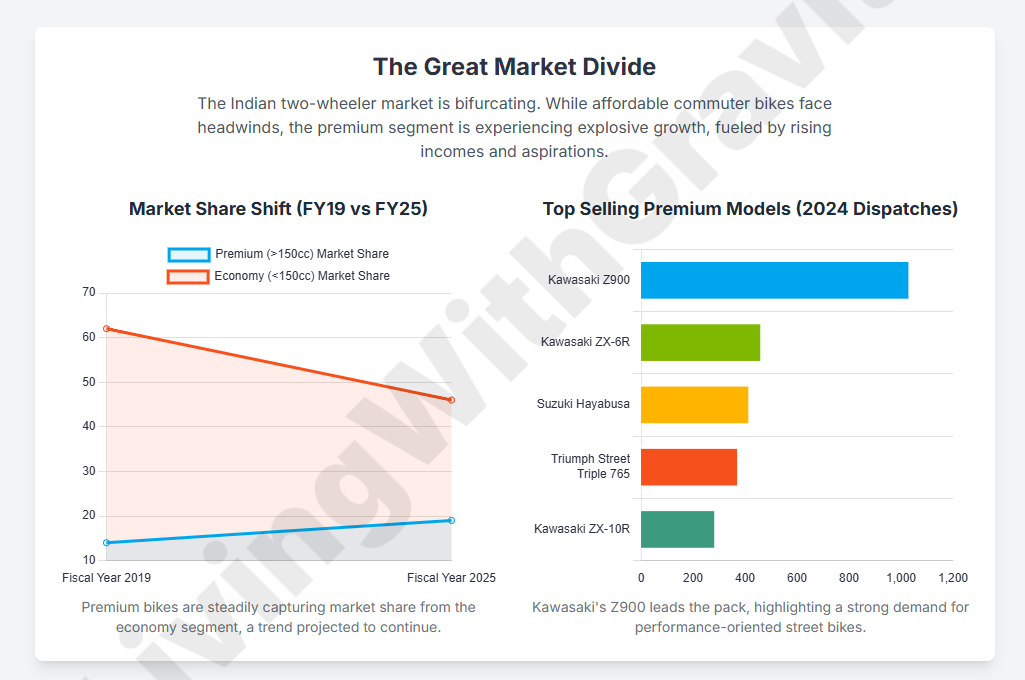
The data clearly indicates a widening gap between the performance of the premium and economy segments. While the overall two-wheeler market struggles, the premium segment thrives, suggesting a market bifurcation where higher-income consumers maintain or increase purchasing power, while lower-income consumers, particularly in rural areas, are disproportionately affected by price increases and stagnant incomes. This observation stems from the fact that premium motorcycle sales are experiencing substantial growth, in stark contrast to the significant decline in economy motorcycle sales. The weak rural demand and the surge in prices for economy models further underscore this disparity.
This indicates that consumers with healthy incomes continue to invest in discretionary, higher-value goods, whereas those with lower or stagnant incomes are retracting from even essential purchases like economy bikes due to escalating affordability challenges. This points to a broader economic trend in India where wealth and income growth are not evenly distributed, leading to a bifurcated consumer market. For manufacturers, this implies a strategic imperative to recalibrate their approaches, either by concentrating on the resilient premium segment or by devising solutions to address the severe affordability constraints within the economy segment.
Furthermore, the shift in the two-wheeler market mirrors trends observed in “other consumer sectors in the country”.4 This suggests that the premiumization of motorcycles is not an isolated phenomenon but rather a manifestation of a broader, underlying macro-consumer trend in India where consumers across various categories are increasingly opting for higher-value, aspirational products.
This conclusion is supported by observations that explicitly state the parallel between premium motorcycle growth and trends in other consumer sectors, alongside discussions of rising disposable incomes fueling demand for luxury goods generally.10 The motorcycle market, therefore, serves as a visible indicator of a larger societal and economic shift towards aspirational consumption. As incomes rise, consumers are upgrading their lifestyles across various categories, not solely in vehicles. This implies that the growth of the premium motorcycle market is likely more sustainable and deeply rooted than a fleeting trend, as it is an integral part of India’s evolving consumer landscape. Businesses should perceive this not as a niche opportunity but as a reflection of a fundamental transformation in consumer behavior.
Section 2: Economic Prosperity and Shifting Affordability
This section explores the fundamental economic drivers underpinning the increased choice for premium motorcycles, focusing on rising incomes and wealth creation in India.
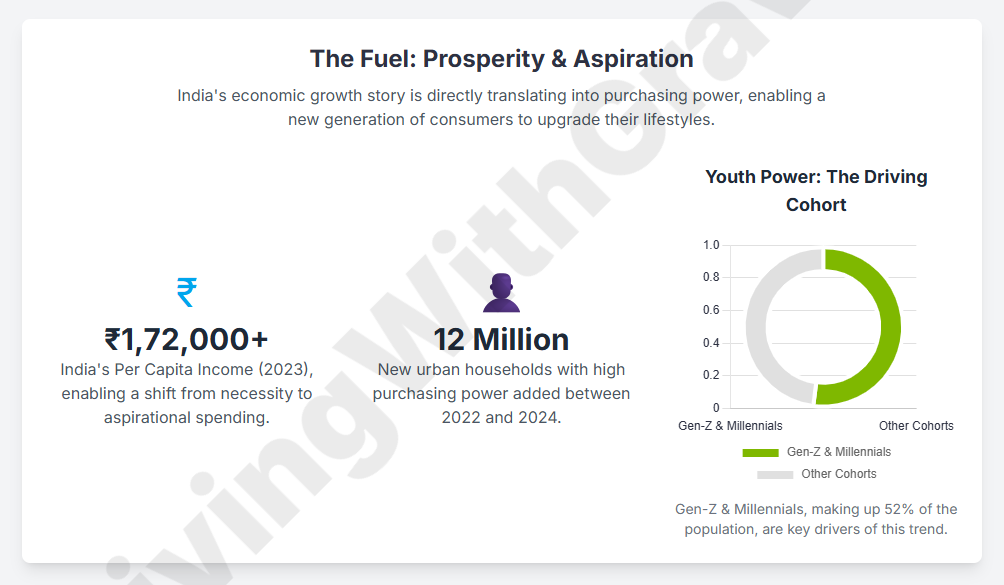
India’s per capita income has been consistently rising, reaching over INR 1,72,000 in 2023.11 This significant increase in disposable income is a primary driver, enabling consumers to shift from necessity-based purchases to aspirational consumption.2 Urban consumers, in particular, are showing a greater inclination towards higher spending on premium products.11 The growing affluence, particularly in Tier 1 and Tier 2 cities, contributes robustly to increased luxury spending across various categories, including automobiles.11 This trend is also fueled by a young, tech-savvy population and resilient private consumption.1
India has seen a steady rise in its High-Net-Worth Individuals (HNWI) population, exceeding 700,000 as of 2024.11 These individuals possess high purchasing power and are key consumers of luxury goods, including premium motorcycles.11 The number of urban households with high purchasing power grew by approximately 12 million between 2022 and 2024.11 Overall, India’s economy is forecast to expand by 6.6% in 2025, driven by strong public investment and resilient private consumption.1 Economists expect India’s economy to grow at an average of 6.5% between 2025 and 2030. This “structural long-term growth story” is supported by favorable demographics and stable governance.1
The rising disposable income is not merely allowing more people to purchase any motorcycle; it is specifically enabling them to cross the affordability threshold for premium motorcycles. This means that what was once considered an unattainable luxury for many is now within reach for a growing segment of the population. This conclusion is drawn from the observed increase in per capita income and the corresponding surge in premium motorcycle sales and market share. Concurrently, the decline in economy segment sales, partly attributed to price hikes that render them less affordable for their target demographic, further supports this.
The premium price point, which historically acted as a barrier, is becoming less prohibitive for a larger consumer base. The relative cost of a premium bike, when viewed against rising incomes, positions it as a more viable purchase than ever before, indicating a redefinition of “affordability” within the Indian two-wheeler market. This implies that manufacturers of premium motorcycles can tap into a broader consumer base previously confined to economy or mid-range vehicles. It also suggests that the market for “value-for-money” within the premium segment, exemplified by models like the Kawasaki Z900 5, is particularly robust, as consumers seek optimal features and performance within their newly expanded budgets.
The growth in HNWIs drives the top-tier luxury market, but the broader increase in disposable income among the middle and upper-middle classes suggests a wider accessibility of premium goods. This means that premium motorcycles are becoming accessible not just to the ultra-rich, but to a wider segment of society that can now afford aspirational purchases. While HNWIs are indeed a key driver of the luxury market, the substantial growth in disposable income among the middle and upper-middle classes also contributes significantly to the demand for premium products.11
This wider adoption, evidenced by the notable market share growth of premium motorcycles 6, must be attributed to this expanding middle and upper-middle class, who now possess the financial means for aspirational purchases that were previously out of reach. This shift creates a larger addressable market for premium motorcycle brands beyond just the elite. It encourages both international and domestic manufacturers to introduce a wider range of premium models at various price points 4, catering to this newly affluent and aspirational consumer base.
Section 3: The Aspirational Consumer: Beyond Commuting
This section delves into the evolving motivations of Indian consumers, highlighting the shift from utilitarian needs to lifestyle aspirations as a key driver for premium motorcycle adoption.
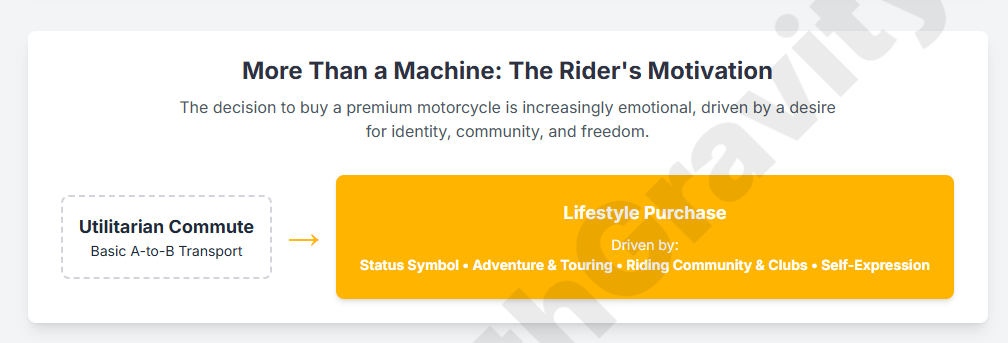
Motorcycles are transitioning from practical vehicles for commuting to symbols of passion, freedom, and an “indomitable spirit”.14 This shift is particularly embraced by Gen-Z and millennial cohorts, who comprise 52% of the nation’s population and seek exciting experiences.14 The demand for premium motorcycles is fueled by a growing preference for these products from buyers with healthy incomes who maintained their purchasing power even during the pandemic.4 Owning certain premium bikes, such as Royal Enfield Classic 350 and Bullet 350, is explicitly considered a “status symbol” by a specific section of Indian society.16 This indicates that the perceived value extends beyond utility to include social standing and personal identity.17 Consumers are increasingly seeking bikes that blend aesthetics with functionality for long rides and touring.12
A youthful demographic and rising global exposure of consumers are identified as key factors driving the improvement in premium motorcycle market share.2 This global exposure, possibly through media, travel, and digital platforms, influences consumer tastes and creates a demand for sophisticated, high-performance vehicles seen internationally.10 India’s biking culture has “exploded in recent years,” evolving into a nationwide movement with motorcycle clubs at its core.19 These clubs unite riders through a shared love for the open road, safe riding practices, and social impact.19
There are over 100 motorcycle clubs in India, with many focusing on adventure travel, long-distance rides, and community building.19 Examples include Riderzarmy, Road Thrill, and Group of Delhi’s Superbikers (GODS).19 Events like MotoGP in India are expected to further boost racing culture and consumer awareness of cutting-edge technologies in motorcycles.14 Motorcycles are increasingly used for leisure and adventure tourism, not just daily commuting.22 The sense of freedom and adventure is a key motivator for motorcycle tourists, who seek to explore new places and scenic routes.22
Premium motorcycles are no longer just a means of transport; they are becoming powerful tools for self-expression and identity building, particularly among younger, affluent demographics. The choice of a premium bike reflects a desired lifestyle, social status, and a sense of belonging to a community. This is evident as motorcycles transition from practical vehicles to symbols of aspiration, with certain models explicitly recognized as status symbols.
The growing preference among buyers with healthy incomes and the proliferation of riding clubs and motorsport culture further underscore a community and lifestyle built around motorcycling. This indicates that the purchase decision for a premium motorcycle is increasingly driven by emotional and social factors rather than purely rational, utilitarian ones. It is about how the bike makes the owner feel, how it is perceived by others, and the experiences it enables, such as touring or club rides. This implies that marketing strategies for premium motorcycles should focus less on functional benefits, though still important, and more on brand narrative, lifestyle association, community engagement, and the emotional fulfillment of ownership. The “experience” economy is clearly influencing vehicle purchases in this segment.
While urbanization typically increases commuting needs, the growth of premium bikes for touring and leisure suggests that urban dwellers are seeking an “escape” from hectic city life. Premium motorcycles offer a means to explore, engage in adventure travel, and find personal space, which is a growing need in densely populated urban centers. This interpretation arises from the observation that urbanization plays a key role in the expansion of the premium motorcycle market, while simultaneously, the “need of one’s ‘own’ space” and “adventure travel” are fueling the growth of the riding industry and clubs. Furthermore, motorcycles are increasingly being used for leisure and for exploring “quieter places with more distinctive landscapes”.22
Urbanization, while contributing to wealth creation and global exposure, also generates stress and a desire for escape. Premium motorcycles, particularly adventure touring models 12, fulfill this need by enabling long-distance travel and exploration, offering a stark contrast to daily urban commutes. This highlights a dual role for premium motorcycles in the urban context: serving as a status symbol for city life and simultaneously acting as a gateway to leisure and adventure outside the city. Manufacturers can strategically position their touring and adventure models to cater to this “escape” motivation among urban consumers.
Section 4: Supply-Side Evolution: Product Innovation and Market Expansion
This section analyzes how manufacturers are responding to and further driving the premiumization trend through product development and market strategies.
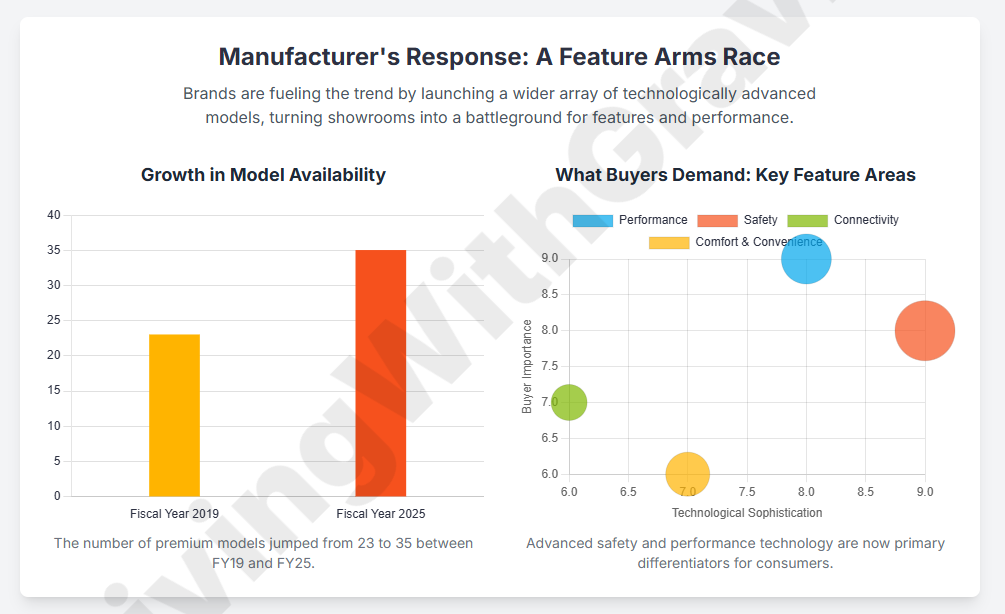
The number of motorcycle models available in the premium segment significantly increased from 23 in fiscal 2019 to 35 in the last fiscal year.2 This expanded range offers consumers more choices, catering to diverse preferences within the premium category.6 Over 75% of new motorcycle launches are now in the premium segment, with brands like Royal Enfield, TVS, Bajaj, Yamaha, and Honda doubling down on high CC models.23 Examples of new luxury motorcycle launches include Triumph Speed Twin 1200, BMW F 900 GS, Ducati Multistrada V4 RS, and Triumph Daytona 660.24 The market offers various types of premium bikes: Street, Cruiser, Sports (Hyper Sports, Super Sports), Touring (Adventure Touring), and Transroader.25 Adventure touring motorcycles, in particular, are rapidly gaining popularity due to their dual-purpose capability for urban and off-road conditions.12
Consumers are increasingly ready to invest in motorcycles equipped with superior technology, comfort enhancements, and advanced safety features.13 Premium bikes offer advanced tech, better design, and a superior riding experience.23 Key technological features becoming crucial in buyer decision-making include digital instrument clusters, navigation aids, smart connectivity options, ride-by-wire systems, smart traction control, adaptive cruise control, and customizable riding modes.13 The upcoming TVS Norton V4, for example, is expected to feature multiple riding modes, a full-color TFT display with smartphone connectivity, cruise control, and keyless ignition.26
Safety features are a significant consideration for premium bike buyers.13 Anti-Lock Braking System (ABS) is a crucial safety feature, mandatory for all bikes above 150cc in India, and significantly reduces the chances of tire skids during hard braking.27 Premium bikes often feature dual-channel ABS, which equips both front and rear wheels for enhanced safety.27 Many popular bikes now offer rear disc brakes, providing riders with more control, especially during sudden braking or on wet roads, and reducing stopping distance.28 The TVS Norton V4 is expected to include cornering ABS and traction control for enhanced safety.26
Table 4: Key Technological and Safety Features Driving Premium Motorcycle Adoption
| Feature Category | Specific Features | Impact on Rider Experience | |
| Performance | Ride-by-wire systems, Multiple riding modes, Bi-directional quickshifters, Adjustable suspension (Öhlins) | Precise throttle control, Customizable power delivery, Smooth gear changes, Enhanced handling for varied conditions | |
| Safety | Dual-channel ABS, Cornering ABS, Traction control, Rear disc brakes, Brembo Stylema brakes | Prevents wheel lock-up, Improves braking stability in turns, Reduces wheel spin, Shorter stopping distances, Superior braking power | |
| Connectivity | Full-color TFT display, Smartphone connectivity, Navigation aids | Modern interface, Access to calls/messages, Turn-by-turn directions | |
| Comfort/Convenience | Cruise control, Keyless ignition, Lightweight carbon fiber components, Ergonomic design | Reduced rider fatigue on long rides, Easy start-up, Improved power-to-weight ratio, Enhanced rider comfort | |
| Source: 13 |
Numerous international companies are entering or expanding their presence in the Indian market, fueled by rising disposable incomes.10 The Indian premium motorcycle market includes a wide array of brands such as BMW, Kawasaki, Harley-Davidson, Suzuki, Ducati, Indian, Triumph, and Moto Morini.12 Domestic players like Royal Enfield and TVS are also shining in the premium segments.3 TVS Motor Company’s acquisition of Norton and the upcoming Norton V4 exemplify the fusion of British heritage with Indian engineering, poised to challenge established European rivals.26
The rapid increase in available models and the emphasis on advanced technological and safety features suggest that manufacturers are engaged in a competitive drive to add more capabilities. As the market becomes more competitive and consumers more discerning, the inclusion of cutting-edge technology and safety becomes a primary differentiator, driving up the perceived value and justifying higher price points. This is supported by the significant increase in the number of premium models available and the fact that new launches are predominantly in this segment. Consumers are increasingly willing to invest in bikes equipped with superior technology, comfort enhancements, and advanced safety features.
Manufacturers are not simply offering more bikes; they are offering more sophisticated bikes. This intense focus on adding features and technology is a direct response to consumer demand for “more power, more features, more thrill” 23 and a strategy to capture market share in a segment where consumers are less price-sensitive and more value-conscious.15 This trend implies a continuous cycle of innovation and upgrading within the premium segment. Brands that fail to keep pace with technological advancements and safety standards risk losing market relevance. It also suggests that the definition of “premium” is constantly evolving, driven by consumer expectations and competitive offerings.
The success of domestic players like Royal Enfield and TVS in the premium segment, alongside the entry of global brands, indicates that Indian manufacturers are effectively competing and innovating in this higher-margin space. TVS’s acquisition of Norton is a strategic move to leverage global heritage with Indian engineering, signaling ambition beyond traditional domestic market dominance. This is evidenced by Royal Enfield’s dominance in the 250-350cc category and TVS Motor Company’s leadership in the 150-200cc segment, coupled with its strong growth in the 200-250cc category.3
Furthermore, TVS’s acquisition of Norton and its plans to launch the Norton V4 to compete with established European brands like Ducati, Aprilia, and BMW 26 underscore this ambition. Indian manufacturers are not merely reacting to market shifts; they are actively shaping the premium segment. They are demonstrating capability in product development, brand building, and strategic acquisitions to compete directly with established global luxury brands. This signifies a maturing of the Indian automotive industry, moving beyond mass-market production to high-value, technologically advanced products. This could lead to increased research and development investment within India, fostering local expertise and potentially positioning India as a hub for premium motorcycle manufacturing and innovation in the long term.
Section 5: Ecosystem Development: Infrastructure, Financing, and After-Sales
This section examines the external factors and support systems that influence the adoption and ownership experience of premium motorcycles in India.
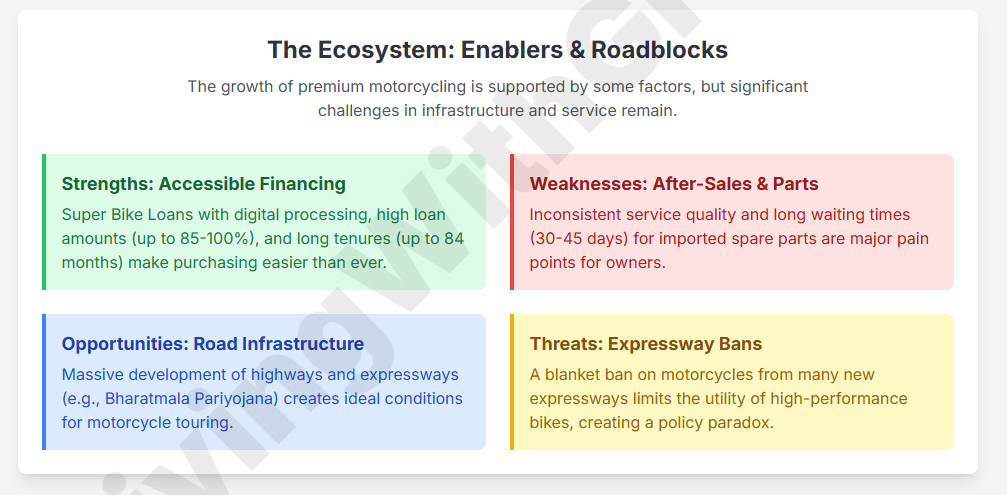
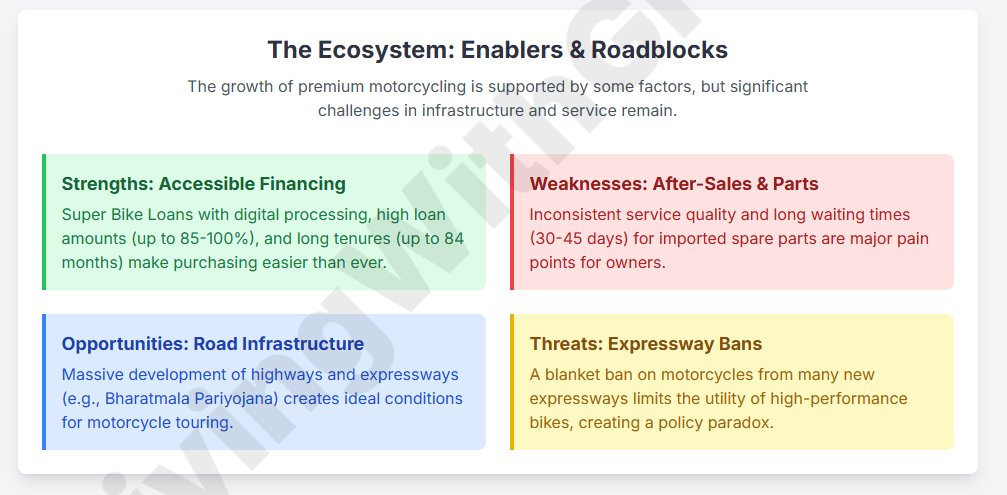
The development of extensive road networks, including national highways and expressways, is a crucial pillar of India’s economic growth.30 Projects like Bharatmala Pariyojana aim to improve connectivity, reduce logistics costs, and enhance the quality of roads across the country.30 This improved infrastructure supports long-distance travel and motorcycle tourism.22 Motorcyclists look forward to hitting highways/expressways for higher speeds and freedom.33
However, a significant challenge remains the blanket ban on motorcycles (of any engine capacity) from entering many highways and expressways in India.33 This forces premium bike owners onto alternative, often less safe or more congested routes.33 Indian roads present unique hazards for motorcyclists, including potholes, slippery road markings, inadequate drainage, lack of shoulder space, and poor lighting, which are particularly dangerous for two-wheelers.34 The “unspoken hierarchy” on Indian roads also places motorcycles lower, increasing vulnerability.35 Despite these challenges, the desire for adventure and exploration, coupled with the development of safer, more comfortable motorcycles, continues to drive motorcycle tourism.22
Financial institutions like HDFC Bank offer “Super Bike Loans” with contactless digital applications and disbursals, making it easier to purchase dream bikes from brands like Harley Davidson, Triumph, BMW, and Kawasaki.36 These loans offer long repayment tenures (up to 60 months for HDFC 36; up to 72-84 months for Royal Enfield 37) and high loan amounts (up to 85% finance 36), including accessory funding.36 Pre-approved customers can get instant disbursals, highlighting the ease of access to credit.36 Royal Enfield also offers financing up to 100% of the On Road Price, including extended warranty and accessories.37 The Reserve Bank of India’s recent rate cuts are expected to ease retail finance, making two-wheeler loans more affordable.3
After-sales service quality varies significantly by location, service center, and personnel.38 While some premium brand service centers, like Honda Big Wing, are praised for better attention due to limited volume 38, others, like Royal Enfield, face criticism for issues such as forgetting oil changes, siphoning petrol, or unhelpful staff.39 Unavailability of even basic wear-and-tear spare parts is a significant issue for premium brands like Triumph, with long waiting times (30-45 days) and advance payment requirements.40 Overinflation of spare parts prices and labor costs are also concerns.40 While there are online platforms and shops for aftermarket parts for various brands 41, challenges exist for imported motorcycles regarding spare parts availability.40
The Indian spare parts industry is growing and supplies neighboring countries, but this primarily pertains to mass-market Indian brands.44 For imported premium bikes, reliance on overseas manufacturing for parts can lead to high import duties and taxes, substantially raising retail prices and limiting affordability.12
The ongoing development of high-quality road infrastructure, such as the Bharatmala Pariyojana, is theoretically a boon for premium motorcycle touring. However, the persistent ban on motorcycles from expressways creates a significant paradox. This policy effectively limits the utility and enjoyment of high-performance machines on the very roads designed for speed and long-distance travel, potentially dampening the full realization of the premium segment’s growth potential for touring. This observation stems from the fact that India is actively building extensive, high-quality road networks and expressways, and premium motorcycles are increasingly being used for touring and leisure.
Yet, a policy barrier prevents motorcycles from accessing many of these expressways, forcing riders onto less suitable routes. The infrastructure is being built, but policy barriers prevent premium motorcycles from fully benefiting from it. This creates a disconnect between the aspirational use case—long-distance, high-speed touring—and the practical reality of road access. This policy gap could hinder the premium segment’s growth, particularly for touring-oriented models. It also raises questions about equitable road access given the high taxes and duties paid on these vehicles.33 Advocacy for policy changes, such as allowing higher CC bikes on expressways with proper gear and tolls, could unlock further market potential.
While financing options are making premium motorcycles more accessible, the inconsistent after-sales service and spare parts availability represent a critical challenge and a future battleground for brand loyalty. A seamless ownership experience, extending beyond the purchase, will become a key differentiator for premium brands. This is evident from the ready availability and flexibility of financing options, contrasted with the highly variable and often criticized after-sales service quality. Furthermore, spare parts availability is a major issue for imported premium brands, leading to long waits and high costs.
As more Indians choose premium motorcycles, their expectations for the entire ownership lifecycle—not just the initial purchase—will rise. Poor after-sales support can erode brand trust and lead to dissatisfaction, even if the initial product is excellent. Brands that can consistently deliver exceptional after-sales service, ensure timely and affordable spare parts, and build robust dealer networks will gain a significant competitive advantage. This will necessitate substantial investment in service infrastructure, technician training, and supply chain optimization, especially for imported brands facing high tariffs and logistical hurdles.12
Section 6: Premium Motorcycles vs. Luxury Cars: A Comparative Value Proposition
This section analyzes the decision-making process for high-income consumers, comparing the perceived benefits and trade-offs of investing in a premium motorcycle versus a luxury car in India.
For many, a premium motorcycle offers a unique “thrill of riding on the open road” and a sense of adventure that a car cannot replicate.45 They are often seen as “weekend toys” or passion purchases.46 Cost efficiency can be a factor; buying a used premium motorcycle can offer significant cost savings and shield from steep initial depreciation of new models.45 Even new, a superbike might be financially comparable to a premium car, but the experience is distinct.46 Premium motorcycles symbolize passion, freedom, and an “indomitable spirit”.14 Luxury cars, on the other hand, are often justified for business purposes due to depreciation benefits.17 They offer superior comfort for long trips, isolation from traffic, enhanced safety features (multiple airbags, metal body), and a “snob value” or “signalling effect”.17 They are a family-oriented investment, providing comfort and enjoyment for all members.46
The choice between a superbike and a premium car often presents a dilemma, especially for salaried individuals and “family guys”.46 A premium car is often perceived as a “no brainer” for parents and can earn “major brownie points” with the family, as the entire family can enjoy it and benefit from its safety and comfort.46 A superbike, while offering personal enjoyment, is often seen as a “selfish” investment as it primarily benefits only the owner.46 Despite this, the “OneLife” philosophy and the allure of superbikes continue to appeal to enthusiasts.46 The “perceived value” of a motorcycle, including its quality, performance, and technology, is increasingly important to Indian consumers who “don’t settle for less”.15
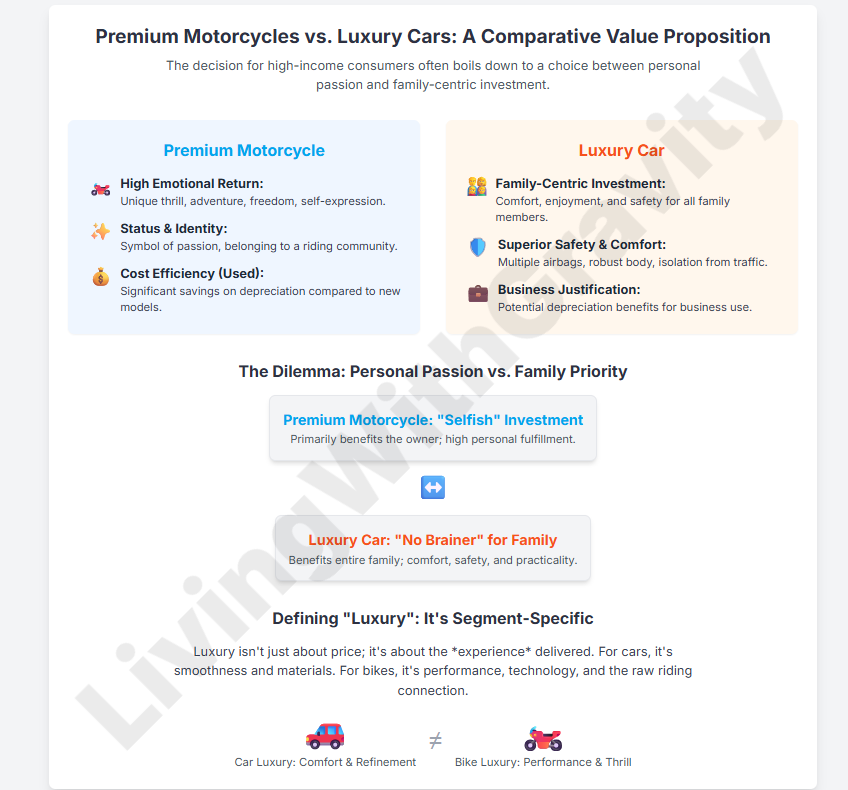
While luxury cars offer tangible benefits like family comfort and safety, premium motorcycles offer a high emotional return on investment for the individual. This suggests that for a growing segment of Indian consumers, personal fulfillment, passion, and the unique thrill of riding are increasingly outweighing purely rational or family-centric investment considerations. This conclusion is derived from the observation that luxury cars are viewed as family investments, providing comfort and safety for all, whereas premium motorcycles are often deemed “selfish” investments, benefiting only the owner. Yet, despite this, the demand for premium motorcycles is surging, driven by “passion, freedom, and an indomitable spirit”.14
The decision to purchase a premium motorcycle, particularly for individuals with family responsibilities, is fueled by a strong desire for personal gratification and a unique experiential value that a car cannot provide. The “thrill” and “lifestyle” aspects 25 serve as powerful motivators that transcend the practical benefits of a family car. This highlights a growing segment of affluent Indian consumers who are willing to allocate significant discretionary income towards personal passions and experiences. For premium motorcycle brands, this implies emphasizing the unique emotional and experiential benefits of riding, rather than attempting to compete directly on practicality or family utility with luxury cars.
The definition of “luxury” is segment-specific and not solely tied to price. While a Rolls Royce offers luxury through smoothness and high-quality materials, a premium motorcycle offers luxury through performance, advanced technology, and the raw, unadulterated riding experience. This implies that consumers are discerning about how they experience luxury and are willing to pay for it in different forms. This is supported by the observation that luxury cars are valued for smoothness, quality materials, comfort, and safety, while premium motorcycles are valued for “power, features, thrill,” and a “superior riding experience”.23 Indian consumers “don’t settle for less” and expect “the best of the best for the price they’re paying”.15
Consumers are not simply purchasing the most expensive option; they are acquiring the best experience for their specific desire. For some, this entails the insulated comfort of a luxury car; for others, it is the visceral, connected experience of a high-performance motorcycle. Both represent “luxury” but are delivered through distinct means. This suggests that premium motorcycle brands should emphasize their unique value proposition of performance, agility, and the direct connection to the road, rather than attempting to emulate the comfort and isolation of luxury cars. The market is mature enough to appreciate distinct forms of premium experiences.
Conclusion and Future Outlook:
The surge in premium motorcycle adoption in India is a confluence of robust economic growth leading to increased disposable incomes and a rising affluent class. This economic buoyancy empowers a youthful and globally exposed demographic to pursue aspirational purchases, shifting motorcycles from mere utilitarian transport to symbols of lifestyle, passion, and status. Manufacturers have responded with an expanded portfolio of technologically advanced, feature-rich, and safety-enhanced models, catering to this evolving consumer demand. While financing options have become more accessible, challenges in road infrastructure policy and inconsistent after-sales service remain critical areas for improvement. The premium segment is projected to continue its upward trajectory, with its market share expected to reach 22% by fiscal 2030, driven by sustained economic expansion and evolving consumer preferences. The market will likely see further innovation in technology, a diversification of models, and a continued emphasis on the experiential aspects of riding.
Recommendations:
To capitalize on this burgeoning trend and address existing challenges, strategic recommendations are outlined for key stakeholders:
- For Manufacturers:
- Deepen Product Portfolio: Continuously innovate and expand the range of premium models, with a particular focus on adventure touring and performance-oriented bikes that cater to the aspirational and leisure-seeking consumer. Emphasize advanced technology, connectivity, and safety features as crucial differentiators.
- Localize and Optimize Supply Chains: Invest in local manufacturing capabilities or establish robust regional spare parts hubs. This approach can mitigate the impact of high import duties and address persistent spare parts availability issues, thereby improving the overall ownership experience and potentially reducing costs for consumers.
- Brand Storytelling: Shift marketing narratives from purely utilitarian aspects to themes of lifestyle, passion, and community. Highlight the emotional and experiential benefits of ownership, aligning with the aspirational desires of Gen-Z and millennial buyers who seek more than just transportation.
- For Dealers:
- Enhance After-Sales Service: Prioritize the delivery of consistent, high-quality after-sales service across all locations. This requires investment in skilled technicians, efficient service processes, and transparent communication to build customer trust and loyalty, which is currently a significant pain point for many premium brands.
- Curate Customer Experiences: Develop and actively promote riding clubs, organized tours, and community events. These initiatives foster a sense of belonging among owners and significantly enhance the lifestyle aspect of premium motorcycle ownership, reinforcing the emotional investment in the brand.
- Leverage Financing Options: Proactively partner with financial institutions to offer flexible and attractive loan schemes. This will make premium motorcycles more accessible to the expanding pool of eligible buyers, converting aspirational interest into concrete sales.
- For Financial Institutions:
- Tailored Loan Products: Continue to develop specialized loan products specifically for premium motorcycles. These products should offer competitive interest rates, longer repayment tenures, and comprehensive financing options that can include accessories and extended warranties, reflecting the full cost of ownership.
- Streamlined Digital Processes: Further enhance digital application and disbursal processes to provide quick and seamless access to financing. This caters directly to the tech-savvy demographic that forms a significant portion of the premium motorcycle buyer base.
- Suggestions for addressing existing challenges:
- Policy Advocacy: Industry bodies and premium motorcycle manufacturers should collaboratively advocate for policy changes regarding expressway access for higher-capacity motorcycles. This advocacy could propose specific regulations based on engine size, mandatory safety gear, and toll payments, which would unlock the full potential of improved road infrastructure for touring.
- Investment in Service Infrastructure: Manufacturers, especially those with imported models, require significant investment in expanding their service network. This includes ensuring an adequate stock of genuine spare parts and providing comprehensive training to personnel to meet global service standards. Such investment is crucial for long-term customer satisfaction and maintaining brand reputation.
- Consumer Education: Promote widespread awareness campaigns on proper riding gear, lane discipline, and general road safety, particularly for high-performance bikes. These efforts contribute to a safer riding environment and can positively influence policy makers to consider more inclusive road access regulations.
Sources
- Indian Motorcycles Market – Facts & Data 2025 | MotorCyclesData, accessed on July 23, 2025, https://www.motorcyclesdata.com/2025/07/07/indian-motorcycles-market/
- Market share of premium bikes in India zooms 5 per cent in 6 years – Suryaa, accessed on July 23, 2025, https://www.suryaa.com/167536-market-share-of-premium-bikes-in-india-zooms-5-per-cent-in-6-years.html
- Indian Motorcycle Industry Faces Challenging Start to FY2026 – ACKO Drive, accessed on July 23, 2025, https://ackodrive.com/news/indian-motorcycle-industry-faces-challenging-start-to-fy-2026/
- Premium Motorcycles Set To Reach 22% Market Share By 2030: Crisil – KNN India, accessed on July 23, 2025, https://knnindia.co.in/news/newsdetails/sectors/automobile/premium-motorcycles-set-to-reach-22-market-share-by-2030-crisil
- 2024 Annual Report Card – Superbikes & Imported Motorcycles Sales Analysis – Team-BHP, accessed on July 23, 2025, https://www.team-bhp.com/forum/superbikes-imports/290812-2024-annual-report-card-superbikes-imported-motorcycles-sales-analysis.html
- Indians Are Buying More Premium Motorcycles: Market Share Expected To Reach 22% By 2030 | Bike News – Times Now, accessed on July 23, 2025, https://www.timesnownews.com/auto/bike-news/indians-buying-premium-motorcycles-market-share-rise-2030-article-152257804
- Premium motorcycles likely to account for 22 pc of total market by 2030: Crisil, accessed on July 23, 2025, https://www.ptinews.com/story/business/premium-motorcycles-likely-to-account-for-22-pc-of-total-market-by-2030-crisil/2715541
- Premium motorcycles likely to account for 22% of total market by 2030: Crisil, accessed on July 23, 2025, https://www.telegraphindia.com/business/premium-motorcycles-likely-to-account-for-22-of-total-market-by-2030-crisil/cid/2112421
- India’s Premium Motorcycle Market Surges: Consumer Trends Transforming the Two-Wheeler Landscape, ETAuto, accessed on July 23, 2025, https://auto.economictimes.indiatimes.com/news/two-wheelers/indias-premium-motorcycle-market-surges-consumer-trends-transforming-the-two-wheeler-landscape/122377113
- The world’s biggest names are racing to enter India – The Economic Times, accessed on July 23, 2025, https://m.economictimes.com/industry/services/retail/india-is-suddenly-on-global-brands-launch-list/articleshow/122636834.cms
- India Luxury Goods Market Share Analysis & Sector Trends to 2028 – Ken Research, accessed on July 23, 2025, https://www.kenresearch.com/industry-reports/india-luxury-goods-market
- India Premium Motorcycles Market By Engine Capacity (500-800cc, 801-1600cc and >1600cc), By Propulsion Type (ICE, Electric), By Region, Competition, Forecast & Opportunities, 2020-2030F – GII Research, accessed on July 23, 2025, https://www.giiresearch.com/report/tsci1771235-india-premium-motorcycles-market-by-engine.html
- India Premium Motorcycles Market to Grow with a at a CAGR of 12.5% during the forecast period – TechSci Research, accessed on July 23, 2025, https://www.techsciresearch.com/news/13715-india-premium-motorcycles-market.html
- MotoGP: From Track to Trend: India’s motorsport culture and the promise it holds, accessed on July 23, 2025, https://timesofindia.indiatimes.com/auto/bikes/motorcycles-transitioning-from-practical-to-aspiration-purchases/articleshow/103600881.cms
- Perceived Quality & Value Perception in Motorcycles – Tiivra, accessed on July 23, 2025, https://tiivra.com/blogs/news/perceived-quality-value-perception-in-motorcycles
- Top 10 Most Famous Bikes in India – Features & Price – TATA AIG, accessed on July 23, 2025, https://www.tataaig.com/knowledge-center/two-wheeler-insurance/famous-bikes-in-india
- Is it worth buying a premium luxury car in India? – Team-BHP, accessed on July 23, 2025, https://www.team-bhp.com/forum/indian-car-scene/230031-worth-buying-premium-luxury-car-india-3-print.html
- What benefits do luxury cars actually provide? : r/CarsIndia – Reddit, accessed on July 23, 2025, https://www.reddit.com/r/CarsIndia/comments/1auk8bs/what_benefits_do_luxury_cars_actually_provide/
- Top 10 Motorcycle Clubs in India for 2025: Brotherhood, Adventure, and Social Impact, accessed on July 23, 2025, https://www.riderzarmy.in/post/top-10-motorcycle-clubs-in-india-for-2025-brotherhood-adventure-and-social-impact
- Amdavad sees a steady rise in number of bikers’ clubs – The Times of India, accessed on July 23, 2025, https://timesofindia.indiatimes.com/life-style/spotlight/amdavad-sees-a-steady-rise-in-number-of-bikers-clubs/articleshow/109587560.cms
- Motorcycle Club Trend In India » BikesMedia.in, accessed on July 23, 2025, https://www.bikesmedia.in/reviews/motorcycle-club-trend-in-india.html
- Discovering the Dynamics and Impact of Motorcycle Tourism: Insights into Rural Events, Cultural Interaction, and Sustainability – Preprints.org, accessed on July 23, 2025, https://www.preprints.org/frontend/manuscript/2bbe340e72f5400b8b89c70ff2e283d2/download_pub
- Why more Indians are choosing high-performance motorcycles? | bl.Explained – YouTube, accessed on July 23, 2025, https://www.youtube.com/watch?v=FbYRSjzYaGA
- Rev It Up With These Luxury Motorcycle Launches In India – Outlook Luxe, accessed on July 23, 2025, https://luxe.outlookindia.com/tech-auto/auto/rev-it-up-with-these-luxury-motorcycle-launches-in-india
- Premium bikes are the rage now – The Times of India, accessed on July 23, 2025, https://timesofindia.indiatimes.com/life-style/spotlight/premium-bikes-are-the-rage-now/articleshow/94758121.cms
- TVS Norton V4: The British-Indian Superbike Set to Redefine Performance, accessed on July 23, 2025, https://omegagears.in/tvs-norton-v4-the-british-indian-superbike-set-to-redefine-performance/
- 5 Best ABS Bikes in India – Safety & Performance Guide – TATA AIG, accessed on July 23, 2025, https://www.tataaig.com/knowledge-center/two-wheeler-insurance/best-abs-bikes-in-india
- 5 Premium Bikes in India With Rear Disc Brakes – BikeJunction, accessed on July 23, 2025, https://bikes.tractorjunction.com/en/news/5-premium-bikes-in-india-with-rear-disc-brakes
- 139 Luxury Bikes In India 2025, Price & Reviews – HT Auto, accessed on July 23, 2025, https://auto.hindustantimes.com/new-bikes/luxury
- Development in highway and road networks to boost economic growth in India, accessed on July 23, 2025, https://www.investindia.gov.in/team-india-blogs/development-highway-and-road-networks-boost-economic-growth-india
- Bharatamala Pariyojana – Visionary Corridor across India – Make In India, accessed on July 23, 2025, https://www.makeinindia.com/bharatamala-pariyojana-visionary-corridor-across-india
- Bharatmala Pariyojana is rapidly transforming connectivity and improving lives of people. Better roads are enabling faster economic development., accessed on July 23, 2025, https://static.pib.gov.in/WriteReadData/specificdocs/documents/2022/nov/doc20221118130601.pdf
- Should large capacity motorbikes be allowed on Expressways? – Team-BHP, accessed on July 23, 2025, https://www.team-bhp.com/news/should-large-capacity-motorbikes-be-allowed-expressways
- Are Our Roads Built for Motorcycles? Infrastructure Gaps That Endanger Riders, accessed on July 23, 2025, https://indianautosblog.com/are-our-roads-built-for-motorcycles-infrastructure-gaps-that-endanger-riders-p327583
- Motorcycle Touring in India: Roads Less Traveled, accessed on July 23, 2025, https://bigbiketouring.com/the-ultimate-guide-to-motorcycle-touring-in-india-roads-less-traveled/
- Superbike Loan – Apply for Super Bike Loan Online in India | HDFC Bank, accessed on July 23, 2025, https://www.hdfcbank.com/personal/borrow/popular-loans/super-bike-loan
- Finance Scheme On Motorcycles | Royal Enfield, accessed on July 23, 2025, https://www.royalenfield.com/in/en/finance/
- Best Two Wheeler After Sales Service Company? – TechnoFino, accessed on July 23, 2025, https://www.technofino.in/community/threads/best-two-wheeler-after-sales-service-company.24002/
- Which motorcycle brand has good after sales service and which one has the worst in general? : r/indianbikes – Reddit, accessed on July 23, 2025, https://www.reddit.com/r/indianbikes/comments/1fi7wny/which_motorcycle_brand_has_good_after_sales/
- Issues faced by Triumph Motorcycle owners | An open letter to Triumph India & Triumph UK, accessed on July 23, 2025, https://www.team-bhp.com/forum/superbikes-imports/276176-issues-faced-triumph-motorcycle-owners-open-letter-triumph-india-triumph-uk.html
- India’s No.1 Store for Motorcycle Accessories – Bandidos Pitstop – Bandidos pitstop, accessed on July 23, 2025, https://bandidospitstop.com/
- Buy Bike Performance Parts In India | Lowest Price at Bikegear, accessed on July 23, 2025, https://bikegear.in/performance-parts
- Motorcycle Spares, Parts and consumables – Motousher | Motorcycle Parts Importer, accessed on July 23, 2025, https://www.motousher.com/
- 2-Wheeler and 4-Wheeler Spare Parts Demand in India and Neighbouring Countries, accessed on July 23, 2025, https://www.quintessinternational.in/2-wheeler-and-4-wheeler-spare-parts-demand-in-india-and-neighbouring-countries/
- Hathi Ka Sound Sunke Maza Aagaya – 5 Benefits Of Buying A Used Premium Motorcycle, accessed on July 23, 2025, https://m.youtube.com/watch?v=AXBFVru63yM
- Superbike or a Premium car at the age of 35? – Team-BHP, accessed on July 23, 2025, https://www.team-bhp.com/forum/what-car/222686-superbike-premium-car-age-35-a.html
Our Social Media Handles
- Instagram : LivingWithGravity
- Medium : Akash Dolas
- YouTube Channel : Gear and Shutter