







The Fifth Generation: Engineering and Strategic Analysis of the 2026 Ducati Monster
I. Strategic Context and Platform Architecture
1.1. The Evolution of an Icon: From Trellis to Monocoque—Ducati’s Naked Strategy
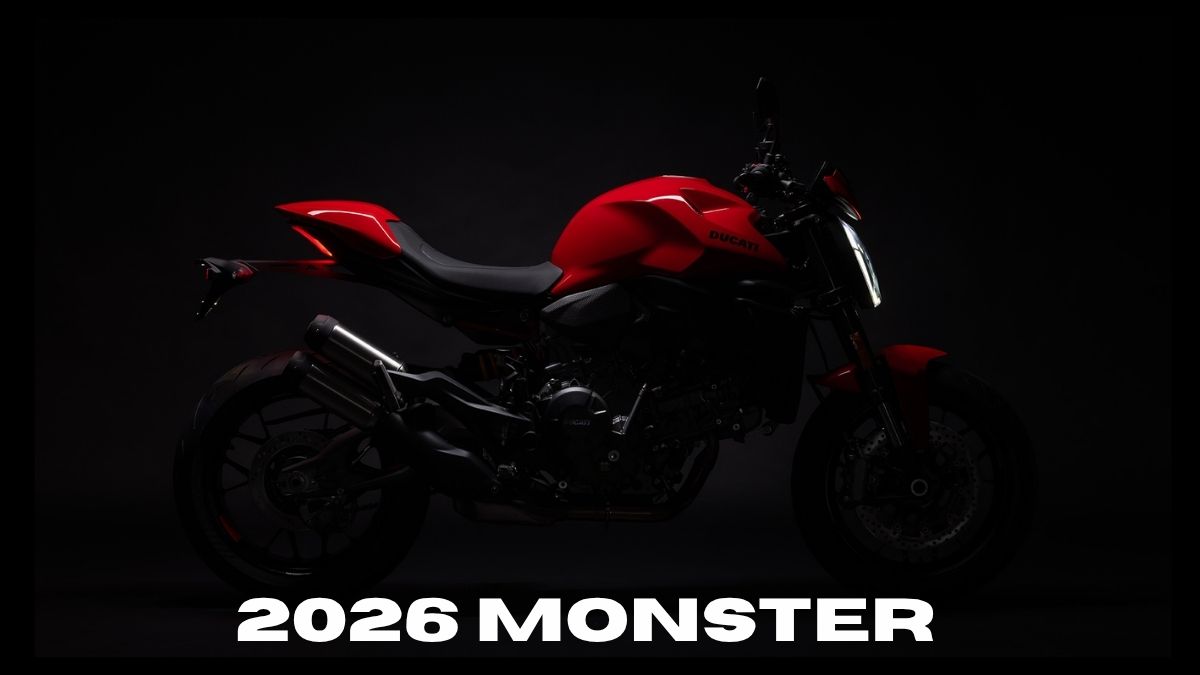
The Ducati Monster, since its inception, has been defined by its minimalist design philosophy, centered around an exposed steel trellis frame and the characteristic Desmodromic L-twin engine. The 2026 Monster, representing the fifth generation, solidifies a profound strategic departure for this iconic line. Following the path set by its immediate predecessor, the new model completely abandons the traditional steel trellis in favor of a modern, lightweight aluminum monocoque structure.1
This paradigm shift is not merely aesthetic but fundamental to the motorcycle’s dynamic performance envelope. The monocoque design dramatically reduces overall chassis mass and enhances torsional rigidity compared to a traditional perimeter or trellis frame. This engineering direction aligns the Monster structurally with Ducati’s high-performance V2 lineage, namely the Panigale and Streetfighter platforms, where stiffness and mass centralization are paramount.1 By making the new 890cc V2 engine a stressed member of the chassis, the need for a heavy, full frame is eliminated, enabling the aggressive lightness targets mandated for this generation.
1.2. Product Placement: The 890cc Monster in the V2 Lineup
The introduction of the new 890cc V2 engine platform signals a crucial consolidation within Ducati’s mid-range portfolio. The engine’s use in the Monster, alongside other models like the Panigale V2 and Multistrada V2, simplifies manufacturing complexity and standardizes key components across the Ducati lineup.2
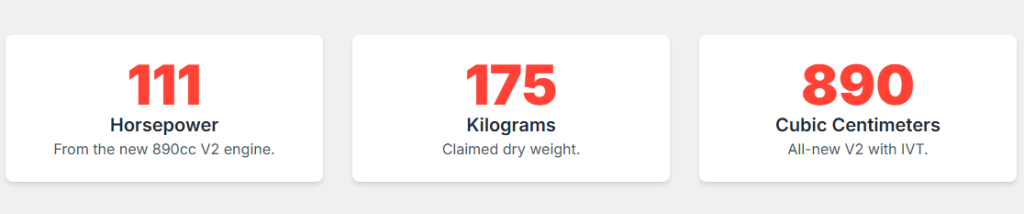
The Monster’s power output of 111 hp 3 carefully positions the bike hierarchically below the higher-performance, larger-displacement models like the Streetfighter V2, which occupies the flagship naked V2 position. The Monster is engineered to deliver powerful yet tractable street performance, defining a clear progression path for riders entering or moving within the Ducati brand hierarchy.
To capture broad market demand, Ducati is launching the 2026 Monster in three expected variants: the base Monster, the Monster+ (which adds essential accessories like a cowl and passenger seat cover), and a higher-spec Monster SP model.3 Furthermore, recognizing the importance of market access in Europe, a 35 kW version is available for A2-licensed motorcyclists.3 This comprehensive lineup ensures maximum coverage from entry-premium levels to performance-oriented consumers. The official launch schedule targets delivery to dealers in February 2026.3
1.3. Structural Engineering and Mass Reduction Analysis
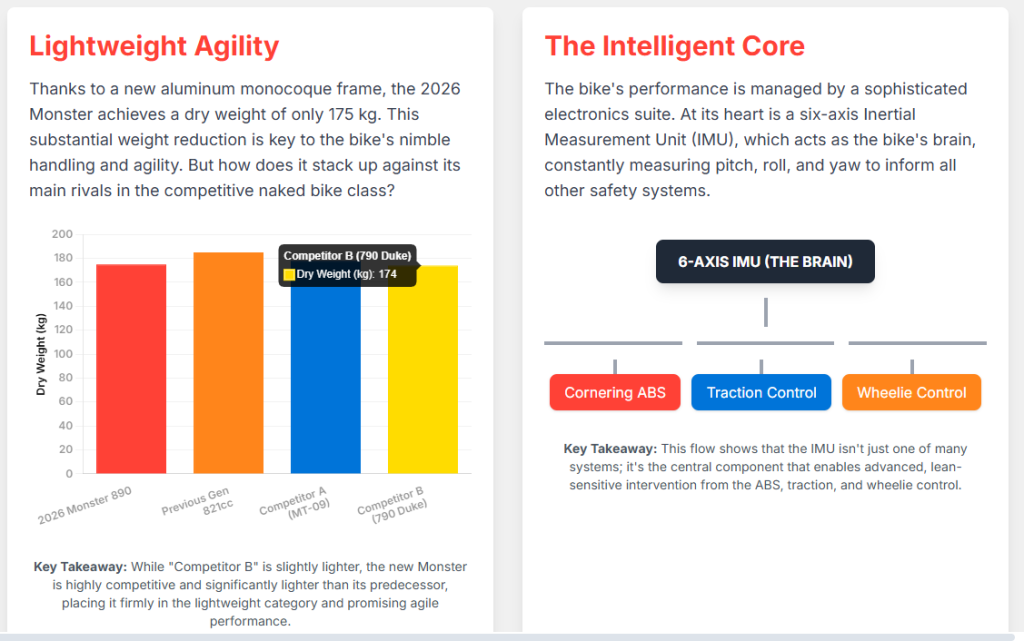
The cornerstone of the 2026 Monster’s engineering is its relentless pursuit of lightness. The claimed wet weight (without fuel) is 175 kg (386 lbs).3 This figure represents a meaningful reduction of 4 kg (8.8 lbs) compared to its predecessor.1 This low mass is achieved through holistic design choices across the motorcycle.
A critical aspect of Ducati’s communication strategy is the precise definition of the weight metric: “wet weight with no fuel”.1 This provides a direct measure of the bike’s mechanical mass (including oil, coolant, battery, etc.) but must be accounted for when comparing against competitors who often quote total curb weight (fuel included). Even allowing for approximately 10–12 kg of fuel in the 14-liter tank, the total ready-to-ride weight remains aggressively competitive, notably lighter than rivals such as the Triumph Street Triple 765 RS (188 kg wet) or the Yamaha MT-09 SP (194 kg wet).4
The monocoque structure utilizes the V2 engine, which itself is remarkably light at just 54.4 kg 6, as a primary stressed load-bearing component.1 The rest of the chassis is optimized using a double-sided swingarm inspired by the Panigale V4’s hollow design and a unique rear subframe.1 This subframe is a hybrid construction, combining a technopolymer element with a trellis, likely utilizing advanced materials to further reduce mass and optimize the load path for the tail section and rider seat.1 The combination of these measures ensures the motorcycle is exceptionally agile and easy to handle in all conditions.1
Table 1 provides a detailed view of the motorcycle’s core metrics.
Table 1: 2026 Ducati Monster 890 Key Technical Specifications
| Feature | Metric (EU) | Metric (US) | Significance |
| Engine Type | 90° V2 Testastretta 11°, IVT | 90° V2 Testastretta 11°, IVT | Advanced V2 platform 7 |
| Displacement | 890 cc | 890 cc | New displacement platform 1 |
| Max Power | 111 CV @ 9,000 RPM (81.6 kW) | 110.7 hp @ 9,000 RPM (81.4 kW) | Street-focused peak performance 3 |
| Max Torque | 93 Nm (9.5 kgm) @ 6,500 RPM | 67 ft-lb @ 7,250 RPM | Accessible, usable mid-range torque 1 |
| Bore x Stroke | 96.0 mm x 61.5 mm | 96.0 mm x 61.5 mm | Highly oversquare (1.56:1) 7 |
| Compression Ratio | 13.1:1 (or 13.3:1) | 13.1:1 (or 13.3:1) | Requires premium fuel 7 |
| Wet Weight (No Fuel) | 175 kg | 386 lbs | Class-leading lightness 1 |
| Valve Check Interval | 28,000 miles | 28,000 miles | Benchmark for low ownership cost 1 |
II. Powertrain Analysis: The 890cc V2 Testastretta with IVT
2.1. Technical Deep Dive: Engine Geometry and Performance Metrics
The new liquid-cooled V2 Testastretta 11° engine displaces 890 cc, featuring a highly oversquare bore and stroke ratio of 96.0 mm by 61.5 mm.7 This ratio of approximately 1.56:1 is inherently biased towards generating power at higher rotational speeds, culminating in a peak output of 111 hp (81.6 kW) delivered at 9,000 RPM.3
However, the defining characteristic for street usability is the torque curve. The engine produces a maximum torque of 93 Nm (67 ft-lb) peaking in the relatively low range of 6,500 to 7,250 RPM.1 This strategy prioritizes maximizing usable midrange grunt, a key attribute for daily commuting and rapid acceleration between corners, rather than chasing absolute peak horsepower. The compression ratio is high, listed at 13.1:1 or 13.3:1, necessitating premium fuel for optimal performance.7
2.2. The Nuance of Intake Variable Timing (IVT): Engineering Mechanism and Tractability
The hallmark technological feature of the new 890cc V2 is the incorporation of the Intake Variable Timing (IVT) distribution system.1 This system represents a major engineering step in overcoming the traditional compromises inherent to large-displacement, fixed-timing V-twin engines. In a conventional V-twin, the valvetrain timing is fixed, forcing designers to choose between optimal low-end torque (achieved through early intake valve closing) or high-end power (achieved through late closing).
The IVT system eliminates this compromise by dynamically adjusting the timing of the intake valve operation relative to the crankshaft position across the engine’s entire operating range.3 At low RPMs, the IVT can optimize valve timing to boost volumetric efficiency and smooth combustion, directly addressing the traditional V-twin issue of choppiness or poor fueling during low-speed maneuvering. As RPMs rise, the timing is adjusted to maximize cylinder filling and high-rev power.
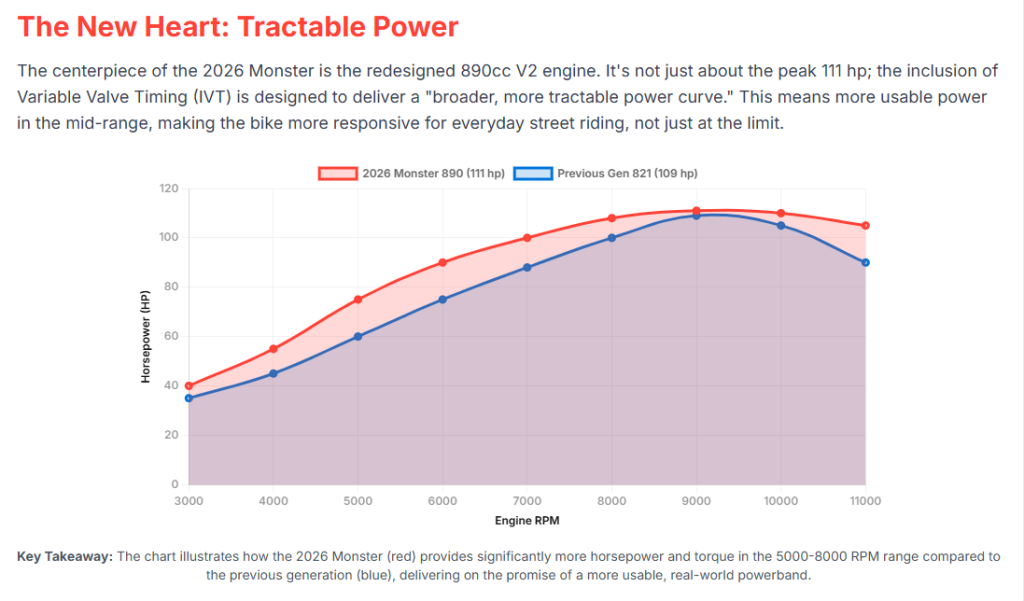
This flexibility allows the Monster engine to effectively deliver “smoothness at low revs, vigour at medium revs and power at high revs”.3 Ducati confirms the effectiveness of this design by stating that the engine delivers more than 80% of its maximum torque between 4,000 and 10,000 rpm.1 This broad, accessible plateau of torque makes the Monster instantly responsive and forgiving, significantly improving the everyday riding experience by reducing the need for constant gear selection.
2.3. Thermal Management and Running Costs: The 28,000-Mile Benchmark
Beyond performance, the new V2 engine incorporates engineering advancements aimed squarely at minimizing the long-term cost of ownership (TCO). A previously significant barrier to mass-market adoption of Ducati’s high-performance engines was the relatively short maintenance interval required for Desmodromic valve clearance checks.
The 2026 Monster shatters this expectation with a monumental 28,000-mile maintenance interval for valve clearance checks.1 This figure is competitive with, and often exceeds, the service intervals of many non-Desmo competitors in the market. Achieving such a lengthy interval suggests substantial internal breakthroughs in component durability, material selection, and thermal stability within the valvetrain. By guaranteeing this extended interval, Ducati strategically removes a major financial risk and perception barrier for prospective owners, making the premium ownership experience more accessible. The engine also features a compact and lightweight 8-plate slipper clutch system, which reduces friction and enhances the precision and smoothness of gear shifts.8
III. Structural Engineering, Suspension, and Braking Systems
3.1. Monocoque Chassis Execution: The Performance-to-Usability Balance
The aluminum monocoque frame is fundamentally built around the V2 engine, which serves as a load-bearing element.1 This integration provides an ideal combination of lightness and structural rigidity. The overall technical layout, including the frame and engine integration, delivers an estimated weight savings of 8.8 lbs compared to the previous model.1
The chassis architecture is completed by a new double-sided swingarm whose design is structurally inspired by the lightweight Ducati Hollow Swingarm used on the Panigale V4.1 Although the Monster utilizes a double-sided configuration, the inspiration suggests meticulous design focused on optimizing stiffness and reducing unsprung mass for high-performance handling characteristics. The agility resulting from this chassis design ensures the bike is manageable in all situations.1
3.2. Suspension and Wheel Setup
The suspension components chosen for the base Monster and Monster+ strike a calculated balance between sport performance and comfort for daily riding. The motorcycle is equipped with a Showa 43 mm upside-down fork at the front and a Showa monoshock at the rear, with the monoshock offering preload adjustability.1
Crucially, both components have been specifically calibrated by Ducati engineers to optimize comfort during everyday use while still providing the necessary sportiness for aggressive riding on mixed roads.1 This calibration choice confirms the motorcycle’s “dual soul” mandate—stable and confidence-inspiring when cruising, yet agile and enjoyable when pushed hard.1 The bike rolls on high-performance Pirelli Diablo Rosso IV tires, with a 120/70 front and 180/55 rear setup, affirming Ducati’s commitment to high-grip street performance.1
3.3. Braking System Mastery
To manage the performance potential and exploit the bike’s low mass, the Monster features a premium braking system. The front end is equipped with dual 320 mm discs paired with Brembo M4.32 radial calipers.1 A key detail for rider feel and control is the inclusion of a radial PR18/21 master cylinder.3
The combination of M4.32 calipers and large 320 mm discs is extremely powerful relative to the motorcycle’s scant 175 kg mass (wet, no fuel). This setup, coupled with the sophisticated electronic management systems, ensures controlled, confident deceleration. The system provides maximum stopping power while maintaining the stability essential for premium sportbike standards, which is further bolstered by the standard Cornering ABS functionality.
IV. Electronic Command and Control: The 6D IMU Ecosystem
The 2026 Monster features a latest-generation electronics package centered around a six-axis Inertial Measurement Unit (6D IMU).1 This comprehensive electronic safety and performance suite is a key differentiator, providing technology typically reserved for top-tier superbikes, thereby justifying the Monster’s position in the premium naked segment.
4.1. Core Functionality: The 6-Axis IMU (6D IMU)
The 6D IMU continuously measures the motorcycle’s dynamic attitude—its lean angle, pitch, and yaw—and transmits this data instantly to the control unit.1 This continuous feedback loop is vital for enabling dynamic rider aids, particularly Cornering ABS. Cornering ABS utilizes IMU data to adjust braking pressure and intervention based on the motorcycle’s lean angle, thereby increasing safety and stability when braking mid-corner.10 This level of control provides the rider with unmatched confidence, allowing them to brake harder and later, even while fully leaned over.11
The IMU is also the brain behind the management of other critical dynamic systems: Ducati Traction Control (DTC), Ducati Wheelie Control (DWC), Engine Brake Control (EBC), and the Ducati Quick Shift (DQS) 2.0 system for clutchless up and down shifting.3
4.2. Riding Modes Configuration Breakdown (Sport, Road, Urban, Wet)
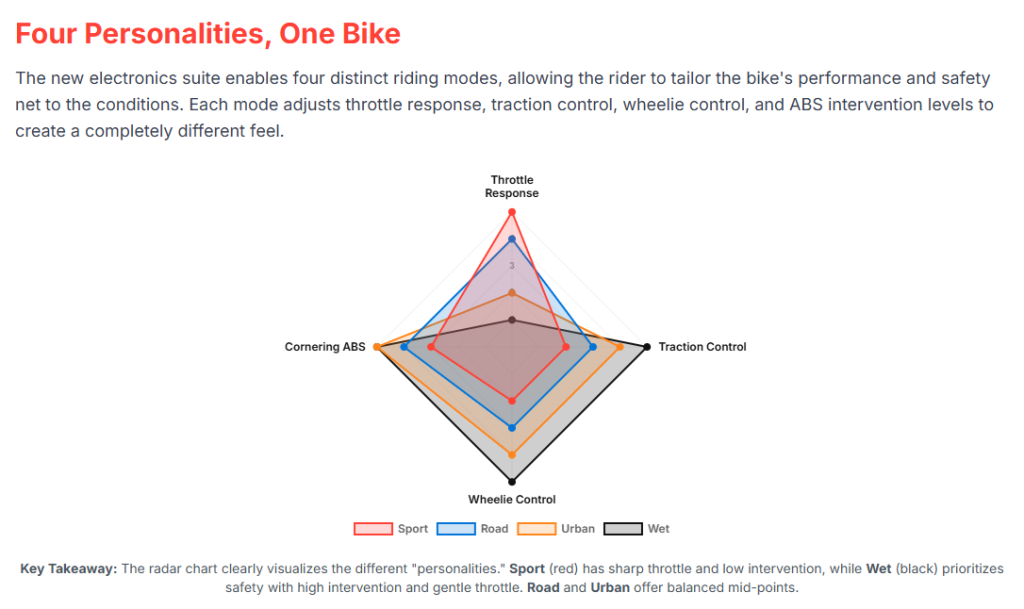
The Monster’s electronics are managed through four distinct pre-configured Riding Modes: Sport, Road, Urban, and Wet.3 Each mode simultaneously adjusts multiple parameters, including Power Mode, throttle response, Cornering ABS sensitivity, DTC level, DWC level, and EBC setting. This allows the rider to instantly adapt the bike’s personality to different conditions or riding styles.12
The intended objective of these modes ensures versatility and safety. The Sport mode delivers full power (111 hp) with a direct, spirited throttle response and minimal electronic intervention, designed for maximum performance.3 Road mode maintains full power but uses a smoother throttle map and intermediate safety intervention levels for balanced daily use. Urban and Wet modes restrict power output (likely to a maximum of 95 hp, similar to other Ducati models in these settings 12) and maximize electronic control intervention, guaranteeing maximum stability in challenging low-grip situations or dense city traffic.3 This comprehensive safety net ensures that riders of varying experience levels, including those using the A2-licensed version, can safely manage the bike’s potential and ultra-lightweight chassis.
Table 2 provides an estimated mapping of how key electronic parameters are adjusted across the four modes, based on standard Ducati practices.
Table 2: Estimated Electronic Parameter Mapping by Riding Mode (2026 Monster)
| Riding Mode | Power Output | Throttle Response | DTC/DWC Intervention | Cornering ABS Setting | Intended Use |
| Sport | Full (111 hp) | Direct, Spirited | Low (Performance focus) | Reduced (Max braking force) | Maximum performance, track-oriented 12 |
| Road | Full (111 hp) | Smooth, Progressive | Medium (Balanced safety) | Full Safety Intervention | Daily commuting, all-around use 12 |
| Urban | Reduced (Est. 95 hp) | Very Smooth | High (Max Stability) | Full Safety Intervention | City filtering, traffic, low speed 12 |
| Wet | Reduced (Est. 95 hp) | Extremely Smooth | Maximum (Priority Safety) | Full Safety Intervention | Wet roads, adverse conditions 12 |
4.3. Rider Interface and Connectivity
The rider interface is managed through a new, full-TFT 5” dashboard featuring a 16:9 aspect ratio and 800×400 resolution.3 This screen provides clear, vibrant visualization of the electronic settings and riding mode status. Navigation through the complex menu structure is simplified by the introduction of a new “petal-shaped joystick” control.3 Furthermore, the Monster comes ready for the Ducati Multimedia System (DMS), turn-by-turn navigation, and Cruise Control, fulfilling the expectation of modern connectivity and touring capabilities.3
V. Competitive Landscape Assessment: The Premium Middleweight Naked Segment
5.1. Performance Metrics Comparison: V2 vs. Triple vs. Parallel-Twin
The 2026 Ducati Monster is positioned directly against the highest-spec middleweight naked bikes, primarily defined by high technology and dynamic chassis performance, including the Triumph Street Triple 765 RS, the KTM 890 Duke GP, and the Yamaha MT-09 SP.
Table 3 provides a comparison of key metrics among these leaders.
Table 3: Competitive Naked Bike Specification Comparison
| Model | Engine | Displacement (cc) | Claimed Peak HP | Peak HP RPM | Wet Weight (Kg / Lbs) |
| Ducati Monster (2026) | V2 (IVT) | 890 | 111 hp | 9,000 | 175 (No fuel) / 386 3 |
| Triumph Street Triple 765 RS | Inline 3 | 765 | 128 hp | 12,000 | 188 / 414 4 |
| KTM 890 Duke GP | Parallel Twin | 889 | 121 hp | 9,250 | ~181 (169 dry) / 399 Est. 13 |
| Yamaha MT-09 SP | Inline 3 | 890 | 117 hp | 10,000 | 194 / 428 5 |
When assessing these figures, the Monster’s engineering priorities become clear. Although the Ducati has the lowest peak horsepower of the group (trailing the Triumph 765 RS by 17 hp), its exceptionally low wet weight of 175 kg (without fuel) is its primary competitive differentiator. This mass reduction provides a superior power-to-weight ratio in practice, particularly in street applications where the immediate torque delivery of the IVT engine is leveraged. This trade-off—sacrificing absolute top-end speed for superior agility and dynamic handling—is a deliberate strategic choice that makes the Monster feel more responsive and effortless in demanding environments than its heavier competitors.
5.2. Chassis Philosophy and Technology Investment
The Ducati monocoque structure, combined with the stressed V2 engine, provides a chassis that is inherently stiffer and lighter than the steel tubular trellis frame used by KTM 13 or the aluminum twin-spar frames of its Japanese competitors. This advanced architecture results in superior road feel, predictable feedback at maximum lean, and enhanced handling during high-speed transitions, continuing the performance legacy of the Panigale influence.
Furthermore, the standard fitment of the 6D IMU, which enables Cornering ABS and dynamic traction/wheelie control, gives the Monster a technological edge in safety and dynamic management that often requires expensive optional packages on rival machines.
5.3. Price-to-Performance Ratio: Justification of the Premium Price Point
The 2026 Ducati Monster, priced starting from approximately £11,995 (UK) and $13,995 (US) for the base model 3, is positioned firmly at the premium end of the middleweight naked segment. The pricing strategy reflects the advanced engineering and technology integrated into the motorcycle.
Ducati justifies this premium not by delivering class-leading peak horsepower, but by achieving unparalleled mass reduction (lowest weight in the class), integrating advanced technology (6D IMU, Cornering ABS, DQS 2.0 standard), and critically, by offering a significantly reduced Total Cost of Ownership (TCO). The 28,000-mile valve clearance interval is a game-changing feature that dramatically reduces the financial burden of maintenance over the life of the motorcycle.1 This value proposition targets a sophisticated buyer who prioritizes high-end componentry, dynamic performance engineering, brand prestige, and long-term ownership predictability over raw peak power numbers.
VI. Market Projection and Final Conclusion
6.1. Target Demographic and Sales Forecast
The 2026 Monster is strategically targeted to appeal both to existing Ducati enthusiasts seeking a lighter, more technologically rich street machine than the Streetfighter V2, and to riders transitioning from other brands who value superior chassis dynamics and accessibility. The engine’s tractability, courtesy of the IVT system, ensures the V2 character is potent yet friendly for everyday use. A key element of Ducati’s market penetration is the availability of the 35 kW A2-licensed version, which is crucial for cultivating brand loyalty among younger riders in European markets.3
6.2. Anticipated Success of Variants
The launch strategy includes the standard Monster, the Monster+ (offering minor aesthetic additions like a cowl and seat cover) 3, and the highly anticipated Monster SP. The Monster+ is likely intended as the volume seller, providing practical value for a marginal increase in price. The Monster SP, priced at £14,295 3, will secure the high-margin, performance-oriented demographic by incorporating superior components, likely higher-spec suspension and lighter components, further capitalizing on the inherent agility of the monocoque chassis.
6.3. Long-Term Impact on the Middleweight Naked Segment
The 2026 Monster represents a complete execution of Ducati’s modern naked sport bike philosophy: “Everything you need, nothing more.” By leveraging Panigale-derived technology—the lightweight monocoque, the advanced IVT system, and the 6D IMU electronics—Ducati successfully addresses the traditional drawbacks of the high-performance V-twin configuration.
The ultimate conclusion is that the 2026 Monster is not defined by its peak horsepower but by its overall dynamic capability. It has established itself as the new dynamic benchmark in the premium middleweight category, achieving class-leading agility through engineering excellence. The strategic reduction in Total Cost of Ownership via the 28,000-mile service interval eliminates a historical market weakness, positioning the Monster as a technologically advanced, highly usable, and financially sustainable choice for the premium naked segment. Its success is predicated on riders valuing this blend of high-end engineering, accessible performance, and dynamic handling above the absolute horsepower figures of its competition.
Sources
- Ducati Monster 2026: everything you need, nothing more, with an …, accessed October 24, 2025, https://www.ducati.com/us/en/news/ducati-monster-2026-everything-you-need-nothing-more-with-an-unmistakable-design
- Ducati’s 2026 Red Riot! – Australian Motorcycle News, accessed October 24, 2025, https://amcn.com.au/editorial/ducatis-2026-red-riot/
- Ducati Monster 2026: everything you need, nothing more, with an …, accessed October 24, 2025, https://www.ducati.com/gb/en/news/ducati-monster-2026-everything-you-need-nothing-more-with-an-unmistakable-design
- Street Triple 765 RS Model | For the Ride – Triumph Motorcycles, accessed October 24, 2025, https://www.triumphmotorcycles.com/motorcycles/roadsters/street-triple-765/street-triple-765-rs-2023
- 2025 MT-09 SP – Specifications | Yamaha Motorsports, USA, accessed October 24, 2025, https://yamahamotorsports.com/models/mt-09-sp/specs
- New V2 Engine: Ducati’s lightest twin-cylinder engine, accessed October 24, 2025, https://www.ducati.com/ww/en/company/innovation/engines/v2-engine
- 2026 Ducati Monster First Look | Motorcycle.com, accessed October 24, 2025, https://www.motorcycle.com/bikes/new-model-preview/2026-ducati-monster-first-look-44652682
- New 2026 Ducati Monster + Motorcycles in Columbus, OH – Motohio European Motorbikes, accessed October 24, 2025, https://www.motohio.com/Motorcycles-Ducati-Monster-2026-Columbus-OH-316b950d-a6b9-4f19-b86c-b3450030ae4f
- New 2026 Ducati Monster + Ducati Red | Motorcycles near Milwaukee | – Moto Union, accessed October 24, 2025, https://www.motounion.net/Motorcycles-Ducati-Monster-2026-West-Allis-WI-f00d1da3-5977-4e71-8ba8-b3450030ae4f
- Insights Ducati Monster, accessed October 24, 2025, https://www.ducati.com/ww/en/bikes/monster/monster-937/insights
- The brakes of the future: Bosch Cornering ABS – Ducati, accessed October 24, 2025, https://www.ducati.com/us/en/editorial/cornering-abs
- Electronics Ducati DesertX: configure your adventure, accessed October 24, 2025, https://www.ducati.com/ww/en/bikes/desertx/desertx-937/electronics
- KTM Duke 890 GP 2023 – Motorcycle specifications, reviews, photos – MotoPlanete, accessed October 24, 2025, https://www.motoplanete.us/ktm/9644/Duke-890-GP-2023/contact.html
- KTM 890 DUKE GP (2023-Present) Specs, Performance & Photos – autoevolution, accessed October 24, 2025, https://www.autoevolution.com/moto/ktm-890-duke-gp-2023.html
Our Social Media Handles
- Instagram : LivingWithGravity
- Medium : Akash Dolas
- YouTube Channel : Gear and Shutter
- Facebook : LivingWithGravity