










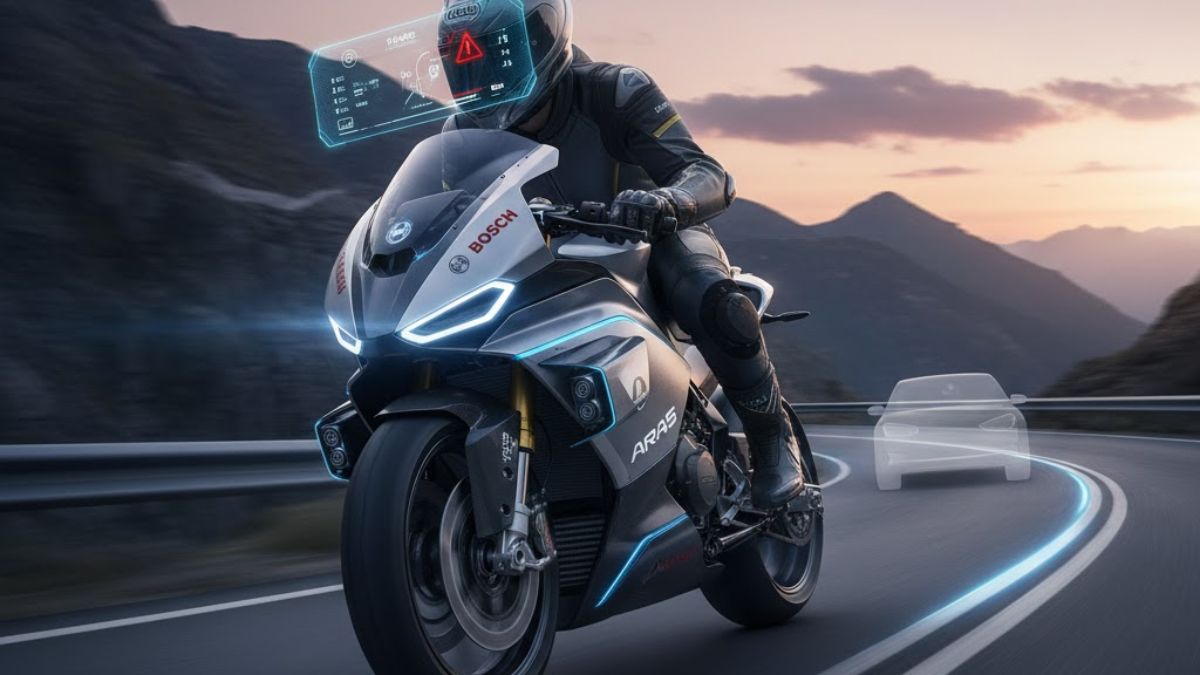
Strategic Analysis of Next-Generation Motorcycle Safety and Connectivity Systems
I. The Evolution of Radar-Based Advanced Rider Assistance Systems (ARAS) by Bosch
A. Foundational Technology and the Motorcycle Safety Imperative
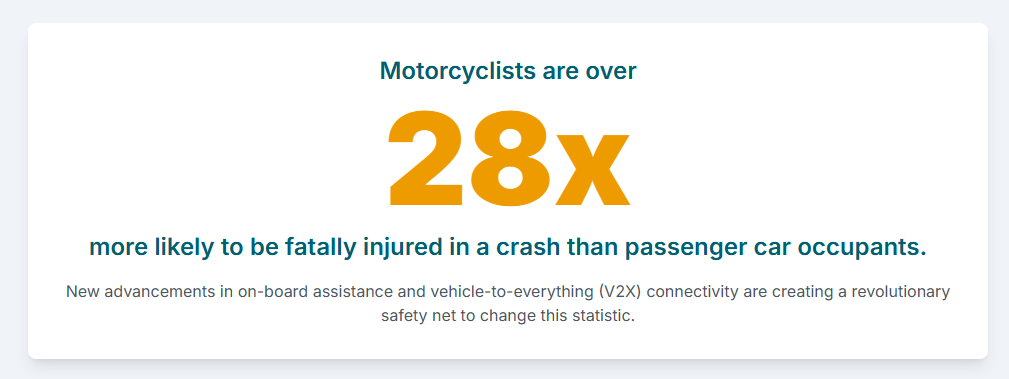
Motorcyclists represent a highly vulnerable class of road users, making the implementation of proactive safety technology critical to reducing collision rates and severity.1 Robert Bosch GmbH, a world leader in motorcycle safety technology 2, estimates that the widespread adoption of radar-based Advanced Rider Assistance Systems (ARAS) could potentially prevent one in six motorcycle accidents.2
The latest generation of ARAS relies on Bosch’s compact 5th-generation radar sensor platform. This hardware, which operates in the 76 to 77 GHz and 77 to 81 GHz frequency ranges, is engineered for enhanced performance characteristics specific to dynamic vehicle applications.3 Key specifications include physical dimensions of $56 \text{ mm} \times 76 \text{ mm} \times 20 \text{ mm}$, a maximum detection range extending up to 530 meters, and improved truck detection.3 Furthermore, the system is capable of operating at higher maximum speeds, reaching $160 \text{ km/h}$ or more.4
For ARAS functions to operate effectively on a motorcycle, they require deep integration into the vehicle’s dynamic control infrastructure. The system architecture combines the radar sensor outputs with the braking system, engine management, and the Human Machine Interface (HMI).2 Central to this integration is the Motorcycle Stability Control (MSC) system, which uses an Inertial Measurement Unit (IMU) to continuously measure the vehicle’s dynamic state, including acceleration and angular rate, up to 100 times per second.6
This constant, high-frequency monitoring of vehicle dynamics is essential for sophisticated brake control that can adapt interventions based on the bike’s current lean and pitch angles, ensuring that automated acceleration or deceleration remains stable and safe, even when cornering.6 This reliance on highly nuanced dynamic state detection ensures that automated braking interventions do not destabilize the two-wheeled vehicle, positioning the ARAS as an extension of the core stability control rather than a simple sensor application.
B. Core Radar Functions: Technical Deep Dive and Operational Mechanics
Bosch has debuted a suite of new radar-based functions designed to address specific challenges faced by riders in modern traffic environments.
1. Adaptive Cruise Control – Stop and Go (ACC S&G)
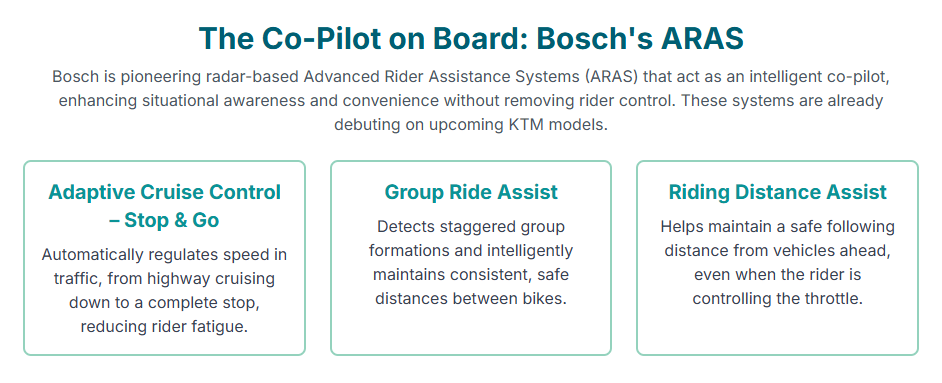
ACC S&G represents the advanced evolution of standard Adaptive Cruise Control. Utilizing the front-facing radar, the system automatically adjusts the motorcycle’s speed to maintain a pre-set following distance from the vehicle ahead. The critical addition is the “Stop & Go” capability, which allows the system to decelerate the motorcycle to a complete, controlled standstill in heavy traffic and automatically resume motion.4 This minimizes the need for manual adjustments, particularly reducing rider fatigue during long highway stretches or in congested urban traffic.4
The system offers a high degree of rider configuration, including five adjustable distance settings (Very Short, Short, Middle, Long, and Very Long) and three distinct operational modes: Sport (for quick response), Comfort (for smooth adjustments), and Group Ride.4 The realization of the full comfort benefit—the seamless stop and automatic pull-away—is technically dependent on the motorcycle having an integrated Automatic Manual Transmission (AMT) capability to manage the clutch engagement at zero speed.4
2. Group Ride Assist (GRA): Algorithmic Mitigation of Staggered Formation
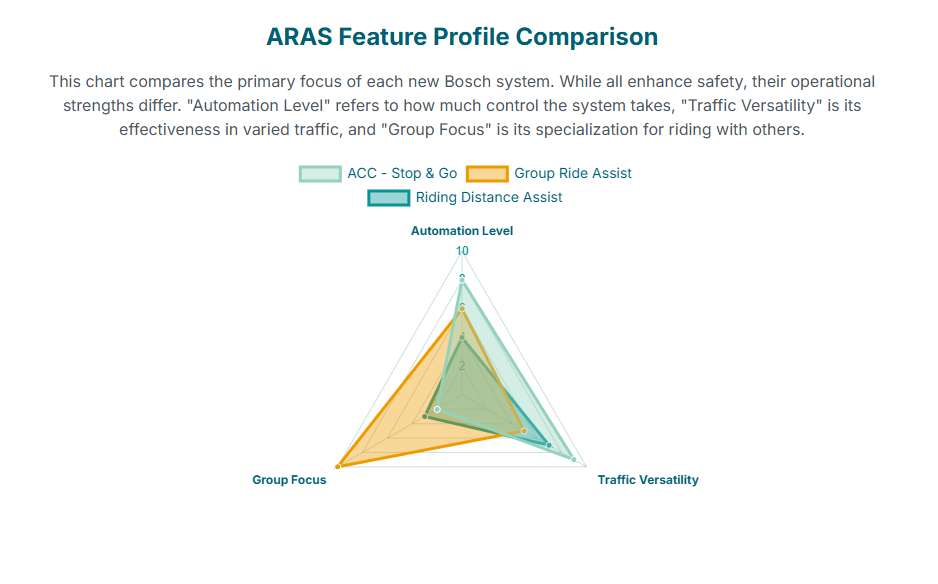
Group Ride Assist (GRA) is a highly specialized function tailored for the common practice of staggered riding formations.2 Conventional ACC systems often struggle in this scenario because they expect the vehicle ahead to be centered in the lane. When faced with staggered riders, the system frequently switches tracking targets, resulting in erratic and disruptive speed adjustments.2
GRA resolves this through a specific algorithm that detects the staggered riding formation. This algorithm regulates speed to automatically maintain a consistent distance from the motorcycles immediately ahead.9 When the system is operating in Group Ride mode, object detection focuses on the nearest object, even if that object has a lateral offset.4 The logic dictates that the system keys on the closest rider for speed adjustments, preventing the motorcycle from accelerating or attempting to pass a staggered group member if the lead rider pulls far ahead.5 This sophisticated approach demonstrates an advanced level of lateral object tracking and intelligent filtering unique to the social and kinematic context of motorcycling, enabling a “natural group formation”.9 Rider feedback has confirmed that GRA is effective and precise, consistently holding distance without unintentional acceleration.11
3. Riding Distance Assist (RDA)
Riding Distance Assist (RDA) functions as a safety overlay that aids the rider in maintaining a safe following distance from vehicles ahead while the rider maintains direct control of the throttle.11 RDA monitors traffic ahead and intervenes non-aggressively, smoothly applying brakes or modulating fueling as necessary to keep the distance consistent.11 This function is particularly beneficial in situations where traffic ahead constantly varies speed on twisting roads, helping to mitigate the possibility of slow reactions caused by fatigue.11
Table 1: Bosch Next-Generation ARAS Feature Matrix and Technical Context
| Feature | Primary Function | Unique Motorcycle Benefit/Innovation | System Integration Requirement |
| Adaptive Cruise Control – Stop and Go (ACC S&G) | Automated speed/distance regulation down to 0 km/h, and automatic resumption (Stop & Go) | Eliminates clutch intervention in heavy traffic, drastically reducing rider fatigue. | Front Radar (5th Gen), Brake System, Engine Management, KTM AMT/Automatic Clutch Control 4 |
| Group Ride Assist (GRA) | Maintains consistent spacing between riders in a group formation. | Algorithmic detection of lateral offset inherent in staggered riding, ensuring distance consistency to the nearest group member, preventing unintended passing. | Front Radar, Specialized Staggered Formation Algorithm, ACC S&G Activation 2 |
| Riding Distance Assist (RDA) | Provides distance warnings/smooth intervention while rider maintains throttle control. | Acts as a constant safety buffer against inconsistent traffic speeds and potential rider fatigue without fully taking control. | Front Radar, HMI Display 11 |
C. OEM Integration: The KTM Strategy and AMT Synergy
KTM is serving as a key launch partner for these next-generation Bosch ARAS systems, primarily integrating the technology into its high-end Adventure and Sports Tourer segments.8 For instance, the 2025 KTM 1390 Super Adventure S lists “Front Radar” as optional technology, indicating the platform readiness for these features.13
The full realization of ACC S&G functionality hinges on concurrent advancement in transmission technology. KTM’s introduction of the Automated Manual Transmission (AMT) is a technical prerequisite for the seamless Stop & Go feature.14 AMT provides automated clutch control and rapid, seamless shifting via an electromechanical shift actuator, offering the rider a choice between a clutchless manual mode or a fully automated mode.12 When ACC S&G brakes the bike to a controlled stop, the automated clutch control provided by AMT ensures the engine does not stall and allows for automatic pull-away upon throttle input or system command.4 This suggests that AMT is a necessary enabling technology; without automatic clutch management, the rider would still be burdened by clutch operation at every stop, fundamentally negating the comfort objective of ACC S&G in heavy traffic. Full adoption of the most advanced comfort features of ARAS will thus likely track the integration of automated transmission systems across the industry.
Bosch maintains its leading position in providing these foundational technologies.2 However, the market for ARAS features is competitive, with major players like Continental AG, ZF Friedrichshafen AG, and motorcycle OEMs such as BMW Group, which offers its own Automated Shift Assistant (ASA), working to adapt similar safety and convenience systems.15
Table 3: KTM Next-Gen ARAS Deployment and Integration Context
| KTM Model/Series | Anticipated Debut Year | Core ARAS Functionality | Enabling Technology / Notes |
| 1390 Super Adventure S | 2025 | Front Radar (Optional), ACC, Collision Warning | High-displacement Adventure segment focus. Optional Front Radar confirms system availability.13 |
| 1390 Super Adventure S EVO | 2025 | ACC S&G, GRA, RDA (Expected) | Confirmed platform for AMT (Automated Manual Transmission), which is essential for full ACC S&G Stop & Go functionality.14 |
| Other Top-Shelf Tourers/ADVs | 2026+ | Full Bosch ARAS Suite | Expected rapid adoption driven by regulatory pressure and consumer demand for long-distance comfort and safety.11 |
II. Connected Safety Systems: The La Trobe C-ITS Pilot and HMI Innovation
While radar-based ARAS excels at immediate, line-of-sight collision mitigation, Cooperative Intelligent Transport Systems (C-ITS) provide a crucial layer of foresight by leveraging network connectivity.
A. Cooperative Intelligent Transport Systems (C-ITS) Fundamentals
C-ITS operates within the Vehicle-to-Everything (V2X) communication architecture, encompassing Vehicle-to-Vehicle (V2V), Vehicle-to-Infrastructure (V2I), and Vehicle-to-Vulnerable Road User (V2VRU) communication.18 This ecosystem allows vehicles and road systems to share real-time safety messages, providing riders with alerts about hazards that are difficult or impossible to detect with the human eye or even line-of-sight radar systems.20
The key value proposition of C-ITS is addressing non-line-of-sight hazards. The technology delivers proactive warnings regarding conditions like slippery surfaces, traffic congestion, and potential collision risks at blind intersections.20 Radar systems, constrained by their physical field of view (e.g., approximately $\pm 60^{\circ}$ horizontally for common front radars 21), are limited to mitigating what is immediately ahead. C-ITS overcomes this limitation by utilizing network data to provide wide-area situational awareness, informing the rider of hazards around corners, over hills, or miles ahead, thereby serving as a critical complement to sensor-based ARAS.19 This ability to “see” beyond obstacles fundamentally accelerates reaction time, a vital capability for two-wheelers.18
B. Project Execution, HMI, and Rider Acceptance
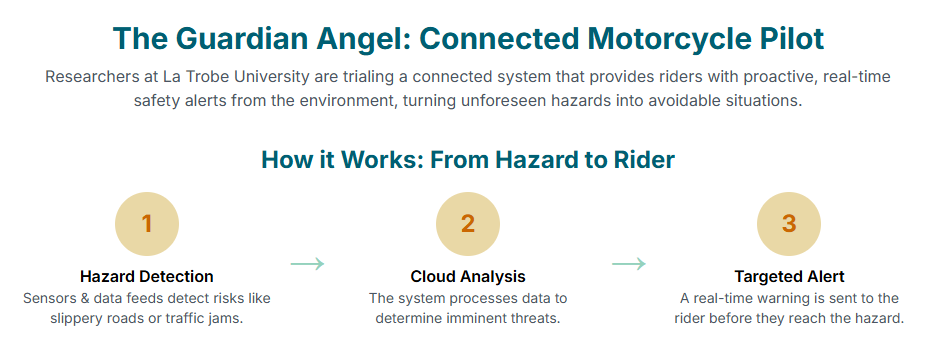
La Trobe University researchers spearheaded the “Connected motorcycle pilot,” an industry-leading effort to test C-ITS prototypes at scale with riders.22 The project, funded by Australian transport agencies, involved live trials with nearly 100 riders at the Toyota Autodrome track.20 The primary objective was to assess technical viability, rider acceptance, and the system’s measurable impact on behavior.22
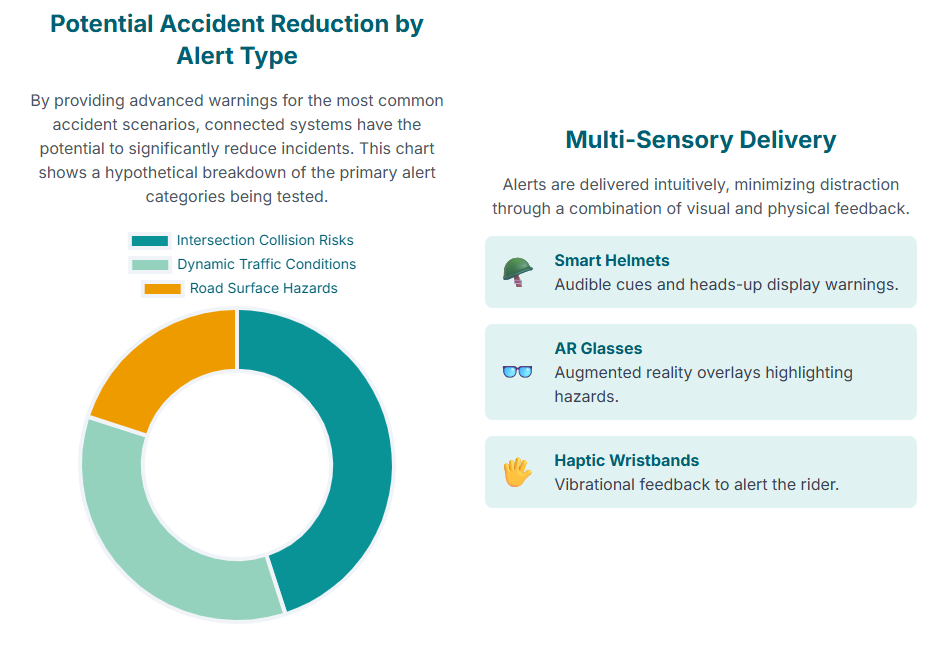
A core challenge in deploying C-ITS for motorcycles is designing a Human Machine Interface (HMI) that effectively delivers critical information without imposing excessive cognitive load. The research team tested multi-modal alert systems, including alerts delivered via smart helmets, augmented-reality (AR) glasses, haptic wristbands, and LED lights.20 AR head-up displays (HUDs) overlaid information like navigation and collision warnings directly onto the rider’s visual field.23 Haptic wristbands provided tactile (vibratory) warnings, using a non-visual, non-auditory channel.22
Feedback from the riders was explicit: alerts must be intuitive, timely, and, crucially, non-distracting.22 Riders articulated their requirement as: “Just tell me where the danger is—then I’ll deal with it.”.22 The movement toward multi-modal sensory outputs (haptic/AR) is validated by this constraint. Because a rider’s visual and auditory channels are saturated by the immediate task of dynamic vehicle control, warnings that utilize secondary senses, such as the haptic wristband, are superior for providing high-impact alerts quickly while conserving cognitive resources for the actual mitigation maneuver.
C. Quantitative Efficacy and Safety Impact
The La Trobe pilot produced crucial quantitative data demonstrating the significant safety benefits of C-ITS for motorcycles. The data confirms that connectivity provides measurable, life-saving seconds of reaction time.22
In tests assessing forward collision warnings at $50 \text{ km/h}$, the C-ITS system provided riders with an additional 8.5 meters to react.22 The most dramatic finding concerned non-anticipated hazards. In intersection use cases where the rider could not foresee the risk of a potential collision, the reaction distance doubled, increasing from $15 \text{ meters}$ without a warning to $30 \text{ meters}$ with C-ITS alerts.22
This doubling of reaction distance in blind intersection scenarios is the most powerful empirical proof of C-ITS’s inherent value. Intersection conflicts are a primary source of severe motorcycle accidents, and gaining $15 \text{ meters}$ of anticipatory warning time translates directly into substantially reduced impact speeds or successful crash avoidance.22 This data is essential for justifying future policy decisions and capital investment in the required V2X infrastructure.
Table 2: Quantified Safety Impact of La Trobe Connected Motorcycle Pilot (C-ITS)
| Scenario Type | Hazard Type | Metric Assessed | Result without C-ITS Warning | Result with C-ITS Warning | Safety Improvement Significance |
| Forward Collision Warning ($50 \text{ km/h}$) | Line-of-sight hazard | Additional Reaction Distance (meters) | N/A | Additional 8.5 meters of reaction distance | Enhanced proactive braking time, potentially reducing impact severity 22 |
| Intersection Collision Warning | Non-line-of-sight (Hidden) hazard | Rider Reaction Distance (meters) | 15 meters | 30 meters | 100% Increase (Doubling) of reaction distance, critical for avoiding cross-traffic conflicts 22 |
III. Strategic Analysis, Challenges, and Future Convergence
A. Safety Efficacy, Regulation, and the Automation Paradox
The integration of advanced electronic aids has demonstrably positive safety outcomes. Academic research evaluating combined ARAS functions, such as optimized Adaptive Cruise Control and Autonomous Emergency Braking (AEB), suggests these systems could prevent up to 53% of crashes in simulated real-world conditions, alongside impact speed reductions ranging from 4 to $25 \text{ km/h}$.24
This proven potential is driving regulatory mandates, particularly in Europe. The European Union’s revised General Safety Regulation II (GSR II, Regulation (EU) 2019/2144) is accelerating the adoption of specific Advanced Driver Assistance Systems (ADAS).25 Although implementation timelines vary by vehicle category, the core features under consideration or future mandate for L-category vehicles (motorcycles) include AEB, Blind-Spot Detection (BSD), ACC, and Forward Collision Warning (FCW).26 The timeline requires new vehicle types to comply with certain standards by July 7, 2024 (Stage C), with all newly registered vehicles following by July 7, 2026.25
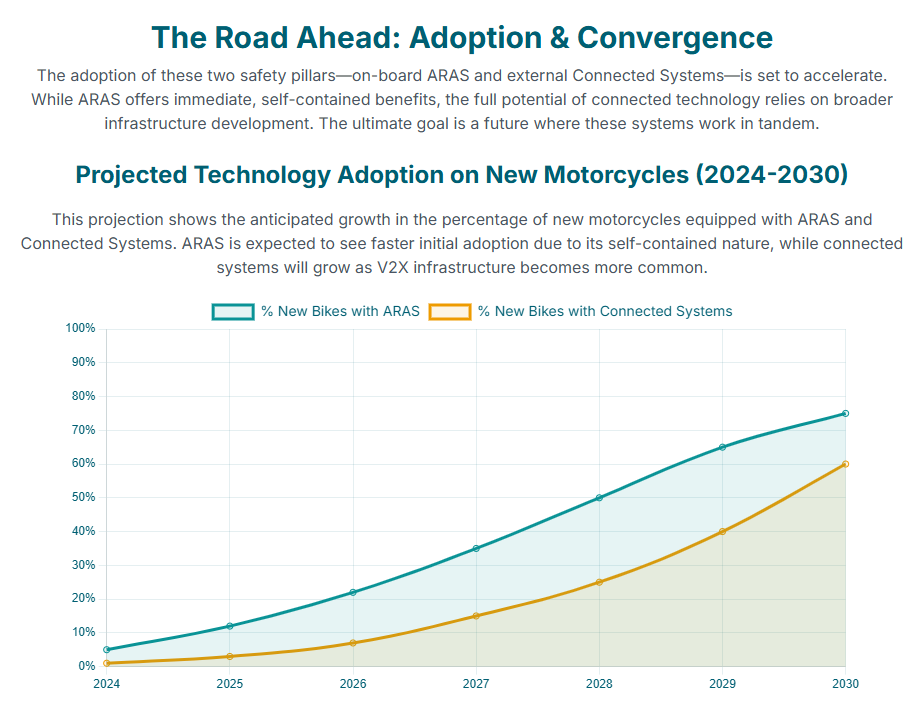
A divergence exists between the regulatory drivers and the maximal safety achieved by connectivity. Current regulatory momentum focuses heavily on vehicle-centric, sensor-based technologies like ARAS.26 Because manufacturers can unilaterally install and control ARAS hardware (e.g., Bosch radar), this technology is serving as the immediate pathway for compliance. C-ITS, however, despite demonstrating superior efficacy in non-line-of-sight scenarios (as quantified by the La Trobe pilot), requires complex infrastructure development and cross-OEM interoperability (evidenced by collaborations like the C-V2X project involving Ducati, Audi, and Qualcomm).18 Therefore, ARAS is the necessary immediate compliance solution, while C-ITS represents the longer-term, higher-impact safety goal.
The increasing effectiveness of automation, particularly features like ACC S&G which manages clutch control and movement down to zero speed, introduces the potential for the automation paradox.28 There is a risk that riders, finding low-speed traffic maneuvers handled automatically, may become complacent and reduce their necessary vigilance.29 The successful integration strategy must rely on HMI development that supports, rather than supplants, rider awareness, as demonstrated by the co-designed intuitive and non-distracting alert systems evaluated by La Trobe researchers.22
B. The Future State: Merging ARAS, C-ITS, and AI
The future of motorcycle safety involves the architectural convergence of ARAS, C-ITS, and Artificial Intelligence (AI). AI is already integral to existing ARAS algorithms, analyzing sensor data from IMU and radar to optimize intervention timings and predict potential failures.19
The ultimate integrated safety system will fuse localized, high-resolution kinematic and radar data from Bosch ARAS with the wide-area, proactive situational awareness provided by La Trobe-style C-ITS systems.19 Radar will continue to be responsible for high-precision, immediate control functions (ACC S&G, GRA, AEB), while connectivity delivers anticipatory warnings about macro-environmental hazards (traffic density, slippery surfaces, intersection conflict).19
A critical component of this convergence is the feedback loop generated by real-world behavioral testing. The rich, quantitative data collected during C-ITS trials—measuring precise reaction distances, braking input, and throttle modulation in response to timely warnings 22—provides invaluable empirical material. This data can be used to train future machine learning models within ARAS. By utilizing actual human reaction data in high-stress situations, AI-enhanced ARAS can evolve beyond reliance on predefined kinematic models toward more refined, adaptive, and human-centric intervention strategies, ensuring systems intervene effectively yet non-intrusively.
Conclusion
The evolution of motorcycle safety is currently driven by two complementary technological streams: Bosch’s advanced, radar-based ARAS and the connected, V2X-driven C-ITS research exemplified by the La Trobe pilot. The new Bosch features, particularly Adaptive Cruise Control – Stop and Go and Group Ride Assist, represent significant steps forward in mitigating rider fatigue and managing complex group dynamics, enabled commercially by necessary OEM integration of Automated Manual Transmission (AMT). Simultaneously, the C-ITS systems are yielding powerful empirical evidence—such as the proven doubling of reaction distance in blind intersection scenarios—demonstrating their unique ability to address non-line-of-sight risks. The future safety architecture of motorcycling will rely on the fusion of these technologies, where localized radar control is augmented by proactive connectivity, all refined by AI algorithms trained on real-world rider behavior data to ensure maximum safety without compromising the riding experience.
Sources
- Advanced Rider Assistance Systems Market Size, Share, Forecast, Report, 2032 – MarketsandMarkets, accessed on October 21, 2025, https://www.marketsandmarkets.com/Market-Reports/advanced-rider-assistance-systems-market-117908528.html
- Advanced rider assistance systems – Bosch Mobility, accessed on October 21, 2025, https://www.bosch-mobility.com/en/solutions/assistance-systems/advanced-rider-assistance-systems-2w/
- Front radar sensor – Bosch Mobility, accessed on October 21, 2025, https://www.bosch-mobility.com/en/solutions/sensors/front-radar-sensor/
- Adaptive Cruise Control | KTM United States, accessed on October 21, 2025, https://www.ktm.com/en-us/tech-guide/adaptive-cruise-control.html
- Bosch Advanced Rider Assistance System (ARAS) test: The future of riding aids – RevZilla, accessed on October 21, 2025, https://www.revzilla.com/common-tread/bosch-advanced-rider-assistance-system-aras-first-ride-review
- Motorcycle stability control (MSC) – Bosch Mobility, accessed on October 21, 2025, https://www.bosch-mobility.com/en/solutions/driving-safety/motorcycle-stability-control/
- New motorcycle safety systems tested | Bosch Global, accessed on October 21, 2025, https://www.bosch.com/stories/motorcycle-safety-systems/
- The Upcoming KTM Super Adventure Will Brake And Pull Away For You – ADV Pulse, accessed on October 21, 2025, https://www.advpulse.com/adv-news/the-upcoming-ktm-super-adventure-will-brake-and-pull-away-for-you/
- Bosch: New radar-based assistance system from Bosch to be used for the first time at KTM, accessed on October 21, 2025, https://silicon-saxony.de/en/bosch-new-radar-based-assistance-system-from-bosch-to-be-used-for-the-first-time-at-ktm/
- New Bosch radar-based assistance system used for first time by KTM, accessed on October 21, 2025, https://us.bosch-press.com/pressportal/us/en/press-release-25798.html
- Bosch Can Stop and Start Your Motorcycle Automatically – Cycle World, accessed on October 21, 2025, https://www.cycleworld.com/motorcycle-reviews/bosch-advanced-rider-assistance-systems-review/
- AMT | KTM United States, accessed on October 21, 2025, https://www.ktm.com/en-us/tech-guide/AMT.html
- 2025 KTM 1390 SUPER ADVENTURE S – SET YOUR COURSE – AND SLAY IT, accessed on October 21, 2025, https://www.ktm.com/en-int/models/adventure/2025-ktm-1390-superadventures.html
- KTM Launches Automated Manual Transmission for Ultimate Ride Control, accessed on October 21, 2025, https://www.ktmworld.com/blog/blog/2024/10/18/ktm-launches-automated-manual-transmission-for-ultimate-ride-control
- Motorcycle Advanced Rider Assistance System Companies – Mordor Intelligence, accessed on October 21, 2025, https://www.mordorintelligence.com/industry-reports/motorcycle-advanced-rider-assistance-system-market/companies
- The automated shift assistant (ASA) – BMW Motorcycles, accessed on October 21, 2025, https://www.bmwmotorcycles.com/en/engineering/automated-shift-assistant.html
- 2025 KTM 1390 SUPER ADVENTURE S EVO – MORE IS MORE, accessed on October 21, 2025, https://www.ktm.com/en-int/models/adventure/2025-ktm-1390-superadventuresevo.html
- V2X Auto Technology | The Future of Autonomous Connectivity – Qualcomm, accessed on October 21, 2025, https://www.qualcomm.com/products/automotive/v2x
- Exploring the Unknown: How AI is Revolutionizing Motorcycle Safety Systems in the Market, accessed on October 21, 2025, https://www.riderdome.com/post/exploring-the-unknown-how-ai-is-revolutionizing-motorcycle-safety-systems-in-the-market
- Groundbreaking motorcycle safety alert system – La Trobe University, accessed on October 21, 2025, https://www.latrobe.edu.au/news/articles/2025/release/groundbreaking-motorcycle-safety-alert-system2
- Radar systems for Off-highway applications – Bosch Mobility, accessed on October 21, 2025, https://www.bosch-mobility.com/en/solutions/assistance-systems/radar-systems-ohw/
- Blog Archives – Connected Motorcycle Consortium, accessed on October 21, 2025, https://www.cmc-info.net/news/archives/06-2025
- Enhancing Motorcycle Safety through Augmented Reality: Design and Development of a Smart Helmet Prototype – AHFE Open Access, accessed on October 21, 2025, https://openaccess.cms-conferences.org/publications/book/978-1-964867-35-9/article/978-1-964867-35-9_113
- Enhancing motorcycle safety: Quantifying the effects of Autonomous Emergency Braking and Adaptive Cruise Control in crashes reduction – PubMed, accessed on October 21, 2025, https://pubmed.ncbi.nlm.nih.gov/40068002/
- New vehicle safety systems – BMV, accessed on October 21, 2025, https://www.bmv.de/SharedDocs/EN/Articles/StV/Roadtraffic/new-vehicle-safety-systems.html
- The European Union’s Road Safety Vision: Debating Mandatory ADAS for Motorcycles and its Industry Impact, accessed on October 21, 2025, https://www.motorcyclesdata.com/2025/08/26/the-european-unions-road-safety-vision-debating-mandatory-adas-for-motorcycles-and-its-industry-impact/
- Ducati is working with industry leaders in developing direct communication interoperability between motorcycles, vehicles, and infrastructure, accessed on October 21, 2025, https://www.ducati.com/ww/en/news/ducati-is-working-with-industry-leaders-in-developing-direct-communication-interoperability-between-motorcycles-vehicles-and-infrastructure
- The Dangers of Complacency: Why Relaxing Too Soon on a Motorcycle Can Lead to Accidents – YouTube, accessed on October 21, 2025, https://www.youtube.com/watch?v=OXTg8P36mg0
- Motorcycle crashes: attitudes of the motorcyclists regarding riders’ experience and safety measures – PubMed, accessed on October 21, 2025, https://pubmed.ncbi.nlm.nih.gov/24894403/
- How the Rise of AI is Changing Motorcycle Safety – Factory Racing, accessed on October 21, 2025, https://factory.racing/blogs/factory-racing-shop-news/the-rise-of-ai-is-changing-motorcycle-safety
Our Social Media Handles
- Instagram : LivingWithGravity
- Medium : Akash Dolas
- YouTube Channel : Gear and Shutter
- Facebook : LivingWithGravity