









I. Executive Summary: The Strategic Imperative of Continuity
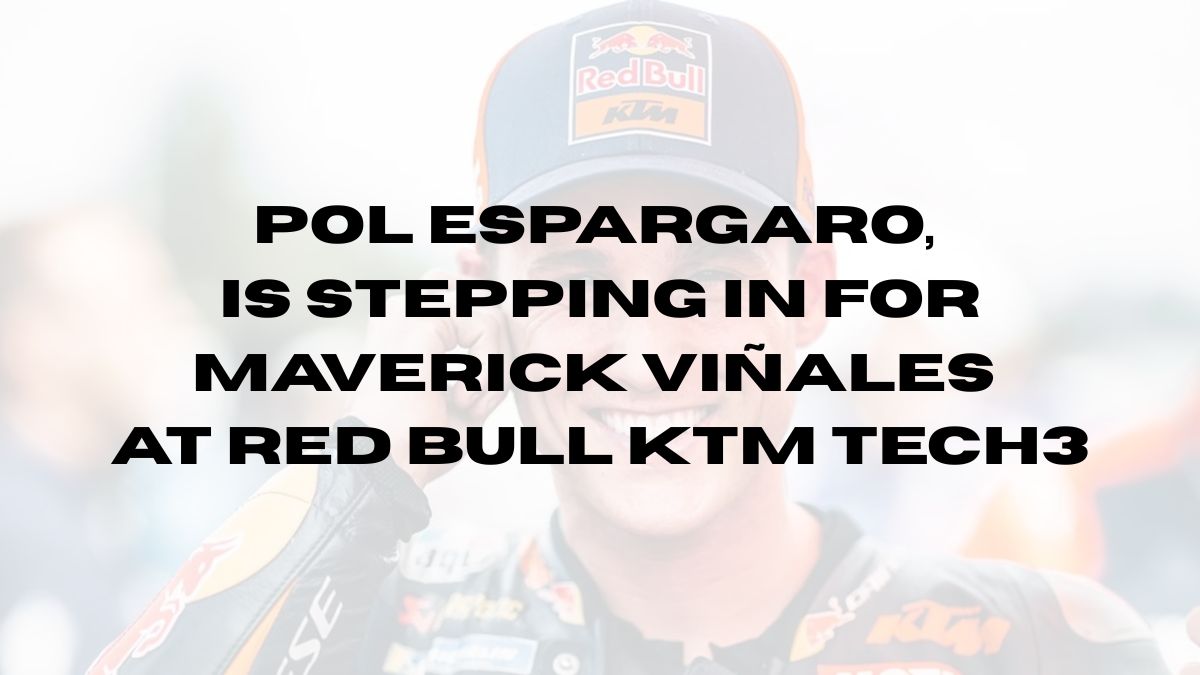
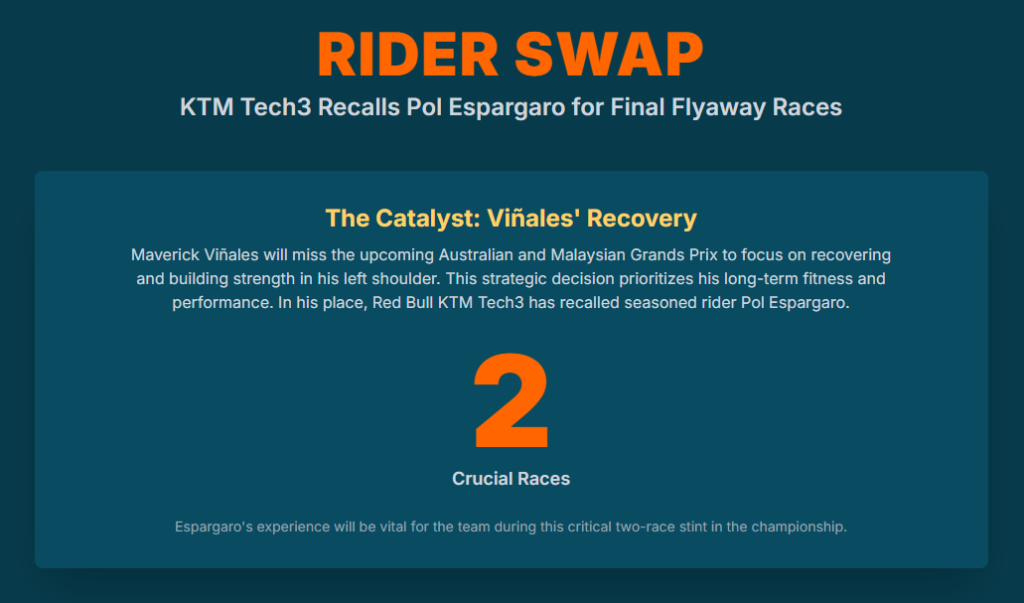
The decision by Red Bull KTM Tech3 to recall Red Bull KTM Test Rider Pol Espargaro to replace contracted rider Maverick Viñales for the nineteenth and twentieth rounds of the 2025 MotoGP World Championship—the Australian and Malaysian Grands Prix—is a calculated strategic maneuver.1 This substitution is driven by the urgent necessity for Viñales to step away from the KTM RC16 saddle to focus on recovery and build strength in his compromised left shoulder.1 Viñales and his team determined that continued race participation risked physical detriment and compromised the quality of technical feedback required for the program’s evolution.
Espargaro’s deployment serves a crucial dual mandate. Firstly, he is tasked with maintaining competitive continuity, leveraging his recent strong substitute performances (including Top 10 finishes in previous 2025 GPs) to mitigate the loss of championship points.1 Secondly, and more importantly, Espargaro operates as a high-fidelity “Development Racer”.1 His extensive knowledge of the RC16 is being strategically utilized to validate critical setup and component configurations across the contrasting demands of Phillip Island (high-speed flow and stability) and Sepang (engine power, braking, and thermal efficiency).3 This deployment represents the optimal organizational utilization of a competitive test rider asset during a critical phase of the RC16’s annual development cycle, ensuring that KTM’s development trajectory remains intact as the season concludes.
II. Contextual Foundation: Viñales’ Injury, Struggle, and Strategic Withdrawal
This substitution is not merely a precautionary measure but a necessary intervention following a sustained physical struggle that compromised Viñales’ performance and the integrity of the data he was generating.
A. The Origin of the Setback: Chronology and Severity
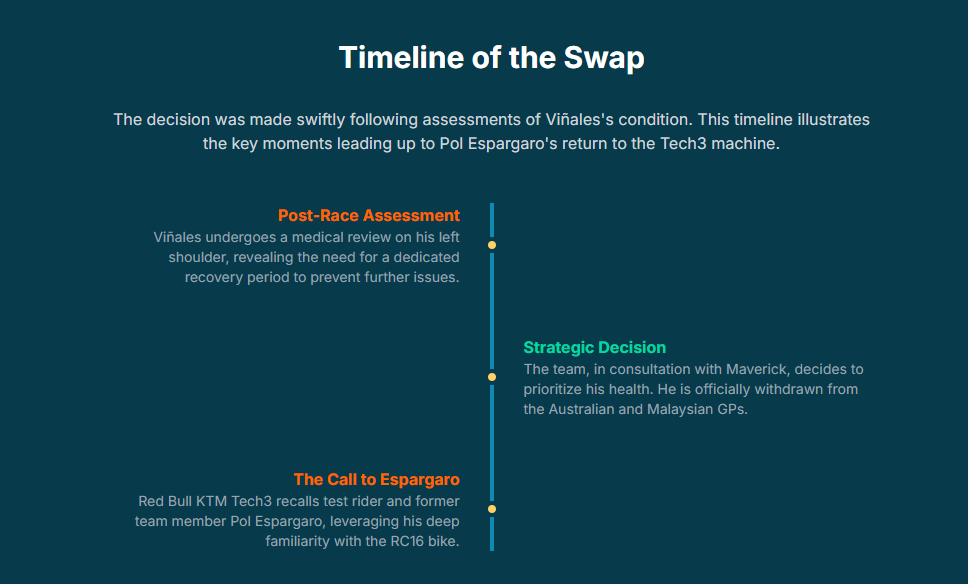
Maverick Viñales suffered the injury that derailed the second half of his 2025 season during the German Grand Prix at Sachsenring in July.4 The injury occurred in a wet Q2 session, involving a highside crash that resulted in a significant left shoulder injury, specifically a break.4 Following the incident, Viñales underwent successful left shoulder surgery in Italy.5 Team Manager Hervé Poncharal noted the severity, stating that a normal person would require six months to recover from such an injury, which involved both ligament healing and a small bone fracture.4 Due to the immediate incapacitation, Viñales was forced to miss the subsequent Czechia GP (Brno), where Pol Espargaro made his first race appearance of the 2025 season.5
B. The Athlete’s Dilemma: The Cost of Competing Injured
Despite the severity of the setback, Viñales, demonstrating the resilience characteristic of premier-class athletes, attempted to return quickly. He attempted a comeback following the summer break at the Austrian GP, but the effort revealed he needed more rehabilitation time, leading him to withdraw mid-weekend.4 He subsequently tried to contest full weekends, notably at Barcelona, Misano, and Motegi.9
This effort came at a cost of significant performance degradation. The lack of strength in his left shoulder became a pronounced handicap in the second half of the year, directly inhibiting his ability to handle the extreme physical requirements of managing a MotoGP prototype.9 The mechanical leverage required for rapid changes of direction and maintaining confidence in front-end feel proved impossible to sustain. The extent of this deficit was quantified by Viñales himself at the Indonesian GP (Mandalika), where he admitted he was losing approximately one second across just five corners compared to his fully fit KTM teammates, purely due to the lack of strength.9 The compromised physical state meant he was unable to maximize performance; he finished 17th on the Misano grid and 13th in the Catalan GP.9 He ultimately withdrew from the Indonesian GP ahead of qualifying, stating he was at a “crunch point”.9
When a rider continues to compete while significantly compromised, the competitive organization faces a risk of contaminated development data. Viñales’ high value to KTM lies in his front-running speed and precise input on critical component changes, such as new aerodynamics designed for better turning.11 When he is riding in pain and losing strength, he is losing crucial “feedback from the bike”.9 This circumstance creates a condition where continuing to race not only risks further injury but actively pollutes the development pipeline with compromised or misleading feedback.
C. The Decision to Withdraw: Prioritizing Long-Term Fitness
The realization that he was “not improving now” 9 led to the collective decision to prioritize long-term fitness. KTM formally announced the substitution, confirming that Viñales and the team elected for further “recovery and rehab work away from the saddle of the KTM RC16 to build up strength” in the left shoulder.1
Red Bull KTM Factory Racing Team Manager Aki Ajo confirmed the physical demands of the recent, tight schedule of Grands Prix meant Viñales “reached a limit” and required more dedicated time off the bike for recovery.1 This strategic withdrawal reflects an organizational maturity in asset management, recognizing that a full recovery now protects the investment in Viñales’ future with the Tech3 team, which he joined in 2025.12 By allowing him to rest and rebuild strength, the team ensures he is 100% physically prepared for the crucial pre-season testing for the following year 13, thereby maximizing his competitive contribution to the platform’s overall development arc.
III. Pol Espargaro: Activation of the Strategic Development Racer
Pol Espargaro’s role in the KTM structure transcends that of a mere replacement; he is a critical, high-value asset whose activation guarantees competitive and technical continuity.
A. The KTM Test Rider Program and Espargaro’s Institutional Knowledge
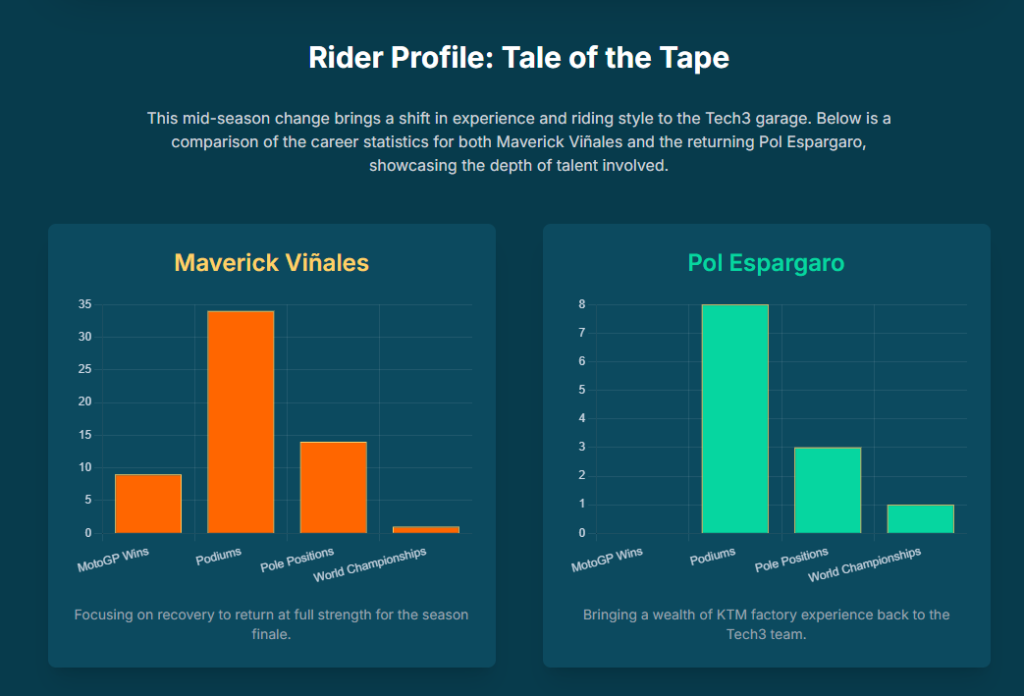
Espargaro, now 34, holds the designated position of Red Bull KTM Test Rider.5 This role grants him extensive and continuous access to the evolving KTM RC16 platform, including multiple variants of chassis, engines, and aerodynamic packages.11 His utility is magnified by his significant history with the organization, encompassing four seasons with Tech3 (2014 to 2016) and subsequent time as a factory KTM rider.3 This deep institutional memory of the RC16 across various development phases positions him uniquely to provide informed, high-fidelity feedback, often referring to the Red Bull KTM Tech3 outfit as his “Tech3 family”.2
Furthermore, utilizing Espargaro as a substitute for an injured contracted rider provides KTM with a vital regulatory advantage. FIM regulations confirm that substitute riders are not subjected to the standard restrictions placed on contracted riders regarding private testing.17 This flexibility allows KTM to seamlessly transition their dedicated development resource onto the race weekend schedule, maximizing data collection opportunities on the RC16 under competitive pressure.
B. Quantifying Performance: Espargaro’s Proven Track Record in 2025
The decision to deploy Espargaro is strongly supported by his quantifiable competitive performance in his previous 2025 stand-in rides. These results confirm that he provides a high caliber of competitive stability, significantly mitigating the loss of Viñales’ potential points.
During his first replacement ride at the Czechia (Brno) GP, Espargaro secured a 9th position in the Sprint race and a 10th position finish in the full Grand Prix.1 He continued this strong performance in his second appearance at the Hungarian (Balaton Park) GP, where he again finished 9th in the Sprint and improved to an 8th position finish in the Grand Prix race.1 Notably, his P8 finish at Balaton Park was the highest GP result achieved by the Red Bull KTM Tech3 machine during this mid-season period.2
Achieving consistent Top 10 finishes in both formats demonstrates that Espargaro is performing near the level expected of a regular factory-backed competitor, establishing a superior competitive threshold for a test rider substitution. This strong baseline confirms that the KTM test program is successful in keeping its developmental riders race-ready and provides the organization with a robust buffer against injury-related performance drops. The organization relies on this inherent competitive capability, allowing them to focus his mandate away from pure point-scoring and toward technical validation.
Pol Espargaro 2025 Substitute Performance Metrics
| Race Location | Viñales Status | GP Race Finish | Sprint Finish | Mandate/Value |
| Czechia (Brno) | Injured/Surgery 5 | 10th Position 1 | 9th Position 13 | Validated older RC16 configuration/familiar track. |
| Hungary (Balaton Park) | Injured/Rehabbing 6 | 8th Position 1 | 9th Position 13 | Developed baseline data for a new circuit layout. |
| Australia (Phillip Island) | Recovery/Rehab 1 | TBD | TBD | Test chassis stability and high-speed aero.3 |
| Malaysia (Sepang) | Recovery/Rehab 1 | TBD | TBD | Test engine response and thermal efficiency.3 |
C. The Dual Mandate for Phillip Island and Sepang
Espargaro’s deployment across this critical back-to-back overseas swing of fixtures is highly strategic.1 His primary directive is clear: to “help the project as much as I can and making the most of these weekends to make progress with our bike and support the other riders”.1 This statement indicates his focus is geared toward maximizing technical output rather than solely securing points.
The technical value of this substitution is enhanced by the deep, consistent relationship Espargaro shares with the Tech3 organization. This historical bond, described as returning to his “family,” facilitates rapid setup adaptation and seamless knowledge transfer, which is crucial for overseas events where track time and adjustment windows are limited.2 This organizational continuity reinforces the stability of the entire four-bike KTM structure (Factory and Tech3 teams) during a demanding phase of the calendar.
IV. Technical Analysis of the Flyaway Challenge (Rounds 19 & 20)
The selection of Phillip Island and Sepang for Espargaro’s competitive testing is deliberately calculated to maximize the validation of the RC16 across a spectrum of technical challenges.
A. The KTM RC16: Current Development Focus
The RC16 development roadmap has recently centered on addressing specific handling characteristics. Viñales had previously identified and worked extensively on improving cornering performance, particularly “turning off-brakes”.11 This led to the introduction of updated components, including new aerodynamic fairings and the latest generation of the mass damper system (colloquially termed the ‘salad box’), designed to reduce vibration and chatter.11
Viñales’ injury created a temporary gap in high-load, race-pace feedback regarding these specific parts. Espargaro, who has been involved in parallel testing of these components 11, is ideally suited to bridge this data gap. His mandate is to continue the critical assessment, providing competitive, race-weekend data on the durability and efficacy of these key development components, ensuring that the factory receives accurate information for future homologation decisions.
B. Circuit-Specific Demand 1: Phillip Island (Round 19)
The Liqui Moly Australian Motorcycle Grand Prix at the Phillip Island Grand Prix Circuit presents a unique technical challenge for the RC16.18 This circuit is known for its fast, flowing layout, characterized by high commitment corners and a high average speed.3 It is one of the least demanding tracks on the brake system, featuring only one ‘High-category’ braking zone, contrasting sharply with other circuits.19
The RC16’s performance focus here rests on chassis stability and the rider’s front-end confidence.3 The long, sweeping corners necessitate maximum aerodynamic efficiency and stability at maximal lean angles. Espargaro, a former Moto2 winner at the venue and a previous top 10 finisher in the premier class on a KTM 20, is well-positioned to assess the bike’s behavior under sustained lateral load. His priority is validating the performance of the new chassis rigidity and aero package in generating stability and improving turning response through rapid, high-speed direction changes.
C. Circuit-Specific Demand 2: Sepang (Round 20)
The Petronas Grand Prix of Malaysia at the Sepang International Circuit offers a distinct technical contrast to Phillip Island.18 Sepang is characterized by long straights followed by heavy braking zones, combined with high ambient temperature and humidity.3 The circuit features four ‘High-category’ braking zones, making brake performance and stability a critical factor.19
The RC16’s development focus shifts to engine response, braking performance, and thermal management.3 The punishing climate demands solutions for optimal engine response and cooling efficiency. Espargaro’s role in Malaysia is to stress-test the durability and thermal consistency of all components, including engine maps and the mass damper system (which can be sensitive to thermal variation).11 This venue provides the ideal environment for the final competitive stress test of new engine configurations before the end-of-season homologation deadlines.21
The inherent organizational value of this twin mandate is substantial. Because Espargaro is a reliable, professional benchmark, his data provides a high-fidelity comparison point against the four primary riders (Brad Binder, Pedro Acosta, Enea Bastianini, and potentially other KTM riders).22 If Espargaro runs specific component variants or different setups, the data allows for direct A/B testing under authentic race conditions, which is crucial for the factory engineers to make informed decisions for the subsequent year’s development package.
Technical Characteristics and RC16 Development Mandates for Flyaway Circuits
| Circuit | Key Technical Demand | RC16 Performance Focus | Espargaro’s Development Input Priority |
| Phillip Island, Australia 18 | High commitment, continuous flow, minimal heavy braking 3 | Chassis stability, front-end confidence, rapid changes of direction 3 | Validation of chassis rigidity, new aero efficacy for turning at high speed. |
| Sepang, Malaysia 18 | Long straights, heavy braking, high heat/humidity 3 | Engine response, thermal management, braking stability, aero efficiency 21 | Stress testing engine maps, brake system performance, thermal stability of components (e.g., mass damper). |
V. Strategic Implications and Development Feedback Loop
The substitution strategy confirms a critical organizational priority: maximizing the effectiveness of the developmental infrastructure to secure long-term platform competitiveness, even at the expense of marginal short-term championship gains.
A. The Development Feedback Loop: Pol Espargaro as the Data Conduit
Viñales’ inability to ride at full strength resulted in a significant drop-off in the quality of feedback regarding new development parts aimed at addressing turning and chatter.9 Pol Espargaro’s integration into the Tech3 pitbox is designed to provide development continuity. As a dedicated test rider, his focus is intrinsically geared toward providing precise, actionable technical feedback that complements the engineers’ objectives.13
His mandate to “help the project” 1 means he effectively acts as a knowledgeable data conduit. He translates the performance and limitations of new components into engineering terms, picking up the thread of validation Viñales had been working on. This systematic approach, placing a rider with “deep knowledge of the bike” 5 into the race team, prevents the organization from suffering a two-race data void, ensuring the crucial link in the development chain remains strong.
B. Competitive Continuity and Team Championship Status
While securing high-ranking points is secondary to technical development, maintaining competitive visibility is necessary. Espargaro’s established record of achieving consistent Top 10 finishes in his two previous 2025 outings (P8 and P10) 1 provides essential competitive continuity. This performance stability mitigates the organizational damage that a less competent replacement, or the complete absence of a second bike, would inflict upon the team’s standing in the Team Championship.
Furthermore, Espargaro’s presence stabilizes the Red Bull KTM Tech3 garage during a period complicated by injury. His veteran status and familiarity with the team structure provide Enea Bastianini, the other Tech3 rider 22, with a reliable benchmark and collaborative partner. This cohesive approach contrasts sharply with the disruption caused by an empty pitbox or a struggling replacement rider, ensuring the focus of the crew remains on maximizing the potential of the RC16 platform. The internal alignment, where a test rider focuses on component progress even in a race scenario, highlights a robust, integrated factory structure.
C. Regulatory Framework and Resource Utilization
The organizational benefit of this maneuver is amplified by the MotoGP regulatory framework. Substituting an injured rider with a test rider bypasses standard testing restrictions.17 This effectively grants the factory development team four extra days of competitive track time (two GPs, two Sprints) at two contrasting circuits, utilized by a rider whose primary function is providing technical validation.
This strategic conversion of race participation into high-value competitive testing demonstrates superior resource utilization. By making the data integrity and long-term recovery of Viñales the primary focus, KTM is optimizing the RC16 platform for a stronger competitive package in the forthcoming season. This decision underscores that the organization’s current strategy is focused on technical maturity and development optimization for the future, leveraging every competitive opportunity for engineering gain.
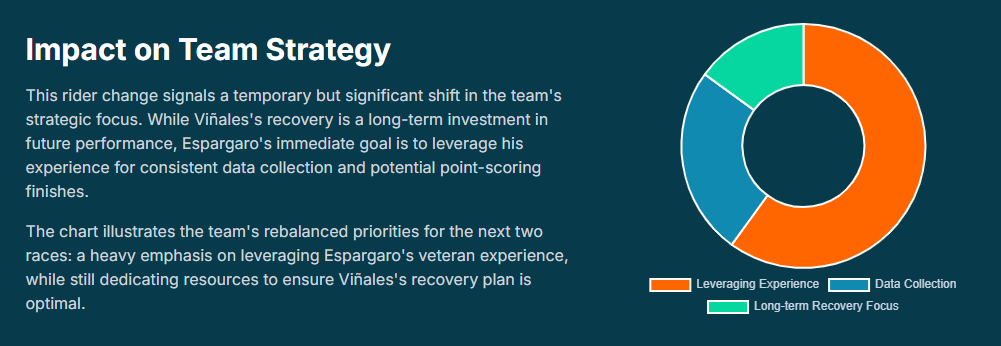
VI. Conclusion and Future Outlook
A. Assessment of the Short-Term Strategy’s Success
The substitution of Maverick Viñales by Pol Espargaro for the Australian and Malaysian Grands Prix is a highly successful short-term strategic decision. The move adeptly manages competitive risk by installing a proven Top 10 performer while simultaneously protecting a key contracted asset (Viñales) from further physical damage. Critically, the deployment of Espargaro converts these two overseas races into integrated, high-fidelity competitive testing sessions, ensuring the RC16 development trajectory remains accelerated and informed during a crucial end-of-season period. The strong integration between the test rider program and the race team ensures KTM maximizes the competitive value of its entire MotoGP structure.
B. Projection for Viñales’ Fitness and Return Timeline
Viñales’ absence is dedicated to building strength in his injured left shoulder, necessitated by the physical limits he reached during his efforts to continue racing.1 The MotoGP calendar includes a critical two-week break following the Malaysian Grand Prix (Round 20) before the penultimate Portuguese GP (Portimão, Round 21) and the final race in Valencia (Round 22).18
The targeted return date is likely the Portuguese GP or the Valencian GP, contingent upon his ability to achieve 100% functional strength.13 The condition for his return will be the confirmed regaining of strength required to manage the motorcycle under heavy load, thereby ensuring he can once again deliver high-quality, reliable performance and accurate development feedback.1
C. Recommendations for KTM’s Technical Priorities in the Final Races and Winter Testing Phase
Based on the technical demands of the flyaway circuits and the established development goals of the RC16 platform, the following priorities are recommended for the conclusion of the 2025 season:
- Prioritize Thermal and Engine Data Collection at Sepang: The high heat and humidity of the Sepang International Circuit offer an ideal stress environment. KTM should utilize Espargaro’s data to finalize 2025 engine specification maps and cooling solutions, providing critical data for validation under maximum thermal stress.
- Immediate Analysis of Front-End Compliance Data from Phillip Island: The high-speed flow and minimum-braking environment of Phillip Island provides unique data on chassis stiffness and suspension settings. The data gathered by Espargaro must be immediately processed to refine the RC16’s chassis setup, specifically addressing the turning deficits previously identified by Viñales.11
- Ensure Full Viñales Fitness for 2026 Prototype Testing: The ultimate strategic goal is to maximize Viñales’ contribution to the subsequent year’s platform. It is imperative that Viñales is 100% recovered and fully cleared for the post-season official test in Valencia and the pre-season winter testing phase.14 This ensures he can immediately commence development work on the 2026 prototype package, utilizing the refined baseline of knowledge secured by Pol Espargaro in the latter half of the 2025 season.
Sources
- Pol Espargaro recalled to MotoGP™ duty once more for Australian and Malaysian Grands Prix | KTM United States, accessed October 14, 2025, https://www.ktm.com/en-us/racing/racing-news/pol-espargaro-recalled-to-motogp–duty-once-more-for-australian-.html
- Official: Pol Espargaro back in MotoGP action for Tech3 | Crash.net, accessed October 14, 2025, https://www.crash.net/motogp/news/1083969/1/official-pol-espargaro-back-motogp-action-tech3
- Maverick Vinales sidelined again as Pol Espargaro steps in for Phillip Island and Sepang, accessed October 14, 2025, https://portal.ufgd.edu.br/pos-graduacao/mestrado-doutorado-ciencia-tecnologia-ambiental/dissertacoes-defendidas?s-news-700668-2025-10-13-maverick-vinales-injury-pol-espargaro-replaces-tech3-phillip-island-sepang
- Maverick Vinales considers withdrawing from remaining MotoGP races to recover, accessed October 14, 2025, https://www.motorsport.com/motogp/news/injured-maverick-vinales-weighs-withdrawing-from-remainder-of-motogp-2025-to-recover/10764503/
- Pol Espargaro to substitute Maverick Viñales at 2025 Grand Prix of Czechia – KTM, accessed October 14, 2025, https://www.ktm.com/en-int/racing/racing-news/pol-espargaro-to-substitute-maverick-vinales-at-2025-grand-prix-.html
- Espargaro confirmed for Hungarian MotoGP™ Red Bull KTM Tech3 appearance, accessed October 14, 2025, https://www.ktm.com/en-us/racing/racing-news/espargaro-confirmed-for-hungarian-motogp–red-bull-ktm-tech3-app.html
- Maverick Vinales “will also miss Phillip Island and Sepang” – replacement plan | Crash.net, accessed October 14, 2025, https://www.crash.net/motogp/news/1083699/1/maverick-vinales-will-also-miss-phillip-island-and-sepang-motogp-rounds
- Maverick Viñales – MotoGP™ Riders | Profiles | Stats & Results, accessed October 14, 2025, https://www.motogp.com/en/riders/maverick-vinales/71df6f0d-51c3-4cdb-9f5c-51939e6f33f2
- Vinales steps down from more MotoGP races – The Race, accessed October 14, 2025, https://www.the-race.com/motogp/vinales-steps-down-from-more-motogp-races-as-injury-woe-goes-on/
- Viñales withdraws from Indonesian GP to focus on recovery – MotoGP, accessed October 14, 2025, https://www.motogp.com/en/news/2025/10/04/vinales-withdraws-from-indonesian-gp-to-focus-on-recovery/760502
- Maverick Vinales explains new KTM aero, mass damper, at Aragon MotoGP test | Crash.net, accessed October 14, 2025, https://www.crash.net/motogp/news/1073117/1/maverick-vinales-fastest-talks-aero-mass-damper-aragon-motogp-test
- Maverick Viñales – Wikipedia, accessed October 14, 2025, https://en.wikipedia.org/wiki/Maverick_Vi%C3%B1ales
- Espargaro confirmed for Hungarian MotoGP™ Red Bull KTM Tech3 appearance, accessed October 14, 2025, https://www.ktm.com/en-iq/racing/racing-news/espargaro-confirmed-for-hungarian-motogp–red-bull-ktm-tech3-app.html
- KTM is fixed for 2025 Moto GP Grid, Test in already in December : r/motogp – Reddit, accessed October 14, 2025, https://www.reddit.com/r/motogp/comments/1h7aqeg/ktm_is_fixed_for_2025_moto_gp_grid_test_in/
- Pol Espargaro – The Official Home of MotoGP, accessed October 14, 2025, https://www.motogp.com/en/videos/riders/pol-espargaro
- Pol Espargaro to substitute Maverick Viñales at 2025 Grand Prix of Czechia – KTM, accessed October 14, 2025, https://www.ktm.com/en-us/racing/racing-news/pol-espargaro-to-substitute-maverick-vinales-at-2025-grand-prix-.html
- RÈGLEMENTS DU CHAMPIONNAT DU MONDE FIM DES GRANDS PRIX FIM GRAND PRIX WORLD CHAMPIONSHIP REGULATIONS, accessed October 14, 2025, https://www.fim-moto.com/fileadmin/user_upload/Documents/2025/2025_MotoGP__Moto2___Moto3_Regulations_-_update_17Feb.pdf?t=1757601178
- 2025 MotoGP World Championship – Wikipedia, accessed October 14, 2025, https://en.wikipedia.org/wiki/2025_MotoGP_World_Championship
- MotoGP, here are the most challenging circuits according to Brembo, accessed October 14, 2025, https://www.brembo.com/en/motorsport/motogp/demanding-circuit
- KTM: Espargaro and Smith only 0.011s apart over the line – MotoGP, accessed October 14, 2025, https://www.motogp.com/en/news/2017/10/24/ktm-espargaro-and-smith-only-0011s-apart-over-the-line/177716
- Sepang speed gets 2023 MotoGP™ off to a flyer | KTM Indonesia, accessed October 14, 2025, https://www.ktm.com/en-id/racing/racing-news/sepang-speed-gets-2023-motogp–off-to-a-flyer.html
- MotoGP 2025 preview: Rider line-up, calendar and new rules – Red Bull, accessed October 14, 2025, https://www.redbull.com/int-en/motogp-schedule-race-calendar
Our Social Media Handles
- Instagram : LivingWithGravity
- Medium : Akash Dolas
- YouTube Channel : Gear and Shutter
- Facebook : LivingWithGravity