









Honda’s R$1.6 Billion Power Play: Defending Market Hegemony in Brazil’s Accelerating Motorcycle Sector (2026–2029)
I. Executive Summary: The R$1.6 Billion Power Play in the Amazon
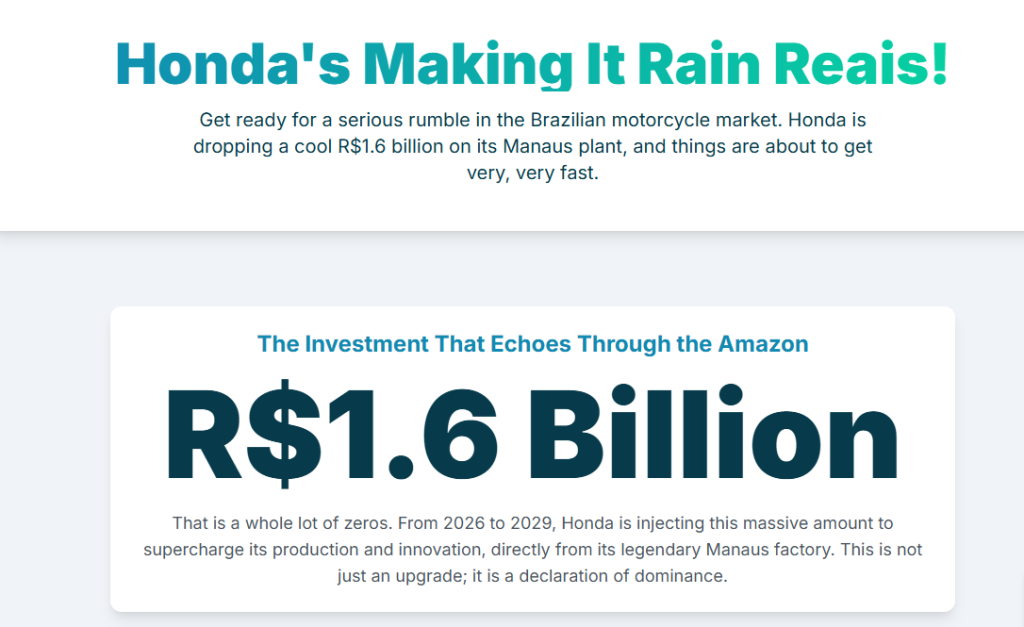
Honda’s commitment to invest approximately 1.6 billion reais into its Manaus motorcycle plant over four years (2026–2029) stands as one of the most significant capital deployments in the Brazilian automotive sector in recent history.1 This investment is fundamentally a dual-strategy commitment: it is a necessary, immediate action to secure production volume in an intensely growing market, and simultaneously, it acts as a preemptive operational defense against aggressive new competitors who are rapidly fracturing the established market structure.
This massive capital infusion targets critical operational bottlenecks, with a clear objective of expanding the Manaus plant’s production capacity to 1.6 million units annually by 2026.2 Such scale is paramount, given that the Brazilian motorcycle market is accelerating at an unprecedented pace, exceeding 1.876 million units sold in 2024 and recording an astonishing 18.6% year-on-year growth.3 The investment is geographically anchored in the Manaus Free Trade Zone (MFTZ), providing the necessary fiscal and political stability for such a long-term venture.4 Strategically, while Honda maintains its global push toward electrification (as seen with the global launch of the Honda 0 Series EV 5), the investment remains firmly focused on optimizing the dominant, locally pragmatic Flex-Fuel technology, which continues to overwhelm the nascent electric vehicle (EV) market segment (which held only a 2.5% market share in 2024).3
II. The Brazilian Mobility Paradox: A Market Unstoppable
2.1. Scale and Velocity: Quantifying the Growth Imperative
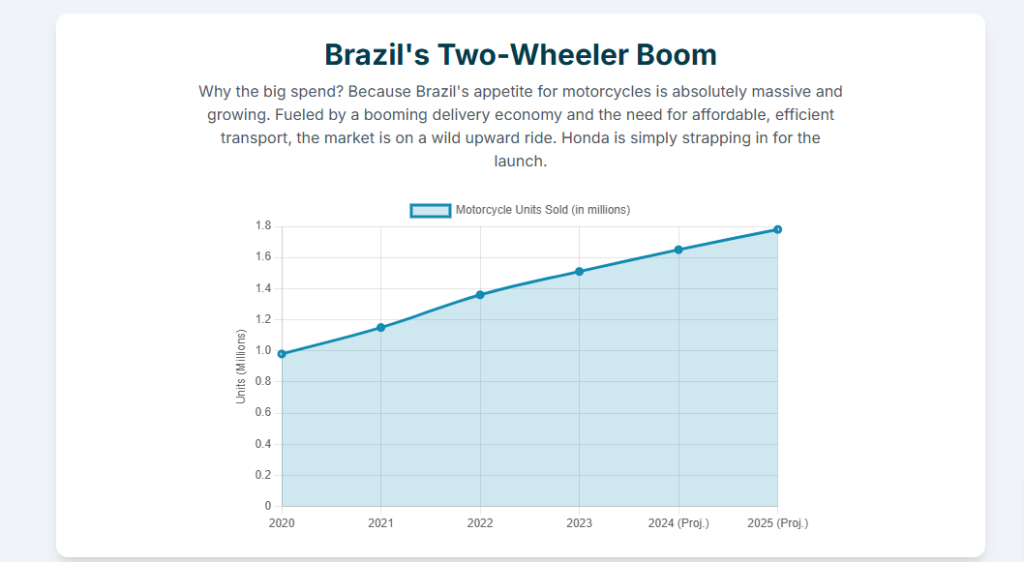
Brazil’s two-wheeler industry is undergoing a profound transformation, positioning the nation as one of the world’s largest motorcycle markets, often cited as the fourth or sixth largest globally, depending on the metric applied.3 The recent market velocity has demanded immediate, structural capacity adjustments from all major players. Motorcycle production in Brazil surpassed 1.748 million units in 2024, yet sales volume surged even higher to 1.876 million units, reflecting the enormous 18.6% year-on-year market expansion.3 This explosive growth is anticipated to continue, with production projected to hit 1.88 million motorcycles in 2025, representing a robust 7.5% growth rate compared to 2024.7
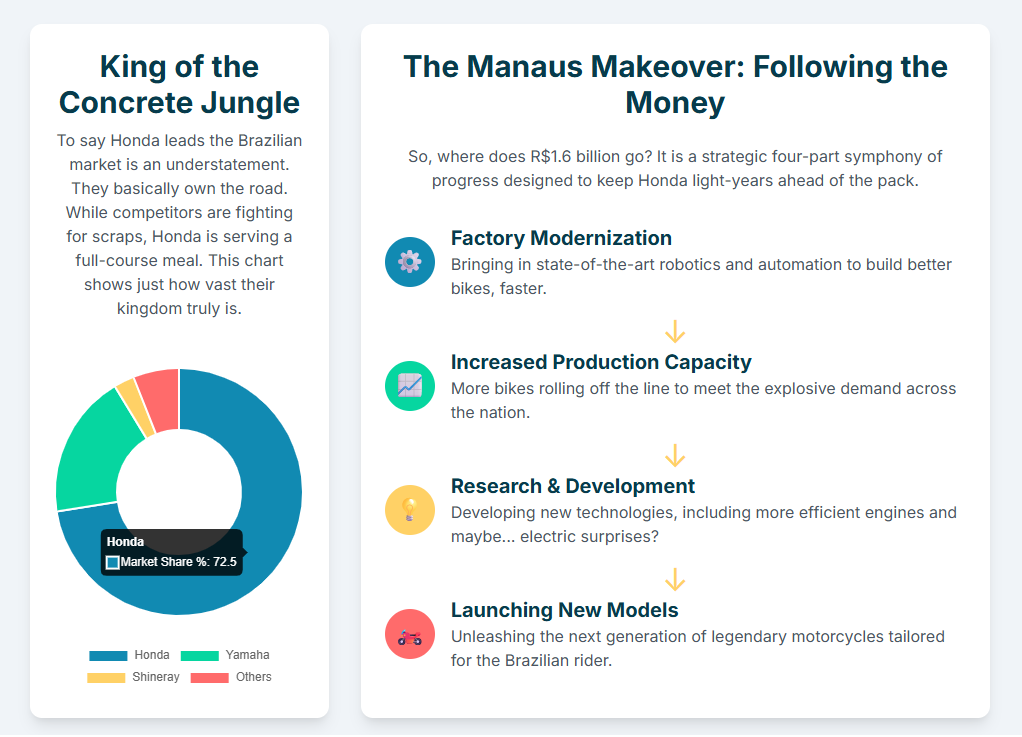
This extraordinary growth rate mandates immediate operational adjustments, particularly from the market leader. Since Honda has long controlled the largest share of the market—historically around 70%—the total sales volume of 1.876 million units in 2024 implies Honda sold roughly 1.3 million units during that period. The R$1.6 billion capital deployment, which targets expanding capacity to 1.6 million units by 2026 2, reveals a critical operational necessity. The difference between Honda’s estimated 2024 sales volume and its 2026 capacity target suggests that the current, pre-investment production infrastructure was either highly stretched or constrained by significant bottlenecks. Therefore, this investment is not merely an anticipation of distant growth; it is an urgent requirement to stabilize and secure future volume in a market that is already running at peak velocity.
Furthermore, the structural demand drivers within the market complicate the supply challenge. The market is predominantly utilitarian, relying heavily on small-displacement models (160cc or less), which accounted for over 70% of the market share in 2024, catering effectively to the public’s daily commuting needs.3 However, simultaneously, the demand for mid- and high-end models has also shown a pronounced upward trajectory, signifying an increasing consumer requirement for enhanced performance and comfort.3 This structural split necessitates that Honda leverage its R$1.6 billion investment to increase both the volume of its high-demand commuter segment (to defend against aggressive low-cost entrants) and the sophistication of its assembly lines to handle more margin-rich, technically complex mid-to-high-end models.
2.2. The Manaus Mega-Hub: Honda’s Unshakeable Fortress
The entirety of the R174 billion in total revenue in 2022 and sustaining an estimated 700,000 direct and indirect jobs.4
Honda’s long-standing operational history in Manaus provides substantial institutional leverage. Having first established operations there in the late 1960s, Honda chose the Amazon citing the “warm welcome” from the local populace.8 Crucially, the company built significant historical goodwill by holding fast and refusing to pull out even during periods of severe recession and recurring inflation when many competitors abandoned the market, underscoring a deep commitment to its customers and community.8
The deployment of R10.080.9
By committing this immense sum and explicitly projecting the creation of approximately 350 new jobs 2, the company strategically reinforces its political capital. The investment effectively functions as a massive, long-term lobbying chip. It makes it politically and economically challenging for the government to entertain proposals that might weaken or eliminate the MFTZ incentives, which are foundational to Honda’s cost structure and its status as the region’s largest private employer. This strategic capital deployment is a proactive measure aimed at mitigating political and regulatory risk, ensuring the longevity of its operations.
Furthermore, operational optimization is critical, as the investment explicitly includes modifying line layouts and improving internal factory logistics.2 Operating in the remote Amazon region presents inherent, complex logistical challenges, including supply chain bottlenecks and high transport costs. This investment in internal
optimization aims to neutralize this geographical necessity, transforming a potential logistical disadvantage into a relative competitive edge by establishing superior internal supply chain management—a crucial element when competing against foreign brands that rely on different regional assembly structures or imported components.
III. The Shrinking Giant: Honda’s Defensive Dominance
3.1. The Erosion of Hegemony: A Statistical Reality Check
Honda remains the undisputed volume leader in Brazil, yet the market data for the first half of 2025 reveals a structural erosion of its dominance. The brand’s market share decreased from approximately 70.7% to 67.6%.10 This 3.1 percentage point decline, although seemingly small, is highly significant in a market that is simultaneously growing rapidly. The statistics show that for every 100 motorcycles sold in Brazil during this period, nearly three units that would previously have been Honda were captured by a competitor.10
This situation illustrates the paradox of the market leader: Honda’s sales were still up by a commendable 7.3% 6, which might suggest robust success. However, because the total market growth rate exceeded 7.3%, Honda’s relative relevance decreased. This phenomenon, often observed in fragmented growth markets, means the market leader is struggling to adapt to the speed and diversification of smaller, niche competitors who are operating across the market spectrum. The R$1.6 billion investment is thus a mandate to secure volume growth
and market share stabilization.
The struggles of the long-time runner-up further underscore the opportunity for disruptors. Yamaha saw its market share shrink even more dramatically, falling from 17.5% to 14.1%, and recorded an absolute decline of more than 11% in units sold.10 If Yamaha, potentially attempting to repeat historical strategic moves seen in other Asian markets like Vietnam, focuses too heavily on “higher value added,” brand, and design without sufficient volume or distribution muscle, it risks being squeezed out of the high-volume commuter segments.11 This opens a crucial vacuum, allowing aggressive new entrants like Bajaj and Royal Enfield to capture the mid-to-high-end market segments without having to directly contest Honda’s entrenched mass-market volume drivers (like the CG160 and the Biz 125).6
3.2. The 1.6 Million Unit Mandate: Operational Defense
The R$1.6 billion investment is specifically an operational war chest aimed at efficiency, speed, and flexibility. The capital will be used to introduce new equipment, modify line layouts, and optimize production processes, all with the goal of achieving an annual capacity of 1.6 million units by 2026.2 This strategic focus on
Monozukuri (the Japanese “art of making things” philosophy applied to the assembly line) ensures that Honda can respond “more swiftly and flexibly to market changes, increased demand, and future product lineup expansions”.2
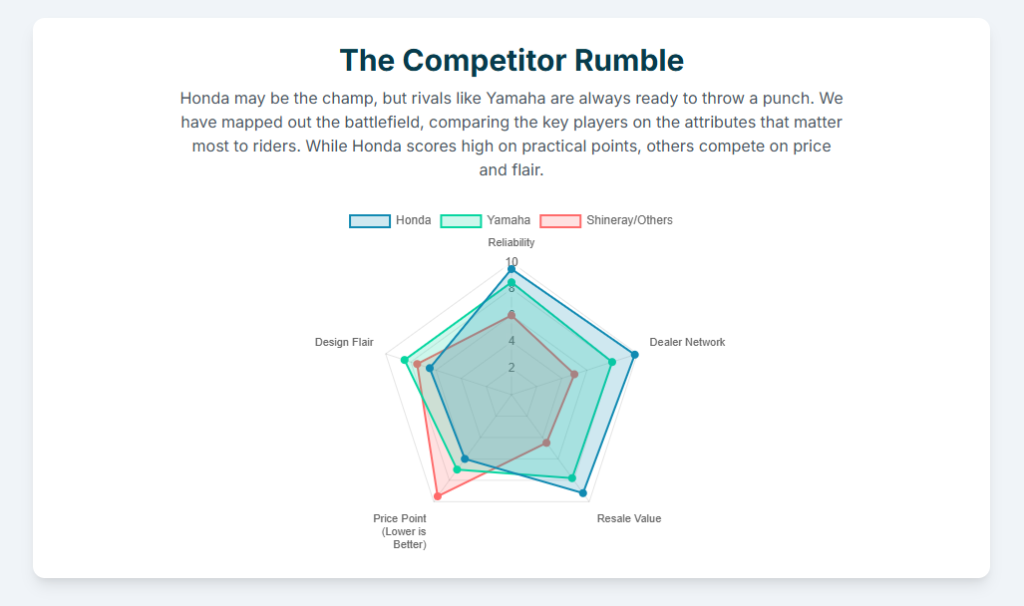
This operational flexibility is the primary defense mechanism against the highly aggressive competitive landscape. By maximizing production efficiency, Honda ensures its foundational strength—the capacity to produce vast volumes of affordable, reliable commuter bikes—remains unassailable. This scale enables Honda to maintain entry-level price competitiveness with models that are essential for market penetration and volume maintenance.9
IV. The Invaders at the Gates: A Competitive Threat Matrix
4.1. The Asian Assault: Indian and Chinese Dynamics
The fragmentation challenging Honda’s dominance is driven by a coordinated, two-pronged assault from Chinese and Indian competitors.6 These rivals are not fighting Honda on a single front; they are executing a segmented strategy that attacks the entire market structure.
Chinese brands, such as Shineray, Avelloz, and the local Mottu, primarily target extreme volume and low price points. Their growth figures are astronomical, with Avelloz soaring by +919.9% and Shineray jumping by +83.1%.6 These figures indicate successful exploitation of extreme low-cost or regional distribution gaps, likely in the Northern and Northeastern municipalities, which are known growth corridors with high motorcycle-to-car ratios.13
In contrast, Indian brands, namely Bajaj and Royal Enfield, are targeting specific, higher-margin niches with established global quality. Bajaj has successfully cemented its position in the naked segment with the Dominar D400 12, while Royal Enfield dominates the custom/lifestyle category, with several models becoming best-sellers in that segment.12 Bajaj’s sales surged by +213%, and Royal Enfield grew by +80.8%.6 This attack threatens Honda’s long-term profitability by capturing segments where consumers increasingly demand performance and comfort.3
The severity of this competitive landscape is best visualized through the differential growth rates observed across manufacturers:
Table 1: Competitive Disruption in the Brazilian Two-Wheeler Market (H1 2025 Sales Performance)
| Manufacturer | Sales Growth Rate (YTD) | Market Share Trajectory (H1 2025) | Strategic Significance for Honda |
| Honda | +7.3% | Shrinking (67.6% from 70.7%) | Requires R$1.6B to maintain volume lead despite losing relative share. |
| Yamaha | -9.6% (Volume Loss) | Rapidly Shrinking (14.1% from 17.5%) | Incumbent weakness creates opportunity for disruptors. |
| Avelloz | +919.9% | Skyrocketing (From negligible base) | Exploiting extreme low-cost volume segments. Immediate defensive priority. |
| Bajaj Auto (India) | +213% | Rapidly Gaining | Direct assault on the mid-range performance and higher margin segments. |
| Shineray (China) | +83.1% | Significant Mass Market Penetration | Direct competitor in the low-displacement, volume-driven commuter categories. |
| Royal Enfield (India) | +80.8% | Niche Dominance | Capturing the profitable, custom/lifestyle segment appeal. |
The data confirms that while Honda continues to sell more units (+7.3%), the sheer velocity of competitor growth (e.g., Avelloz’s nine-fold expansion) means Honda must invest the R$1.6 billion to support a dramatically broader and more competitive product portfolio than merely relying on its best-selling models, the CG160 and Biz 125.6 Without this capital, the mass market base would become vulnerable to being outmaneuvered by cheaper, faster-growing rivals.
V. The Flex-Fuel Fortress vs. The Electric Frontier
5.1. Ethanol’s Unshakeable Grip: The Brazilian Fuel Reality
The Brazilian energy policy and consumer behavior provide a powerful, protective moat for Flex-Fuel technology, which is central to Honda’s current and future strategy in the country. Flex-fuel vehicles, which allow consumers to choose between ethanol and gasoline based on price parity (ethanol must be below 70% of the gasoline price) 15, revolutionized the nation’s transportation sector, with 80% of cars sold by 2018 being flex models.15 Honda has been at the forefront of this shift in the two-wheeler segment, already offering Flex-Fuel (E100) motorcycle models in Brazil.16
This ethanol-gasoline policy has strategically inhibited the rapid development of pure electric motorcycles 3, as the flexible fuel option provides a commercially viable, low-emission solution that consumers can easily adopt without needing new infrastructure. The flexibility offered by this technology remains the commercially pragmatic choice today.
5.2. The 2.5% Problem: Analyzing EV Market Inertia
In contrast to the global push for electrification, the Brazilian pure EV market remains marginal. In 2024, pure electric motorcycles held only a 2.5% market share.3 The internal combustion engine variants, which include Flex-Fuel models, retained a massive 88.32% share of the two-wheeler market in 2024.13
While the EV segment is projected for substantial expansion, with a forecast 12.41% Compound Annual Growth Rate (CAGR) through 2030 (the fastest growth rate among all propulsion types) 13, and local EV start-ups are experiencing rapid sales increases (+90.0% this year) 6, the segment’s current size is too small to warrant a complete shift in immediate capital priorities.
The distribution of capital in the R$1.6 billion investment, primarily focused on capacity expansion, line optimization, and logistics 2, represents a pragmatic, localized strategy. It acknowledges the low current EV consumer acceptance and the insufficient charging infrastructure, prioritizing the technology (Flex-Fuel leadership) where Honda currently possesses an undeniable competitive advantage and market share.
The commitment, however, is not technologically blind. Honda’s global plans include launching the “Honda 0 Series” EV in 2026 5 and leveraging its core manufacturing expertise—the
Monozukuri know-how—to develop highly competitive EV platforms that integrate the core components (battery, PCU, and motor).16 The operational efficiency gains generated by the R$1.6 billion in optimizing logistics and creating flexible line layouts 2 serve a crucial dual purpose. They maximize the throughput and efficiency of the profitable ICE operations
now and simultaneously prepare the physical and systemic infrastructure of the Manaus plant for the eventual integration of electric vehicle components and assembly processes when the local market reaches a tipping point, effectively mitigating significant future technological disruption risk.
Table 2: Brazilian Two-Wheeler Propulsion Market Share and Growth (2024/2025-2030)
| Propulsion Type | Market Share (2024) | Projected CAGR (2025-2030) | Strategic Reality |
|—|—|—|
| Internal Combustion Engine (ICE/Flex-Fuel) | 88.32% | Dominant | The core revenue segment for the R$1.6B investment; secure volume. |
| Pure Electric Vehicles (EV) | 2.5% | 12.41% (Fastest Projected) | Marginal today; high CAGR necessitates platform readiness for the future. |
| Flexible Fuel Vehicles (E100, E20) | Dominant within ICE Segment | Continued Strength | Honda’s key technological differentiator, protected by local infrastructure. |
This analysis confirms that despite the future growth potential of EV, the massive dominance of the ICE/Flex-Fuel segment validates the strategic necessity of deploying R$1.6 billion to scale the established, highly profitable technology platform first.3
VI. Strategic Review: The Good, The Bad, and The Beautifully Designed
6.1. Strategic Strengths (The Upside: Genius of the R$1.6B)
The investment exhibits several undeniable strategic strengths that secure Honda’s regional position:
A. Capacity Security and Competitive Scale. The immediate target of 1.6 million units provides a vital operational floor, allowing Honda to fully exploit its innate advantage of scale manufacturing in a market defined by the necessity of high-volume commuter bikes.2 By optimizing internal logistics and production layouts 2, the company maximizes output per labor hour, significantly reducing the cost base on high-volume products like the CG160. This operational excellence is the most effective means of competing directly against rapidly scaling, low-cost Chinese entrants like Shineray (+83.1%) and Avelloz (+919.9%).6 This investment purchases the necessary breathing room to focus on high-margin competition.
B. Manaus Commitment: Political and Fiscal Mastery. By committing a substantial R$1.6 billion to the MFTZ, Honda expertly leverages its long-held institutional and historical goodwill (having never abandoned the market during recessions) to lock in crucial future tax benefits necessary for its long-term cost viability.4 This strong local commitment, reinforced by the projected creation of 350 new jobs 2, creates an institutional shield. It reinforces the MFTZ’s political importance, making it far more challenging for any legislative body to successfully challenge or roll back the tax incentives that underpin Honda’s cost advantage over non-localized competitors.
C. Technological Flexibility and Pragmatism. The investment shrewdly reinforces Flex-Fuel leadership, recognizing it as the only commercially successful low-emission technology currently in Brazil.3 This allows Honda to postpone immediate, disruptive, and astronomically expensive EV infrastructure overhauls while simultaneously preparing the internal structure for future EV platforms through the application of its
Monozukuri philosophy.16 This strategy is financially astute risk management: it maximizes returns from the profitable, established 88% ICE market share 13 before committing major local capital to the 2.5% EV segment 3, awaiting clearer market signals and policy direction.
6.2. Strategic Risks (The Dislikes: Where Analysts See Turbulence)
Despite the operational excellence, the investment carries inherent risks tied to market fragmentation and technological timing:
A. Fragmentation Risk and Oversupply Potential. If the market continues its rapid fragmentation, with highly specialized competitors capturing niches and low-cost volume at speed (Bajaj +213%, Shineray +83.1%) 6, the creation of a massive 1.6 million unit capacity floor could expose Honda to the risk of oversupply or damaging price wars in the commuter segment.10 Honda’s reliance on scale might become an operational anchor if it cannot rapidly diversify its product offerings beyond its core high-volume models. The R$1.6 billion commitment must be swiftly followed by a rapid R&D integration plan to introduce competitive mid-to-high-end Flex-Fuel models that directly counter niche attacks in the naked and custom segments.12
B. Technological Inertia in the Global Context. The intense, necessary focus on Flex-Fuel, while pragmatic for Brazil today, carries the danger of technological inertia. Should global EV adoption rates unexpectedly accelerate, or if the Brazilian government swiftly introduces heavy EV subsidies, Honda’s established Flex-Fuel infrastructure could quickly transition from a competitive moat into a significant sunk cost liability. Such a scenario could slow the implementation of the global Honda 0 Series platform 5, ceding crucial first-mover advantage in the highest CAGR segment (12.41%) to nimble local start-ups or dedicated global EV players.6 The existing ethanol policy has already “inhibited the rapid development of electric motorcycles” 3, suggesting a high degree of dependence on continued political support for Flex-Fuel.
C. Logistical Fragility of the Manaus Corridor. The MFTZ, despite its economic benefits, requires complex and costly supply chains to operate within the Amazon region. While the investment specifically targets improving internal logistics and optimization 2, external vulnerabilities remain an inherent threat to the efficiency of the R$1.6 billion investment. Geopolitical instability, external infrastructure failures, or continued high external transport costs to connect Manaus to the major consumer markets in the South and Southeast pose structural risks that are difficult to mitigate through internal plant optimization alone.
VII. Conclusion and Actionable Recommendations
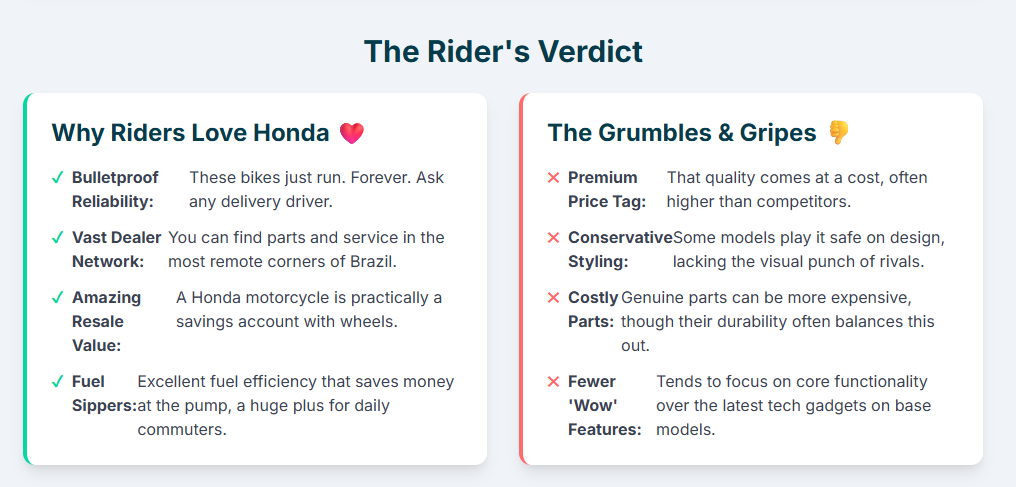
Honda’s R$1.6 billion investment is a highly sophisticated, calculated defensive maneuver. It is a necessary redoubling of commitment to the Brazilian market designed to maximize profitability in the short term by securing scale and optimizing the dominant Flex-Fuel ICE platform. This capital infusion simultaneously manages significant political risk in the sensitive Manaus region and secures the operational efficiency required to contend with a rapidly fragmenting competitive future. The investment ensures Honda can utilize its fundamental strength—mass production volume—to maintain its overwhelming leadership position while buying time to prepare for the inevitable future technological shift.
Actionable Recommendations for Strategic Execution
- Mandate Product Diversification: Honda should rapidly deploy capital from the R$1.6 billion investment toward accelerated R&D integration to launch aggressive, mid-displacement (250cc–400cc range) Flex-Fuel models. These new products must be specifically engineered and marketed to compete head-to-head with market disruptors, countering Bajaj’s successful Dominar platform and Royal Enfield’s lifestyle models, effectively leveraging the newfound capacity flexibility created by the investment.12
- EV Component Pre-Positioning: The operational efficiency gains secured through optimized logistics should be channeled into localizing the assembly of essential EV components—such as the battery pack housing, PCUs, and motor assemblies—within the Manaus ecosystem. This strategic move prepares the supply chain for faster integration of global Monozukuri EV platforms (like the Honda 0 Series) by 2027/2028, serving as a robust hedge against the anticipated high EV CAGR.13
- Harden Distribution Channel Dominance: Critical investment must be directed towards modernizing and expanding Honda’s distribution and service networks, particularly within the crucial Northern and Northeastern municipalities identified as key growth corridors.13 This channel hardening is essential to counter the grassroots, rapid distribution success demonstrated by highly localized competitors such as Avelloz and Mottu 6, ensuring that the expanded 1.6 million unit capacity can be absorbed efficiently across the entire national market.
Sources
Sources
- Honda Announces New Investment in Motorcycle Plant in Brazil …, accessed on October 3, 2025, https://global.honda/en/newsroom/news/2025/c251003eng.html
- Honda Announces New Investment in Motorcycle Plant in Brazil, accessed on October 3, 2025, https://global.honda/en/newsroom/news/2025/c251003eng.html?from=latest_area
- Brazil electric two-wheeler industry status and trend analysis 2025, accessed on October 3, 2025, https://batteryswapcabinet.com/brazil-electric-two-wheeler-industry-status-and-trend-analysis/
- Brazilian Chamber of Deputies celebrates the 56th anniversary of the Manaus Free Trade Zone – Latam FDI, accessed on October 3, 2025, https://latamfdi.com/manaus-free-trade-zone/
- Honda Introduces Next-generation Technologies for Honda 0 Series Models at Honda 0 Tech Meeting 2024 | Honda Global Corporate Website, accessed on October 3, 2025, https://global.honda/en/newsroom/news/2024/c241009eng.html
- Brazilian Motorcycles Market – Data & Fact 2025 | MotorCyclesData, accessed on October 3, 2025, https://www.motorcyclesdata.com/2025/09/16/brazilian-motorcycles-market/
- Record Motorcycle Production in Brazil – Power Systems Research, accessed on October 3, 2025, https://www.powersys.com/2025/02/record-motorcycle-production-in-brazil/
- Chapter II: Global Expansion of Business Section 3: South America | 75 Years of Honda History, accessed on October 3, 2025, https://global.honda/en/about/history-digest/75years-history/chapter2/section3/
- Honda launches new 2026 motorcycle that does 49 km/L, costs less than R$ 11 thousand and has an estimated autonomy of 206 km – Click Oil and Gas, accessed on October 3, 2025, https://en.clickpetroleoegas.com.br/honda-lanca-nova-moto-2026-que-faz-49-km-l-custa-menos-de-r-11-mil-e-possui-autonomia-estimada-em-206-km-vml97/
- Motorcycle market turns around: Honda and Yamaha lose ground to Shineray, Royal Enfield and Bajaj in Brazil – CPG Click Oil and Gas, accessed on October 3, 2025, https://en.clickpetroleoegas.com.br/Motorcycle-market-turns-the-game-around%3A-Honda-and-Yamaha-lose-space-to-Shineray–Royal-Enfield-and-Bajaj-in-Brazil-btl96/
- Franco Malerba, Sunil Mani – Sectoral Systems of Innovation and Production in Developing C – Scribd, accessed on October 3, 2025, https://www.scribd.com/document/661599783/Franco-Malerba-Sunil-Mani-Sectoral-Systems-of-Innovation-and-Production-in-Developing-C-1
- Chinese and Indian motorcycles advance and challenge leadership in the Brazilian market – Click Oil and Gas, accessed on October 3, 2025, https://en.clickpetroleoegas.com.br/motos-chinesas-e-indianas-avancam-e-desafiam-lideranca-no-mercado-brasileiro/
- Brazil Two Wheeler Market Size, Share & 2030 Growth Trends Report – Mordor Intelligence, accessed on October 3, 2025, https://www.mordorintelligence.com/industry-reports/brazil-two-wheeler-market
- Bajaj Auto starts Brazil journey on a high, gears up for long slog, accessed on October 3, 2025, https://auto.economictimes.indiatimes.com/news/industry/bajaj-autos-strategic-move-in-brazil-expanding-in-a-competitive-market/123361765
- Economic, Legal, and Political Control of the Developmental State (Part II), accessed on October 3, 2025, https://www.cambridge.org/core/books/decadent-developmentalism/economic-legal-and-political-control-of-the-developmental-state/8BA49BB5ED1CF72F3BB3A9523F4196FD
- Summary of Briefing on Honda Motorcycle Business, accessed on October 3, 2025, https://hondanews.com/en-US/electrification/releases/release-1503019bd8a757ea08267d79441c602b-summary-of-briefing-on-honda-motorcycle-business
Our Social Media Handles
- Instagram : LivingWithGravity
- Medium : Akash Dolas
- YouTube Channel : Gear and Shutter
- Facebook : LivingWithGravity