

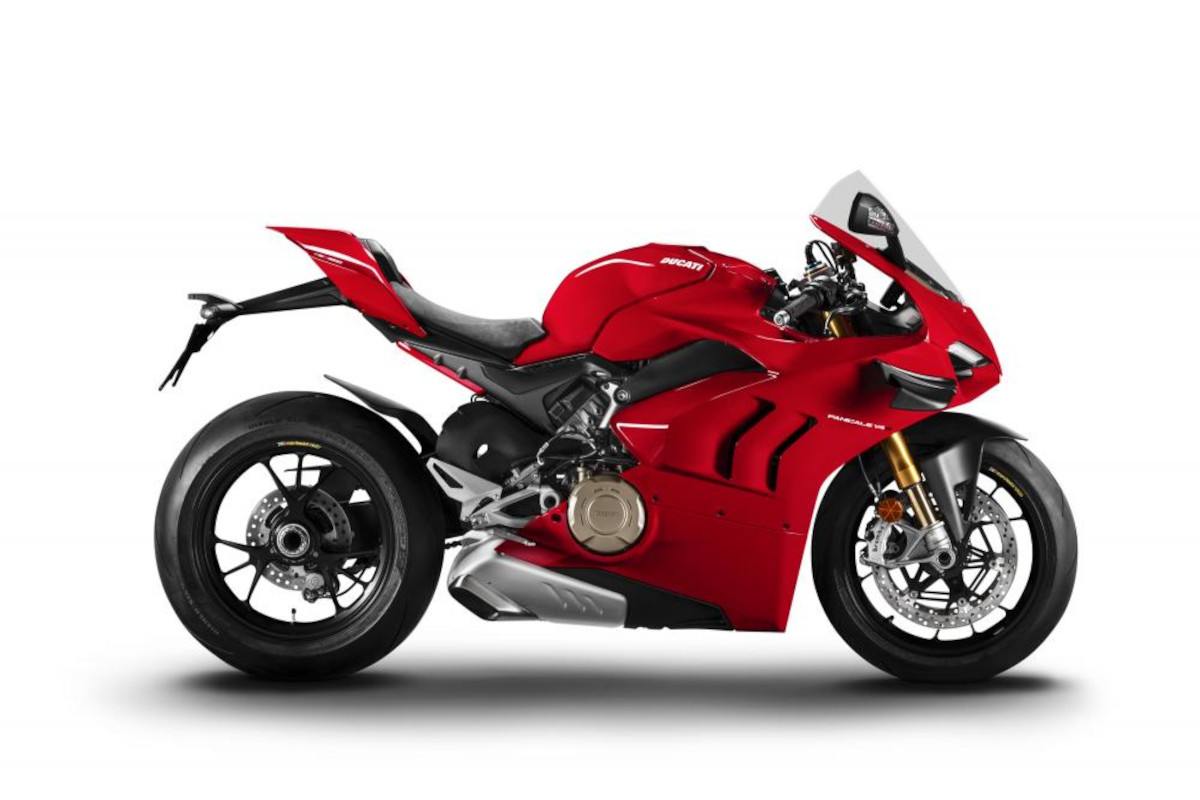





The 2025 Ducati Streetfighter V4 Platform: A Comprehensive Technical and Market Analysis for the Indian Hyper-Naked Segment
I. The 2025 Streetfighter V4 Platform: A Technological Convergence
Ducati has officially launched the highly anticipated 2025 Streetfighter V4 range in the Indian market, bringing substantial technical enhancements focused on chassis dynamics, performance refinement, and electronic sophistication. Deliveries of the new variants are commencing immediately.
A. Launch Overview and Pricing Structure
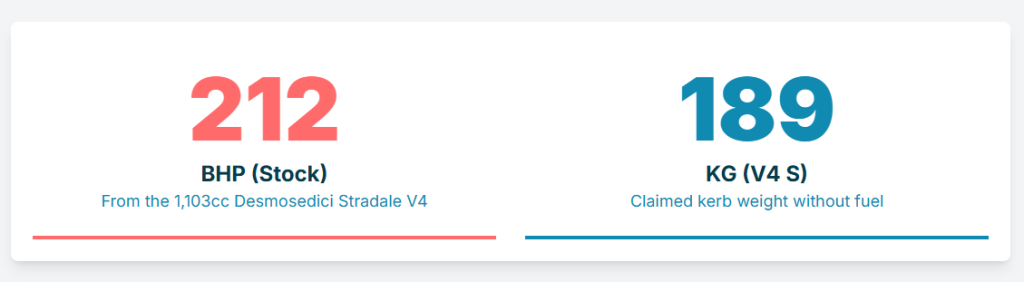
The 2025 range is introduced in two primary variants, with official ex-showroom pricing establishing the motorcycle at the absolute apex of the hyper-naked category in India. The standard Streetfighter V4 is offered in Ducati Red at an ex-showroom price of Rs 28,68,600. The higher-specification Streetfighter V4 S, also in Ducati Red, carries an ex-showroom price of Rs 32,38,400 .
The differential pricing structure reveals an inherent strategic objective. The V4 S commands a significant 12.9% price premium, equating to approximately Rs 3.7 lakh over the standard V4 model. This pricing strategy positions the Streetfighter V4 S squarely in the territory of dedicated superbikes, such as the Panigale V4, which was previously listed around Rs 30.33 lakh.1 This suggests that Ducati is not marketing the Streetfighter V4 S as merely a stripped-down, ergonomically softer superbike, but rather as an elite, ergonomically enhanced performance vehicle built upon the very latest and most sophisticated iteration of the Panigale V4 platform.2 Consumers purchasing the V4 S are effectively acquiring a top-tier superbike chassis and electronics package tailored for maximum road and track usability.
B. Performance Metrics and Power-to-Weight Calculus
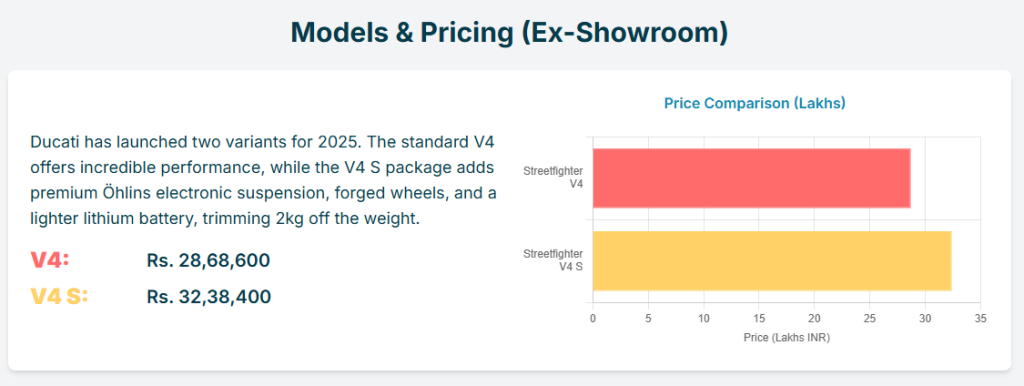
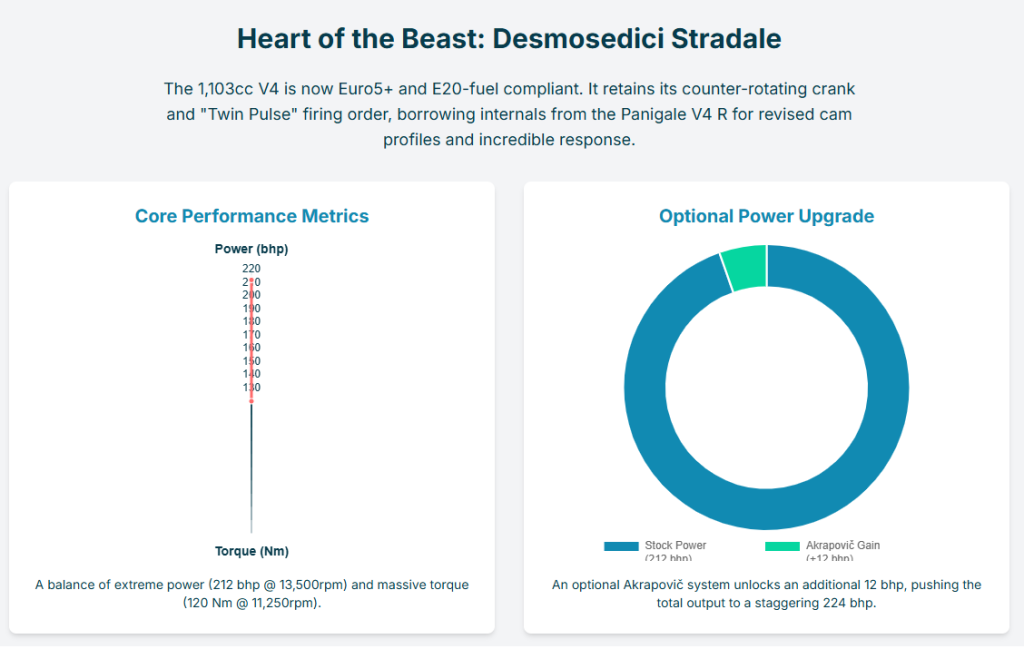
At the core of both variants lies the 1,103cc Desmosedici Stradale V4 engine. This unit produces a formidable 212 bhp at 13,500 rpm and 120 Nm of torque at 11,250 rpm .
The performance quotient is defined by the motorcycle’s exceptional mass reduction. The claimed kerb weight (without fuel) is recorded at 191 kg for the standard V4, dropping to a remarkably low 189 kg for the V4 S . Utilizing the dry weight figure for the V4 S (189 kg) combined with the standard power output (212 bhp), the resulting dry power-to-weight ratio is approximately $1.12 \text{ bhp/kg}$. This metric places the 2025 Streetfighter V4 S among the most performance-intensive production motorcycles available globally. This extraordinary performance relative to mass underscores Ducati’s objective of creating a hyper-naked machine with ballistic track capabilities.
II. Engine Architecture and Environmental Compliance: The Desmosedici Stradale V4 Revisions
The 2025 engine revisions are comprehensive, integrating race-derived technology to enhance both performance envelope and long-term reliability, while crucially ensuring compliance with modern environmental mandates.
A. Technical Engine Overhaul and Lineage
The 1,103cc Desmosedici Stradale V4 maintains its unique character through the counter-rotating crankshaft and the familiar “Twin Pulse” firing order, which ensures the MotoGP-derived acoustic signature and contributes to better handling by mitigating gyroscopic effects .
The 2025 iteration benefits from a significant overhaul by incorporating key internal components directly sourced from Ducati’s limited-homologation machines, the Panigale V4 R and Superleggera V4. Specifically, the engine features revised cam profiles with higher valve lift, along with a new alternator and oil pump borrowed from the Panigale V4 R. Furthermore, the gear drum is sourced from the exotic Superleggera V4.2 This strategic transfer of components, typically designed for the rigorous demands of endurance racing and high-RPM reliability in homologation-spec engines, suggests an inherent increase in performance consistency and component robustness under severe operating conditions.
A major technical enhancement for the Streetfighter V4 platform is the introduction of variable-length intake trumpets. These intakes automatically adjust between 25 mm (short configuration) and 80 mm (long configuration).2 Short trumpets optimize air velocity for peak top-end power output, necessary for achieving the maximum 212 bhp figure. Conversely, the long trumpets are utilized to boost low-to-mid-range torque delivery and enhance overall rideability.3 This technology is essential for stabilizing the torque curve, a factor critical for compensating for any potential loss in volumetric efficiency or low-end power often associated with environmental constraints (such as Euro5+) or the lower energy density of E20 fuel.
For riders focused exclusively on track performance, an optional Akrapovic full race exhaust system is available. This system is claimed to increase maximum power output to 224 bhp . Acquiring a full titanium Akrapovic system for the V4 platform represents a substantial aftermarket investment, with similar official systems for the Panigale V4 platform ranging upwards of ₹7,28,555.4 The installation of such a system requires specific ECU mapping to adapt all electronic parameters, including Ducati Traction Control (DTC) and Ducati Wheelie Control (DWC), to the enhanced performance characteristics.5
B. Euro5+ and E20 Fuel Compliance: Strategic Necessity in India
The 2025 Streetfighter V4 is certified Euro5+ compliant, indicating adherence to stringent modern European emission standards, and is additionally compliant with E20 fuel standards . The E20 compliance is a fundamental strategic advantage for the Indian market, given the nation’s aggressive rollout of E20 (20% ethanol blend) petrol.6
By designing the platform for E20 use, Ducati proactively ensures that the vehicle’s fuel system components—including hoses, seals, and gaskets—are chemically compatible with the higher ethanol concentration, thereby mitigating the risk of material degradation, corrosion, and associated maintenance failures observed in older, non-compliant superbikes.7 This certification essentially de-risks the ownership experience for the premium buyer, transforming compliance from a regulatory burden into a crucial market differentiator and a prerequisite for competitiveness in India.
It is universally acknowledged that ethanol, possessing lower energy density than pure gasoline, typically results in a minor decrease in fuel economy, estimated between 1% and 6%.7 Therefore, the E20-ready Desmosedici Stradale engine relies heavily on its updated management system and the variable intake trumpets to minimize this potential performance drop-off and stabilize throttle response.
For an engine operating at 13,500 rpm and generating 212 bhp, utilizing the highest quality, high-octane fuel remains optimal. While E20-compliant, owners seeking peak performance may opt for ethanol-free, high-octane premium fuels. In cities like Pune, Maharashtra, ethanol-free options such as XP100 or poWer100 are available, but they are significantly more expensive, priced over Rs 160 per liter compared to regular petrol at approximately Rs 103 per liter.6 The high cost differential forces a significant choice for the Indian superbike owner: either utilize the compatible, less expensive E20 fuel and accept minor performance/mileage variance, or incur substantially higher operating costs (a difference of approximately Rs 57 per liter 6) to maximize the full 212 bhp output using ethanol-free fuel.
III. Advanced Chassis Dynamics and Suspension Differentiation
The chassis of the 2025 Streetfighter V4 has been profoundly revised, drawing heavily from the latest generation of the Panigale V4 to achieve superior handling and rider feedback. These structural modifications underscore Ducati’s commitment to making the Streetfighter a true superbike in a naked format.2
A. Panigale-Derived Structural Revisions
The architecture features a new, lighter Front Frame with retuned stiffness . This stiffness revision is paramount. Data from the derivative Panigale platform indicates a reported reduction in lateral stiffness of approximately 40%.9 While seemingly counter-intuitive for a high-performance motorcycle, this reduction in lateral stiffness is a clear engineering choice, mirroring modern MotoGP chassis philosophy. A softer chassis transmits more nuanced feedback to the rider through the handlebars and allows the suspension to function more effectively, ultimately increasing the achievable grip compliance under high lean angles, making the bike “easier to ride at the limit”.9
In a move prioritizing performance geometry over the traditional aesthetic, Ducati has incorporated a new hollow symmetrical double-sided swingarm, replacing the visually distinctive single-sided unit.10 This design improvement reduces unsprung mass and, critically, optimizes geometry for enhanced drive off corners and improved traction.11 The adoption of the race-derived geometry confirms that the Streetfighter V4 platform is engineered for maximum dynamic capability, elevating its status above most hyper-naked rivals.
B. V4 vs. V4 S: The Suspension and Weight Hierarchy
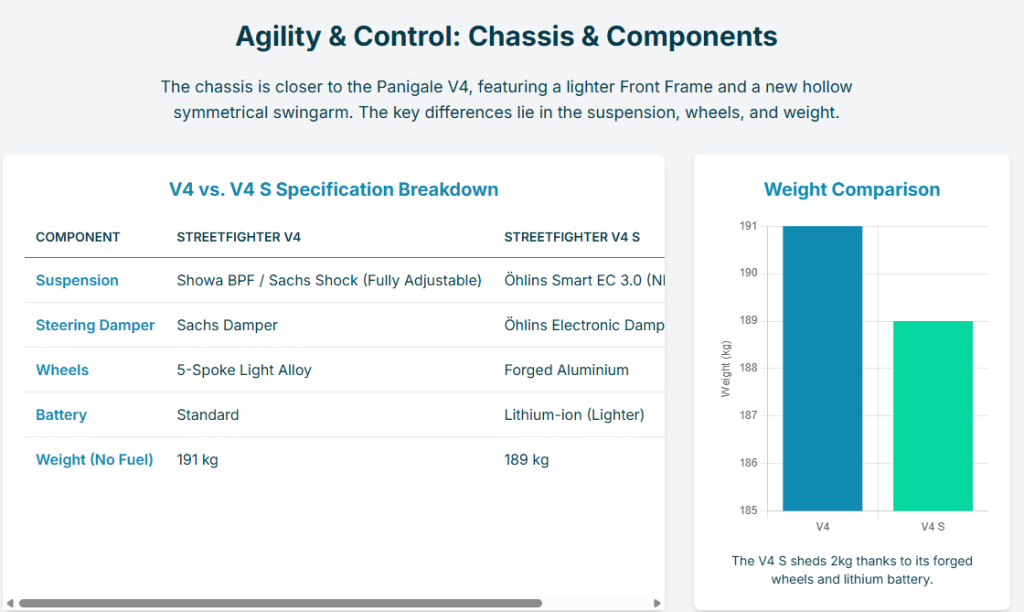
The differentiation between the standard V4 and the premium V4 S is based entirely on the complexity of the chassis components and the reduction of mass.
The standard V4 uses a high-quality but passive suspension setup, including a fully adjustable 43mm Showa Big Piston Fork (BPF), paired with a Sachs shock absorber and a Sachs steering damper . This configuration provides reliable, track-capable performance that requires manual adjustment by the rider or technician.
The V4 S, however, represents the technological peak. It is equipped with the comprehensive Öhlins Smart EC 3.0 semi-active suspension suite, featuring the NIX-30 fork, the TTX36 shock, and an electronic steering damper.12 This Smart EC 3.0 system utilizes event-based software and the innovative Öhlins Based Testing Interface (OBTi) logic.13 This semi-active system continuously and automatically adjusts the damping parameters in milliseconds based on four predefined modes (Track, Dynamic, Comfort, and Low Grip) and real-time kinematic data.12 This adaptability ensures optimal chassis balance and tire contact patch management across a vastly wider range of road and track conditions compared to any passive system.
The other major component justifying the premium price of the V4 S is the reduction in rotational mass. The ‘S’ variant is equipped with high-performance forged aluminum wheels and a lighter lithium battery . The combination of these components provides a significant weight saving of 3.4 kg compared to the aluminum wheels and conventional battery of the standard V4.14 This reduction in unsprung mass and rotational inertia yields a profound, non-electronic, and permanent enhancement to the motorcycle’s dynamic handling. The V4 S will accelerate more efficiently, require noticeably less physical effort to initiate and hold a lean angle, and demonstrate superior nimbleness during rapid direction changes, distinguishing its mechanical responsiveness from the standard model.15
IV. Predictive Electronics and Braking Systems: The DVO and Race eCBS Paradigm Shift
The electronics package on the 2025 Streetfighter V4 is arguably the most advanced element of the platform, marking a shift from traditional reactive stability control systems to predictive, adaptive management, spearheaded by Ducati Corse technology.
A. Ducati Vehicle Observer (DVO): The Predictive Leap
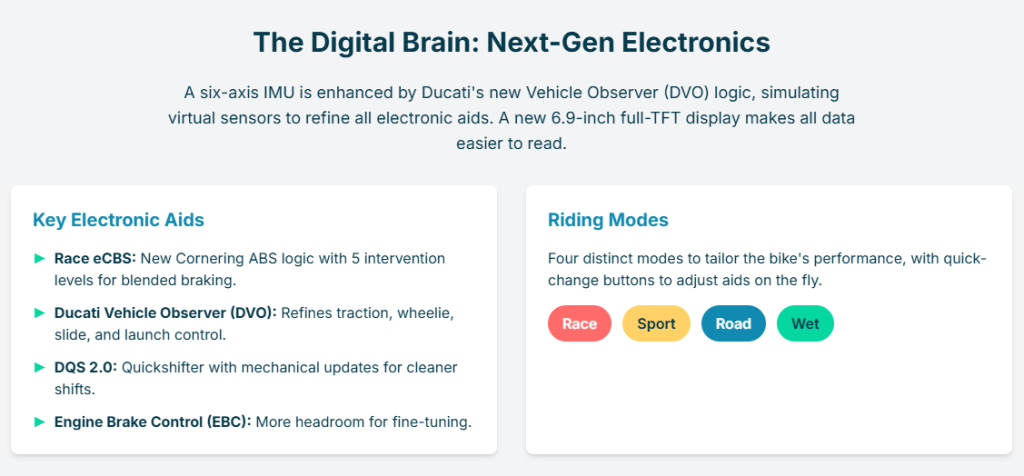
The foundation of the new electronic suite is the six-axis Inertial Measurement Unit (IMU), supplemented by Ducati’s revolutionary Vehicle Observer (DVO) logic . The DVO is an advanced algorithm, refined by Ducati Corse, designed to make the electronic controls predictive rather than purely reactive.13
The DVO logic achieves this by simulating inputs from dozens of “virtual sensors.” It continuously evaluates a large array of kinematic and dynamic parameters to calculate acceleration, forces exerted on the tires, and the precise maximum torque the vehicle can support during every riding phase.16 This capability means the system acts before a slip, wheelie, or loss of grip occurs. This data stream refines all primary electronic controls, including DTC, DWC, Ducati Slide Control (DSC), and Ducati Power Launch (DPL).13 For example, the DVO allows for more accurate identification and precise, almost predictive intervention in Ducati Wheelie Control (DWC).13 This represents a technical quantum leap, allowing the bike’s stability controls to transition from mere damage control (intervening after instability begins) to true performance enhancement (proactively managing optimal tire force before limits are reached).13 This dramatically raises the overall performance ceiling achievable by riders of varied skill levels.
B. Race eCBS and Brembo Hypure Braking Hardware
Braking hardware has been upgraded across both variants. The motorcycles feature the new Brembo Hypure™ front calipers, which are fractionally lighter than the previous Stylema units (by 2 ounces per pair 2) and are designed specifically for improved heat dispersion during high-intensity, repeated braking maneuvers.2
Complementing this advanced hardware is the new Race Electronic Combined Braking System (eCBS) with a Cornering function. The Race eCBS system is engineered to activate and modulate the rear brake automatically when the front brake lever is applied.13 This combined braking action is crucial for stabilizing the chassis under heavy deceleration. By automatically applying a controlled amount of rear brake, the system limits the forward load transfer, preserving the rear wheel’s contact patch and preventing the rear from lifting or “squiggling”.12 This functional stabilization allows the rider to brake later and maintain greater commitment into corners, directly improving corner entry speed.
The system offers five distinct intervention levels, permitting the rider to fine-tune the combined braking effect, ranging from road-friendly stability assistance to a minimal, track-biased setting . Rider feedback suggests that the stabilization benefit provided by Race eCBS under hard braking is substantial, often becoming a feature relied upon heavily for securing the chassis in difficult downhill braking zones.12
C. Rider Interface and Control
The sheer complexity and depth of the electronic adjustments are managed through a sophisticated user interface. The system features four core Riding Modes—Race, Sport, Road, and Wet—each utilizing intelligent presets to pre-populate appropriate settings for power delivery, electronic suspension (on the V4 S), and rider aids.12 This allows the rider to manage the myriad of customizable settings (including five eCBS levels, multiple power modes, and eight levels of DTC/DWC 12) without experiencing “analysis paralysis.”
Further enhancing usability, quick-change buttons are strategically positioned on the left switchgear, allowing riders to adjust crucial parameters like DTC, DWC, DSC, and Engine Brake Control (EBC) dynamically while riding . All performance data and configuration settings are displayed on a new 6.9-inch full-TFT display, which utilizes an 8:3 aspect ratio for superior data layering and readability.
V. Ergonomics, Aerodynamics, and Rider Experience
Ducati implemented several subtle but crucial ergonomic and aerodynamic revisions aimed at enhancing both rider control during extreme use and improving comfort during routine road riding, particularly in challenging climates.
A. Refined Rider Triangle for Control and Comfort
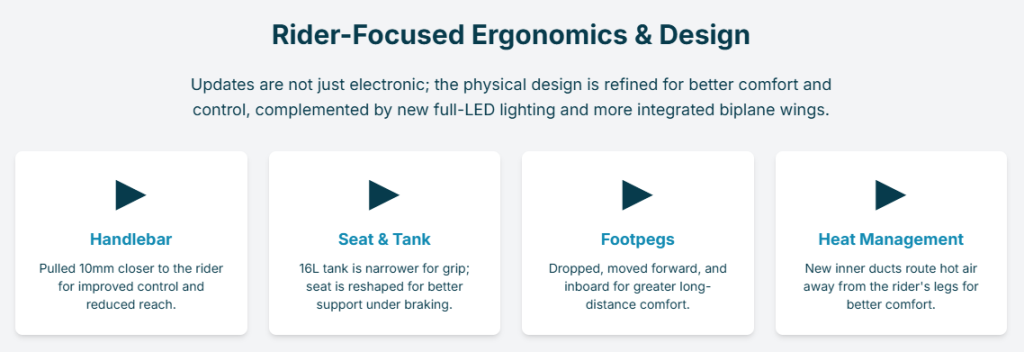
The rider triangle has been carefully recalibrated, maintaining the machine’s aggressive posture while subtly shifting the control points for enhanced usability. The handlebar has been pulled 10 mm closer to the rider . This creates a slightly more upright posture, which improves leverage for swift directional changes and reduces physical strain over extended distances—a significant consideration for a naked motorcycle.
The footpegs have also been dropped, moved slightly forward, and shifted inboard. While the dropped and forward position contributes to general comfort, the inboard shift (0.4 inches) represents an ergonomic compromise. Rider feedback has indicated that at extreme track lean angles, this inward shift can cause the rider’s toes to tuck against the footpeg assembly, potentially constraining the most aggressive hang-off positions.12
The fuel tank has a 16-liter capacity and is narrowed where the rider’s knees grip, working in conjunction with a reshaped seat designed to provide better support under heavy braking and during high-G cornering . This improved “knee grip” is vital for the rider’s sense of security and stability when managing the bike’s high cornering forces.17
B. Aerodynamics and Thermal Management
The forward-slanted biplane wings have been redesigned to integrate more neatly into the motorcycle’s overall styling, while simultaneously providing increased downforce compared to the previous model. This enhanced aerodynamic stability is necessary for controlling the 212 bhp output and keeping the front wheel securely planted during ferocious acceleration runs.
The issue of heat management has been a historical challenge for the V4 platform, particularly in slow-moving traffic and high ambient temperatures. The 2025 model introduces dedicated thermal management innovations to address this. New inner ducts have been added to the design to actively route hot air away from the rider’s legs. These ducts are paired with revised water and oil coolers that improve overall engine cooling.11 This explicit investment in thermal comfort directly addresses a known weakness of the V4 engine in non-race applications, significantly enhancing the machine’s practical usability index for daily commuting in climates like India.12
VI. Market and Financial Analysis in the Indian Context
The launch of the 2025 Streetfighter V4 necessitates a detailed analysis of its competitive standing and the consequential financial burden imposed by the Indian tax structure.
A. Competitive Pricing Structure Analysis
The Ducati Streetfighter V4 platform is unambiguously positioned as the technological leader in the Indian hyper-naked segment, commanding a price premium justified by its race-derived componentry.
Table 1: Competitive Positioning in Indian Hyper-Naked Segment (Ex-Showroom)
| Model | Engine Capacity (cc) | Peak Power (bhp) | Starting Ex-Showroom Price (INR) | Power-to-Price Index (BHP/Lakh INR) |
| Ducati SF V4 (2025) | 1,103 (Desmo) | 212 | ₹ 28,68,600 | 7.39 |
| Ducati SF V4 S (2025) | 1,103 (Desmo) | 212 | ₹ 32,38,400 | 6.55 |
| Kawasaki Z H2 (Base) | 998 (Supercharged) | ~200 | ₹ 25,85,000 | 7.74 |
| BMW S 1000 R | 999 | 167.6 | ₹ 21,27,000 | 7.88 |
Note: Competitive data aggregated from various market sources.18
The data confirms that the Ducati V4, while providing the highest peak horsepower, does not offer the most efficient price-per-horsepower ratio, falling below the Kawasaki Z H2 and the BMW S 1000 R. The BMW S 1000 R, priced nearly Rs 7.4 lakh below the standard Streetfighter V4 19, presents a compelling alternative for performance buyers focused strictly on cost efficiency.
This lower Power-to-Price Index for the Ducati demonstrates that its core value proposition is based on technological sophistication and component quality—specifically the inclusion of the DVO logic, Race eCBS, Öhlins Smart EC 3.0 suspension, and the lightweight Superleggera-derived components.3 Buyers are investing in an uncompromised chassis and predictive electronics package that is fundamentally more advanced than its immediate rivals. Furthermore, the significantly higher pricing of the 2025 models compared to previous iterations (where the V4 S was listed around Rs 27.80 lakh 21) suggests that the cost of integrating the advanced components derived from the V4 R and Superleggera is substantial and directly reflected in the consumer price.
B. Estimated On-Road Pricing (Pune, Maharashtra Case Study)
The financial analysis must account for the high RTO fees and mandatory insurance charges typical of high-value vehicles in India. For Pune, Maharashtra, the road tax for motorcycles with an engine capacity exceeding 299cc (the Desmosedici Stradale is 1,103cc) is fixed at 12% of the vehicle’s ex-showroom price.22
Table 2: Estimated On-Road Price Calculation (Pune, Maharashtra)
| Component | Streetfighter V4 (Rs) | Streetfighter V4 S (Rs) | Calculation Basis |
| Ex-Showroom Price (A) | 28,68,600 | 32,38,400 | |
| RTO/Road Tax (B) | 3,44,232 | 3,88,608 | 12% of Ex-Showroom Price 22 |
| Insurance (C) | 28,686 | 32,384 | Estimated Comprehensive Premium (1% of Ex-Showroom Value) |
| Registration/TCS/Handling (D) | 35,000 | 40,000 | Standardized Logistics/Dealer Fees |
| Estimated On-Road Price (A+B+C+D) | ~32,76,518 | ~37,09,392 | Estimate aligns with market reports [24] |
The heavy 12% RTO tax structure in Maharashtra adds a substantial cost multiplier, increasing the final on-road price by over 12% of the initial ex-showroom cost. For the V4 S, the RTO tax alone amounts to nearly Rs 3.9 lakh. This structure significantly widens the financial gap between the V4 S and the standard V4; the original Rs 3.7 lakh ex-showroom difference expands to approximately Rs 4.3 lakh on-road, requiring the buyer to place a high value on the V4 S’s superior suspension and rotational mass advantages. The final on-road price of nearly Rs 37.1 lakh confirms the Streetfighter V4 S as a luxury investment in the Indian two-wheeled market.
VII. Strategic Conclusion and Recommendations
A. Strategic Verdict: Performance and Technology Superiority
The 2025 Ducati Streetfighter V4 range represents the complete application of the “Fight Formula” concept derived from the Panigale V4. The migration to a predictive electronic architecture via the Ducati Vehicle Observer (DVO) logic, coupled with aggressive chassis optimization (reduced lateral stiffness, hollow swingarm, and race-spec internals from the Superleggera V4), confirms the machine as a technological benchmark in the hyper-naked category.2
The standard V4 is already a formidable machine, but the V4 S variant successfully delivers a performance package mechanically superior to the base model. Its unique features, including the Öhlins Smart EC 3.0 semi-active suspension and, critically, the reduced rotational inertia provided by the forged wheels and lithium battery, yield tangible, kinetic advantages that functionally justify the substantial price premium over the standard V4.14
Ducati’s pricing strategy is clear: the Streetfighter V4 is positioned as the technological leader, not the price leader. Its ability to integrate cutting-edge components and achieve essential compliance (Euro5+, E20) while maintaining this extreme performance threshold is its primary competitive edge against segment rivals like the BMW S 1000 R and Kawasaki Z H2, which offer high power but lack the sophisticated, race-derived electronic and chassis convergence found in the V4 platform.
B. Key Recommendations for Market Strategy
- Harness E20 Compliance as a Reliability Assurance: Ducati India should aggressively market the certified E20 compliance. This feature should be framed not merely as a regulatory requirement, but as a critical, long-term reliability feature that protects the owner’s substantial investment and minimizes potential degradation issues associated with non-compliant superbikes using E20 blended fuel.7
- Ensure Rigorous Technical Support for Advanced Electronics: Given the integration of highly complex systems such as the DVO, the OBTi logic governing the Öhlins suspension, and the customizable Race eCBS, robust technical training for dealership service personnel is non-negotiable. Proper calibration and maintenance of these predictive, multi-level electronic aids are essential for maintaining the motorcycle’s performance and safety profile, especially when owners install track-only accessories like the high-performance Akrapovic exhaust system.5
- Emphasize Thermal Management Success: Communications should highlight the targeted improvements in rider comfort, specifically the addition of inner ducts and revised cooling systems.11 This addresses a known functional drawback of the V4 engine in the previous generation and demonstrates Ducati’s responsiveness to rider feedback and the demands of the demanding Indian climate.
Sources
- Bmw S 1000 R vs Ducati Streetfighter V4 – Which is Better? – Bike Junction, accessed on November 1, 2025, https://thebikejunction.com/compare-bikes/bmw-s-1000-r-vs-ducati-streetfighter-v4
- New Ducati Streetfighter V4: the highest performing Fight Formula ever, accessed on November 1, 2025, https://www.ducati.com/us/en/news/new-ducati-streetfighter-v4-the-highest-performing-fight-formula-ever
- Ducati Streetfighter V4 (2025) – Technical Review – Bennetts Insurance, accessed on November 1, 2025, https://www.bennetts.co.uk/bikesocial/reviews/bikes/ducati/streetfighter-v4-v4s-2025-review
- Complete titanium exhaust system. | Exhaust systems | accessory Ducati, accessed on November 1, 2025, https://www.ducati.com/in/en/accessories/ACC011056
- Akrapovic Racing Full Titanium High Exhaust System for 2025+ Ducati V4 – Pit Lane Moto, accessed on November 1, 2025, https://www.pitlanemoto.com/products/akrapovic-racing-full-titanium-high-exhaust-system-for-2025-ducati-v4-v4s
- Where can you buy ethanol free petrol in Pune? – The Indian Express, accessed on November 1, 2025, https://indianexpress.com/article/cities/pune/ethanol-free-petrol-pune-10222703/
- E20 fuel & older motorcycles in India: What riders must know, accessed on November 1, 2025, https://www.bikeleague.in/motorcycle-articles/motorcycle-editorials/e20-fuel-older-motorcycles-in-india-what-riders-must-know/
- Effects of E20 Fuel on Motorcycles – Bikester Global, accessed on November 1, 2025, https://bikesterglobal.com/blogs/motorcycle-blogs/effects-of-e20-fuel-on-motorcycles
- 2025 Ducati Streetfighter V4 S Review – Cycle News, accessed on November 1, 2025, https://www.cyclenews.com/2025/04/article/2025-ducati-streetfighter-v4-s-review/
- 2025 Ducati Streetfighter V4: The Naked Panigale We’ve Been Waiting For – YouTube, accessed on November 1, 2025, https://www.youtube.com/watch?v=TpoHovnkX5Q
- Streetfighter V4 2025 Chassis & Ergonomics | Precision Meets Comfort | Ducati Motorcycles USA, accessed on November 1, 2025, https://www.ducati.com/us/en/bikes/streetfighter/streetfighter-v4/chassis-and-ergonomics
- 2025 Ducati Streetfighter V4 S first ride review – RevZilla, accessed on November 1, 2025, https://www.revzilla.com/common-tread/2025-ducati-streetfighter-v4-s-first-ride-review
- Cutting-edge electronics – Ducati Streetfighter V4, accessed on November 1, 2025, https://www.ducati.com/ww/en/bikes/streetfighter/streetfighter-v4/electronics
- Streetfighter V4 SP2 Ducati – The Ultimate Formula, accessed on November 1, 2025, https://www.ducati.com/ww/en/bikes/streetfighter/streetfighter-v4-sp2
- Ducati Streetfighter V4 SP2 – Riding Experience, accessed on November 1, 2025, https://www.ducati.com/us/en/bikes/streetfighter/streetfighter-v4-sp2
- Electronics Ducati Panigale V4, accessed on November 1, 2025, https://www.ducati.com/ww/en/bikes/panigale/panigale-v4/electronics
- Review Ducati Streetfighter V4S – This is how it feels to ride 214 hp! – YouTube, accessed on November 1, 2025, https://www.youtube.com/watch?v=A0ByOANy6MM
- BMW S 1000 R vs Ducati Streetfighter V4 – Know Which Is Better! – BikeWale, accessed on November 1, 2025, https://www.bikewale.com/compare-bikes/bmw-s-1000-r-vs-ducati-streetfighter-v4/
- BMW S 1000 R Bike – 170 HP Power, Dynamic Traction, M Package Option, accessed on November 1, 2025, https://www.bmw-motorrad.in/en/models/roadster/s1000r.html
- Kawasaki Z H2 Price – Mileage, Images, Specs & Reviews – Bike Junction, accessed on November 1, 2025, https://thebikejunction.com/kawasaki-bikes/z-h2
- Ducati Streetfighter V4 Price in Pune (On Road) – BikeDekho, accessed on November 1, 2025, https://www.bikedekho.com/ducati/streetfighter-v4/price-in-pune
- Road Tax in Maharashtra: Two-Wheeler Rates and Rules – ICICI Lombard, accessed on November 1, 2025, https://www.icicilombard.com/blogs/two-wheeler-insurance/mb/bike-road-tax-in-maharashtra
- Maharashtra Road Tax: Calculations and Online Payment Explained – Digit Insurance, accessed on November 1, 2025, https://www.godigit.com/road-tax/maharashtra-road-tax
Our Social Media Handles
- Instagram : LivingWithGravity
- Medium : Akash Dolas
- YouTube Channel : Gear and Shutter
- Facebook : LivingWithGravity