








I. Executive Summary
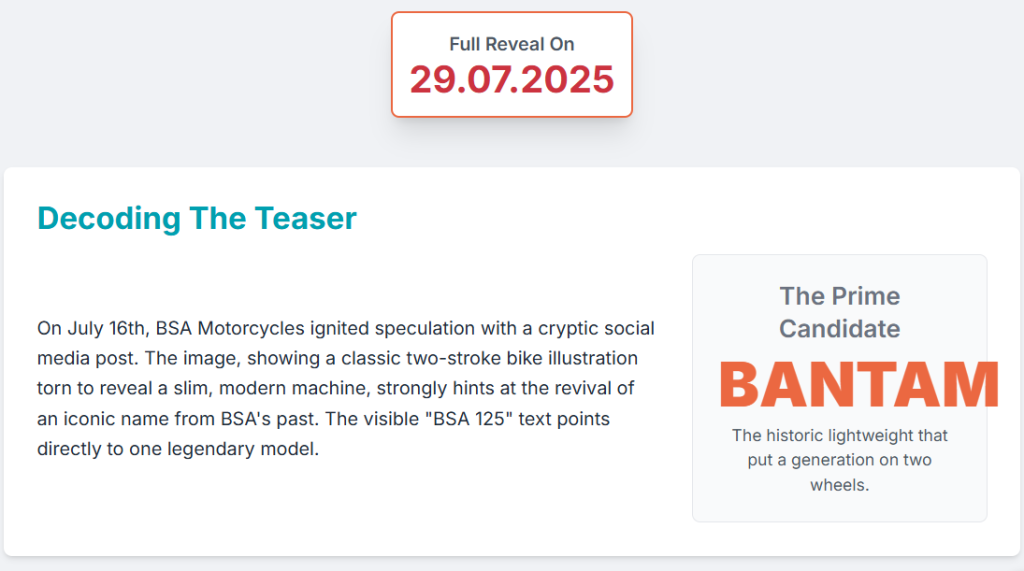
BSA Motorcycles, under the strategic stewardship of Classic Legends, a subsidiary of the Mahindra Group, has successfully re-established its presence in the global motorcycle market. This resurgence is characterized by a strong emphasis on leveraging its profound British heritage. Following the successful reintroduction of the Gold Star 650 and the recent unveiling of the B65 Scrambler, the company’s social media teaser, “We’re going back to the future on 29.07.25,” signals the imminent launch of a third, distinct model. This forthcoming launch is pivotal for BSA, as it represents a crucial step in diversifying its product portfolio and enhancing its overall market penetration.
A comprehensive analysis of prevailing market trends, BSA’s extensive historical model range, and Classic Legends’ overarching strategic direction strongly indicates that the upcoming third model will be a contemporary reincarnation of the iconic BSA Bantam. This new Bantam is anticipated to be a lightweight, entry-level, four-stroke, single-cylinder motorcycle, most likely utilizing an existing or developing engine platform from Classic Legends’ current Jawa/Yezdi lineup, such as the 334cc or the newly announced 450cc engine. Its strategic positioning will target the rapidly expanding sub-500cc retro motorcycle segment, aiming to appeal to a broader demographic, including riders holding A2 licenses in European markets, and directly competing with established players like Royal Enfield and the forthcoming Triumph models in this category.
II. Introduction: BSA’s Strategic Revival and the “Back to the Future” Teaser
Context of BSA’s Ownership under Classic Legends (Mahindra Group) and its Focus on Heritage
BSA, a legendary British motorcycle marque with roots dating back to 1861, is undergoing a significant revival orchestrated by the Indian conglomerate Mahindra & Mahindra Group.1 This strategic initiative is executed through its dedicated subsidiary, Classic Legends, which specializes in resurrecting iconic motorcycle brands.2 The core philosophy underpinning this revival is a meticulous blend of historical DNA with cutting-edge modern engineering and manufacturing capabilities.1 This commitment is evident in the company’s stated aim to produce “retro motorcycles, staying true to the company’s glorious heritage” 2, a principle reflected in the design aesthetics, marketing campaigns, and overall product strategy of their current offerings. This approach aims to tap into the nostalgia of seasoned enthusiasts while attracting new riders with timeless designs and modern reliability.
Overview of Current Models: Gold Star 650 and B65 Scrambler
The inaugural product of BSA’s modern revival was the Gold Star 650, a quintessential modern classic motorcycle. It is powered by a 652cc liquid-cooled, single-cylinder DOHC engine, which generates a robust 45 horsepower at 6,500 rpm and 55 Nm of torque at 4,000 rpm.4 This model seamlessly integrates classic aesthetics with contemporary reliability and performance, featuring premium components such as Brembo brakes, Pirelli tyres, and Excel rims.4 The Gold Star has achieved considerable market success, notably becoming the top-selling model in the ‘modern classic’ segment in the UK, with 253 units registered in March of the current year alone.7 Its global footprint continues to expand, having launched in Europe, Turkey, New Zealand, the Philippines, and recently India, with further expansion plans for the US, Australia, and Japan.1
Building upon the success of the Gold Star, the B65 Scrambler was officially unveiled and is slated to be available in showrooms by June 2025.9 This variant incorporates specific scrambler design elements, including a larger 19-inch front wheel, Pirelli Scorpion Rally STR tires, a raised front mudguard, and a distinctive high-mounted exhaust system.10 It retains the 652cc engine, albeit tuned to produce 44.4 horsepower, and is equipped with Brembo brakes and ABS for enhanced safety.10 The fact that the B65 Scrambler had its official debut and public appearances in early 2025 (February 2025 in London and Lyon) 12 definitively confirms that it is not the model scheduled for the July 29, 2025 launch, indicating that the upcoming announcement pertains to a distinct and new offering.
Interpretation of the “We’re Going Back to the Future on 29.07.25” Teaser and the Significance of the Launch Date
The evocative phrase “We’re going back to the future” serves as a powerful marketing statement and a clear indication of BSA’s overarching strategy: to revive another iconic model from its illustrious past, meticulously integrating modern technology and engineering advancements while faithfully retaining the classic aesthetic that defines its brand.2 This approach is highly resonant with the broader trend observed across the motorcycle industry, which is experiencing a distinct shift towards retro-styled machines that evoke a sense of heritage and nostalgia.7
The specific date, “29.07.25” (July 29, 2025), is designated for the official unveiling of this new, third model. Considering the established presence of the Gold Star and the confirmed showroom launch of the B65 Scrambler in June 2025 10, this July date is unequivocally reserved for a distinctly new offering, rather than merely a variant or an extended rollout of an already announced model. This timing suggests a significant product announcement that will further broaden BSA’s market appeal and diversify its portfolio.
III. Decoding the Motif: The Case for the BSA Bantam
Analysis of Trademark Applications and Historical Model Names (Bantam, Lightning, Thunderbolt)
BSA has strategically undertaken efforts to secure trademark rights for several of its historically significant model names, including ‘Bantam’, ‘Lightning’, and ‘Thunderbolt’.7 This proactive measure provides strong and direct clues regarding the company’s future product development pipeline and potential model introductions. Historically, the original Lightning and Thunderbolt models were characterized as 650cc parallel-twin motorcycles.7 Given that BSA has already successfully launched the 650cc Gold Star single and the B65 Scrambler (which also utilizes a 650cc engine), introducing another 650cc twin at this juncture could potentially lead to internal product competition or dilute the brand’s current strategic focus on its single-cylinder 650cc offerings.7 While a 650cc twin remains a plausible future addition to the lineup, its introduction as the immediate “third model” does not align as strongly with the narrative of filling a new, distinct market segment.
Detailed Argument for the Bantam as the Most Probable Motif, Given its Historical Role as an Entry-Level, Lightweight Model
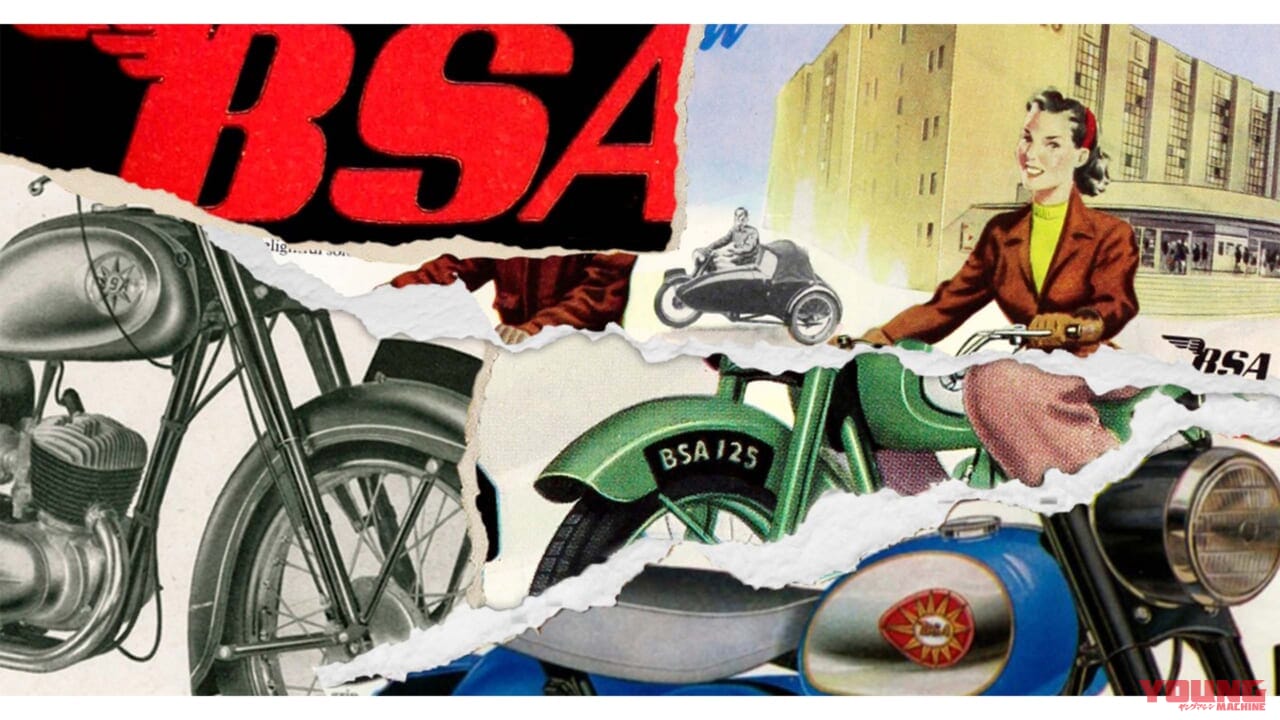
The Bantam holds a unique and significant place in BSA’s history as its “lightweight, entry-level model”.7 It enjoyed an exceptionally long and prolific production run from 1948 to 1971 7, becoming the best-selling small motorcycle of the 1950s.14 Its widespread popularity and iconic status, including extensive use by the Royal Post Office 15, make it an exceptionally strong candidate for a modern revival. The sheer volume of Bantams produced and their ubiquitous presence in post-war Britain cemented their place in motorcycling folklore, offering a deep well of nostalgia for the brand to draw upon.
BSA’s current product portfolio primarily consists of the 650cc Gold Star and its Scrambler variant. Examining the broader motorcycle market reveals a significant and continuously expanding segment for sub-500cc retro motorcycles, a category particularly appealing to riders with A2 licenses in European markets.7 This segment is currently dominated by Royal Enfield with its highly successful 350cc singles, and is poised for increased competition with the anticipated entry of Triumph’s 250-400cc models.7 By introducing a modern Bantam within this lower displacement category, BSA can strategically expand its market reach. This move allows the company to attract new riders who may find the 650cc models too powerful or expensive, and to compete directly in a highly lucrative and growing segment without the risk of cannibalizing sales from its existing 650cc offerings. This represents a classic and effective product strategy aimed at segment diversification and market share expansion.
The historical Bantam’s reputation for affordability, exceptional fuel efficiency, and overall accessibility 15 aligns perfectly with the current market trend favoring more budget-friendly retro machines.7 This positioning would make a new Bantam an attractive option for a broad spectrum of riders, from urban commuters to weekend enthusiasts. The anecdotal evidence from the Visordown article, where the author fondly recalls the BSA Bantam 125 as their first motorcycle, powerfully reinforces the model’s enduring nostalgic appeal and widespread recognition.11 This emotional connection is a valuable asset that BSA can effectively capitalize on in its marketing and brand narrative.
IV. The Bantam Legacy: A Historical Perspective
Origins and Evolution of the Original BSA Bantam (1948-1971)
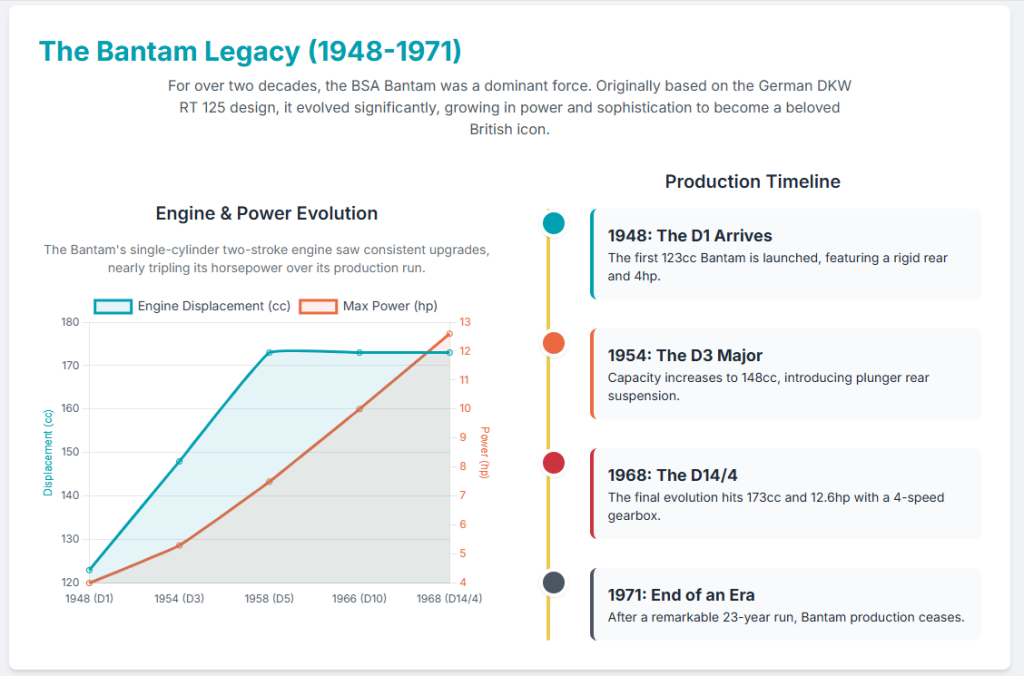
The foundational design of the BSA Bantam was derived from the German DKW RT 125, a blueprint acquired by the Allied powers as part of war reparations following World War II.7 BSA ingeniously “mirror-imaged” this design, meticulously converting all metric measurements to imperial units and repositioning the gearchange to the right side of the motorcycle, thereby conforming to the prevailing standards of other British motorcycles of that era.13 The inaugural model, the D1, was first launched in 1948 for international markets and subsequently in 1949 within the UK. The Bantam enjoyed an exceptionally long production run, continuing until 1971.13
Key Characteristics: 2-Stroke Engine, Various Displacements (123cc, 148cc, 173cc), Design Features, and Market Impact
The original Bantam was powered by a single-cylinder two-stroke engine. Its displacement evolved over its production life, starting at 123cc for the D1, increasing to 148cc for the D3 Major, and further expanding to 173cc for the D5 and subsequent models.13 Correspondingly, the power output saw a progressive increase, from an initial 4 bhp to a peak of 12.6 bhp in later variants.13
Early D1 models featured a rigid rear suspension and unsprung, undamped telescopic front forks, which were rudimentary by modern standards. Over time, the design evolved significantly to incorporate more advanced suspension systems, including plunger and then swinging-arm rear suspensions, along with hydraulically damped front forks for improved ride comfort and handling.13 The transmission initially consisted of a three-speed gearbox, which was later upgraded to a four-speed unit in later models.13
Distinctive design elements included a characteristic “fishtail” silencer on early models, deeply-valanced mudguards that provided extensive coverage, and a diverse range of color schemes introduced throughout its production run, such as the iconic Mist Green, Black, Grey, Maroon, and the striking Orange and White combination for the off-road Bushman variant.13 The Bantam gained widespread acclaim for its exceptional fuel consumption, often achieving between 100-125 miles per gallon, with some advertisements even touting figures as high as 200 mpg.15 This, combined with its affordability (initial UK price of £60 plus purchase tax) 17, made it an “instant hit” globally.17 Its inherent versatility allowed it to be widely adopted for various purposes, including competitive trials events and as a workhorse for the British Post Office, which ordered thousands of Bantams in the 1950s and 60s.14
Historical BSA Bantam Model Evolution: Key Specifications and Features
The following table provides a concise overview of the Bantam’s extensive development throughout its production history. This detailed historical context is essential for fully understanding the “Back to the Future” motif that BSA is employing, as it allows for a clear appreciation of how a modern Bantam would represent a significant yet respectful evolution of this storied legacy. Furthermore, it facilitates quick comparisons between different historical variants and sets a well-informed foundation for the subsequent discussion on modern adaptations and engineering choices.
| Model Name | Years Produced | Engine Capacity (cc) | Max Power (bhp) | Top Speed (mph) | No. of Gears | Rear Suspension Type | Key Distinguishing Features |
| D1 | 1948–1963 | 123 | 4 | 45 | 3 | Rigid (1948–56), Plunger (1953–63) | Original design, “fishtail” silencer, Mist Green only |
| Bantam de luxe/BD1 | 1949–1953 | 123 | 4 | 45 | 3 | Rigid | Limited edition, black enamel, chrome details, leg shields |
| D3 Major | 1954–1957 | 148 | 5.3 | 50 | 3 | Plunger (1954–56), Swinging arm (1956–57) | First development, increased bore, enlarged fins, dualseat standard, new colors |
| D5 Super | 1958 | 173 | 7.5 | 57 | 3 | Swinging arm | Lengthened rear section, Amal Monobloc carb, larger rounded fuel tank, maroon with ivory panels |
| D7 | 1959-1967 | 173 | 7.4 | 57 | 3 | Swinging arm | New frame design, hydraulically damped front fork, 18-inch wheels, 5-inch brakes |
| D10 (Sports, Supreme, Silver, Bushman) | 1966-1967 | 173 | 10 | 60 | 3 (Supreme, Silver), 4 (Sports, Bushman) | Swinging arm | First 4-speed (Sports, Bushman), separate headlamp (Sports, Bushman), off-road focus (Bushman) |
| D14/4 & B175 | 1968-1971 | 173 | 12.6 | 65 | 4 | Swinging arm | Revised engine, central spark plug, higher compression, larger exhaust |
Note: Data compiled from.13
V. Modern Adaptation: Engineering the New Bantam
Challenges of Modern 2-Stroke Engines and Why a New Bantam Would be 4-Stroke
While the original Bantam’s two-stroke engine design was characterized by its simplicity and impressive power-to-weight ratio for its time, it poses significant and largely insurmountable challenges for modern motorcycle manufacturing due to increasingly stringent global environmental regulations.18 Despite advancements in electronic fuel injection and oil mixing technologies for 2-strokes, these engines still face considerable hurdles regarding their emissions profile, notably unburned hydrocarbons, carbon monoxide, and particulate matter.18 They also tend to be noisier and less fuel-efficient compared to modern 4-stroke counterparts.18 Regulatory bodies worldwide have either phased out or severely restricted the use of 2-stroke engines in many applications, particularly for road-legal vehicles.19
To successfully meet contemporary emission standards (such as Euro 5 or BS6) and to align with consumer expectations for reliability, smoothness, and fuel economy, a new Bantam must be powered by a 4-stroke engine. This is explicitly stated in the available information, noting that “any future Bantam clearly won’t be a two-stroke”.7 This fundamental shift represents a necessary departure from the original’s mechanical heart but is absolutely crucial for the commercial viability and widespread market acceptance of a new Bantam in the 21st century. The key challenge for BSA will be to meticulously design and engineer the new model in such a way that it retains the “spirit,” “character,” and nostalgic appeal of the original Bantam, despite this significant underlying mechanical change. Four-stroke engines inherently offer superior fuel efficiency, significantly lower emissions, smoother operational characteristics, and generally greater durability, making them the undisputed industry standard for modern passenger vehicles and motorcycles.18
Exploration of Potential Engine Platforms from Classic Legends’ Existing Portfolio
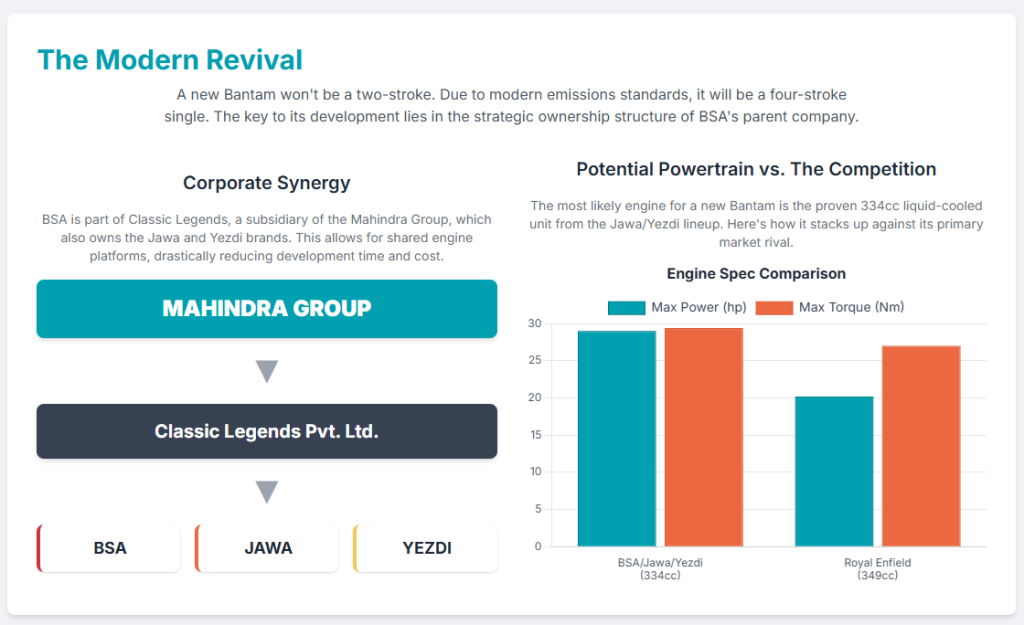
Classic Legends already possesses a robust and proven portfolio of modern single-cylinder, liquid-cooled, DOHC engines that are currently utilized in its Jawa and Yezdi motorcycle ranges.3 The Jawa 350 and various Yezdi models (Roadster, Scrambler, Adventure) are powered by a 334cc liquid-cooled engine 3, which produces approximately 22-29 PS and 28-30 Nm of torque. This engine capacity aligns very well with the historical Bantam’s role as a smaller, accessible motorcycle and would enable the new model to directly compete with Royal Enfield’s popular 350cc offerings.7
Furthermore, Classic Legends has officially confirmed that it is actively developing a “new 450cc engine platform” specifically designed for the competitive sub-500cc segment.16 This larger displacement platform would allow for higher performance capabilities and potentially a more premium positioning within the entry-level segment, enabling the new Bantam to effectively compete with upcoming 400cc Triumphs and other mid-capacity motorcycles.7
Classic Legends’ strategic ownership of the Jawa and Yezdi brands, combined with their existing and developing engine platforms (295cc, 334cc, and the upcoming 450cc), provides a substantial strategic advantage for BSA. Instead of incurring the significant time and cost associated with developing an entirely new engine from scratch, BSA can efficiently leverage these already proven, modern, and emissions-compliant powerplants.3 This shared platform approach offers multiple benefits: it drastically reduces research and development costs, significantly accelerates the time-to-market for new models, and streamlines manufacturing processes. This efficiency enables BSA to rapidly introduce a highly competitive product into the sub-500cc segment. This is a clear example of how a diversified parent company’s portfolio can generate powerful cross-brand efficiencies, facilitating rapid expansion and market responsiveness.
Discussion of Expected Modern Features While Retaining Retro Aesthetics
Consistent with the approach taken for the Gold Star 6, the new Bantam-inspired model would undoubtedly integrate essential modern features designed to enhance safety, reliability, and rider convenience. These would include standard fitment of dual-channel ABS (Anti-lock Braking System), precise electronic fuel injection for optimal performance and efficiency, and a reliable electric start system.6
The suspension system would represent a significant upgrade from the original Bantam’s rudimentary rigid or plunger designs. It is expected to feature modern telescopic forks at the front and twin shock absorbers at the rear, likely with adjustable preload, to provide vastly improved ride comfort, superior handling dynamics, and better absorption of road imperfections.4
Crucially, the design would meticulously retain the “old-school style” and embody the “glorious heritage” of the BSA brand.2 This would manifest in design elements such as classic wire-spoke wheels, a traditional round headlight design, and potentially a “pea shooter-style exhaust” 6 adapted to suit the smaller engine’s characteristics while still delivering a distinctive sound. Modern conveniences like digital-analogue instrumentation 5 and a USB charging port 1 would also be seamlessly integrated to cater to contemporary rider needs without compromising the retro aesthetic.
VI. Market Positioning and Competitive Landscape
How the New Bantam Would Fit into BSA’s Product Hierarchy
The introduction of a Bantam-inspired model would strategically position it as BSA’s definitive entry-level offering, slotting in below the more premium Gold Star 650 and the B65 Scrambler in the brand’s product hierarchy.7 This creates a clear and logical product ladder, allowing BSA to effectively cater to a broader spectrum of riders, ranging from new motorcyclists entering the market to experienced riders seeking a more accessible, lightweight, or urban-friendly retro motorcycle. Its anticipated sub-500cc engine displacement (e.g., 334cc or 450cc) is a critical factor, as it would render the motorcycle A2 license-friendly in crucial European markets.7 This is a vital segment for attracting younger riders and expanding BSA’s overall market share by tapping into a demographic that may otherwise be excluded from higher-displacement models.
Analysis of Key Competitors in the Sub-500cc Retro Segment
The primary and most formidable competitor for the new Bantam would be Royal Enfield’s highly successful 350cc lineup, which includes popular models such as the Classic 350, Bullet 350, and Meteor 350.7 These motorcycles currently dominate the middleweight retro segment in terms of sales volume and market presence. Triumph’s upcoming 250-400cc singles 7 will also emerge as direct rivals, introducing another iconic British brand into this fiercely competitive space and intensifying the battle for market share. Internally, the new Bantam would complement, and potentially experience some overlap with, Classic Legends’ own Jawa and Yezdi 350cc models.16 The strategic challenge for BSA will be to effectively differentiate the new Bantam through distinct styling, brand prestige, unique rider experience, and possibly specific feature sets, to justify its position and appeal alongside its stablemates within the Classic Legends portfolio.
BSA’s Global Expansion Strategy and Manufacturing Footprint
BSA’s global market strategy is characterized by a dual approach: design and research & development activities are primarily conducted in the UK, while initial manufacturing operations are centered at Classic Legends’ Pithampur plant in Madhya Pradesh, India.7 This hybrid model leverages cost efficiencies in production while maintaining a strong connection to its British design heritage. Significantly, there are confirmed plans to establish a new manufacturing facility in the UK 8, which underscores BSA’s long-term commitment to its British roots and could potentially enhance perceptions of quality and authenticity in key international markets. The Gold Star’s ongoing global expansion – already launched in Europe, Turkey, New Zealand, the Philippines, and recently India, with imminent plans for the US, Australia, and Japan 1 – demonstrates BSA’s ambitious market reach. The new Bantam would likely follow a similar, phased international rollout, leveraging the established distribution channels.
Comparative Analysis: BSA’s New Model vs. Key Competitors (Estimated Specifications & Market Positioning)
This table provides a clear, concise, and direct side-by-side comparison of the anticipated new BSA Bantam with its most significant direct market rivals. It enables industry stakeholders, potential buyers, and competitors to quickly assess the new model’s competitive strengths and weaknesses based on critical performance indicators, design philosophy, and intended market positioning. This structured comparison is instrumental in understanding the strategic implications of BSA’s entry into this highly competitive segment and how the brand intends to carve out and capture its share of the market.
| Motorcycle Model | Manufacturer/Brand | Estimated Engine Capacity (cc) | Estimated Max Power (PS/bhp) | Estimated Max Torque (Nm/ft-lb) | Target Audience/License Compatibility | Key Differentiating Factor | Estimated Price Range (£/₹) |
| New BSA Bantam | BSA | 334 / 450 | 29 / 40 | 29 / 35 | Entry-level, A2-friendly, Urban commuter, Nostalgia-driven | Pure British heritage, iconic name revival, accessible retro | £4,500 – £5,500 / ₹2.0 – ₹2.5 Lakh |
| Royal Enfield Classic 350 | Royal Enfield | 349 | 20.2 | 27 | Mass-market classic, urban/touring, A2-friendly | Established market leader, strong dealer network, accessible price | £4,579 / ₹1.93 – ₹2.25 Lakh |
| Triumph Speed 400 | Triumph | 398 | 40 | 37.5 | Premium entry-level, performance-oriented, A2-friendly | Premium brand, modern performance with classic styling, agile handling | £4,995 / ₹2.33 Lakh |
| Jawa 350 | Jawa | 334 | 22.57 | 28.1 | Classic cruiser, urban commuting, A2-friendly | Distinct exhaust note, retro aesthetic, comfortable ride | ₹1.99 – ₹2.29 Lakh |
| Yezdi Roadster | Yezdi | 334 | 29 | 29.4 | Neo-retro roadster, versatile, A2-friendly | Modern features, aggressive styling, comfortable for long rides | ₹2.06 – ₹2.18 Lakh |
Note: Estimated specifications for New BSA Bantam based on Classic Legends’ existing/developing platforms.16 Competitor specifications are based on available data.7 Triumph Speed 400 specifications are inferred as typical for its class within the competitive landscape.
VII. Strategic Implications and Future Outlook
The Role of the New Model in Strengthening BSA’s Brand and Market Share
The introduction of a Bantam-inspired model will be a transformative step for BSA, significantly broadening its market appeal beyond the more niche and premium 650cc segment. By offering an accessible, A2-friendly option, BSA can effectively attract a new generation of riders, including those with restricted licenses, as well as seasoned motorcyclists seeking a more manageable, lighter, or urban-friendly retro bike. This strategic expansion will directly contribute to a substantial increase in BSA’s overall market share and sales volume.
The BSA Gold Star, while successful, is positioned as a premium offering, primarily appealing to a specific niche of enthusiasts who appreciate its heritage and performance. The original Bantam, however, was historically a mass-market phenomenon, known for its accessibility and widespread adoption.14 By reviving the Bantam as an entry-level model, BSA strategically makes its brand accessible to a much wider and more diverse audience, including younger riders, budget-conscious consumers, and those new to motorcycling. This move is not merely about expanding sales volume; it profoundly reinforces BSA’s historical legacy as a brand that catered to all riders, not exclusively the high-performance or luxury segments. This foundational approach helps build brand loyalty from the ground up, ensuring long-term sustainability, broader market recognition, and a deeper connection with a new generation of motorcyclists.
Potential for Further Model Diversification Based on This New Platform
Just as the Gold Star platform has successfully spawned the B65 Scrambler variant 10, the new Bantam platform holds immense potential to serve as the foundation for further model diversification. Historically, the Bantam itself was produced in numerous iterations, including the “Sports” and “Bushman” (off-road) models 13, demonstrating its inherent adaptability. Classic Legends has explicitly stated its ambitious plan to introduce “four new motorcycles in FY26” 16, indicating a rapid and aggressive expansion strategy. A new Bantam platform, with its inherent versatility and potential for different body styles, would be an ideal candidate for this accelerated product rollout. This could include the development of a “Scrambler” or “Roadster” variant of the new Bantam, leveraging the same core engine and chassis with distinct styling, ergonomics, and feature sets, mirroring the successful platform strategy already employed with the Jawa/Yezdi models.26
Classic Legends’ established and successful strategy with the Jawa and Yezdi brands involves building multiple distinct models on shared engine platforms.16 Extending this proven approach to BSA with a new Bantam platform (whether it utilizes the 334cc or 450cc engine) allows for highly efficient and cost-effective development of a diverse product line. This could encompass a range of Bantam variants, such as a classic Bantam roadster, a more rugged Bantam scrambler, or even a stylish Bantam café racer. This strategy not only maximizes the return on investment for the underlying engine platform but also facilitates the creation of a more comprehensive and appealing BSA ecosystem. By offering riders a broader array of choices within the brand, spanning different price points and stylistic preferences, Classic Legends can foster greater brand loyalty and achieve deeper market penetration across various rider segments.
Overall Outlook for BSA and Classic Legends in the Global Motorcycle Market
BSA, under the strategic direction of Classic Legends, is exceptionally well-positioned for significant and sustained growth in the global motorcycle market. Their methodical approach, which combines the revival of iconic brand names with modern, reliable engineering, coupled with a robust global expansion strategy and a consistent focus on refining existing products 16, places them as a formidable contender in the highly competitive retro motorcycle segment.
The forthcoming introduction of the Bantam will undoubtedly be a pivotal moment for the brand. It will serve as a clear demonstration of BSA’s capability to innovate within its rich heritage and effectively compete across various market segments, thereby solidifying its position as a serious and long-term player against established industry leaders like Royal Enfield and the re-emerging Triumph singles. Classic Legends’ ongoing commitment to expanding its dealership network from the current 350 to 500 outlets 16 and continuously improving its customer assurance programs 27 further underscores a robust and forward-looking long-term strategy, indicating a strong foundation for sustained market presence and continued growth in the global motorcycle industry.
VIII. Conclusion
The analysis strongly indicates that the BSA Motorcycles teaser, “We’re going back to the future on 29.07.25,” points to the reintroduction of the iconic BSA Bantam. This strategic move aligns with BSA’s core philosophy of blending heritage with modern engineering and fills a critical market gap below its current 650cc offerings. The new Bantam is expected to be a four-stroke, single-cylinder motorcycle, likely utilizing Classic Legends’ existing 334cc or developing 450cc engine platforms, ensuring compliance with modern regulations and leveraging cross-brand efficiencies.
Its positioning as an accessible, A2-license-friendly model will enable BSA to significantly expand its market reach, attract new demographics, and directly compete in the burgeoning sub-500cc retro segment against rivals like Royal Enfield and Triumph. This launch is not merely a product introduction but a strategic reinforcement of BSA’s historical legacy as a brand for all riders, laying the groundwork for further model diversification and solidifying Classic Legends’ formidable presence in the global motorcycle market.
Sources
- Legendary marque BSA launches Gold Star 650 motorcycle in India – The World’s Most Eligible Single is Here! – Mahindra, accessed July 25, 2025, https://www.mahindra.com/news-room/press-release/legendary-marque-bsa-launches-gold-star-650-motorcycle-in-india-the-worlds-most-eligible-single-is-here
- BSA Motorcycles To Make A Comeback, Company Teases Launch On Social Media, accessed July 25, 2025, https://www.zigwheels.com/news-features/general-news/bsa-motorcycles-to-make-a-comeback-company-teases-launch-on-social-media/43972/
- Classic Legends ushers in next gen Jawa Motorcycles – Mahindra, accessed July 25, 2025, https://www.mahindra.com/news-room/press-release/classic-legends-ushers-in-next-gen-jawa-motorcycles
- BSA Gold Star 650 Price, Colors, Specifications, accessed July 25, 2025, https://www.bsamotorcycles.in/bsa-goldstar/
- BSA Goldstar – BSA Motorcycles, accessed July 25, 2025, https://www.bsacompany.co.uk/bsa-goldstar/
- 2022-on BSA Gold Star review: single cylinder simplicity – Motorcycle News, accessed July 25, 2025, https://www.motorcyclenews.com/bike-reviews/bsa/gold-star/2022/
- What’s next from BSA? – Bennetts Insurance, accessed July 25, 2025, https://www.bennetts.co.uk/bikesocial/news-and-views/news/2023/april/bsa-bantam-lightning-thunderbolt
- BSA Gold Star 650 Heading To The USA & Japan Soon – ACKO Drive, accessed July 25, 2025, https://ackodrive.com/news/bsa-gold-star-650-heading-to-the-usa-and-japan-soon/
- BSA Launches A Set Of B65 Scrambler 2025 With A2 License – YouTube, accessed July 25, 2025, https://www.youtube.com/watch?v=G01yh3TR-VQ
- BSA Motorcycles Revives British Heritage with 2025 Lineup – Bill Smith Motors, accessed July 25, 2025, https://www.billsmithmotors.co.uk/news/bsa-motorcycles-revives-british-heritage-with-2025-lineup
- The bike I’m looking forward to most in 2025 and Why… | Visordown, accessed July 25, 2025, https://www.visordown.com/features/bike-im-looking-forward-most-2025-and-why
- Company News Archives – BSA Motorcycles, accessed July 25, 2025, https://www.bsacompany.co.uk/category/company-news/
- BSA Bantam – Wikipedia, accessed July 25, 2025, https://en.wikipedia.org/wiki/BSA_Bantam
- BSA Bantam D1 – – National Motor Museum, accessed July 25, 2025, https://nationalmotormuseum.org.uk/collections/vehicles/bsa-bantam-d1/
- The BSA Bantam: A Basic Two-Stroke From England | – SteveMcKelvie.com, accessed July 25, 2025, https://stevemckelvie.wordpress.com/2012/06/04/the-bsa-bantam-a-basic-two-stroke-from-england/
- Classic Legends Is Developing A New 450 cc Engine Platform – ACKO Drive, accessed July 25, 2025, https://ackodrive.com/news/classic-legends-is-developing-a-new-450-cc-engine-platform/
- BSA Bantam – One clever little rooster – Old Bike Australasia, accessed July 25, 2025, https://www.oldbikemag.com.au/bsa-bantam-one-clever-little-rooster/
- 2-Stroke vs. 4-Stroke Outboard Motors (Pros and Cons) – Universal Technical Institute, accessed July 25, 2025, https://www.uti.edu/blog/marine/2-stroke-vs-4-stroke
- Reasons for Banning 2-Stroke Outboards – Blog by Betts Boat Repair, accessed July 25, 2025, https://bettsboatrepair.com/blog/reasons-for-banning-2-stroke-outboards/
- 4-Stroke Engines: What Are They and How Do They Work? | UTI, accessed July 25, 2025, https://www.uti.edu/blog/motorcycle/how-4-stroke-engines-work
- How a two stroke vs a four stroke engine works : r/mechanical_gifs – Reddit, accessed July 25, 2025, https://www.reddit.com/r/mechanical_gifs/comments/fncx7l/how_a_two_stroke_vs_a_four_stroke_engine_works/
- Explore Our Range of Jawa Motorcycles models | JAWA Motorcycles India, accessed July 25, 2025, https://www.jawamotorcycles.com/motorcycles
- Jawa 350 Specifications & Features, Mileage, Weight – ZigWheels.com, accessed July 25, 2025, https://www.zigwheels.com/jawa-bikes/jawa-300/specifications
- JAWA Yezdi Roadster : Price, Colours, Engine, Specifications & Features, accessed July 25, 2025, https://www.jawayezdimotorcycles.com/products/yezdi-roadster-starts-at-2-06-lakhs
- Yezdi Roadster Specifications, Features, Mileage, Weight, Tyre Size – BikeDekho, accessed July 25, 2025, https://www.bikedekho.com/yezdi-motorcycles/cruiser/specifications
- Yezdi Motorcycle Official Website | Yezdi Motorcycles India, accessed July 25, 2025, https://www.yezdi.com/
- Yezdi Roadster Price, Mileage, Weight, Colors – BikeDekho, accessed July 25, 2025, https://www.bikedekho.com/yezdi-motorcycles/cruiser
- Jawa 42 Price, Mileage, Weight, Specifications – BikeDekho, accessed July 25, 2025, https://www.bikedekho.com/jawa-motorcycles/jawa-42
- Young Machine
Our Social Media Handles
- Instagram : LivingWithGravity
- Medium : Akash Dolas
- YouTube Channel : Gear and Shutter