






Executive Summary
The motorcycle industry is at a critical inflection point, transitioning from a focus on passive protective gear to a dynamic, data-driven ecosystem. This evolution is driven by the industry-wide pursuit of “vision zero”—the ambitious goal of eradicating all road fatalities.1 The rapid integration of Advanced Rider Assistance Systems (ARAS), connected platforms, and smart gear marks a fundamental shift toward a proactive, integrated safety paradigm.
The current market for these technologies is characterized by a strategic bifurcation. Top-tier Original Equipment Manufacturers (OEMs) such as BMW, Ducati, and KTM are spearheading the integration of sophisticated, deeply embedded, radar-based systems into their flagship models.1 Concurrently, a robust aftermarket sector, exemplified by companies like Ride Vision and MOTOEYE, is democratizing access to comparable safety features through modular, camera-based solutions that can be retrofitted onto virtually any motorcycle.5

This report examines the strategic implications of this technological evolution. It details the causal relationships between foundational safety innovations and the development of new systems, highlighting the transformation of the motorcycle from a mechanical product into an interconnected data platform. The analysis emphasizes the growing importance of data analytics for predictive maintenance and underscores the critical need for continued rider training to ensure these technologies augment, rather than replace, core riding skills.
The New Frontier of Motorcycle Safety: An Introduction to ARAS
Defining the Modern Era of Rider Assistance
Advanced Rider Assistance Systems (ARAS) represent a new class of active safety technologies engineered to perceive, predict, and assist the rider in mitigating potential hazards. This marks a strategic and philosophical departure from the traditional model of relying on passive protection, such as helmets and jackets, to a proactive, layered safety framework. The industry has been building toward this for decades, with the development of the first production-ready Anti-lock Braking System (ABS) for automobiles in 1978, which later paved the way for the first motorcycle-specific ABS unit in 1995.1 This initial motorcycle ABS weighed 4.5 kilograms, a stark contrast to the modern units, which now weigh as little as 450 grams.1 This reduction in size and weight demonstrates the maturity of the technology and its successful adaptation for the unique demands of two-wheeled vehicles.
The integration of these systems is a response to several key market forces. Globally, there is a unified push for the “Vision Zero” initiative, which aims to eliminate road fatalities entirely.1 This is particularly relevant given the rapid growth of the two-wheeler market, especially in Asia and the electric vehicle segment, which is projected to grow by more than 13% by 2030.1 Additionally, regulatory mandates in major markets, such as the UNECE R155/R156 mandates in Europe, are compelling OEMs to integrate secure, connected features and telematics as standard equipment, which further drives innovation in this sector.9
Layered Technological Dependencies
The proliferation of radar-based ARAS is not a standalone innovation but a direct consequence of foundational advancements in other critical systems. The ability to implement an Advanced Cruise Control (ACC) system that can actively and intelligently decelerate a motorcycle is directly reliant on the prior development of sophisticated braking and stability control technologies.1 Unassisted or unsophisticated braking on a motorcycle is inherently risky, especially when the vehicle is leaned over in a corner or in an emergency situation.8
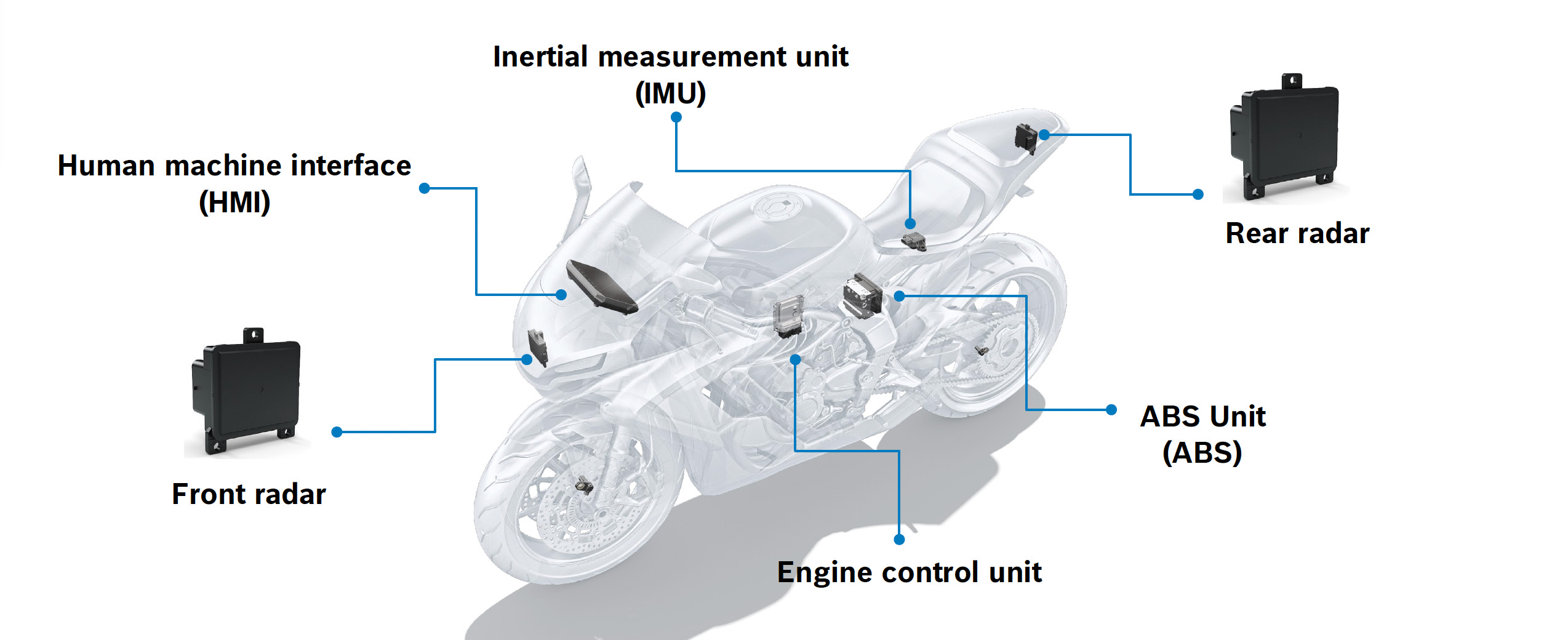
The capability to modulate brake pressure with precision and safety in a dynamic situation requires a foundational Inertial Measurement Unit (IMU) and a sophisticated stability control system.1 An IMU, for example, analyzes acceleration and angular velocity nearly one hundred times per second to provide the necessary data for electronic interventions.1 This allows the successful implementation of a radar-based ACC, which depends on the prior maturation of braking technologies like Cornering ABS and Motorcycle Stability Control (MSC).1 These systems are now foundational components of the broader ARAS suite, demonstrating a clear technological layering where each new innovation builds upon and is enabled by the maturity of previous ones.
Core Safety and Stability Systems
Radar-Based Rider Assistance: The OEM Integration Strategy
OEMs have largely adopted radar as the primary sensory organ for their ARAS. Systems from suppliers like Bosch utilize two radar sensors—one at the front and one at the rear—to continuously scan the motorcycle’s surroundings and provide an accurate picture of the environment.1 The front radar is capable of detecting objects up to 160 meters ahead, while the rear radar monitors hard-to-see areas and blind spots.1
These radar-based systems enable a suite of key safety features:
- Adaptive Cruise Control (ACC): This system automatically adjusts the motorcycle’s speed to maintain a safe, pre-set distance from the vehicle ahead. This significantly reduces rider fatigue, particularly in heavy traffic or on long highway rides.3 More advanced versions, such as “Stop & Go,” can bring the motorcycle to a complete standstill in traffic and then automatically resume motion with a simple push of a button or a slight turn of the throttle.3
- Forward Collision Warning (FCW): Active as soon as the vehicle is started, this non-intrusive system warns the rider via an acoustic or visual signal if it detects a critical proximity to a vehicle in front and the rider fails to react.12
- Blind Spot Detection (BSD): Using the rear radar sensor, this function keeps a lookout in all directions to assist riders in changing lanes safely. If a vehicle is detected in the blind spot, the system provides a warning through an optical signal, for example, in the rear-view mirror.12
- Group Ride Assist (GRA): This is a specialized ACC mode that uses an algorithm to detect when a group is riding in a staggered formation. It then automatically regulates speed to maintain a consistent distance from the motorcycles in front, assisting riders in maintaining a natural and safe group formation.3
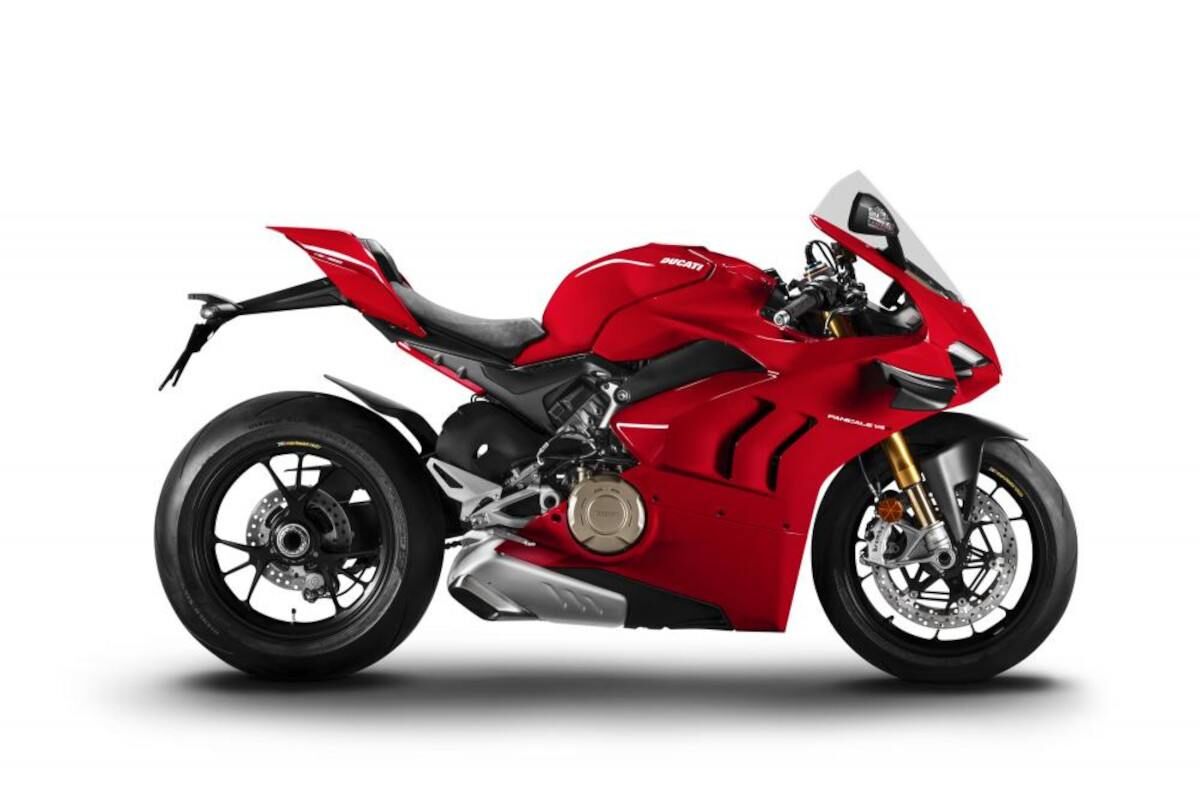
OEMs like Ducati, KTM, BMW, Moto Guzzi, and Harley-Davidson are at the forefront of deploying these deeply integrated features, which are typically found on their highest-end, flagship models.1
Camera- and AI-Based Collision Aversion: The Aftermarket Alternative
In parallel with OEM development, the aftermarket has introduced a different approach to collision avoidance. Systems such as Ride Vision’s Collision Aversion Technology (CAT™) rely on a fusion of Artificial Intelligence (AI) and Computer Vision, using two wide-angle cameras instead of radar.6 The system’s patented Predictive Vision algorithm analyzes visual data to identify critical threats, which eliminates the need for expensive and cumbersome radar hardware.6
This technology is designed to be a non-intrusive rider assistance system, providing alerts via unobtrusive, mirror-mounted LED lights.6 The system also functions as a dashcam, continuously recording a 2-hour loop of footage that can be accessed via an app. Additionally, it can record valuable ride statistics such as lean angles and speed.6 The key market position of this technology is its universal compatibility; it can be hardwired to virtually any motorcycle or scooter, regardless of make or model. This makes it a compelling and more affordable solution for a wider range of riders who do not have access to flagship OEM models.6
Advanced Braking and Stability Control
The foundation of modern motorcycle safety is an evolved braking and stability platform. One of the most significant advancements is Cornering ABS, a revolutionary system that uses an Inertial Measurement Unit (IMU) to monitor the motorcycle’s pitch, lean, and roll angles in real-time.8 The system can then regulate braking pressure to prevent the wheels from locking up, even while the bike is leaned over in a corner.8 This allows the rider to make a “panic stop” while mid-corner without crashing, a feat that previously seemed like science fiction.8
Similarly, comprehensive safety suites like Bosch’s Motorcycle Stability Control (MSC) and Harley-Davidson’s Reflex™ Defensive Rider System (RDRS) go beyond a single feature.1 These systems integrate Cornering ABS (C-ABS), Cornering Enhanced Traction Control (C-TCS), and Drag-Torque Slip Control (DSCS) to manage braking and power delivery dynamically across all riding conditions.14
The Strategic Division in the Safety Market
There is a clear and distinct strategic separation in the market. OEMs are committing to deeply integrated ARAS packages that are foundational to the bike’s design and architecture.7 This strategy, championed by premium brands, leverages existing foundational technologies and reinforces their identity as leaders in holistic, premium safety. This approach, however, confines this advanced safety technology to a select, high-cost segment of the market.7
Aftermarket companies have identified this precise market gap. By leveraging the power of AI and computer vision, they are creating hardware-agnostic, modular systems that can be retrofitted to any motorcycle.6 While these solutions may not be as deeply integrated as OEM systems, they offer a viable and more accessible path for any rider to add advanced safety features to their bike, irrespective of the make, model, or age. This development has created a multi-tiered safety market, which raises a key strategic question for OEMs: do they continue to reserve this technology for the top-end of the market, or do they develop their own modular, more accessible solutions to compete in the broader market?
Table 1: The OEM vs. Aftermarket Safety Ecosystem
| Technical Principle | OEM Integration Strategy | Aftermarket Modularity Strategy |
| Primary Sensor | Radar 1 | Camera & AI (Computer Vision) 6 |
| Typical Range | Up to 160 meters (front), full blind spot (rear) 1 | Non-specified alert range based on visual data 6 |
| Key Features | ACC, FCW, BSD, Group Ride Assist 3 | Collision Aversion Alerts, Ride Recording, Data Analytics 6 |
| Integration Method | Deeply embedded and integrated into vehicle architecture 7 | Universal retrofit, hardwired, modular design 6 |
| Cost Profile | High-cost, typically bundled on flagship models 7 | Moderate cost, sold as a standalone accessory 5 |
| Target Market | Premium, flagship motorcycles (e.g., Ducati, BMW) 1 | All motorcycles and scooters, regardless of age or brand 6 |
The Connected Rider: Smart Helmets and Gear
Heads-Up Displays (HUDs) and Augmented Reality (AR)
Smart helmets are a groundbreaking innovation that merges traditional head protection with technology to provide a safer and more informed riding experience.16 A key feature is the integrated heads-up display (HUD), which projects critical information such as navigation, speed, and hazard alerts directly into the rider’s line of sight.5 The primary goal of this technology is to reduce rider distraction and combat “tunnel vision” by eliminating the need to look down at a phone or traditional instrument cluster.18 Companies like MOTOEYE and HUDWAY offer external HUD accessories that can be attached to a wide range of helmets.5 These displays are often paired with voice-activated commands that allow riders to control navigation, music, and phone calls, enabling a hands-free experience while maintaining focus on the road.5

Voice Command and Communication Systems
Bluetooth communication systems, such as those from Sena and Cardo, have become a staple for modern riders. These devices enable riders to listen to music, make and receive hands-free phone calls, and get turn-by-turn GPS directions without needing to handle their smartphone.21 For group riding, the advent of Mesh Intercom technology allows for a self-organizing communication network among multiple riders. This technology, which operates without a cellular network, offers a reliable and seamless alternative to traditional Bluetooth intercoms for real-time communication between riders.5 Rider testimonials confirm the value of these systems for group safety, as they allow riders to audibly alert one another to road hazards.22
Lifesaving Features and Telematics
One of the most significant advancements in smart gear is crash detection. Devices like the Cardo Packtalk Pro and some smart helmets are equipped with sensors, such as accelerometers and gyroscopes, that can detect a severe impact.17 In the event of a crash, the system can automatically notify emergency services or pre-defined emergency contacts with the rider’s precise GPS location.17 User testimonials corroborate this feature’s life-saving potential, as it can reduce response times for riders who are incapacitated or unconscious after an accident.17 In addition to reactive safety, some helmet prototypes are exploring preventative sensors that can detect alcohol presence or ensure the rider is wearing the helmet correctly, preventing the engine from starting if these conditions are not met.24
The Paradox of Connectivity
While smart helmets and communication systems are explicitly designed to reduce physical distraction by enabling hands-free operation, they introduce a different kind of risk. The very act of taking a call, listening to music, or processing information from a HUD can divert cognitive attention from the primary and highly demanding task of riding, particularly in complex or high-risk situations.23 The operation of a motorcycle requires a high level of situational awareness and concentration, and a phenomenon known as “tunnel vision” can occur when riders over-focus on a single subject, impacting their ability to avoid dangers.12
This creates a paradox: a technology engineered to reduce one form of distraction—taking a hand off the handlebar to check a phone—may inadvertently create a cognitive one. While a well-designed HUD aims to keep the rider’s eyes on the road, it still presents a visual stimulus that must be processed by the brain. A hands-free phone call, while convenient, still consumes cognitive resources that are critical for making split-second decisions. The central challenge for developers is to design interfaces that are truly “minimal-distraction” 25 and ensure that voice-activated commands genuinely allow riders to maintain their focus on the road.16
The Connected Motorcycle Ecosystem
Seamless Smartphone Integration
The demand for a connected experience has led to the development of solutions that integrate the rider’s smartphone directly with the motorcycle. Platforms like Bosch’s mySPIN and Abalta’s WebLink offer a way to mirror smartphone content onto the bike’s built-in display, such as a full-color TFT screen.2 These systems provide access to familiar smartphone functions like navigation, media players, and voice assistants through a simplified, rider-friendly interface.25 This approach provides a significant benefit to OEMs by reducing hardware complexity and development costs while leveraging the rapid innovation cycle of the mobile app ecosystem.25 For the rider, it provides a consistent, familiar user experience across different models and brands.25
Remote Monitoring and Diagnostics
The motorcycle industry is undergoing a fundamental transformation from a mechanical product to a “data-driven platform”.9 This is particularly evident in the electric two-wheeler market, where cloud-connected diagnostics, predictive maintenance, and real-time monitoring of battery health are becoming standard features.9 These systems continuously monitor critical components like brakes, tires, and the engine, using AI to detect wear and tear and predict potential failures before they occur.16
This shift to a data-centric model offers significant new business opportunities for OEMs. They can leverage the data to offer subscription services for features and lifecycle optimization, creating new, recurring revenue streams.9 Beyond maintenance, connected platforms enable features like anti-theft tracking, remote monitoring, and safety systems that allow riders to share their location with emergency contacts in real-time, such as the “LiveRIDE Safety Features” found in the REVER app.28
The OEM vs. Aftermarket Dilemma for Connectivity
The choice between OEM and aftermarket solutions extends to the connectivity and wiring of the motorcycle itself. OEM harnesses and components are model-specific, guaranteeing a perfect fit and flawless compatibility, as they are manufactured to the bike’s exact specifications.29 They undergo rigorous factory testing for durability and come with official warranty protection, providing peace of mind.30 This makes them the ideal choice for restorations or for maintaining a vehicle’s value.30
In contrast, aftermarket solutions offer greater cost-efficiency, wider availability, and unmatched flexibility, making them a popular choice for budget-conscious riders or those looking for customization.29 These harnesses and connectivity kits are ideal for adding new technology, such as LED lighting or audio systems, to older models or custom builds.29 However, aftermarket parts can present challenges, including inconsistent quality, fitment issues, and the potential to complicate or void manufacturer warranties.31 Despite these drawbacks, many reputable aftermarket brands are now matching or exceeding OEM standards, and a warranty can only be voided if the aftermarket part is the direct cause of a failure.32
Table 2: Key Players in the Connected Motorcycle Market
| Company/Brand | Market Segment | Core Products/Technologies | Market Position |
| Bosch | ARAS, Connectivity, ABS | ACC, Cornering ABS, mySPIN, ICC | OEM & Component Supplier Leader 1 |
| Ducati | OEM, ARAS | Radar-based ACC, Blind Spot Detection | Premium OEM Integrator 1 |
| BMW Motorrad | OEM, ARAS, Connectivity | Active Cruise Control (ACC), Connected Dashboards | Premium OEM Integrator 4 |
| KTM AG | OEM, ARAS | Radar-based ACC, Cornering ABS | Premium OEM Integrator 3 |
| Harley-Davidson | OEM, Connectivity | Reflex™ Defensive Rider System (RDRS) | Premium OEM Integrator 9 |
| Ride Vision | Aftermarket Safety | Collision Aversion Technology (CAT™) | Aftermarket Innovator, Camera-based Systems 6 |
| MOTOEYE | Aftermarket Gear | Helmet Smart HUD (E6), Voice Command | Aftermarket Innovator, Helmet Accessories 5 |
| Cardo Systems | Aftermarket Gear | Packtalk Pro, Mesh Intercom, Crash Detection | Aftermarket Innovator, Communication Systems 21 |
| Abalta Technologies | Connectivity Platforms | WebLink | Technology Supplier, Smartphone Integration 25 |
The Motorcycle as a Node in the IoT
The most significant trend is not simply making motorcycles smarter, but transforming them into integral nodes within a larger, interconnected Internet of Things (IoT) ecosystem. This is a crucial distinction between a static “smart product” and a dynamic “connected platform.” The shift is driven by a combination of consumer demand for modern conveniences and regulatory pressure, such as the mandated eCall devices with automatic crash detection in Europe.9
As the motorcycle becomes an “always-connected” device, it begins to generate and consume real-time data on everything from rider behavior to battery health.9 This data can be leveraged for predictive maintenance, optimized route planning, and insurance-linked telematics.9 Furthermore, a future vision includes direct bike-to-vehicle (B2V) communication, where vehicles can exchange data on their position, speed, and direction. This would allow a rider to be warned of a potential collision with a car at an intersection long before the vehicle can be seen, which would be a transformative safety feature.34 The motorcycle is no longer just a vehicle; it is a mobile data hub. The strategic competition among OEMs and tech companies will increasingly focus on controlling this data and the services built upon it, creating a new, subscription-based revenue paradigm.

Human Factors and the Future of Rider-Assist Technology
Human-AI Collaboration: Balancing Control and Assistance
The integration of ARAS necessitates a collaboration between the rider and an intelligent system. The technology is designed to augment, not replace, human decision-making and is meant to assist in critical situations and reduce cognitive load.16 For example, by handling a repetitive task like maintaining a constant distance in traffic, systems like ACC free up the rider to concentrate more on the overall traffic situation.12
A significant safety and ethical concern arises with the potential for over-reliance. When riders become too dependent on these systems, their core riding skills can degrade over time, leading to a false sense of security. This is a well-documented psychological phenomenon in the field of automation. For instance, a system that autonomously applies the brakes in an emergency can save a life, but if the rider begins to expect it in all situations, they may not be prepared to react when a system is unavailable or fails.16
The Importance of Advanced Rider Training
As motorcycle technology evolves, so must rider education.36 Advanced rider training is no longer just about mastering basic skills, but also about understanding and properly utilizing the new technologies on a motorcycle.36 Studies have shown that riders who have completed advanced training courses have fewer collisions per mile, better situational awareness, and more confidence in their skills.37 The training provides a “drill-mindset” and enhances “hazard awareness” that complements the electronic aids.37 It teaches riders to fully understand the capabilities and limitations of their new technology, ensuring they maintain the skills necessary to take control when a system cannot or will not intervene.36
The Evolving Role of the Rider
The ultimate impact of ARAS is a fundamental redefinition of the human-machine relationship in motorcycling. The rider is no longer the sole source of control and decision-making; they have become a collaborator with an intelligent system. These systems are explicitly designed to handle tasks that previously required high concentration, such as maintaining a constant distance from a vehicle ahead in traffic.12 This frees up the rider to shift their cognitive focus from rote tasks to higher-level situational awareness. The success of ARAS is therefore not just a measure of the technology’s effectiveness, but a measure of the rider’s ability to trust, understand, and effectively collaborate with it, without losing their foundational skills. This dynamic will be the central challenge for both the industry and the rider moving forward.
Table 3: The ARAS Impact Matrix: Benefits vs. Human Factors
| ARAS/Feature | Core Benefit | Potential Human Factor Risk |
| Adaptive Cruise Control (ACC) | Reduces rider fatigue; improves concentration in traffic 12 | Over-reliance on the system; skill degradation 16 |
| Cornering ABS/MSC | Enhances stability and control in dynamic situations 8 | False sense of security; riders may take unnecessary risks 31 |
| Heads-Up Display (HUD) | Keeps eyes on the road; reduces physical distraction 17 | Cognitive overload; mental distraction from the display 23 |
| Crash Detection | Expedites emergency response time; life-saving potential 17 | False sense of security; may reduce vigilance 16 |
| Connected Navigation | Provides optimized, real-time route planning 16 | Over-reliance on the system; loss of a sense of direction 40 |

Conclusion & Recommendations
The analysis confirms that the adoption of advanced rider-assist features is not a fleeting trend but a fundamental paradigm shift in motorcycle safety. The vision of “accident-free motorcycling” is now closer to reality than ever before, driven by the confluence of technological innovation and market demand. The future of motorcycling will involve systems that are increasingly interconnected, intelligent, and proactive, with emerging trends pointing toward semi-autonomous riding modes and sophisticated bike-to-vehicle communication.16
Based on this analysis, the following recommendations are proposed:
- For OEMs: The focus should remain on developing seamless, deeply integrated ARAS that leverage the entire vehicle platform. At the same time, OEMs should consider a dual-track strategy by exploring modular, more accessible solutions to capture a larger share of the market, particularly for older or less expensive models.
- For Aftermarket Companies: The strategic advantage lies in interoperability and universal compatibility. These companies should continue to position their products as accessible gateways to advanced safety, leveraging robust data analytics and app-based user experiences to provide a compelling alternative to expensive OEM features.
- For Riders: It is imperative for riders to embrace this technology but to do so with an informed perspective. The electronic aids are not a substitute for skill. Therefore, riders should prioritize advanced training to ensure a deep understanding of the capabilities and limitations of these systems, ensuring that technology serves as an augmentation of their core riding skills, not a replacement for them.
Works cited
- New motorcycle safety systems tested | Bosch Global, accessed on September 8, 2025, https://www.bosch.com/stories/motorcycle-safety-systems/
- Safety first: en route to accident-free motorcycling – Bosch Mobility, accessed on September 8, 2025, https://www.bosch-mobility.com/en/mobility-topics/en-route-to-accident-free-motorcycling/
- Adaptive Cruise Control | KTM United States, accessed on September 8, 2025, https://www.ktm.com/en-us/tech-guide/adaptive-cruise-control.html
- Active Cruise Control (ACC) – technology in detail | BMW Motorrad, accessed on September 8, 2025, https://www.bmwmotorcycles.com/en/engineering/detail/comfort-ergonomics/acc.html
- MOTOEYE E6, accessed on September 8, 2025, https://www.motoeye.com/products/40
- Tech – Ride Vision, accessed on September 8, 2025, https://ride.vision/technology/
- On the radar: Blind spot detection systems for all bikes – RevZilla, accessed on September 8, 2025, https://www.revzilla.com/common-tread/on-the-radar-blind-spot-detection-systems-for-all-bikes
- The brakes of the future: Bosch Cornering ABS – Ducati, accessed on September 8, 2025, https://www.ducati.com/us/en/editorial/cornering-abs
- Connected Motorcycle Market worth $3.40 billion by 2032 | MarketsandMarkets, accessed on September 8, 2025, https://www.prnewswire.com/news-releases/connected-motorcycle-market-worth-3-40-billion-by-2032–marketsandmarkets-302547737.html
- Cornering ABS | KTM United States, accessed on September 8, 2025, https://www.ktm.com/en-us/tech-guide/cornering-abs.html
- KTM – ABS and Cornering ABS Explained | Motorcycle Stability Control – YouTube, accessed on September 8, 2025, https://www.youtube.com/watch?v=hHRWg91hv-M
- Advanced rider assistance systems – Bosch Mobility, accessed on September 8, 2025, https://www.bosch-mobility.com/en/solutions/assistance-systems/advanced-rider-assistance-systems-2w/
- Beyond Riding: The Safest & Best Motorcycle Brands This 2024 – Motorcyclist Attorney, accessed on September 8, 2025, https://motorcyclistattorney.com/beyond-riding-the-safest-best-motorcycle-brands-this-2024/
- Safety Features of the 2024 Harley-Davidson® Road Glide®: A Guide for League City Motorcyclists, accessed on September 8, 2025, https://www.sjhd.com/About/Blog/Safety-Features-of-the-2024-Harley-Davidson-Road-Glide-A-Guide-for-League-City-Motorcyclists
- Reflex Defensive Rider System – Indianapolis Southside Harley-Davidson, accessed on September 8, 2025, https://southsideharley.com/reflex-defensive-rider-system
- How the Rise of AI is Changing Motorcycle Safety – Factory Racing, accessed on September 8, 2025, https://factory.racing/blogs/factory-racing-shop-news/the-rise-of-ai-is-changing-motorcycle-safety
- This is How Smart Helmets Are Changing Motorcycle Safety – Factory Racing, accessed on September 8, 2025, https://factory.racing/blogs/factory-racing-shop-news/this-is-how-smart-helmets-are-changing-motorcycle-safety
- Wearable heads-up display for any helmet | HUDWAY Sight, accessed on September 8, 2025, https://hudway.co/sight
- Development of an AI-Integrated Smart Helmet for Motorcycle Accident Prevention: A Feasibility Study – PMC, accessed on September 8, 2025, https://pmc.ncbi.nlm.nih.gov/articles/PMC11846507/
- MOTOEYE Helmet Smart HUD, accessed on September 8, 2025, https://www.motoeye.com/
- Cardo Systems: Bluetooth Headsets & Speakers for Helmets, accessed on September 8, 2025, https://cardosystems.com/
- Sena R1 Smart Cycling Helmet Review – Road Bike Action, accessed on September 8, 2025, https://roadbikeaction.com/sena-r1-smart-cycling-helmet-review/
- Bluetooth Communication Systems: Do you use them? : r/motorcycles – Reddit, accessed on September 8, 2025, https://www.reddit.com/r/motorcycles/comments/48hoad/bluetooth_communication_systems_do_you_use_them/
- Design Of Smart Helmet for Accident Prevention and Alcoholic Detection – ijireeice, accessed on September 8, 2025, https://ijireeice.com/wp-content/uploads/2021/04/IJIREEICE.2021.9504.pdf
- WebLink® for Motorcycles – Abalta Technologies, Inc., accessed on September 8, 2025, https://abaltatech.com/solutions-motorcycles/
- Integrated connectivity cluster – Bosch Mobility, accessed on September 8, 2025, https://www.bosch-mobility.com/en/solutions/displays/integrated-connectivity-cluster-2w/
- The Role of AI in Transforming Electric Motorcycle Maintenance, accessed on September 8, 2025, https://caofenbikes.com/ai-predictive-maintenance-electric-motorcycles/
- REVER – Motorcycle GPS & Rides on the App Store, accessed on September 8, 2025, https://apps.apple.com/us/app/rever-motorcycle-gps-rides/id975571447
- Motorcycle Wire Harness Upgrades: OEM vs Aftermarket – Romtronic, accessed on September 8, 2025, https://www.romtronic.com/motorcycle-wire-harness-upgrades-oem-vs-aftermarket/
- OEM Motorcycle Parts Benefits | Carmel, IN – Rahal Piaggio, accessed on September 8, 2025, https://www.rahalpiaggio.com/blog/advantages-of-buying-oem-parts-for-your-motorcycle–77691
- Choosing Between OEM vs. Aftermarket ATV Parts: What You Need to Know, accessed on September 8, 2025, https://blog.carolinacycle.com/choosing-between-oem-vs-aftermarket-atv-parts-what-you-need-to-know
- OEM vs. Aftermarket Components – A Comprehensive Guide to Choosing the Right Parts, accessed on September 8, 2025, https://www.gvei.com/oem-vs-aftermarket-components/
- Connected Motorcycle Market Companies – SkyQuest Technology, accessed on September 8, 2025, https://www.skyquestt.com/report/connected-motorcycle-market/companies
- Connected services for motorcycles – Bosch Mobility, accessed on September 8, 2025, https://www.bosch-mobility.com/en/solutions/connectivity/connectivity-solutions-2w/
- Bosch Motorcycle-to-vehicle communication. Get connected for greater safety on the roads., accessed on September 8, 2025, https://www.youtube.com/watch?v=BXXlodI9gO0
- Mastering the Motorcycle: The Benefits of Advanced Rider Training Courses, accessed on September 8, 2025, https://www.hupy.com/library/mastering-the-motorcycle-the-benefits-of-advanced-rider-training-courses.cfm
- Thoughts on Advanced Riders Course : r/motorcycle – Reddit, accessed on September 8, 2025, https://www.reddit.com/r/motorcycle/comments/1b11vrl/thoughts_on_advanced_riders_course/
- Are Advanced Riders safer riders? – Devitt Insurance, accessed on September 8, 2025, https://www.devittinsurance.com/guides/motorcycle-features/are-advanced-riders-safer-riders/
- Advanced RiderCourse (ARC) – Motorcycle Safety Foundation, accessed on September 8, 2025, https://msf-usa.org/advance-your-ride/advanced-ridercourse-arc/
- Does anyone have experience with the beeline nav? Seems ingenious but is it practical? : r/motorcycle – Reddit, accessed on September 8, 2025, https://www.reddit.com/r/motorcycle/comments/107ti2f/does_anyone_have_experience_with_the_beeline_nav/
Our Social Media Handles
- Instagram : LivingWithGravity
- Medium : Akash Dolas
- YouTube Channel : Gear and Shutter
- Facebook : LivingWithGravity