










Executive Summary
The powersports landscape is undergoing a profound transformation driven by electrification, a shift most vividly demonstrated in the electric motorcycle segment. While vehicles like the Stark Varg EX showcase the exhilarating, precisely controllable power delivery inherent to electric powertrains, the Utility Task Vehicle (UTV) market has, to date, adopted electrification at a comparatively slower pace, primarily focusing on utility-oriented models. This report posits that a significant inflection point is imminent, driven by the convergence of two groundbreaking technologies: YASA’s ultra-high power density axial flux motors and the commercialization of advanced solid-state batteries.
YASA’s prototype motor, delivering an astonishing 738 horsepower from just 29 pounds, represents an unprecedented leap in power-to-weight ratio, offering a foundational component for extreme performance. Concurrently, solid-state batteries promise superior energy density, faster charging, and enhanced safety, directly addressing the critical limitations of current lithium-ion technology for demanding off-road applications.
An analysis of major OEM strategies reveals a “utility-first” approach to electric UTVs, with fragmented electrification roadmaps across the industry. However, the impending availability of these enabling technologies, coupled with strategic partnerships and the potential for swappable battery solutions, is poised to unlock a new era of high-performance, sport-oriented electric UTVs. While challenges related to battery integration, charging infrastructure, and initial cost remain, the potential for engineering innovation to harness this “phenomenal cosmic power” suggests a future where electric UTVs redefine off-road speed, agility, and environmental responsibility.
1. The Electrified Powersports Landscape: A High-Performance Overview
1.1. The Allure of Electric Torque: Lessons from Electric Motorcycles
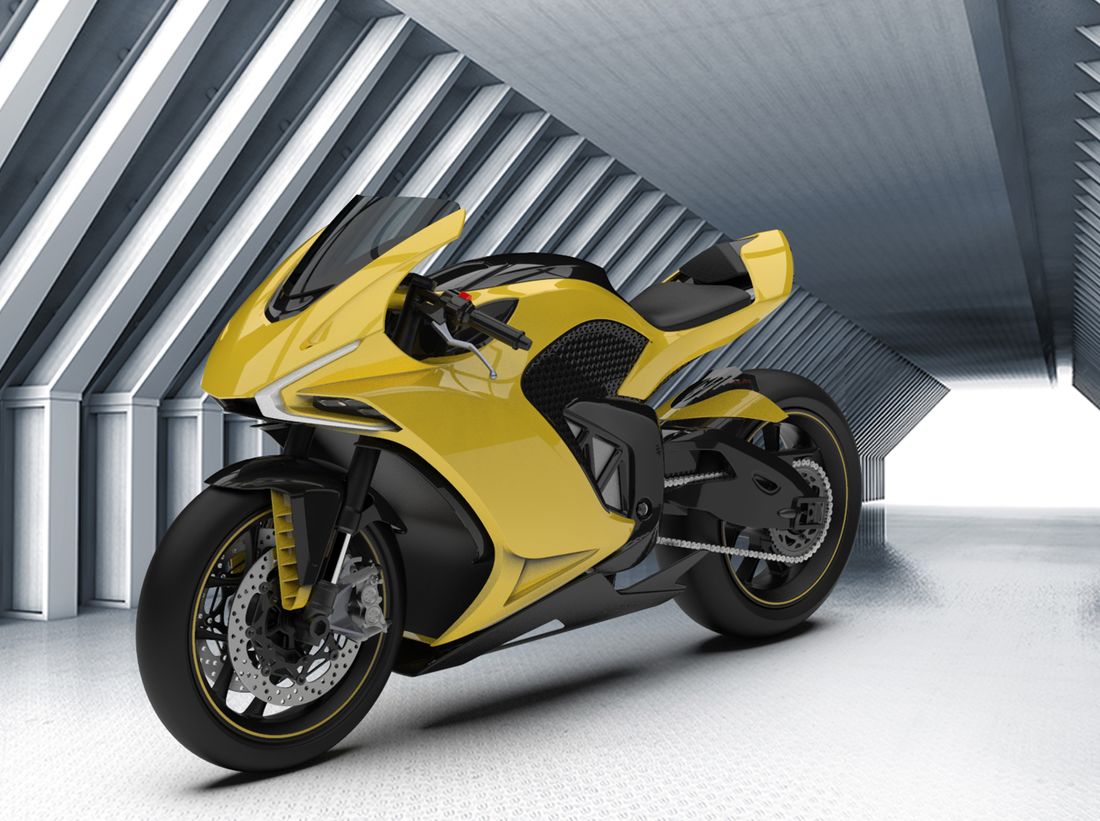
The immediate, exhilarating power delivery characteristic of electric powertrains is perhaps best exemplified in the evolving electric motorcycle segment. Models such as the Stark Varg EX demonstrate the unique performance attributes of electric vehicles (EVs), where monumental horsepower can be precisely metered for nuanced control or instantly unleashed for breathtaking acceleration. The Stark Varg EX, for instance, is noted for its ability to “light up that rear wheel at a staggering 50+ mph” even at a 60 horsepower setting, with an 80 horsepower option remaining untouched by some riders due to the already overwhelming output. This capability underscores the inherent strength of electric motors in delivering instant torque, a critical advantage for dynamic performance across various powersports applications.
The electric motorcycle market is a rapidly evolving arena, marked by dynamic competition and varying degrees of success among brands like LiveWire, Energica, Stark, and Zero. This competitive environment is actively pushing the boundaries of electric performance in a two-wheeled format, establishing a clear precedent for the transformative potential of electrification across other powersports categories. The experiences and innovations in this sector provide valuable insights into how electric power can fundamentally alter the performance envelope of off-road vehicles.
1.2. The UTV Market: Awaiting its Electric Revolution
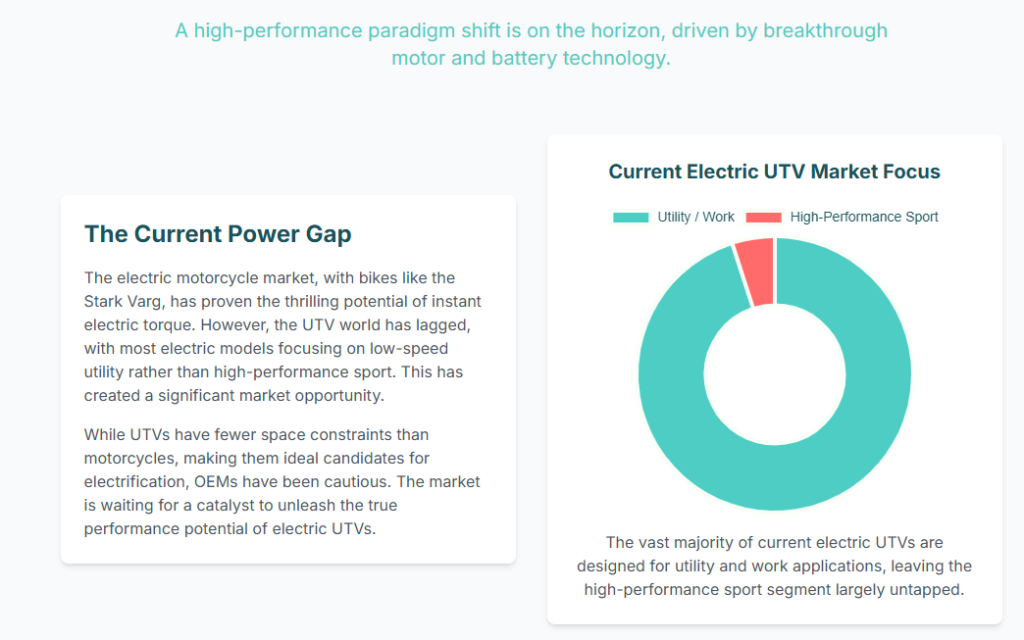
Despite the compelling advantages that electric power offers for off-road applications—including quiet operation, instant torque for navigating challenging terrain, and reduced maintenance needs due to fewer moving parts—the Utility Task Vehicle (UTV) market has demonstrated a comparatively slower pace in adopting high-performance electric solutions. This presents a notable disparity, particularly given that UTVs, with their larger chassis and fewer space constraints compared to motorcycles, might intuitively seem easier to electrify for performance applications.
Current electric UTV offerings are predominantly confined to utility-focused models. These vehicles prioritize work capabilities, such as hauling and towing, and low-speed efficiency over the high-performance, sport-oriented demands that are increasingly met by electric motorcycles. This strategic emphasis on utility has created a discernible gap in the market, where the full sporting potential of electric UTVs remains largely untapped. The segment appears to be awaiting a breakthrough product or a transformative technology that can catalyze its shift towards high-performance electrification, mirroring the excitement and innovation seen in other electrified powersports categories. This market segmentation suggests that while electrification is underway in UTVs, it is not yet addressing the high-performance, sport-oriented segment with the same vigor, leaving a significant opportunity for future development.
2. YASA’s Axial Flux Motor: A Catalyst for High-Performance UTVs
2.1. Unprecedented Power Density: Specifications and Technical Advantages
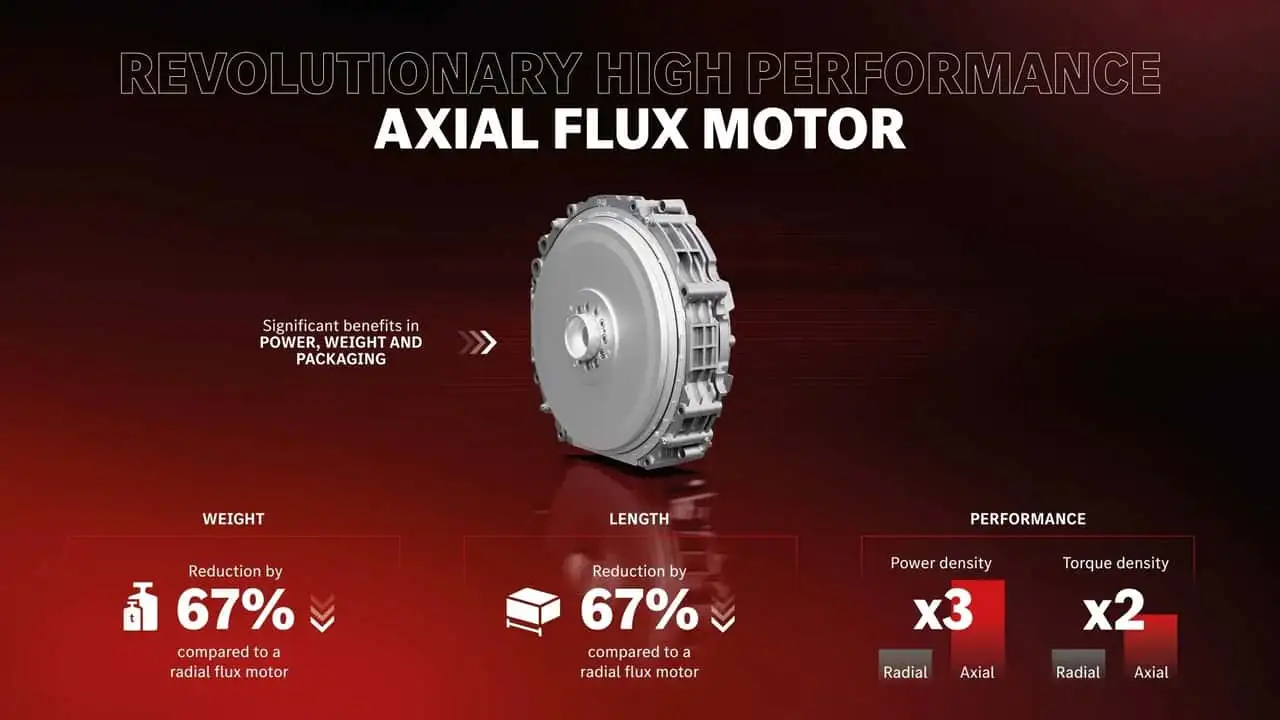
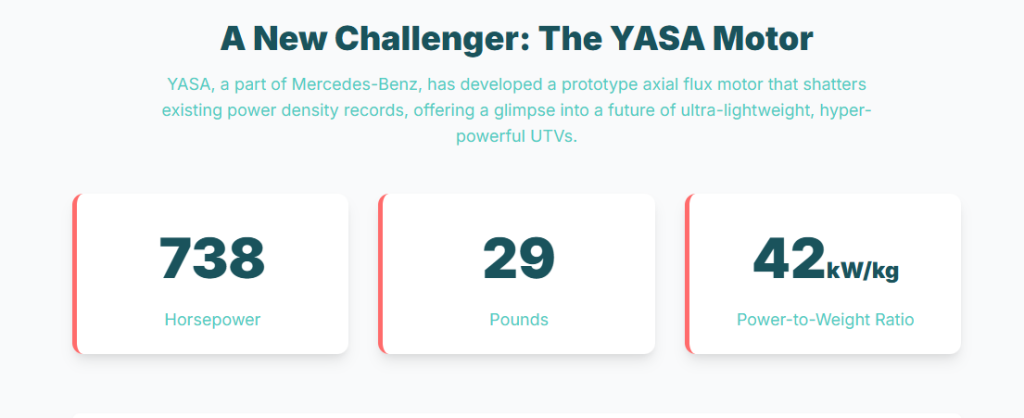
YASA, an Oxfordshire, England-based company and a leader in axial flux motor technology, has unveiled a prototype electric motor that establishes a new industry benchmark for power density. This prototype generates an astonishing 738 horsepower (550kW) from a package weighing just 29 pounds (13.1 kg).1 This remarkable achievement results in an industry-leading power-to-weight ratio of 42kW/kg, which is more than double the previous best in the business.1 This level of performance represents a fundamental shift in what is possible for electric motors. For off-road vehicles, this means engineers can achieve extreme power levels with minimal weight penalty, or even reduce overall vehicle weight while maintaining high power, directly enabling the vision of a “rocket ship” UTV.
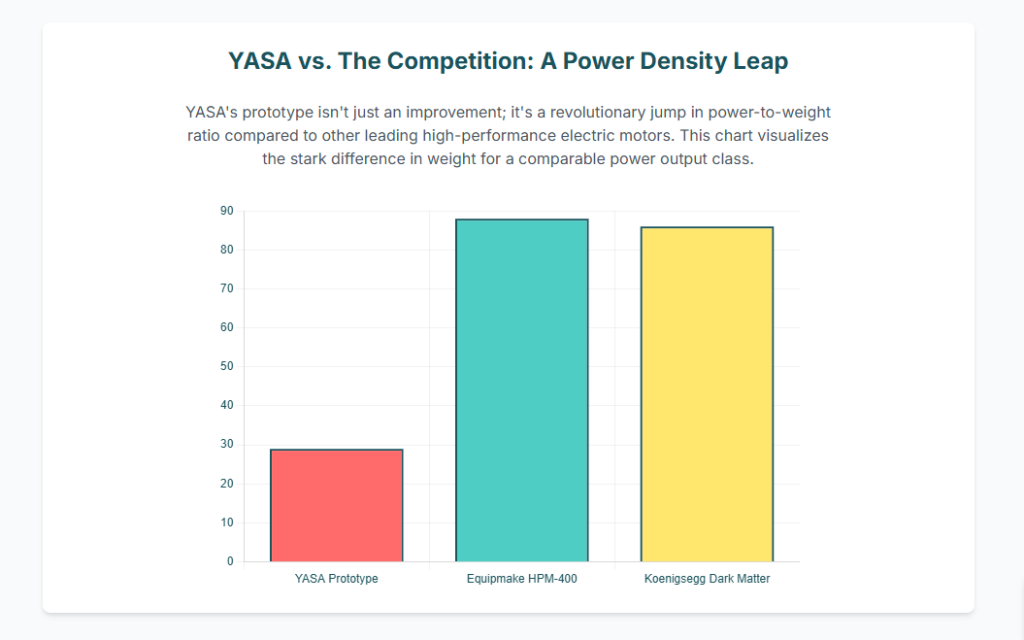
The core of this breakthrough lies in YASA’s proprietary axial flux technology. Unlike conventional radial motors, where magnetic fields are aligned around the motor’s axis, YASA’s design aligns them parallel to the axis. This innovative configuration yields a flatter, lighter motor that delivers significantly more power for its size.1 For comparative context, the previous industry leader, Equipmake’s HPM-400, delivered 536hp from a much heftier 40kg package, and even Koenigsegg’s powerful Dark Matter motor weighs 39kg for 800hp.3 YASA’s prototype dramatically surpasses these benchmarks in terms of power density, making it a true outlier in the electric motor landscape. The imaginative scenario of installing “four of them onto each axle of a UTV and have more horsepower than God” is directly supported by this unprecedented power-to-weight ratio, which opens the door to extreme performance levels previously unimaginable for lightweight vehicles like UTVs.
Table 1: YASA Motor Prototype Specifications vs. Industry Benchmarks
| Motor Name/Type | Manufacturer | Power Output (HP/kW) | Weight (lbs/kg) | Power-to-Weight Ratio (kW/kg) | Source Snippet IDs |
| YASA Axial Flux Prototype | YASA | 738 HP / 550 kW | 29 lbs / 13.1 kg | 42 kW/kg | 1 |
| HPM-400 | Equipmake | 536 HP | 88 lbs / 40 kg | – | 3 |
| Dark Matter | Koenigsegg | 800 HP | 86 lbs / 39 kg | – | 3 |
2.2. Current Automotive Integration and Future Potential for Off-Road
YASA’s advanced technology is not merely a theoretical concept; it is already being integrated into some of the world’s most prestigious high-performance vehicles. This includes applications in Lamborghini’s Temerario, the hybrid Huracan successor, which utilizes three YASA motors, each contributing 148hp, as well as Ferrari’s SF90 Stradale and Lamborghini’s Revuelto.1 Furthermore, the Mercedes-AMG GT XX concept leverages three YASA motors to achieve an astounding output of over 1,341hp.1
A pivotal development for YASA was its acquisition by the Mercedes-Benz Group in 2021.1 This full ownership signifies a profound strategic commitment to axial flux technology as a core component for Mercedes-Benz’s and AMG’s future high-performance electric models. Such institutional support from a major automotive giant significantly de-risks YASA’s technology and accelerates its path to market. Mercedes’ substantial investment has enabled YASA to significantly expand its design, development, testing, and manufacturing teams, including the establishment of a new development line in Oxfordshire specifically focused on scaling production.4 This backing makes YASA a more attractive and reliable potential supplier for other OEMs, potentially via licensing or direct supply if Mercedes-Benz allows, looking to electrify their high-performance UTVs, underscoring the technology’s long-term viability.
Beyond its high-profile automotive applications, YASA’s existing product lines, such as the P400R and 750R motors, are explicitly designed for a versatile range of uses including “traction, generation, hydraulic replacement and P2 Hybrid”.6 These motors are already deployed across various demanding sectors, including “off-road, marine, industrial and aerospace”.5 This broad application spectrum clearly demonstrates the inherent adaptability and robustness of YASA’s axial flux technology for diverse, high-power, and often harsh, off-road environments. The motor itself is not the limiting factor for UTV adoption; rather, it is the UTV OEMs’ strategic priorities, vehicle integration challenges, and the availability of suitable battery technology that will dictate its widespread use.
2.3. Manufacturing Readiness and Scalability
A critical differentiator for YASA’s prototype is its “production-ready innovation”.1 Unlike many advanced motor designs that rely on exotic materials or complex, costly production methods, YASA’s prototype utilizes standard components. This strategic choice makes the technology inherently scalable for mass production.1 This addresses a major barrier for OEMs: the ability to source advanced components at scale and at a commercially viable cost.
YASA has ambitious plans to target an annual production volume of 10,000 to 50,000 units at a commercially “affordable price”.1 To meet this goal, a new £12 million factory is set to open in Yarnton, Oxfordshire, in 2025, with a projected capacity to produce over 25,000 motors per year using advanced automation techniques like CNC coil winding and laser welding for precision.1 This facility’s objective is to democratize access to high-performance motors, making them available not only to luxury brands but also to mainstream manufacturers.1 While the prototype is acknowledged to be “still a ways away from entering the market” and requires further production ramp-up and strategic partnerships within the UTV industry, its demonstrated production readiness and scalability make it an exceptionally appealing and “easy proposition” for major UTV OEMs such as Polaris, Can-Am, Kawasaki, Yamaha, or Honda to consider for adoption.
3. Current OEM Strategies in Electric UTVs: A Competitive Analysis
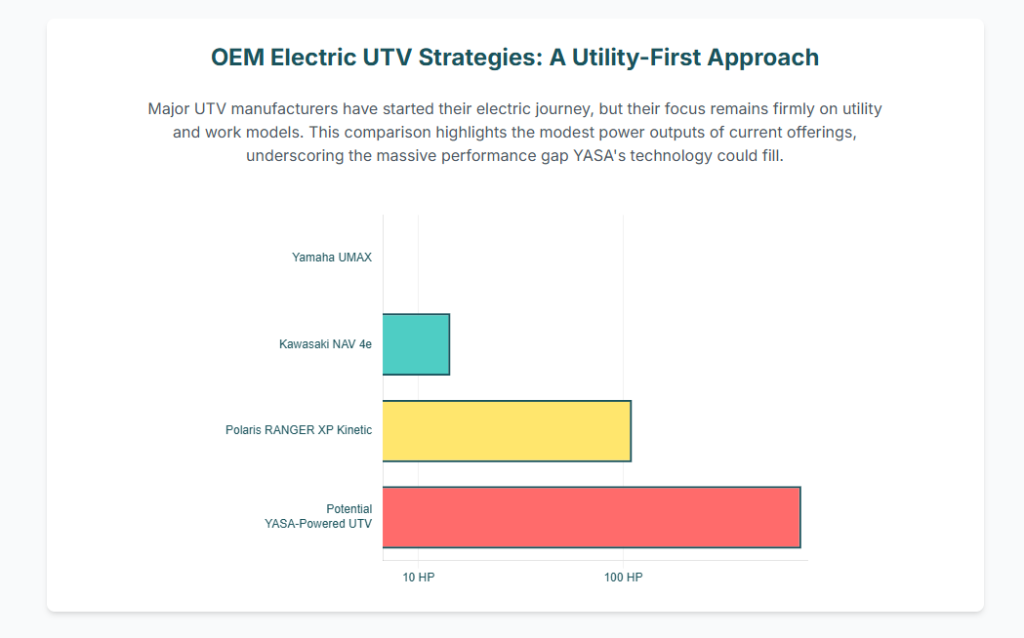
The current landscape of electric UTV offerings from major manufacturers reveals a strategic focus predominantly on utility and neighborhood applications, rather than high-performance sport models. This “utility-first” strategy by OEMs suggests that the present limitations of EV technology, particularly concerning battery cost, weight, and charging time for high-performance demands, are more manageable within utilitarian contexts. This deliberate market segmentation leaves the high-performance sport segment largely unaddressed by current electric solutions.
Table 2: Current Electric UTV Offerings by Major OEMs (2024-2025 Models)
| OEM | Model Name | Year | Power Output (HP/kW) | Range (Miles) | Top Speed (mph) | Primary Application | Key Features | Source Snippet IDs |
| Polaris | RANGER XP Kinetic | 2024 | 110 HP | – | – | Utility/Work | 140 lb-ft Torque, Partnership with Zero Motorcycles | 7 |
| John Deere | TE 4×2 Electric Utility Vehicle | – | – | – | 13 mph (20.92 km/h) | Utility/Work | 48-V electrical system, Dynamic braking, Regeneration | 10 |
| Kawasaki | NAV 4e | 2025 | 14.3 HP (10.7 kW max) | 17.5 (Lead-acid), 40 (Li-ion) | 19 mph | Neighborhood Activity Vehicle (NAV) | First 4-wheel EV, Regenerative braking, Lifted style, Off-road-style tires | 11 |
| Yamaha | UMAX Electric | – | 6.7 HP (5.0 kW) | – | 17.5-19.5 mph | Utility/Golf Course | Gas/Electric/Lithium options, 800 lbs cargo capacity | 13 |
| Can-Am | (No current electric UTV models listed) | – | – | – | – | – | Focus on electric motorcycles (Pulse, Origin) | 16 |
| Honda | (No current electric UTV models listed) | – | – | – | – | – | Broad EV vision, Battery production in 2025, Focus on electric motorcycles | 23 |
3.1. Polaris: Pioneering the Electric UTV Segment
Polaris has positioned itself as an early leader in the electric UTV market with the introduction of its RANGER XP Kinetic.7 This model was developed through a strategic partnership with Zero Motorcycles, a recognized leader in electric power and battery technology.8 The RANGER XP Kinetic features a robust 110 HP electric motor and 140 lb-ft of torque.7
Its launch in early 2022 was a key initiative within Polaris’s overarching “rEV’d up” electrification strategy, aimed at defining a new chapter in powersports innovation and meeting the evolving needs of customers.8 The vehicle is explicitly marketed as a “hardest working, smoothest riding” utility side-by-side, emphasizing its design for demanding work applications and general recreational utility.8 However, the XP Kinetic’s power output, while substantial for utility tasks, remains considerably below the “mind-melting near 1,000 horsepower” envisioned for extreme sport UTVs, indicating that Polaris’s current electrification efforts in UTVs are primarily focused on the work and utility segments rather than high-performance sport.
3.2. Can-Am: Electrification Beyond Two Wheels?
Can-Am has made significant strides in electric two-wheeled vehicles, with the upcoming launch of the 2025 Can-Am Pulse, a naked electric motorcycle, and the 2025 Can-Am Origin, a dual-sport electric motorcycle.20 Both models are rated at 47 HP and offer ranges tailored for urban commuting or versatile dual-sport use, powered by Rotax E-POWER technology.21 These models represent Can-Am’s return to its two-wheeled motorcycle heritage, blending nostalgia with modernity through electric capabilities.29
However, a review of Can-Am’s current UTV lineup—including popular models like the Commander, Defender, Maverick R, Sport, Trail, and X3 16—reveals that it consists exclusively of internal combustion engine (ICE) vehicles. The available information does not explicitly detail any current electric UTV models or specific future plans for their introduction. This suggests that Can-Am’s immediate electrification roadmap is largely concentrated on motorcycles and 3-wheel vehicles, indicating a strategic prioritization that has not yet extended to high-performance electric UTVs.
3.3. Kawasaki: Strategic Electrification and the NAV 4e
Kawasaki has articulated a clear and diversified electrification strategy, aiming to electrify all its motorbikes for key markets by 2035, encompassing both Battery Electric Vehicles (BEV) and Hybrid Electric Vehicles (HEV), with plans to introduce at least ten such models by 2025.30 Furthermore, they intend to launch five electric off-road quads by 2025.30
In the four-wheeled segment, Kawasaki has introduced the 2025 NAV 4e, specifically marketed as a “Neighborhood Activity Vehicle”.11 This vehicle represents Kawasaki’s inaugural fully electric four-wheeled offering.12 The NAV 4e is equipped with a 4 kW nominal (10.7 kW max, approximately 14.3 HP) electric motor, achieves a top speed of 19 mph, and offers ranges of 17.5 miles (with lead-acid batteries) or 40 miles (with lithium-ion batteries).12 While its design incorporates a “lifted style” and “off-road-style tires” 12, hinting at recreational applications beyond strict utility, its performance metrics clearly position it outside the high-performance sport UTV category. This type of vehicle, while not high-performance, serves as a valuable market testbed for Kawasaki, allowing the company to gain practical experience with 4-wheel EV integration and assess customer acceptance of electric off-road-styled vehicles in a lower-risk environment. The NAV 4e could be a strategic stepping stone for future, more powerful recreational electric UTVs, enabling Kawasaki to gradually scale its electric offerings as battery technology improves and market demand for higher-performance electric UTVs solidifies.
3.4. Yamaha: Utility Focus and Emerging Concepts
Yamaha’s current electric UTV offering is the UMAX electric utility vehicle, which is available with both traditional gas and electric powertrains.13 The UMAX AC electric model is powered by a 6.7 HP (5.0 kW) motor and achieves a maximum speed of 17.5-19.5 mph, explicitly designed for “golf course or utility needs”.13 This aligns with the prevalent “utility-first” approach observed in the current electric UTV market.
Yamaha has also demonstrated a commitment to “going green” in the off-road sector through its investment in Electric Motion SAS, a French EV company specializing in electric trials and off-road motorcycles.31 Further illustrating its forward-looking approach, Yamaha showcased EV concepts such as the C580 and C682 at the Tokyo Auto Salon 2025.33 These concepts are built upon Yamaha’s “Diapason” personal mobility platform, notably utilizing Honda Mobile Power Pack e: swappable battery packs.34 While these are conceptual vehicles and not yet production models, they signal Yamaha’s active exploration of new electric vehicle types, though specific high-performance electric UTVs are not explicitly detailed. The exploration of swappable battery packs is a crucial development for the high-performance UTV segment, as it could effectively bypass lengthy charging times and mitigate range anxiety, making electric UTVs more practical for demanding off-road use.
3.5. Honda: Broader EV Vision and Powersports Implications
Honda has articulated a comprehensive global electrification strategy, with an ambitious target of achieving 100% EVs and Fuel Cell Electric Vehicles (FCEVs) in its global vehicle sales by 2040.28 This strategy involves substantial investment, approximately 10 trillion yen through 2030, and a dedicated focus on developing advanced “thin and light batteries”.23 As part of this initiative, Honda is establishing an EV Hub in Ohio, which includes a joint venture EV battery plant with LG Energy Solution. This facility is slated for mass production of pouch-type lithium-ion batteries beginning in 2025.23
While Honda has clear plans for electric motorcycles, with models powered by two Mobile Power Packs (MPPs) in 2024, and micro-mobility products utilizing four MPPs in fiscal year 2026 28, their current UTV lineup, exemplified by the Pioneer series 25, consists entirely of internal combustion engine (ICE) models. The available information does not explicitly outline immediate product roadmaps or specific strategies for the introduction of electric UTVs. However, Honda’s broader EV investment and significant battery development efforts could eventually extend to this segment, particularly as battery technology improves and the market for high-performance electric UTVs matures. The company’s focus on cost reduction for batteries and overall production, aiming for a 35% reduction by 2030, could also make high-performance electric UTVs more commercially viable in the future.28
The fragmented approach to electrification across major OEMs suggests that either the technological enablers (especially advanced batteries) are not yet mature enough for widespread OEM commitment to high-performance UTVs, or the perceived market demand for such vehicles has not yet reached a critical mass to justify significant investment. This also highlights a potential first-mover advantage for an OEM willing to aggressively pursue this segment once battery technology matures.
4. Solid-State Batteries: Unlocking the Next Generation of Electric UTV Performance
4.1. Advantages for Off-Road: Range, Charging, and Safety
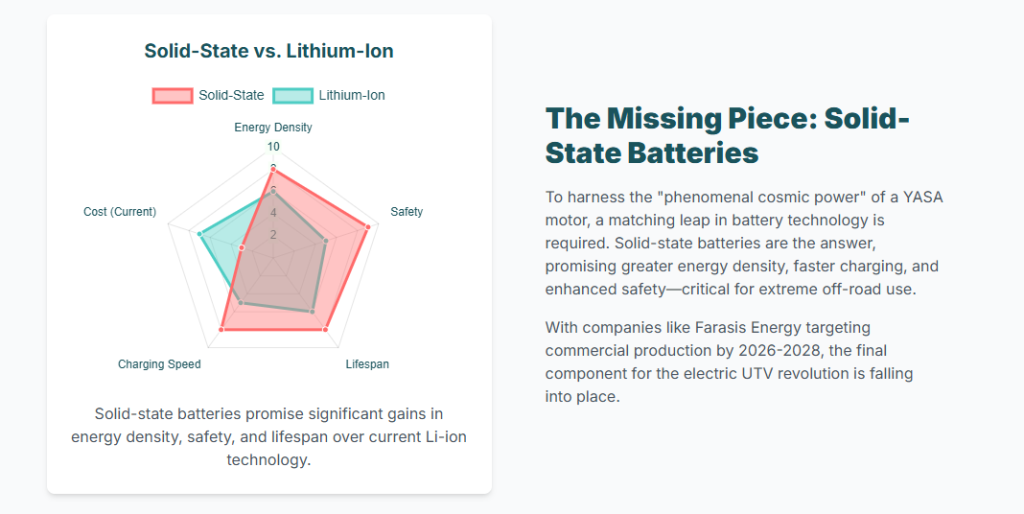
Solid-state batteries (SSBs) are widely regarded as a transformative technology for electric vehicles, poised to deliver significant improvements over current lithium-ion battery chemistries. Their key advantages include the promise of faster charging times, extended driving ranges, and fundamentally enhanced safety.35 These attributes are not merely incremental upgrades; they represent a fundamental prerequisite for realizing truly high-performance, safe, and practical electric UTVs capable of competing with or surpassing ICE counterparts in extreme conditions.
Crucially for demanding off-road applications, SSBs eliminate the need for flammable liquid electrolytes, thereby dramatically reducing fire risks and concerns about leakage.35 This represents a critical safety enhancement for vehicles operating in challenging, high-impact environments characteristic of off-road racing or extreme trail riding, where collisions and punctures are potential hazards. SSBs offer superior energy density, with development targets exceeding 400 Wh/kg, a notable improvement compared to the 250-300 Wh/kg typically found in advanced lithium-ion batteries.35 Some thin-film SSB types show even higher potential, reaching 300-800 Wh/kg.37 This increased energy density could extend EV ranges by a substantial 30-50% without adding prohibitive battery weight 35, directly addressing the critical issue of range anxiety in demanding and remote off-road scenarios. Furthermore, preliminary research suggests that solid-state chemistry may support significantly more charge-discharge cycles before capacity degradation, leading to a considerably extended lifespan for the battery pack.35 This inherent durability is highly valuable for the rugged and often punishing use cases of UTVs.
Table 3: Solid-State Battery Advantages for Off-Road Vehicles
| Advantage Category | Specific Benefit for Off-Road UTVs | Comparison to Lithium-Ion | Source Snippet IDs |
| Safety | Eliminates flammable liquid electrolytes, dramatically reduces fire risks and leakage concerns, crucial for high-impact environments. | Significantly safer, removes a major hazard. | 35 |
| Energy Density | Extends EV range by 30-50% without increasing battery weight, enabling longer off-road excursions. | Higher: 400 Wh/kg+ target vs. 250-300 Wh/kg for Li-ion. | 35 |
| Charging Speed | Promises significantly faster charging capabilities, allowing for quicker “pit stops” or rapid top-ups. | Faster than current Li-ion. | 36 |
| Lifespan | Supports significantly more charge-discharge cycles before degradation, enhancing battery pack durability for rugged use. | Extended lifespan. | 35 |
| Thermal Management | Superior thermal performance reduces need for complex, heavy cooling systems, saving weight and simplifying design. | Less complex thermal management. | 35 |
4.2. Commercialization Timelines and Key Industry Developments
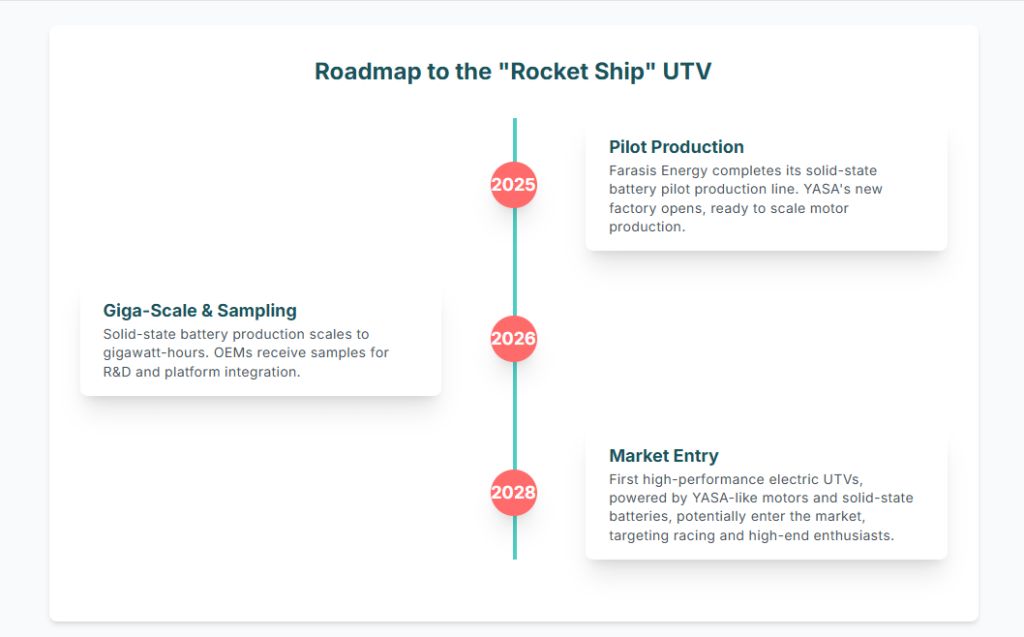
The commercialization trajectory of solid-state batteries is advancing rapidly, transforming the vision of high-performance electric UTVs into a tangible mid-term goal. For instance, Farasis Energy is actively developing a dedicated pilot production line for sulfide-based solid-state batteries, with its completion targeted for the end of 2025.35 Encouragingly, Farasis’s third-generation prototypes, which underwent testing around January 2025, have demonstrated stable cycle performance in rigorous testing regimes, indicating that the technology is steadily maturing towards practical and reliable application.35
Initial sample deliveries of these advanced batteries to strategic partners, including Mercedes-Benz (which holds a 3% stake in Farasis since 2020), are projected for late 2025.35 This strong backing from the automotive sector means powersports OEMs can potentially leverage these advancements without bearing the full R&D burden themselves, accelerating adoption. Farasis has outlined ambitious plans for scaling production, aiming to reach gigawatt-hour capacity as early as 2026, with the potential for the first commercial vehicle applications following extensive validation in 2027-2028.35 The company anticipates achieving cost parity with conventional lithium-ion batteries in the early 2030s.35 This detailed timeline is crucial, as vehicle development cycles typically span several years, meaning that if SSBs are available for sampling and initial production by 2026, OEMs can realistically begin integrating them into new platforms for launch in the late 2020s.
Beyond Farasis, other major players are also heavily invested in SSB development. Toyota notably holds the most SSB-related patents 38 and has been conducting extensive research into automotive applications since 2012, including a long-standing partnership with Panasonic.39 Companies like Solid Power, backed by funding from Samsung and Hyundai, are also establishing manufacturing lines for their all-solid-state battery prototypes.39 This broad and diverse industry push signifies a high degree of confidence in solid-state technology and increases the likelihood of successful commercialization. It also suggests that the eventual market will offer a variety of SSB solutions, providing OEMs with choices tailored to specific performance and cost requirements.
Table 4: Projected Solid-State Battery Commercialization Timeline (Farasis Energy)
| Milestone | Projected Year/Period | Key Details/Capacity | Source Snippet IDs |
| Pilot Production Line Completion | End of 2025 | Dedicated sulfide-based SSB pilot line (0.2 GWh) | 35 |
| Initial Sample Distribution | Late 2025 | To strategic partners (e.g., Mercedes-Benz) | 35 |
| Scaling to Gigawatt-Hour Production | 2026 | Ambitious timeline for commercial-scale production | 35 |
| Potential First Commercial Vehicle Applications | 2027-2028 | Following extensive validation | 35 |
| Possible Cost Parity with Conventional Li-ion | Early 2030s | As production scales | 35 |
4.3. Impact on UTV Design and Performance
The profound advantages of solid-state batteries, particularly their high energy density and inherently improved safety profile, will empower UTV engineers to fundamentally re-imagine and design lighter, more powerful, and safer electric vehicles. The significant reduction in battery pack weight for equivalent range and power compared to current lithium-ion batteries will free up considerable space within the chassis, allowing for greater design flexibility and innovative vehicle architectures. This directly supports the aspiration for engineers to “do their thing and come up with innovative ways of putting that ‘phenomenal cosmic power’ to the ground.”
The promise of significantly faster charging capabilities will dramatically enhance the practical usability of electric UTVs for extended periods. This could enable quick “pit stops” for rapid top-ups during long off-road expeditions or between stages in a race, effectively mimicking the efficiency of refueling an internal combustion engine (ICE) vehicle. Furthermore, the superior thermal performance and inherent safety of solid-state batteries 35 will substantially reduce the need for complex, heavy, and often bulky thermal management systems. This directly contributes to additional weight savings and simplifies overall vehicle design. The combined effect of these battery advancements with the YASA motor’s power density will enable a new class of UTVs with unprecedented performance envelopes, transforming their capabilities for sport and racing.
5. The Vision for High-Performance Electric UTVs: Opportunities and Challenges
5.1. Realizing the “Rocket Ship” UTV: Applications in Sport and Racing
The synergistic combination of YASA’s ultra-high power density motors and the impending availability of energy-dense solid-state batteries creates a compelling and achievable vision for “rocket ship” UTVs. A single YASA prototype motor alone can deliver 738 HP from a mere 29 lbs 1, meaning that integrating multiple motors (e.g., one per wheel for advanced torque vectoring) could result in unprecedented power-to-weight ratios that far surpass the capabilities of current internal combustion engine (ICE) UTVs. The potential for such extreme power levels, for instance, a four-motor UTV putting out 2,800 horsepower, moves beyond theoretical capabilities to a realm where traditional performance benchmarks become obsolete.
Such high-performance electric UTVs would be ideally suited for extreme off-road applications, particularly demanding events like desert racing (e.g., Dakar, Baja). In these environments, instant torque for rapid acceleration out of corners, sustained high power for navigating dunes, and significantly reduced vehicle weight are critical factors for competitive performance. The explicit imagination of “Can-Am or Polaris’ Dakar or Baja entries with this motor and a bank of energy dense, but lighter batteries” captures this transformative potential perfectly, indicating a future where electric UTVs could dominate these grueling races. Beyond professional racing, these cutting-edge electric UTVs could fundamentally redefine recreational off-roading. They would offer a unique blend of silent operation, immense power, and environmental responsibility, providing an unparalleled thrill for enthusiasts seeking the ultimate off-road experience.
5.2. Overcoming Hurdles: Battery Integration, Charging Infrastructure, and Cost
While the technological promise is immense, several significant hurdles must be addressed for the widespread adoption of high-performance electric UTVs.
Battery Integration: The successful integration of solid-state batteries into UTV platforms will necessitate significant engineering ingenuity. This includes designing extremely robust battery enclosures capable of withstanding the severe impacts and vibrations inherent in extreme off-road conditions. Effective thermal management under prolonged high-discharge cycles is also critical to ensure both performance and longevity. Furthermore, optimizing packaging for ideal weight distribution and chassis dynamics will be paramount to fully leverage the weight advantages of SSBs. The observation that OEMs would “only really have to solve for the batteries” underscores that this remains the primary and most complex engineering challenge.
Charging Infrastructure: For high-performance electric UTVs, especially those used in remote off-road environments or competitive race settings, the availability of robust, rapid, and accessible charging solutions is paramount. While public EV charging networks are expanding (e.g., Honda’s participation in IONNA aiming for 30,000 chargers by 2024, and the broader adoption of NACS) 23, specialized off-grid or dedicated race-support charging infrastructure will be essential for widespread adoption in the UTV context. The concept of swappable battery packs, already being explored by Yamaha and Kawasaki for motorcycles 30, presents a highly viable solution for UTVs to mitigate lengthy charging times and extend operational periods in the field, effectively making electric UTVs more practical and competitive with ICE counterparts.
Cost: Although YASA aims for “affordable” motors, and solid-state battery costs are projected to achieve parity with lithium-ion in the early 2030s 35, initial high-performance electric UTVs leveraging these cutting-edge technologies will undoubtedly command a premium price. This elevated cost structure could initially limit market penetration to affluent high-end enthusiasts and professional racing teams, before broader market adoption as technology matures and costs decline.
5.3. Engineering Innovation: Harnessing Phenomenal Cosmic Power
The immense power-to-weight ratio afforded by YASA motors combined with the capabilities of solid-state batteries will necessitate a paradigm shift in UTV engineering, particularly in drivetrain, chassis, and suspension design. Engineers will face the challenge of developing axles, differentials, and other driveline components robust enough to reliably handle potentially 2,800 horsepower from a four-motor setup without introducing excessive weight or compromising durability in harsh conditions.
The ability to precisely meter out or instantly unleash this power will require sophisticated control systems and torque vectoring capabilities to ensure optimal traction and handling across varied terrain. Furthermore, chassis and suspension systems will need to be re-engineered to manage the unprecedented acceleration forces and higher speeds, while maintaining the ruggedness and resilience demanded by off-road environments. This convergence of advanced motor and battery technology will not only push the boundaries of UTV performance but also stimulate a new wave of innovation in vehicle dynamics and control.
Conclusions
The UTV market stands at the precipice of a significant transformation, poised to embrace high-performance electrification in a manner previously unseen. While the segment has historically favored utility-focused electric models, the advent of technologies such as YASA’s ultra-high power density axial flux motors and the imminent commercialization of solid-state batteries are set to redefine the performance envelope of off-road vehicles.
YASA’s motor, with its unparalleled power-to-weight ratio, offers a foundational component for achieving extreme acceleration and speed in a lightweight package. This represents a paradigm shift from incremental improvements to a fundamental re-imagining of electric powertrain capabilities. Concurrently, solid-state batteries are emerging as the critical enabler, addressing the long-standing limitations of current lithium-ion technology by offering superior energy density, faster charging, and significantly enhanced safety—all paramount for demanding off-road applications. The detailed commercialization timelines for solid-state batteries indicate that these advancements are not a distant dream but are realistically poised for integration into new vehicle platforms within the next 3-5 years.
While major OEMs currently exhibit fragmented electrification roadmaps, largely prioritizing electric motorcycles or utility UTVs, the convergence of these advanced motor and battery technologies creates a compelling opportunity for a first-mover advantage in the high-performance electric UTV segment. Challenges related to robust battery integration, the development of specialized charging infrastructure (potentially including swappable battery packs), and initial cost premiums will require significant engineering innovation and strategic investment. However, the potential to create “rocket ship” UTVs capable of excelling in extreme environments like desert racing, while offering a unique blend of power, precision, and environmental responsibility for recreational enthusiasts, is substantial. The future of high-performance off-road vehicles appears increasingly electric, driven by these technological breakthroughs and the ingenuity of engineers ready to harness “phenomenal cosmic power.”
Sources
- YASA’s Electric Axial Flux Motor Prototype Generates 738HP from a Package That Weighs Just 29 Pounds – TechEBlog, accessed on July 23, 2025, https://www.techeblog.com/yasa-axial-flux-motor-prototype-density/
- Electric motor specialist Yasa reports industry-leading power performance, accessed on July 23, 2025, https://www.electrichybridvehicletechnology.com/news/electric-motor-specialist-yasa-reports-industry-leading-power-performance.html
- This Featherweight Motor Packs More Power Than Most Supercars – Carscoops, accessed on July 23, 2025, https://www.carscoops.com/2025/07/yasa-electric-motor-redefines-power-weight-ev-performance/
- YASA & Mercedes Benz – A message from our Chairman, accessed on July 23, 2025, https://yasa.com/yasa-mercedes-benz/
- YASA Limited – Wikipedia, accessed on July 23, 2025, https://en.wikipedia.org/wiki/YASA_Limited
- Axial Flux Electric Motors: YASA P400R & YASA 750R, accessed on July 23, 2025, https://yasa.com/yasa-p400-r/
- 2024 Polaris RANGER XP Kinetic UTV, accessed on July 23, 2025, https://www.polaris.com/en-us/off-road/ranger/models/ranger-xp-kinetic/
- Polaris Reveals Plan for All-New Full-Size Electric RANGER, accessed on July 23, 2025, https://www.polarisbritain.com/news-draft/detail.html?tx_news_pi1%5Bnews%5D=862&cHash=54b019833e7bcf387105e6bd1185617e
- Polaris Reveals Plan for All-New Full-Size Electric RANGER, accessed on July 23, 2025, https://www.polaris.com/en-us/news/product/polaris-reveals-plan-all-new-full-size-electric-ranger/
- TE 4×2 Electric Utility Vehicle – John Deere, accessed on July 23, 2025, https://www.deere.com/en/gator-utility-vehicles/traditional-gators/te-4×2-electric-utility-vehicle/
- Kawasaki reveals premium electric neighborhood vehicle | Powersports Business, accessed on July 23, 2025, https://powersportsbusiness.com/top-stories/2025/02/26/kawasaki-reveals-premium-electric-neighborhood-vehicle/
- Kawasaki Launches Its First 4-Wheel Electric Vehicle, and It Is Not What We Expected, accessed on July 23, 2025, https://gearjunkie.com/motors/2025-kawasaki-nav-4e-launch
- Umax – Yamaha Golf Car, accessed on July 23, 2025, https://www.yamahagolfcar.com/golf-car/golf/umax/
- Yamaha UMX AC | Electric Utility Vehicle – Parkland Products, accessed on July 23, 2025, https://www.parkland.co.nz/shop/yamaha-electric-utility-vehicle-ac/
- Yamaha UMX AC Electric Utility Vehicle 2025 – Tuckwells, accessed on July 23, 2025, https://www.tuckwells.com/shop/yamaha-umax-ac-electric-utility-vehicle/
- Build your own SxS, ATV or 3-wheel vehicle – Can-Am, accessed on July 23, 2025, https://can-am.brp.com/us/en/build-your-can-am.html
- Customize your ATV or Side-by-Side – Can-Am Off-Road – BRP, accessed on July 23, 2025, https://can-am.brp.com/off-road/ca/en/customize-your-own.html
- 2025 Side-by-Sides (SxS) for Work & Play – Can-Am Off-Road – BRP, accessed on July 23, 2025, https://can-am.brp.com/off-road/ca/en/models/side-by-side-vehicles.html
- 2025 ATV & Side-By-Side (SxS) models – Can-Am Off-Road – BRP, accessed on July 23, 2025, https://can-am.brp.com/off-road/ca/en/models.html
- 2025 Can-Am 3-Wheel Motorcycles & Electric Motorcycles – BRP, accessed on July 23, 2025, https://can-am.brp.com/on-road/us/en/
- 2025 All Electric Motorcycles – Can-Am On-Road – BRP, accessed on July 23, 2025, https://can-am.brp.com/on-road/us/en/models/motorcycles.html
- 2025 All Electric Motorcycles – Can-Am On-Road – BRP, accessed on July 23, 2025, https://can-am.brp.com/on-road/ca/en/models/motorcycles.html
- Our Electrified Future – Honda, accessed on July 23, 2025, https://www.honda.com/environment/our-electrified-future
- Honda Is Already Backing Off Its Big EV Plans – InsideEVs, accessed on July 23, 2025, https://insideevs.com/news/760093/honda-ev-investment-cut-hybrid-push/
- Utility Side-by-Side (SXS) – Honda Powersports, accessed on July 23, 2025, https://powersports.honda.com/sxs/recutility
- Pioneer 700-4 – 4 Seater UTV – Honda Powersports, accessed on July 23, 2025, https://powersports.honda.com/sxs/recutility/pioneer-700-4
- Summary of 2025 Honda Business Briefing, accessed on July 23, 2025, https://hondanews.com/en-US/honda-corporate/releases/release-0d29cf91ab5515b985a1c286910e85d8-summary-of-2025-honda-business-briefing
- Summary of 2024 Honda Business Briefing on Direction of Electrification Initiatives and Investment Strategy, accessed on July 23, 2025, https://hondanews.com/en-US/electrification/releases/release-cb0091ae98fe7cec023630898408af59-summary-of-2024-honda-business-briefing-on-direction-of-electrification-initiatives-and-investment-strategy
- Revolutionizing Powersports: Can-Am’s Electric Motorcycles Coming in 2024, accessed on July 23, 2025, https://www.landdracetech.com/Riders-Blog/Riders-Blog-Article/post/can-am-electric-motorcycles/2023-07-26
- Kawasaki to electrify main markets by 2035 – electrive.com, accessed on July 23, 2025, https://www.electrive.com/2021/10/12/kawasaki-to-electrify-main-markets-by-2035/
- Yamaha Motor invests in Electric Motion SAS – Green Car Congress, accessed on July 23, 2025, https://www.greencarcongress.com/2024/11/20241111-yamaha.html
- Yamaha Wants More Electric Off-Roaders, So It Invested In a French EV Company, accessed on July 23, 2025, https://www.rideapart.com/news/740920/yamaha-investment-electric-motion-french-ev-company/
- Is This Electric Yamaha UTV Concept the Cutest Workhorse You’ve Ever Seen?, accessed on July 23, 2025, https://www.rideapart.com/news/759184/yamaha-diapason-c580-concept-video-utv-electric-ev/
- Would You Choo-Choo-Choose This Strange Little Yamaha EV Quad? – RideApart.com, accessed on July 23, 2025, https://www.rideapart.com/news/747322/yamaha-concept-rideon-ev-kennyroberts/
- Farasis Energy Launches Solid-State Battery Pilot Production for 2025 – Discovery Alert, accessed on July 23, 2025, https://discoveryalert.com.au/news/farasis-solid-state-battery-pilot-production-2025/
- how will solid-state batteries change the EV landscape in the next 10 years? – Reddit, accessed on July 23, 2025, https://www.reddit.com/r/electricvehicles/comments/1lzjabn/how_will_solidstate_batteries_change_the_ev/
- www.laserax.com, accessed on July 23, 2025, https://www.laserax.com/blog/solid-state-vs-lithium-ion-batteries#:~:text=Solid%2Dstate%20batteries%20offer%20much,250%2D500%20Wh%2Fkg.
- Toyota’s Groundbreaking Solid-State Battery: The Key to Ending Range Anxiety – YouTube, accessed on July 23, 2025, https://www.youtube.com/watch?v=OLNn_f25DGU
- Solid-state battery – Wikipedia, accessed on July 23, 2025, https://en.wikipedia.org/wiki/Solid-state_battery
Our Social Media Handles
- Instagram : LivingWithGravity
- Medium : Akash Dolas
- YouTube Channel : Gear and Shutter