
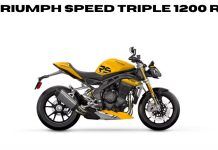






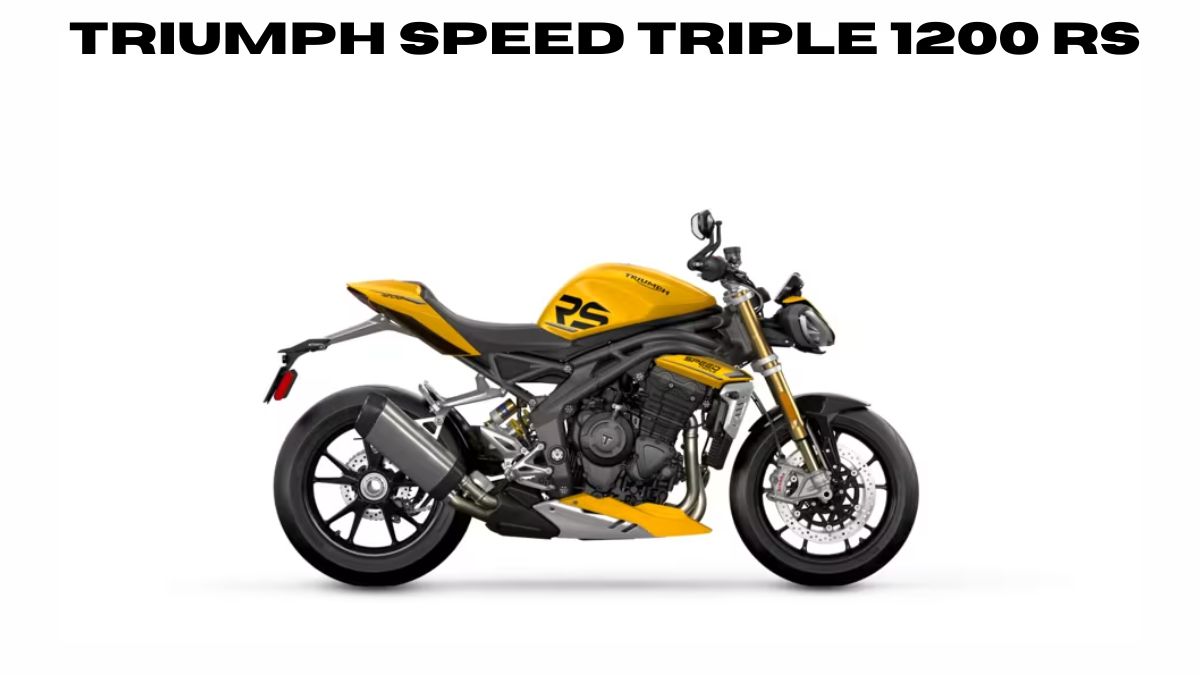
Triumph Speed Triple 1200 RS: A Technical and Comparative Analysis of the Naked Sports Icon’s Evolution
I. Executive Summary: The Hypernaked Evolution and Strategic Positioning
The Triumph Speed Triple 1200 RS represents a complete strategic and engineering overhaul of the iconic naked sports platform, marking a decisive shift from its historical role as a powerful streetfighter to a technologically advanced hypernaked motorcycle. Triumph explicitly framed the release of the 1200 RS not as a minor iteration, but as a “revolution” in power, performance, handling, and technology.1
This new generation is defined by three core advancements: a substantial increase in engine output, a radical commitment to weight reduction, and the incorporation of class-leading electronic chassis management. The liquid-cooled, 1160 cc triple engine now delivers 177 HP, representing an approximate 29 HP increase over the previous 1050cc model.2 Simultaneously, the vehicle’s wet weight has been reduced by 10 kg , settling at just 198 kg ready to ride.2
The critical engineering element that defines the 1200 RS’s market identity is the integrated Öhlins Smart EC3 semi-active suspension system. This sophisticated technology allows the motorcycle to instantly switch character, minimizing the typical performance trade-offs inherent in naked sportbikes. It transforms from a compliant, comfortable road machine to a razor-sharp track weapon simply by selecting a riding mode.4

The overall strategic positioning of the 1200 RS is centered on delivering refined, accessible hypernaked performance and exceptional versatility. The vehicle is engineered to provide the “ultimate combination of performance, handling, rider-focused technology, track specification equipment and aggressive new style,” positioning the Triumph as a balanced yet highly capable competitor against the most aggressive V-twin and V4 motorcycles in the premium segment.2 The resulting package is far more accessible, versatile, and easier to ride than its predecessors, which is genuine progress given the quality of the previous generation.4
II. Engineering a Revolution: Detailed Analysis of the 1160cc Triple Engine
The heart of the Speed Triple 1200 RS is an entirely new engine design, developed specifically to meet the demands of the modern hypernaked category. This unit moves Triumph away from the longer-stroke characteristics of previous generations toward a high-performance, high-revving architecture derived, in part, from lessons learned during the company’s Moto2 engine supply program.4
A. Architecture, Bore/Stroke Ratio, and Compression Dynamics
The 1200 RS is powered by a liquid-cooled, 12-valve, DOHC, inline 3-cylinder engine boasting an 1160 cc capacity.1 The transition to this new powerplant necessitated a fundamental shift in internal geometry.
The engine employs a short-stroke design, quantified by a bore of 90.0 mm and a stroke of 60.8 mm.1 This is a significant mechanical departure from the previous 1050 cc engine, which featured a bore of 79 mm and a longer stroke of 71.4 mm.5 The aggressive short-stroke ratio is a crucial design choice in high-performance racing platforms, as it allows the piston assembly to achieve much higher velocities before piston speed limits are reached. This enables the engine to rev higher, pushing the peak performance further up the rev range to 10,750 rpm.1 This structural optimization is a direct consequence of technology adapted from Triumph’s high-level involvement in competitive motorcycling.4
Furthermore, maximizing the energy extracted from the increased capacity is achieved through a high compression ratio of 13.2:1.1 This high ratio contributes directly to the maximum power output by ensuring greater thermal efficiency during combustion.
B. Quantification of the Performance Leap: 1200 RS vs. Previous Generations
The new engine architecture translates into exceptional performance gains. The maximum power output is 177 HP (132.4 kW) achieved at 10,750 rpm.1 This represents a monumental increase of 29 HP compared to the previous Speed Triple generation.2 Peak torque is measured at 92 lb-ft (approximately 125 Nm), delivered at 9,000 rpm.1
This power-to-weight optimization has allowed Triumph to confidently claim the 1200 RS is the “fastest accelerating Speed Triple ever”.1 On track, this acceleration is translated into demonstrable top-end speed, with the motorcycle reportedly hitting 250-260 km/h at the end of long straights.4
The magnitude of this evolutionary change is detailed below in a comparative table illustrating the transformation in the core engine metrics:
Table 1: Comparative Analysis: Speed Triple Generations (1050 vs. 1200 RS)
| Feature | Previous Speed Triple (1050cc Est.) | Speed Triple 1200 RS (Current) | Evolutionary Change | Source |
| Displacement (cc) | 1,050 | 1,160 | 110 cc | 5 |
| Max Power (HP / PS) | 131 HP | 177 HP 180 PS | 46 HP + 35 | 1 |
| Peak Power RPM | 9,250 rpm | 10,750 rpm | Higher Rev Focus | 5 |
| Bore x Stroke (mm) | 79 times 71.4 (Longer Stroke) | 90 \times 60.8 (Shorter Stroke) | Short-Stroke Design | 5 |
| Wet Weight (kg) | 208 kg(Est.) | 198 kg | 10 kg Reduction | 3 |
| Suspension | Showa (Manual Adjust) | Öhlins Smart EC3 (Semi-Active) | Technology Leap | 5 |
C. Power Delivery Profile: Midrange Torque vs. Peak Power Access
The unique nature of the inline triple configuration allows Triumph to balance two seemingly opposing requirements: usable road power and extreme peak track performance. For street use, the engine’s character is defined by a “surging glut of torque” in the midrange, which makes it satisfying for riders who prefer to short-shift and drive hard through the mid-range.4 This smooth linearity prevents the bike from feeling overwhelming, a desirable trait for general road use.
However, some expert reviewers noted that accessing the true “thrill” of the claimed 177 HP requires commitment, often requiring acceleration beyond 8,000 RPM.8 This stands in contrast to rivals equipped with large-capacity V-twin engines, which typically deliver explosive, immediate torque lower down the rev range. The consequence of this design is that the 1200 RS is incredibly manageable and less intimidating than its hypernaked competitors, thereby broadening its market appeal to riders prioritizing refinement. However, riders seeking instant, overwhelming street performance might find that the engine requires dedicated track application to fully unlock its high-horsepower potential.
The fuel system employs multipoint sequential electronic fuel injection with electronic throttle control.1 This sophisticated control ensures precise fueling tailored to the five available riding modes.

D. Noise, Aural Character, and Ancillary Systems
The distinctive, signature sound of the Hinckley triple engine is maintained and enhanced in the 1200 RS. Reviewers praise the engine’s aural character, noting that it produces excellent noise, including “pops, bangs,” and a pronounced induction sound described as a “hornet’s nest,” even when utilizing the standard muffler.8 The exhaust system itself is a stainless steel 3-into-1 header system with an underslung primary silencer and a side-mounted secondary silencer.1 While the stock muffler is acoustically rich, its aesthetic appearance has been noted as a potential drawback, suggesting a strong consumer drive toward optional performance systems, such as the Akrapovic muffler, which also transforms the appearance of the swingarm area.4
Power transfer utilizes a 6-speed gearbox linked to a wet, multi-plate, slip and assist clutch and an X-ring chain final drive.1
III. The Agile Core: Chassis Design, Weight Reduction, and Mass Centralization
The dramatic performance transformation of the Speed Triple platform is equally attributable to a clean-sheet redesign of the chassis, which placed paramount importance on mass centralization and significant weight reduction.
A. Radical Weight Reduction and Frame Architecture
The new chassis was designed from the ground up to create the lightest and best-handling Speed Triple ever.3 The primary achievement is the reduction of the total wet weight to just 198 kg (437 lb).1 This figure means the new model is an “incredible 10 kg lighter” than the outgoing generation, or 22 lbs lighter ready to ride.2
The foundation of this weight reduction is a new cast aluminium frame, which is lighter than its predecessor.3 The frame utilizes a twin-tube architecture.5 Furthermore, mass centralization was a core engineering philosophy, ensuring that the weight distribution is intentionally positioned “further forward and lower down” than before.3 This forward mass bias, combined with the overall weight savings and the use of a lightweight Lithium-ion battery 1, dramatically minimizes the motorcycle’s polar moment of inertia. This engineering synergy directly results in the bike’s high-level agility and its celebrated feeling of being “chuckable” 4, leading to “more agile, precise and dynamic handling”.3
B. Geometric Specifications and Dynamic Stability
The chassis geometry is configured for quick response and precision handling, featuring a rake of 23. circ and a trail of 104.7 (mm}( 4.1 { in}).1 The wheelbase is set at 1445 { mm} ( 56.9 ( in).1
This sharp geometry ensures rapid turn-in capabilities, essential for a machine competing at the apex of the naked sports segment. To maintain stability at the high speeds the 177 HP engine is capable of achieving, especially given the lightweight and centralized mass, the 1200 { RS} is equipped with a Marzocchi steering damper.4 This component acts as a crucial safety measure to mitigate any potential high-speed headshake or twitchiness that might arise from the aggressive geometry and lightweight front end.
C. Ergonomics and Rider Interface
The rider triangle has been carefully revised to complement the new, tighter, and more toned chassis package.3 The motorcycle is now narrower, promoting a more dominant and purposeful riding position.2 The flat, one-piece handlebar is 10 mm wider and 7 mm higher than the previous model, offering a roomier yet poised posture.4
The seat height is officially stated as 830 mm 32.7 in.1 Despite the official metric, some riders have subjectively noted that the bike feels taller than its predecessor, possibly due to the interaction between the performance rear shock pre-load, rider leg length, and overall revised ergonomics.9
D. Rolling Components and Grip Assurance
The handling dynamics are further enhanced by lightweight wheels, which significantly contribute to the bike’s overall agile behavior.4 Ensuring that the high power output can be successfully transferred to the tarmac, the 1200 RS comes factory-fitted with high-performance Pirelli Diablo Supercorsa V3 tyres.1 These race-specification tires provide the necessary grip levels for track use and confidence-inspiring traction in challenging road conditions.

IV. Dynamic Precision: Suspension and Braking Systems
The 1200 RS utilizes uncompromising, track-specification equipment to manage its performance envelope.2 The combination of advanced damping control and high-fidelity braking hardware ensures precise, confident handling across all dynamic scenarios.
A. Deep Dive into Öhlins Smart EC3 Semi-Active Suspension Technology
The most defining technological upgrade for the 1200 RS is the standard fitment of the state-of-the-art Öhlins Smart EC3 semi-active suspension system.4 This system moves beyond manually adjustable suspension, allowing the rider to “effortlessly tailor [the] ride” through electronic control.7
Expert evaluations confirm this system is the central component of the improvement, transforming the bike’s versatility.4 In comfort settings, such as those automatically selected in Road mode, the suspension provides a “sumptuously plush ride,” soaking up irregularities even on poorly surfaced or potholed roads, making it “supremely forgiving” at slower speeds.4 When the rider increases aggression—or selects a Sport or Track mode—the system instantly reacts by firming up, offering “understated control” and eliminating instability such as wallow or excessive dive.4
The EC3 system is instrumental to the 1200RS s market identity, justifying the claim that the bike is “three bikes in one.” The capability to rapidly and electronically adjust damping characteristics to match immediate riding needs—from comfortable road cruiser to dedicated track machine—is the primary technological differentiator in the highly competitive hypernaked class. This flexibility ensures the bike remains highly composed, even in adverse conditions like a damp track, where the rider can forensically “feel the grip levels” through the chassis, enhancing confidence.4
B. Brembo Stylema Monobloc Calipers and Optimized Braking
To match the increased power and reduced weight, Triumph has equipped the 1200 RS with premium braking components. Radial-mounted Brembo Stylema brakes are fitted, providing the necessary stopping force and feel expected of a track-ready motorcycle.4 Reviews universally praise the braking performance, describing the brakes as “amazing” 11, offering high finesse and ease of modulation.4
C. Cornering Safety Integration
The high-performance braking hardware is intrinsically linked to the sophisticated electronic safety suite via the Inertial Measurement Unit (IMU). The system includes Optimized Cornering ABS, which is specifically calibrated for use in conjunction with Brake Slide Assist.1 The utilization of an IMU allows the braking systems to account for lean angle, optimizing braking pressure to ensure maximum stability and control during extreme maneuvers, providing critical reassurance, even during aggressive track testing in the rain.4

V. State-of-the-Art Rider Aids and Electronics Package
The sheer performance of the Speed Triple 1200 RS necessitates a comprehensive and highly advanced electronics suite, designed to manage the extreme outputs and provide maximum rider confidence regardless of conditions.
A. IMU Integration: Cornering Safety Systems
The foundation of the electronics package is the full integration of a sophisticated Inertial Measurement Unit (IMU). This unit provides continuous spatial data necessary for controlling lean-sensitive aids, including Optimized Cornering ABS and switchable Optimized Cornering Traction Control (TC).1
The Traction Control system is praised for its sophistication. It is described as “really really unintrusive”.11 When rear-wheel traction loss is detected, the TC intervention is characterized as soft, gently taking over and then reintroducing power smoothly, minimizing aggressive cuts and misfires.4 This sophisticated and non-abrupt intervention ensures rider confidence, particularly when riding in challenging conditions like heavy rain.4 The package also includes Front Wheel Lift Control (anti-wheelie) integrated into the TC system.1
B. The Five Configurable Riding Modes and Limitations
To provide tailored control over the bike’s performance parameters—including throttle map, TC sensitivity, ABS intervention, and Öhlins suspension damping—the 1200 RS offers five configurable riding modes: Rain, Road, Sport, Track, and Rider (customizable).1 The Rain mode significantly reduces the bike’s potential, capping peak power output at 100 HP.4
The modes are designed to be dynamic and versatile. However, a significant constraint noted by advanced riders pertains to the interaction between the safety aids. A criticism highlighted during track testing is the inability to decouple the Front Wheel Lift Control (wheelie control) while simultaneously keeping Traction Control active.4 This forces riders who wish to perform controlled power wheelies to operate without the safety net of TC. This coupling suggests a predetermined, safety-focused electronic philosophy by Triumph, diverging from some competitors who allow more granular, independent tuning of these parameters, which track specialists often prefer.
C. Shifting, Utility Aids, and User Interface
The mechanical connection between the rider and the engine is enhanced by the standard Triumph Shift Assist, a smooth, up-and-down quickshifter that eliminates the need for clutch input during aggressive acceleration or deceleration.1
Beyond performance, the 1200 RS is equipped with several features that elevate its practical utility above a pure streetfighter classification. These include standard Cruise Control and a full keyless ignition system.1 The motorcycle uses a full-color 5 ” TFT instrument panel.1 However, despite the advanced nature of the underlying electronics, the interface itself has received criticism; one review likened the experience of accessing the large quantity of information or changing modes to operating an old, slow computer.4 This responsiveness deficit in the user experience is a noticeable area for software optimization to ensure seamless rider interaction commensurate with the bike’s premium price and technological focus.
Table 3: Integrated Rider Electronics and Aids Summary
| Electronic System | Technology/Component | IMU Dependency | Configurability / Versatility | Source |
| Suspension System | Öhlins SmartEC3 Semi-Active | N/A | Road (Comfort) / Track (Stiff) / Dynamic Adjustment | 4 |
| Stability Control | Optimized Cornering TC | Yes | Switchable, Lean Sensitive, 5 Modes | 1 |
| Braking Control | Optimized Cornering ABS | Yes | Brake Slide Assist, Lean Sensitive | 1 |
| Shifting | Triumph Shift Assist | N/A | Up and Down Quickshifter (Standard) | 1 |
| Power Control | Riding Modes (Rain, Road, Sport, Track, Rider) | Yes | Limits HP in Rain Mode (100 HP cap) | 1 |
| Hooligan Control | Front Wheel Lift Control | Yes | Personalized tech; Linked to TC (non-decoupleable) | 1 |
VI. Performance Assessment: Road and Track Dynamics
The true measure of the Speed Triple 1200 RS’s success lies in its execution across the wide spectrum of use cases: from commuting on compromised road surfaces to pushing the absolute limits on a circuit.
A. The Accessible Beast: Road Dynamics and Rideability
The overall consensus from performance reviews is that the 1200 RS is “painstakingly refined” and “incredibly easy to ride and enjoy in all conditions”.4 The primary enabler of its exceptional road dynamics is the Öhlins Smart EC3 suspension, which delivers a “supremely forgiving” and plush ride in Road mode, even on challenging or crumbling surfaces.4 This combination of lightweight chassis, refined electronics, and linear power delivery makes the motorcycle accessible and less fatiguing than many high-powered rivals. The engine provides a robust, surging glut of torque in the midrange, making it highly satisfying for short-shifting road use, promoting versatility and everyday enjoyment.4
B. High-Performance Testing: Track Prowess
When transitioned to track environments, the 1200 RS confirms its hypernaked credentials. The motorcycle exhibits “well-balanced, poised” handling 11, benefiting significantly from the electronically firmed-up suspension that provides precise control and eliminates instability.4 The low overall wet weight of 198 kg is keenly felt, allowing the bike to be thrown into corners with agility.4
The full 177 HP potential of the short-stroke engine is realized on the track, where it feels “outrageously quick,” with verifiable high speeds of 250-260 km/h achieved on straights.4 The engine demands dedication; it performs optimally when ridden like a conventional sportbike, requiring the rider to maintain revs in the upper register to utilize peak power, rather than relying solely on low-end torque. This requires higher rider commitment but rewards the effort with exhilarating acceleration.8 The bike’s overall handling confidence is so high that the sophisticated electronics are often “really really unintrusive”.11
C. Ownership and Maintenance Cost Advantage
Beyond performance, the 1200 RS offers competitive advantages in long-term ownership. Triumph specifies a remarkably long 10,000 miles 12 months service interval, whichever comes first.1 This extended interval is highly competitive within the hypernaked segment, which often features race-derived engines demanding more frequent and expensive maintenance. The long service interval suggests a reduced total cost of ownership compared to many of its high-performance rivals.
VII. Competitive Landscape and Market Analysis
The Triumph Speed Triple 1200 RS operates within the highly contested and premium hypernaked category, competing directly against benchmarks from Italy and Austria, namely the Ducati Streetfighter V4 S and the KTM 1290 Super Duke R.
A. Benchmarking Power-to-Weight Against Key Rivals
The hypernaked segment is often defined by the power-to-weight ratio, a metric where the 1200 RS is competitive but strategically differentiated. With 177 HP and a 198 kg wet weight, the 1200 RS achieves a power-to-weight ratio of approximately 0.894 HP/kg.
Table 2: Hypernaked Segment Key Metrics Comparison
| Model | Engine Type | Max Power (HP) | Max Torque (Nm) | Wet Weight (kg) | HP-to-Weight Ratio (HP/kg) | Key Technology | Source |
| Triumph Speed Triple 1200 RS | Triple | 177 | 125 | 198 | 0.894 | Öhlins Smart EC3, IMU, Cruise Control | 1 |
| Ducati Streetfighter V4 S | V4 | 205 | 120 | sim 197 | 1.040 | Desmosedici Stradale, Biplane Wings | 12 |
| KTM 1290 Super Duke R | V-Twin | 180 | High (V-Twin torque focus) | sim 200 (Est.) | sim 0.900 | LC8 Engine, Torque Focus, Optional Semi-Active | 8 |
The comparative data reveals that the Ducati Streetfighter V4 S maintains the lead in absolute power output and power-to-weight ratio, delivering 205 HP from its 1103 cc V4 engine.13 The KTM 1290 Super Duke R, known as “The Beast,” relies on the visceral, immediate power and torque characteristic of its large V-twin engine.8
The strategic competitive advantage for the Triumph Speed Triple 1200 RS is not based on maximizing raw horsepower, but on technological sophistication and dynamic versatility. The 1200 RS primary differentiator is the standard-fitment Öhlins Smart EC3 system. This technology allows the Triumph to offer exceptional handling refinement and road accessibility that often surpasses its more aggressively tuned, higher-output rivals. The Triumph is positioned as the most technologically polished choice, offering a unique blend of linear performance and dynamic adaptability.
B. Market Pricing and Internal Competition
In key markets, the 1200 RS is positioned competitively. For example, in Australia, the price point of the 1200 RS’s sibling, the 1200 RR, was competitive with machines like the BMW 1000 R Sport.16 In Pune, India, the on-road price for the 1200\ RS STD variant is quoted around ₹}26,84,779, or sometimes lower depending on the specific package, placing it near the Ducati Streetfighter V2 and BMW R 1300 R in comparison.17 Initial market availability was tightly controlled, with the first batch in India consisting of only 30 units, suggesting focused production or high anticipated localized demand.10
An interesting dynamic arises from Triumph’s own portfolio: the highly capable Street Triple 765 RS. This model offers compelling performance at a significantly lower price point, leading some consumers to question the value of the 1200 RSs additional power, particularly if the bike is intended exclusively for road use where the full 177 HP cannot be safely accessed.16 The 1200 RS therefore must rely on its advanced chassis technology, superior torque output, and greater speed potential to justify its premium position.

IX. Conclusion and Strategic Outlook
The Triumph Speed Triple 1200 RS successfully fulfills the ambition of a triple-powered “revolution,” establishing a formidable presence in the hypernaked segment. The machine’s identity is founded upon a symbiotic engineering relationship: the dramatic 10 kg weight reduction and mass-centralized chassis 3, combined with the dynamic intelligence provided by the Öhlins Smart EC3 semi-active suspension.4
While the new 1160 cc short-stroke engine demands high commitment—requiring the rider to utilize the upper echelons of the rev range to extract its maximum 177 HP —it delivers a uniquely refined and highly usable performance profile on the road, rich in midrange torque and complemented by a compelling aural character.4
The strategic success of the 1200 RS lies in its technological completeness and inherent versatility. The comprehensive package of IMU-controlled aids, high-spec Brembo Stylema brakes, and the instant adaptability of the semi-active damping system makes its extreme performance accessible to a wider pool of riders. Although competitors may offer higher peak power (e.g., Ducati Streetfighter V4 S), the 1200 RS differentiates itself by offering exceptional handling poise, refinement, and dynamic sophistication. It is positioned as the most polished and versatile entry in the highly aggressive hypernaked category, capable of satisfying the demands of both high-end road riding and serious track performance.
Sources
- Speed Triple 1200 RS Model | For the Ride – Triumph Motorcycles, accessed on December 14, 2025, https://www.triumphmotorcycles.com/motorcycles/roadsters/speed-triple-1200/speed-triple-1200-rs
- Reasons To Ride – Triumph Motorcycles, accessed on December 14, 2025, https://www.triumphmotorcycles.com/motorcycles/roadsters/speed-triple-1200/reasons-to-ride
- ALL NEW SPEED TRIPLE 1200 RS – TRIPLE POWERED REVOLUTION, accessed on December 14, 2025, https://triumph-mediakits.com/en/news-articles/all-new-speed-triple-1200-rs-triple-powered-revolution.html?highlight=Triumph
- ROAD & TRACK TEST | Triumph Speed Triple 1200 RS – Australian …, accessed on December 14, 2025, https://amcn.com.au/editorial/road-track-test-triumph-speed-triple-1200-rs/
- Triumph Speed Triple 1200 RS 2025 vs Triumph Speed Triple 1050 2010 – 1000PS.com, accessed on December 14, 2025, https://www.1000ps.com/en-us/comparison/444020/triumph-speed-triple-1200-rs-2025-vs-triumph-speed-triple-1050-2010
- Speed Triple 1200 Specifications | For the Ride – Triumph Motorcycles, accessed on December 14, 2025, https://www.triumphmotorcycles.com/motorcycles/roadsters/speed-triple-1200/specification
- Speed Triple 1200 RS – Triumph Motorcycles, accessed on December 14, 2025, https://www.triumphmotorcycles.com/motorcycles/roadsters/speed-triple/speed-triple-1200-rs-2025
- KTM Superduke 1290R vs Triumph Speed Triple 1200RS – Jaber Engineering Consultancy, accessed on December 14, 2025, https://www.jaberec.com.au/post/ktm-superduke-1290r-vs-triumph-speed-triple-1200rs
- Walk Around Side by side Speed Triple 1200 RS and 1050 S – YouTube, accessed on December 14, 2025, https://www.youtube.com/watch?v=xLh0AJl2uT0
- Triumph Speed Triple 1200 RS launched at Rs 16.95 lakh – The Times of India, accessed on December 14, 2025, https://timesofindia.indiatimes.com/auto/bikes/triumph-speed-triple-1200-rs-launched-at-rs-16-95-lakh/articleshow/80495755.cms
- Speed triple 1200 RS independent reviews | For the Ride – Triumph Motorcycles, accessed on December 14, 2025, https://www.triumphmotorcycles.com/motorcycles/roadsters/speed-triple-1200/reviews
- Ducati Streetfighter V4 vs Triumph Speed Triple 1200 Rs – Which is Better? – BikeJunction, accessed on December 14, 2025, https://thebikejunction.com/compare-bikes/ducati-streetfighter-v4-vs-triumph-speed-triple-1200-rs
- Ducati Streetfighter V4 MY25 – Engine & Performance, accessed on December 14, 2025, https://www.ducati.com/us/en/bikes/streetfighter/streetfighter-v4/engine
- 2024 Ducati Streetfighter V4 S – New Haven Powersports, accessed on December 14, 2025, https://www.nhpowersports.com/Motorcycles-Ducati-Streetfighter-V4-S-2024-New-Haven-CT-885508b9-8616-47b3-b5c2-b054004ae4bd
- 1290 SUPER DUKE RR – KTM, accessed on December 14, 2025, https://www.ktm.com/en-int/1290-super-duke-rr.html
- 2024 Street triple RS or 2022 Speed triple 1200 RR or BMW s1000r Sport? – Reddit, accessed on December 14, 2025, https://www.reddit.com/r/Triumph/comments/13pe7mk/2024_street_triple_rs_or_2022_speed_triple_1200/
- Triumph Speed Triple 1200 RS On Road Price in Pune – BikeWale, accessed on December 14, 2025, https://www.bikewale.com/triumph-bikes/speed-triple-1200-rs/price-in-pune/
- Triumph New Speed Triple 1200 RS On Road Price in Pune – HT Auto – Hindustan Times, accessed on December 14, 2025, https://auto.hindustantimes.com/new-bikes/triumph/speed-triple-1200-rs/on-road-price-pune
Our Social Media Handles
- Instagram : LivingWithGravity
- Medium : Akash Dolas
- YouTube Channel : Gear and Shutter
- Facebook : LivingWithGravity