






Strategic Competitive Analysis
I. Executive Summary: Strategic Implications of the V2 Evolution
The 2026 model year for the Ducati Monster represents a calculated and fundamental platform revision, signaling a significant strategic pivot for the Bologna-based manufacturer in the premium middleweight naked segment. This is not simply a cosmetic update but a tactical realignment involving core engineering architecture. The model is transitioning away from the existing 937cc Testastretta L-twin to the newer, consolidated 890cc V2 engine platform.1
The decision to implement these sweeping changes is driven by interconnected strategic mandates designed to improve market penetration and long-term competitiveness. First, component standardization across the V2 family (including the Multistrada V2, Streetfighter V2, and DesertX) allows Ducati to leverage improved manufacturing economies of scale.1 Second, the engineering focus is on optimizing performance through significant weight reduction and reshaping the engine’s torque curve for enhanced real-world power delivery, a direct response to segment competition.2
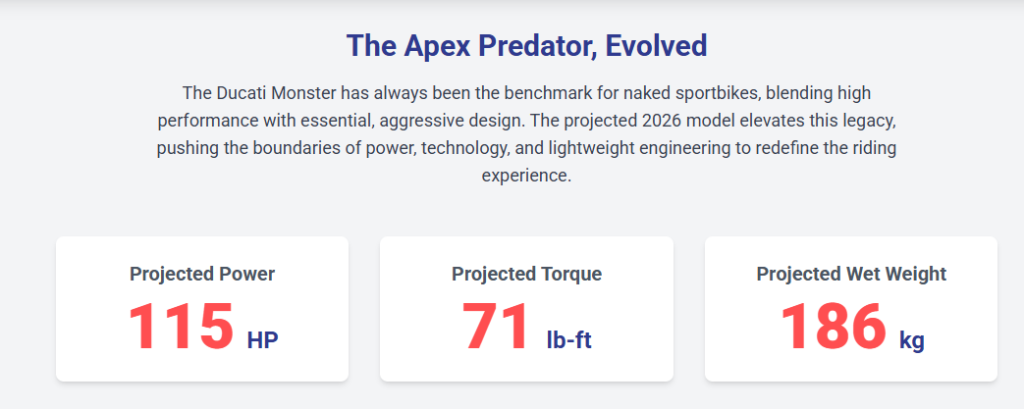
Most critically, the strategic shift involves adopting conventional valve springs (non-Desmodromic operation) on the 890cc V2 engine. This crucial engineering change aims to dramatically reduce the Total Cost of Ownership (TCO) and extend service intervals, effectively addressing the primary non-purchase barrier for entry-level and middle-tier buyers.3 The platform revision is forecasted to maintain high-performance credibility, with engine output expected to increase slightly from the current 111 horsepower to a projected range of 115–120 horsepower, while achieving a superior power-to-weight ratio through mass reduction.5 The confirmed North American MSRP, starting at $13,195 USD, solidifies the Monster’s positioning as a premium, yet accessible, gateway into the Ducati performance lineup.7
Analysis of Strategic Risks: The Non-Desmo Paradox
The removal of the Desmodromic valve actuation system is perhaps the most scrutinized element of the 2026 platform. The Desmo system is a historical hallmark of Ducati engineering, deeply tied to its racing heritage and brand identity.9 However, the mechanical complexity of the Desmo system necessitates the expensive and frequently maligned “Desmo Service,” which traditionally hinders customer retention and complicates the ownership experience.10
By migrating the 890cc V2 engine to conventional valve springs, Ducati eliminates the costly service requirements, potentially extending valve inspection intervals significantly, perhaps toward the 60,000 km mark achieved by the spring-valved V4 Granturismo engine.4 This move sacrifices an element of historical engineering fidelity that appealed to purists, particularly following the prior move away from the traditional trellis frame.9 Nevertheless, for the targeted middleweight naked demographic—a segment increasingly concerned with total lifetime cost and ease of ownership—the high maintenance cost structure represents the principal point of operational friction.11 This choice demonstrates that Ducati is deliberately prioritizing long-term market growth, competitiveness on the TCO metric, and industrial efficiency over strict adherence to historical engineering principles on its entry-to-mid-tier platforms. This is a calculated repositioning designed to increase market volume and simplify the dealer network’s operational commitments.
II. Launch Context and Model Lineup Confirmation
A. Official Ducati World Première and Anticipated Debut
Ducati has formalized the timeline for the introduction of its 2026 Model Year lineup under the banner of the Ducati World Première 2026. The official calendar confirms that model presentations are set to commence on September 12th.12
A dedicated unveiling event strongly suggested to feature the Monster is scheduled for October 23, 2025.6 This timing is strategically placed just before the traditional major European motorcycle exhibitions, specifically EICMA in Milan, which typically occurs in November.3 This sequencing allows Ducati to dominate the news cycle preceding the largest industry show, maximizing the impact of the Monster’s platform debut. Based on standard manufacturing and distribution timelines following a late-calendar year reveal, the 2026 Model Year vehicles are anticipated to begin arriving in North American and European dealerships and showrooms throughout the first half of 2026.5
B. 2026 Variant Structure and Preliminary North American Pricing Matrix
The 2026 Monster range is confirmed through multiple pre-listing dealer inventories and pricing sheets to feature three core variants: the Base Monster, the Monster+, and the range-topping Monster SP.7
The Base Monster holds a confirmed Starting Manufacturer’s Suggested Retail Price (MSRP) of $13,195 USD.7 This pricing is highly competitive within the premium segment, particularly considering the extensive electronic package included as standard equipment (detailed in Section V).
The Monster+ variant carries a starting MSRP of $13,595.7 Historically, the ‘+’ model includes minor functional and cosmetic enhancements, typically comprising a small flyscreen and a pillion seat cover, positioning it as the volume model for mainstream sport touring and daily riding.
The high-performance Monster SP variant commands a significant price premium, starting at $16,595.7 This 26% price increase over the base model is justified by the substantial upgrade in chassis componentry, including sophisticated Öhlins suspension and high-spec Brembo Stylema calipers.17
Table 1: 2026 Ducati Monster Preliminary North American Pricing Matrix
| Model Variant | Confirmed MSRP (Starting) | Primary Differentiator | Strategic Function |
| Monster (Base) | $13,195 | 890cc V2 engine, Aluminum Front Frame | Volume/Entry-level access to the premium market. |
| Monster + | $13,595 | Aesthetic/Minor convenience additions (Flyscreen, Cover) | Mainstream sport touring/daily rider. |
| Monster SP | $16,595 | Öhlins NIX30, Brembo Stylema, Termignoni, Steering Damper | Track-oriented, halo-product positioning. |
The price structure reveals a calculated strategy concerning internal market segmentation. The MSRP of the range-topping Monster SP ($16,595) actually exceeds that of the base Streetfighter V2 (955cc, $15,495 MSRP).8 This price overlap suggests Ducati is deliberately differentiating product appeal based on buyer profile. The Streetfighter V2 remains the choice for performance purists seeking maximum output from the Superquadro engine.19 Conversely, the Monster SP is targeted at riders who prioritize the highest-grade, lightweight chassis components—Öhlins NIX30 suspension, Brembo Stylema brakes, and the Termignoni exhaust—over outright peak power. The Monster SP, therefore, targets the sophisticated road-sport buyer who values premium componentry, whereas the Streetfighter V2 targets the aggression and track-day enthusiast. This segmentation strategy aims to capture distinct buyer profiles without allowing complete cannibalization between the two mid-weight naked platforms.20
III. Core Engineering Deep Dive: The 890cc V2 Engine
A. Architecture Shift: 937cc Testastretta 11° Replacement
The core of the 2026 revision is the cessation of the 937cc Testastretta 11° L-twin, a liquid-cooled engine known for its Desmodromic actuation.15 In its place, the Monster will adopt the newer 890.3cc V2 engine architecture.1 This is a strategic move toward engine consolidation across Ducati’s mid-tier V2 motorcycles, ensuring standardization of componentry and simplifying future homologation processes.
Although the displacement is slightly reduced from the outgoing engine, this shift is often utilized in contemporary motorcycle engineering to comply with increasingly stringent global emission standards (e.g., Euro 5+) while simultaneously improving the engine’s specific output (power per unit of displacement) and reducing overall mass.21
B. Performance Projection and Delivery Profile
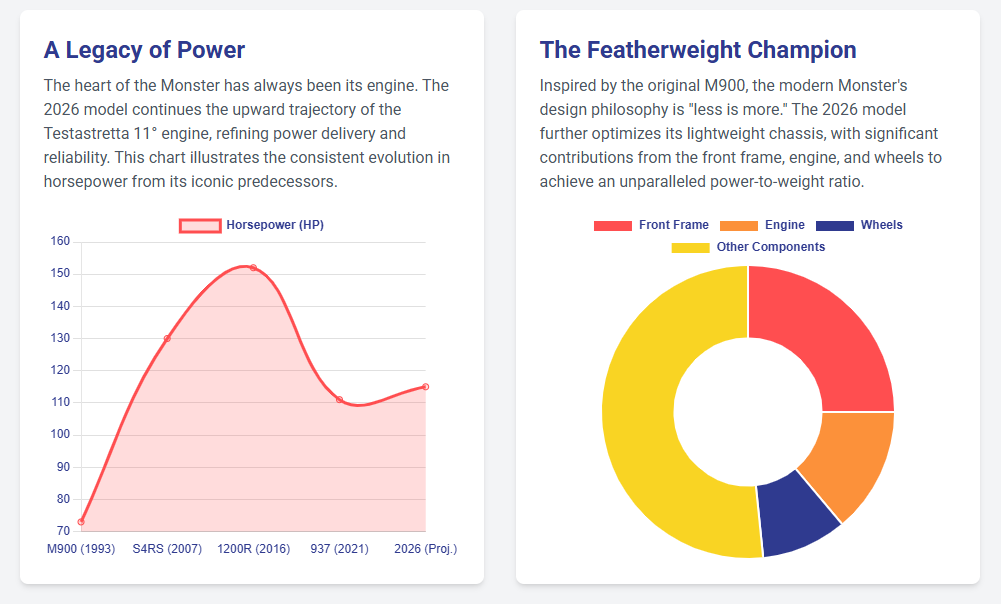
The outgoing 937cc Testastretta 11° engine provided a robust output of 111 horsepower (82 kW) delivered at 9,250 rpm, and a maximum torque of 69 lb-ft (93 Nm) peaking at 6,500 rpm.22 The 890cc V2 platform, as employed in other Ducati models, is capable of producing up to 120 horsepower (claimed).19 The conservative projection for the 2026 Monster V2 places peak output in the 115–120 horsepower range.5 Torque is anticipated to remain highly competitive, approximating the outgoing model’s 69 lb-ft.19
Despite the marginal reduction in displacement, the engine redesign features a very high compression ratio (claimed at 13.5:1 for the V2 platform) protected by knock detection systems.21 This aggressive tuning, combined with other technical modifications, is directed toward performance optimization.5 While peak power sees a modest increase, the most significant performance gain is anticipated in the delivery profile. The new design targets an “improved mid-range torque” and “smoother power delivery”.2 This focus addresses a common critique of V-twins, which can feel less responsive than competitive inline-triple or inline-four configurations in the middle-RPM spectrum. By reshaping the torque curve, Ducati aims to ensure the Monster delivers a more satisfying, immediate “pull when accelerating out of corners” critical for spirited street and canyon riding.2
Table 2: Comparison of Current and Projected Monster Engine Specifications
| Specification | Current 937cc Testastretta 11° (Benchmark) | 2026 890cc V2 (Forecast) | Difference |
| Displacement (cc) | 937 | 890.3 | Decreased (4.7%) |
| Valvetrain | Desmodromic | Conventional Spring Valves | Fundamental Shift |
| Compression Ratio | 13.3:1 | 13.5:1 (Claimed) | Increased |
| Peak Power (hp) | 111 @ 9,250 rpm | 115–120 (Projected) | Increased |
| Peak Torque (lb-ft) | 69 @ 6,500 rpm | ~69 | Consistent |
| Valve Check Interval | 18,000 mi (30,000 km) | Projected up to 37,000 mi (60,000 km) | Significantly Extended |
C. The Non-Desmodromic Decision: Technical & Financial Justification
The definitive confirmation that the new 890cc V2 engine utilizes conventional helical steel valve springs rather than the traditional Desmodromic system represents the most controversial yet strategically important technical decision.21 This move is explicitly justified as a necessary technical measure to reduce both manufacturing complexity and subsequent ownership costs.21
For the customer, the implications are overwhelmingly positive regarding long-term ownership. The complex nature of the Desmo valvetrain, requiring precise mechanical actuation to open and close the valves, results in the infamous, high-cost “desmo service,” often a deterrent for prospective owners.9 By switching to valve springs, the design simplifies the cylinder head, drastically reducing component count and easing the valve clearance inspection process.21
This engineering transition allows Ducati to project dramatically extended service intervals. The outgoing 937cc Testastretta required valve clearance checks every 18,000 miles (30,000 km).25 The new spring-valved V2 is expected to push this interval toward 60,000 km, aligning the Monster’s total cost of ownership (TCO) with industry leaders and addressing a major operational weakness cited by customers and purists alike.3 The implication here is twofold: not only does it provide a critical sales advantage by reducing customer friction (TCO), but the elimination of the specialized Desmo system components also streamlines the cylinder head manufacturing process, lowering internal industrial costs and increasing the potential profit margin on each unit sold in this high-volume middleweight segment. This choice reflects a mature, rationalized industrial strategy focused on market dominance rather than engineering tradition alone.
IV. Chassis Dynamics, Mass Reduction, and Ergonomics
The 2026 Monster platform continues to capitalize on its identity as a lightweight, high-performance naked machine, achieving further mass reduction through targeted chassis component changes.
A. Structural Revisions and Weight Reduction Targets
The fundamental chassis architecture retains the proven Aluminum alloy Front Frame, which uses the engine as a stressed member, contributing to the bike’s overall lightness and torsional rigidity.15 However, the rear structure is undergoing refinement. Technical reviews indicate that the existing Glass Fiber Reinforced Polymer (GFRP) subframe, previously utilized for weight reduction, is being replaced by a new, visibly sleeker aluminum alloy setup.24
The cumulative effect of these structural shifts, combined with the new, inherently lighter 890cc V2 engine platform 21, suggests a strong commitment to enhancing agility. The current Monster’s wet weight (without fuel) is documented at an already impressive 395 lb (179 kg).16 The sum of these changes, particularly on the higher-spec SP model, strongly indicates that the 2026 Monster will target a running weight substantially below 400 lbs (wet/ready-to-ride). This focus on mass reduction is crucial, as it maintains the Monster’s distinct performance advantage—its superior power-to-weight ratio—over heavy middleweight rivals such as the Kawasaki Z900 (~463 lbs wet).
B. Suspension and Braking Componentry
The Base and Monster+ variants feature high-quality, non-fully-adjustable suspension components: a 43 mm USD fork at the front and a preload-adjustable monoshock linked to an aluminum double-sided swingarm at the rear.15 The standard braking system employs dual 320 mm semi-floating discs managed by radially mounted Brembo M4.32 monobloc four-piston calipers.15
The Monster SP, positioned as the track-oriented flagship, receives substantial upgrades that justify its premium price point.18 The SP variant is equipped with fully adjustable Öhlins NIX30 suspension, which provides superior road feel and is 1.3 lbs lighter than the fork used on the Base model. The upgraded suspension also increases ground clearance, facilitating greater lean angles.18 The braking system is significantly enhanced with Brembo Stylema® front calipers and aluminum-flanged 320 mm front discs, reducing unsprung mass by an additional 1.1 lbs compared to the standard model’s equipment.17 Furthermore, the SP model adopts a lithium-ion battery, contributing to an overall weight saving of approximately 4.4 lbs in running order compared to the standard model, despite the addition of a steering damper.18
C. Ergonomic and Aesthetic Refinements
Aesthetically, the 2026 model aims for a more aggressive and muscular presence. Early images and spy reports indicate a newly shaped fuel tank.5 This redesigned tank is visually distinctive, featuring more aggressive cutouts intended to improve knee grip during spirited riding and address criticisms that the prior generation lacked the visual bulk associated with the traditional Monster aesthetic.24
Ergonomically, revisions include a repositioned, flatter handlebar and a roomier seat, suggesting a focus on balancing aggressive sport geometry with day-to-day comfort.24 The rear rim has also been subtly adjusted to enhance comfort for both the driver and the front passenger.5 Minor styling updates include the relocation of the turn signals from the tank fairing to the forks, a commonly seen change across many premium manufacturers.5
In terms of acoustics, the new V2 engine necessitates a revised exhaust system, including completely redesigned manifolds. This change is predicted to result in a “changed sound character,” which is a critical element for retaining the visceral and addictive appeal of the Ducati V-twin sound—a defining characteristic of the Monster experience.5
V. Electronic Systems and Rider Aid Integration
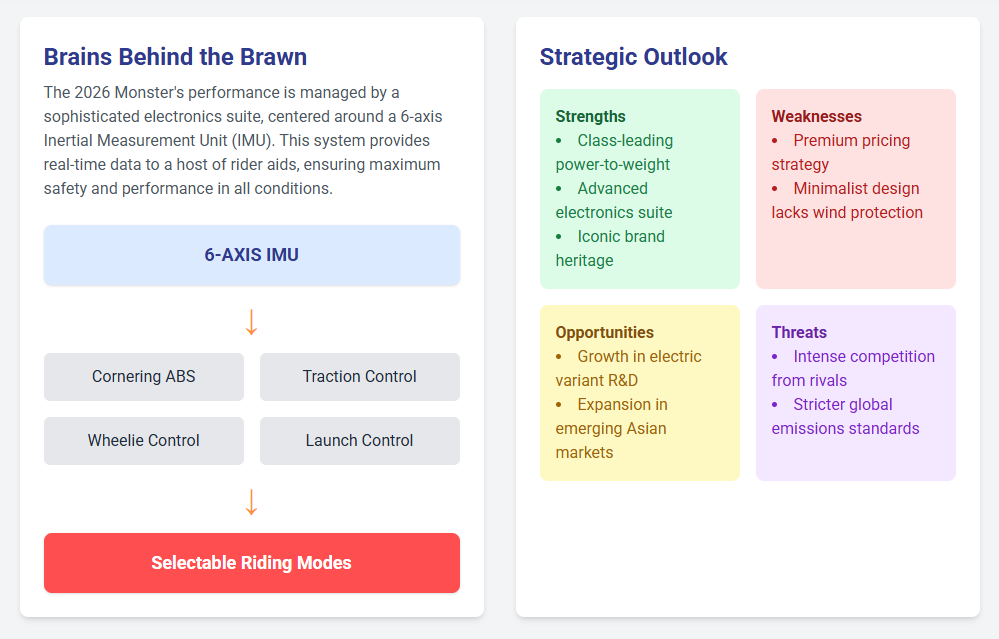
The 2026 Ducati Monster maintains a strong advantage in its segment by offering a sophisticated and comprehensive electronics package as standard equipment, leveraging Inertial Measurement Unit (IMU) data for dynamic control and safety systems.
A. IMU-Based Rider Aids and Control Systems
The integration of an IMU allows for complex, dynamic rider aid systems, setting a high standard for the middleweight naked category. Key safety features include:
- Cornering ABS (Anti-lock Braking System): This crucial system utilizes IMU data to calculate lean angle, adjusting brake pressure to maintain stability and safety when braking mid-corner.27
- Ducati Traction Control (DTC) and Ducati Wheelie Control (DWC): These dynamic control systems are fully integrated into the electronics suite and are adjustable through multiple intervention levels, allowing the rider to tailor the motorcycle’s character to prevailing road conditions or personal skill level.25
- Ducati Power Launch (DPL): Included standard, the DPL system ensures highly efficient, lightning-fast starts by autonomously managing engine revs, allowing the rider to focus solely on clutch management.27
The standardization of these advanced, IMU-based aids—including Cornering ABS and Ducati Power Launch—provides significant justification for the Monster’s premium pricing relative to its rivals. Many competitive models in the naked segment require riders to purchase quickshifters or accept less sophisticated non-IMU-based ABS systems as standard, positioning the Monster V2 as the technical benchmark in rider safety and control.11
B. User Interface and Control
Rider interaction is managed via a 4.3” color TFT display.16 This instrumentation is designed to provide clear, useful on-board information, prioritizing the rev counter and the currently selected gear in the center of the screen.27
The motorcycle utilizes Ride-by-Wire technology to facilitate the Riding Modes (RM) system. Like other latest-generation Ducati machines, the Monster offers different selectable modes—such as Sport, Touring, and Urban—that instantly modify the motorcycle’s behavior by adjusting throttle mapping, engine Power Modes, and the sensitivity and intervention levels of the DTC and DWC.27
Furthermore, the Ducati Quick Shift (DQS) system, providing smooth, clutchless gear changes both up and down, is confirmed as standard equipment.15 This feature enhances both the sporting prowess on spirited rides and the seamlessness required for daily commuting. The entire lighting system, including the modern headlight with Daytime Running Light (DRL) capability, utilizes full LED technology, ensuring excellent visibility and contributing to the bike’s technological aesthetic.27
VI. Competitive Positioning and Market Strategy
The revised 2026 Ducati Monster V2 is strategically positioned to reinforce its dominance in the premium lightweight naked category while making an aggressive play for market share traditionally held by volume manufacturers.
A. Internal Market Dynamics and Differentiation from Streetfighter V2
The transition to the 890cc V2 engine narrows the performance envelope separating the Monster V2 from the higher-tier Streetfighter V2, which utilizes the 955cc Superquadro engine (153 hp).19 Ducati’s strategy for internal differentiation is clear: the Streetfighter V2 will continue to command the segment dedicated to outright horsepower, high-revving characteristics, and aggressive streetfighter styling. The Monster V2, especially the standard and ‘+’ variants, is strategically placed to dominate the segment prioritizing sophistication, superior agility due to low weight, advanced standard electronics, and, most importantly, the newfound competitive advantage of substantially reduced maintenance costs. The Base Monster’s focus is on attracting new riders and urban commuters to the Ducati brand with a platform that is accessible, aesthetically compelling, and now functionally less expensive to maintain long-term.11
B. External Competitive Matrix Analysis
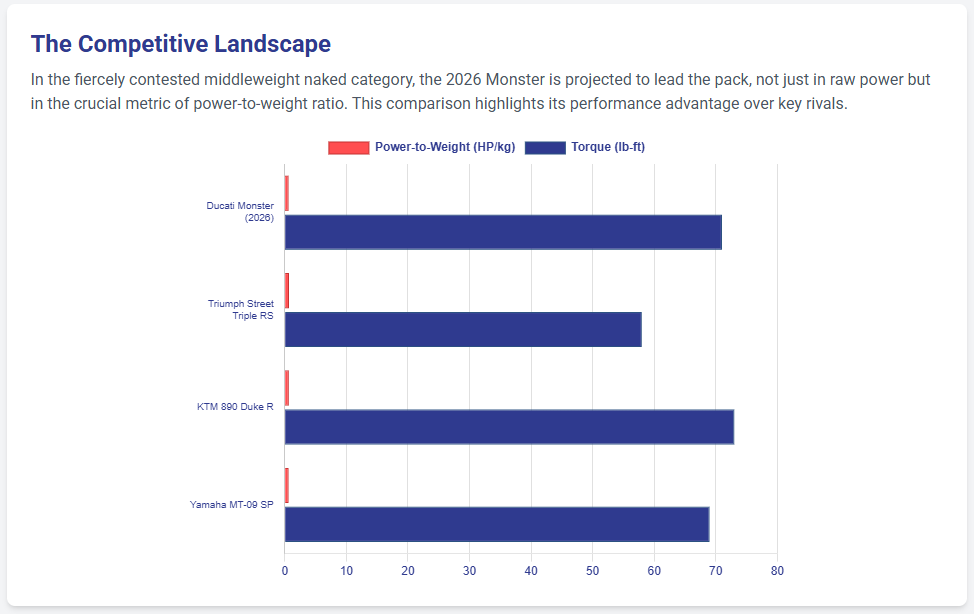
The primary external rivals for the 2026 Monster V2 remain the established benchmarks in the high-performance middleweight segment: the Kawasaki Z900 and the Triumph Street Triple 765.3
Competitive Comparison of Key Middleweight Naked Models (2026 Forecast)
| Model | Engine Configuration | Approx. Displacement (cc) | Projected Power (HP) | Wet Weight (Approx. Lbs) | Starting MSRP (USD) | Strategic Strength |
| 2026 Ducati Monster V2 | 90° V-twin | 890 | 115-120 | <395 | $13,195 7 | Best power-to-weight, lowest projected TCO, advanced standard electronics. |
| Triumph Street Triple 765 RS | Inline-Triple | 765 | ~130 (RS) | ~417 | ~$13,500 (RS) | Superior engine smoothness, I-3 character, and chassis balance. |
| Kawasaki Z900 | Inline-Four | 948 | 125 | ~463 | ~$9,799 – $10,899 | Highest raw horsepower (base), I-4 refinement, most aggressive entry price. |
C. Total Cost of Ownership as the Market Disruptor
Historically, the Ducati Monster, while technically advanced, has been penalized in competitive analysis by its elevated Total Cost of Ownership (TCO), primarily driven by the Desmodromic valve service.9 The engineering pivot to spring valves fundamentally alters this market equation. By achieving competitive power output (115–120 hp) and class-leading lightness (<400 lbs wet) while dramatically reducing maintenance frequency (projected toward 60,000 km valve checks), Ducati is effectively converting a traditional, debilitating brand weakness into a new competitive advantage.
This aggressive repositioning using the TCO metric targets the critical urban and new rider demographics.11 It allows Ducati to compete directly with the volume-leading models from Japan and Europe that have historically dominated this segment based on low running costs. The 2026 Monster V2 aims to deliver the premium appeal of the Italian brand without the prior financial penalty of ownership, ensuring the bike maintains a high price premium over the Z900 base model but justifying it through advanced standard electronics and unparalleled lightness.
VII. Conclusion and Strategic Recommendations
The 2026 Ducati Monster V2 represents a highly calculated evolution of the platform, signifying Ducati’s commitment to industrial efficiency and long-term market sustainability in the middleweight segment. The motorcycle successfully integrates powerful, torque-optimized performance (115–120 hp) with class-leading mass reduction and a comprehensive electronics suite, all contained within a premium price bracket starting at $13,195. The most critical strategic shift is the removal of the Desmodromic valvetrain, a move that fundamentally changes the ownership proposition by lowering TCO and extending service intervals to a predicted industry-competitive level. The risk of backlash from traditionalists is balanced by securing a pathway to higher market volume and appeal among modern, cost-conscious buyers.
Recommendations for Competitive Response
For competing premium OEMs, the launch of the 2026 Monster requires immediate strategic countermeasures, particularly concerning TCO and component segmentation:
- Neutralize the TCO Advantage: The projected 60,000 km valve service interval is designed to be a decisive marketing pillar for Ducati. Competitors, especially those producing premium naked bikes like the Street Triple 765, must immediately allocate engineering and marketing resources to validate and aggressively advertise similar or superior low maintenance requirements. If Ducati successfully repositions itself as a low-TCO leader, it will severely impact the competitive narrative of rivals.
- Exploit Engine Character Differentiation: The 890cc Monster V2, while powerful, retains the inherent character and heat of a V-twin engine. Competitors utilizing inline-triple (Triumph) or inline-four (Kawasaki) configurations should enhance marketing efforts around the superior linearity, auditory appeal, and inherent smoothness of their engines, arguing for a more flexible and comfortable riding experience, especially in crowded urban environments.
- Undercut the SP Variant’s Premium Pricing: The $16,595 price point of the Monster SP makes it highly susceptible to strategic attack. This price is higher than the Streetfighter V2 and well into larger displacement territories. Competitors should develop enhanced suspension/braking packages for their equivalent halo models (e.g., Street Triple RS) that offer equivalent component quality (Öhlins/Brembo) or marginal technical superiority (e.g., electronic suspension integration) while maintaining a strategic price ceiling below $16,000 USD. This would effectively disrupt Ducati’s premium component positioning and redirect sophisticated buyers toward a more financially compelling high-spec machine.
Sources
- Ducati Monster and DesertX To Get V-2 – Cycle World, accessed on October 18, 2025, https://www.cycleworld.com/motorcycle-news/ducati-monster-and-desertx-v-2-engine-replacement/
- Ducati Monster, DesertX: 890cc Engine Revealed – Maxabout News, accessed on October 18, 2025, https://autos.maxabout.com/news/bikes/ducati/ducati-monster-desertx-890cc-engine-revealed/
- Updated Ducati Monster Spied Testing – BikeDekho, accessed on October 18, 2025, https://www.bikedekho.com/news/updated-ducati-monster-spied-testing-17991
- Ducati Is Ditching Their Desmodromic Valvetrain System, Here’s Why – YouTube, accessed on October 18, 2025, https://www.youtube.com/watch?v=5GcpX8fUgck
- 2026 NEW DUCATI MONSTER V2 OFFICIALLY ANNOUNCED! – AGGRESSIVE DESIGN, 115HP & HIGH-TECH FEATURES, accessed on October 18, 2025, https://www.youtube.com/watch?v=WkBXdtF_c5M
- Next-gen Ducati Monster to debut on October 23 | Autocar India, accessed on October 18, 2025, https://www.autocarindia.com/bike-news/next-gen-ducati-monster-to-debut-on-23rd-october-437867
- 2026 Ducati Monster Motorcycles Models & Prices | Richfield MN Dealer, accessed on October 18, 2025, https://www.ducatirichfield.com/Ducati/Ducati-Models/Model-List/Ducati/Motorcycles/Monster/2026
- 2026 Ducati Motorcycles Models & Prices | Milwaukee WI Dealer | Moto Union, accessed on October 18, 2025, https://www.motounion.net/Bikes/Manufacturer-Models/Model-List/Ducati/Motorcycles/2026
- Without Desmo, is a Duc just another bike? : r/Ducati – Reddit, accessed on October 18, 2025, https://www.reddit.com/r/Ducati/comments/1ezee5s/without_desmo_is_a_duc_just_another_bike/
- End Of The Road For Ducati Desmo Valve System? – BikesRepublic.com, accessed on October 18, 2025, https://www.bikesrepublic.com/english/archive/end-of-the-road-for-ducati-desmo-valve-system/
- Monster 2026 Prototype prictures : r/Ducati – Reddit, accessed on October 18, 2025, https://www.reddit.com/r/Ducati/comments/1khllzi/monster_2026_prototype_prictures/
- Ducati World Première 2026: presentations of Ducati’s new models begin on September 12, accessed on October 18, 2025, https://www.ducati.com/us/en/news/ducati-world-premiere-2026-presentations-of-ducati-s-new-models-begin-on-september-12
- Ducati World Première 2026 – Discover the first Motocross Ducati, accessed on October 18, 2025, https://www.ducati.com/ww/en/home/ducati-world-premiere
- Next-generation Ducati Monster Spied Testing in Europe – BikeWale, accessed on October 18, 2025, https://www.bikewale.com/news/next-generation-ducati-monster-spied-testing-in-europe/
- 2026 Ducati Monster – Power Motorcycles, accessed on October 18, 2025, https://www.powermotorcyclesusa.com/showroom?view=specs&key=2026ducatimonster
- New 2026 Ducati Monster +, Portland OR | Specs, Price, Photos – MotoCorsa, accessed on October 18, 2025, https://www.motocorsa.com/Motorcycles-Ducati-Monster-2026-Portland-OR-f00d1da3-5977-4e71-8ba8-b3450030ae4f
- New 2026 Ducati Monster SP Motorcycles in Albuquerque, NM | Stock Number:, accessed on October 18, 2025, https://www.ducatiabq.com/Motorcycles-Ducati-Monster-SP-2026-Albuquerque-NM-ecf40484-627b-4dad-8260-b345003f0a68
- Ducati Monster SP – High-Performance Sport Motorcycle, accessed on October 18, 2025, https://www.ducati.com/us/en/bikes/monster/monster-sp
- V2 engine difference : r/Ducati – Reddit, accessed on October 18, 2025, https://www.reddit.com/r/Ducati/comments/1kp3ag1/v2_engine_difference/
- The future of the Ducati Monster? – Reddit, accessed on October 18, 2025, https://www.reddit.com/r/Ducati/comments/1kc9is2/the_future_of_the_ducati_monster/
- Ducati’s New V2 V-Twin Has No Desmo | Cycle World, accessed on October 18, 2025, https://www.cycleworld.com/motorcycle-news/ducati-v2-v-twin-has-no-desmo/
- Ducati Monster MY24 – Iconic Sport Motorcycle, accessed on October 18, 2025, https://www.ducati.com/us/en/bikes/monster/monster-937
- New 2026 Ducati Monster + Motorcycles in Albuquerque, NM | Stock Number:, accessed on October 18, 2025, https://www.ducatiabq.com/Motorcycles-Ducati-Monster-2026-Albuquerque-NM-316b950d-a6b9-4f19-b86c-b3450030ae4f
- SPIED: New Ducati Monster V2 Looks Ready For Your Homes – Top Speed, accessed on October 18, 2025, https://www.topspeed.com/ducati-monster-v2-spied-testing/
- New 2026 Ducati Monster + Ducati Red | Motorcycles near Milwaukee | – Moto Union, accessed on October 18, 2025, https://www.motounion.net/Motorcycles-Ducati-Monster-2026-West-Allis-WI-f00d1da3-5977-4e71-8ba8-b3450030ae4f
- 2026 Ducati Monster First Ride Review: More Power, Less Weight – YouTube, accessed on October 18, 2025, https://www.youtube.com/watch?v=ADPLDQMj114
- New 2026 Ducati Monster, Richfield MN | Specs, Price, Photos | Dark Stealth, accessed on October 18, 2025, https://www.ducatirichfield.com/Motorcycles-Ducati-Monster-2026-Richfield-MN-a2e253b4-a953-4327-b7e0-b3450027977a
- New 2026 Ducati Monster +, North Tonawanda NY – Bob Weaver Motorsports, accessed on October 18, 2025, https://www.weaverfever.com/Motorcycles-Ducati-Monster-2026-North-Tonawanda-NY-f00d1da3-5977-4e71-8ba8-b3450030ae4f
- Z900 vs Street Triple 765 – the middle class dream : r/indianbikes – Reddit, accessed on October 18, 2025, https://www.reddit.com/r/indianbikes/comments/1htaeq2/z900_vs_street_triple_765_the_middle_class_dream/
Our Social Media Handles
- Instagram : LivingWithGravity
- Medium : Akash Dolas
- YouTube Channel : Gear and Shutter
- Facebook : LivingWithGravity