









Forget everything you know about sensible parallel twins. The 2026 tech scene has just gone full “mad scientist,” and the big players are trading efficiency for raw, unadulterated mechanical theater.
Here is the “insider” breakdown of the heavy hitters making waves this month:
Honda’s V3R 900: The “Non-Rail Roller Coaster”
Honda is tired of being the “sensible” brand. They just unveiled the V3R 900 E-Compressor prototype, and it is a technical flex of the highest order.
- The Layout: A liquid-cooled 75-degree V3 (two cylinders up front, one in the back). It’s narrow, it’s weird, and it sounds like a GP bike from the gods.
- The Secret Sauce: It features the world’s first electronically-controlled supercharger for a production bike. Unlike traditional turbos, this “E-Compressor” doesn’t care about your RPM—it can dump full boost at a standstill.
- The Result: Honda claims this 900cc motor hits like a 1200cc heavyweight but handles with the agility of a middleweight. They’re calling the experience a “Non-Rail Roller Coaster.” Buckle up.
KTM’s “CamShift” Heroics: 37,200 Miles Between Services?
KTM is officially bringing its CamShift variable valve timing to the 1390 Super Adventure R, but the real news is hidden in the maintenance manual.
- VVT for the Dirt: The intake cams now shift sideways. At low revs, it’s a smooth, torque-rich tractor; at high revs, the valves open wider and longer, unleashing over 170 hp.
- The “Unbreakable” Valve Train: Thanks to new ultra-durable valve seat materials, KTM has doubled the valve clearance interval. You now only need to check them every 60,000 km (37,200 miles).
- Context: That is essentially “set it and forget it” for the life of most bikes. KTM just made the world’s most high-strung ADV bike actually low-maintenance.
Kawasaki’s “Lego” EV: The Modular Revolution
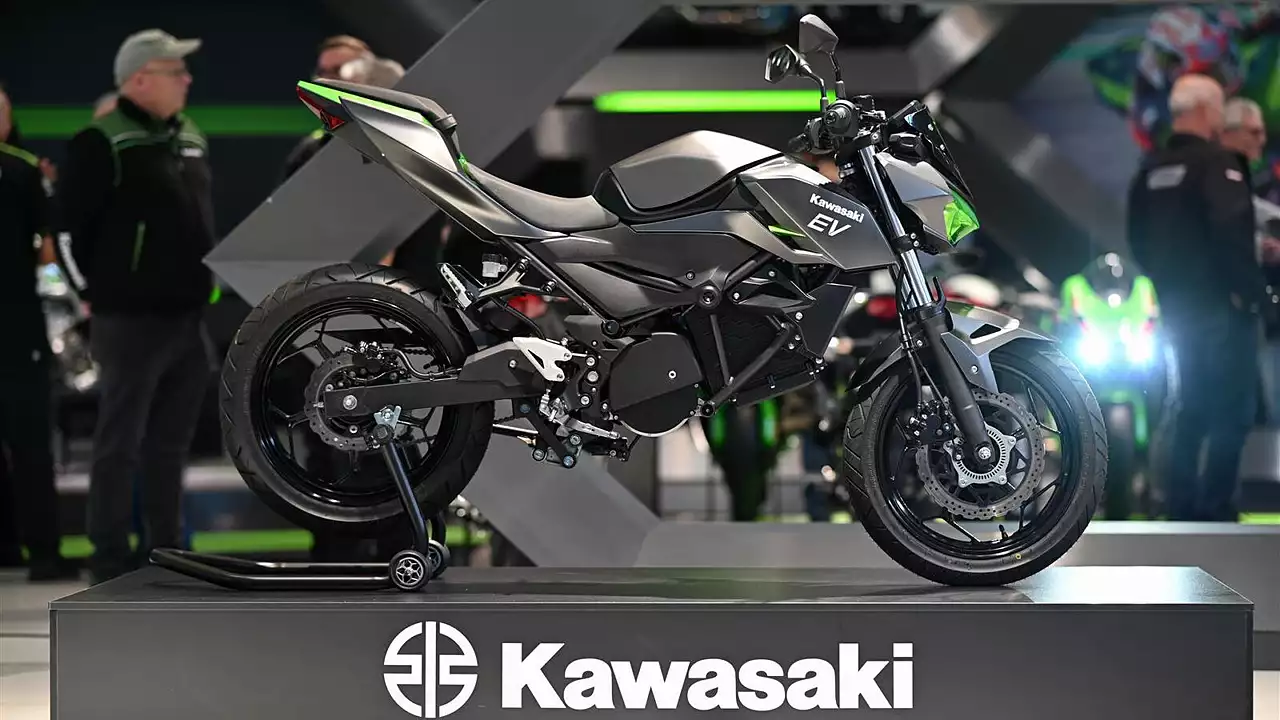
Kawasaki’s latest patent reveals they’ve stopped trying to build “an electric bike” and started building a Modular Electric Platform.
- The Swappable Subframe: Instead of bolting the motor to the main frame, Kawasaki is using an intermediate subframe.
- Mix & Match: Want a lightweight urban Z e-1? Bolt in the small motor. Want a high-performance Ninja e-1? Swap the subframe segments and drop in a beefier unit.
- The “Lego” Effect: The main chassis stays identical, which slashes R&D costs. This means “Team Green” could theoretically update your motor or battery tech in a few years without you needing to buy a whole new bike.
The Verdict: Between Honda reviving the V3 with a supercharger and KTM promising 37k miles of abuse, the “boring” era of motorcycling is officially over.
Buckle up, because the leaked data on the Honda V3R 900 suggests this isn’t just a “fast” bike—it’s a torque delivery system designed to make liter-bikes look lazy.
While the official dynamometer charts are still guarded in a vault in Tokyo, the 2026 patent leaks and prototype briefs have given us enough math to reconstruct the “V3R curve.”
The “Non-Rail” Power Profile
Unlike a traditional supercharger (belt-driven) or turbo (exhaust-driven), Honda’s E-Compressor can spin up to its maximum PSI at virtually zero RPM. This creates a torque curve that looks less like a “hill” and more like a “plateau.”
| Metric | Honda V3R 900 (Est.) | Standard 1000cc Inline-4 |
| Max Torque | ~108 lb-ft (146 Nm) | ~80 lb-ft (110 Nm) |
| Torque Arrival | Instant (2,500 RPM) | Peak at 8,000+ RPM |
| Estimated HP | 160–180 hp | 150–200 hp |
| Engine Character | Bottom-end “Punch” | High-rev “Scream” |
Why the Curve is a “Game Over” for the Competition
In a head-to-head with a bike like the BMW S1000R or the Ducati Streetfighter V4, the V3R 900 plays a different game:
- Zero Lag: Because the compressor is electric, the ECU “pre-spools” it the moment you crack the throttle. There is no waiting for exhaust gases or engine speed to build.
- The 1200cc “Phantom”: Honda claims 900cc displacement but 1200cc performance. This means it has the grunt of a massive touring bike like the old VFR1200 but in a chassis lighter than a 600cc supersport.
- The Flat-Line Torque: While an inline-four is still searching for its powerband at 5,000 RPM, the V3R is already at 90% of its maximum torque.
The “Insider” Detail: Firing Order
Leaked engineering data suggests the V3 uses a unique firing interval (similar to a 4-cylinder engine with one cylinder “missing”). This creates a “big-bang” style power delivery that helps the rear tire find grip despite the massive low-end torque.
Rumor Mill: Word is that Honda is testing an E-Clutch version of this V3R specifically to handle those instant-torque launches, meaning you could do 0–60 runs that feel like being fired out of a railgun—without even touching the clutch lever.
It is the ultimate “Science vs. Brute Force” matchup. While the Kawasaki Ninja H2 is the undisputed king of raw, mechanical power, the Honda V3R 900 represents a new era of “intelligent” boost.
Here is how the leaked V3R specs stack up against the supercharged legend:
The Supercharger Showdown: Electric vs. Mechanical
| Feature | Kawasaki Ninja H2 | Honda V3R 900 |
| Drive System | Mechanical (Chain/Gears) | Electric (E-Compressor) |
| Max Boost At | 14,000 RPM (Crank-dependent) | Any RPM (Instant) |
| Intercooler | No (Uses high-efficiency impeller) | No (Runs significantly cooler) |
| Engine Layout | 998cc Inline-4 | 900cc 75° V3 |
| Character | Exponential “Jet Engine” rush | Linear “Electric Motor” pull |
The “Technical Knockout” Details
1. The Death of “Lag”
- The H2: Since its supercharger is geared directly to the crankshaft, boost builds with engine speed. It’s a monster at the top end, but at 3,000 RPM, it’s essentially just a heavy 1000cc bike.
- The V3R: Because the compressor is spun by an independent high-speed electric motor, Honda can command 100% boost the millisecond you touch the throttle, even at a red light. It effectively eliminates the “waiting period” for power.
2. Thermal Warfare
- The H2: Compressing air creates massive heat. Kawasaki manages this with a highly specialized engine block and cooling system.
- The V3R: Honda’s e-compressor doesn’t sit in a heat-soaked engine casing. It’s often mounted near the airbox, away from the cylinder head. Because it only spins exactly as much as needed (and doesn’t have to fight engine friction), the intake charges are much cooler, leading to better combustion without needing a bulky intercooler.
3. Weight & Agility
- The H2: The Ninja H2 is a heavy hitter (approx. 524 lbs / 238 kg). It’s designed for high-speed stability, not flicking through tight hairpins.
- The V3R: By using a V3 configuration (two cylinders forward, one back), the engine is incredibly narrow. Leaks suggest the V3R is targeting a “middleweight” weight class—think under 440 lbs (200 kg). It will likely run circles around the H2 in a canyon, even if the H2 wins on a 2-mile straightaway.
The Verdict
If you want to feel like you’re being chased by a hurricane, the Kawasaki H2 remains the king. But if you want a bike that defies the laws of physics—delivering 1200cc torque in a 600cc-sized frame with zero delay—the Honda V3R 900 is the new “Insider” choice.
If Kawasaki is the heavy-metal sledgehammer and Honda is the precision laser, KTM has just invented the High-Tech Multi-Tool.
While the 1390 Super Adventure R is dominating headlines with its massive 37,200-mile service intervals, the “insider” chatter is all about KTM’s secret weapon: the H-Supercharger. It’s a hybrid system that effectively bridges the gap between the Ninja H2 and the Honda V3R.
The KTM H-Supercharger: The “Best of Both Worlds”
KTM’s new patent reveals a Hybrid Electromechanical Supercharger. Unlike the others, it doesn’t just pick one power source—it uses an electronically controlled clutch to swap between them based on what you’re doing.
- Electric Mode (Low RPM): At low revs, the clutch is open. A high-speed electric motor spins the compressor independently of the engine. This gives you that “instant-on” torque Honda is chasing, making the bike a beast off the line.
- Mechanical Mode (High RPM): Once you’re pinned, the clutch closes. The engine’s crankshaft takes over via a chain drive. This is pure Kawasaki H2 territory—efficient, high-pressure boost that doesn’t drain your battery when you’re screaming toward the redline.
- Generator Mode: This is the genius part. When you’re cruising or decelerating, the electric motor reverses its role and becomes a generator, topping up the battery using the engine’s rotation.
Forced Induction: The 2026 Power Hierarchy
How do these three monsters actually compare when you twist the grip?
| Feature | Kawasaki Ninja H2 | KTM “H-Supercharger” | Honda V3R 900 |
| Philosophy | Raw Mechanical Power | The “Hybrid” Swiss Army Knife | The “Electric” Precision Tool |
| The “Kick” | Hits like a freight train at 8k RPM | Hits instantly, stays forever | Smooth, linear “Digital” push |
| Complexity | Medium (Bulletproof Gears) | High (Clutch + Motor + Gears) | Medium (High-Voltage Electronics) |
| Reliability | Proven over 10 years | 37,200 mile service (Claimed) | “Honda” Reliable (Unknown) |
Why KTM is the “Maintenance King” (For Now)
You mentioned that 37,200-mile service interval—it’s not just marketing fluff. To make a supercharged V-Twin survive those distances, KTM has reportedly moved to Diamond-Like Carbon (DLC) coatings on the entire valvetrain and a new fused-alloy valve seat material that conducts heat away from the head 30% faster than traditional steel.
They aren’t just building a faster bike; they’re building a bike that lives in the desert for three years without needing a mechanic.
The Official Tech Source Links
Honda’s V3R 900 E-Compressor
- Official EICMA Reveal: Honda V3R 900 E-Compressor, Power Under Control
- Technical Deep-Dive: Honda Unveils 900cc V3 Prototype Details – Bennetts
- Honda Global Official Release: World’s First V3 Engine with Electrical Compressor
KTM’s 1390 Super Adventure & CamShift
- Service Interval Leak: KTM 1390 Super Duke R (2024+) Maintenance Schedule & 37k Mile Valve Service
- Hybrid Supercharger Patent: KTM’s Hybrid Electric Supercharger Breakdown – Cycle World
Kawasaki’s Modular EV
- Patent Analysis: Kawasaki Patents Modular Electric Motorcycle Platform – carandbike
- Chassis Diagrams: Kawasaki Patent Shows Modular Electric Bike – Cycle World
Our Social Media Handles
- Instagram : LivingWithGravity
- Medium : Akash Dolas
- YouTube Channel : Gear and Shutter
- Facebook : LivingWithGravity