







Prospects of the BSA Bantam 350 in the Indian Market
Executive Summary
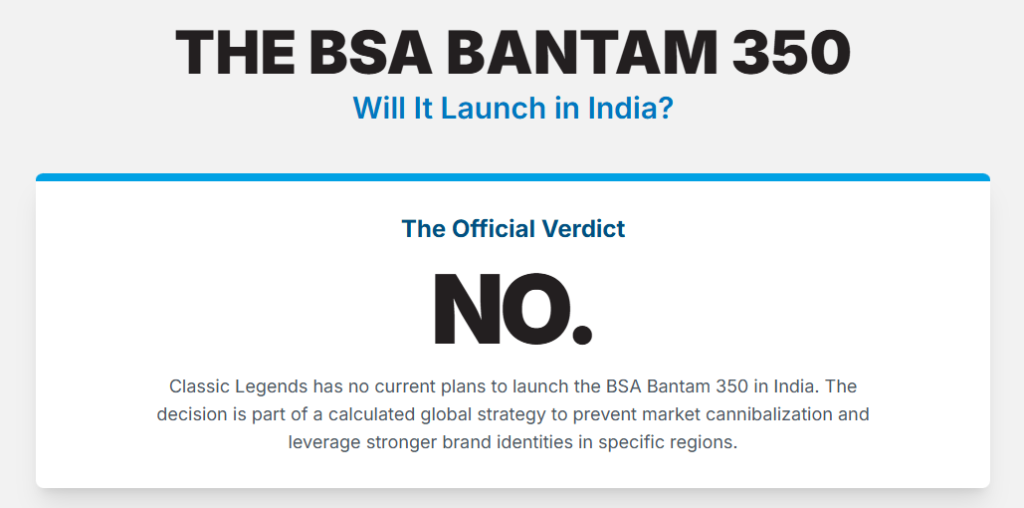
The BSA Bantam 350 is currently not planned for launch in the Indian market. Despite being manufactured in India by Classic Legends, the company has explicitly stated its intention to focus this model on overseas markets, particularly the UK and Europe.1
This strategic decision is primarily driven by two factors. First, Classic Legends already possesses a comprehensive portfolio of 350cc motorcycles under its well-established Jawa and Yezdi brands in India, with the Bantam 350 sharing significant mechanical commonalities with the existing Jawa 42 FJ.1 Introducing a highly similar product would lead to internal competition and market saturation. Second, the BSA brand currently lacks the widespread recognition and recall in the Indian market that Jawa and Yezdi enjoy 1, making a direct competitive entry in the saturated 350cc segment less strategically viable at this juncture.
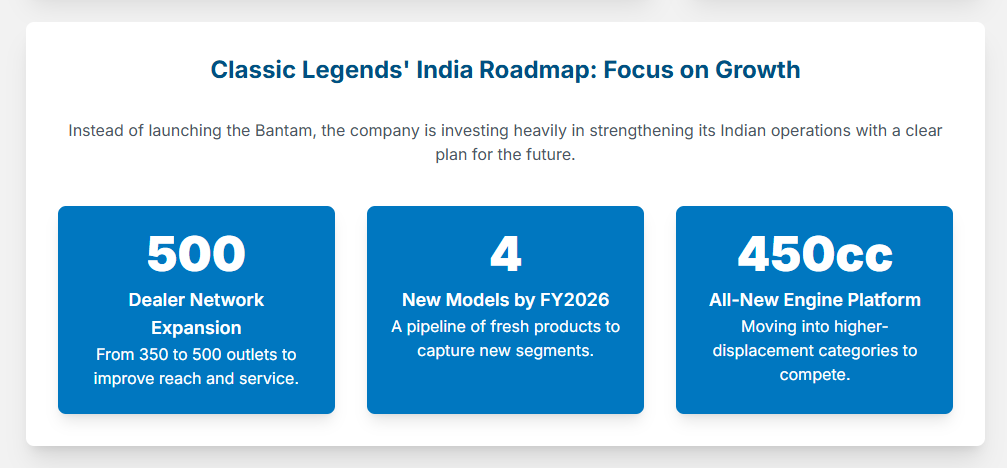
Classic Legends’ broader strategic direction in India involves consolidating and expanding its presence through the refinement of existing Jawa and Yezdi models, a significant dealer network expansion, and the introduction of distinct new models, including a new 450cc platform, by FY2026.4 BSA’s role is primarily to drive international market penetration and diversify the company’s global portfolio with models like the Bantam 350, while its Indian presence is focused on more premium, higher-displacement offerings.
Introduction: The BSA Bantam 350 and the Indian Market Context
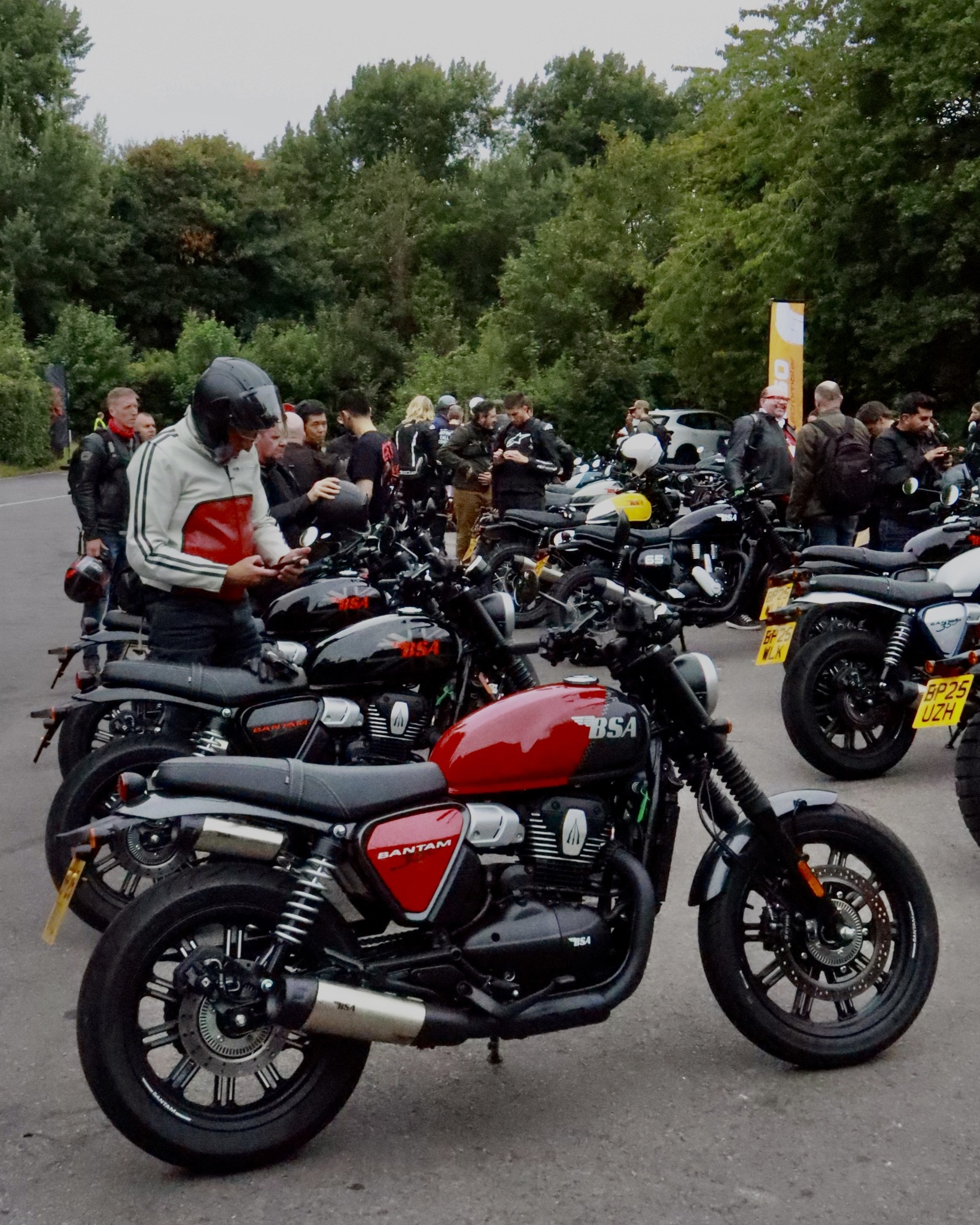
The BSA Bantam 350 represents the latest addition to BSA’s resurrected portfolio, making its global debut at the Bike Shed Moto Show in London.6 This launch marks a significant step in expanding BSA’s international presence, positioning the Bantam 350 as the most affordable and accessible machine from the brand. It is designed to sit below the higher-displacement Gold Star 650 and Scrambler 650 models in the overseas lineup 1, a strategic placement aimed at broadening BSA’s appeal to a wider range of international customers. The new Bantam 350 pays homage to the original lightweight 2-stroke Bantam, a highly successful model produced between 1948 and 1971, which achieved substantial sales figures in its era.1 This connection to heritage is a key aspect of BSA’s brand revival.
The question of the Bantam 350’s arrival in India is particularly pertinent given that Classic Legends, the parent company, is based in India and the motorcycle is implied to be manufactured there, as it is stated it “will not be sold in the market where it is manufactured”.1 This report will provide a comprehensive analysis of the strategic considerations influencing Classic Legends’ decision regarding the Bantam 350’s market deployment, specifically addressing its prospects in the Indian two-wheeler market.
BSA Bantam 350: Specifications and Global Positioning
The BSA Bantam 350 is a modern interpretation of a classic nameplate, designed with contemporary performance and technology. It is powered by a 334cc, liquid-cooled, single-cylinder, DOHC, Alpha 2 engine.1 This is the same powertrain found in other Classic Legends models, specifically the Jawa 350 and the Jawa 42 FJ.1 The engine is expected to produce approximately 28.7 bhp and 29.6 Nm of peak torque, consistent with its performance in Jawa bikes.6 Another source suggests figures around 30 HP and 27 Nm of maximum torque.3 Power is delivered through a 6-speed gearbox, likely incorporating a slipper clutch for smoother shifts and enhanced control.6
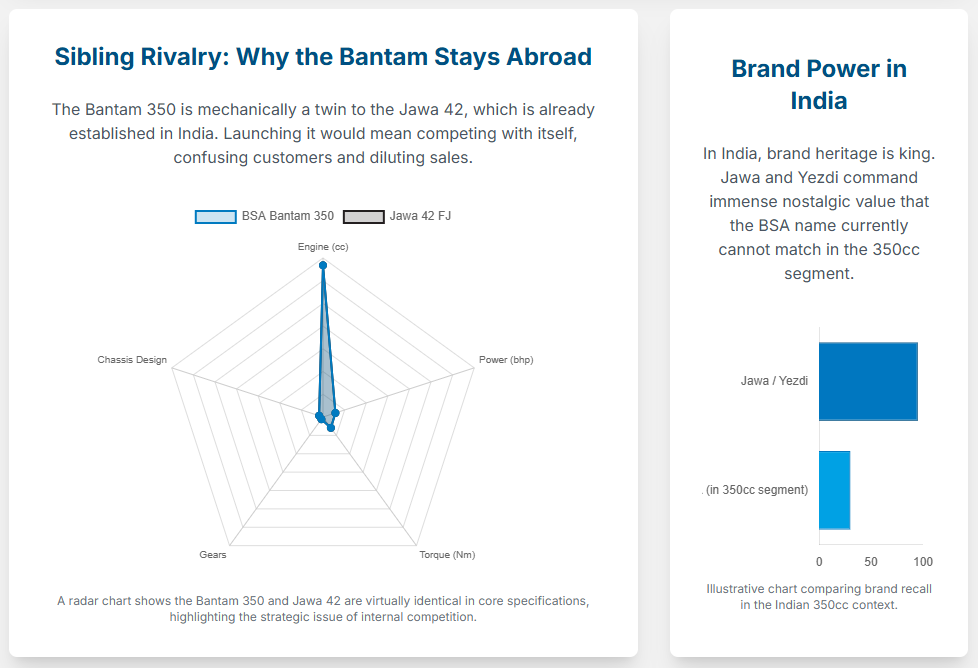
The Bantam 350 shares significant chassis-level similarities with the Jawa 42 FJ 1, making it a “rebadged version” 6 or a “platform engineered sibling”.1 Its suspension setup comprises a telescopic fork with rubber gaiters at the front and dual shock absorbers at the rear, providing a classic yet functional ride.8 For stopping power, the motorcycle is equipped with disc brakes at both the front and rear. It rides on dual-tone alloy wheels, with an 18-inch front and 17-inch rear, mirroring the setup of the Jawa 42 FJ.6
In terms of design, the Bantam 350 features a retro-modern aesthetic, characterized by a teardrop-shaped fuel tank, a circular LED headlamp, a single-pod instrument console, wide handlebars with bar-end mirrors, and a single-piece seat.3 A notable visual distinction from its Jawa siblings is its single exhaust pipe, contrasting with the twin pipes typically seen on Jawas.1 Unique BSA branding elements include the Union Jack flag on the fuel tank and the “Three Gun Salute” badge on the crankcase.6 The model is available in a range of five colors: yellow, red, blue, black, and grey.2
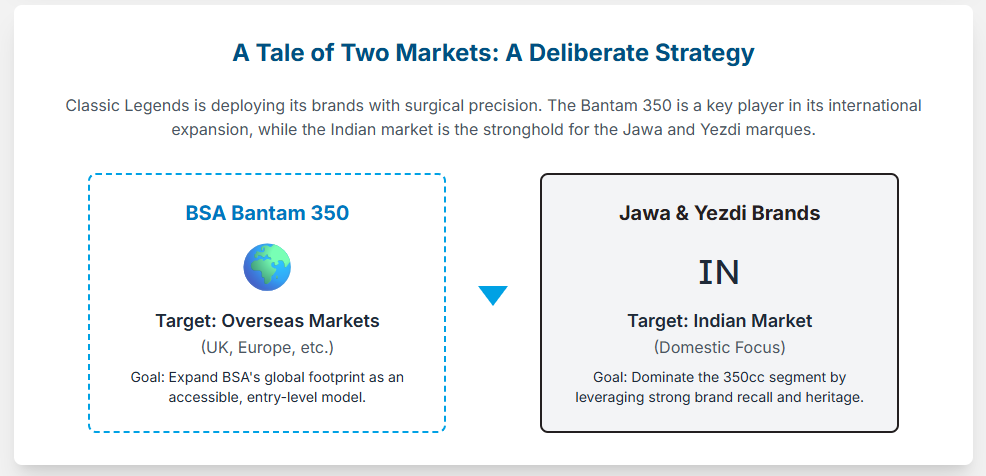
The Bantam 350 is strategically positioned as the “entry-level BSA in overseas markets”.1 Its initial debut is slated for the UK and Europe, with subsequent expansion “across the pond”.1 This clear geographical focus underscores its role in expanding BSA’s global footprint and diversifying its product portfolio internationally, making it more accessible to a broader customer base outside of India.6
The decision to position the BSA Bantam 350, which is mechanically nearly identical to the Jawa 42 FJ, exclusively for overseas markets and not for India, reveals a deliberate strategy by Classic Legends. The Jawa 42 FJ is already a prominent model sold in the Indian market. By explicitly stating that the Bantam 350 has no current plans for an Indian launch, the company directly prevents internal competition and market cannibalization between two highly similar models within the Indian market. This approach is indicative of a sophisticated brand management strategy. Classic Legends appears to be segmenting its brands geographically and by market perception to maximize overall market penetration and brand equity.
Jawa and Yezdi are being leveraged for their strong historical recall and established market presence in India, where they serve as the primary volume drivers in the 350cc segment. Conversely, BSA, while potentially manufactured in India, is being strategically deployed as a premium, retro-modern brand for international markets (UK, Europe) where its British heritage may resonate more strongly or where it faces a different competitive landscape. This long-term vision aims to prevent brand dilution and ensure each brand can thrive in its designated strategic space without directly competing against its siblings. This demonstrates a nuanced understanding of brand equity and market dynamics beyond mere product replication, focusing on tailored market approaches.
The key specifications of the BSA Bantam 350 are summarized in the table below:
| Feature | Specification |
| Engine Type | Liquid-cooled, single-cylinder, DOHC, Alpha 2 |
| Engine Capacity | 334cc |
| Max Power | ~28.7 bhp (expected) 6 / ~30 HP (expected) 3 |
| Max Torque | ~29.6 Nm (expected) 6 / ~27 Nm (expected) 3 |
| Transmission | 6-speed gearbox, likely with slipper clutch 6 |
| Chassis Type | Shares significant similarities with Jawa 42 FJ 1 |
| Front Suspension | Telescopic forks with rubber gaiters 8 |
| Rear Suspension | Dual shock absorbers 8 |
| Front Wheel/Tyre | Dual-tone alloy, 18-inch 6 |
| Rear Wheel/Tyre | Dual-tone alloy, 17-inch 6 |
| Front Brake | Disc brake 8 |
| Rear Brake | Disc brake 8 |
| Key Design Features | Single exhaust pipe, circular LED headlamp, single-pod instrument console, teardrop fuel tank, Union Jack flag on tank, “Three Gun Salute” badge 1 |
| Available Colors | Yellow, Red, Blue, Black, Grey 2 |
| Target Market | UK, Europe, and other overseas markets 1 |
Prospects for BSA Bantam 350 in India: A Definitive Analysis
Multiple authoritative sources unequivocally state that there are “No plans to sell in India currently”.1 This provides a direct answer to the user’s query. Furthermore, it is explicitly mentioned that the Bantam 350 “will not be sold in the market where it is manufactured”.1 Given that Classic Legends, the parent company, is based in India and manufacturing operations for its brands are established there, this statement strongly implies that India is the manufacturing hub and thus, the market from which the Bantam 350 will be withheld. One report reinforces this by stating the Bantam 350 “will not be available for a few years” in India.3 The Bantam 350’s launch strategy clearly prioritizes its debut in the UK and Europe, followed by expansion “across the pond” 1, consistently emphasizing its international market focus over an Indian release. While one snippet posed a speculative question about an August 15 launch in India 6, this appears to be a journalistic inquiry rather than an official indication, and it is directly contradicted by the more definitive and consistent statements across other, more recent articles.1
This decision is rooted in a clear strategic rationale. The primary reason cited for not launching the Bantam 350 in India is that Classic Legends “already has a comprehensive spread of products in this displacement and price range across the Yezdi/Jawa brands”.1 The Bantam 350 is powered by the same 334cc engine as the Jawa 350 and 42 FJ 1 and shares significant chassis similarities with the Jawa 42 FJ.1 Introducing a highly similar product would inevitably lead to direct internal competition and market cannibalization within Classic Legends’ own portfolio, potentially diluting sales of existing successful models. The company’s focus in India is on “refining and sharpening our current offerings” within the Jawa and Yezdi brands 4, indicating a commitment to optimizing their established products rather than adding redundancy.
A crucial factor influencing this decision is that “the BSA name doesn’t have the same widespread brand recall as the Yezdi and Jawa brands do in India”.1 While BSA has a rich global history, its brand recognition in contemporary India is significantly lower compared to the deeply entrenched nostalgic appeal of Jawa and Yezdi. Launching a new 350cc model under a less-recognized brand in a highly competitive segment would pose significant marketing and sales challenges. The Bantam 350 is a key component of BSA’s strategy to expand its international portfolio. Its launch is intended to diversify BSA’s product offerings, making them more accessible and enhancing overall market penetration specifically in overseas markets.6 This indicates a clear strategic division of labor for the brands within Classic Legends’ global portfolio, with BSA primarily targeting non-Indian markets for this particular model.
The explicit decision to withhold the Bantam 350 from India, despite its shared platform with an existing Indian model (Jawa 42 FJ) and implied Indian manufacturing, underscores a highly deliberate strategy by Classic Legends. This is not merely about avoiding cannibalization; it is a sophisticated approach to strategic brand positioning and resource allocation. Classic Legends is consciously building distinct brand identities and market territories for its marques. Jawa and Yezdi are positioned as the heritage and volume drivers for the Indian market, where their historical appeal is strong and their dealer networks are established.
BSA, conversely, is being cultivated as a premium, retro-modern brand for global markets (UK, Europe), where its British heritage might hold more weight and where it faces a different competitive landscape. This long-term vision aims to prevent brand dilution and ensure each brand can thrive in its designated strategic space without competing against its siblings. This reflects a mature understanding of brand equity and market dynamics beyond simple product replication, indicating a strategic deployment of assets to optimize global market share rather than a blanket global launch for all models.
Classic Legends’ Broader India Strategy and Future Outlook
Classic Legends has ambitious growth targets for the Indian market, aiming to double its sales 4, signaling strong confidence in its existing and upcoming product lines. To support this sales growth, Classic Legends plans a significant expansion of its dealer network, increasing from the current 350 retail outlets to 500.4 This aggressive expansion indicates a strong commitment to increasing market reach, improving accessibility for customers, and strengthening its after-sales service infrastructure across India.
As part of its future product strategy for India, Classic Legends plans to roll out 4 new models in the fiscal year 2026 (FY2026).4 This indicates a dynamic product development pipeline aimed at capturing new market segments or strengthening existing ones. A key highlight of this pipeline is the development of a new middleweight motorcycle powered by an “all-new 450cc engine”.4 This strategic move suggests Classic Legends’ intent to enter or expand its presence in a higher displacement category, potentially to compete more directly with Royal Enfield’s growing 450cc lineup (e.g., Himalayan 450) and to offer more distinct, performance-oriented products beyond the highly competitive 350cc segment. Classic Legends’ co-founder, Anupam Thareja, emphasized the company’s commitment to “refining and sharpening our current offerings to deliver more value and versatility”.4 This suggests an ongoing effort to enhance the quality, features, and overall appeal of their existing Jawa and Yezdi models. Thareja also stated a focus on getting “more focused with our positioning, pricing, and product lines”.4 This indicates a strategic approach to optimize their current successful models, address customer feedback, and ensure their products are well-differentiated and competitively positioned within their respective segments.
Despite these ambitious plans, Classic Legends has faced challenges in the Indian market. Forum comments from consumers highlight past criticisms regarding the company’s operational approach, specifically mentioning “rolling out multiple products hastily” which reportedly led to “overall quality and service suffers massively”.4 These comments underscore the importance of meticulous planning and execution in product launches and after-sales support. Observations were made about the company’s struggle to effectively compete with Royal Enfield, noting that despite BSA’s legacy, the Gold Star 650 was priced similarly to the Royal Enfield Interceptor 650 (a twin-cylinder engine versus BSA’s single-cylinder), potentially offering less perceived value.4 Similarly, the Yezdi ADV’s design was seen as very similar to the Himalayan 440, suggesting a lack of distinct character.4 Concerns about “basic service experience” and potential long-term issues for products like the Gold Star 650 were also raised.4 These criticisms provide crucial context for Classic Legends’ current strategic decisions, including why they might be hesitant to introduce another 350cc model under a less-recalled brand in an already competitive and service-sensitive market.
Classic Legends is simultaneously pursuing aggressive growth targets (sales, dealer network), new product development (450cc engine), and a stated commitment to refining existing Jawa/Yezdi models, all while consumer feedback points to past issues with product quality and service. The decision to not launch the Bantam 350 in India, despite its readiness and shared platform, appears to be a calculated move to concentrate resources on strengthening their core Indian market. By focusing on refining existing, recognized Jawa/Yezdi models and developing a distinct, higher-displacement 450cc platform, Classic Legends appears to be prioritizing sustainable growth and actively addressing past criticisms related to quality and service. This strategy suggests a shift from broad, rapid product introductions to a more focused approach on delivering quality, differentiation, and an improved customer experience within their established Indian brands. It implies that the Bantam 350, being a 350cc model and a rebadge, would potentially distract from these core strategic objectives and could exacerbate existing service or quality perceptions if rushed into a saturated market. This strategic prudence aims to build a more robust and trusted brand foundation in India.
Current BSA Presence in India
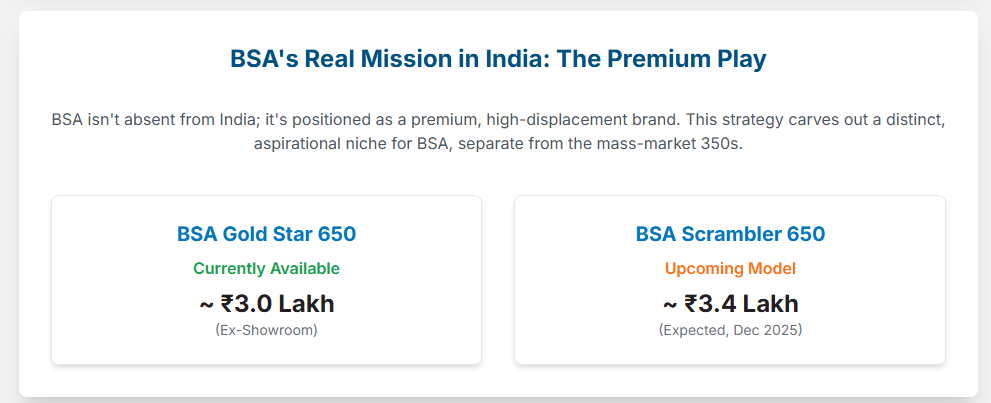
Despite a statement in one snippet that “the brand does not currently sell in India” 3, BSA does have an active, albeit selective, presence in the Indian market. The BSA Gold Star 650 is currently available for purchase in India, with an ex-showroom price starting at approximately ₹3 Lakhs.9 This model represents BSA’s flagship offering in the country. Furthermore, the BSA Scrambler 650 is an upcoming model for the Indian market, with an expected launch date of December 15, 2025, and an estimated price range of ₹3.4 – 3.6 Lakhs.9 These 650cc models clearly position BSA in a more premium and higher-displacement segment within the Indian motorcycle market, distinct from the 350cc category where the Bantam would fall.
The current and upcoming BSA motorcycle models in India are summarized below:
| Model Name | Current Status | Expected Launch Date | Ex-Showroom Price Range (₹ Lakhs) |
| BSA Gold Star 650 | Currently Available | N/A | 3.00 – 3.35 9 |
| BSA Scrambler 650 | Upcoming Model | December 15, 2025 (Expected) 9 | 3.40 – 3.60 (Expected) 9 |
BSA has an established and expanding dealer network across various major Indian cities, which further contradicts the notion of the brand not selling in India. Dealerships are listed in locations such as Mumbai, Surat, Hyderabad, Bangalore, Chennai, Delhi NCR, and numerous other cities nationwide.10 Many of these retail outlets appear to be co-branded or shared with Jawa and Yezdi dealerships, as evidenced by names like “Jawa Yezdi Bsa Nal Stop” or “Jawa Synergy”.11 This co-location strategy likely leverages existing infrastructure and customer footfall for Classic Legends’ other brands. The establishment dates of some dealerships, such as “Om Sai Traders” and “PADMSHRI AUTO” in 2024 11, indicate recent efforts to formalize and expand BSA’s retail presence, suggesting a growing commitment to the Indian market for specific models. The presence of these authorized dealerships confirms that BSA motorcycles are actively being sold, serviced, and supported in India, providing test rides and other customer services.11
A direct factual contradiction exists between the statement in one piece of information 3 claiming BSA does not currently sell in India and the evidence from other sources 9, which clearly show the BSA Gold Star 650 is available and a dealer network exists. The statement about BSA not selling in India might be a historical or generalized comment, perhaps implying BSA’s limited or re-established presence compared to its historical peak or compared to the more dominant Jawa/Yezdi brands in India. It is likely an oversimplification or outdated phrasing. This clarifies that BSA is indeed present in India, but its presence is highly strategic and selective. Classic Legends has chosen to introduce higher-displacement, more premium models (the 650cc Gold Star and the upcoming Scrambler) under the BSA brand in India. This suggests a deliberate strategy to build BSA’s image as a premium, aspirational brand in the Indian market, distinct from the more mass-market oriented 350cc segment that is already saturated with competition and Classic Legends’ own Jawa/Yezdi offerings. The Bantam 350, being an “entry-level” 1 and platform-shared model, does not align with this initial premium positioning for BSA in India. This selective approach aims to establish BSA’s brand equity in India without diluting its premium appeal or directly competing with its own sister brands in a crowded segment.
Regulatory Considerations for Motorcycle Launches in India
Before any vehicle, including motorcycles, can be legally sold or marketed in India, it must undergo a mandatory homologation process.12 This is a critical regulatory step that ensures product compliance. The primary purpose of homologation is to certify that a product meets the country’s stringent technical and safety regulations.12 The Central Motor Vehicles Rules (CMVR) serve as the foundational regulations governing vehicle homologation in India. These rules establish comprehensive technical and safety standards covering various aspects such as vehicle construction, dimensions, safety features, emission limits, and noise control.12 The process is overseen by key regulatory bodies in India, primarily the Automotive Research Association of India (ARAI) and the Bureau of Indian Standards (BIS).12
The homologation process involves several rigorous stages. The initial step involves obtaining type approval from government-appointed agencies like the ARAI.12 Following this, individual components such as engines, brakes, lighting systems, and seat belts are tested to ensure they meet relevant safety and performance standards.12 After component approval, integrated systems like fuel systems, emission control systems, and safety systems (e.g., airbags, ABS) undergo approval.12 The final and most comprehensive test is the Whole Vehicle Type Approval (WVTA), where the entire vehicle is evaluated collectively for crash safety, braking efficiency, emissions, noise levels, and structural integrity under various conditions.12 Emissions testing is a crucial part of the process, requiring vehicles to comply with the Bharat Stage Emission Standards (BSES), which regulate pollutant emissions.12 Manufacturers are required to submit detailed documentation outlining design specifications and test results. Regulatory agencies may also conduct inspections of manufacturing facilities and require periodic batch testing to ensure ongoing compliance.12 Successful completion of the homologation process results in a certificate from the ARAI, indicating compliance with CMVR and roadworthiness. This certification is essential for legal sale and marketing in India and plays a vital role in building consumer confidence in the brand.12
The homologation process in India is comprehensive and rigorous, involving multiple stages of testing, extensive documentation, and continuous compliance checks.12 This process demands substantial investment in terms of time, financial resources, and engineering effort from the manufacturer; it is not a trivial hurdle. While Classic Legends could technically put the Bantam 350 through the homologation process for India, especially given its shared platform with an already homologated Jawa 42 FJ, their explicit decision not to do so, combined with their stated strategic reasons (market saturation in the 350cc segment and lower BSA brand recall), strongly implies a strategic cost-benefit analysis.
Investing significant resources in homologation for a model that would directly compete with their own established brands (Jawa/Yezdi) and has lower brand recognition for BSA in that specific segment would represent an inefficient allocation of capital and effort. This further reinforces their strategic choice to prioritize overseas markets for the Bantam 350 and to focus their Indian market investments on new, differentiated products (like the 450cc engine platform) or the refinement of existing successful lines. It highlights that market entry decisions are not solely based on product readiness but also on a careful evaluation of regulatory hurdles against potential market returns and strategic fit.
Conclusion and Strategic Implications
Based on a comprehensive analysis of available information, the BSA Bantam 350 is definitively not slated for launch in the Indian market in the foreseeable future. This decision is a cornerstone of Classic Legends’ deliberate brand and market segmentation strategy.
Several key factors influence Classic Legends’ strategy. The company is meticulously managing its brand portfolio, leveraging Jawa and Yezdi for the highly competitive Indian 350cc segment, capitalizing on their strong brand recall and established presence. Conversely, BSA is strategically positioned for international growth, and in India, it is being introduced with more premium, higher-displacement offerings like the Gold Star 650. The Indian 350cc segment is already saturated, and Classic Legends has a robust presence with its own Jawa and Yezdi brands. Introducing the Bantam 350, a mechanically similar model, would lead to internal cannibalization and dilute market share without adding significant strategic value.
Classic Legends’ broader Indian strategy emphasizes refining existing products, aggressively expanding its dealer network, and developing new, differentiated platforms, such as the upcoming 450cc engine. This approach aims to address past criticisms regarding product quality and service, fostering sustainable growth by building a stronger foundation for its core Indian brands. The Bantam 350 is a pivotal component of BSA’s international market penetration strategy, designed for accessibility and diversification in overseas markets where the BSA legacy carries a different weight and competitive landscape. The rigorous Indian homologation process, while surmountable, represents a significant investment. Classic Legends’ decision to withhold the Bantam 350 from India reflects a strategic allocation of resources towards more impactful initiatives for the Indian market, such as new platform development and strengthening existing brands.
For Indian consumers, those anticipating the BSA Bantam 350 will need to consider Classic Legends’ existing Jawa and Yezdi 350cc offerings, particularly the Jawa 42 FJ, which shares the core platform and engine. BSA’s presence in India will continue to be defined by its more premium 650cc models, establishing a distinct identity for the brand. For the competitive landscape, this strategic decision by Classic Legends avoids further fragmentation and internal competition within its own 350cc portfolio in India. It allows Jawa and Yezdi to consolidate their positions against dominant players like Royal Enfield. Simultaneously, BSA is carving out its niche in international markets and a premium segment within India. The company’s focus on developing a new 450cc engine signals its intent to challenge competitors in emerging middleweight segments with truly distinct and new product offerings, rather than relying on rebadged models for the Indian market.
Sources
- BSA Bantam resurrected as a new 350cc model based on Jawa 42 FJ | Autocar India, accessed July 30, 2025, https://www.autocarindia.com/bike-news/bsa-bantam-resurrected-as-a-new-350cc-model-based-on-jawa-42-fj-436405
- BSA Bantam 350 image gallery – Autocar India, accessed July 30, 2025, https://www.autocarindia.com/auto-images/bsa-bantam-350-image-gallery-436411
- BSA Bantam reborn as a 350 cc model, inspired by Jawa 42 FJ – Carbike360, accessed July 30, 2025, https://www.carbike360.com/news/bsa-bantam-reborn-as-a-350-cc-model-inspired-by-jawa-42-fj
- Classic Legends plans to launch 4 new motorcycles in FY2026 – Team-BHP, accessed July 30, 2025, https://www.team-bhp.com/forum/motorbikes/295140-classic-legends-plans-launch-4-new-motorcycles-fy2026.html
- Classic Legends plans to launch 4 new motorcycles in FY2026 – Team-BHP, accessed July 30, 2025, https://www.team-bhp.com/news/classic-legends-plans-launch-4-new-motorcycles-fy2026
- BSA Bantam 350 Official Breaks Cover At Bike Shed Moto Show In London – ACKO Drive, accessed July 30, 2025, https://ackodrive.com/news/bsa-bantam-350-official-breaks-cover-at-bike-shed-show-in-london/
- BSA motorcycles – Wikipedia, accessed July 30, 2025, https://en.wikipedia.org/wiki/BSA_motorcycles
- Classic Legends debuts BSA Bantam 350 for overseas markets – Team-BHP, accessed July 30, 2025, https://www.team-bhp.com/news/classic-legends-debuts-bsa-bantam-350-overseas-markets
- BSA Bikes in India : Price, New Models 2025, Mileage, Images, Colour and More. – HT Auto, accessed July 30, 2025, https://auto.hindustantimes.com/new-bikes/bsa
- Dealerships – BSA Motorcycles, accessed July 30, 2025, https://www.bsamotorcycles.in/dealerships/
- Top Bsa Motorcycle Dealers in Kolkata – Justdial, accessed July 30, 2025, https://www.justdial.com/Kolkata/Motorcycle-Dealers-BSA/nct-15155532
- What Is Vehicle Homologation? Meaning & Approval Process – Shimnit India, accessed July 30, 2025, https://www.shimnit.com/blog/vehicle-homologation-explained-meaning-process-and-why-it-matters/
- Homologation Certificate | Online Procedure | Fee – Corpbiz, accessed July 30, 2025, https://corpbiz.io/homologation-certificate
Our Social Media Handles
- Instagram : LivingWithGravity
- Medium : Akash Dolas
- YouTube Channel : Gear and Shutter