



















I. Executive Summary
DJI, a dominant force renowned for its innovation in drone technology and camera stabilization systems, has officially confirmed its strategic entry into the dedicated 360-degree action camera market with the forthcoming Osmo 360. This move represents a significant expansion of its “Osmo” handheld camera lineup, positioning the company to contend directly with established leaders such as Insta360 and GoPro. The official teaser, released on July 24, 2025, and the confirmed launch date of July 31, 2025, underscore DJI’s clear intent to become a serious contender in this specialized segment.1
Preliminary information, largely derived from regulatory filings and industry leaks, indicates that the Osmo 360 is poised to offer compelling capabilities. These include rumored 8K video recording at 30 frames per second (fps), 120-megapixel (MP) still photography, and 10-bit D-Log M color recording. A particularly notable, albeit nuanced, claim is “1-inch 360 imaging,” which is clarified to be “equivalent to a 1-inch sensor”.1 The device is also expected to integrate robust stabilization, extended battery life, and seamless compatibility with DJI’s existing accessory ecosystem, including DJI Mic transmitters.1

The Osmo 360 is positioned as a direct challenger to the Insta360 X5, currently a market frontrunner, and the anticipated GoPro Max 2. Its rumored specifications, particularly concerning sensor capabilities and high-resolution output, suggest DJI aims to establish a new benchmark for image quality and professional features within the consumer 360-degree camera space. An estimated competitive launch price of $500–$550 USD further emphasizes DJI’s aggressive market entry strategy.1
DJI’s entry is expected to intensify competition across the 360-degree camera market, likely fostering accelerated innovation. The company’s strong brand recognition, expansive existing user base, and proven expertise in stabilization and imaging software could facilitate rapid market penetration. The ultimate success of the Osmo 360 will depend not only on its hardware prowess but also critically on the sophistication of its software, including stitching algorithms, and its seamless integration within the broader DJI ecosystem.
II. The DJI Osmo 360 Teaser: Official Confirmation and Initial Insights
Analysis of the Official Teaser Content and Messaging (“All In One”)
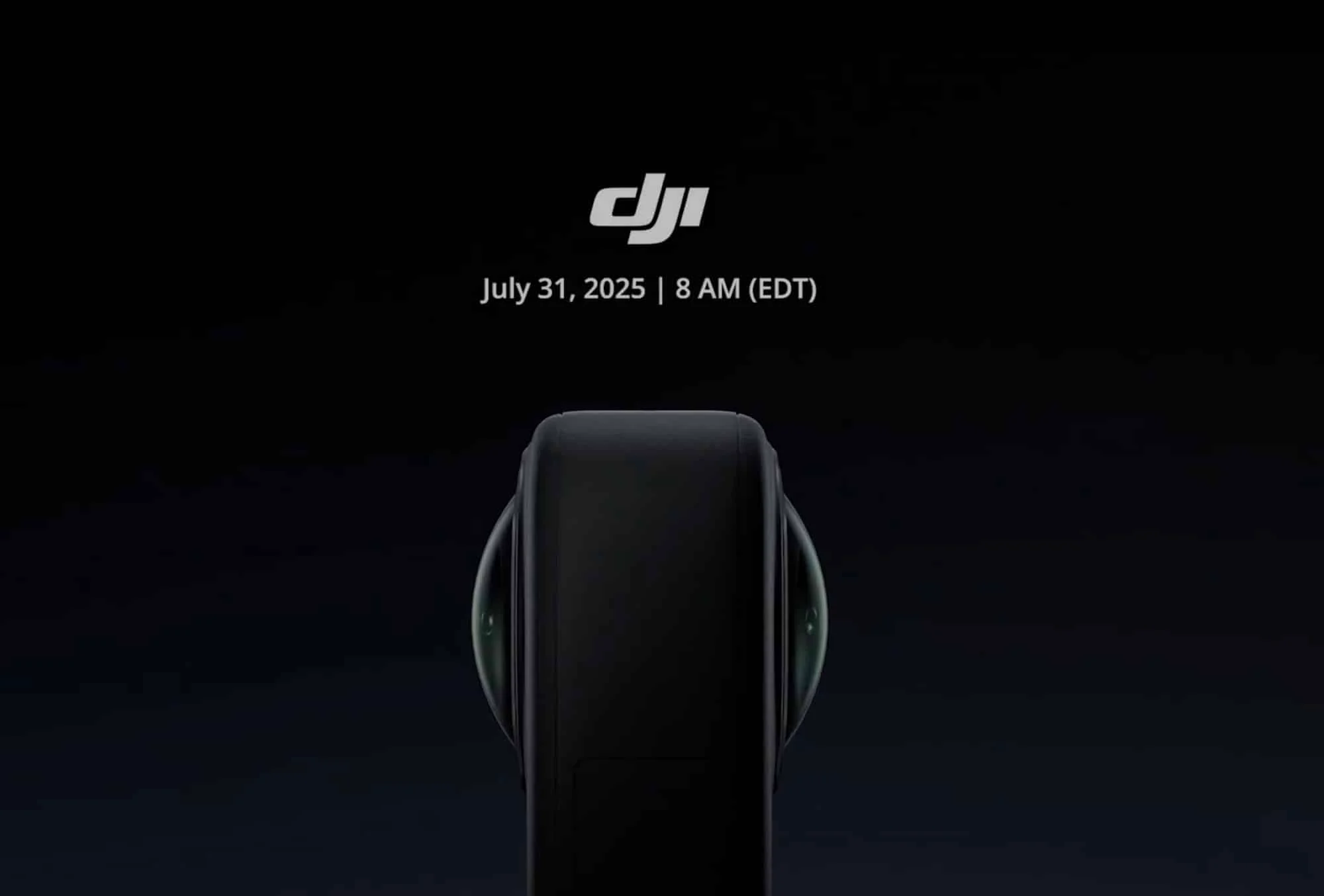
DJI officially unveiled a teaser for the Osmo 360 on July 24, 2025, prominently featuring a dramatic silhouette of a dual-lens camera. This visual was accompanied by the compelling tagline “All In One”.1 This messaging is highly indicative of DJI’s product philosophy for the Osmo 360: a compact, integrated device engineered to deliver immersive, spherical video capture without the need for cumbersome external accessories or complex multi-camera setups. The phrase “All In One” is not new to DJI’s branding, having been previously associated with products like its “All-in-One Vlog Camera Drone” 3, reinforcing a consistent strategic emphasis on streamlined user experiences.
The emphasis on an “All In One” concept represents a deliberate strategic communication designed to address a common challenge in the 360-degree camera market: the perceived complexity of capturing and processing spherical content. Historically, achieving high-quality 360-degree video often necessitated multiple cameras, intricate rigs, and extensive post-production stitching. By promoting a unified design that allows users to “shoot immersive video out of the box” 1, DJI aims to simplify the entire creative process. This approach is poised to broaden the appeal of the Osmo 360 beyond technical enthusiasts and professional creators, extending to a wider, more casual mainstream audience seeking straightforward and immediate results. This focus on user-friendliness leverages DJI’s established reputation for developing intuitive and integrated solutions across its product lines.
Confirmed Launch Date and Significance
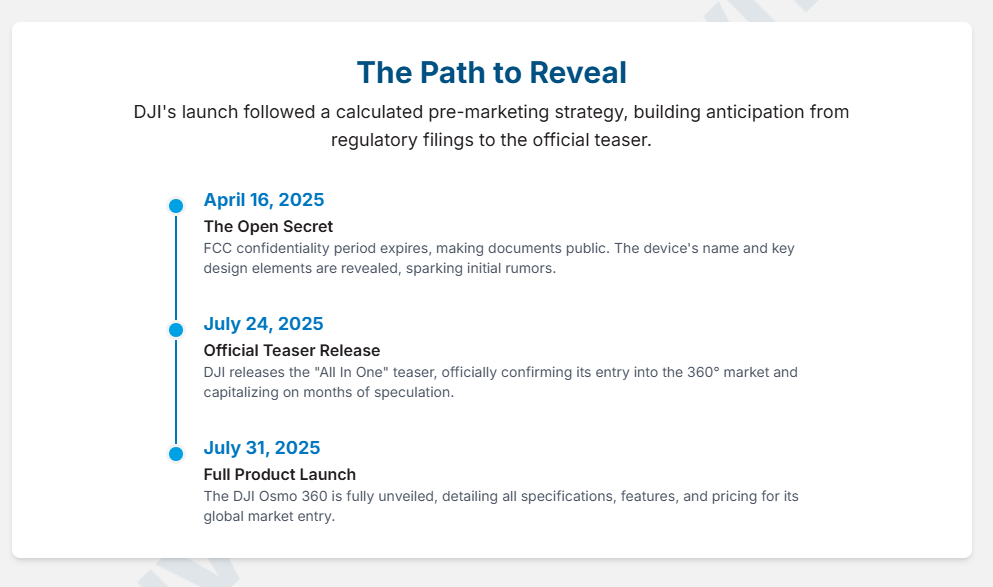
DJI has unequivocally confirmed that the full product reveal for the Osmo 360 is scheduled for July 31, 2025, at 8:00 a.m. EDT.1 The specificity of this launch date, rather than a general “coming soon” announcement, is a strong indicator of DJI’s readiness for immediate market introduction. This aligns with industry expectations for a rapid transition from announcement to product availability, with leaked retail packaging in Australia suggesting that units may already be in distribution.1
The precise timing of the official teaser and subsequent launch date, following months of public information from regulatory sources, points to a sophisticated pre-marketing strategy. While regulatory requirements necessitate the disclosure of product details, the timing of their public release, particularly after confidentiality periods expire, can function as an unofficial “soft launch.” This generates substantial buzz and speculation among tech enthusiasts and industry observers well in advance of any official marketing.1 DJI effectively capitalized on this pre-existing anticipation, which was evident from the “months of rumors and speculation” preceding the official confirmation.1 This extended period of public discussion allows the company to gauge initial consumer sentiment and refine its official marketing messages, maximizing media attention across a prolonged product announcement cycle.
Role of Regulatory Filings (FCC) in Pre-Release Information
The existence and many key attributes of the Osmo 360 were not a complete surprise to industry watchers, having been an “open secret” for several months prior to the official teaser.1 This early disclosure was primarily due to public regulatory filings, specifically with the Federal Communications Commission (FCC) in the United States. Companies developing wireless devices, such as the Osmo 360, are mandated to submit comprehensive product documentation to the FCC for approval before market release. These filings typically include internal photographs, test reports, and user manuals.1
In the case of the Osmo 360, the temporary confidentiality period for its FCC documents expired on April 16, 2025, rendering these detailed materials publicly accessible.1 This regulatory transparency provided early confirmation of the device’s name, “DJI Osmo 360,” and revealed essential design elements and functional features long before DJI’s official marketing efforts began.1 This pre-release information, while mandated, allowed for an extended period of public discourse and anticipation, contributing to the significant interest surrounding the Osmo 360’s formal announcement.
III. In-Depth Analysis of Rumored Specifications and Features
Imaging Capabilities
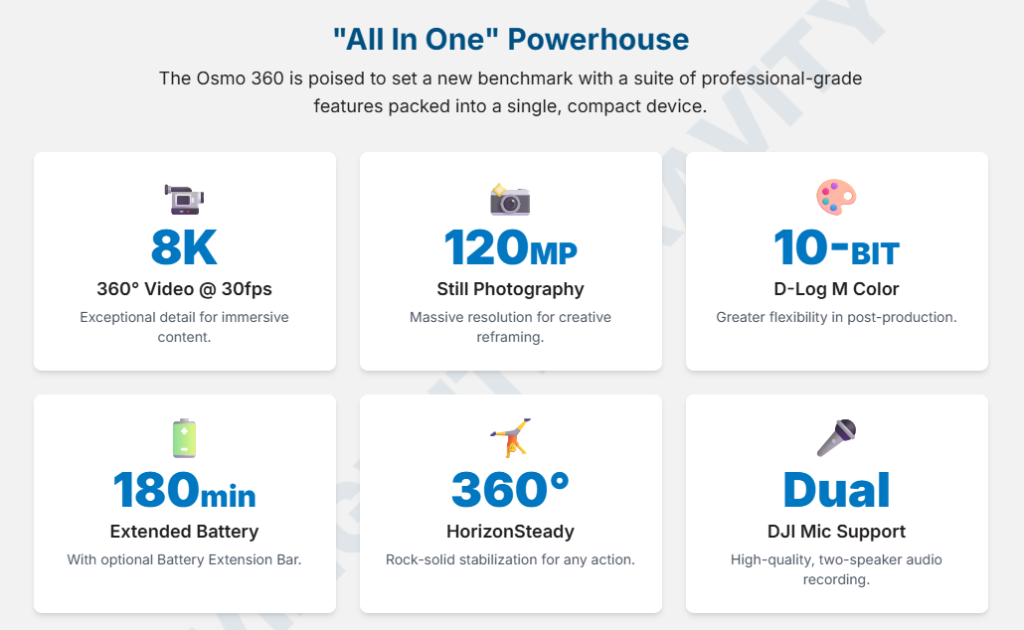
The DJI Osmo 360 is rumored to introduce a suite of advanced imaging capabilities designed to elevate the standard for consumer 360-degree capture. The device is expected to support 8K video recording at 30 frames per second (fps), a resolution that promises exceptional detail and clarity for immersive content. Furthermore, it is anticipated to capture high-resolution 120-megapixel (MP) still photos, offering significant flexibility for reframing and post-production.1 Leaked information also suggests the camera may offer 6K 360° video recording at 60fps and 4K slow-motion capabilities, catering to diverse creative needs.2
A particularly debated aspect of the Osmo 360’s imaging system is the claim of “1-inch 360 imaging.” While prominently displayed on leaked packaging, a crucial footnote clarifies that the CMOS sensor area is “equivalent to that of a 1-inch sensor”.1 This phrasing has sparked considerable discussion within the tech community. The implication is that DJI may be utilizing two smaller, potentially square-shaped sensors, and then employing sophisticated computational photography techniques, including advanced image processing and stitching algorithms, to achieve image
quality comparable to what one would expect from a true 1-inch sensor, rather than physically incorporating two full 1-inch sensors. This engineering decision allows DJI to balance the desire for high-end imaging performance with the practical constraints of creating a compact, dual-lens 360-degree camera. True 1-inch sensors are inherently larger and more costly, making their integration into a small, dual-lens form factor challenging. By opting for an “equivalent” approach, DJI can potentially deliver perceived high-end imaging (8K video, 10-bit D-Log M) while maintaining a more consumer-friendly size and price point. The success of this strategy will heavily depend on the efficacy of DJI’s image processing and stitching software, which are critical components in the highly competitive 360-degree camera market.1 If the resulting image quality does not meet the high expectations set by the “1-inch” branding, it could lead to consumer dissatisfaction.
The camera is also expected to offer 10-bit D-Log M recording, a feature typically associated with professional-grade cameras. This capability provides significantly greater color depth and dynamic range, allowing for extensive color grading and post-production flexibility, which is highly valued by professional content creators.1 Furthermore, rumored Field of View (FOV) options include 170° at 4K/120fps and 155° at 5K/60fps, offering versatility for different shooting scenarios.2
Design and Ergonomics
Leaked images and reports suggest the Osmo 360 will feature a compact, somewhat distinct, and square design, contrasting with the more elongated, stick-like form factors commonly seen in competitor products like those from Insta360. Preliminary dimensions indicate the device will be approximately 6.5 centimeters (2.6 inches) wide and around 9 centimeters tall.5
The user interface is rumored to include a 5.08 cm (2-inch) tap-and-swipe touchscreen with a resolution of 314 × 556 pixels. In addition to the touchscreen, the camera is expected to feature three physical buttons for essential controls such as power, recording, and menu navigation, offering tactile feedback for quick adjustments.2
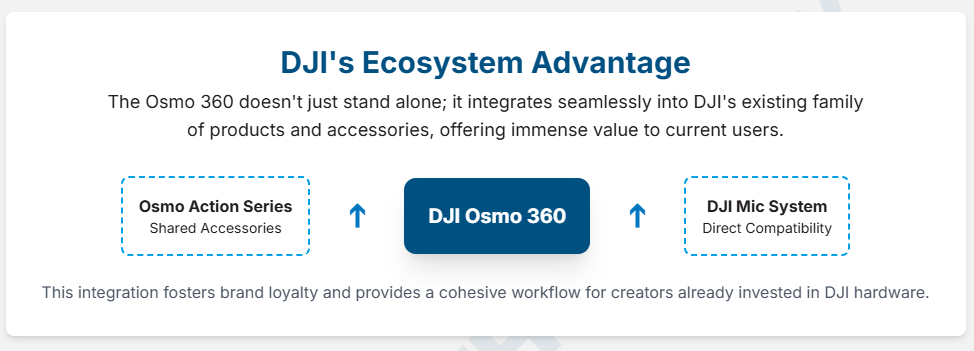
A significant design element is the anticipated inclusion of DJI’s magnetic quick-release system. This feature, along with a standard 1/4” thread and magnetic charging support, ensures broad compatibility with existing Osmo Action accessories and a wide range of universal mounts.1 This deep integration into the existing DJI Osmo ecosystem provides a substantial advantage. Users who already possess DJI microphones or Osmo Action accessories will find a seamless transition and enhanced value, reducing the need for additional equipment purchases. The magnetic quick-release system, a popular and convenient feature in the Osmo Action line, further simplifies setup and expands mounting possibilities. This strategy fosters brand loyalty and creates a cohesive ecosystem, making DJI’s 360-degree camera more appealing to its established customer base and potentially attracting new users into the broader DJI product family, particularly those seeking a unified creative workflow.
Performance and Ecosystem Integration
The Osmo 360’s performance is expected to be robust, with a rumored battery life of up to 100 minutes when recording 8K/30fps video. This can be extended to an impressive 180 minutes with the use of an optional Battery Extension Bar.1 The internal battery is rumored to be 1,950 mAh, a capacity similar to those found in DJI’s Osmo Action series, suggesting optimized power management.5
Advanced stabilization is a hallmark of DJI products, and the Osmo 360 is anticipated to feature HorizonSteady 360° stabilization. This technology is designed to deliver exceptionally smooth footage, even during dynamic movements or rapid rotations, which is crucial for high-quality immersive content.2
For audio capture, the camera is rumored to support dual DJI microphone transmitters, enabling high-quality two-speaker audio recording. Additionally, its built-in microphone is expected to offer an ambient sound backup mode, enhancing realism and providing redundancy.1
A distinctive feature rumored for action sports enthusiasts is the capability to overlay fitness data from third-party devices, such as Apple Watch and Garmin, directly onto the recorded footage.1 This specific functionality, combined with high-resolution video, professional-grade color profiles, and advanced stabilization, collectively points to DJI’s clear targeting of professional content creators, vloggers, and especially action sports enthusiasts. These features are essential for producing high-quality, data-rich video content. By offering capabilities that cater directly to the needs of these demanding users, DJI aims to establish the Osmo 360 as a serious tool for high-quality immersive content, potentially attracting a loyal, professional user base and commanding a premium position in the market.
Connectivity options are expected to include Wi-Fi 6.0 and Bluetooth 5.1, ensuring fast data transfer and seamless integration with mobile devices.2 The device will support MicroSDHD memory cards for storage 2, and its build is rumored to be waterproof, enhancing its durability for action-oriented use.2
IV. Competitive Landscape: DJI Osmo 360 vs. Market Leaders
The DJI Osmo 360 enters a highly competitive market segment currently dominated by Insta360 and GoPro. These companies have established strong footholds, with Insta360 particularly noted for its rapid innovation and market leadership in recent years.1
Insta360 X5
The Insta360 X5 is widely recognized as the current market leader in consumer 360-degree cameras.1 Its specifications include 8K video recording at 30fps, 5.7K at 60fps, and 4K at 120fps. The X5 features 1/1.28-inch sensors, a notable upgrade from its predecessor, offering 144% larger sensor area compared to the X4.7 It boasts a maximum battery life of 185 minutes when recording at 5.7K 24fps in its Endurance mode and is waterproof up to 15 meters.8 Storage is expandable up to 1 TB, and its price is approximately €589 or $549.99 USD.6
Insta360’s strengths lie in its innovative features, such as the “invisible selfie stick” effect, which seamlessly removes the selfie stick from footage, and PureVideo, an AI-powered mode designed for superior low-light noise reduction.7 The X5 also incorporates Active HDR and a Triple AI Chip system that enhances image quality and processing power, making it a robust offering for diverse content creation.7
GoPro Max (and rumored Max 2)
The original GoPro Max, released in 2019, currently features 5.3K stitched video at 30fps and up to 18MP still photos, utilizing two 1/2.3-inch cameras.6 Due to its age, its price has dropped significantly, making it available for as low as $299.99.6
GoPro is actively teasing the Max 2, a refreshed 360-degree action camera, with a rumored launch in late 2025, likely in September or October.6 The Max 2 is expected to maintain a similar form factor but with design enhancements such as centered camera locations and additional venting for improved cooling.6 Significant increases in specifications are anticipated, aiming to match or surpass the Insta360 X5, with a focus on better video capabilities, heat management, and potentially modularity.6 GoPro’s strategy with the Max 2 is clearly to reclaim its position as the “ultimate 360-degree action camera” by addressing the limitations of its predecessor and aligning with current market leaders.11
Comparative Analysis
The entry of the DJI Osmo 360 into this segment intensifies an already “fiercely competitive market where software, stitching algorithms, and ecosystem integration can matter as much as hardware”.1 While the Insta360 X5 remains “the 360 camera to beat in 2025” 1, DJI appears to be “coming in hot with a product that could exceed expectations”.1
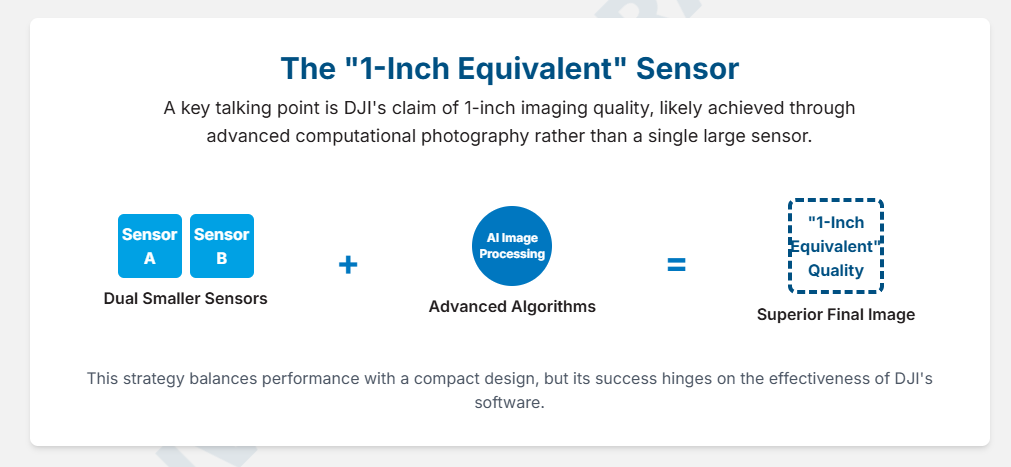
The rumored “1-inch equivalent” sensor of the Osmo 360 represents a direct challenge to the Insta360 X5’s 1/1.28-inch sensors, signaling DJI’s ambition to offer superior image quality. The phrasing “1-inch equivalent” is a critical nuance here. While Insta360 X5 boasts a genuinely larger sensor than its predecessors and the current GoPro Max, DJI’s approach suggests it aims to achieve comparable or even superior image quality through a combination of potentially smaller physical sensors and advanced computational photography.
This implies that raw sensor size might not be the sole determinant of image quality; DJI is relying on its sophisticated image processing capabilities to bridge any physical sensor gap. This sets up a fascinating competition where the overall image pipeline and user experience, driven by software and algorithms, become as important as the underlying hardware. The market will closely evaluate whether DJI’s “equivalent” performance truly rivals or surpasses Insta360’s larger native sensors, potentially shifting the industry’s focus from pure hardware specifications to comprehensive imaging solutions. This could compel competitors to invest more heavily in their own AI-driven image processing.
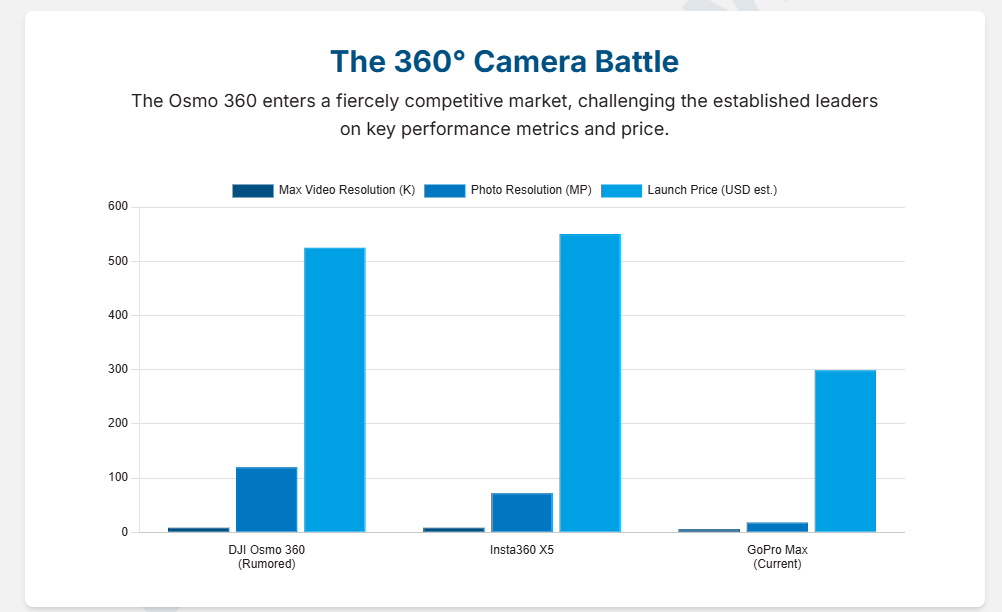
The simultaneous entry of DJI and the anticipated refresh from GoPro herald a period of heightened competition in the 360-degree camera segment. This competitive pressure will compel all market participants to innovate rapidly across hardware, software (including stitching, stabilization, and AI features), battery life, and pricing strategies. This scenario, characterized by “360-camera battles” 6, is highly advantageous for consumers. It is expected to lead to faster technological advancements, more feature-rich products, and potentially more aggressive pricing as companies vigorously compete for market share. As a result, consumers will gain access to more sophisticated and affordable options, pushing the boundaries of immersive content creation.
| Feature / Model | DJI Osmo 360 (Rumored) | Insta360 X5 | GoPro Max 2 (Rumored) | GoPro Max (Current) |
| Launch/Release Year | 2025 | 2025 | 2025 | 2019 |
| Max Video Resolution (360) | 8K@30fps | 8K@30fps | 8K@30fps+ | 5.3K@30fps |
| Max Video Resolution (Single Lens/Flat) | 4K@120fps | 4K@120fps | 4K@120fps+ | 4K |
| Max Still Photo Resolution | 120MP | 72MP | 18MP+ | 18MP |
| Sensor Size | Dual 1-inch equivalent | 1/1.28″ | TBD/Larger than 1/2.3″ | 1/2.3″ |
| Color Depth | 10-bit D-Log M | 10-bit D-Log M | TBD | TBD |
| Stabilization | HorizonSteady 360° | FlowState + 360° Horizon Lock | HyperSmooth Digital | HyperSmooth Digital |
| Battery Life (approx.) | 100-180 min | 185 min | Longer | TBD |
| Waterproof Depth | TBD/Waterproof | 15m | TBD | 5m |
| Key Features | Magnetic Quick Release, DJI Mic support, Fitness Data Overlay | PureVideo, InstaFrame, Triple AI Chip | Improved Cooling, Modularity | Single Lens Hero Mode, GPS |
| Estimated Price (USD) | $500-$550 | $549.99 | TBD/Higher than X5 | $299.99 |
Table 1: Comparative Specifications: DJI Osmo 360 (Rumored) vs. Insta360 X5 vs. GoPro Max 2 (Rumored)
V. DJI’s Strategic Play in the 360-Degree Camera Market
Positioning the Osmo 360 within DJI’s Existing Osmo Product Line
The introduction of the Osmo 360 represents a “significant expansion” of DJI’s well-established Osmo product lineup.1 This family of handheld cameras already includes the highly popular Osmo Pocket gimbal cameras, recognized for their portability and integrated stabilization, and the rugged Osmo Action series, designed for extreme durability and dynamic shooting.1 The “All In One” tagline associated with the Osmo 360 aligns perfectly with DJI’s overarching philosophy of delivering integrated, user-friendly devices, now extending this approach to the realm of immersive spherical capture.1
The Osmo 360 fills a critical void in DJI’s comprehensive imaging portfolio. While existing DJI products offer some panoramic capabilities, none provide a true, integrated, high-resolution 360-degree video capture experience in a compact form factor. This strategic move allows DJI to diversify its revenue streams beyond its core drone business and traditional action cameras, tapping into the burgeoning market for immersive content. This is a calculated strategic maneuver to offer a complete suite of imaging solutions. By providing options across drones, gimbals, action cameras, and now dedicated 360-degree cameras, DJI aims to become a single source for diverse content creation requirements, thereby deepening user engagement within its ecosystem and enhancing overall customer lifetime value.
Differentiation from Existing DJI Products with Panorama Capabilities
While DJI’s drone platforms, such as the Mavic 3, and its action cameras, like the Osmo Action 4, possess panorama modes, including the ability to capture spherical 360-degree photos, these capabilities differ fundamentally from a dedicated 360-degree camera. For instance, the Mavic 3 can automatically capture 25 photos to create a 360 panorama in approximately 40 seconds of shooting time.12 However, this process typically results in a “90-degree hole in the zenith” (the area directly above the drone), which the software automatically blurs to fill.12 Similarly, the Osmo Action 4 offers “360° HorizonSteady” for stabilization but is not designed for full spherical video capture.14
The Osmo 360, as a purpose-built 360-degree action camera, is engineered to provide seamless, real-time spherical video recording and is expected to feature superior in-camera stitching capabilities. This represents a significant leap beyond the static panorama features found in other DJI products, establishing its unique value proposition within the company’s portfolio. It is designed for continuous, dynamic 360-degree video capture, unlike the multi-shot still image approach of its drone and action camera counterparts.
Anticipated Pricing Strategy and Market Entry Point
Based on leaked retail pricing observed in Australia, where the Osmo 360 was listed at AU$759, the camera is estimated to launch globally at approximately $500–$550 USD.1 This pricing strategy positions the Osmo 360 directly “competitively against the Insta360 X5 and GoPro Max 2”.1 This indicates DJI’s clear intention to challenge the market leaders head-on and capture a significant share of the segment, rather than entering at a lower, more cautious price tier.
Discussion on the Importance of Software, Stitching Algorithms, and Ecosystem Integration for Success
The 360-degree camera market is characterized by intense competition, where “software, stitching algorithms, and ecosystem integration can matter as much as hardware”.1 DJI’s established track record in delivering powerful stabilization (exemplified by RockSteady in the Osmo Action series and the rumored HorizonSteady 360° for the Osmo 360), robust battery life, and professional-level controls within compact form factors provides a strong foundational advantage.1
However, the ultimate success of the Osmo 360 will largely depend on the quality of its proprietary stitching algorithms. These algorithms are crucial for minimizing visible seams and distortion in the spherical footage, ensuring a smooth and immersive viewing experience. Furthermore, seamless integration with DJI’s mobile applications, such as the DJI Mimo app (as rumored 5), will be vital for intuitive editing, reframing, and sharing of content. The anticipated compatibility with the DJI Mic system further strengthens its ecosystem play for creators, offering high-quality audio solutions.1
DJI benefits from significant brand recognition and trust among content creators and technology enthusiasts, a reputation built on the success of its drones and the Osmo series. This pre-existing brand loyalty and a substantial installed user base, many of whom may already own DJI accessories, provide a formidable launchpad for the Osmo 360. Users are more likely to trust DJI’s entry into a new product category compared to a lesser-known brand, potentially leading to faster adoption rates despite the competitive market. This exemplifies how a strong brand can leverage its core competencies and existing customer relationships to successfully enter a new, competitive market segment, effectively reducing the marketing hurdles and customer acquisition costs that new entrants would face.
| Product Line | Primary Function | Key Feature/Value Prop | 360° Capability | Target User | Integration with Osmo 360 |
| Osmo Pocket Series | Gimbal Camera (Stabilized Vlogging) | Compact stabilization, Low-light, Portable | Limited/No (Panoramas only) | Vloggers, everyday creators | N/A |
| Osmo Action Series | Rugged Action Camera | Extreme durability, 4K/120fps, Magnetic Mount | Limited/No (HorizonSteady, not full 360 video) | Action sports, adventure | Shared accessories/ecosystem (magnetic mounts, DJI Mic) |
| Mavic Drone Series (with Pano) | Aerial Photography/Videography | Aerial views, 4/3 sensor, Long flight time | 360° Still Panoramas (with zenith hole) | Professional cinematographers, enthusiasts | N/A |
| Osmo 360 (New) | Dedicated 360° Action Camera | Immersive spherical video, 8K 360°, 1-inch equivalent imaging | Full 360° Video & Photo | Immersive content creators, VR, Action sports, Vlogging | Core part of Osmo ecosystem |
Table 2: DJI Osmo Lineup Expansion: Osmo 360’s Unique Value Proposition
VI. Conclusion and Market Outlook
Summary of the DJI Osmo 360’s Potential to Disrupt the Market
The impending entry of the DJI Osmo 360 is poised to significantly disrupt the 360-degree camera market, a segment that has long been dominated by Insta360 and GoPro. Its rumored high-end specifications, particularly the 8K video resolution and the innovative “1-inch equivalent” sensor technology, combined with DJI’s established reputation for superior stabilization and robust ecosystem integration, position it as a formidable challenger.1 The competitive pricing strategy further indicates that DJI is not merely testing the waters but is actively aiming for a substantial share of the market.1
Key Takeaways for Industry Stakeholders and Consumers
For manufacturers within the imaging technology sector, DJI’s move signals an imperative for intensified research and development. This will likely focus on computational photography, advanced stabilization systems, and even more seamless ecosystem integration. The competitive landscape suggests that the emphasis will increasingly shift beyond raw sensor size to the overall performance of the image pipeline and the comprehensive user experience.
For consumers, this heightened competition is a highly positive development. A new wave of innovation is anticipated, potentially leading to the availability of more advanced, user-friendly, and competitively priced 360-degree cameras. The array of choices for high-quality immersive content creation is set to broaden significantly.
Future Trends and Competitive Dynamics in the 360-Degree Camera Segment
The “360-camera battles” 6 are clearly intensifying, with 2025 shaping up to be a pivotal year for the segment. Future developments are likely to include further advancements in AI-powered stitching and reframing capabilities, leading to even more seamless and versatile content creation. Improvements in low-light performance and extended battery life will continue to be areas of focus, alongside tighter integration with popular social media platforms and emerging virtual reality (VR) and augmented reality (AR) applications.
The recurring theme of “All In One” solutions, as highlighted by DJI’s messaging and Insta360’s “InstaFrame” mode 7, points to a significant market trend: the prioritization of user experience. Early 360 cameras often required complex post-production. Now, manufacturers are focusing on making the entire process, from capturing footage to sharing it, as streamlined and integrated as possible. This emphasis on reducing friction in the workflow suggests that the future growth of the 360-degree camera market will depend not just on technical specifications but on democratizing immersive content creation, appealing to a much larger mainstream audience beyond tech enthusiasts and professional creators, thereby driving wider adoption of 360-degree content.
Furthermore, the inclusion of “pro-grade” features such as 10-bit D-Log M recording, dual microphone support, and fitness data overlay in a consumer-oriented 360-degree action camera suggests a blurring of the lines between consumer and professional-grade equipment.1 This indicates a maturation of the consumer electronics market, where advanced capabilities previously reserved for high-end cinema cameras are increasingly integrated into compact, accessible devices. This empowers a new generation of “prosumers” and independent creators to produce high-quality content without needing extensive, expensive setups. This trend suggests that as technology advances, capabilities once considered niche or professional will continue to become mainstream, driving expectations for higher quality and more versatile tools at accessible price points across the entire consumer imaging sector.
Sources
- DJI Osmo 360 camera teaser confirms July 31 launch date – DroneDJ, accessed July 25, 2025, https://dronedj.com/2025/07/24/dji-osmo-360-camera-launch/
- DJI Osmo 360 Latest Rumors, Launch Date Speculation, and Leaks, accessed July 25, 2025, https://www.imaging-resource.com/news/2025/07/24/dji-osmo-360-latest-rumors-launch-date-speculation-and-leaks
- DJI – Official Website, accessed July 25, 2025, https://www.dji.com/
- DJI OSMO 360 Official Confirmed Specs – Sensor, New Date & More! – YouTube, accessed July 25, 2025, https://www.youtube.com/watch?v=Ds5aMdxXtw0
- DJI Osmo 360: Leaks, Rumours, and Speculation – DrDrone.ca, accessed July 25, 2025, https://drdrone.ca/blogs/drone-news-drone-help-blog/dji-osmo-360-leaks-rumours-and-speculation
- GoPro teases Max 2, its new 360 action camera – DroneDJ, accessed July 25, 2025, https://dronedj.com/2025/07/07/gopro-teases-max-2-its-new-360-action-camera/
- Insta360 Unveils X5: The Smartest, Toughest 360° Camera Ever Made, accessed July 25, 2025, https://www.insta360.com/blog/news/insta360-launches-X5-360-action-cam.html
- Insta360 X5 Release: Specifications and new features – vs the X4 – MOJOGEAR, accessed July 25, 2025, https://mojogear.eu/en-be/blogs/blog/insta360-x5-release-specifications-and-new-features-vs-the-x4
- GoPro Max 360 HD Video Camera Black CHDHZ-203-TH – Best Buy, accessed July 25, 2025, https://www.bestbuy.com/site/gopro-max-360-hd-video-camera-black/6620086.p?skuId=6620086
- GoPro MAX 360 Action Camera – B&H, accessed July 25, 2025, https://www.bhphotovideo.com/c/product/1503547-REG/gopro_chdhz_201_max_360_action_camera.html
- GoPro Max 2 Is Coming! Leaked Specs, Features & Release Date – YouTube, accessed July 25, 2025, https://www.youtube.com/watch?v=Ctc_iWoeuAU
- Flying DSLR: DJI Mavic 3 honest review for aerial 360 photos (full resolution samples), accessed July 25, 2025, https://360rumors.com/mavic-3-review-360-pano/
- DJI Mavic 3 long-term use report – DPReview, accessed July 25, 2025, https://www.dpreview.com/articles/9409623672/dji-mavic-3-long-term-use-report
- DJI Osmo Action 4 – Set the Tone, accessed July 25, 2025, https://www.dji.com/osmo-action-4
- Osmo Action Series Comparison – Compare DJI Action 5 Pro, Osmo Action 4 and Osmo Action 3, accessed July 25, 2025, https://www.dji.com/products/comparison-action
Our Social Media Handles
- Instagram : LivingWithGravity
- Medium : Akash Dolas
- YouTube Channel : Gear and Shutter