








Introduction
The mid-20th century Japanese motorcycle market was predominantly characterized by small-displacement machines, primarily serving domestic transportation needs and early export markets with economical models. This era saw the rise of manufacturers like Honda with their highly successful small-capacity offerings. Following World War II, the Japanese motorcycle industry began a slow recovery, with production numbers gradually increasing from a mere 127 units in 1945 to 2,633 in 1950.1 This nascent industry primarily focused on small-displacement, economical machines, catering to the domestic demand for affordable transportation in a recovering economy.
Honda, a key player, spearheaded this trend with models like the Super Cub, which rapidly became a global bestseller after its 1953 introduction.2 Other successful small-displacement models included the Honda Dream (250cc and 350cc variants) and the Honda Benly, which were considered venerable products in Japan.2 These bikes, like the Honda 50 (Super Cub in America), were competitively priced ($215-$250) to appeal to a broad audience, a stark contrast to the $700-$1,000 cost of larger bikes.2 Early Japanese motorcycle ventures often involved ingenious use of wartime leftovers, such as Honda’s first production of 500 bicycles powered by Mikuni generator engines.3
The prevalence of small-displacement bikes was not merely a market preference but a pragmatic response to post-WWII economic realities in Japan, focusing on affordable, efficient transportation for a recovering nation. This foundational experience in mass-production efficiency for small bikes would later become a significant competitive advantage when Japanese manufacturers scaled up to larger displacements.
Amidst this landscape, Kawasaki emerged as a pioneer in challenging the small-displacement norm, strategically venturing into the “big bike” segment. This move was not just about product diversification but about establishing a global presence and competing with established Western manufacturers. Kawasaki was explicitly one of the first Japanese manufacturers to introduce a big bike. The Kawasaki W series initiated the big bike boom in Japan, despite large motorcycles being mostly produced by European makers who dominated the U.S. market at the time.4
Exports of Japanese large-displacement motorcycles were, however, expected to grow dramatically.4 Kawasaki’s entry into the “big bike” market was a calculated strategic move to tap into lucrative export markets, particularly the U.S., where large-displacement motorcycles were seen as a necessity and were dominated by European brands.2 This represented a direct challenge to the existing global hierarchy.
A foundational element in Kawasaki’s “big bike” journey was the absorption of Meguro Manufacturing Co., a well-established Japanese motorcycle manufacturer with a rich history of developing larger displacement machines. Meguro, founded in 1924, had a long history, producing transmissions early on and developing a 498 cm3 OHV single-cylinder engine in the early 1930s.5 Their 1937 Z97 model became a leader of large-displacement motorcycles in Japan pre-WWII, even adopted as a police motorcycle.5
Meguro also pioneered twin-cylinder designs with the 651 cm3 Parallel Twin Senior T1, aiming for the highest-performing motorcycle in Japan.5 Meguro’s pre-existing expertise in larger engines and its history of reverse-engineering and improving upon Western designs, such as Harley-Davidson and the BSA A7, made it an invaluable, ready-made asset for Kawasaki, significantly accelerating their entry into a technically demanding market segment.6
This report will detail the historical context of the Japanese motorcycle market, the strategic Meguro-Kawasaki integration, the engineering evolution of the K2 and W1, and their nuanced impact on the Japanese and global motorcycle markets, revealing how Kawasaki leveraged heritage for innovation.
Chapter 1: The Japanese Motorcycle Landscape (Pre-1960s)
Dominance of Small-Displacement Motorcycles
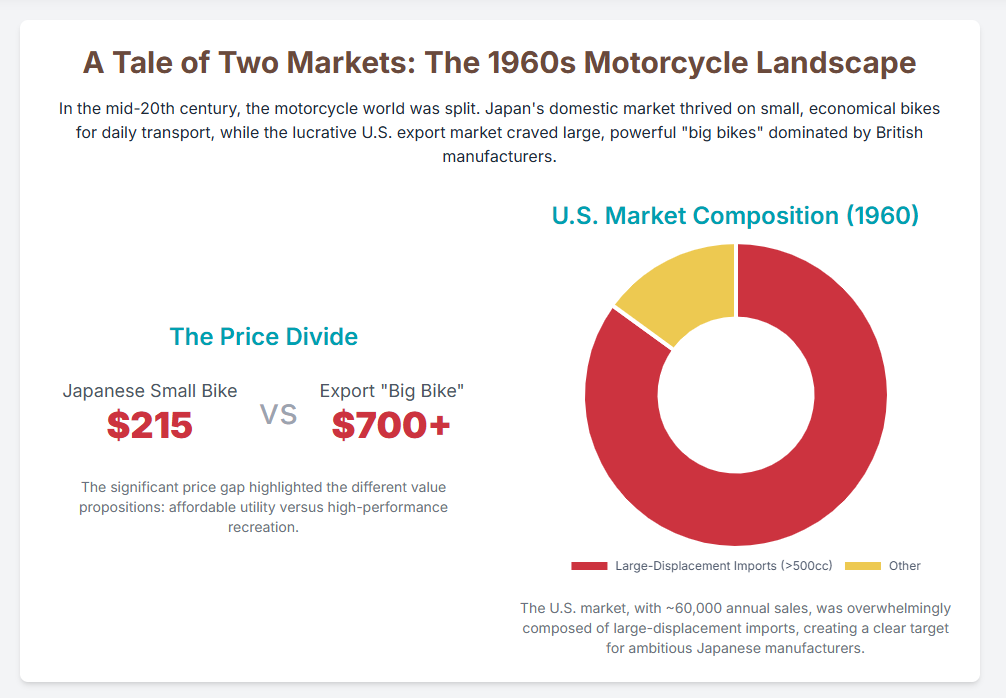
In the aftermath of World War II, the Japanese motorcycle industry was in its nascent stages, with production volumes modest, climbing from a mere 127 units in 1945 to 2,633 by 1950.1 This period saw a pragmatic focus on small-displacement, economical machines, primarily serving the domestic market’s need for affordable and efficient transportation. The extremely low production numbers immediately after the war indicate severe resource limitations and infrastructure challenges. Honda, for instance, achieved remarkable success with models like the Super Cub, introduced in 1953, which rapidly became a global bestseller.2 Other popular small-displacement offerings included the Honda Dream (available in 250cc and 350cc variants) and the Honda Benly, which proved to be venerable products in Japan.2 These motorcycles, exemplified by the Honda 50 (known as the Super Cub in America), were strategically priced between $215-$250, making them accessible to a broader audience, in stark contrast to the $700-$1,000 cost of larger motorcycles.2
The low price point of Honda’s popular small bikes made them accessible to a recovering populace. Early manufacturing efforts often involved resourceful utilization of available materials, such as Honda’s initial production of 500 bicycles powered by repurposed Mikuni generator engines from wartime leftovers.3 This collective evidence suggests that the industry’s survival and initial growth were predicated on maximizing efficiency and affordability, naturally leading to small-displacement, mass-producible machines. This experience in high-volume, cost-effective production for small bikes would later become a significant competitive advantage when Japanese manufacturers scaled up to larger displacements, enabling them to produce “big bikes” at competitive prices and volumes.
Post-WWII Industry Consolidation
The immediate post-war period witnessed a proliferation of motorcycle manufacturers in Japan, with estimates suggesting as many as two hundred companies.3 However, this burgeoning industry underwent a rapid and intense consolidation. By the early 1970s, the vast majority of these manufacturers had either gone bankrupt or been absorbed, leaving only the “Big Four”—Honda, Kawasaki, Suzuki, and Yamaha—to dominate the market.3 A significant factor in this massive purge was a highly competitive national racing scene, often featuring challenging off-road events, which effectively sorted the quick from the dead and laid the groundwork for the Big Four’s eventual global push.3 The explicit statement that the consolidation to just the “Big Four” was partly due to a “hugely competitive national racing scene” that “quickly sorted the quick from the dead” is crucial.
This competitive pressure forced companies to constantly improve their engineering and performance, which directly contributed to the later ability of these companies to produce world-class motorcycles across all displacements. Kawasaki’s own entry into motorcycle manufacturing was comparatively later, with its first motorcycle, a scooter, appearing in 1953, powered by the 148cc KE1 engine designed by its experienced aircraft engineers in 1949.3 This highlights that even Kawasaki’s initial foray aligned with the prevailing small-displacement trend before its strategic shift. Kawasaki’s late entry but strong engineering background from its aircraft division suggests they were already positioned to be a survivor in this competitive landscape, indicating a pre-existing foundation of technical capability that would be crucial for their “big bike” ambitions.
The Global “Big Bike” Standard
In stark contrast to the Japanese domestic market’s preference for smaller machines, large-displacement motorcycles were highly sought after in developed countries, particularly the United States. In the U.S., these bikes were considered a necessity on American roads and appealed to a specific demographic of “manly men”.2 In 1960, the U.S. market for large motorcycles was substantial, estimated at approximately 60,000 units annually, with the overwhelming majority being imports from British makers.7 The prevailing “world standard” for these high-performance machines was largely defined by British parallel-twin engines, exemplified by iconic models such as the BSA A7 and Triumph Bonneville.6
These engines typically featured an air-cooled, 4-stroke OHV parallel twin configuration, often employing a pre-unit construction architecture.7 The significant demand for large-displacement motorcycles in key export markets, coupled with the dominance of British parallel twins, created a clear strategic imperative for Japanese manufacturers like Kawasaki to develop competitive “big bike” offerings, even if it meant adapting existing foreign designs. The Kawasaki W1 was explicitly based heavily on a licensed version of the post-war, pre-unit construction, 500cc vertical-twin BSA A7, and was clearly aimed at the market then dominated by the classic British twins of the day.7 This confluence of market demand and established design standards directly influenced Kawasaki’s product development strategy, leading them to acquire Meguro’s expertise in this specific engine type to gain a foothold in this lucrative segment.
Table 1.1: Snapshot of Japanese Motorcycle Market (1950s-Early 1960s)
| Characteristic / Manufacturer | Honda | Meguro | Kawasaki | Global “Big Bike” Market (U.S.) |
| Dominant Displacement | Small (50cc, 250cc, 350cc) | Medium to Large (250cc, 500cc, 650cc) | Small (148cc scooter initially) | Large (500cc+, British twins) |
| Key Models | Super Cub (Honda 50), Dream, Benly | Z97, Senior T1, Junior, Stamina K-series | KE1 (scooter), B8 (post-Meguro affiliation) | BSA A7, Triumph Bonneville, Harley-Davidson |
| Market Focus | Domestic transportation, mass export | Domestic prestige, police, early large bikes | Industrial, later motorcycles | Performance, necessity, export market |
| Pricing (Honda 50) | $215-$250 (competitive) 2 | Higher (e.g., 1958 consumer models too expensive) 6 | N/A (early models) | $700-$1,000 (large bikes) 2 |
| Annual Production (Japan) | 1945: 127; 1950: 2,633 1 | Significant pre-WWII, declining late 1950s | First motorcycle 1953 3 | 1960: ~60,000 units (mostly imports) 7 |
| Industry Landscape | Leading mass-producer, driving consolidation | Longest-running, prestige, then struggling | Diversified heavy industry, late entry | Dominated by European manufacturers |
This table visually encapsulates the prevailing market conditions that Kawasaki sought to disrupt. By presenting concrete examples of small-displacement bikes and their market positioning, it provides a clear baseline against which Kawasaki’s “big bike” strategy can be measured. This visual context reinforces the premise about the dominance of small machines, making Kawasaki’s strategic shift and the introduction of the W series appear more impactful and audacious for its time.
Chapter 2: Meguro Manufacturing Co.: A Foundation of Expertise
Founding and Early History
Meguro Manufacturing Co. (目黒製作所) possessed a deep-rooted history in Japanese industry, tracing its origins back to Murato Iron Works, established in 1924.6 The dedicated motorcycle manufacturing entity, Meguro Seisakusho, was formally founded in 1937 by Nobuji Murata and Takaji Suzuki.6 Early in its history, Meguro quickly established a formidable reputation as a transmission manufacturer, notably becoming the first company in Japan to produce transmissions for three-wheeled vehicles in 1928.5
This foundational expertise in precision mechanical components would prove crucial for its later motorcycle endeavors. The detail about Meguro being “the first in Japan to produce transmissions for three-wheeled vehicles, earning it a high reputation as a transmission manufacturer” 5 is significant. Transmissions are complex mechanical components requiring high precision, durability, and robust engineering. This pre-existing expertise in a critical motorcycle component suggests a deep engineering capability and a commitment to quality, which would be a highly valuable asset for Kawasaki, a company known for heavy machinery and aircraft, looking to enter the motorcycle sector with reliable and high-performance products. This indicates that Meguro offered more than just existing motorcycle models; it provided a proven engineering and manufacturing foundation.
Pre-War and Post-War Contributions to Large Displacement
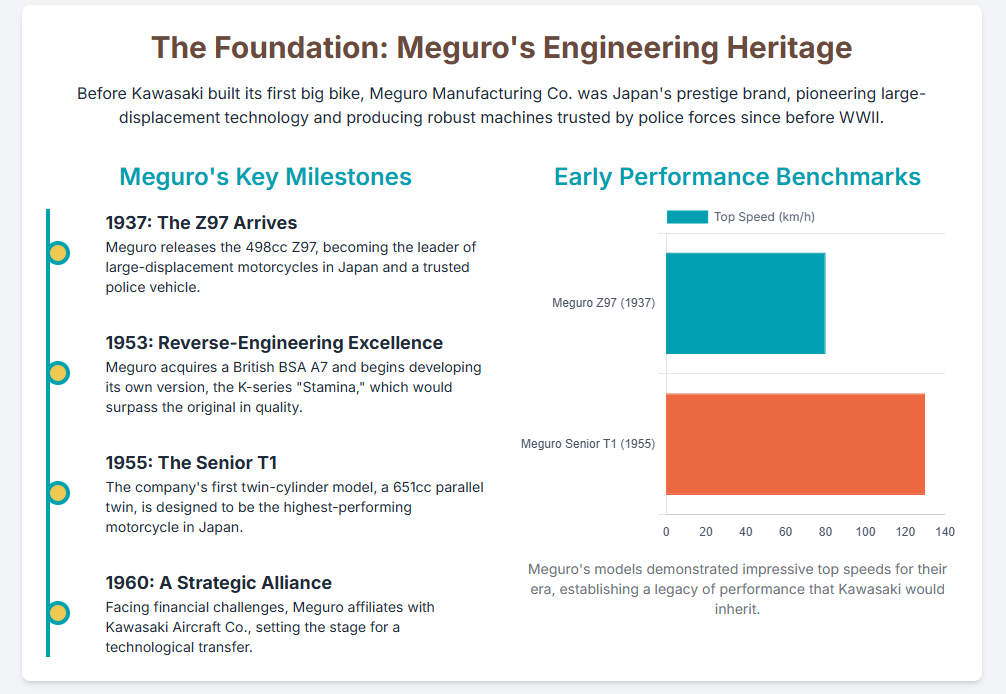
Meguro was recognized as one of the earliest Japanese motorcycle companies and held a prestigious brand status, even supplying military and police motorcycles.6 In the early 1930s, the company successfully developed a 498 cm3, air-cooled, 4-stroke OHV, single-cylinder engine.5 This engine powered their first complete motorcycle, the Type Z97, which debuted in 1937. Producing 11 PS and capable of 80 km/h, the Z97 gained acclaim for its performance and was adopted as a police motorcycle in Japan by 1939, solidifying Meguro’s position as the “leader of large-displacement motorcycles in Japan” prior to World War II.5 The Z97 model’s historical significance is underscored by its recognition as one of Japan’s 240 Landmarks of Japanese Automotive Technology.6
Meguro’s experience with larger engines continued into the post-war era. Their Senior T1 marked the company’s first twin-cylinder model, featuring a 651 cm3, air-cooled, 4-stroke OHV Parallel Twin engine, producing 29.5 PS and capable of 130 km/h. Designed with police motorcycle use in mind, it was engineered to be the “highest-performing motorcycle in Japan”.5 The K-series “Stamina” model, a 500cc class motorcycle introduced in 1956, utilized a 498 cm3 OHV single-cylinder engine and was lauded for its “excellent durability and reliability,” also serving as a police motorcycle.5 Notably, this model was a direct copy of the British BSA A7, which Meguro had acquired in 1953.6 The repeated mention of Meguro’s models (Z97, Senior T1, Stamina Z7) being adopted for police use 5 is a key observation.
Police motorcycles demand exceptional durability, reliability, and consistent performance under rigorous conditions, indicating that Meguro’s engineering was robust and proven in real-world, high-stress applications. This directly supports the idea that Kawasaki inherited advanced motorcycle technology that Meguro had developed since before World War II. Furthermore, the detail that Meguro’s K-series “Stamina” was a “copy of the BSA A7” but its “quality and engineering was superior to the BSA” and was called “too good to be true” by Edward Turner, a prominent British designer, reveals Meguro’s capability not just to replicate, but to improve upon leading Western designs.6 This demonstrates a sophisticated engineering approach and a commitment to excellence that Kawasaki could leverage for its own “big bike” aspirations.
Financial Challenges and Affiliation with Kawasaki
Despite its impressive technical prowess and its status as Japan’s longest-running motorcycle company by 1960, Meguro faced significant financial headwinds in the late 1950s. Its existing models had become less competitive in a rapidly evolving market, and a strategic misstep saw a range of 50cc, 125cc, 250cc, and 350cc consumer products launched in 1958 fail commercially due to being “too expensive” for the target market.6 These financial woes were further exacerbated by a protracted, year-long labor strike.6 These compounding challenges ultimately led to Meguro seeking affiliation with the Kawasaki Aircraft company in 1960.6
This initial affiliation marked the strategic genesis of Kawasaki’s formal entry into the motorcycle industry. The contradiction of Meguro being a technically advanced “prestige brand” and “Japan’s longest running motorcycle company” 6 yet facing bankruptcy due to “lightweight motorcycles which sold poorly” and a “yearlong labor strike” 6 is a crucial point. This indicates that Meguro’s struggles were more commercial and operational, such as misjudging market demand for small, affordable bikes and labor issues, rather than technical deficiencies. This situation presented a perfect strategic opportunity for Kawasaki, a financially robust heavy industry conglomerate, to acquire a technically rich but struggling entity, thereby gaining a significant head start in motorcycle manufacturing, particularly in the larger displacement segment, without having to build that expertise from scratch.
Chapter 3: The Kawasaki-Meguro Integration and the K2’s Engineering Leap
Kawasaki Aircraft’s Strategic Entry and Acquisition
Kawasaki Heavy Industries, a diversified conglomerate with foundational roots in shipbuilding dating back to 1878 and subsequent expansion into rolling stock and aircraft manufacturing 11, made a deliberate strategic move into the motorcycle industry. Its aircraft division played a pivotal role, initiating involvement with Meguro Manufacturing, a company with a motorcycle production history dating back to 1935.13 The collaboration commenced with Kawasaki Aircraft acquiring an interest in Meguro in 1960.6 This initial partnership evolved into the formation of Kawasaki-Meguro in 1962, a joint entity that successfully produced the 125cc B8 model.6 The relationship culminated in October 1964 when Kawasaki took “full control” of Meguro, recognizing the profound “commercial and marketing value of having a motorcycle producing division alongside its heavy industry services and particularly its already established sales outlets”.6
This complete absorption was strategic, with Kawasaki having “learned all it needed to know from the company” 6, effectively acquiring Meguro’s specialized knowledge and market presence. The progression from “acquiring an interest” in 1960 7 to “affiliation” 6 to “Kawasaki-Meguro” in 1962 6 and finally “full control” in October 1964 6 demonstrates a methodical, strategic integration process. The statement that Kawasaki “learned all it needed to know from the company” 6 implies a highly effective and perhaps even systematic knowledge transfer, where Kawasaki systematically extracted Meguro’s intellectual property and manufacturing processes related to motorcycles. This was not a mere merger or rescue mission but an absorption of critical capabilities, allowing Kawasaki to bypass years of independent research and development in a field where Meguro was a seasoned expert, thereby accelerating their entry into the “big bike” market.
Integration of Meguro’s Technology
Kawasaki directly inherited and seamlessly integrated Meguro’s long-standing motorcycle technology, which had been developed since before World War II. This comprehensive transfer included not just specific engine designs but also Meguro’s “advanced technologies like pipe frame design and manufacturing techniques,” which significantly influenced subsequent Kawasaki large-displacement motorcycles.5 The 500cc K-series twin-cylinder model, originally a Meguro design known as the Meguro K “Stamina,” served as a direct predecessor to Kawasaki’s efforts.6 Furthermore, the Meguro T1 Senior 650cc OHV parallel twin-cylinder is explicitly noted to have exerted a “strong influence” on the development of the Kawasaki W-series 6, indicating multiple points of technological inheritance. Following the full acquisition, the newly formed “Kawasaki-Meguro Works” continued joint production of 125cc, 175cc, and 250cc single-cylinder vehicles 6, signifying a broader integration of manufacturing operations beyond just the K-series.
The integration was a symbiotic process where Kawasaki gained not just specific engine designs but also fundamental manufacturing expertise and a heritage of robust, police-proven machines, which were critical for building their “big bike” reputation for durability and reliability. The explicit statement that Meguro’s “advanced technologies like pipe frame design and manufacturing techniques” influenced “subsequent Kawasaki large-displacement motorcycles” 5 is more than just inheriting an engine design; it is about absorbing fundamental engineering and production methodologies that underpin the entire motorcycle structure. This demonstrates that Kawasaki’s “big bike” foundation was built on decades of Meguro’s accumulated knowledge and practical experience, particularly in creating durable, larger-displacement machines for demanding applications like police use, which added a layer of credibility and reliability to Kawasaki’s nascent motorcycle division.
The Transformation: Meguro K1 to Kawasaki K2
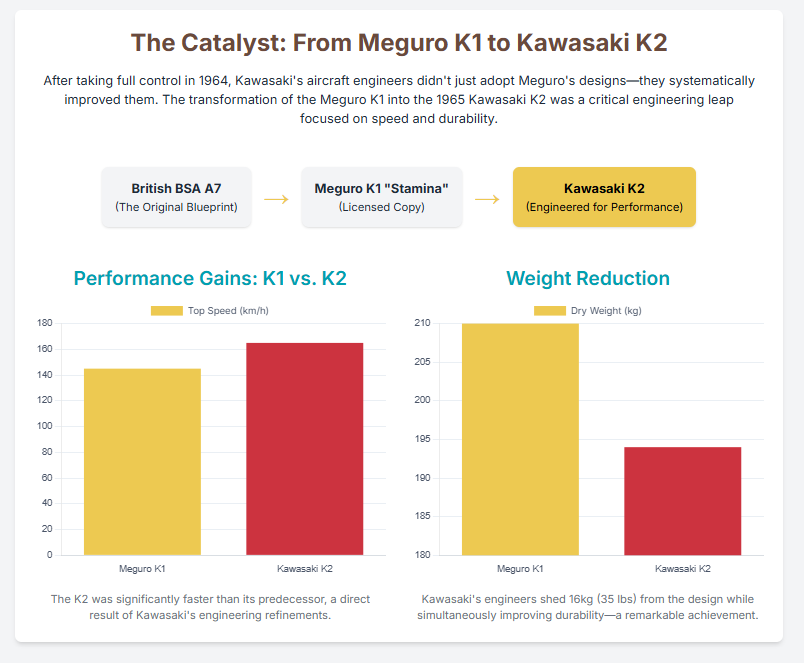
The 1965 Kawasaki K2 represented a critical evolutionary step, directly based on Meguro’s K Series models.7 The original Meguro K, which was itself a licensed copy of the 500cc BSA A7, became retrospectively known as the K1 following the K2’s introduction.7 Kawasaki Aircraft Co. Ltd. undertook substantial design modifications to the K2, moving beyond mere reproduction of the licensed design. These engineering efforts were specifically aimed at significantly increasing both the motorcycle’s durability and its top-speed performance.5 Quantifiable improvements included a notable weight reduction of 16 kg, decreasing the K2’s dry weight from 210 kg to 194 kg.5 This reduction was achieved concurrently with “greatly improved durability” compared to its predecessor, the Stamina K1.5
Furthermore, the K2 demonstrated a significant enhancement in maximum speed, increasing from 145 km/h to 165 km/h, a substantial 20 km/h improvement.5 Specific mechanical refinements included an “improved crankshaft” designed to address “lubrication problems” identified in the earlier Meguro K1.7 Aesthetically, the K2 was distinguished by a “larger timing cover” and a redesigned “rear subframe, fuel tank and side panels,” which imparted a “typically conservative Meguro image, dissimilar to the original BSA A7” 7, signaling Kawasaki’s emerging design identity.
The transformation from the Meguro K1 to the Kawasaki K2 illustrates Kawasaki’s strategic intent to not just acquire, but to actively improve and optimize the inherited technology. The focus on durability and top-speed performance, coupled with a significant weight reduction, indicates a clear engineering mandate from Kawasaki Aircraft Co. Ltd. to enhance the bike’s competitiveness. The direct addressing of “lubrication problems” with an “improved crankshaft” 7 demonstrates a sophisticated approach to engineering, moving beyond mere replication to fundamental problem-solving and performance enhancement.
This rigorous engineering refinement of an existing, proven design allowed Kawasaki to rapidly develop a more robust and faster machine, laying the groundwork for its subsequent flagship “big bike” without the need to start from scratch. The K2’s design and engineering advancements were not an end in themselves but served as the direct basis for the later developed 650-W1 model, incorporating Meguro Manufacturing’s advanced technologies like pipe frame design and manufacturing techniques, which influenced subsequent Kawasaki large-displacement motorcycles.5
Chapter 4: The Kawasaki W1: A Bold Entry into the Big Bike Market
Evolution from K2 Prototype to W1
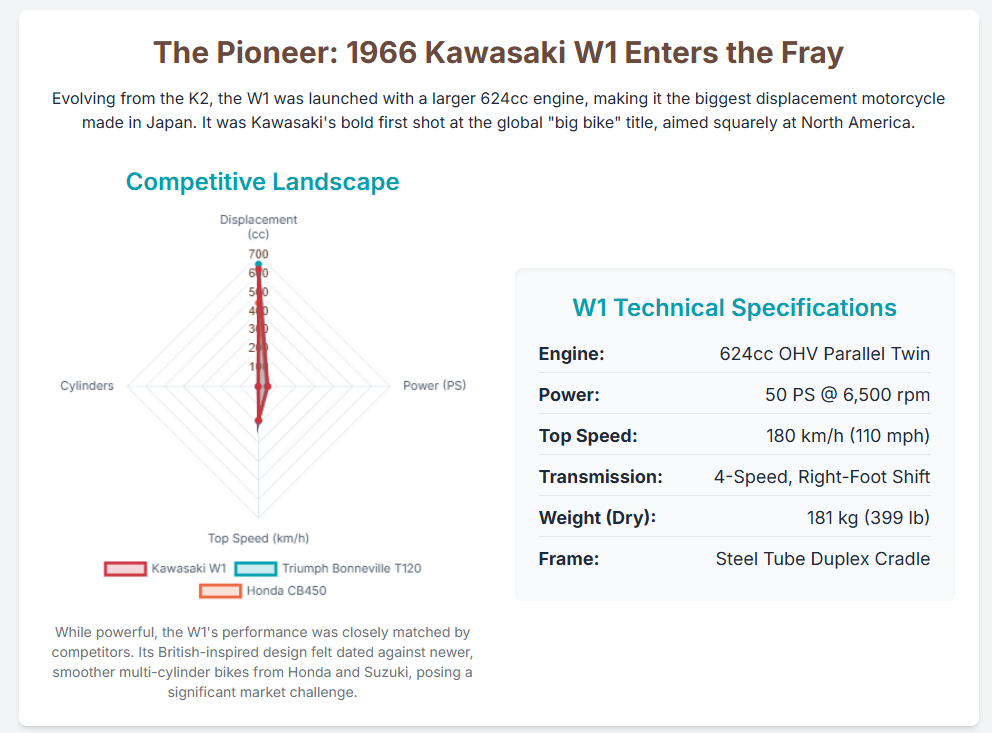
The success of the 1965 K2, with its enhanced durability and top-speed performance, paved the way for Kawasaki’s next significant step into the large-displacement market. A prototype model based on the K2 evolved into the W1, which was officially released the following year, in 1966.7 This evolution involved a crucial enlargement of the engine displacement. The K2’s design was scaled up to 624 cc to become the Meguro X-650 prototype, which was prominently displayed at the 1965 Tokyo Motor Show.7 This prototype then directly transitioned into the Kawasaki W1.7 At its launch, the initial Kawasaki W1 boasted the largest engine displacement of any model manufactured in Japan at the time.7 Beyond the engine, Kawasaki made deliberate stylistic changes to the W1, replacing the traditional Meguro look with a “sleeker fuel tank, sportier mudguards (fenders) and other details intended to appeal to export markets, especially North America”.7 This strategic design shift underscored Kawasaki’s ambition to compete on a global stage, moving beyond the domestic market’s aesthetic preferences.
Technical Specifications and Design Philosophy
The Kawasaki W1 was powered by a 624 cc (38.1 cu in) 4-stroke, air-cooled, OHV (Overhead Valve) Parallel Twin engine.7 This engine configuration, with its roots in the Meguro K-series and ultimately the BSA A7, featured a bore of 74.0 mm and a stroke of 72.6 mm.7 The W1 had a compression ratio of 8.7:1, producing 50 PS (49 hp) at 6500 rpm, enabling a top speed of 180 km/h (110 mph).7 The engine utilized battery ignition and was mated to a manual 4-speed transmission.7 The chassis featured a robust steel tube duplex cradle frame, telescopic front suspension, and swingarm-style rear suspension.7 Braking was handled by mechanical drums, with a double 2-leading shoe setup at the front and a leading-trailing drum at the rear.7 The W1 weighed 181 kg (399 lb) dry and had a fuel capacity of 15 liters.7
The design philosophy of the W1 was heavily influenced by the classic British road bikes that dominated the global “big bike” market.7 This influence was evident not only in the engine architecture but also in details such as the right-foot gear shift and left-foot brake, which was the standard configuration for British motorcycles of the era.7 From 1966 to 1968, W1 engines were built with a single 31 mm Mikuni carburetor, a feasible setup for a straight-twin with a 360° crankshaft angle.7 In 1968, the W1SS variant was introduced with two 28 mm Mikuni carburetors, taking the place of the original W1.7 The W2 (also known as Commander) emerged in the same year, with the W2SS being a restyled W1SS offering slightly more horsepower, and the W2TT featuring a high-pipe design with twin mufflers on the left side.7 These variations demonstrate Kawasaki’s early attempts to refine and diversify the W series to appeal to different market segments.
Initial Market Reception and Challenges
Despite its pioneering status as the largest-displacement Japanese motorcycle at the time, the Kawasaki W1 faced significant market challenges. Kawasaki quickly realized that even an improved version of the BSA A10 (which had already been discontinued) was at a disadvantage against the newer and faster unit construction British twins, such as the BSA Spitfire and the Triumph Bonneville T120.7 The W1 also encountered stiff competition from other Japanese twin-cylinder street bikes, including the Suzuki T500 and the Honda CB450.7 The perception was that the W1 was “behind the times” despite its engine size.7 This perception stemmed from the rapid technological advancements occurring in the motorcycle industry.
The dominance of the inline-twin engine for high-performance street bikes began to wane in 1968 with the development of inline-triple engines by British manufacturers like Triumph Engineering for the BSA Rocket 3/Triumph Trident.7 This shift was further accelerated by the introduction of the 1969 Kawasaki H1 Mach III, with its inline-triple two-stroke engine, and Honda’s groundbreaking CB750 with its inline-four engine.7 These multi-cylinder engines signaled a new era of performance and refinement. While the W series engines were noted for being oil-tight and reliable, they offered lower overall performance and generated higher vibration compared to their rapidly evolving competitors, ultimately leading to their lack of success in sales in key export markets.7
Due to flat sales in North America, the W2TT was discontinued in 1969, followed by the W2SS in 1970, and finally the W1SS in 1971.7 While the 650cc W series remained popular in Japan, and some units were exported to Europe in the 1970s, subsequent models were produced primarily for the domestic market.7 The penultimate model in the W series was the W1SA, which introduced stylistic changes and, importantly, adopted the standard Japanese configuration of a left-side gear shift lever and a right-side rear brake pedal.7 The final version of the original series was the 1973 W3 model (also known as RS650), which featured upgraded suspension and twin disc brakes in the front.7 Production of the original W series ceased in 1974.7 The market’s rapid evolution towards multi-cylinder, higher-performance, and smoother engines quickly outpaced the W1’s traditional parallel-twin design, demonstrating the intense competitive pressure in the late 1960s.
Chapter 5: Legacy and Impact
Challenging the Status Quo
Despite its relatively short production run and challenges in export markets, the Kawasaki W series holds a significant place in motorcycle history as a pioneering effort. Kawasaki, through the W1, was one of the first Japanese manufacturers to introduce a “big bike” to the global market, challenging the prevailing notion that Japanese motorcycles were exclusively small-displacement machines.4 This bold move initiated the “big bike boom” in Japan, setting a precedent for other Japanese manufacturers to follow.4 While Honda’s CB750 later became the definitive “superbike” of the era, the W1’s earlier entry demonstrated Kawasaki’s strategic foresight and willingness to compete in a segment dominated by European brands.14 The W series represented Kawasaki’s initial foray into establishing a reputation for large-displacement motorcycles, a reputation that would be solidified by later, more successful models like the H1 Mach III and the Z1.4 This early commitment to larger engines was crucial in shifting the global perception of Japanese motorcycle capabilities.
Foundation for Future Kawasaki Innovations
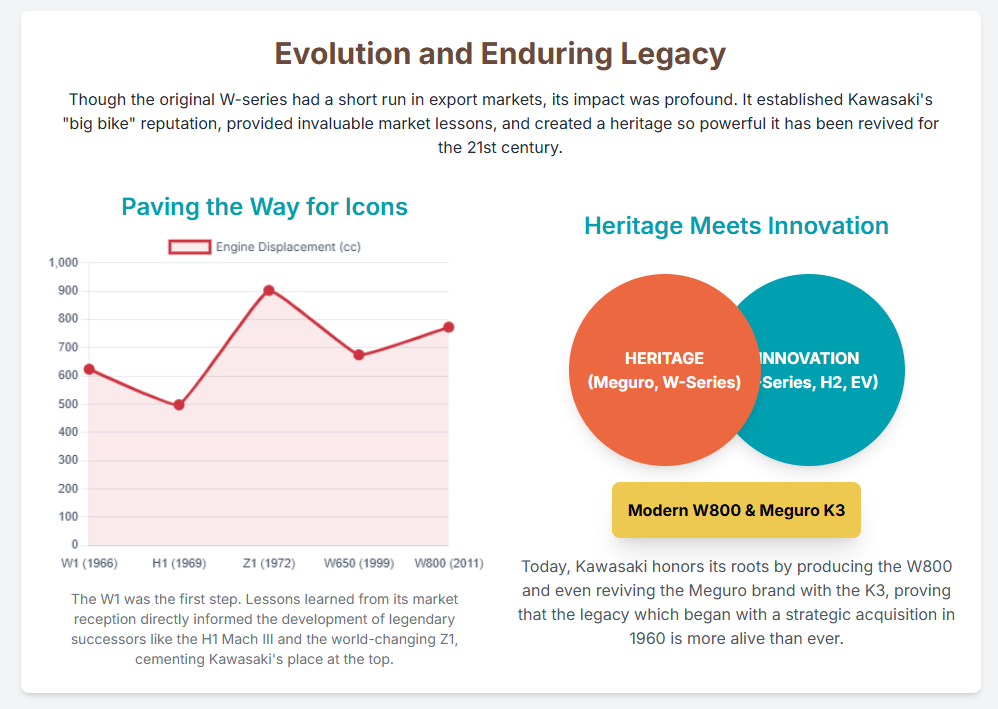
The experience gained from the W series, though commercially challenging in some markets, proved invaluable for Kawasaki’s future motorcycle development. The company quickly adapted to market demands, recognizing the limitations of the traditional parallel-twin in the face of emerging multi-cylinder designs. This led to a strategic pivot towards more advanced engine technologies. For instance, Kawasaki introduced the high-performance two-stroke A7 Avenger in 1967, offering performance at least equal to the W1.7 This was followed by the epoch-making H1 (2-stroke, 3-cylinder, 498 cm3) in 1969, which further confirmed Kawasaki’s “big bike reputation and position in the U.S. market”.4 Ultimately, Kawasaki found a successful formula for four-stroke street bikes with its Z series, which began with the Z1 (Kawasaki 900 Super4).7 The lessons learned from the W series’ market reception, particularly its performance and vibration characteristics compared to competitors, directly informed the development of these subsequent, more competitive models. This iterative process of market entry, evaluation, and rapid innovation became a hallmark of Kawasaki’s engineering strategy, allowing them to evolve from adapting existing designs to pioneering new ones.
Enduring Influence of the W Series and Meguro Brand
The legacy of the W series and the Meguro brand extends far beyond their initial production runs. Kawasaki has consistently paid homage to this heritage through its modern retro-classic lineup. In 1999, Kawasaki launched the W650, a 675cc parallel twin retro-style motorcycle directly inspired by the W2.6 This was followed by the W800, which continues to be produced, meticulously crafted to pay homage to the past while incorporating modern technology such as a 773cc air-cooled vertical-twin engine, assist & slipper clutch, and disc brakes with ABS.7 The W175 was also released in 2017, further expanding the retro line.7 These retro models evoke nostalgia for classic motorcycles from decades earlier, demonstrating that the W series established an iconic aesthetic and riding experience that continues to resonate with riders.7
Furthermore, Kawasaki has explicitly revived the Meguro brand itself. In 2020, Kawasaki announced the return of Meguro with the K3 model, available in 2021.6 This new K3 is mechanically identical to the Kawasaki W800 but visually distinct, sold at a higher price point, symbolizing the enduring prestige and historical significance of Meguro.6 This revival is Kawasaki’s way of reaffirming the history and heritage of Japanese motorcycles and carrying on the lineage of all the models that have come before.18 The guiding theme for Kawasaki Motors, “Heritage and Innovation,” directly reflects this dual commitment to honoring its roots, particularly through the Meguro legacy and the W Series, while simultaneously exploring cutting-edge technologies like strong hybrid and hydrogen-engine equipped motorcycles.16 The meticulous attention to detail in modern Meguro and W models, such as steel fenders and carefully tuned exhaust notes to mimic the originals, highlights the profound respect for the foundational engineering and design principles inherited from Meguro.18
Conclusion
Kawasaki’s entry into the “big bike” market in the mid-1960s, marked by the introduction of the W series, represents a pivotal moment in the history of Japanese motorcycling. This strategic shift was made possible by the calculated acquisition and integration of Meguro Manufacturing Co., a company with a rich pre-war and post-war legacy in developing larger displacement engines and robust manufacturing techniques. Meguro’s established expertise in parallel-twin engines, its history of improving upon Western designs, and its proven reliability through police contracts provided Kawasaki with an invaluable foundation, accelerating its entry into a technically demanding market segment.
The transformation from the Meguro K1 to the Kawasaki K2 demonstrated Kawasaki Aircraft’s engineering prowess, significantly enhancing durability and performance through targeted modifications. This refinement directly led to the W1, which, despite being the largest-displacement Japanese motorcycle at its launch, faced intense competition from rapidly evolving British and Japanese multi-cylinder designs. The W1’s initial commercial struggles in export markets underscored the dynamic nature of the global motorcycle industry during this period, forcing Kawasaki to quickly adapt and innovate.
Ultimately, the W series, while not a commercial blockbuster in its initial form, served as a crucial learning platform and a bold statement of intent. It laid the groundwork for Kawasaki’s future dominance in the “big bike” segment, paving the way for iconic models like the H1 Mach III and the Z series. The enduring legacy of the W series and the Meguro brand, evident in Kawasaki’s modern retro-classic motorcycles and the revival of the Meguro name, highlights a deep respect for heritage. This historical trajectory reveals how Kawasaki leveraged a foundational acquisition and continuous engineering refinement to transform from a diversified heavy industry conglomerate into a global leader in motorcycle manufacturing, embodying a philosophy of “Heritage and Innovation” that continues to define its brand identity.
Sources
- magazine.cycleworld.com, accessed July 27, 2025, https://magazine.cycleworld.com/article/1967/11/1/the-history-of-japanese-motorcycles#:~:text=Only%20127%20were%20made%20in,climbing%20to%20387%20in%201947.&text=motorcycle%20makers%20began%20to%20get,up%20to%202%2C633%20in%201950.
- Understanding Honda Motor Company’s Early Success in the American 2-wheeled Vehicle Market Through Utilization of Marketing 4p, accessed July 27, 2025, https://www.u-hyogo.ac.jp/mba/pdf/SBR/10-4/045.pdf
- How Honda, Kawasaki, Suzuki and Yamaha were forged by WW2 – Motor Sport Magazine, accessed July 27, 2025, https://www.motorsportmagazine.com/articles/motorcycles/motogp/how-honda-kawasaki-suzuki-and-yamaha-were-forged-by-ww2/
- 1950-1989 | Kawasaki Heavy Industries, Ltd., accessed July 27, 2025, https://global.kawasaki.com/en/corp/history/03.html
- Hisotory: W & MEGURO – The Original Icon Since 1924, accessed July 27, 2025, https://www.global-kawasaki-motors.com/w_meguro/en/history/
- Meguro motorcycles – Wikipedia, accessed July 27, 2025, https://en.wikipedia.org/wiki/Meguro_motorcycles
- Kawasaki W series – Wikipedia, accessed July 27, 2025, https://en.wikipedia.org/wiki/Kawasaki_W_series
- The Dream CB750 FOUR / 1969 – Honda Global, accessed July 27, 2025, https://global.honda/en/heritage/episodes/1969cb750four.html
- BSA unit twins – Wikipedia, accessed July 27, 2025, https://en.wikipedia.org/wiki/BSA_unit_twins
- Origins of the British Parallel Engine | Cycle World, accessed July 27, 2025, https://www.cycleworld.com/story/blogs/ask-kevin/origins-british-parallel-motorcycle-engine/
- Exploring the World of Kawasaki Motorcycles: From History to Manufacturing, accessed July 27, 2025, https://www.fullthrottlehouston.com/Learn/Blog/post/exploring-the-world-of-kawasaki-motorcycles-from-history-to-manufacturing/2023-09-14
- History | Kawasaki Heavy Industries, Ltd., accessed July 27, 2025, https://global.kawasaki.com/en/corp/history/index.html
- The History of Kawasaki Motorcycles | UTI – Universal Technical Institute, accessed July 27, 2025, https://www.uti.edu/blog/motorcycle/kawasaki-motorcycle-history
- Top 10 Classic Japanese Motorcycles – Top Speed, accessed July 27, 2025, https://www.topspeed.com/top-classic-japanese-motorcycles/
- The Best and Worst Japanese Bikes of the Sixties – Good Motorcycles, accessed July 27, 2025, https://goodmotorcycles.com/used-bike-guide/best-worst-japanese-bikes-sixties/
- Model categories | Kawasaki Motors, Ltd., accessed July 27, 2025, https://www.global-kawasaki-motors.com/en/model/
- Kawasaki W800 | Retro Modern Motorcycle | Original Icon, accessed July 27, 2025, https://www.kawasaki.com/en-us/motorcycle/w/retro-classic/w800
- Meguro: Japan’s Oldest Active Motorcycle Brand Founded 100 Years Ago Meguro S1 Developers Share Their Thoughts on the Brand | ANSWERS, accessed July 27, 2025, https://answers.khi.co.jp/en/mobility/20250228e-01/
Our Social Media Handles
- Instagram : LivingWithGravity
- Medium : Akash Dolas
- YouTube Channel : Gear and Shutter