








Executive Summary
Kawasaki Motors, a formidable entity within the global motorcycle industry, is embarking on a strategic refresh of its core 2026 model year lineup. This initiative places a significant emphasis on aesthetic enhancements, primarily through the introduction of new color schemes. This report delivers an exhaustive analysis of the 2026 Ninja and Versys 1100 series updates, meticulously detailing the new liveries, contextualizing these changes within the models’ existing technological and performance frameworks, and assessing their broader market implications.
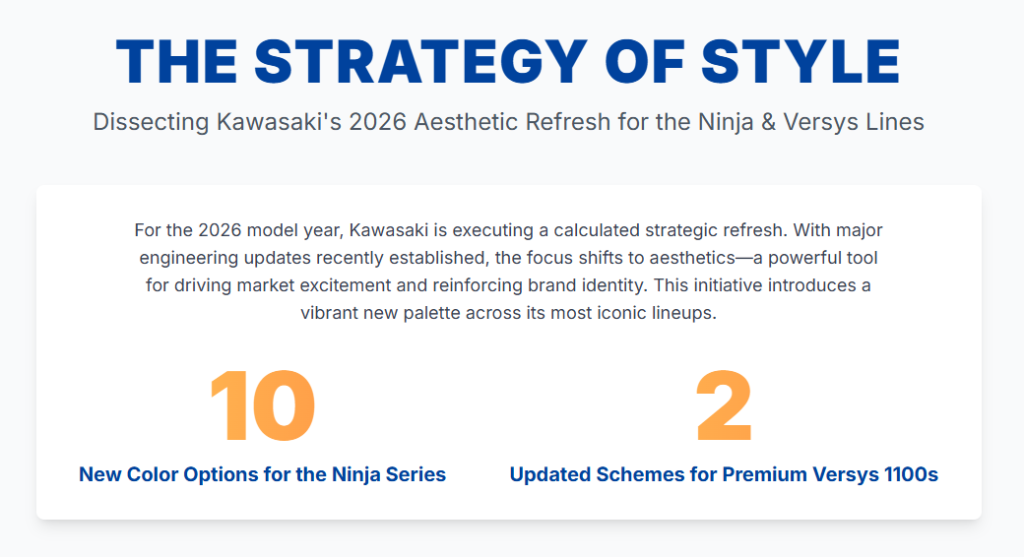
While the initial query indicated “nine new colors across five of its 2026 Ninja models,” this report, drawing from official Kawasaki sources, clarifies that ten new color options have been introduced across five distinct Ninja models, within a broader lineup of six 2026 Ninja models. Concurrently, the Versys 1100 S and SE models are receiving two updated color schemes, building upon their substantial mechanical enhancements introduced in the 2025 model year.
These aesthetic refreshes, synergistically combined with the models’ advanced features and strategic marketing initiatives—such as the Versys 1100’s prominent role in the Tour de France—underscore Kawasaki’s unwavering commitment to maintaining product freshness, reinforcing its distinctive brand identity, and appealing to the evolving preferences of a diverse consumer base in a highly competitive global market.
1. Introduction: Kawasaki’s 2026 Vision – Blending Heritage with Modern Appeal
1.1. Kawasaki’s Market Position and Brand Strategy
Kawasaki Heavy Industries’ motorcycle division commands a formidable presence in the global motorcycle market, widely recognized for its engineering prowess, distinctive product lines, and a relentless pursuit of performance. The brand consistently delivers high-performance motorcycles across a diverse array of segments, ranging from the track-focused Ninja supersports to the supremely versatile adventure tourers embodied by the Versys series. This robust market standing is firmly rooted in a foundation of continuous innovation, unwavering reliability, and a profound connection to its storied racing heritage, a legacy often visually symbolized by its iconic “Lime Green” livery.1
The strategic introduction of new colorways for the 2026 models, alongside the carry-over of recent mechanical enhancements, signifies a deliberate and dynamic approach to product lifecycle management. This methodology ensures sustained market relevance and continuous consumer engagement without necessitating annual ground-up redesigns for every model. This consistent rollout of aesthetic updates, even in years without major mechanical overhauls, illustrates a strategic cadence aimed at maintaining a continuous market presence and fostering a perception of ongoing innovation. This “perpetual refresh” model is particularly crucial in a fast-paced consumer market where visual novelty can significantly influence purchasing decisions and maintain product desirability over time. By strategically updating appearances, Kawasaki can extend the lifecycle of its successful platforms, optimize the return on its research and development investments, and provide a consistent stream of “newness” to the market. This approach offers a cost-effective means to signal innovation and sustain a competitive advantage.
1.2. The Strategic Importance of Aesthetic Refreshes in the Motorcycle Industry
In the intensely competitive motorcycle industry, visual appeal transcends mere superficiality; it plays a pivotal role in shaping consumer perception, cultivating brand loyalty, and ultimately driving sales. Color and graphics are not simply decorative elements; they function as powerful communicative tools, conveying a motorcycle’s inherent character, its modernity, and its exclusivity.1
Regular color updates empower manufacturers to align their products with prevailing design trends, respond adeptly to evolving consumer tastes, and generate a sense of novelty that can effectively re-engage existing customers while simultaneously attracting new demographics. This strategy is particularly vital in market segments where performance metrics are closely matched among competitors, making aesthetic differentiation a critical battleground for market share. The primary focus on new colors for the 2026 models across both the Ninja and Versys 1100 lineups underscores this point.1 Given that no major mechanical overhauls are indicated for these models in 2026—beyond the significant 2025 Versys engine update—it becomes evident that if the underlying engineering remains robust, aesthetic changes represent the most effective and efficient lever for stimulating demand and maintaining product freshness.
This suggests that Kawasaki is strategically leveraging design as a key differentiator. By offering fresh color palettes, they can effectively re-engage existing customers who might be considering an upgrade and attract new buyers who prioritize contemporary aesthetics, all without needing to invest heavily in costly new engine or chassis development every single year. This approach maximizes the return on previous research and development expenditures.
1.3. Contextualizing the 2026 Updates within Kawasaki’s Broader Product Development Cycle
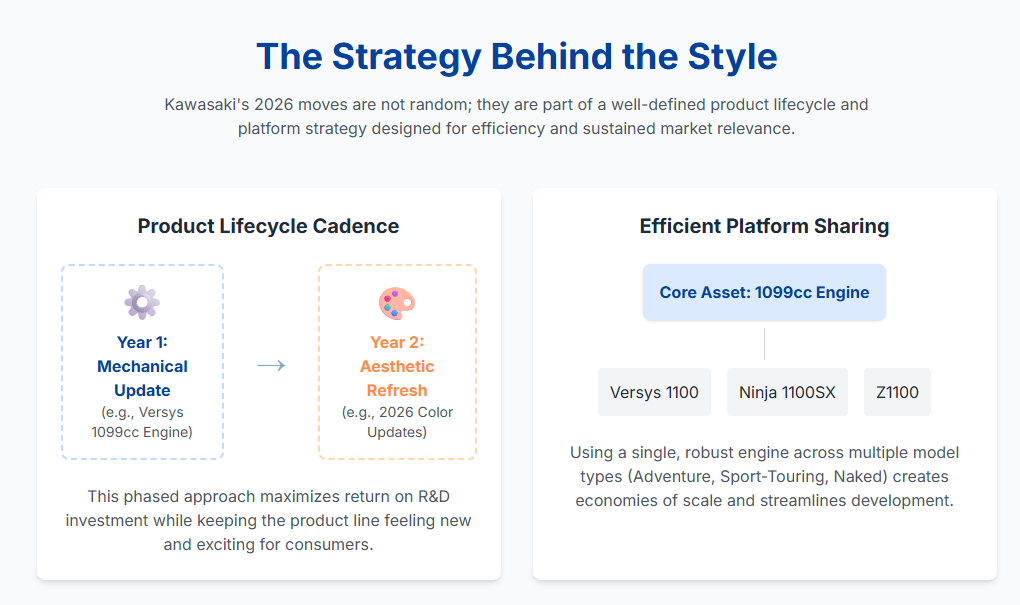
The 2026 color updates for the Ninja and Versys 1100 models are best understood within the framework of Kawasaki’s broader, multi-year product development strategy. This comprehensive approach typically involves a phased introduction, where significant mechanical or platform revisions are unveiled in one model year, followed by strategic aesthetic refinements in subsequent years.
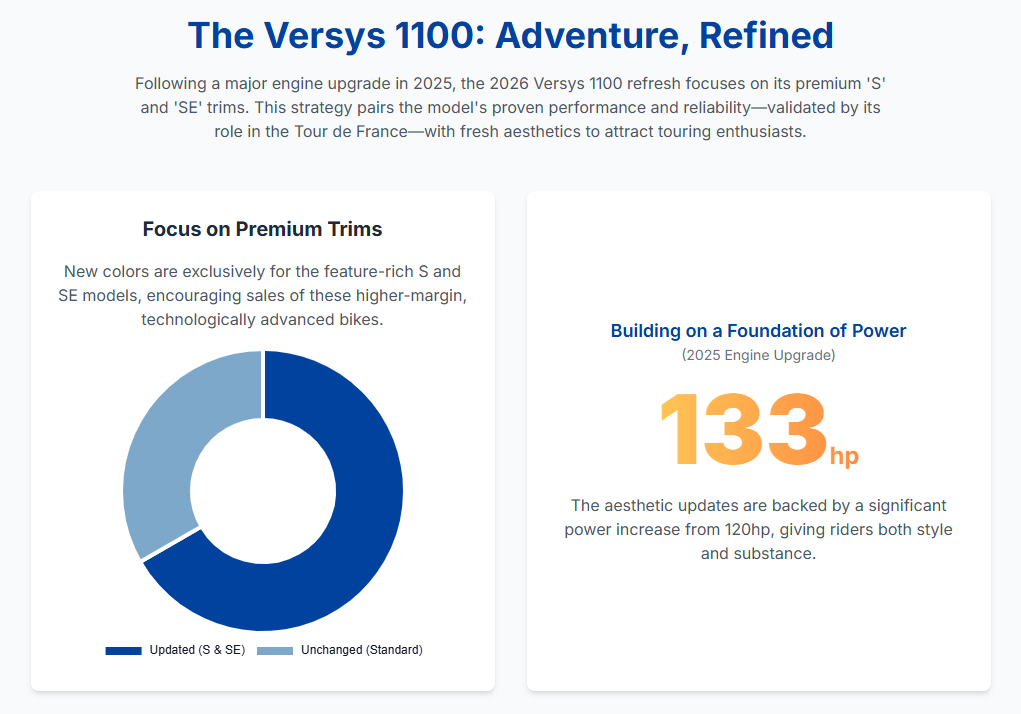
A prime illustration of this phased strategy is the Versys 1100. For the 2025 model year, this adventure-tourer received a substantial engine capacity increase, growing from 1,043cc to 1,099cc, accompanied by a notable power bump from 120bhp to 133bhp.4 The 2026 color updates for the Versys 1100 S and SE models 6 are designed to build upon these recent performance enhancements, ensuring that the visual appeal of the motorcycle remains contemporary and keeps pace with its mechanical evolution.
Furthermore, the confirmed introduction of the 2026 Z1100 naked motorcycle 8, which is set to share the same 1099cc inline-four engine as the Versys 1100 and the Ninja 1100SX, highlights Kawasaki’s overarching strategy of platform sharing. The expansion of the 1099cc engine platform to a new Z1100 model alongside the Versys 1100 and Ninja 1100SX suggests a deliberate strategy of maximizing component commonality across diverse segments. These three models belong to distinct motorcycle categories: adventure-touring, sport-touring, and naked, respectively.
By utilizing a common, robust engine platform across these varied product lines, Kawasaki achieves significant economies of scale in both manufacturing and research and development. This shared foundation simplifies parts inventory, streamlines production processes, and allows for more focused investment in other areas, such as advanced electronics or frequent aesthetic updates. This strategic approach supports a broader and more diverse product portfolio, enabling Kawasaki to compete effectively in multiple market segments while optimizing production costs. It also means that any improvements or refinements made to this core engine platform benefit a wider range of models simultaneously, thereby enhancing overall brand value and market competitiveness.
2. The 2026 Kawasaki Ninja Lineup: A Spectrum of Sport and Style
2.1. Ninja Brand Philosophy and Market Segmentation
The Kawasaki Ninja series stands as a foundational pillar of the brand’s identity, embodying a core philosophy centered on “sportiness, modernity, and passion”.3 This iconic family of motorcycles is meticulously engineered and designed to cater to an exceptionally broad spectrum of riders, encompassing everyone from novices making their initial foray into the sportbike world to seasoned enthusiasts who demand peak performance capabilities. The lineup is strategically diversified across various displacements and engine configurations, ensuring that an appropriate model exists for nearly every skill level and riding preference.
This expansive market segmentation, which ranges from the highly accessible Ninja 500 and Ninja 650 (both compatible with Europe’s A2 license requirements 1) to the formidable high-performance supersport models like the Ninja ZX-6R and the high-revving Ninja ZX-4RR, necessitates a highly nuanced aesthetic strategy. Each model within this diverse portfolio requires a distinct visual identity that not only resonates deeply with its specific target demographic but also consistently reinforces the overarching “Ninja” brand ethos.
The broad appeal of the Ninja lineup, from the approachable Ninja 500/650 to the high-performance ZX-6R/ZX-4RR, indeed demands a varied aesthetic approach that balances brand consistency with individual model distinction. A singular, uniform color strategy across all these models would likely fail to connect effectively with the diverse preferences of their respective target audiences. This indicates that Kawasaki must carefully curate color palettes for each model, allowing them to maximize appeal within specific niches while still maintaining a cohesive brand identity under the “Ninja” umbrella. This reflects a sophisticated understanding of consumer psychology and market segmentation.
2.2. Clarifying the 2026 Ninja Color Count Discrepancy
The initial user query specified “nine new colors across five of its 2026 Ninja models.” However, a critical review of official Kawasaki European news releases reveals a slight but significant discrepancy in this count. The Kawasaki EU news release explicitly states, “Ten new colours across six 2026 Ninja models”.1 This count is further corroborated by Paddock-GP, which similarly reports “Ten new colors for six 2026 Kawasaki Ninja models”.3 Conversely, another news source, Superbike-News, aligns with the user query’s stated numbers, indicating “Nine new colours across five 2026 Kawasaki Ninja models”.10
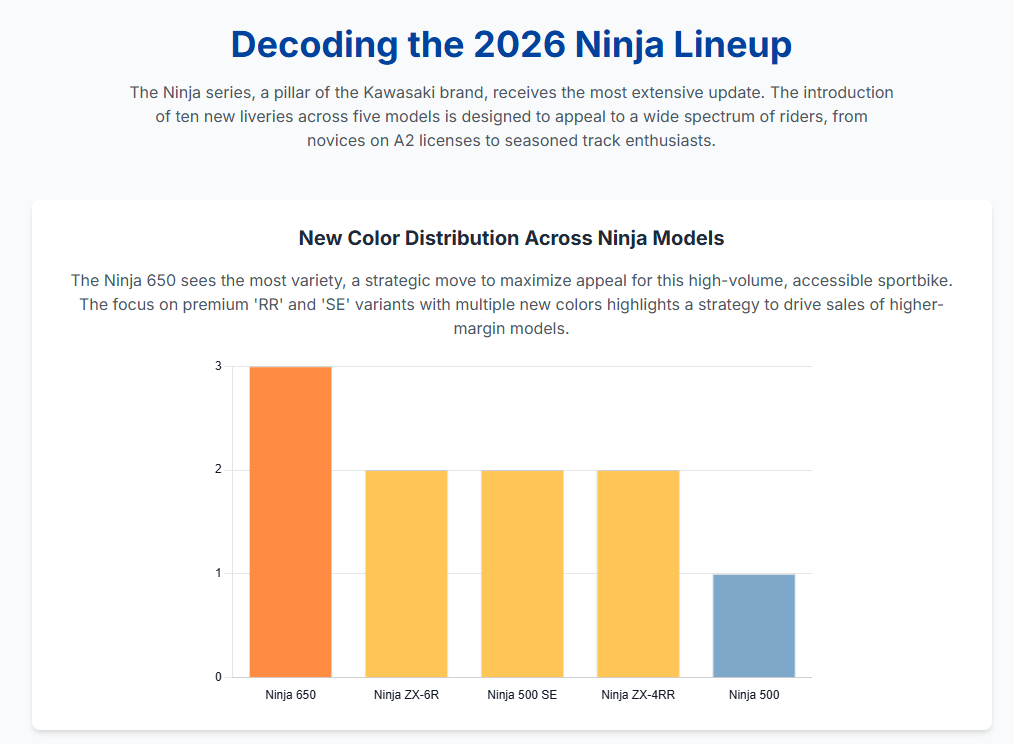
To resolve this discrepancy, it is essential to prioritize the most authoritative source: Kawasaki’s official European news release.1 According to this primary source, the 2026 Ninja lineup indeed comprises six distinct models: the Ninja ZX-6R, Ninja 650, Ninja 500, Ninja 500 SE, Ninja ZX-4R, and Ninja ZX-4RR. However, the Ninja ZX-4R is specifically noted to “continue into 2026 with the same high impact colour and graphic treatment” 1, meaning it does not receive any new colors for the upcoming model year. The other five models—the Ninja ZX-6R, Ninja 650, Ninja 500, Ninja 500 SE, and Ninja ZX-4RR—collectively receive ten new color options. By systematically counting the new colors listed for each model in the official release (Ninja ZX-6R: 2, Ninja 650: 3, Ninja 500: 1, Ninja 500 SE: 2, Ninja ZX-4RR: 2), the total indeed amounts to ten new colors. Therefore, the most accurate representation is
ten new color options introduced across five distinct Ninja models, within a broader lineup of six total 2026 Ninja models. For executive reporting, such precision is paramount. Explicitly addressing and resolving these minor variations in reporting, by prioritizing official manufacturer statements, significantly enhances the credibility of the analysis and demonstrates thorough research. It also serves as a reminder that minor discrepancies can occur across different media sources, necessitating careful cross-referencing for definitive information.
2.3. Ninja ZX-6R: Racing Pedigree with Fresh Visuals
The Kawasaki Ninja ZX-6R, serving as the foundational model for Kawasaki’s WorldSSP racing team 1, is a formidable 636cc supersport machine. For the 2026 model year, it receives two new color options, designed to further enhance its aggressive supersport identity and appeal directly to its performance-oriented target audience.
The new color schemes introduced are:
- Metallic Matte Graphenesteel Gray / Metallic Spark Black / Lime Green: This is a striking new livery that masterfully blends a sophisticated matte gray with classic Kawasaki green, resulting in a modern yet undeniably aggressive aesthetic.1
- Updated Variation of the Iconic Lime Green Livery: This represents a subtle refinement of the fan-favorite, signature Kawasaki green. This careful evolution, rather than a complete overhaul, ensures that the timeless appeal of Kawasaki’s most recognizable and historically significant racing color remains contemporary and visually appealing to current tastes.1 The introduction of an “updated variation” of Lime Green for the ZX-6R, rather than a completely new shade, demonstrates a nuanced approach to brand heritage. This subtle evolution allows Kawasaki to maintain the iconic status of its signature color while ensuring it remains visually current and appealing to contemporary tastes. This strategy effectively balances tradition with innovation, catering to long-standing brand loyalists who expect the “green machine” while simultaneously subtly updating the aesthetic to attract new buyers who might find the classic livery too static. This reflects a sophisticated management of brand legacy and market evolution.
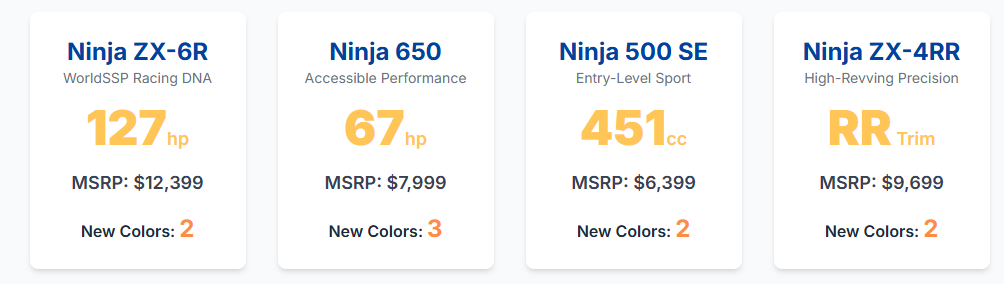
In terms of performance, the Ninja ZX-6R is powered by a 636cc in-line four-cylinder liquid-cooled engine, capable of delivering a formidable 127 hp with RAM air at 13,000 rpm and 69 Nm of torque at 10,800 rpm.2 Its robust stopping power is ensured by a braking system featuring 310 mm dual semi-floating discs at the front and a 220 mm single disc at the rear.2
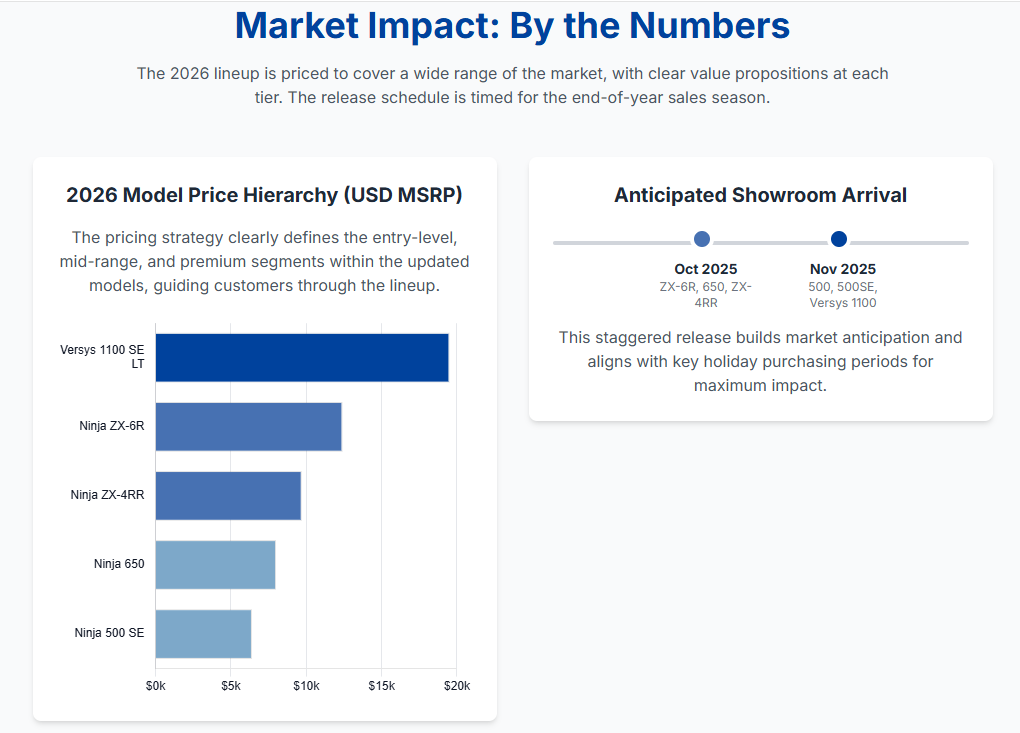
For the European market, the 2026 Ninja ZX-6R is anticipated to be available in dealer showrooms by late October 2025.10 In the United States, the 2026 Ninja ZX-6R ABS model has a confirmed Manufacturer’s Suggested Retail Price (MSRP) of $12,399 11, providing a clear pricing benchmark for the US market.
2.4. Ninja 650: The Accessible Sportbike’s Evolving Palette
The Kawasaki Ninja 650 holds a pivotal position within the Ninja lineup, highly regarded for its optimal “balance between performance and accessibility”.3 This model is a key choice for riders holding A2 licenses in Europe, as well as experienced motorcyclists who prioritize maneuverability and a compact form factor.1 For the 2026 model year, the Ninja 650 benefits from the introduction of three new color options, further enhancing its broad appeal.
The new color schemes available for the 2026 Ninja 650 are:
- Metallic Matte Graphenesteel Gray / Metallic Flat Spark Black.1
- Metallic Flat Spark Black / Metallic Carbon Gray.1
- Lime Green.1
The strategic decision to offer three distinct new colorways for the Ninja 650, including a prominent Lime Green option, reflects a deliberate effort to maximize market penetration within its accessible segment. This diversification aims to cater to a broader spectrum of aesthetic preferences, thereby increasing the likelihood of a specific color resonating with an individual buyer. For a model designed for broad appeal and high sales volume like the Ninja 650, a wider array of color choices directly translates to a higher probability of a potential customer finding a livery that aligns with their personal taste and style. This is particularly important for a volume-selling model, as it can significantly contribute to overall sales figures.
Key features of the Ninja 650 include:
- Engine Performance: It is powered by a 649cc parallel-twin liquid-cooled engine, delivering 67 hp at 8,000 rpm and 64 Nm of torque at 6,700 rpm. This engine is paired with a smooth six-speed gearbox, making it well-suited for both urban commuting and spirited weekend rides.2
- KTRC (Kawasaki Traction Control): An advanced traction control system that provides enhanced sport riding performance and peace of mind, especially on low-traction surfaces. It offers two modes, plus the option to turn the system off, allowing riders to adjust settings to suit their riding situation and preference.12
- Smartphone Connectivity: A Bluetooth chip integrated into the instrument panel enables riders to connect wirelessly to their motorcycle. Utilizing the “RIDEOLOGY THE APP” smartphone application, various instrument functions can be accessed, contributing to an enhanced motorcycling experience.12
- LED Headlights: Twin LED headlights, each featuring low and high beams as well as a position lamp, offer increased brightness and contribute to the motorcycle’s modern aesthetic.12
- Sharper Ninja Styling: The Ninja 650’s refined styling provides a sportier appearance and reinforces its strong connection to the Ninja family. Its sleek and sporty design is intended to inspire confidence in riders. The motorcycle features a lightweight chassis with an estimated dry weight of 178 kg, and Dunlop Sportmax Roadsport 2 tyres contribute to its agile handling characteristics.12
For the European market, the 2026 Ninja 650 is expected to be available in October 2025.10 In the US, the 2025 Ninja 650 ABS had an MSRP of $7,999 14, which is likely indicative of the pricing for the 2026 model year.
2.5. Ninja 500 & Ninja 500 SE: Entry-Level Innovation with Vibrant Choices
The Ninja 500 and its Special Edition (SE) variant remain essential models within Kawasaki’s range, particularly valued for their easy handling and immediate riding pleasure, whether navigating city streets or carving through winding weekend roads.3 These models are equipped with a newly developed water-cooled twin-cylinder engine, designed by Kawasaki.3
For the 2026 model year, the standard Ninja 500 will welcome one new shade:
- Metallic Flat Spark Black / Metallic Spark Black.1
The Ninja 500 SE will be available in two new, more vibrant color options:
- Lime Green.1
- Metallic Matte Twilight Blue / Candy Persimmon Red: This is described as a striking color duo.1
The choice of a “striking color duo” for the Ninja 500 SE is a deliberate strategy to enhance the perceived value and exclusivity of this special edition model. By offering bold and unique color combinations, Kawasaki targets buyers who are willing to pay a premium for distinctive aesthetics. This approach allows the SE model to stand out visually, reinforcing its “special” designation and appealing to consumers who seek a more personalized or eye-catching motorcycle.
Key features of the Ninja 500 series generally include:
- Engine: A powerful, rider-friendly 451cc parallel-twin engine, offering smooth and powerful acceleration across the rev range, making it suitable for various riding situations.15
- Instrumentation with Smartphone Connectivity: Both the full LCD instrument panel on standard models and the TFT display on SE models offer smartphone connectivity, allowing riders to access display notifications, riding logs, and community features.15
- Lightweight Trellis Frame: The Ninja 500 features a trellis frame design similar to that of the Ninja H2, utilizing Kawasaki’s advanced dynamic rigidity analysis for optimal rigidity and light weight. The engine is rigid-mounted and acts as a stressed member, contributing significantly to the bike’s low curb mass, with an estimated dry weight of 157 kg.15
- Large-Diameter Front Brake Disc: A 310 mm semi-floating front disc, the same size used on the Ninja ZX-14R, provides confident stopping power. ABS models offer additional reassurance.15
- High-Class, Intense Design: The Ninja 500’s distinctive front face and sleek, flowing lines clearly identify it as a member of the Ninja family, with a race-inspired, big-bike aesthetic.15
For the European market, both the Ninja 500 and Ninja 500 SE are expected to be available in November 2025.10 In the US, the 2025 Ninja 500 SE ABS had an MSRP of $6,399 14, which serves as an indicative price point for the 2026 models.
2.6. Ninja ZX-4RR: Unchanged Performance, Refreshed Presence
The Ninja ZX-4R is renowned for its explosive high-revving performance.3 For the 2026 model year, the standard Ninja ZX-4R will continue with its already well-established punchy graphics and high-impact color treatment, remaining unchanged visually.1 This decision to retain the existing livery for the ZX-4R suggests that its current visual identity continues to resonate strongly with its target audience, or that Kawasaki is prioritizing its core performance attributes for this niche model, where aesthetic novelty may be considered less critical than its unique engine characteristics.
On the other hand, the more cutting-edge Ninja ZX-4RR, the premium variant, will benefit from two brand new colors for the 2026 model year:
- Lime Green.1
- Metallic Matte Graphenesteel Gray / Metallic Spark Black.1
The decision to provide new colors specifically for the ZX-4RR, while the ZX-4R remains unchanged, serves to further differentiate the premium ‘RR’ variant. This offers a distinct visual identity for a model aimed at enthusiasts who appreciate both its unique performance characteristics and a refreshed aesthetic. This strategic distinction can enhance the perceived value and desirability of the higher-tier model.
For the European market, the 2026 Ninja ZX-4RR is expected to be available in October 2025.10 In the US, the 2025 Ninja ZX-4RR ABS had an MSRP of $9,699 14, providing a reference point for the 2026 pricing.
3. The 2026 Kawasaki Versys 1100 Series: Adventure Touring with Refined Aesthetics
3.1. Versys 1100 Series Positioning and 2025 Enhancements
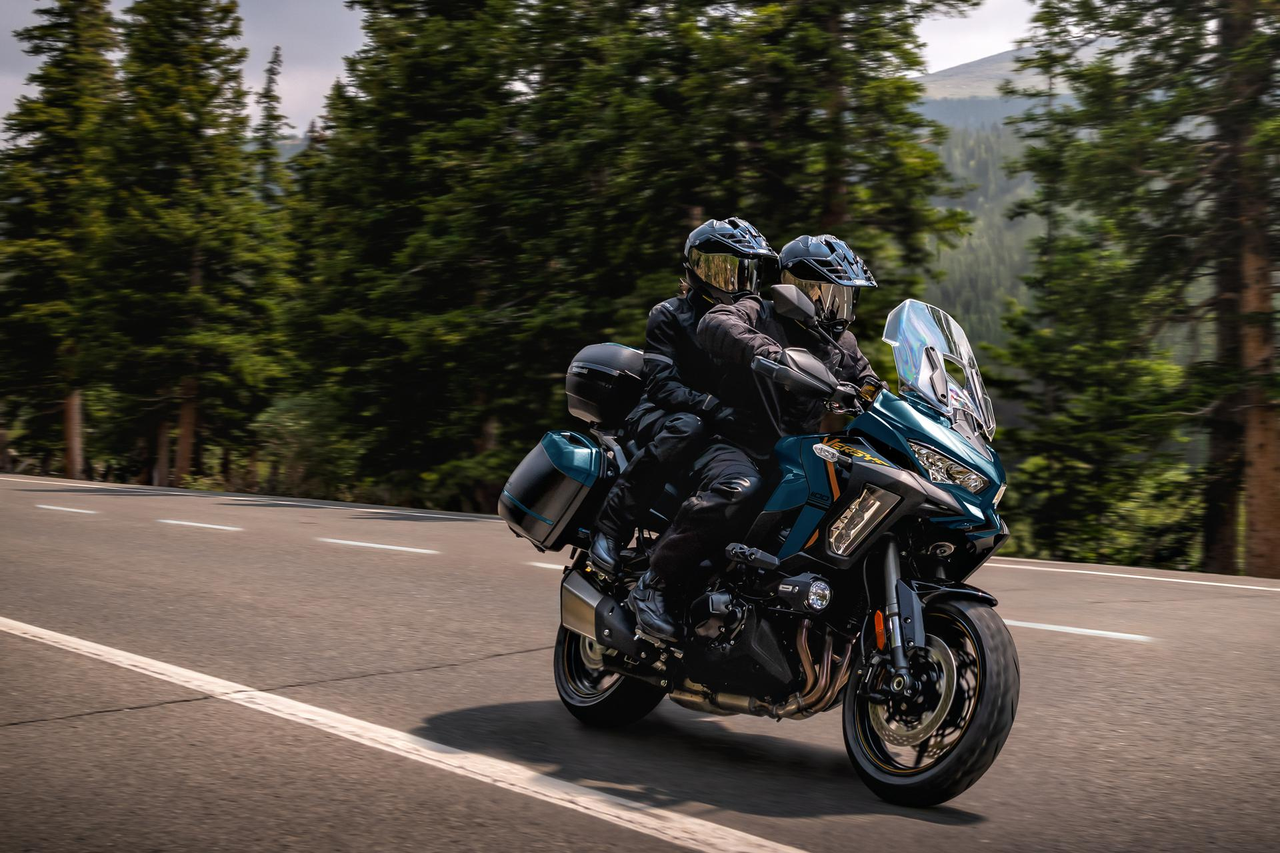
The Kawasaki Versys 1100 series is positioned as the “ultimate travel companion,” designed to offer long-range comfort and exceptional any-road versatility.6 It caters to riders seeking to extend their horizons, whether touring vast countrysides or navigating bustling cityscapes, either solo or with a passenger.6
The Versys 1100 underwent significant enhancements for the 2025 model year, which are carried over into 2026. These updates included a substantial increase in engine capacity from 1,043cc to 1,099cc, resulting in a notable power bump from 120bhp to 133bhp.4 Crucially, the engine also received improved midrange torque, right where the engine spends most of its time, making the bike feel “zippier and more fun to ride”.4 The quickshifter was also refined, now operating at engine speeds down to 1500 rpm (a 1000 rpm floor drop) and offering more precise operation.4
A significant marketing highlight for the Versys 1100 was its central role in the Tour de France, where a fleet of Versys 1100 machines served as the official motorcycle supplier for the event organizers (ASO).5 These motorcycles were utilized for various critical functions, including road closures, allied safety aspects, fast response medical bikes, and assisting the peloton across twenty-one demanding stages and over 3300 kilometers of French roads.7 This high-profile marketing initiative served as a powerful validation of the Versys’s reliability, durability, and versatility under extreme conditions. Such direct involvement in a world-renowned event translates directly into enhanced brand perception and significantly bolsters consumer trust in the model’s capabilities. It provides tangible evidence of the Versys 1100’s “go the distance” ethos.6
3.2. 2026 Versys 1100 Color Updates
For the 2026 model year, the standard Versys 1100 will retain its current livery.7 However, the more premium Versys 1100 S and Versys 1100 SE models will each receive two updated color schemes.5
The new color schemes for both the Versys 1100 S and SE are:
- Metallic Deep Blue / Metallic Diablo Black.5
- Emerald Blazed Green / Metallic Diablo Black.5
The strategic decision to focus the new color updates exclusively on the S and SE models, rather than the base Versys 1100, is a deliberate move to emphasize the premium variants within the lineup. These higher-tier models come equipped with advanced features such as electronic suspension (SE), an up/down quick shifter, electronic cruise control, and smartphone connectivity with voice command.5 By pairing these advanced technological features with fresh, appealing aesthetics, Kawasaki aims to leverage the visual novelty to drive sales of these higher-margin models. This approach encourages consumers to opt for the more feature-rich and profitable versions of the Versys 1100, enhancing the overall profitability of the adventure-touring segment.
3.3. Key Features of the Versys 1100 SE (and S where applicable)
The Versys 1100 series, particularly the SE model, is equipped with a comprehensive suite of features designed to maximize touring comfort, versatility, and rider enjoyment.
Prominent features include:
- KECS with Showa’s Skyhook Technology (SE only): The Versys 1100 SE is equipped with Kawasaki Electronic Control Suspension (KECS) featuring Showa’s innovative Skyhook Technology. This electronic suspension system delivers a smoother ride for both rider and passenger, significantly contributing to increased comfort and enjoyment across varied road conditions.6
- Grip Heaters and Hand Covers (SE): For enhanced comfort in colder climates, the SE model includes grip heaters to keep riders’ hands warm, while hand covers offer increased wind protection, further contributing to overall rider comfort.6
- Smartphone Connectivity with Voice Command (S & SE): In addition to existing features like the ability to record Ride Logs and share them, the “RIDEOLOGY THE APP MOTORCYCLE” smartphone application now offers voice command capabilities. This allows riders to control the app and adjust motorcycle settings orally, providing a hands-free and more integrated experience.4
- Fun to Ride Performance: Both the Versys 1100’s engine and chassis are meticulously designed to maximize rider enjoyment on the street. Its in-line four-cylinder engine delivers a rewarding surge of acceleration with every twist of the throttle, especially with its increased displacement. This enhanced engine performance is complemented by excellent chassis balance and long-travel suspension settings, enabling superb control and feedback, and offering a high level of rider confidence in numerous street riding situations.6
- Touring Comfort and Advantage Performance: The Versys 1100 is not only exciting to ride but also offers the comfort and carrying capacity necessary for long-distance touring. A highly comfortable seat and effective wind protection complement the relaxed riding position, making extended time in the saddle more enjoyable. Passenger comfort is also a priority. The long-travel suspension capably handles a wide range of road conditions, adding to rider confidence, with the SE model’s electronic suspension further enhancing ride comfort. A high payload capacity accommodates panniers and a top case simultaneously, and numerous accessories are available to add to comfort and convenience, particularly beneficial on multi-day trips.6
- Emotional, Well-Integrated Design: The Versys 1100 features an emotional design that invites the rider. Its flowing styling presents a clear line of color traceable from the front to the rear of the motorcycle. A balanced use of color and materials emphasizes the functional beauty of the bike’s individual parts and the sculpted bodywork, which is shaped with rider comfort in mind.6
- Clean-Mount Pannier System: The mounting system for accessory panniers is designed for simplicity, allowing for very easy attachment and removal. The clean-mount system’s clutter-free design ensures that the rear of the bike maintains an appealing aesthetic even when the panniers are removed.6
- Color-Matched Accessories: Kawasaki offers color-matched accessories, such as the Pannier Kit (79L / 79L) with a One-Key System, and Deco Stripe Kits, ensuring visual cohesion with the new 2026 color schemes.6 The presence of these color-matched accessories highlights a comprehensive product strategy that extends beyond the motorcycle itself. This approach not only enhances the overall aesthetic appeal and functionality for the customer but also creates an additional revenue stream for the manufacturer and its dealers. By offering integrated accessory options, Kawasaki fosters an ecosystem that encourages further investment in customization and personalization, thereby increasing customer lifetime value.
3.4. Availability and Pricing
For the European market, the 2026 Versys 1100 family is anticipated to be available from November 2025.16
In the United States, the 2025 Versys 1100 SE LT ABS model had a Manufacturer’s Suggested Retail Price (MSRP) of $19,499.14 This pricing is indicative for the 2026 model year, as significant mechanical changes are not noted for 2026, building on the 2025 enhancements. The “LT” designation in the US models typically signifies a package that includes standard luggage (side cases and handguards), highlighting a market-specific bundling strategy tailored for the touring segment.4 This strategic bundling simplifies the purchasing decision for touring-focused customers and ensures the motorcycle is immediately ready for extended journeys.
4. Market Implications and Strategic Outlook
4.1. Enhancing Brand Appeal and Market Competitiveness
The introduction of new color schemes across the 2026 Kawasaki Ninja and Versys 1100 lineups represents a calculated move to enhance the brand’s overall appeal and competitive standing. These fresh aesthetics contribute significantly to the perceived modernity and freshness of the models.1 In a dynamic market where technological advancements can be incremental, visual differentiation becomes a powerful tool. By offering a “vibrant makeover” 2, Kawasaki ensures its lineup remains visually current and exciting for riders across all experience levels, from beginners to seasoned enthusiasts. This proactive approach reinforces Kawasaki’s position as a forward-thinking brand, capable of adapting to evolving consumer tastes and maintaining a strong presence against rivals in various segments, including the burgeoning large-displacement naked bike class with the upcoming Z1100.8 This strategy is crucial for maintaining market share and attracting new customers in a highly competitive global landscape.
4.2. Consumer Engagement and Sales Strategy
Aesthetic updates are a proven method for re-engaging existing customers and attracting new ones.1 For current Kawasaki owners, new color options can provide a compelling reason to upgrade, offering a fresh visual experience even if the underlying mechanicals remain largely consistent with recent model years. For prospective buyers, a modern and appealing color palette can be the decisive factor in their purchasing decision, especially when comparing models with similar performance characteristics.
Beyond the motorcycles themselves, Kawasaki’s strategy extends to enhancing customization and driving additional revenue through accessories. The availability of color-matched panniers and deco stripe kits for the Versys 1100 6, and various accessories for the Ninja 650 such as single seat covers and top cases 12, exemplifies this. This creates a synergistic relationship where the new colorways encourage the sale of complementary accessories. This integrated approach not only allows customers to personalize their motorcycles to a greater extent but also generates additional revenue streams for Kawasaki and its dealer network, contributing to a higher average transaction value and fostering a more comprehensive customer relationship. This effectively creates an ecosystem for increased customer lifetime value.
4.3. Future Product Trajectory and Innovation
The emphasis on color updates for the 2026 model year, particularly for models that received significant mechanical updates in 2025 (like the Versys 1100), suggests a period of refinement for existing platforms rather than immediate radical redesigns. This approach allows Kawasaki to capitalize on its recent engineering investments while maintaining product desirability through visual novelty. The continued focus on rider aids, smartphone connectivity, and touring comfort, particularly evident in the Versys series 6, indicates a commitment to incremental technological refinements that enhance the overall riding experience.
Furthermore, the versatility of the 1099cc engine platform, now shared across the Versys 1100, Ninja 1100SX, and the upcoming Z1100 8, signals potential for further model expansion or variants in the future. This strategic commonality in core components allows for efficient resource allocation and faster development cycles for new models built on proven foundations. This balance between aesthetic and technological updates indicates that Kawasaki is likely prioritizing incremental technological refinements and leveraging its existing robust platforms, while strategically using visual updates to maintain market dynamism and consumer interest. This ensures that the brand remains competitive and responsive to market trends without over-committing to costly, annual ground-up redesigns across its entire portfolio.
5. Conclusions
Kawasaki’s 2026 model year strategy for its Ninja and Versys 1100 series is a sophisticated and well-orchestrated blend of aesthetic refreshment and the astute leveraging of established, robust engineering platforms. The introduction of ten new color options across five distinct Ninja models, within a broader lineup of six 2026 Ninja models, alongside two updated color schemes for the Versys 1100 S and SE, demonstrates a clear understanding of market dynamics and consumer preferences.
This strategic emphasis on visual appeal is not merely cosmetic; it is a critical component of Kawasaki’s broader product lifecycle management, designed to enhance brand appeal, maintain market competitiveness, and drive consumer engagement. By meticulously curating color palettes and offering diverse options, Kawasaki ensures its motorcycles remain fresh, modern, and desirable. The targeted approach for the Versys 1100, focusing new colors on the premium S and SE variants, further underscores a strategy to maximize profitability by pairing advanced features with compelling aesthetics.
The continued integration of advanced rider aids, smartphone connectivity, and the strategic use of high-profile marketing initiatives like the Tour de France sponsorship, collectively reinforce the value proposition of these models. This comprehensive approach allows Kawasaki to effectively balance tradition with innovation, cater to a wide range of rider segments, and capitalize on its engineering investments. In an evolving motorcycle market, Kawasaki’s strategic agility and commitment to product dynamism position it strongly for continued success.
Sources
- Ten new colours across six 2026 Ninja models | Kawasaki, accessed August 10, 2025, https://www.kawasaki.eu/en/news/2025/august/ten-new-colours-across-six-2026-ninja-models-.html
- Kawasaki Revels New Colors for 2026 Models In International Market | Bike News, accessed August 10, 2025, https://www.timesnownews.com/auto/bike-news/kawasaki-revels-new-colors-for-2026-models-in-international-market-article-152431210
- Street: Ten new colors for six 2026 Kawasaki Ninja models – Paddock GP, accessed August 10, 2025, https://www.paddock-gp.com/en/Street-ten-new-colors-for-six-2026-Kawasaki-Ninja-models/
- 2025 Kawasaki Versys 1100 SE LT ABS Review [15 Fast Facts] – Ultimate Motorcycling, accessed August 10, 2025, https://ultimatemotorcycling.com/2025/03/17/2025-kawasaki-versys-1100-se-lt-abs-review-15-fast-facts/
- Kawasaki Versys 1100 models to gain new colours as part of 2026 update – Visordown, accessed August 10, 2025, https://www.visordown.com/news/kawasaki-gives-two-versys-1100-models-fresh-colours-2026
- Versys 1100 SE | 2026 | Kawasaki, accessed August 10, 2025, https://www.kawasaki.eu/en/Motorcycles/Adventure_Tourer/Versys_1100_se_2026.html
- Versys 1100 new season colours unveiled – Kawasaki, accessed August 10, 2025, https://www.kawasaki.co.uk/en/news/Versys_1100_new_season_colours_unveiled__?Uid=07F9CV9fUVsNUFBQXl9eXFteWFELUQsLXl9QX1oKUF1bWws
- 2026 Kawasaki Z1100 Details Emerge – Cycle World, accessed August 10, 2025, https://www.cycleworld.com/motorcycle-news/2026-kawasaki-z1100-details/
- 2026 Kawasaki Z1100 Confirmed – Cycle World, accessed August 10, 2025, https://www.cycleworld.com/motorcycle-news/kawasaki-z1100-confirmed/
- Nine new colours across five 2026 Kawasaki Ninja models – Superbike News, accessed August 10, 2025, https://superbike-news.co.uk/nine-new-colours-across-five-2026-kawasaki-ninja-models/
- 2026 KAWASAKI NINJA ZX-6R ABS ZX636JSFAL Visalia CA | Goshen Ivanhoe Tulare California JKBZXJJ15SA024250 – GA Motorsports, accessed August 10, 2025, https://www.ga-motorsports.com/new-Visalia-2026-KAWASAKI-NINJA+ZX+6R+ABS-ZX636JSFAL-JKBZXJJ15SA024250
- Ninja 650 | 2026 | Kawasaki, accessed August 10, 2025, https://www.kawasaki.eu/en/Motorcycles/Supersport_Sport/Ninja_650_2026.html
- Ninja 650 | 2026 – Kawasaki EU, accessed August 10, 2025, https://www.kawasaki.eu/en/Motorcycles/Supersport_Sport/Ninja_650_2026.html/EX650STFNN/EX650STFNN/MetallicFlatSparkBlackMetallicCarbonGray
- Kawasaki Motorcycles Models & Prices | Village Motorsports, Unionville VA, accessed August 10, 2025, https://www.villagemotorsportsva.com/Brands/Manufacturer-Models/Model-List/Kawasaki/Motorcycles
- Ninja 500 | 2025 – Kawasaki EU, accessed August 10, 2025, https://www.kawasaki.eu/en/Motorcycles/Supersport_Sport/Ninja_500_2025.html
- Kawasaki Versys 1100 new season colours unveiled – Superbike News, accessed August 10, 2025, https://superbike-news.co.uk/kawasaki-versys-1100-new-season-colours-unveiled/
- Kawasaki Versys® 1100 SE LT | Sport Tourer Motorcycle | Versatile Touring Performance, accessed August 10, 2025, https://www.kawasaki.com/en-us/motorcycle/versys/adventure-touring/versys-1100-se-lt
- 2025 Kawasaki Versys 1100 SE LT Confirmed For US – Cycle World, accessed August 10, 2025, https://www.cycleworld.com/motorcycle-news/kawasaki-versys-1100-launches-in-europe/
Our Social Media Handles
- Instagram : LivingWithGravity
- Medium : Akash Dolas
- YouTube Channel : Gear and Shutter