













Executive Summary
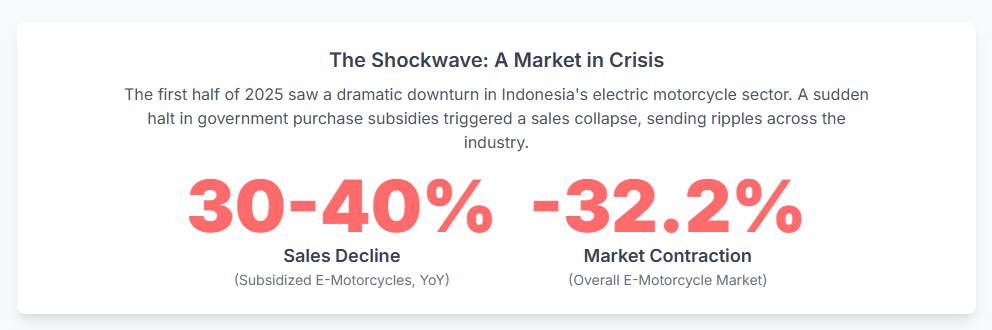
The first half of 2025 presented a significant and nuanced setback for Indonesia’s electric vehicle (EV) market. While total EV sales, including cars and hybrids, demonstrated robust year-on-year growth, the critical electric two-wheeler segment experienced a severe sales contraction. Industry data indicates a sales decline of 30% to 40% for subsidized electric motorcycles during this period, leading manufacturers to implement production cuts and accumulate inventories.1
The primary catalyst for this market disruption was the prolonged policy vacuum created by the government’s decision to halt its direct purchase subsidy program in late 2024.1 This lack of a clear, active policy prompted a widespread “stop buying” phenomenon among price-sensitive consumers, who chose to delay their purchases while awaiting the program’s reinstatement.3 This primary policy failure was compounded by broader macroeconomic headwinds, including a Value-Added Tax (VAT) increase and fragile consumer confidence, which contributed to a cautious market environment.5
In response to the market instability, the Indonesian Electric Motorcycle Industry Association (Aismoli) publicly demanded policy clarity from the government.1 Manufacturers concurrently shifted their strategies, seeking to offset weak consumer demand by pivoting toward business-to-business (B2B) partnerships with logistics and transportation companies.1 This report concludes that without a stable, predictable, and simplified policy framework, Indonesia’s ambitious long-term goals of becoming a leading EV hub and having 13 million electric two-wheelers on the road by 2030 are in jeopardy. The H1 2025 slump serves as a critical warning, underscoring the necessity of consistent and well-executed policy to foster a resilient market.
1. The 2025 H1 Sales Contraction: An Economic and Market Analysis
1.1. Validating and Quantifying the Decline
The Indonesian electric motorcycle market experienced a severe downturn in the first half of 2025. Data from market data providers reveal that the market contracted by 32.2% during this period.2 The Indonesian Electric Motorcycle Industry Association (Aismoli) provided a more granular perspective, reporting that sales of subsidized electric motorcycles plummeted by 30% to 40% year-on-year in the first six months of the year.1 This steep decline is particularly striking when compared to the 2024 monthly average of approximately 5,100 subsidized units sold.1 The contraction in demand led directly to a buildup of inventory at dealerships and factories, forcing original equipment manufacturers (OEMs) to scale back production accordingly.1 The broader Indonesian motorcycle market also showed a modest decline of 2.7% in the first half of the year, indicating a general softness in consumer purchasing behavior.7 The more pronounced decline in the electric segment highlights its specific vulnerability to the factors at play.
The specific impact on Aismoli-affiliated manufacturers, who reported the steepest drops in sales, suggests a heightened reliance on the now-lapsed subsidy program.1 This indicates that the policy failure did not uniformly affect the market but instead disproportionately impacted those domestic players whose business models were most tightly integrated with the government’s incentive scheme. The abrupt cessation of support created a particularly challenging environment for these companies, underscoring a structural weakness in an industry that has not yet matured to a point of self-sustainability.
1.2. Reconciling the Paradox: A Bifurcated Market
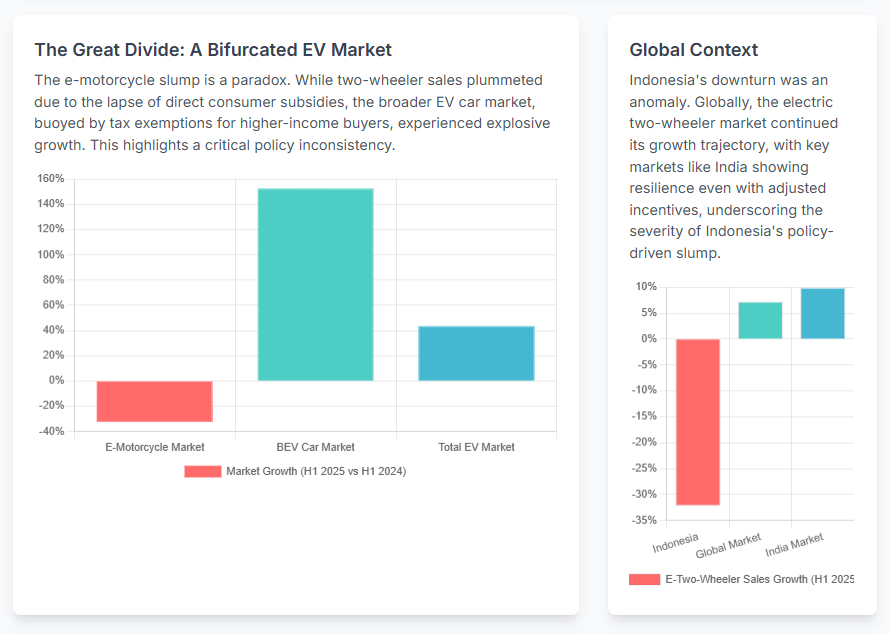
The sales slump in the electric two-wheeler segment stands in stark contrast to the overall performance of Indonesia’s electric vehicle market. A review of Q1 2025 sales reveals that total EV sales—which include battery electric vehicles (BEVs), plug-in hybrid electric vehicles (PHEVs), and hybrids—increased by a substantial 43.4% year-on-year.5 This growth was primarily driven by a remarkable 152.5% surge in BEV sales and a 44.8% rise in PHEV sales.5 This robust performance of the broader EV market was attributed to a range of government incentives, including a 100% luxury sales tax exemption for EV imports and sales, as well as an extension of VAT exemptions.5
This seemingly contradictory data points to a fundamentally bifurcated market. The electric car segment, which caters to a higher-income demographic and is primarily stimulated by broad tax exemptions, has thrived. The electric motorcycle segment, conversely, targets a mass-market consumer base and relies on a direct, per-unit subsidy to make the vehicles affordable.8 The government’s policy framework, while providing consistent high-level tax relief for the EV car market, failed to maintain the specific, direct, and critical subsidy for the two-wheeler segment. This inconsistency created a lopsided ecosystem where one part of the market flourished while the other collapsed, demonstrating the critical importance of a stable, segment-specific policy framework.
1.3. Broader Economic Headwinds
While the subsidy lapse was the primary trigger, the H1 2025 sales contraction was exacerbated by a confluence of broader macroeconomic factors. The Indonesian economy faced headwinds including a VAT increase from 11% to 12% in January 2025, which raised vehicle prices, and persistently high interest rates.5 These elements combined to foster a cautious market environment and affect consumer purchasing behavior.5
Consumer confidence data further illustrates this fragile economic backdrop. The Indonesia Consumer Confidence Index, while showing a tentative rebound in April and June 2025, remained subject to mixed signals.6 Forward-looking expectations remained under pressure, with a decline in the outlook for future job availability and the overall economy.10 This sentiment, influenced by global uncertainties and a slow rollout of government fiscal programs, suggests that even with a reinstated subsidy, the market would have faced significant challenges. The decreased purchasing power of consumers was cited by industry leaders as another contributing factor to the slowdown, underscoring that the absence of a subsidy was a critical blow to an already sensitive market.4 The market slump was not a standalone event but a result of a policy failure that occurred at a time of broader economic vulnerability.
2. The Central Role of Subsidy Policy and Its Flawed Execution
2.1. A Timeline of Policy Disruption and Uncertainty
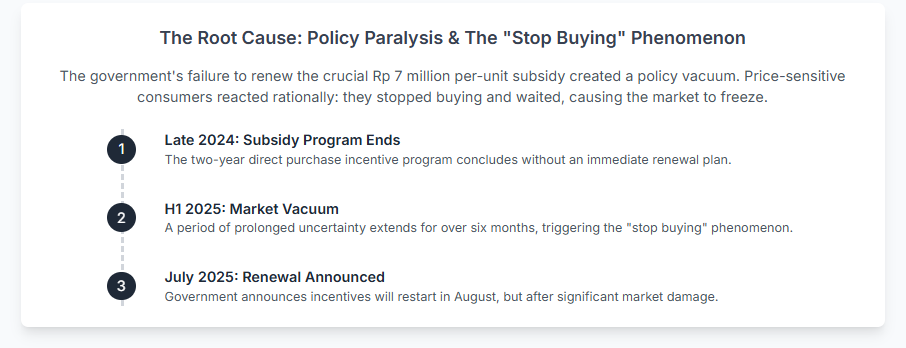
The Indonesian government’s two-wheeler subsidy program, which had been in place for the previous two years, concluded in late 2024.1 The subsequent decision to not immediately renew the incentives created a market vacuum and caused what was described as “embarrassing reactions” from both domestic and foreign companies, including Yadea and Tailg, who had made recent investments in Indonesia with the expectation of a stable commitment to the sector.2 This period of uncertainty extended throughout the first half of 2025. While Deputy Industry Minister Faisol Riza announced in July that a budget had been approved and incentives were slated to restart in August, the market had already suffered a protracted period of stagnation.1 This delay was reportedly due to “macroeconomic considerations and the state’s cash limitations”.11 The government’s short-term fiscal prudence inadvertently created a significant long-term setback for the industry, as it undermined the trust of both manufacturers and consumers who rely on policy predictability for their investment and purchase decisions.
2.2. A System in Transition and Its Fundamental Flaws
The policy chaos of H1 2025 was not simply due to the absence of a program but also to fundamental flaws in its design and delivery. The previous scheme, which offered a direct Rp 7 million discount, was a powerful incentive.1 However, its implementation was deeply problematic. In 2023, despite a substantial quota of 200,000 units, only 637 subsidies had been claimed by June of that year.12 This abysmal uptake was a direct result of complex and restrictive eligibility requirements, which Moeldoko, the Chief of Staff to the President, acknowledged as obstacles that discouraged potential recipients.12
The government’s response was to pivot to a new scheme based on a Government-Borne Value-Added Tax (PPN DTP) subsidy, a change that was part of a five-package economic stimulus plan.13 This new model required vehicles to have a minimum domestic component level (TKDN) of 40%.13 While this new approach may be a strategic long-term move to stimulate local industry, its introduction added another layer of complexity and uncertainty for a consumer base that was already struggling to navigate the previous, flawed system. The failure of the previous subsidy to reach its target recipients and the protracted delay in introducing a new, simplified model demonstrate a systemic issue with policy design and implementation that extends beyond mere budget constraints.
2.3. The Behavioral Economics of the “Stop Buying” Phenomenon
The sales collapse was driven by a clear and powerful consumer reaction: the “stop buying” phenomenon.3 Industry leaders confirmed that the public was delaying purchases while waiting for a decision on the subsidy, which had been a critical driver of sales.1 Data from the Indonesian Electric Motorcycle Industry Association (Aismoli) shows that the demand for electric two-wheelers fell sharply after the Rp 7 million per-unit subsidy was halted.4
For a mass-market consumer, a Rp 7 million (approximately $435) discount is not merely an added benefit; it represents a significant portion of the total vehicle cost and is a key determinant of affordability.1 The absence of a clear timeline for the subsidy’s return created a rational incentive for consumers to wait, rather than risk purchasing at the full price. This consumer behavior illustrates how in a nascent market, government incentives can act as a crucial psychological bridge, turning a purchase from a risky proposition into a viable and financially attractive one. The sudden removal of this bridge effectively froze the market, leading to thousands of units accumulating at dealerships and factories.4
3. Manufacturer and Industry Association Responses
3.1. Production Adjustments and Inventory Management
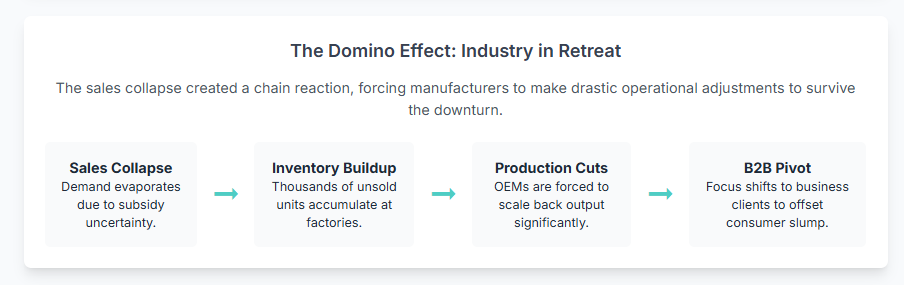
In response to the sharp decline in sales, electric motorcycle manufacturers were forced to take immediate action. The chairman of Aismoli, Budi Setiyadi, confirmed that original equipment manufacturers (OEMs) had begun to scale back output to address the increasing inventories at dealerships and production facilities.1 This rational business decision has broader implications for the nascent domestic industry and foreign investors. Companies like Yadea and Tailg, which had recently established production facilities in Indonesia with an annual capacity of 300,000 units, were caught off guard by the sudden policy change.2 The production cuts and market instability threaten to undermine the very industrial development and job creation that the government’s long-term EV strategy is meant to foster.8
3.2. Strategic Shifts and Diversification
To mitigate the impact of the consumer sales slump, manufacturers began to shift their focus toward business-to-business (B2B) partnerships with logistics and transportation companies.1 For example, a local player, ALVA, explicitly markets its electric motorcycles as scalable solutions for businesses to improve operational efficiencies.14 While this pivot is a pragmatic short-term response, it is not a sustainable solution for achieving national adoption targets. The individual consumer market remains the largest segment and a key driver of long-term growth for the industry.1 The reliance on B2B sales as a fallback strategy highlights the deep vulnerability of the consumer market to policy disruptions and signals a lack of confidence that the government will quickly and effectively fix the underlying issues. The industry’s tactical shift away from the mass market underscores the urgency of re-establishing a stable and reliable policy environment.
3.3. Calls for Policy Clarity
In light of the market turmoil, the Indonesian Electric Motorcycle Industry Association (Aismoli) has publicly urged the government to provide clarity on the purchasing subsidies.1 Aismoli’s chairman noted that the uncertainty was a key impediment for both consumers and producers, hindering their ability to plan for future purchases and production.1 This plea for a consistent and transparent policy framework is a direct response to the market chaos of H1 2025. The industry’s call for government action demonstrates that a successful EV ecosystem requires continuous collaboration and communication between policymakers and industry stakeholders.
4. The Wider Ecosystem: Systemic Challenges and Opportunities
4.1. The Infrastructure Gap
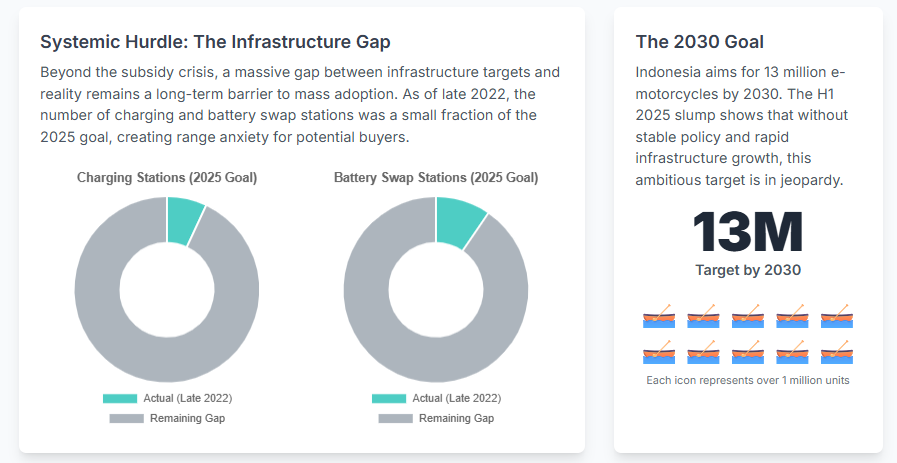
Beyond the immediate crisis of subsidy uncertainty, the Indonesian EV market faces a significant long-term structural barrier: inadequate charging and battery swapping infrastructure. The government has set a target of having 6,318 EV charging stations and 10,000 battery swap stations by 2025.15 However, as of late 2022, the actual numbers were dramatically lower, with only 439 charging stations and 961 battery swap stations.16 A separate source confirms that the infrastructure is “far from the target” 8 and is heavily concentrated on the island of Java, with half of all stations located in Jakarta as of 2021.17
This persistent gap between ambitious targets and on-the-ground reality creates a psychological barrier for potential buyers. Research indicates that for electric motorcycles, the availability of public charging stations and battery life are among the most important factors for consumers, ranking even higher than government subsidies.18 While the H1 2025 slump was a direct result of policy failure, the long-term viability of the market is contingent on a robust and widespread infrastructure. The government’s failure to meet its own infrastructure targets demonstrates a systemic lack of execution that will continue to impede the market’s growth even after the subsidy issue is resolved.
4.2. End-User Adoption Barriers: Beyond the Subsidy
While the H1 2025 sales data demonstrates the critical importance of subsidies, consumer decisions are influenced by a complex interplay of factors.18 Research highlights that a high upfront cost remains a major obstacle to widespread adoption, which subsidies are intended to address.8 However, other psychological and functional barriers, such as range anxiety, concerns about battery replacement costs, and a lack of model variety, also play a significant role.8
A study on consumer preferences for electric motorcycles found that while emissions, environmental conservation, and maintenance costs were highly ranked, the availability of public charging stations and battery life were the most important factors, with government subsidies and price comparison ranking lower.18 This apparent contradiction between consumer survey data and market behavior in H1 2025 can be reconciled by distinguishing between stated preferences and revealed preferences. The “stop buying” phenomenon serves as a powerful testament to consumers’ actions, which demonstrate that the subsidy is the single most powerful and immediate motivator for a purchase. The subsidy, therefore, serves a dual purpose: it makes the vehicle financially accessible and acts as a psychological enabler, providing the necessary incentive for consumers to overcome other lingering concerns.
4.3. Comparative Market Analysis: Learning from Global Leaders
Indonesia’s H1 2025 market contraction is an anomaly in the global electric two-wheeler landscape. In the first half of the year, global electric two-wheeler sales grew by 7.2%, driven by major players.2 For example, India, the world’s second-largest market, saw its electric two-wheeler sales increase by 9.9% in H1 2025, even with reduced government incentives.2 China, which remains the dominant global player, built its market on a comprehensive, long-term strategy of subsidies, tax exemptions, and infrastructure support, which were gradually phased out as the market matured.17
The stark contrast between Indonesia’s market collapse and the growth of other major markets highlights the importance of a stable, predictable policy roadmap. The Indonesian government’s impulsive decision to suddenly stop incentives, as noted by industry observers, stands in sharp relief against the well-orchestrated, long-term strategies of China.2 This comparison suggests that while incentives are crucial for market development, their success is predicated on consistency and a long-term commitment.
5. Strategic Outlook and Actionable Recommendations
5.1. Feasibility of Ambitious Government Targets
Indonesia has set highly ambitious targets for its electric motorcycle sector. Projections from various government bodies have aimed for domestic production of 2 million units by 2025 and an operational fleet of 13 million units by 2030.19 The Ministry of Industry’s updated plan targets 750,000 units sold by 2025.16 Based on the severe sales slump in H1 2025, which saw sales plummet by 30-40%, these goals are currently unattainable. The significant gap between political rhetoric and market reality underscores the urgent need for a decisive and sustained policy intervention to put the sector back on track. The H1 2025 data serves as a critical indicator that the current trajectory is insufficient to achieve the country’s decarbonization and industrialization objectives.
5.2. Recommendations for Policymakers
The following strategic recommendations are proposed for policymakers to stabilize the market and achieve long-term growth:
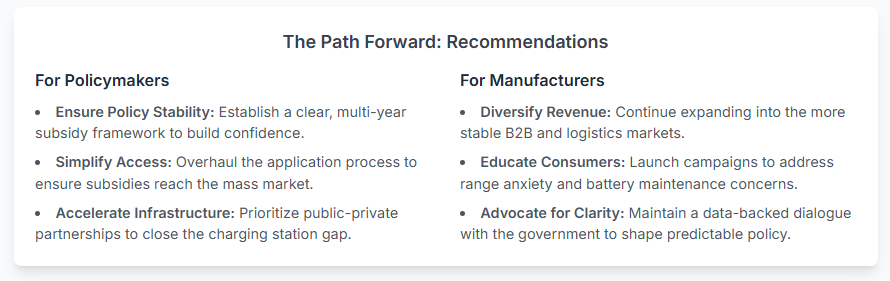
Provide a Stable and Predictable Policy Framework: The government must move beyond short-term budget considerations and establish a clear, multi-year subsidy program.2 The new PPN DTP scheme must be communicated with a transparent, long-term commitment to build consumer and manufacturer confidence.13 A stable policy is the most fundamental requirement for fostering long-term investment and consumer trust.
Simplify the Application Process: The government should overhaul the flawed SISAPIRa system that has hindered subsidy uptake.12 The eligibility criteria should be simplified or broadened to ensure the subsidy reaches the intended mass-market audience.21 A well-funded policy is ineffective if it is inaccessible to the public.
Accelerate Infrastructure Development: The government must treat the development of charging and battery swapping infrastructure as a top priority.15 It should seek to bridge the gap between its ambitious targets and the current reality by fostering public-private partnerships with state-owned enterprises like PLN.15 A robust infrastructure is a critical long-term driver of adoption and addresses a primary concern for consumers.
Consider Complementary Non-Fiscal Policies: To reduce reliance on subsidies, the government should explore complementary non-fiscal policies. These could include urban access restrictions for internal combustion engine (ICE) motorcycles or other regulations that favor electric alternatives, as has been successfully implemented in other markets.22
5.3. Recommendations for Manufacturers
Manufacturers must also take a proactive role in navigating the evolving market landscape:
Diversify Revenue Streams: Companies should continue to expand their pivot toward the B2B market, including partnerships with logistics and ride-hailing companies.1 This strategy can provide a stable revenue base that is more resilient to shifts in consumer-facing policy.
Focus on Consumer Education: Manufacturers should invest in marketing and educational campaigns that address the non-monetary barriers to adoption, such as range anxiety and concerns about battery maintenance and replacement costs.18 By educating the public on the long-term benefits of electric motorcycles, the industry can build a more resilient consumer base less reliant on immediate government incentives.
Engage in Policy Advocacy: The industry, through organizations like Aismoli, must maintain a strong, data-backed dialogue with the government. By providing clear evidence of the market’s response to policy changes, manufacturers can help shape a more stable and predictable regulatory environment for the future.
Conclusion
The Indonesian electric motorcycle market’s performance in the first half of 2025 was a self-inflicted wound stemming from policy inconsistency. While the government’s support for the electric car sector remained steady, the sudden withdrawal of a crucial direct-purchase subsidy for the mass-market two-wheeler segment triggered a cascading market failure. This crisis, however, serves as a valuable stress test, revealing deeper systemic vulnerabilities, including an inefficient subsidy delivery mechanism and a vast infrastructure gap. The path to achieving Indonesia’s ambitious EV targets is now clearer: it demands a fundamental shift from ad-hoc policy decisions to a well-articulated, long-term strategy. Without a consistent, simplified, and holistic policy framework—one that aligns with the successes of global leaders and restores consumer and investor confidence—the H1 2025 slump will be a harbinger of continued market instability. The future of Indonesia’s electric mobility revolution hinges on the government’s ability to provide not just incentives, but also the stability and predictability required for a market to thrive.
Works cited
- Sales slump slows electric motorcycle production – Markets – The …, accessed on August 20, 2025, https://www.thejakartapost.com/business/2025/08/19/sales-slump-slows-electric-motorcycle-production.html
- Electric Motorcycles Market 2025 – Data & Facts | MotorCyclesData, accessed on August 20, 2025, https://www.motorcyclesdata.com/2025/08/05/electric-motorcycles-market/
- Kemenperin Beri Sinyal Subsidi Motor Listrik Rp7 Juta Lanjut Tahun Ini – kabarbisnis.com, accessed on August 20, 2025, https://www.kabarbisnis.com/read/28130037/kemenperin-beri-sinyal-subsidi-motor-listrik-rp7-juta-lanjut-tahun-ini
- Penyebab Penjualan Sepeda Motor Listrik Lesu – CNN Indonesia, accessed on August 20, 2025, https://www.cnnindonesia.com/otomotif/20250208213615-603-1196133/penyebab-penjualan-sepeda-motor-listrik-lesu
- Indonesia’s EV market shows strong growth despite broader industry …, accessed on August 20, 2025, https://www.pwc.com/id/en/media-centre/press-release/2025/english/indonesias-ev-market-shows-strong-growth-despite-broader-industry-challenges.html
- Indonesia Consumer Confidence Index: 9 May 2025, accessed on August 20, 2025, https://samuel.co.id/wp-content/uploads/2025/05/CCI_May-25.pdf
- Indonesia Motorcycles – Data & Facts 2025 | MotorcyclesData, accessed on August 20, 2025, https://www.motorcyclesdata.com/2025/07/14/indonesia-motorcycles/
- A Comprehensive Analysis of the Economic Implications … – MDPI, accessed on August 20, 2025, https://www.mdpi.com/1996-1073/18/6/1384
- Indonesia Two Wheeler Market Size, Share and Forecast | Report 2030 – TechSci Research, accessed on August 20, 2025, https://www.techsciresearch.com/report/indonesia-two-wheeler-market/1744.html
- Indonesia Consumer Confidence Index: 8 July 2025, accessed on August 20, 2025, https://samuel.co.id/wp-content/uploads/2025/07/CCI_July-25.pdf
- Batal Lagi? Ini Alasan Subsidi Motor Listrik Belum Turun – KabarBursa.com, accessed on August 20, 2025, https://www.kabarbursa.com/otomotif/batal-lagi-ini-alasan-subsidi-motor-listrik-belum-turun
- Moeldoko Assures Simpler Mechanism for Electric Vehicle Subsidies – Kantor Staf Presiden, accessed on August 20, 2025, https://ksp.go.id/en/moeldoko-assures-simpler-mechanism-for-electric-vehicle-subsidies.html
- Simak Subsidi Motor Listrik di Tahun 2025 – MAKA Motors, accessed on August 20, 2025, https://maka-motors.com/article/simak-subsidi-motor-listrik-di-tahun-2025
- Leading the Future of Electric Vehicles in Indonesia – Alva, accessed on August 20, 2025, https://www.alvaauto.com/about
- Indonesia Electric Vehicles – International Trade Administration, accessed on August 20, 2025, https://www.trade.gov/market-intelligence/indonesia-electric-vehicle
- Indonesia’s Electric Vehicle Outlook | AC Ventures, accessed on August 20, 2025, https://acv.vc/wp-content/uploads/2023/07/Report-Indonesias-Electric-Vehicle-Outlook-Supercharging-Tomorrows-Mobility_NEW.pdf
- ELECTRIFYING INDONESIA’S TWO-WHEELER INDUSTRY – Boston Consulting Group, accessed on August 20, 2025, https://web-assets.bcg.com/4d/a7/b73e2a5a4c88b34598e8663fb8ee/bcg-x-aeml-electrifying-indonesias-two-wheeler-industry-nov-2022-1.pdf
- Technological, Environmental, Economic, and Regulation Barriers to …, accessed on August 20, 2025, https://www.mdpi.com/2032-6653/15/9/422
- Indonesia projected to produce 2 million electric motorcycles in 2025 – ANTARA News, accessed on August 20, 2025, https://en.antaranews.com/news/137335/indonesia-projected-to-produce-2-million-electric-motorcycles-in-2025
- Indonesia plans 15mn electric vehicles on roads by 2030 | Latest Market News, accessed on August 20, 2025, https://www.argusmedia.com/en/news-and-insights/latest-market-news/2571582-indonesia-plans-15mn-electric-vehicles-on-roads-by-2030
- Cara Daftar & Cek Subsidi Motor Listrik Secara Online 2025, accessed on August 20, 2025, https://maka-motors.com/article/cara-cek-subsidi-motor-listrik-panduan-lengkap-untuk-pemohon-baru
- Electric Motorcycle Charging Infrastructure Road Map for Indonesia – Asian Development Bank, accessed on August 20, 2025, https://www.adb.org/sites/default/files/publication/830831/electric-motorcycle-charging-infrastructure-indonesia.pdf
Our Social Media Handles
- Instagram : LivingWithGravity
- Medium : Akash Dolas
- YouTube Channel : Gear and Shutter