























Executive Summary
Motorcycle theft in the United Kingdom has evolved into a sophisticated and persistent problem, moving beyond opportunistic crime to a highly profitable, professional enterprise. The recent high-value heist of Aprilia motorcycles, valued at over $120,000, is not an isolated incident but a high-profile manifestation of this worrying trend. The analysis finds that while high-volume urban centers like London dominate raw theft statistics, a deeper per-capita examination reveals a disproportionately high risk in smaller cities.
This shift in criminal activity is fueled by technological vulnerabilities and a low-risk environment for offenders, where charge rates have historically been low. The financial and emotional toll on riders is significant, leading to rising insurance premiums and psychological distress. A path forward requires a unified, national strategy that combines legislative reform to address the root causes of theft, industry-led security initiatives to engineer out vulnerabilities, and public education campaigns to promote a culture of layered security among riders.
1. The Resurgence of a Pervasive Threat
1.1. The Growing Problem: From High-Value Heists to Everyday Crime
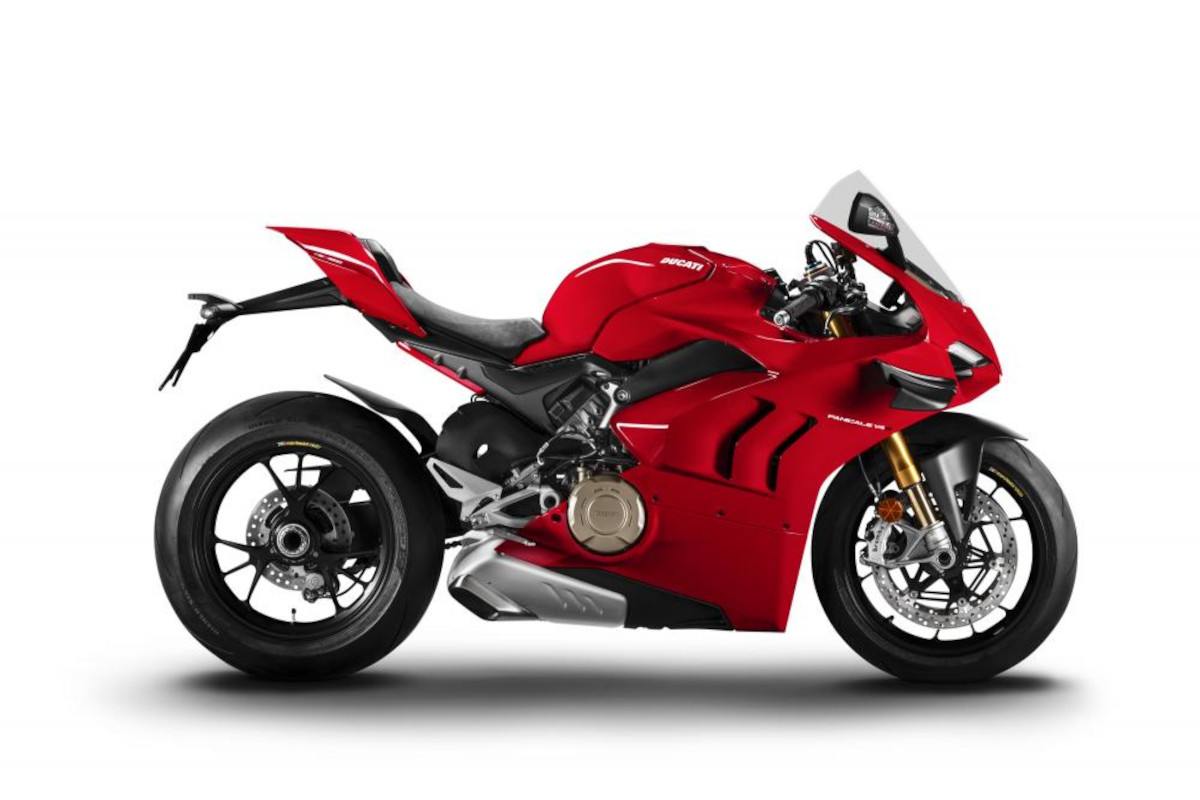
The recent theft of seven Aprilia motorcycles, a heist valued at around $120,000, serves as a stark reminder of the financial stakes and increasingly organised nature of modern motorcycle theft in the UK.1 This incident is a high-profile symptom of a broader, more concerning trend. The analysis of this event shows an evolution in criminal methodology, moving away from simple, opportunistic acts to a professional enterprise that targets specific, high-value assets. This type of large-scale theft, often perpetrated by organised gangs, highlights how vehicles are either stolen to order for export or to be quickly dismantled for their valuable parts.1
1.2. A Decade of Reversal: Contextualizing the Current Trends
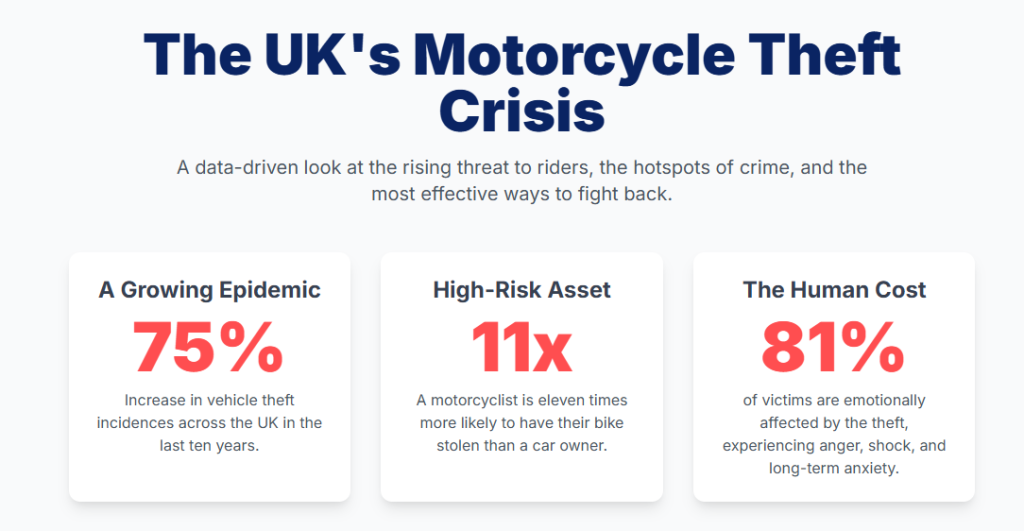
The surge in motorcycle theft is part of a decade-long reversal of previous positive trends. According to data from the UK Home Office, incidences of vehicle theft have risen by 75% in the past ten years.4 While overall crime rates generally fell during the COVID-19 pandemic, motorcycle theft was a notable exception, with a temporary 30% drop recorded in 2020 before the trend reversed.5
This pervasive problem is exacerbated by the unique vulnerability of motorcycles. Data from the Motorcycle Action Group (MAG) indicates that the national average for motorcycle thefts stands at 22 per 1,000 registered machines, a statistic that shifts to 18 per 1,000 when updated data is included, but still represents a frightening reality.6 This makes bikes the most likely vehicle type to be stolen in the UK. A motorcyclist is 11 times more likely to have their bike stolen than a car owner is to have their car stolen.7
1.3. The Motorcycle as a High-Risk Asset: A Comparative View
The problem of motorcycle theft is not isolated to the UK; it is a global issue with shared characteristics. European nations such as France, Italy, and Germany face similar challenges, with organised crime networks exploiting open borders to traffic stolen machines.8 These networks operate with impunity, and the cross-border trafficking of stolen motorcycles and their parts turns a domestic law enforcement issue into an international security challenge.9 In the United States, motorcycle theft numbers are also high in population-dense states like California, Florida, and Texas, and the national recovery rate is low, hovering around 42%, mirroring the global reality where more than half of all stolen bikes are never recovered.11 This global context shows that motorcycle theft is not a local anomaly but a deeply entrenched part of the international criminal ecosystem.
2. Deconstructing the Statistics: A Data-Driven Examination
2.1. The Challenge of Data Integrity and Reporting Nuance
Accurate and consistent data on motorcycle theft is difficult to obtain. The Motorcycle Action Group (MAG) has repeatedly pointed to serious concerns regarding the accuracy of police-reported theft statistics, which are often compiled through Freedom of Information requests.5 Furthermore, a review of interactive theft maps reveals significant data limitations. These maps often exclude entire regions, such as Scotland and Northern Ireland, due to missing or unreliable police data, which makes a complete, nationwide analysis challenging.14 This patchwork of information can hinder efforts to form a comprehensive understanding of the problem.
2.2. Hotspot Analysis: Pinpointing Geographical Concentrations of Crime
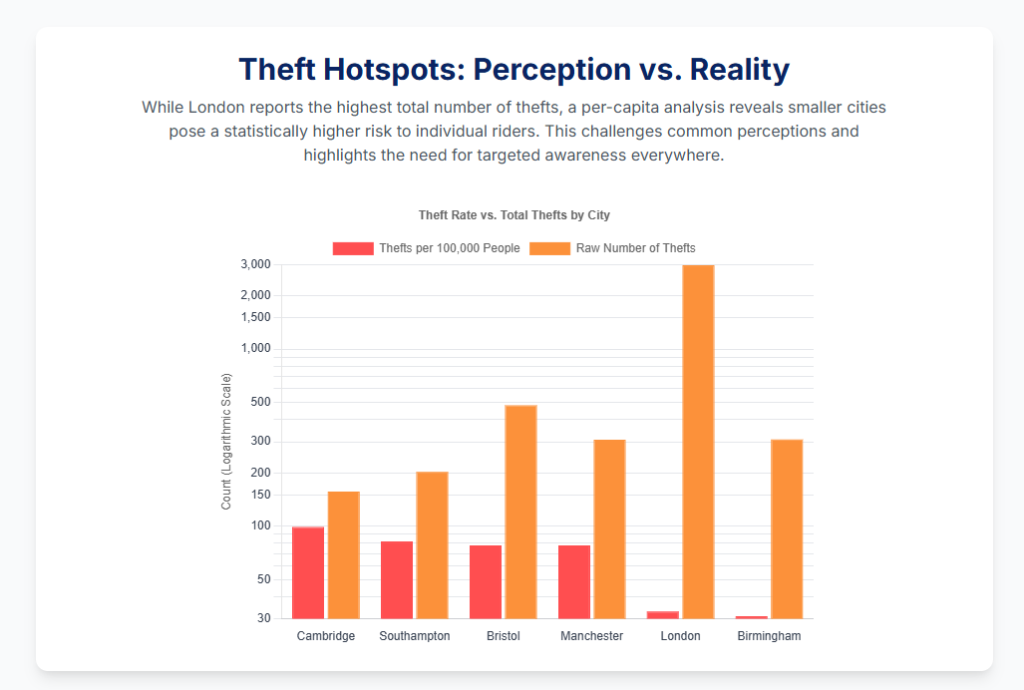
While the public perception of motorcycle theft hotspots often centers on London, a deeper look at the data reveals a more complex picture. The Metropolitan Police area consistently reports the highest raw number of thefts, with 618 thefts in a single month, representing an increase of 3%.2 This staggering figure accounts for more than a quarter of all reported vehicle thefts in England and Wales.15
However, when viewed in the context of population, the situation appears very different. A per capita analysis of thefts demonstrates that riders in other, smaller cities may face a statistically higher individual risk. This distinction is critical for resource allocation and targeted public awareness campaigns. The following table illustrates this divergence, showing that while London has the highest volume of crime, it does not necessarily represent the highest risk per rider.
Table 2.2: UK Motorcycle Theft Hotspots (2023-2025): A Comparison of Raw and Per Capita Rates
| City | Raw Number of Thefts | Population (2023) | Thefts per 100,000 People |
| Cambridge | 157 | 158,434 | 99 |
| Bristol | 482 | 617,280 | 78 |
| Manchester | 308 | 395,515 | 78 |
| Southampton | 203 | 246,201 | 82 |
| London | 2,975 | 8,961,989 | 33 |
| Birmingham | 309 | 984,333 | 31 |
2.3. The “Fearmongering” Fallacy: Interpreting High-Percentage Increases
A common pitfall in public discourse on crime is the misinterpretation of percentage changes, a phenomenon that can lead to misleading and sensationalist reporting. For example, a 200% increase in motorcycle thefts in Central Scotland is striking in a headline, but it represents a rise from just zero to two incidents.2 This kind of statistical “fearmongering” misrepresents the scale of the problem in low-volume areas.
The process behind this misrepresentation is straightforward. A small base number of thefts can be manipulated to produce a large percentage increase with the addition of just a few incidents. This large percentage is then visually highlighted with bright colors on maps or in bold headlines, drawing disproportionate attention. The public, without the proper context, interprets this as a major crime wave. This narrative creates a false sense of security in high-volume areas, where the raw number of thefts is dangerously high, while also causing unnecessary anxiety in low-volume areas, ultimately undermining effective prevention and awareness efforts.
3. The Criminal and the Crime: Typologies and Targets
3.1. The Evolving Profile of the Thief: Opportunism, ASB, and Organised Crime
The profile of a motorcycle thief is evolving. While opportunistic theft of poorly secured bikes remains a problem, the prevailing trend is a shift towards highly organised gangs that operate with sophistication and intent.2 These criminals are not merely motivated by joyriding but by the significant financial gain from stealing and reselling bikes, either whole or as parts.17
Furthermore, the crime of motorcycle theft is frequently a stepping stone to other, more serious offences. Stolen two-wheeled vehicles, particularly lightweight scooters, are the vehicles of choice for criminals committing phone snatches, robberies, and drug offences.3 This makes motorcycle theft a gateway crime, feeding a wider criminal ecosystem and posing a greater threat to public safety.
3.2. What Do They Steal and Why? An Examination of Targeted Makes, Models, and Engine Sizes
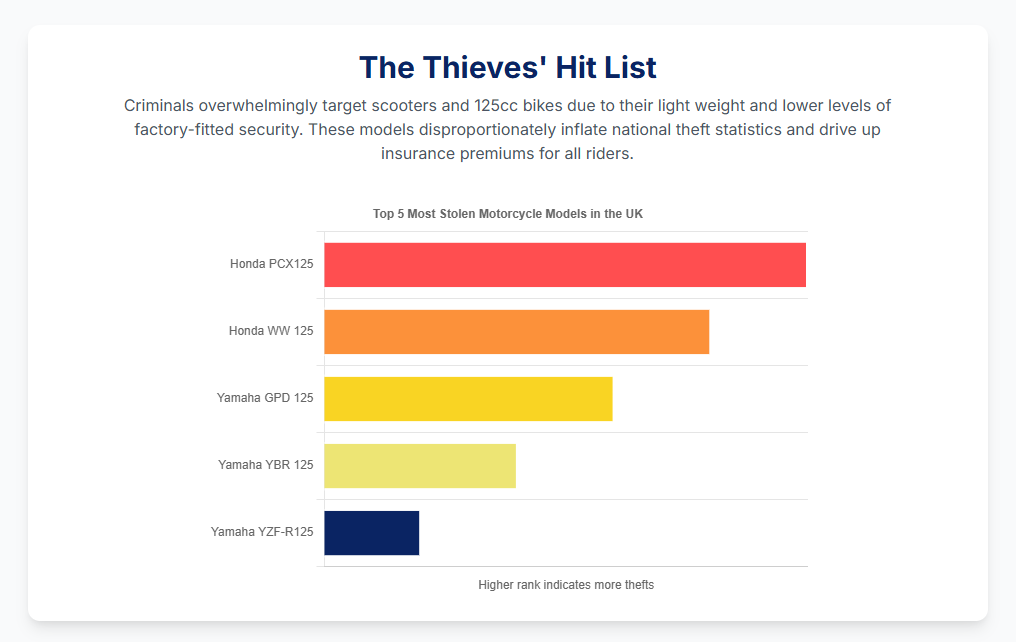
An analysis of theft data reveals that thieves are not indiscriminate in their choice of targets. Scooters and 125cc bikes are disproportionately stolen, primarily because of their low security and light weight.6 The Honda PCX125 and WW 125 are consistently ranked as the most desired models for thieves, with the Yamaha YBR 125 also a top target.18
The prevalence of low-security scooters and 125cc bikes skews national theft statistics, inflating the overall numbers and painting a picture of a more widespread problem than may exist for larger, more expensive bikes.6 This statistical distortion contributes to a negative feedback loop: inflated theft rates lead to higher insurance premiums for all riders, regardless of their bike type. The Honda PCX125, for example, is not a high-value motorcycle in the same category as the Aprilia bikes mentioned in the query, but its high theft rate drives up the overall risk profile for the entire segment.
Table 3.2: Most Stolen Motorcycle Models in the UK
| Make | Model | Engine Size | Notes |
| Honda | PCX125 | 125cc | Scooter, consistently ranked highly |
| Honda | WW 125 | 125cc | Scooter, consistently ranked highly |
| Yamaha | YBR 125 | 125cc | Geared bike, ranked in top 5 |
| Yamaha | GPD 125 | 125cc | Scooter, ranked in top 3 |
| Yamaha | YZF-R125 | 125cc | Geared bike, ranked in top 10 |
4. The Ripple Effect: Impact on Owners and the Wider Community
4.1. The Emotional and Psychological Burden: The Human Cost of Theft
The impact of motorcycle theft extends far beyond financial loss; it carries a significant human cost. A survey by the Office for National Statistics found that 81% of victims were emotionally affected by their bike being taken, with annoyance, anger, and shock being the primary emotions experienced.21 The psychological burden can be long-lasting. The story of one victim revealed an ongoing state of paranoia and heightened anxiety, with the individual waking up at night to check on their new bike, even after the initial theft occurred away from their home.22 This kind of emotional trauma fundamentally changes a victim’s relationship with their property and their environment.
4.2. Financial Ramifications: Insurance, Premiums, and Out-of-Pocket Losses
Motorcycle theft is a major driver of rising insurance costs in the UK. High theft rates and increasing repair costs have been key contributors to a 43% rise in motor insurance premiums across the industry.23 In London, where theft is highly prevalent, average premiums can be over £1,000 per year. A theft claim can make future coverage prohibitively expensive or, in some cases, impossible to find at any cost.24
This financial disincentive creates a complex dilemma for victims. A significant number of riders, particularly those with older or lower-value bikes, may choose not to report a theft to their insurer to avoid future premium hikes. Instead, they might absorb the cost of repair or replacement themselves.24 This anecdotal evidence suggests that the true number of motorcycle thefts is likely higher than official statistics indicate, as many incidents go unreported to insurers, creating a hidden layer of crime that is not fully captured by the data.
5. The Response: A Multi-Layered Approach
5.1. Law Enforcement on the Frontline: Evaluating Police Operations and Tactical Measures
Police forces, particularly the Metropolitan Police, are mounting regular, targeted operations to combat motorcycle theft.25 These efforts include using faster bikes to pursue offenders, deploying “stinger” devices to puncture tires, and utilizing forensic spray to mark individuals committing offences, making them easier to identify later.25 The use of GPS trackers by riders is also highly effective for law enforcement, who are more likely to respond to a static location with a valid GPS fix than to a dangerous, high-speed chase, which they typically will not pursue.24
5.2. Legal and Legislative Reforms: The Impact of New Laws on Theft and ASB
To combat the evolving tactics of criminals, the UK government is introducing new laws. One such law, set to ban the possession of electronic devices like ‘signal jammers,’ directly targets the tools used in an estimated 40% of vehicle thefts.26 Individuals found in possession of such a device could face a maximum penalty of five years’ imprisonment and an unlimited fine.26
Furthermore, the “Crime and Policing Bill” empowers police to immediately seize vehicles used for antisocial behavior without a prior warning, a crucial change to the Police Reform Act 2002.27 This change will enable police to put an immediate stop to dangerous and antisocial behavior, rather than being delayed by the legal requirement of issuing a warning.27
5.3. Gaps in the System: Low Charge Rates and Resource Constraints
Despite these efforts, historical data on the effectiveness of the criminal justice system in prosecuting vehicle theft has been poor. Charge rates have plummeted from 9.2% to between 2.4% and 4% over the past decade, which signals to offenders that theft is a low-risk, high-reward crime.28 While a recent report from the Office for National Statistics shows a promising rise in the charge rate for theft offenses from 5.8% to 7.3% 29, the overall picture remains one of systemic challenges. The low prosecution rate, coupled with the anecdotal lack of police resources for non-GPS-assisted recovery, undermines public confidence in the system and contributes to a sense of victim apathy and fatalism, with many riders believing that if a thief wants their bike, they will take it regardless of security.24
6. A Shield Against Theft: Proactive Prevention Strategies
6.1. The Principle of Layered Security: Best Practices for Deterrence
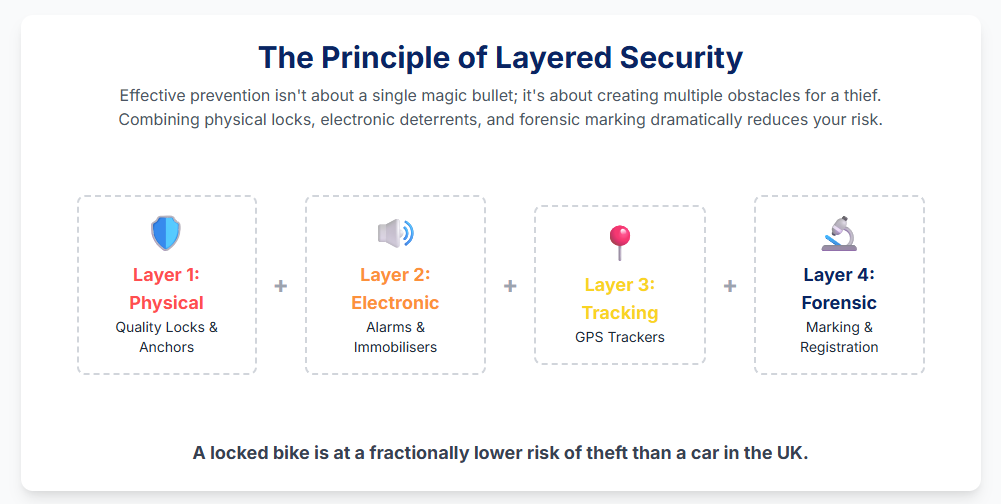
The most effective counter-measure to motorcycle theft is proactive prevention through a layered security approach. Police advice and industry data consistently reinforce this principle. The single most important deterrent is using a quality lock.30 This directly challenges the common belief that “they’ll just take it anyway.” An analysis of insurance data demonstrates that a locked bike is significantly less likely to be stolen. In fact, securely locked motorcycles are at a fractionally lower risk of theft than cars in the UK.6 This proves that a modest investment in security can profoundly alter the risk profile of a motorcycle.
6.2. An Evaluation of Security Devices: From Physical Locks to Smart Technology
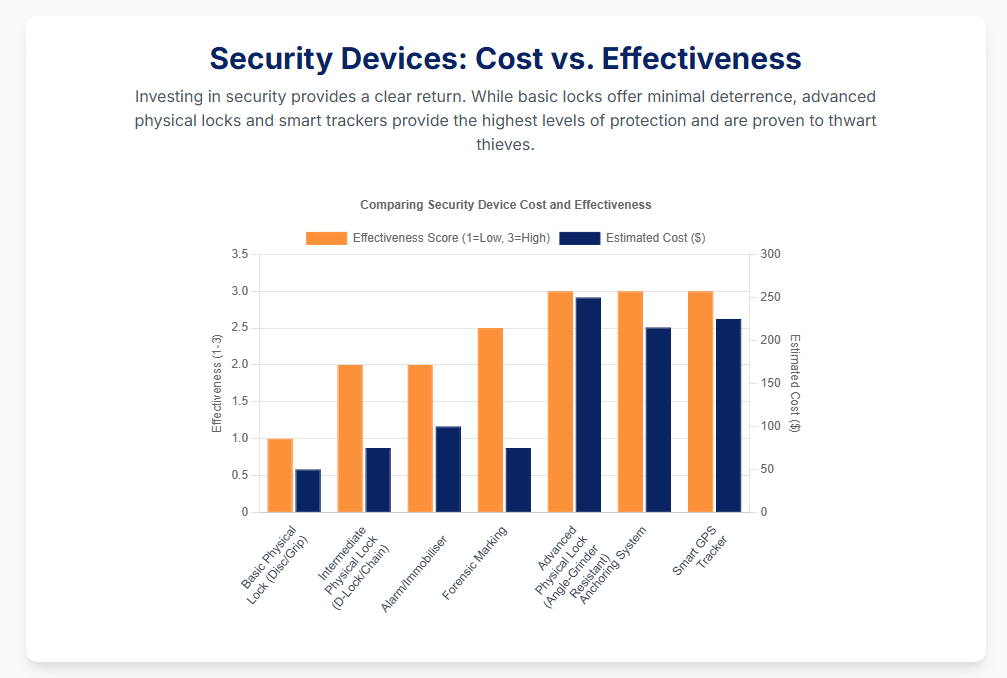
A wide variety of security devices are available to riders, each offering a different level of protection. Physical devices range from basic disc locks and alarms to heavy-duty, angle-grinder-resistant chain locks and ground anchors.25 The cost of these devices varies, with quality D-locks and chains often costing over £100, while advanced trackers carry a higher upfront cost and a monthly subscription fee.32 The following table provides a general overview of the cost and effectiveness of various security measures.
Table 6.2: Motorcycle Security Devices: Cost vs. Effectiveness
| Device Type | Example Products | Estimated Cost (Purchase + Subscription) | Effectiveness Rating |
| Basic Physical Lock | Disc Lock, Grip Lock | $30-70 | Low |
| Intermediate Physical Lock | D-Lock, Chain Lock | $50-100 | Medium |
| Advanced Physical Lock | Angle-Grinder-Resistant Locks | $250+ | High |
| Anchoring System | Ground Anchor | $80-350 | High |
| Alarm/Immobiliser | Thatcham-rated Alarm | $50-150 | Medium |
| Smart GPS Tracker | Monimoto, BikeTrac | $150-300 + Monthly Subscription | High |
| Forensic Marking | Datatag | $60-90 (one-time fee) | Medium-High |
6.3. The Power of Registration and Forensic Marking: An Unsung Deterrent
Beyond physical barriers, security marking systems provide a powerful, multi-layered deterrent that is often overlooked. Systems like Datatag use a combination of electronic identification and forensic marking to protect a vehicle.36 The system includes RFID transponders, microscopic Datadots, and a unique chemical DNA solution applied to the bike’s components, making it virtually impossible for thieves to remove all traces of the bike’s true ownership.36 This form of security makes stolen parts too risky to sell and has reportedly reduced the theft rate for protected machines to less than a tenth of the pre-Datatag rate.37
7. Strategic Recommendations and a Path Forward
7.1. A Call for Coordinated Action: Unifying Public and Private Efforts
To effectively combat the rising tide of motorcycle theft, a unified and coordinated national response is required. This strategy must involve close collaboration between law enforcement agencies, vehicle manufacturers, the insurance industry, and individual riders. A siloed approach will only allow criminals to continue exploiting existing gaps and vulnerabilities.
7.2. Recommendations for Policy and Law Enforcement
First, it is imperative to move swiftly to implement the new legislation that targets electronic theft devices and allows for the immediate seizure of vehicles used for antisocial behaviour.26 These laws, which remove the need for a prior warning before a vehicle is seized, are crucial for a timely and effective police response. Second, policymakers should address critical intelligence gaps, particularly concerning the international trafficking of stolen vehicles, and explore innovative funding models to support specialist anti-theft units and intelligence-sharing bodies like the National Vehicle Crime Reduction Partnership.28
7.3. Recommendations for the Motorcycle Industry and Insurers
The private sector has a central role to play. The motorcycle industry should be encouraged to engineer out security vulnerabilities at the design stage, building in advanced immobilisers and other security features as standard on all new models.28 Concurrently, insurers should create strong financial incentives for riders to adopt security measures. This can be achieved by offering significant premium reductions for riders who fit approved locks, alarms, trackers, and forensic marking systems.6
7.4. Recommendations for Individual Riders
Ultimately, the first line of defence lies with the rider. Individuals must adopt a mindset of proactive prevention and embrace the layered security model as the most effective counter-measure. It is essential to use a quality lock and always secure the bike to an immovable object, as relying on the steering lock alone is insufficient.25 Furthermore, riders should register their bike on a national database and consider using a forensic marking system to make their property traceable and less desirable to criminals.30 By taking these simple yet powerful steps, riders can reduce their personal risk and contribute to a wider culture of security that makes the UK a less inviting target for thieves.
Sources
- Not A Movie: Thieves Made Off With Over $120K Of Aprilias In UK Heist – RideApart.com, accessed on August 21, 2025, https://www.rideapart.com/news/769142/thives-steal-aprilia-motorcycles-uk/
- UK motorcycle theft report AUGUST: Crime trends & arrest stories – Bennetts Insurance, accessed on August 21, 2025, https://www.bennetts.co.uk/bikesocial/news-and-views/news/2025/uk-motorcycle-theft-stats-crime
- Operation Gears sees hundreds of illegal e-bikes and vehicles taken off Merseyside’s roads, accessed on August 21, 2025, https://www.merseyside.police.uk/news/merseyside/news/2025/august-2025/operation-gears-sees-hundreds-of-illegal-e-bikes-and-vehicles-taken-off-merseysides-roads/
- Organised Vehicle Theft in the UK | Royal United Services Institute – RUSI, accessed on August 21, 2025, https://my.rusi.org/resource/organised-vehicle-theft-in-the-uk.html
- National Police Force Bike Theft Rankings Archives – Motorcycle Action Group, accessed on August 21, 2025, https://mag-uk.org/category/campaigns-news/campaigns/crime/national-police-force-bike-theft-rankings/
- How to prevent your motorcycle being stolen – Bennetts Insurance, accessed on August 21, 2025, https://www.bennetts.co.uk/bikesocial/news-and-views/advice/biking-tips/how-to-stop-motorcycle-bike-being-stolen
- How to Get Cheaper Motorcycle Insurance in the UK | Sabre Direct, accessed on August 21, 2025, https://sabredirect.co.uk/news-blogs/cheaper-motorcycle-insurance-uk/
- Lost: a million motorcycles | Professional Security Magazine, accessed on August 21, 2025, https://professionalsecurity.co.uk/news/vertical-markets/lost-a-million-motorcycles/
- Fighting vehicle crime – Interpol, accessed on August 21, 2025, https://www.interpol.int/Crimes/Vehicle-crime/Our-response
- Vehicle crime – Interpol, accessed on August 21, 2025, https://www.interpol.int/Crimes/Vehicle-crime
- 2017 Motorcycle Theft and Recovery (through 02/28/2018) Report (Public Dissemination) Prepared by – National Insurance Crime Bureau, accessed on August 21, 2025, https://www.nicb.org/media/536/download
- Post Script Motorcycle Theft in the United States: A Brief Guide for Riders – USD RED, accessed on August 21, 2025, https://red.library.usd.edu/cgi/viewcontent.cgi?article=1148&context=sdlrev
- 17 Bike and Motorcycle Theft Statistics Every Owner Should Know – Legal jobs, accessed on August 21, 2025, https://legaljobs.io/blog/bike-and-motorcycle-theft-statistics
- Bike theft map – latest UK police data – Stolen Ride, accessed on August 21, 2025, https://www.stolenride.co.uk/bike-theft-map-uk/
- Latest UK car theft statistics 2025 – Zego, accessed on August 21, 2025, https://www.zego.com/car-insurance/car-theft-statistics/
- Latest Motorcycle Theft Data For The UK | June Vs July 2025 : r/MotoUK – Reddit, accessed on August 21, 2025, https://www.reddit.com/r/MotoUK/comments/1moxkvu/latest_motorcycle_theft_data_for_the_uk_june_vs/
- UK’s motorcycling theft hot spots revealed – on2wheels, accessed on August 21, 2025, https://www.o2w.co.uk/uks-motorcycling-theft-hot-spots-revealed/
- UK’s Motorcycle Theft Hotspots Revealed – is Your Town on the List? | Visordown, accessed on August 21, 2025, https://www.visordown.com/news/general/uk-motorcycle-theft-hotspots-revealed-your-town-list
- Where are the UK’s bike theft hotspots? | GoCompare, accessed on August 21, 2025, https://www.gocompare.com/motorbike-insurance/uk-bike-theft-hotspots/
- www.visordown.com, accessed on August 21, 2025, https://www.visordown.com/news/industry/britain%E2%80%99s-most-stolen-motorcycles-confirmed#:~:text=It%20might%20not%20be%20the,in%20a%20top%2D10%20rundown.
- Seen A Stolen Bike For Sale Online? You Can Now Message The …, accessed on August 21, 2025, https://www.bikeregister.com/news/seen-a-stolen-bike-for-sale-online-you-can-now-message-the-owner-direct-to-alert-them
- The Emotional Impact of Having a Bike Stolen – LITELOK, accessed on August 21, 2025, https://www.litelok.com/blogs/news/the-emotional-impact-of-having-a-bike-stolen
- Insurance premiums continue to rise… – British Motorcyclists Federation, accessed on August 21, 2025, https://www.britishmotorcyclists.co.uk/insurance-premiums-rise/
- What I’ve learned about bike theft. : r/MotoUK – Reddit, accessed on August 21, 2025, https://www.reddit.com/r/MotoUK/comments/195gm9l/what_ive_learned_about_bike_theft/
- Protect your motorcycle, moped or scooter from theft – Met police UK, accessed on August 21, 2025, https://www.met.police.uk/cp/crime-prevention/keeping-vehicles-safe/theft-motorcycles-scooters/
- Vehicle theft equipment to be banned under new government law …, accessed on August 21, 2025, https://www.gov.uk/government/news/vehicle-theft-equipment-to-be-banned-under-new-government-law
- Crime and Policing Bill: antisocial behaviour (ASB) factsheet – GOV.UK, accessed on August 21, 2025, https://www.gov.uk/government/publications/crime-and-policing-bill-2025-factsheets/crime-and-policing-bill-antisocial-behaviour-asb-factsheet
- The Dramatic Rise of Vehicle Theft in the UK – YouTube, accessed on August 21, 2025, https://www.youtube.com/watch?v=KbY9jLYlSwk
- Crime outcomes in England and Wales 2024 to 2025 – GOV.UK, accessed on August 21, 2025, https://www.gov.uk/government/statistics/crime-outcomes-in-england-and-wales-2024-to-2025/crime-outcomes-in-england-and-wales-2024-to-2025
- Protect your bike from theft | Metropolitan Police, accessed on August 21, 2025, https://www.met.police.uk/cp/crime-prevention/keeping-vehicles-safe/how-safe-is-your-bike/
- Best Bike Lock of 2025: Strong and Practical | Ultimate Bicycle Security, accessed on August 21, 2025, https://thebestbikelock.com/
- Motorcycle Security | FREE UK DELIVERY & RETURNS – Urban Rider, accessed on August 21, 2025, https://www.urbanrider.co.uk/accessories/security.html
- Shop Motorcycle Alarm Security Systems & Immobilisers at Demon Tweeks, accessed on August 21, 2025, https://www.demon-tweeks.com/motorcycle/motorcycle-accessories/security/alarms-immobilisers/
- TS10: GPS Motorcycle Tracker | Trackershop UK, accessed on August 21, 2025, https://www.trackershop-uk.com/products/ts10-gps-motorcycle-tracker
- BikeTrac: Home, accessed on August 21, 2025, https://biketrac.co.uk/
- Motorcycle Forensic Security Marking System – Datatag, accessed on August 21, 2025, https://www.datatag.co.uk/motorcycles.php
- Datatag’s Motorcycle Security Marking System protects your bike for life!, accessed on August 21, 2025, https://www.datatag.shop/motorcycle-system
- Top Motorcycle Security Gadgets for 2025 – Factory Racing, accessed on August 21, 2025, https://factory.racing/blogs/factory-racing-shop-news/top-motorcycle-security-gadgets-for-2025
Our Social Media Handles
- Instagram : LivingWithGravity
- Medium : Akash Dolas
- YouTube Channel : Gear and Shutter