

















A Storm on the Horizon, A New Dawn on the Mountain
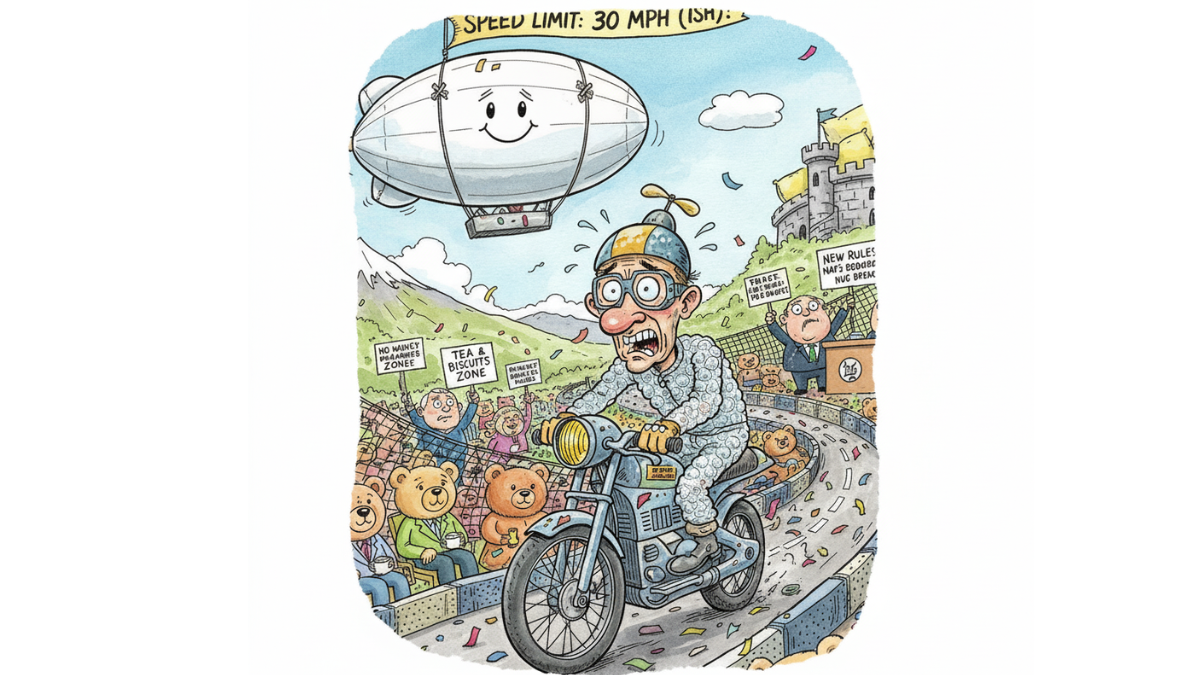
The Isle of Man TT is a magnificent, two-week spectacle of speed and skill, an event that has entranced fans and challenged competitors for over a century. However, as anyone who follows the world’s most famous road race can attest, it also maintains a deeply personal, often turbulent relationship with one particularly stubborn variable: the weather. The 2025 event, a phenomenal success in many respects, showcased this relationship with dramatic flair. Heavy rain, fog, and gusty winds wreaked havoc on the schedule, ultimately leading to the rare and painful cancellation of the headline Senior TT race.1
That very disappointment, a storm on the horizon, has served as the catalyst for a strategic, forward-thinking blueprint for the 2026 Isle of Man TT Races. Instead of merely dusting themselves off and hoping for sunshine, the organizers have announced a host of significant changes to both the schedule and the race classes. These updates are a clear and compelling signal of the event’s commitment to its long-term future, designed to add greater resilience and flexibility, all while preserving the raw, unadulterated thrill that defines the Mountain Course. The two main pillars of this modernization are a refined, weather-resistant schedule and the revolutionary new “Sportbike TT” class, both of which promise to usher in a new era of racing on the legendary 37.73-mile circuit.

The Art of the Pivot: Why the 2026 Schedule is a Masterstroke
The cancellation of the Senior TT in 2025 was a stark reminder that even the most well-laid plans can be foiled by the unruliness of the Mountain. To avoid such heartbreaks in the future, the Department for Enterprise, along with the event organizers, has implemented a series of schedule enhancements that reinforce the core structure of the event. The plan essentially builds in more contingency, creating a more dynamic and adaptable program.1
First and foremost, the 2026 schedule introduces more breathing room for everyone involved. The number of scheduled rest days will increase from two to three, with a new rest day added on Thursday during Qualifying Week.3 This is a profound shift in thinking. The TT, an event built on relentless action, is now openly prioritizing the welfare of its human resources. This valuable downtime gives competitors, marshals, medics, officials, and volunteers a much-needed chance to recharge after three consecutive days of on-course action.6
Beyond rest, the organizers have fortified the schedule with a series of “Plan B” options. The number of contingency periods across the festival fortnight will increase significantly, jumping from 8 to 12.2 This means the organizers have more opportunities to move races and qualifying sessions around as weather forecasts become available, ensuring that as many sessions as possible go ahead even in difficult conditions.1 The Sunday following the Senior TT is set to remain as a fully resourced contingency race day, a final safety net for the event’s most prestigious race.2 The enhancements are designed to safeguard the race program and allow for more efficient operational planning, which in turn helps minimize disruption to the public.8
The schedule also sees a subtle but crucial refinement to the race program itself. The Superstock and Supersport races will switch places in the running order.2 The Superstock competitions will now be paired with the Sidecar races, while Supersport will run alongside the newly christened Sportbike class.1 This change is a direct acknowledgment of the immense physical demands of racing a 1000cc machine on the Mountain Course.3 By now pairing the Superstock TT with the Sidecar races, the organizers are preventing solo riders from having to grapple with two of the most physically punishing races in close proximity. This strategic shift speaks to a new emphasis on competitor wellbeing, which is a necessary step to future-proof the event and continue to attract elite talent who prioritize peak performance and career longevity.
The changes also signal a trend away from evening sessions with the addition of a daytime qualifying session on Wednesday, bringing the total number of practice and qualifying sessions from six to seven.4 This gives riders more opportunities to get themselves and their machines dialed in under conditions that are more reflective of the actual race times.3 The updates are a direct result of “operational learnings, stakeholder feedback, and future planning” 6, confirming that the TT is a living, breathing entity that constantly learns and adapts to its unique and evolving demands.3
To provide a clear, at-a-glance comparison, the following table highlights the key structural changes in the 2026 schedule.
| Feature | Pre-2026 Schedule | 2026 Schedule |
| Scheduled Rest Days | 2 | 3 (including a new Thursday rest day in Qualifying Week) 3 |
| Practice & Qualifying Sessions | 6 | 7 (with an additional daytime session) 4 |
| Contingency Periods | 8 | 12 2 |
| Race Order Swap | Superstock paired with Superbike; Supersport with Supertwin | Superstock paired with Sidecar; Supersport with the new Sportbike class 2 |
The Rise of the Sportbike: A Revolution in Lightweight Racing
For years, the Supertwin class served as a beloved part of the TT program. It was originally introduced as a low-cost, club-level formula, using modified 650cc twin-cylinder machines from manufacturers like Kawasaki and Suzuki.3 However, as is the way with racing, the class evolved into a highly-tuned and surprisingly exotic affair, dominated by the likes of the Kawasaki-powered Paton S1-R and the Aprilia RS 660.3
In a move that promises to ignite the “lightweight” class with a fresh jolt of energy, the Supertwin races will be rebranded as the Sportbike TT races for 2026.8 This is far more than a simple name change; it is a fundamental shift in technical philosophy that opens the door to a wider range of machinery. The new TT Sportbike class will continue to admit the current Supertwin machines but will also allow for bikes that compete in the series of the same name at the British Superbike Championship.3
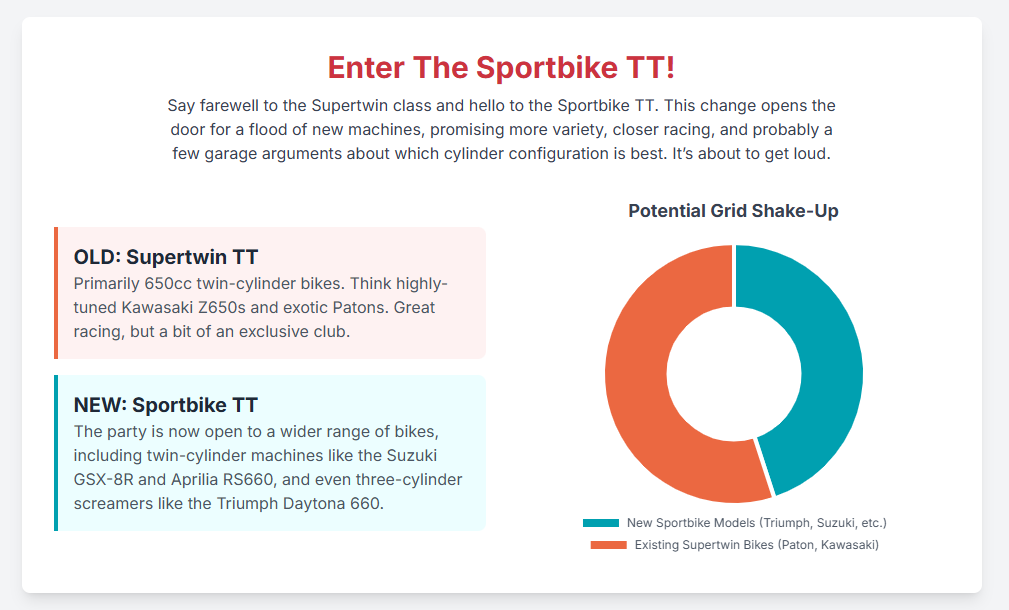
This change will expand the grid’s variety dramatically, bringing in motorcycles like the Suzuki GSX-8R and Honda Hornet 750, as well as three-cylinder machines such as the CF Moto’s 675SR-R and the Triumph Daytona 660.3 It is a move that directly reflects the wider development of the Sportbike class internationally and its adoption in both World and British Championship competitions.3 The Supersport class will also be fully transitioning towards the internationally adopted “Next Generation” regulations, further cementing this global alignment.6
The strategic purpose of these class changes extends far beyond mere cosmetic updates. The TT is not just creating its own rules; it is aligning itself with a proven, globally recognized ecosystem. The FIM’s “Next Generation” regulations were a revolutionary step, created to level the playing field between traditional 600cc four-cylinder screamers and new, larger-capacity twin and three-cylinder bikes.6 This is achieved through a complex balancing of performance system that includes rev limits, minimum weights, and electronics control. By adopting these existing rules, the TT cleverly removes a significant barrier to entry for riders and teams. A competitor from the British or World Supersport series who has already prepared a machine to meet these regulations now has a clear and prestigious destination to race it, attracting fresh talent and a wider fan base to the TT.3
The following table demonstrates the technical evolution from the Supertwin class to the new Sportbike TT, highlighting the increased variety of machines that will now be a part of the spectacle.
| Category | Supertwin (Pre-2026) | Sportbike TT (2026) |
| Class Name | Supertwin TT | Sportbike TT Race 1 & Race 2 10 |
| Engine Configuration | Primarily 650cc twin-cylinders (e.g., Kawasaki ER-6, Suzuki SV650), with some allowances up to 700cc (e.g., Aprilia RS 660, Yamaha R7) 3 | Existing Supertwin machines and new entries with twin or three-cylinder engines, including the Suzuki GSX-8R, Honda Hornet 750, Triumph Daytona 660, and CFMoto 675SR-R 3 |
| Technical Philosophy | A “low cost formula” for club racing that evolved into a highly-tuned class 3 | Alignment with World and British Supersport “Next Generation” regulations to introduce a wider variety of modern machinery 3 |
The Global Grid: A Competitive & Marketing Analysis
The 2026 updates are not just operational; they are a sophisticated marketing and competitive play designed to solidify the TT’s position on the world stage. By aligning its race classes with major international series, the Isle of Man TT transforms itself into a more attractive proposition for a wider range of stakeholders.
This alignment serves as a powerful magnet for motorcycle manufacturers. In a new class that welcomes modern, production-based machines, brands like Triumph, Honda, Suzuki, and CF Moto now have a compelling reason to participate and showcase their latest models on the most demanding course on the planet.3 The TT provides an unparalleled platform for brand recognition and a fresh marketing angle. This is a mutually beneficial arrangement: the TT gets a richer, more diverse grid, and manufacturers get a highly prestigious testbed for their latest two- and three-cylinder sportsbikes.
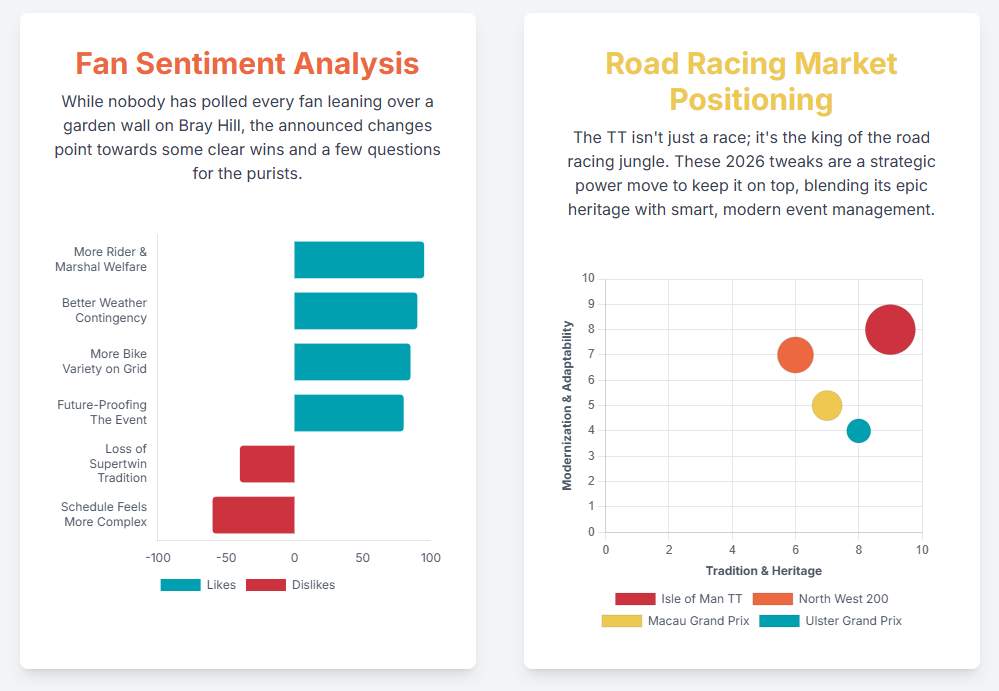
From a competitive standpoint, a wider field of eligible machines promises a more dynamic and unpredictable racing spectacle. The old Supertwin class, while thrilling, often featured a handful of dominant machines. The new Sportbike TT, with its inclusion of three-cylinder bikes and other modern twins, introduces new variables and creates a level playing field where rider skill and team strategy will be paramount. This is precisely the kind of rich competition that keeps fans coming back for more.
The strategic brilliance here is that the TT is outsourcing the most complex part of the process. The “Next Generation” regulations are a technical minefield of performance balancing, involving constant review of data, rev limits, and weight penalties to ensure fair competition between a wide range of engine configurations.6 By simply adopting this framework, the TT trusts an external, dedicated body to handle this technical headache. This allows the event to reap all the benefits—a more diverse, exciting grid—without having to bear the significant cost and logistical burden of developing and enforcing its own complex performance balancing system. This collaborative approach points to a modern, efficient business model that ensures the TT’s long-term sustainability.
The Final Word: A Nuanced Review of the Changes
Like any bold new direction, the 2026 updates bring both immense benefits and a few potential points of friction.
Likes: The Future-Proofing of a Legend
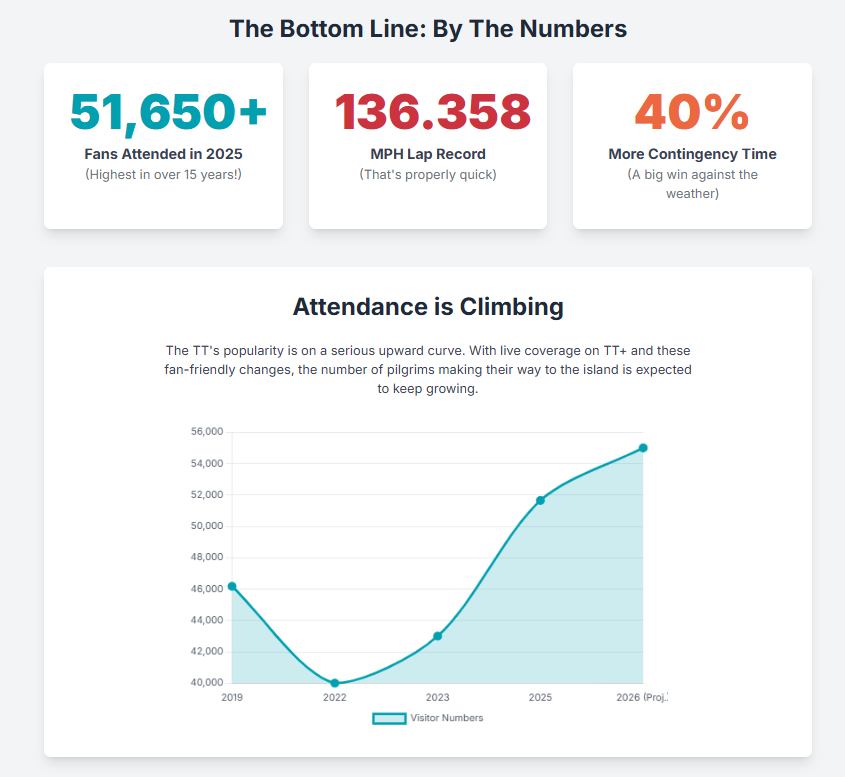
The most immediate and obvious benefit is the enhanced safety and flexibility of the event. The additional rest day and expanded contingency periods are a clear win for event resilience and the welfare of everyone involved.2 Given the record-breaking attendance of over 51,000 fans in 2025 despite the weather issues 2, fans are hungry for a more reliable schedule that promises more racing. The new schedule is a proactive move to deliver exactly that.
The new Sportbike class also promises a richer spectacle. It is a necessary and logical evolution that breathes new life into the “lightweight” class by moving beyond the dominance of a few brands and welcoming a wider range of contemporary machinery. This increased variety on the grid will surely make for some of the most compelling racing of the fortnight.3
Finally, the TT’s move to align with international series is a powerful statement of intent. The TT is not an isolated curiosity; it is a premier event that wants to remain at the forefront of motorcycle racing. By adopting globally relevant rules, it becomes a more attractive destination for top talent and manufacturers, ensuring the TT remains a world-class sporting event for generations to come.1
Dislikes: The Devil in the Detail
The most significant trade-off in the new class is the potential loss of the “budget-friendly” spirit that the Supertwin class was originally founded on. The new rules, while more inclusive, open the door for a new arms race. Racing is inherently a pursuit of victory, and teams with deep pockets will inevitably spend heavily to find an edge, potentially pricing out the very privateers that have long been the lifeblood of the TT. This is a natural tension in motorsport that the new regulations will have to contend with.
Furthermore, while the “Next Generation” regulations are a proven model for balancing performance, the challenge of doing so on a course as unique and demanding as the Mountain Circuit remains. There is always a risk that a single machine or configuration might prove to be disproportionately fast, which could dull the racing spectacle if it leads to a single dominant machine. The organizers will need to remain vigilant to ensure the field stays competitive.
Finally, while official statements praise the changes as beneficial, there is a lack of direct commentary from fans or competitors in the sources. The TT is an event steeped in tradition, and any significant change can face skepticism. However, the record attendance in 2025 and the logical benefits of the changes suggest that most of the community will welcome a more resilient, dynamic, and future-proofed TT.
Conclusion: Beyond the Chequered Flag
The 2026 Isle of Man TT schedule and class changes are a calculated, proactive, and strategic evolution of a legendary event. This is not a radical departure from tradition but a powerful reaffirmation of it. By learning from the challenges of the past, the organizers are building a more resilient framework, prioritizing the welfare of their participants, and aligning their classes with the broader world of motorcycle racing. The new Sportbike TT class and the increased schedule flexibility are designed to protect what makes the TT special today while securing its long-term sustainability. The TT, a series that has adapted continuously since its inception in 1907, is simply continuing its tradition of bold adaptation, ensuring that the world’s most unique road race will continue to thrill fans and challenge riders for years to come.
Sources
- Isle of Man TT revamps schedule after 2025 disruption – The Race, accessed on September 11, 2025, https://www.the-race.com/tt/2026-isle-of-man-tt-schedule/
- Changes to 2026 Isle of Man TT schedule revealed – Yahoo Sports, accessed on September 11, 2025, https://ca.sports.yahoo.com/news/changes-2026-isle-man-tt-104520270.html
- Sportbikes in as Isle of Man TT announces new 2026 schedule | Carole Nash, accessed on September 11, 2025, https://www.carolenash.com/tips-guides/bike-reviews/detail/sportbikes-in-as-isle-of-man-tt-announces-new-2026-schedule
- Isle of Man TT organisers announce major changes to 2026 schedule and confirm Supertwins overhaul as Sportbike machines permitted – Belfast News Letter, accessed on September 11, 2025, https://www.newsletter.co.uk/sport/motorcycling/isle-of-man-tt-organisers-announce-major-changes-to-2026-schedule-and-confirm-supertwins-overhaul-as-sportbike-machines-permitted-5302302
- 2026 Isle of Man TT Schedule – Duke Bookings, accessed on September 11, 2025, https://www.dukebookings.com/2025/09/04/2026-isle-of-man-tt-schedule/
- UPDATED SCHEDULE AND RACE CLASSES CONFIRMED FOR TT 2026, accessed on September 11, 2025, https://www.iomttraces.com/latest/news/updated-schedule-and-race-classes-confirmed-for-tt-2026/
- The Isle of Man TT Gets a Schedule Refresh, accessed on September 11, 2025, https://www.isleofmanbeds.co.uk/the-isle-of-man-tt-gets-a-schedule-refresh/
- New Sportbike TT class revealed for 2026 – Visordown, accessed on September 11, 2025, https://www.visordown.com/news/isle-man-tt-confirms-major-changes-2026
- WTF’s the Difference? Isle of Man TT Race Classes Explained | Muc-Off UK, accessed on September 11, 2025, https://muc-off.com/blogs/articles/isle-of-man-tt-the-no-bs-guide-to-every-race-class
- www.iomttraces.com, accessed on September 11, 2025, https://www.iomttraces.com/latest/news/updated-schedule-and-race-classes-confirmed-for-tt-2026/#:~:text=TT%202026%20will%20also%20see,and%20Sportbike%20TT%20Race%202.
- Sportbike vs Supertwin: What will be faster at the TT? – Visordown, accessed on September 11, 2025, https://www.visordown.com/news/what-do-we-expect-new-sportbike-tt-class-look
- Isle of Man TT adding Sportbike and Supersport Next Gen classes in 2026 | MCNews, accessed on September 11, 2025, https://www.mcnews.com.au/2026-isle-of-man-tt-schedule-categories/
- Supersport World Championship – Wikipedia, accessed on September 11, 2025, https://en.wikipedia.org/wiki/Supersport_World_Championship
- Supersport racing: Next generation | MoreBikes, accessed on September 11, 2025, https://www.morebikes.co.uk/features/280236/supersport-racing-next-generation/
Our Social Media Handles
- Instagram : LivingWithGravity
- Medium : Akash Dolas
- YouTube Channel : Gear and Shutter
- Facebook : LivingWithGravity