





Executive Summary: The Dawn of a New Era, Riddled with Old Challenges
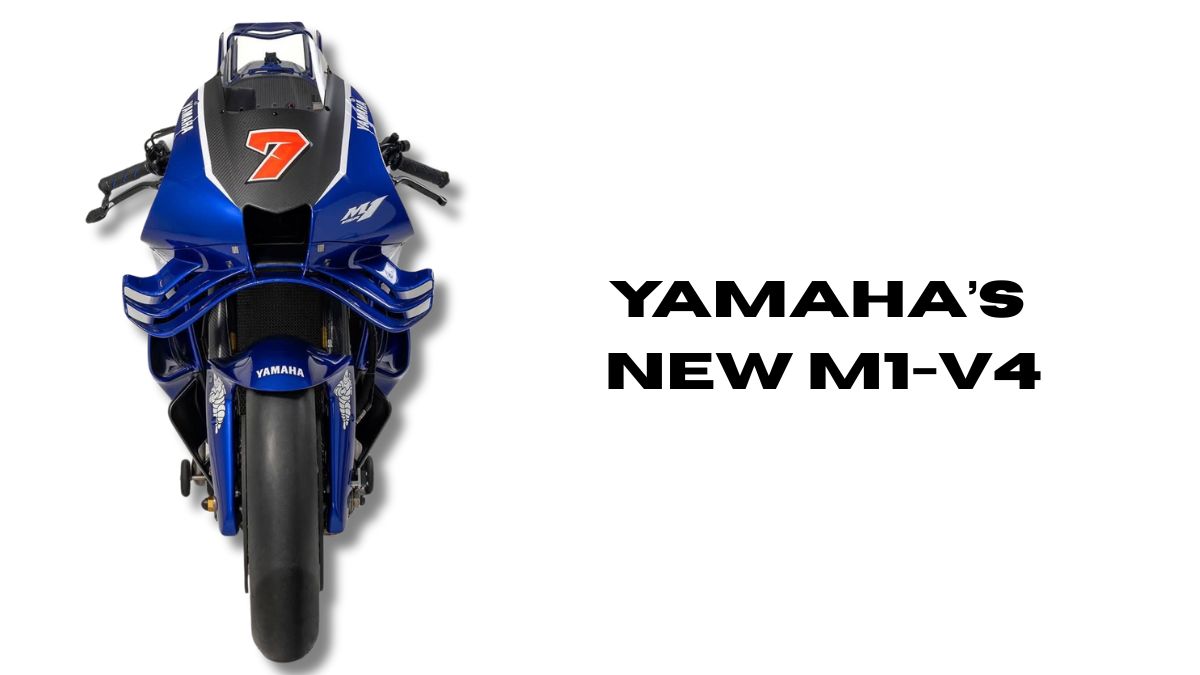
The debut of the Yamaha YZR-M1 V4 prototype marks a pivotal moment in the manufacturer’s history, signaling a definitive departure from the inline-four engine configuration that has defined its MotoGP effort for over two decades. This strategic shift was driven by the chronic performance deficits of the current M1, which has been plagued by a lack of straight-line speed, compromised acceleration, and a struggle for competitiveness against its European rivals.1 Unveiled as a cornerstone of Yamaha’s new, “aggressive approach” to development, the V4 project is a direct response to the dominant V4-powered machines that have come to define the modern era of MotoGP.4 The initiative aims to align Yamaha’s technical philosophy with that of its successful competitors.

Despite the optimism surrounding the project, the prototype’s first public appearances have presented a complex picture. Early private testing in Brno showed the bike was over two seconds per lap slower than the current inline-four M1, leading to public comments from factory riders about “super slow lap times”.7 While the prototype’s wild card debut at the San Marino Grand Prix offered a more encouraging performance, it also revealed a glaring top-speed deficit.9 However, an examination of Yamaha’s development approach suggests this was not an inherent failure but a calculated operational choice. The engine was intentionally detuned to prioritize reliability and data collection over raw performance, reflecting a traditionally cautious, risk-averse Japanese development philosophy.10
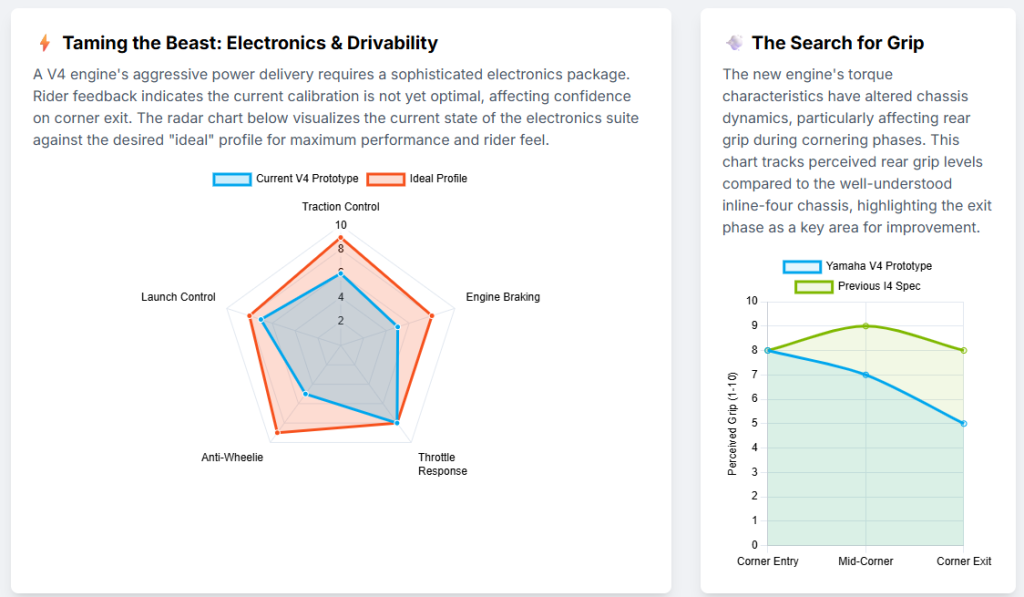
The most significant positive development is the V4’s demonstrable improvement in “rear grip and management of the grip” 13, a long-standing weakness of the inline-four M1.14 This gain, however, introduces a new set of challenges. The prototype still lacks the celebrated front-end feel of its predecessor 13 and continues to suffer from chassis-related “chatter,” an issue that has also affected the inline-four M1.15 To become a championship contender, the V4 program must accelerate its development timeline to achieve competitive power without sacrificing reliability, a precarious balance given the 2026 season’s one-year window before a major displacement change in 2027.16 The team must also resolve the new platform’s chassis balance issues while its factory riders, such as Fabio Quartararo, fundamentally adapt their riding styles to the “V-line” philosophy of the V4.18 The success of this project hinges on whether Yamaha can maintain its newfound “aggressive mindset” while upholding its methodical engineering principles.
Performance and Data Analysis: The V4’s Public Debut
The transition to a V4 engine for the YZR-M1 has presented a mixed bag of performance data, with initial results from private tests creating a stark contrast to its wild card race debut. A thorough analysis of these two distinct testing environments is crucial to understanding the prototype’s current state.
The Raw Data: A Tale of Two Tests
Early private testing at the Brno circuit painted a worrying picture. The V4 prototype, piloted by test rider Augusto Fernández, was recorded lapping over two seconds slower than the current inline-four M1 ridden by Álex Rins.8 Rins clocked a lap time of 1m52.7s, while Fernández’s best was a 1m54.8s. While concerning, this raw data was not considered a true measure of the bike’s potential. The test was focused on basic functionality, with a limited number of laps and no new-tyre runs, a reality highlighted by the fact that the V4 riders completed only about 30 laps combined over two days, compared to Rins’ 110.8
The San Marino Grand Prix provided the first meaningful real-world performance benchmark. Fernández’s performance in a true racing environment showed a significant improvement from the initial two-second deficit. In Friday practice, the V4 was just 1.198s off the fastest lap.13 He qualified in 22nd place, 1.678s behind the pole time 9, and finished the race in 14th position, scoring two points despite receiving a double long-lap penalty for a jump start.20 These race results are more telling than single-lap data, as they indicate the bike’s potential for sustained performance over a full race distance. A comparison of the bikes at the Misano GP reveals critical differences in their current states.
| Rider | Bike | Qualifying Position | Qualifying Time | Race Position | Race Result | Top Speed (km/h) |
| Augusto Fernández | V4 Prototype | 22nd | +1.678s | 14th | 1’01.504s behind 1st | 292.6 |
| Álex Rins | I4 M1 | 20th | +1.198s | P13 | Not provided | 300.8 |
| Francesco Bagnaia | Ducati V4 | 2nd | +0.076s | P2 | +0.568s behind 1st | 304.2 |
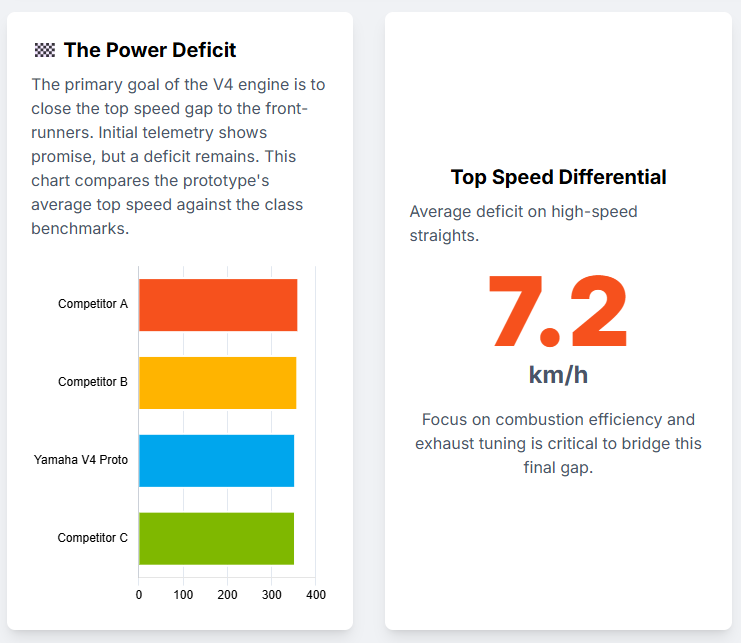
A glaring weakness evident from the data is the V4 prototype’s top speed. At 292.6 km/h, it was significantly slower than both the inline-four M1 (300.8 km/h) and the leading Ducati (304.2 km/h).9 This data point appears to contradict the fundamental advantage of a V4 engine, which is designed for superior top-end performance and acceleration.2
Rider Feedback: The Qualitative Layer
The feedback from test riders adds a crucial qualitative dimension to the raw performance data. Augusto Fernández, who has extensively tested the prototype, has provided valuable insights. He has been particularly positive about a critical area of improvement, stating that the V4 is “much better already” in the “rear part,” specifically concerning “grip and management of the grip”.13 This was the “main issue” with the standard inline-four M1 and represents a major step forward for the new platform.14 Fernández also noted that for the first time, all the setup changes they attempted during the race weekend “worked” as expected, a rare occurrence with the current bike.13
However, the prototype’s current performance is not without its drawbacks. Fernández admitted that the V4 is “still not fast enough”.12 This sentiment is shared by Fabio Quartararo, who, despite receiving “pretty good feedback” on the V4, expressed frustration that “the lap times are super slow” and emphasized that “what matters to me are the lap times”.7 Another critical data point emerged from Fernández’s first “real time attack” on the bike during Friday practice at Misano, which resulted in a crash at turn two.13 Fernández framed this as a necessary step in the development process, stating that they “need to crash to find the limits” of the new machine.13 This suggests that the bike’s boundaries are still being discovered and that its behavior under maximum stress is not yet fully understood.
Strategic & Technical Challenges: The Path to Improvement
Yamaha’s V4 project faces significant hurdles that extend beyond simple performance gains. It is a fundamental re-engineering of the M1 platform, and the team must overcome complex strategic and technical challenges to make the bike a championship contender.
Engine and Power Unit: Unlocking Performance
The primary rationale behind the V4 engine is its inherent technical advantages over an inline-four. A V4 features a shorter, more rigid crankshaft that leads to less friction, fewer pumping losses, and better high-rev performance.19 In a race environment, this translates directly to superior acceleration out of corners and higher top speed, addressing the core weaknesses of the inline-four M1.2
The V4 prototype’s current top speed deficit, which appears to contradict this fundamental advantage, is not a design flaw but a deliberate choice by the development team. The Japanese engineers are following a “gradual process” and have not yet introduced the engine’s “full power”.11 This is a risk-averse strategy designed to prevent a high-profile engine failure on television, which would be a major setback for the project’s public image. This methodical approach stands in contrast to the more aggressive, “all-in” development cycles often seen from European factories. The implication is that the performance deficit is a temporary, calculated state. The immediate challenge is to accelerate this gradual process without compromising reliability. This requires extensive dyno and private testing to unlock the engine’s full potential safely, a precarious balance given the limited time before the 2026 season begins.
Chassis and Dynamic Balance: Re-tuning the M1 DNA
The V4 platform necessitates a fundamental change in chassis dynamics. The inline-four’s longer crankshaft provided a higher moment of inertia, giving the bike superior stability and mid-corner speed—a characteristic known as the “U-line” riding style.6 In contrast, the V4’s shorter, more rigid crankshaft makes it “twitchier” and more demanding to ride.19
The V4 prototype is not a simple modification but a holistic re-engineering of the entire package. It features a “completely new” and “shorter” main frame, a new swingarm, and a redesign of the bike’s dimensions to accommodate the V4 layout.17 The goal is to design a “coherent package” with power delivery, chassis balance, and aerodynamics “tuned as a system”.4
Despite this new approach, a persistent issue from the old platform has reappeared. The V4 prototype suffered from “chatter” during the Misano Sprint 15, the same problem that plagued the inline-four M1 and even led to Fabio Quartararo’s crash. The reappearance of this issue suggests that the problem may not be solely tied to the inline-four’s characteristics but may be rooted in the team’s broader chassis design philosophy or component choices. This is not a new problem for Yamaha; in the mid-2000s, the M1 was famously described as having a “junk” chassis with a “way too rigid” front end and a tendency to “tuck the front”.27 These problems were only solved through unconventional, radical changes to geometry and mass centralization championed by Valentino Rossi and Jeremy Burgess.28 The implication is that the V4 team must conduct a similar deep dive to resolve this core issue and restore the front-end feel and stability that was the inline-four’s hallmark while maintaining the new rear grip advantage.13
Aerodynamics and Packaging: A New Strategic Priority
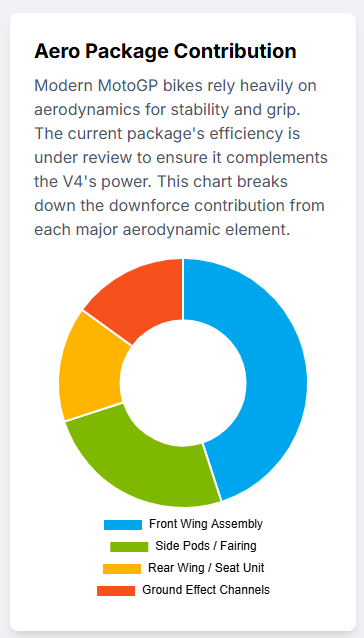
The V4’s narrower configuration offers a significant aerodynamic advantage, as it provides more freedom for designers to shape fairings and downforce-generating surfaces under current rules.2 This is a strategic imperative, especially with new regulations in 2027 that will decrease bike width, further amplifying this advantage.4 The V4 prototype’s visual changes, including “stegosaurus-style fins” reminiscent of the KTM RC16 and a new bellypan and exhaust layout, demonstrate Yamaha’s clear move to emulate the successful aero concepts of its European rivals.16 The current aero package is a work in progress and is not yet optimized for performance. The top speed deficit is also a function of unrefined aero and corner-exit speed 10, and Yamaha’s next step is to refine these elements through intensive testing.
Operational & Human Factor Challenges
Beyond the technical hurdles, the V4 project faces immense pressure from its operational timeline and the human element of rider adaptation.
The Critical Timeline: A Race to 2027
The 1000cc V4 prototype is being developed for the 2026 season, which is poised to be its only year in competition before the major 850cc engine displacement rule change in 2027.16 This unusual one-year window places immense pressure on the team. The 2026 season will not be about championship contention but will serve as a high-stakes, real-world beta test for the 2027 regulations.32 The development of the 1000cc V4 is a “long-term project,” and its performance will inform the crucial 850cc design. This is a massive gamble that risks a “throw away ‘learning season'” 32 at a time when the team needs to be winning to satisfy sponsors and retain top talent. The success of the entire project hinges on how quickly Yamaha can learn and close the performance gap in a single, high-stakes season.
Rider Adaptation: The Philosophical Shift
For factory riders like Fabio Quartararo, who have spent their careers perfecting the “user-friendly” inline-four M1 18, adapting to the V4 is a monumental task. Quartararo is an expert at the inline-four’s “U-line” cornering, prioritizing mid-corner speed and carrying momentum.19 The V4, however, demands a completely different riding philosophy—the “V-line” approach of late braking, quick turn-in, and hard acceleration on corner exit.6 This requires a fundamental retraining and a new level of aggression that contrasts with the traditional finesse of the M1. Quartararo’s public frustration, in which he has expressed that “it’s getting a little tense” and that “we don’t really have any” improvements 7, stems from the tension between his ingrained style and a bike that is not yet ready to be pushed to its V4-specific limits.11 The ultimate success of the project will depend on how quickly he can make this transition and whether the team can provide a bike that inspires confidence in this new, aggressive style.
Recommendations and Outlook: The Path to the Podium
The V4 prototype’s debut was a cautious but successful first step in a long and complex journey. The foundation for success is being laid, with a clear positive development in rear-end grip. However, the path to becoming a championship contender requires a clear, multi-faceted approach.
The top priority is to unlock the engine’s full power potential by transitioning from the current gradual development phase to a more aggressive, performance-focused tuning program. This must be done with robust dyno testing to prevent on-track failures and ensure reliability before the 2026 season. Concurrently, the team must address the persistent chassis balance issues, particularly the “chatter” that plagued both the old and new platforms.15 This will require a deep re-evaluation of frame rigidity, suspension settings, and component integration to find the sweet spot between V4 agility and the M1’s historical front-end feel. Additionally, the team must continue to refine the new aero package to maximize downforce and minimize drag, especially in preparation for the upcoming 2027 rule changes.4
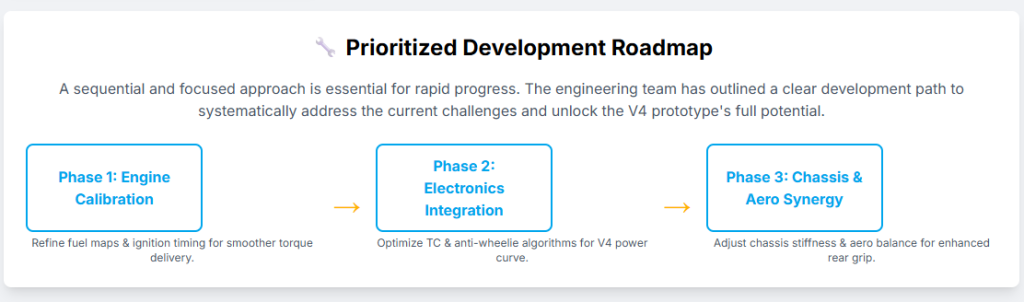
On an operational level, Yamaha must leverage its concessions status and intensified testing program to accelerate development.33 The organization must fully commit to the 2026 season as a high-stakes beta test, using every moment to gather data and inform the design of the crucial 850cc platform. The challenges ahead are significant and multifaceted, involving not just technical engineering but also strategic decision-making and human factor adaptation. Yamaha’s ability to navigate the tension between its cautious heritage and its new “aggressive mindset” will ultimately determine whether this new era results in a return to championship contention or a costly, one-season learning curve.
Sources
- Why Alex Rins can’t wait for Yamaha’s V4 engine – Motorsport.com, accessed September 15, 2025, https://www.motorsport.com/motogp/news/why-rins-cant-wait-for-yamahas-v4-engine/10745212/
- Inline 4 vs V4 Yamaha M1 outline [@mgp1official on Instagram] : r …, accessed September 15, 2025, https://www.reddit.com/r/motogp/comments/1neblzt/inline_4_vs_v4_yamaha_m1_outline_mgp1official_on/
- HUGE NEWS: Yamaha’s V4 MotoGP BEAST Finally Revealed! – YouTube, accessed September 15, 2025, https://www.youtube.com/watch?v=lEce7Nnd_Po
- Yamaha unveils V4-powered bike ahead of Misano MotoGP debut …, accessed September 15, 2025, https://www.motorsportmagazine.com/articles/motorcycles/motogp/yamaha-unveils-v4-powered-bike-ahead-of-misano-motogp-debut/
- MotoGP 2025: Yamaha Unveils V4-Powered YZR-M1 – BikeWale, accessed September 15, 2025, https://www.bikewale.com/news/motogp-2025-yamaha-unveils-v4-powered-yzr-m1/
- The Ultimate Guide to MotoGP Engines: Everything You Need to Know, accessed September 15, 2025, https://www.intentsgp.com/ultimate-guide-motogp-engines/
- Fabio Quartararo admits ‘tensions’ within Yamaha over recent V4 …, accessed September 15, 2025, https://www.motorsport.com/motogp/news/quartararo-admits-its-getting-a-little-tense-at-yamaha-over-recent-v4-comments/10741850/
- Yamaha’s V4 is two seconds a lap slower than current MotoGP bike …, accessed September 15, 2025, https://www.motorsport.com/motogp/news/new-v4-lapping-two-seconds-slower-than-current-motogp-yamaha-says-rins-/10741053/
- “Hard” Misano Sprint for Yamaha V4: “The numbers are not correct” | Crash.net, accessed September 15, 2025, https://www.crash.net/motogp/news/1081747/1/hard-misano-motogp-sprint-yamaha-v4-numbers-are-not-correct
- Yamaha V4 watch- A Fernandez FP2 gap (~1.2s) is unchanged from the M1 – Reddit, accessed September 15, 2025, https://www.reddit.com/r/motogp/comments/1nf5kxa/yamaha_v4_watch_a_fernandez_fp2_gap_12s_is/
- Yamaha’s V4 MotoGP engine “not fast enough,” warns Augusto Fernandez – Reddit, accessed September 15, 2025, https://www.reddit.com/r/motogp/comments/1m2bz59/yamahas_v4_motogp_engine_not_fast_enough_warns/
- Yamaha’s new V4 MotoGP bike “Still Not Fast Enough,” Says Test Rider – IAMABIKER, accessed September 15, 2025, https://iamabiker.com/avin/2025/yamahas-new-v4-motogp-bike-still-not-fast-enough-says-test-rider/
- Yamaha MotoGP V4 “much better already” in key area over inline …, accessed September 15, 2025, https://www.crash.net/motogp/news/1081658/1/yamaha-motogp-v4-much-better-already-key-area-over-inline-four
- V4 Yamaha stars on MotoGP debut: What we’ve learned – The Race, accessed September 15, 2025, https://www.the-race.com/motogp/yamaha-v4-misano-motogp-debut-practice-augusto-fernandez/
- Setback for Yamaha as Augusto Fernandez endures “long, hard” day on V4-powered M1, accessed September 15, 2025, https://www.motorsport.com/motogp/news/setback-for-yamaha-as-augusto-fernandez-endures-long-hard-day-on-v4-powered-m1/10759205/
- V4-Powered Yamaha YZR-M1 Revealed | Motorcycle.com, accessed September 15, 2025, https://www.motorcycle.com/bikes/news/v4-powered-yamaha-yzr-m1-revealed-44648806
- Yamaha showcases V4-powered MotoGP bike ahead of race debut, accessed September 15, 2025, https://www.motorsport.com/motogp/news/yamaha-showcases-v4-powered-motogp-bike-ahead-of-race-debut/10758547/
- Yamaha V4 vs inline-4, what’s everyone thought? : r/motogp – Reddit, accessed September 15, 2025, https://www.reddit.com/r/motogp/comments/1kcavth/yamaha_v4_vs_inline4_whats_everyone_thought/
- Why inline-four MotoGP bikes handle better than V4 MotoGP bikes – Motor Sport Magazine, accessed September 15, 2025, https://www.motorsportmagazine.com/articles/motorcycles/motogp/why-inline-four-motogp-bikes-handle-better-than-v4-motogp-bikes/
- Yamaha V4-Powered Prototype Scores Two Points in First Ever MotoGP Race in Misano, accessed September 15, 2025, https://www.yamahamotogp.com/news/14-09-2025-yamaha-v4-powered-prototype-scores-two-points-in-first-ever-motogp-race-in-misano
- MotoGP: Yamaha unveils its V4 engine at Misano | AutoHebdo, accessed September 15, 2025, https://www.autohebdof1.com/news/MotoGP/Yamaha-lifts-the-veil-on-its-V4-MotoGP-engine.html
- What we learned from Yamaha’s first public outing with its V4 MotoGP bike – Motorsport.com, accessed September 15, 2025, https://www.motorsport.com/motogp/news/what-we-learned-from-yamahas-first-public-outing-with-its-v4-motogp-bike/10758888/
- Yamaha’s V4 MotoGP engine “not fast enough,” warns Augusto Fernandez – Motorsport.com, accessed September 15, 2025, https://www.motorsport.com/motogp/news/yamahas-v4-motogp-engine-is-still-not-fast-enough-says-fernandez/10742845/
- Why V4 bikes are faster than in-line 4s – redridingboots, accessed September 15, 2025, https://redridingboots.com/why-v4-bikes-are-faster-than-in-line-4s/
- Why are MotoGP V4s faster than inline-4s? – Motor Sport Magazine – Reddit, accessed September 15, 2025, https://www.reddit.com/r/motogp/comments/es147i/why_are_motogp_v4s_faster_than_inline4s_motor/
- 2026 NEW YAMAHA M1 V4 OFFICIALLY TESTED AT BRNO CIRCUIT!! – YouTube, accessed September 15, 2025, https://www.youtube.com/watch?v=jW2A6p7OK7o
- World Web Exclusive: Do or Die for the YZR-M1, Part II of III, accessed September 15, 2025, https://www.cycleworld.com/2007/03/28/world-web-exclusive-do-or-die-for-the-yzr-m1-2/
- Twenty years ago today: Rossi fixes Yamaha’s M1 – Motor Sport Magazine, accessed September 15, 2025, https://www.motorsportmagazine.com/articles/motorcycles/motogp/twenty-years-ago-today-rossi-fixes-yamahas-m1/
- How Yamaha made the M1 even better… – Crash.net, accessed September 15, 2025, https://www.crash.net/motogp/news/76906/1/how-yamaha-made-the-m1-even-better
- Why Yamaha’s main riders can’t race its new V4 MotoGP bike this …, accessed September 15, 2025, https://www.the-race.com/motogp/why-yamahas-main-riders-cant-race-its-new-v4-motogp-bike-this-year/
- Yamaha YZR-M1 With V4 Engine to Take to the Track for the First Time This Weekend, accessed September 15, 2025, https://www.autoevolution.com/news/yamaha-yzr-m1-with-v4-engine-to-take-to-the-track-for-the-first-time-this-weekend-257310.html
- Yamaha’s V4 journey so far: what we know as testing continues in Barcelona : r/motogp, accessed September 15, 2025, https://www.reddit.com/r/motogp/comments/1l8vapf/yamahas_v4_journey_so_far_what_we_know_as_testing/
- Fabio Quartararo Extends Contract with Yamaha for 2025-2026, accessed September 15, 2025, https://www.yamaha-racing.com/news/motogp/fabio-quartararo-extends-contract-with-yamaha-for-2025-2026/
Our Social Media Handles
- Instagram : LivingWithGravity
- Medium : Akash Dolas
- YouTube Channel : Gear and Shutter
- Facebook : LivingWithGravity