





I. The Silence of the Throttle: An Introduction to the Safety Imperative
A. Setting the Stage: The Global Reach of the Small-Capacity Giants
For years, KTM and Husqvarna have dominated the premium small-capacity motorcycle segment, offering unparalleled technology and sharp styling at a price point that undercuts traditional Japanese and European rivals. The KTM 390 Adventure defined the entry-level ADV category, providing sophisticated suspension and electronics usually reserved for liter-class machines. Likewise, the Husqvarna twins—the urban scrambler Svartpilen 401 and the café racer Vitpilen 401—used the same potent platform to deliver distinctive, premium aesthetics.1 These bikes represent critical entry points, acting as crucial “gateway drugs” for riders seeking high performance and advanced safety features, features often highlighted in their marketing materials.
However, a serious fault has now cast a shadow over this technological advantage, necessitating a large-scale safety recall that strikes at the core of the machines’ usability. KTM North America, Inc., acting on filings with the National Highway Traffic Safety Administration (NHTSA), initiated a major recall addressing a technical vulnerability in these highly-popular models.

B. The Technical Tsunami: Official Scope and the 9,070-Unit Mandate
The recall specifically targets certain 2022–2024 KTM 390 Adventure motorcycles, alongside 2022–2023 models of the Husqvarna Svartpilen 401 and Vitpilen 401.2 The official NHTSA ID for this action is 25V598000. This is a significant logistical undertaking, affecting 9,070 potential units in the North American market alone.2 Such a high volume immediately confirms that the issue extends beyond an isolated manufacturing error; it suggests a systemic quality control failure relating to component integration and environmental sealing. The sheer scale of the affected motorcycles, concentrated within the highest-growth segment of the market, presents an immediate, urgent challenge to brand reputation management.
C. The Core Failure: Defining the Electronic Throttle (E-Throttle) Vulnerability
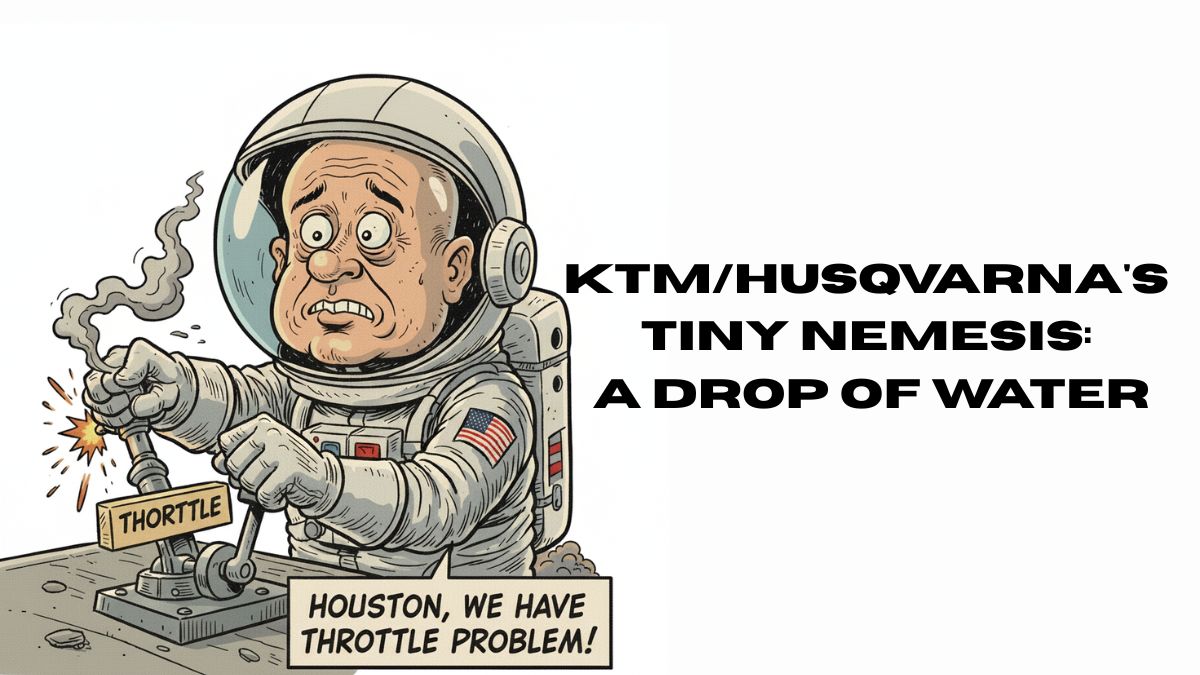
The mechanism of failure is simple, yet devastating: water is able to penetrate the e-throttle control unit.3 The vulnerability involves moisture intrusion, leading to the component’s failure and, crucially, a sudden and unannounced “loss of drive power”.2 Imagine merging onto a highway or navigating a complex off-road section only to have your power silently vanish; the safety implications are profound.
The NHTSA rightly classifies this as a safety hazard because the rider loses all control over vehicle velocity, a scenario which significantly increases the risk of a collision or loss of stability, especially when riding at speed or attempting to accelerate. This issue elevates the recall from a mere inconvenience to a critical safety mandate demanding rapid, high-transparency communication and resolution. KTM and Husqvarna dealers have been tasked with inspecting and replacing the faulty e-throttle control units, free of charge, as the remedy for this critical ride-by-wire moisture issue.2

II. Anatomy of a Power Loss: Deconstructing the E-Throttle Failure
A. Ride-by-Wire Reliability: The Digital Throttle Dilemma
The modern electronic throttle control (ETC), often termed ride-by-wire, eliminates the physical cable link between the throttle grip and the throttle body.5 Instead, sensors in the grip send signals to the Electronic Control Module (ECM), which then commands an actuator motor to open or close the throttle butterfly.6 This system provides immense benefits, allowing for precise throttle modulation, multiple riding modes, and enabling the highly sophisticated rider aids—such as lean-sensitive ABS and cornering traction control—that are key selling points for the 390 and 401 platforms.1
The commitment to ride-by-wire technology, as seen previously in the motorcycle industry, offers superior precision but demands flawless engineering, particularly concerning component weatherproofing.5 Moving a safety-critical system like throttle control entirely into the domain of electronics means any failure, however small, can instantly compromise rider safety.
B. The Root Cause: Moisture Intrusion—A Wet Achilles’ Heel
The specific technical flaw identified is a failure in the ingress protection (IP) rating of the e-throttle control unit. Water is gaining entry to the unit, suggesting seals, component casings, or housing integration are inadequate for the robust demands of motorcycle use, particularly when considering the Adventure moniker or the expected use in heavy rain or washing.4
The consequences, as reported by affected owners prior to the recall, paint a vivid picture of the transient electronic fault. Riders describe the throttle suddenly ceasing operation, leaving the motorcycle idling at minimum RPM.7 The engine light often illuminates, but the problem frequently resolves itself simply by stopping, switching the ignition off and on, and restarting the bike.7 This pattern of intermittent failure strongly suggests signal corruption or a temporary short circuit caused by residual moisture inside the control unit.8
Prior to the official recall, this transient nature created significant frustration for owners. Forums detail numerous instances where dealers failed to replicate the problem during service appointments, leading to high labor costs and unresolved issues.8 The recall, therefore, serves as a formal validation of user feedback that KTM Group should have acted upon more swiftly.

C. The Real-World Consequence: Danger at the Digital Edge
The most significant danger arises from the component’s function. A mechanical failure might lead to a sticky throttle or a slow response, but an electronic failure of the e-throttle causes an immediate, unexpected shutdown of power delivery. This issue is particularly acute for the KTM 390 Adventure recall demographic, riders who bought the bike specifically for multi-terrain, wet-weather, or long-distance touring.
This failure is a formalized recognition of what the community has long referred to as an “electronics gremlin.” The severity of the fault—loss of propulsion while navigating traffic—means that riders exposed to wet climates or those engaging in genuine off-road activities (deep water crossings) are disproportionately affected by the inherent vulnerability. The problem resides not merely in a faulty batch of components, but in a design choice where cost efficiency potentially superseded the required robustness for a safety-critical electronic part.
Table 1 details the officially recognized scope of this significant safety action.
Table 1: KTM/Husqvarna E-Throttle Recall Technical Scope (NHTSA 25V598000)
| Metric | KTM 390 Adventure (NA) | Husqvarna Svartpilen/Vitpilen 401 (NA) | Total Affected Units (NA) |
| Model Years Affected | 2022–2024 | 2022–2023 | N/A |
| Component Failure | Electronic Throttle (E-Throttle) Control Unit | Electronic Throttle (E-Throttle) Control Unit | N/A |
| Failure Mechanism | Moisture Intrusion (Ingress Protection Failure) | Moisture Intrusion (Ingress Protection Failure) | N/A |
| Safety Risk | Sudden and Unannounced Loss of Drive Power | Sudden and Unannounced Loss of Drive Power | N/A |
| Recall Units Identified | Varies by sub-model | Varies by sub-model | 9,070 2 |
III. The Street and Scrambler Landscape: Competitive Analysis
A. Segment Dynamics: The 400cc Premium Battleground
The 400cc segment is immensely important. It offers manufacturers the opportunity to recruit lifelong customers by introducing them to performance motorcycling. Both KTM and Husqvarna built their success here by providing specifications—like advanced suspension and the aforementioned electronic rider aids—that rival competitors could simply not match at the sub-$7,000 price point.1
The high-technology offering represents the Orange and White Advantage, or the “Likes” of these motorcycles. Owners appreciate the engine’s power delivery (“more punch”) and the high level of componentry, justifying the small premium they pay over pure budget offerings.9 The high level of kit, however, depends entirely on the robust function of the digital systems, making the
Husqvarna 401 e-throttle failure a direct attack on their core market differentiator.
B. Key Rivals on the Grid: A Shifting Power Balance
The timing of this high-profile recall could scarcely be worse for KTM Group. The entry of sophisticated, heritage-backed competitors has made this segment fiercely competitive.
The most formidable challenger is the Triumph Scrambler 400 X. Triumph leveraged its reputation for quality, finish, and heritage to launch a machine that competes directly on price (£5595) and appeals to the same rider seeking a premium experience.1 The e-throttle recall gives Triumph an immediate, powerful narrative advantage:
The challenger offers tested quality and classic reliability; the established competitor offers cutting-edge tech that fails when wet. The failure undermines KTM’s reputation for modern powersports reliability, providing the Triumph marketing machine with critical ammunition.
Other important rivals include the Royal Enfield Scram 411, a simpler, more mechanically straightforward machine. While the Scram 411 is openly perceived by some owners as having “low end of okay for reliability” 9, its issues tend to be mechanical nuisances, not sudden, safety-critical failures like a loss of throttle input. This recall effectively drags KTM’s perceived dependability closer to that lower reliability index. The mechanically similar KTM 390 Duke, which shares the platform, also implicitly carries the associated risk of this component failure, broadening the reputational damage across the entire 400cc lineup.
Table 2 illustrates the delicate positioning of the affected models against their primary rivals.
Table 2: Competitive Landscape Analysis (350-500cc Premium Segment)
| Model | Primary USP | Technology Edge (Pre-Recall) | Perceived Reliability Index (PRI) |
| KTM 390 Adventure | Performance & Advanced Electronics | Cornering ABS, Quickshifter | Medium (Performance-focused, minor gremlins accepted) |
| Husqvarna 401 Twins | Style, Design, and Value Tech | Lean-Sensitive ABS, Distinctive Styling | Medium-Low (Aesthetic focus, shared platform risk) |
| Triumph Scrambler 400 X | Premium Brand Finish & Heritage | Solid, Reliable Technology, Competitive Price | High (New model, leveraging brand trust) |
| Royal Enfield Scram 411 | Budget & Proven, Simple Mechanicals | Basic Safety Features (ABS) | Low-Medium (Reliability limitations expected/accepted) |
C. The Manufacturing Paradox: Quality vs. Cost Control
The strategic decision to manufacture these models in India allows KTM/Husqvarna to achieve the price point necessary to undercut rivals like Kawasaki and Yamaha.1 This efficiency, however, is a double-edged sword. The logical implication is that to hit aggressive targets, component sourcing and subsequent quality control checks (particularly on weatherproofing standards) have been subjected to significant pressure.
The failure of the e-throttle—a component required to maintain an extremely high IP (Ingress Protection) rating—points directly to a cost-saving measure that exceeded the threshold for acceptable quality in a safety-critical system. The failure of the centralized digital system, which controls the entire technological suite, collapses the whole “tech USP” that KTM and Husqvarna rely upon to sell their bikes.

IV. Owner Grievances and Grumbles: The Voice of the Riders
A. The Reliability Debate (The Dislikes): A Pattern of Gremlins
For many long-time owners, the e-throttle failure confirms a deeper, underlying tension within the brand regarding electronics and component quality. The KTM 390 Adventure recall is tragically consistent with other reported issues.10 Owners frequently cite a litany of minor but irritating failures that detract from the otherwise stellar riding experience: side stand switch malfunctions that kill the engine, clutch switch failures, and previous complaints of the LCD screen getting moisture and failing.10
The electronic throttle sensor failure itself was a noted problem even before the official recall.10 This established pattern suggests a chronic failure within the platform to correctly specify or seal electronic components for use in an exposed, vibrating, and moisture-prone motorcycle environment. That the moisture ingress problem appears across multiple electronic systems (the dash and the throttle unit) confirms a platform-wide design specification flaw concerning environmental sealing.
These intermittent problems, frustratingly, were often impossible for dealers to diagnose under warranty, forcing riders to live with the risk or pay for non-replicable faults.8 This lack of responsiveness prior to the NHTSA involvement significantly damaged the perception of accountability within the dealership network.
B. The Love Affair (The Likes): Why Riders Return
Despite these persistent “gremlins,” the loyalty and enthusiasm of the KTM and Husqvarna ownership base remain remarkably strong. Riders consistently praise the incredible performance, light weight, and advanced features of the bikes. Many owners report exceptional longevity, with bikes reliably hitting high mileage figures (25,000+ kilometers and even 55,000 kilometers).11
The trade-off is often explicitly acknowledged: riders choose KTM for the raw performance and excitement, recognizing that they must endure the occasional electronic glitch. As one owner observed, the KTM brand is bulletproof in its core mechanical durability, but choosing them over brands like Honda means accepting a different balance where “style and performance” take precedence over “soft and steady” reliability.11
However, the e-throttle failure is the critical point where minor annoyance escalates into a major safety liability. Owners accept minor faults, but sudden loss of propulsion while riding at speed is a fundamental breach of trust that even the most loyal performance rider cannot overlook. This recall significantly threatens the delicate “performance versus reliability” trade-off that defined the ownership experience.
Table 3 summarizes the owner sentiment:
Table 3: Owner Grievances vs. Core Appeal
| Category | Specific Grievances (Dislikes) | Core Appeal Points (Likes) | Significance |
| Electronics/Quality | E-Throttle Failure (Sudden Power Loss), LCD Moisture, Side Stand Switch Malfunction 10 | Advanced Rider Aids (Cornering ABS, TC), Quickshifter (where equipped) 1 | The performance USP relies entirely on the components currently failing due to quality control. |
| Engine/Drivetrain | Low-end stalling, Clutch sensitivity, Chain stretching early 10 | High-mileage endurance (55k+ km), Strong performance, “Bulletproof” perception of engine core 11 | Owners tolerate software/tuning issues but value the engine’s overall durability. |
| Service/Support | Expensive dealer service, Dealers unable to replicate intermittent faults 8 | Strong sense of community, Access to performance-enhancing mods | Dealer network consistency is a vulnerability when dealing with complex, intermittent electronic issues. |
V. Brand Resonance and Reputation Management
A. The Tally of Recalls: A Pattern Emerging
A single recall can be dismissed as an isolated supplier mistake, but high-volume, safety-critical recalls across multiple product lines suggest a deeper, systemic issue impacting the entire KTM Group structure. Coincidentally, KTM North America recently initiated a large-scale recall of over 20,000 off-road Husqvarna and GASGAS motorcycles for an entirely different but equally safety-critical issue: a defective front brake caliper that can crack and dangerously reduce braking effectiveness.13
The implication of recurrent failures in essential safety systems—first the brakes on the dirt bikes, now the throttle on the street and adventure models—is clear: there appears to be a flaw in the organization’s overarching quality assurance processes, supply chain vetting, or component specification standards. The “Ready to Race” slogan, built on a foundation of performance and extreme durability, stands severely contradicted by a sequence of failures in components that ensure basic rider safety. This is a critical blow to the brand trust required for adventure riding, where reliability is often prioritized above all else.
B. The Perception Pivot: Recalls and Brand Recall
In marketing, brand perception is everything.14 When a brand enjoys high awareness, that awareness typically transitions into strong brand recall, which fosters positive perception and consumer choice. Negative safety events, however, reverse this cascade. The widely published recall forces a devastating shift in association: the search engine optimization (SEO) ecosystem begins associating
KTM 390 Adventure not with “best entry-level ADV,” but with “KTM 390 Adventure recall” and “powersports reliability concerns.
This negative SEO exposure requires significant counter-marketing effort. The crisis demands a radical shift in research and development focus. Simply adding more performance features, the traditional KTM response, will not restore confidence. Future models must demonstrate robust, industrial-grade quality control on electrical systems to counter the pervasive negative narrative.
C. Manufacturing Realities: Cost, Quality, and the Indian Connection
As previously established, the ability of these motorcycles to offer premium features at aggressive prices is largely attributable to their manufacturing location in India.1 This strategic advantage creates a continuous tension: achieving the competitive cost structure while simultaneously delivering the rigorous component quality expected by discerning Western buyers.
The e-throttle failure explicitly demonstrates where the cost-optimization process exceeded the acceptable quality threshold. When historical precedent is examined—such as Harley-Davidson’s early adoption of Electronic Throttle Control 5 or past instances like Yamaha’s controversy over a “silent recall” involving undisclosed defect fixes 15—it becomes apparent that proactively handling electronic failure requires radical transparency and rapid, effective engineering solutions. Any attempt to minimize the severity or delay the fix will be interpreted by the market as choosing silence over safety, a path history proves disastrous.

VI. Strategic Imperatives: Steering Through the Storm
A. Immediate Communication Strategy: Radical Transparency
KTM North America must prioritize complete and radical transparency in its communication with affected owners. The company should move beyond the vague, clinical language of “loss of drive power” and clearly explain the technical flaw: moisture ingress causing a short circuit in the ride-by-wire control unit.4 This level of detail reassures the technical owners within the community that the problem is understood and not merely being masked by corporate boilerplate.
Proactive notification is critical, extending well beyond the NHTSA’s minimum requirements. Utilizing VIN tracking 16 and direct digital outreach via email or dedicated rider applications to ensure all 9,070 affected owners are engaged immediately is paramount.
B. Supply Chain Fortification: Mandating IP Rating Superiority
To prevent the recurrence of moisture-related failures (which have plagued both the LCD dash and now the throttle unit 10), KTM must mandate the use of components carrying demonstrably superior Ingress Protection (IP) ratings, such as IP67 or IP68, for all safety-critical electronic modules. This is not simply a matter of swapping a faulty part; the fix must involve installing a
redesigned e-throttle unit validated with superior sealing mechanisms.
Furthermore, procurement protocols must be fundamentally restructured to ensure that cost efficiency does not compromise the environmental sealing of components designed for adventure and all-weather use.
C. The Long Game: Transforming Perceived Quality
The crisis must be used as a catalyst to definitively overhaul the brand’s reputation regarding electronics—a shift from being perceived as “cutting-edge but fragile” to “robustly engineered and reliable.”
The strategic imperative moving forward involves dedicating substantial resources not just to the recall fix, but to eliminating the persistent, irritating electronic “gremlins” that erode trust daily—the recurring issues with the side stand switch, the LCD condensation, and the low-speed stalling.10 Fixing these small, nagging issues is essential, as achieving excellence in the minor components builds the consumer confidence necessary to recover from a major safety catastrophe.
Finally, the dealer network requires urgent retraining to better handle complex, intermittent electronic issues. Dealers must be empowered to immediately recognize and address reported throttle malfunctions, ensuring that owner complaints are never again dismissed as “unreplicable”.8

VII. Conclusion: The Arrow Must Fly Straight
The 9,070-unit safety recall concerning the electronic throttle failure on the KTM 390 Adventure and Husqvarna 401 twins is more than a logistical headache; it represents a critical stress test of the brand’s commitment to quality. The fault, caused by simple moisture intrusion, exposes a systemic failure in ingress protection within a safety-critical ride-by-wire moisture issue, a likely symptom of cost-control pressures impacting component specification.
The competitive landscape demonstrates that KTM and Husqvarna have relied heavily on their technological superiority and aggressive pricing. The failure of the e-throttle, which is the central nervous system for their key safety features, jeopardizes this advantage precisely as reliability-focused rivals like the Triumph Scrambler 400 X are entering the fray. The narrative of superior technology collapses if that technology cannot withstand a simple rain shower.
The integrity of the KTM/Husqvarna brand, particularly in the vital entry-level segments, now hinges entirely upon the flawless and rapid execution of this recall. The organization must signal a clear and visible commitment to prioritizing robust engineering and durability over raw cost efficiency. The “Ready to Race” ethos must be broadened, ensuring that their motorcycles are not merely ready for the track, but also Ready to Last through the real-world conditions their adventure and urban scrambler models are designed to conquer.
Sources
- https://motorsportsnewswire.com/2025/09/22/ktm-recall-certain-2022-2023-husqvarna-svartpilen-401-husqvarna-vitpilen-401-and-2022-2024-ktm-390-adventure-motorcycles/
- https://www.reddit.com/r/svartpilen401/comments/1nmligt/ktm_north_america_inc_is_recalling_certain/
- https://www.reddit.com/r/KTM/comments/1nmk9wj/ktm_north_america_inc_is_recalling_certain/
- https://www.bennetts.co.uk/bikesocial/reviews/bikes/husqvarna/svartpilen-vitpilen-401-2024-review
- https://www.reddit.com/r/SuggestAMotorcycle/comments/11lgoa5/battle_of_the_scramblers_husky_svartpilen_401_vs/
- https://www.reddit.com/r/svartpilen401/comments/15t9ryx/complete_loss_of_throttle/
- https://hqvadventure.com/forum/threads/throttle-issue.1128/
- https://www.reddit.com/r/KTM390ADV/comments/1eqks4b/390_adv_reliability_or_quality_issues/
- https://www.reddit.com/r/KTM390ADV/comments/114y1gi/is_the_ktm_390_adventure_reliable/
- https://www.reddit.com/r/KTM390ADV/comments/1gxltdc/390_adv_reliability/
- https://www.advpulse.com/adv-news/ktm-issues-new-recall-for-over-20000-off-road-motorcycles/?fbclid=IwY2xjawKZfcNleHRuA2FlbQIxMQABHmaEsTRZnJ00GmJTdCVWqU8lPvzI-NUTO5uVfyqs9gQyq8DRHw
- https://www.nhtsa.gov/recalls
- https://ridermagazine.com/2009/02/12/2008-h-d-electronic-throttle-control/
- https://www.alchemer.com/resources/blog/brand-awareness-perception-and-recall-which-matters/
- https://www.semanticscholar.org/paper/Electronic-throttle-control-for-ride-by-wire-in-Corno-Tanelli/eefc39d102845db14d8b6953e587945f383c8201
- https://www.youtube.com/watch?v=g_09ryvaFNM
Sources
- Husqvarna Svartpilen & Vitpilen 401 (2024) – Review – Bennetts Insurance, accessed on September 28, 2025, https://www.bennetts.co.uk/bikesocial/reviews/bikes/husqvarna/svartpilen-vitpilen-401-2024-review
- KTM Recall certain 2022-2023 Husqvarna Svartpilen 401, Husqvarna Vitpilen 401, and 2022-2024 KTM 390 Adventure motorcycles – Motor Sports NewsWire, accessed on September 28, 2025, https://motorsportsnewswire.com/2025/09/22/ktm-recall-certain-2022-2023-husqvarna-svartpilen-401-husqvarna-vitpilen-401-and-2022-2024-ktm-390-adventure-motorcycles/
- “KTM North America, Inc. is recalling certain 2022-2023 Husqvarna Svartpilen 401, Husqvarna Vitpilen 401, and 2022-2024 KTM 390 Adventure motorcycles. Water could enter the throttle (e-throttle) control unit and cause it to fail, resulting in loss of drive power.” – NHTSA : r/svartpilen401 – Reddit, accessed on September 28, 2025, https://www.reddit.com/r/svartpilen401/comments/1nmligt/ktm_north_america_inc_is_recalling_certain/
- KTM North America, Inc. is recalling certain 2022-2023 Husqvarna Svartpilen 401, Husqvarna Vitpilen 401, and 2022-2024 KTM 390 Adventure motorcycles. Water could enter the throttle (e-throttle) control unit and cause it to fail, resulting in loss of drive power. – Reddit, accessed on September 28, 2025, https://www.reddit.com/r/KTM/comments/1nmk9wj/ktm_north_america_inc_is_recalling_certain/
- Harley-Davidson Electronic Throttle Control | Rider Magazine, accessed on September 28, 2025, https://ridermagazine.com/2009/02/12/2008-h-d-electronic-throttle-control/
- [PDF] Electronic throttle control for ride-by-wire in sport motorcycles | Semantic Scholar, accessed on September 28, 2025, https://www.semanticscholar.org/paper/Electronic-throttle-control-for-ride-by-wire-in-Corno-Tanelli/eefc39d102845db14d8b6953e587945f383c8201
- Throttle issue – HQVadventure – The Husqvarna Motorcycle Forum, accessed on September 28, 2025, https://hqvadventure.com/forum/threads/throttle-issue.1128/
- Complete Loss of Throttle : r/svartpilen401 – Reddit, accessed on September 28, 2025, https://www.reddit.com/r/svartpilen401/comments/15t9ryx/complete_loss_of_throttle/
- Battle of the scramblers: Husky Svartpilen 401 vs RE Scram 411 – Reddit, accessed on September 28, 2025, https://www.reddit.com/r/SuggestAMotorcycle/comments/11lgoa5/battle_of_the_scramblers_husky_svartpilen_401_vs/
- 390 Adv reliability or quality issues? : r/KTM390ADV – Reddit, accessed on September 28, 2025, https://www.reddit.com/r/KTM390ADV/comments/1eqks4b/390_adv_reliability_or_quality_issues/
- Is the KTM 390 Adventure reliable? : r/KTM390ADV – Reddit, accessed on September 28, 2025, https://www.reddit.com/r/KTM390ADV/comments/114y1gi/is_the_ktm_390_adventure_reliable/
- 390 ADV reliability? : r/KTM390ADV – Reddit, accessed on September 28, 2025, https://www.reddit.com/r/KTM390ADV/comments/1gxltdc/390_adv_reliability/
- KTM Issues New Recall For Over 20,000 Off-Road Motorcycles – ADV Pulse, accessed on September 28, 2025, https://www.advpulse.com/adv-news/ktm-issues-new-recall-for-over-20000-off-road-motorcycles/?fbclid=IwY2xjawKZfcNleHRuA2FlbQIxMQABHmaEsTRZnJ00GmJTdCVWqU8lPvzI-NUTO5uVfyqs9m6YNGCtZH0uQx2Wa05S_aem_78GVnhOhjGWH9gQyq8DRHw
- Brand Awareness, Perception, or Recall: Which Metric Matters? – Alchemer, accessed on September 28, 2025, https://www.alchemer.com/resources/blog/brand-awareness-perception-and-recall-which-matters/
- Yamaha’s Silent Recall EXPOSED – Thousands at Risk and No One Knew – YouTube, accessed on September 28, 2025, https://www.youtube.com/watch?v=g_09ryvaFNM
- Check for Recalls: Vehicle, Car Seat, Tire, Equipment – NHTSA, accessed on September 28, 2025, https://www.nhtsa.gov/recalls
Our Social Media Handles
- Instagram : LivingWithGravity
- Medium : Akash Dolas
- YouTube Channel : Gear and Shutter
- Facebook : LivingWithGravity