



I. The Re-Emergence of the Inline-Four Middleweight Segment
The motorcycle industry is currently observing a significant strategic shift, moving away from the dominance of parallel-twin configurations in the middleweight category toward the complex, yet highly desirable, inline-four engine architecture. Not long ago, the market for smaller four-cylinder motorcycles—specifically the 400cc and 600cc classes—was considered obsolete . Manufacturers had phased out these designs, primarily driven by stringent Euro emissions regulations, which impose substantial cost penalties for developing four separate exhaust runners and catalytic converters, making the simpler parallel-twin a more economically viable choice.

1.1. Historical Context: The Era of Twin-Cylinder Dominance
Honda’s recent history exemplifies this trend. For decades, the company maintained a presence in the small four-cylinder class with the Japan-only CB400 Super Four and CB400 Super Bol d’Or models . These motorcycles, produced since 1992, embodied the classic Universal Japanese Motorcycle (UJM) aesthetic, featuring a smooth, high-revving 399 cc liquid-cooled inline-four engine that produced 41 kW (56 hp) at 11,000 rpm.1 However, facing mounting economic and regulatory pressures, Honda discontinued the CB400 lineage in October 2022.1 This withdrawal occurred just before the current class revival began to gain momentum, leaving a temporary strategic void in the high-performance sub-500cc segment.3
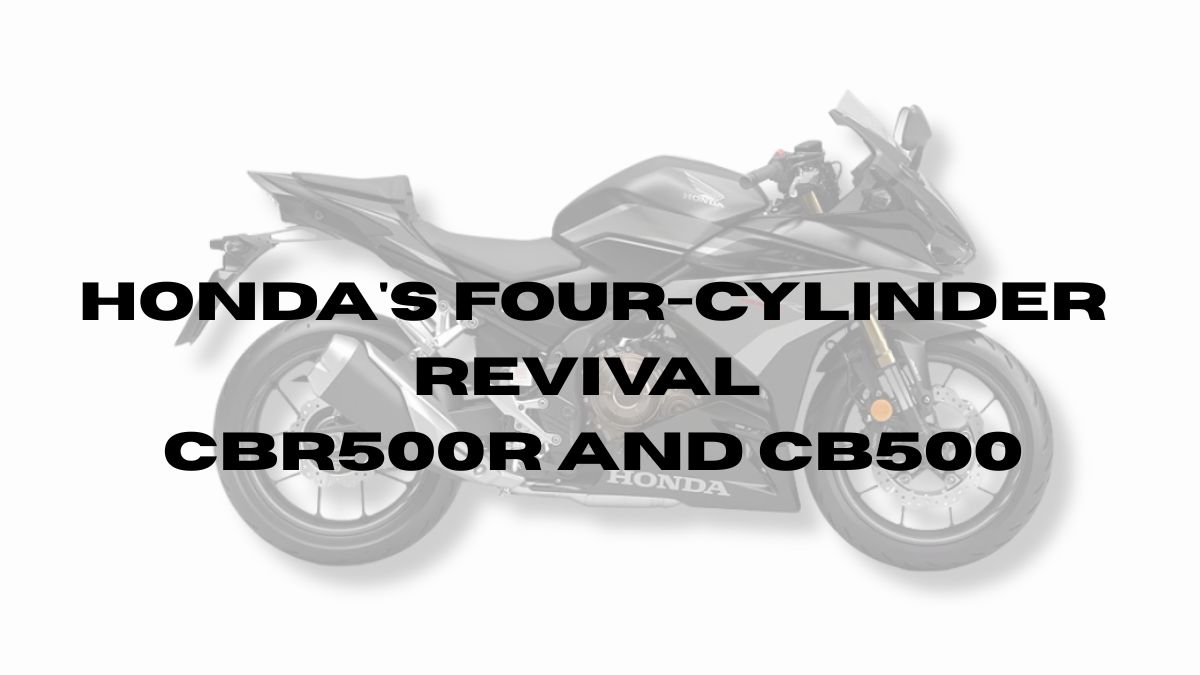
The current standard for Honda’s middleweight displacement is the highly successful 471cc parallel-twin platform, utilized in models such as the CB500F and CBR500R. This platform, which generates 35 kW (47 hp) at 8,600 rpm and 43 Nm of torque at 6,500 rpm, serves a critical function, specifically adhering to the A2 license requirements prevalent in European markets.4 While cost-effective and compliant, this performance profile, characteristic of twin-cylinder engines, fundamentally lacks the high-revving character, unique sound signature, and performance pedigree that enthusiasts associate with an inline-four configuration. The introduction of the new inline-four platform signifies Honda’s move to establish two distinct middleweight offerings: a cost-effective, utility-focused twin, and a premium, performance-oriented four-cylinder.
1.2. The Catalyst for Revival: China and the New Affluence
The primary driver for the resurrection of the small-capacity inline-four is rooted in the shifting dynamics of global motorcycle consumption, particularly the increasing affluence and evolving tastes of riders in the Asian market. Honda strategically chose the CIMAMotor show in Chongqing, China, for the debut of the CB500 Super Four and CBR500R Four, a move that starkly illustrates the immense importance of this region over traditional Western launch events like EICMA.3
The revival was initially catalyzed by Kawasaki’s success with the Ninja ZX-4R and ZX-4RR, which successfully demonstrated the commercial viability of a high-performance sub-500cc inline-four.3 The inline-four configuration, known for its turbine-like smoothness and characteristic high-RPM exhaust note, has become highly associated with prestige and perceived performance value in newly affluent markets, allowing manufacturers to charge a premium that offsets the higher production costs.6 This pattern suggests that the current inline-four revival is not driven by regulatory relaxation but by “Affluence-Driven Technology Transfer,” where products initially developed to meet the demanding, high-volume tastes of Asian riders are subsequently rolled out as premium offerings in global markets.
1.3. Competitive Momentum: The 500cc Race Landscape
Honda is entering a competitive landscape already populated by manufacturers capitalizing on the trend. A host of Chinese manufacturers, including CFMoto, Kove, and ZXMoto, have rapidly introduced four-cylinder machines in the 400cc–500cc segment following Kawasaki’s lead.3
The CFMoto 500SR Voom presents itself as a direct mechanical rival to the new Honda models. This machine utilizes a 499cc inline-four engine, claiming power outputs in the region of 78 hp to 83 hp (the latter achieved with ram air).8 Similarly, Kove has entered the arena with the 450RR, claiming
70 hp at 13,000 rpm.11 These high-specification Chinese models provide an immediate competitive performance benchmark that Honda must meet or exceed, especially when considering cost-competitiveness. Honda’s reliance on proprietary, advanced systems like the E-Clutch and superior brand prestige will be necessary to justify a higher price point against these technologically ambitious and cost-effective rivals.
II. Honda’s New 500-Class Powertrain Architecture
The foundation of Honda’s return to the small-capacity inline-four is an entirely new mechanical platform, incorporating state-of-the-art engine management and component technology.
2.1. The 502cc Inline-Four Engine and Performance Targets
The engine powering both the CB500 Super Four and the CBR500R Four measures 502 cc in displacement. Honda confirmed this is a clean-sheet design developed from the ground up, differentiating it significantly from a mere evolution or rework of the discontinued 399cc CB400SF motor.3
While official performance data is reserved for the global reveal, expectations are high. Multiple sources consistently project the engine’s maximum power output to be in the region of 80 hp (or approximately 55 kW to 60 kW).3 This ambitious target strategically positions the 502cc Honda four-cylinder above its most direct Japanese rival, the international-spec Kawasaki ZX-4RR, which produces around
77 hp.11 The extra displacement (502cc versus 399cc for the Kawasaki) is calculated to allow the Honda engine to achieve high power without requiring the extreme redline or peakiness typical of ultra-small-displacement inline-fours, suggesting an emphasis on superior real-world tractability and torque output—a strategic balance between inline-four character and practical usability.
To remain competitive in the high-performance category, achieving the 80 hp target while managing the complexity and inherent weight penalty of a four-cylinder configuration is critical. Given that the current 471cc parallel-twin CBR500R has a curb weight of 191 kg 5, the four-cylinder is speculated to sit below
200 kg (440 pounds).16 This requires exceptional focus on engineering miniaturization and lightweight component design, crucial for delivering agile handling characteristics that compete successfully against lighter, dedicated sport machines.
2.2. Regulatory Derivations: The 399cc Strategy
Honda’s strategy incorporates market-specific displacement variants to maximize global reach and comply with licensing regulations. Trademark filings have confirmed plans for downsized, 399 cc versions, expected to be named the “CB400 Super Four” and “CBR400R Four”.3 These variants are specifically intended for the Japanese domestic market, where tiered licensing rules provide a significant advantage to sub-
400 cc motorcycles.3
The predecessor, the discontinued 399 cc CB400SF, produced 56 hp at 11,000 rpm and 39 N⋅m of torque.1 The new
399 cc model, leveraging the clean-sheet design of the 502 cc platform and integrating modern features like ride-by-wire (RBW) and advanced electronics, is anticipated to easily match or exceed the performance of the beloved legacy model while adhering to contemporary emissions standards.18 By equipping the new
399 cc bike with a modern stressed-member frame, inverted forks, and radial brakes, Honda is not merely reviving a nostalgic nameplate but introducing a technologically state-of-the-art machine that significantly raises the technical benchmark for the entire 400cc segment.
Furthermore, a restricted version of the 502 cc engine—or potentially the 399 cc variant—will be crucial for capturing the A2 license market in Europe, where the power limit is 35 kW (47 hp). This restriction allows the inline-four platform to serve as a premium option alongside the existing A2-compliant parallel-twin series.
2.3. Advanced Electronics and Engine Management
The adoption of an electronic throttle control system, commonly referred to as Ride-by-Wire (RBW), is confirmed for both new 500-class models.3 This technology is fundamental to modern performance platforms, enabling sophisticated engine management and rider aids.
The RBW system facilitates the integration of several advanced features, including Honda Selectable Torque Control (HSTC) for traction management 6, and a selection of five confirmed ride modes.6 These modes allow riders to tailor the power delivery, throttle response curve, and the characteristics of the E-Clutch system to suit different riding conditions or preferences. The inclusion of these sophisticated electronic controls, powered by RBW, places the new 500-class fours squarely in the premium middleweight category.
Table 1 provides a quantitative comparison of the anticipated performance of the new four-cylinder platform against both its high-performing ancestor and its current twin-cylinder sibling.
Table 1: Anticipated Honda 500-Class Four-Cylinder Specifications (vs. Current/Previous Honda Models)
| Specification | New CB500/CBR500R Four (502cc) | Retired CB400 Super Four (399cc) | Current CBR500R (Parallel Twin) |
| Engine Type | Liquid-cooled Inline-Four (DOHC) | Liquid-cooled Inline-Four (DOHC) | Liquid-cooled Parallel-Twin (DOHC) |
| Displacement | 502 cc | 399 cc | 471 cc |
| Estimated Max. Power (Global) | ∼80 hp (∼60 kW) 13 | 56 hp (41 kW) @ 11,000 rpm 1 | 47 hp (35 kW) @ 8,600 rpm 4 |
| Max. Torque | Unconfirmed (Expected High RPM Peak) | 39 N⋅m @ 9,500 rpm 1 | 43 N⋅m @ 6,500 rpm 4 |
| Throttle Control | Ride-by-Wire (RBW) 17 | PGM-FI (Non-RBW) 21 | PGM-FI (Non-RBW) |
| Clutch System | Gen 2 E-Clutch (Auto-Blipping) 17 | Manual Wet Multi-Plate (Slipper on late models) 1 | Manual Assist/Slipper Clutch 22 |

III. Technical Deep Dive: The Second-Generation Honda E-Clutch
The most critical technological differentiator for the new CB500 Super Four and CBR500R Four is the inclusion of the second-generation Honda E-Clutch system. This technology leverages Honda’s extensive expertise in automated transmissions, derived from its Dual Clutch Transmission (DCT) systems, but applies it in a uniquely accessible format.
3.1. Core E-Clutch Functionality and Integration
The E-Clutch system provides a stepping stone between a conventional manual gearbox and a fully automated manual transmission . It utilizes small electric motors to actuate the clutch engagement and disengagement.14 The transmission itself remains conventional, requiring the rider to use the foot lever to select gears.23 However, the clutch lever operation becomes automated, allowing the rider to smoothly start, stop, and shift gears (both up and down) without ever needing to touch the lever on the handlebar.17 This automation significantly reduces rider fatigue, particularly in demanding urban environments or heavy traffic conditions.23
The design philosophy emphasizes rider choice. The system incorporates an innovative three-part clutch lever shaft that facilitates independent actuation.23 If the rider chooses, they can instantly override the electric control and use the clutch manually, exactly as they would on a traditional motorcycle.17 Furthermore, the system can be completely deactivated via the TFT screen for an individual riding cycle.24 The operational feel of the E-Clutch can also be tailored by the rider, offering “Hard,” “Medium,” and “Soft” settings for both upshifts and downshifts, which can be permanently stored based on rider preference.24 This ability to customize the intensity of clutch engagement is strategically linked to the motorcycle’s confirmed five selectable ride modes, making the E-Clutch an integral, sophisticated element of the overall rider-aid package.
3.2. Gen 2 Enhancements and RBW Synergy
The new version of the E-Clutch debuting on the 500-class fours represents a significant step forward from the initial system found on the CB650R and CBR650R. The primary enhancement is the integration of the E-Clutch with the RBW throttle control system.17
This synergy enables the crucial new feature: automatic rev-matching (auto-blipping) on downshifts.3 When the rider initiates a downshift via the foot lever, the RBW system instantaneously blips the throttle to match engine speed to the wheel speed, ensuring smoother gear changes and preventing rear-wheel hop or excessive engine braking, thereby enhancing both performance and safety under hard deceleration.3 While the system requires manual foot shifting, during upshifts the E-Clutch performs a momentary “half clutch” action combined with a quick cut in fuel injection and ignition control, resulting in seamless, shock-free shifts that rival a conventional quickshifter.28
3.3. Actuator Packaging and Component Relocation
The second-generation E-Clutch unit is physically more compact than the previous design.17 Packaging efficiency and weight distribution were clear priorities in the redesign. The initial E-Clutch system on the 650 models located the actuator and its two internal motors inside the right-hand engine cover, which resulted in a noticeable bulge.25
For the Gen 2 system on the 500-class fours, Honda relocated the clutch operating servo components.14 Multiple sources confirm that the objective was improved weight distribution, necessitating a shift of the components.14 Based on structural analysis and common engineering practice, the components were moved to the left side of the engine, tucked above the transmission, away from the clutch cover.14 This shift improves the overall engine aesthetic and centralizes mass, a critical factor for dynamic handling.
Table 2 outlines the key technological leap represented by the Gen 2 E-Clutch architecture.
Table 2: Evolution of Honda E-Clutch Technology (Gen 1 vs. Gen 2)
| Feature | Gen 1 (CB/CBR650R) | Gen 2 (CB/CBR500R Four) | Significance |
| Throttle Control System | PGM-FI (Non-RBW) | Ride-by-Wire (RBW) 3 | Prerequisite for sophisticated electronic controls (HSTC, Ride Modes, Auto-Blipping). |
| Automatic Downshift Rev-Matching | No | Yes (Auto-Blipping enabled) 3 | Enhances sport performance and safety under deceleration. |
| Actuator Packaging | Housed in right-hand cover (Bulging) 25 | More compact and repositioned (Likely left side) 14 | Improved engine packaging, aesthetics, and weight distribution/centralization. |
| Ride Modes Integration | Limited | Five selectable modes 6 | Allows rider to customize the engine map and E-Clutch aggression levels.24 |
IV. Chassis Dynamics and Platform Differentiation
Despite their vastly different styling cues, the CB500 Super Four and the CBR500R Four are built upon an identical, shared, high-specification chassis platform. This platform represents a complete modernization from Honda’s previous 400cc offerings, ensuring the frame and running gear are fully capable of handling the projected 80 hp output.
4.1. Modern Chassis and Structural Integrity
The structural core of both models is a diamond-shaped steel-tube frame.17 Crucially, the
502 cc inline-four engine is integrated as a stressed component within this frame.14 Utilizing the engine for structural rigidity is a key tenet of modern chassis design, which enhances handling precision and centralizes mass. This configuration is a sharp departure from the discontinued CB400SF, which utilized a spine-framed, twin-shock design.3
The suspension components are high-spec, including an inverted (USD) front fork and a cast aluminum swingarm paired with a rear monoshock, connected via Honda’s proprietary ProLink system.3 This premium suspension package, confirmed to include USD forks, underscores that Honda engineered this platform for performance dynamics and not as a cost-cutting measure.
Braking performance is managed by high-quality hardware. Both bikes feature a dual-disc setup at the front, utilizing Nissin radial four-piston calipers.3 The adoption of radial-mount calipers provides superior mechanical rigidity and improved brake feel compared to older axial-mount designs, components that clearly dated the older CB400 platform.3 This significant investment in performance chassis components validates the platform’s high-power ambitions, confirming that this is not a “parts bin” motorcycle but a dedicated performance machine built to rival the best in its class.
4.2. Styling Divergence: Retro vs. Modern Sport
Honda has efficiently employed platform sharing by creating two aesthetically divergent models that appeal to different rider demographics using the same mechanical foundation.
The CB500 Super Four is a retro roadster designed to evoke classic Honda inline-four heritage, taking styling cues from the legendary CB400SF and the CB1000F concept.14 Its naked design proudly displays the engine, featuring four chrome exhaust headers cascading down to a polished silencer.13 Visual identity is established through its single, round headlight and retro details like dual round LED taillamps.13
In contrast, the CBR500R Four is styled as a thoroughly modern sportbike, aligning with the aggressive aesthetics of the current CBR family.13 This model features a full fairing, angular LED headlights, and a sculpted fuel tank.13 The design is notably clean and aerodynamic, avoiding the complex folds and “winglet” trends seen on many contemporary rivals . While the core mechanical components are shared, the CBR version features distinct bodywork, its own fuel tank, seat unit, and exhaust can style, providing the ergonomic and aesthetic differences necessary for a supersport posture.17 This shrewd platform strategy allows Honda to maximize the return on investment in the expensive new inline-four engine R&D by effectively capturing both the nostalgic Retro/Classic and the cutting-edge Modern Sport market segments with minimal additional manufacturing complexity.

V. Competitive Analysis and Global Market Forecast
Honda’s re-entry into the sub-500cc inline-four category is a high-stakes move, requiring precise positioning against established and emerging rivals.
5.1. Performance and Value Benchmarking
The competitive environment for the 502 cc Honda Inline-Four is intense. The target output of 80 hp places it directly against the highest performers in the category:
- Kawasaki Ninja ZX-4RR: This bike, with its 399 cc inline-four, sets the benchmark for high-revving performance, producing approximately 77 hp in its international full-power trim.11 The Honda must demonstrate superior real-world usability and a broader power delivery curve to differentiate itself from Kawasaki’s focused, track-oriented approach.
- CFMoto 500SR Voom: Representing the rising Chinese competition, the 499 cc CFMoto unit claims power figures between 78 hp and 83 hp, making it Honda’s closest mechanical competitor in terms of displacement and output.9
- Pricing: Pricing is a critical challenge. The high component specification (RBW, E-Clutch, radial brakes) of the Honda suggests a premium price point, likely aligning with or slightly exceeding the Kawasaki ZX-4RR (which starts around 8,999 USD). Chinese rivals typically offer comparable power at substantially lower prices; for example, CFMoto’s three-cylinder 675SS is priced at 7,999 USD.34 Honda’s unique value proposition hinges on the proprietary refinement, brand prestige, and the exclusive, rider-focused technology of the second-generation E-Clutch.
Table 3 provides a summary of the competitive landscape for these high-performance, mid-capacity inline-four models.
Table 3: Competitive Snapshot of New Mid-Capacity Inline-Four Models
| Model | Manufacturer Origin | Displacement (cc) | Engine Type | Estimated Max. Power (hp) | Signature Technology |
| Honda CBR500R Four | Japan/China | 502 | Inline-Four (New) | ∼80 (Claimed) 14 | Gen 2 E-Clutch, RBW, HSTC |
| Kawasaki Ninja ZX-4RR | Japan | 399 | Inline-Four (High-Rev) | ∼77 (International) 11 | Quickshifter, High Redline |
| CFMoto 500SR Voom | China | 499 | Inline-Four | ∼78−83 (Claimed) 9 | Aggressive Styling, Competitive Power |
| Kove 450RR | China | 443 | Inline-Four | ∼70 (Claimed) 12 | Lightweight Design, Performance Focus |
5.2. Global Launch Strategy and Timeline
The initial limited debut at the CIMAMotor show served the strategic purpose of prioritizing the immensely important Chinese market, which is largely driving the demand for this class revival.3
The global reveal of detailed specifications, official performance figures, and full imagery is anticipated to occur later this year, most likely coinciding with the EICMA show in Milan in November.3 Following this, the market launch is slated for early Spring 2026.13
Based on development and regulatory requirements, the initial market focus will be on Asia, specifically Japan (receiving the 399cc variants due to licensing mandates) and China (receiving the 502 cc variants).13 Subsequent expansion into European markets will require confirmation of compliance with modern emission standards (Euro 5/Euro 6).13 The long-term viability of the platform in Western markets depends entirely on its ability to meet these emissions requirements while retaining the projected
80 hp output, demonstrating that Honda has successfully overcome the engineering constraints that doomed the previous generation of small fours.
The prospect for a US market launch remains unconfirmed, positioned as an uncertain possibility.3 However, given the significant research and development costs associated with an all-new inline-four engine and the sophisticated E-Clutch technology, a subsequent entry into the US market is a crucial factor for maximizing global sales volume and justifying the strategic investment, potentially positioning the CBR500R Four against middleweight sport offerings like the Yamaha R7 in the sub-1,000 segment.15

Conclusions
The introduction of the Honda CB500 Super Four and CBR500R Four signals a decisive return by Honda to the high-performance middleweight inline-four segment, a strategic shift driven primarily by burgeoning demand in affluent Asian markets. This revival is anchored by an all-new 502 cc engine platform that promises 80 hp—a performance level that dramatically surpasses Honda’s existing 471 cc twin-cylinder class and challenges high-specification rivals like the Kawasaki ZX-4RR and CFMoto 500SR Voom.
The technical analysis confirms that Honda is adopting a premium strategy, coupling this high-output engine with a sophisticated chassis (diamond steel frame, USD forks, Nissin radial brakes) and proprietary technology. The second-generation E-Clutch system, featuring ride-by-wire integration and automatic rev-matching, serves as a unique selling proposition, establishing a high technical barrier for competitors while offering riders unparalleled convenience without sacrificing the manual shifting experience.
The launch strategy, prioritizing China and the regulated Japanese market (via the 399 cc variant), demonstrates a focus on high-growth and segment-specific regions. Success in these markets, coupled with successful confirmation of Euro 5/6 compliance expected at the EICMA global reveal, will determine the long-term sustainability and global reach of this new generation of inline-four middleweights. The platform’s success confirms that the engineering complexity and high cost of the four-cylinder architecture are now strategically viable, provided the final product offers a premium, technologically advanced experience that justifies the price premium.
Sources
- Honda CB400SF – Wikipedia, accessed on September 28, 2025, https://en.wikipedia.org/wiki/Honda_CB400SF
- HONDA CB400SF (Super Four) 2020 Parts and Technical Specifications – Webike Japan, accessed on September 28, 2025, https://japan.webike.net/HONDA/CB400SF+Super+Four/215/m-spec/y2020/
- Honda CB500 Super Four and CBR500R Four Preview – Cycle World, accessed on September 28, 2025, https://www.cycleworld.com/motorcycle-news/honda-cb500-super-four-and-cbr500r-four-preview/
- Specifications – CBR500R – Super Sport – Range – Motorcycles – Honda UK, accessed on September 28, 2025, https://www.honda.co.uk/motorcycles/range/super-sport/cbr500r/specifications.html
- Specifications and Price | Honda | CBR500R | Super Sport | Racing DNA Inside, accessed on September 28, 2025, https://www.honda.co.uk/motorcycles/range/super-sport/cbr500r/specifications-and-price.html
- Honda CB500 Super Four and CBR500R Four Unveiled- What’s New | Bike News, accessed on September 28, 2025, https://www.timesnownews.com/auto/bike-news/honda-cb500-super-four-and-cbr500r-four-unveiled-whats-new-article-152878127
- 2026 Honda CB500 Super Four Unveiled – Inline-Four Thrills Are Back! – YouTube, accessed on September 28, 2025, https://www.youtube.com/watch?v=Sy0h4Tf8-C0
- 500SR VOOM – CFMOTO Global, accessed on September 28, 2025, https://www.cfmoto.com/global/motorcycles/sportracing/500sr.html
- CFMOTO 500SR 2025, Philippines Price, Specs & Official Promos | MotoDeal, accessed on September 28, 2025, https://www.motodeal.com.ph/motorcycles/cfmoto/500sr
- [Overseas] The 4-cylinder retro sports motorcycle “500SR VOOM” has been officially announced! With 83 PS, exceeding the ZX-4R, the price is about $5248.53 locally. – Webike Japan, accessed on September 28, 2025, https://japan.webike.net/moto_news/latest-news/20240718-overseas-the-4-cylinder-retro-sports-motorcycle-500sr-voom-has-been-officially-announced-with-83-ps-exceeding-the-zx-4r-the-price-is-about-5248-53-locally/
- Updated Kove 450RR | Cycle World, accessed on September 28, 2025, https://www.cycleworld.com/motorcycle-news/kove-450rr-update/
- Kove 450R First Look | Cycle World, accessed on September 28, 2025, https://www.cycleworld.com/motorcycle-news/kove-450r-first-look/
- Honda CB500 Super Four and CBR500R Four: What to expect from the inline-four duo | HT Auto, accessed on September 28, 2025, https://auto.hindustantimes.com/auto/two-wheelers/honda-cb500-super-four-and-cbr500r-four-what-to-expect-from-the-inline-four-duo-41758602458345.html
- Honda Reveals CB500 Super Four and CBR500R Four | Motorcycle.com, accessed on September 28, 2025, https://www.motorcycle.com/bikes/new-model-preview/honda-reveals-cb500-super-four-and-cbr500r-four-44649628
- Why the Honda 500 Four Might Be the Smartest $10K Sportbike – YouTube, accessed on September 28, 2025, https://www.youtube.com/watch?v=mqHkBWJVe-4
- Honda has quietly revealed the CB500 Super Four – New Atlas, accessed on September 28, 2025, https://newatlas.com/motorcycles/honda-cb500-super-four/
- Honda CB500 Super Four and CBR500R Four – Australian Motorcycle News, accessed on September 28, 2025, https://amcn.com.au/editorial/honda-cb500-super-four-and-cbr500r-four/
- 2026 NEW HONDA CB400 SUPER FOUR UNVEILED: HONDA’S ANSWER TO THE Z400RS! – YouTube, accessed on September 28, 2025, https://www.youtube.com/watch?v=IIcWpPGgadk
- New CB400 will be Launched in 2025! Honda’s 400cc 4-Cylinder Engine is Back?, accessed on September 28, 2025, https://japan.webike.net/moto_news/latest-news/20231218-new-cb400-will-be-launched-in-2025-hondas-400cc-4-cylinder-engine-is-back/
- Chongqing Motorcycle Show’s Most Anticipated Motorcycles: Honda CB500SF and CBR500R Super Four 2026 – YouTube, accessed on September 28, 2025, https://www.youtube.com/watch?v=SqIDYdR76jU
- HONDA CB400SF Super Four (2010-2011) Specs, Performance & Photos – autoevolution, accessed on September 28, 2025, https://www.autoevolution.com/moto/honda-cb-400sf-super-four-2010.html
- CBR500R – 500cc Sportbike – Honda Powersports, accessed on September 28, 2025, https://powersports.honda.com/motorcycle/sport/cbr500r/features
- Honda E-Clutch|Honda Technology – Honda Global, accessed on September 28, 2025, https://global.honda/en/tech/Honda_E-Clutch/
- Honda E Clutch – YouTube, accessed on September 28, 2025, https://www.youtube.com/watch?v=fXp4tJcOS8M
- Getting a Taste of Honda’s E-Clutch Technology – Motorcycle.com, accessed on September 28, 2025, https://www.motorcycle.com/bikes/manufacturer/honda/getting-a-taste-of-hondas-e-clutch-technology-44606578
- Honda E-Clutch ride review: How it works – RevZilla, accessed on September 28, 2025, https://www.revzilla.com/common-tread/honda-e-clutch-first-ride-review
- What’s your thoughts about the new Honda cbr650r e-clutch, just took it for a ride today. : r/motorcycles – Reddit, accessed on September 28, 2025, https://www.reddit.com/r/motorcycles/comments/1ghljp4/whats_your_thoughts_about_the_new_honda_cbr650r/
- Honda’s Revolutionary E-Clutch | Honda Engine Room, accessed on September 28, 2025, https://www.honda.co.uk/engineroom/bikes/hondas-revolutionary-e-clutch/
- 2025 Honda CB650R E-Clutch Review [QuickTest#104] – YouTube, accessed on September 28, 2025, https://www.youtube.com/watch?v=B672vY9KETg
- E-Clutch | Technology | Next Level Riding – Honda UK, accessed on September 28, 2025, https://www.honda.co.uk/motorcycles/experience-honda/e-clutch.html
- New Honda CB500 Super Four retro naked announced | Visordown, accessed on September 28, 2025, https://www.visordown.com/news/new-honda-cb500-super-four-retro-naked-announced
- Honda CB500 Super Four And CBR500R Four Breaks Cover – ACKO Drive, accessed on September 28, 2025, https://ackodrive.com/news/honda-cb-500-super-four-and-cbr-500-r-four-breaks-cover/
- 2026 NEW HONDA CB500SF SUPER FOUR AND CBR500R FOUR WALKAROUND REVIEW – YouTube, accessed on September 28, 2025, https://www.youtube.com/watch?v=TQhboUbePv8
- Sportier CFMoto 500SR Voom | Cycle World, accessed on September 28, 2025, https://www.cycleworld.com/motorcycle-news/cfmoto-500sr-voom-sportbike/
Our Social Media Handles
- Instagram : LivingWithGravity
- Medium : Akash Dolas
- YouTube Channel : Gear and Shutter
- Facebook : LivingWithGravity