








Hero Xpulse 421: Strategic Analysis of Hero MotoCorp’s Flagship Entry into the Global Adventure Touring Segment
I. Executive Summary: The Flagship ADV as Hero’s Global Pivot
The anticipated introduction of the Hero Xpulse 421 represents a critical inflection point in the operational strategy of Hero MotoCorp, signaling a calculated shift from its traditional focus on high-volume, low-cost commuter segments towards the higher-margin, performance-oriented mid-capacity adventure (ADV) market.1 Positioned as the largest and most technologically advanced motorcycle in the Xpulse lineage, the 421 is not merely a product upgrade but a strategic vehicle designed to secure market dominance in India and spearhead the manufacturer’s ambitious global expansion, particularly into the highly competitive European theater.2
The underlying mandate of the Xpulse 421 is two-fold. Domestically, it aims to capitalize on the popularity of the Xpulse 200/210 platform by offering the requisite power and features demanded by Indian enthusiasts for long-distance touring and challenging off-roading. Globally, it must meet stringent quality and performance standards to compete directly with established international players.1
This pursuit of premium status through advanced engineering validates Hero’s substantial internal research and development capabilities. Historically, the company has concentrated its engineering efforts on high-volume motorcycles, typically featuring displacements under 200cc and utilizing simplified air-cooled technology.1 The development and imminent mass production of a new, liquid-cooled, 421cc powerplant marks the organization’s first proprietary engine over 400cc 4, confirming a necessary transition toward technically sophisticated powertrains that are competitive on a global scale. This movement indicates a decisive corporate shift away from securing market share purely through volume toward generating value through higher-margin, technically relevant products.
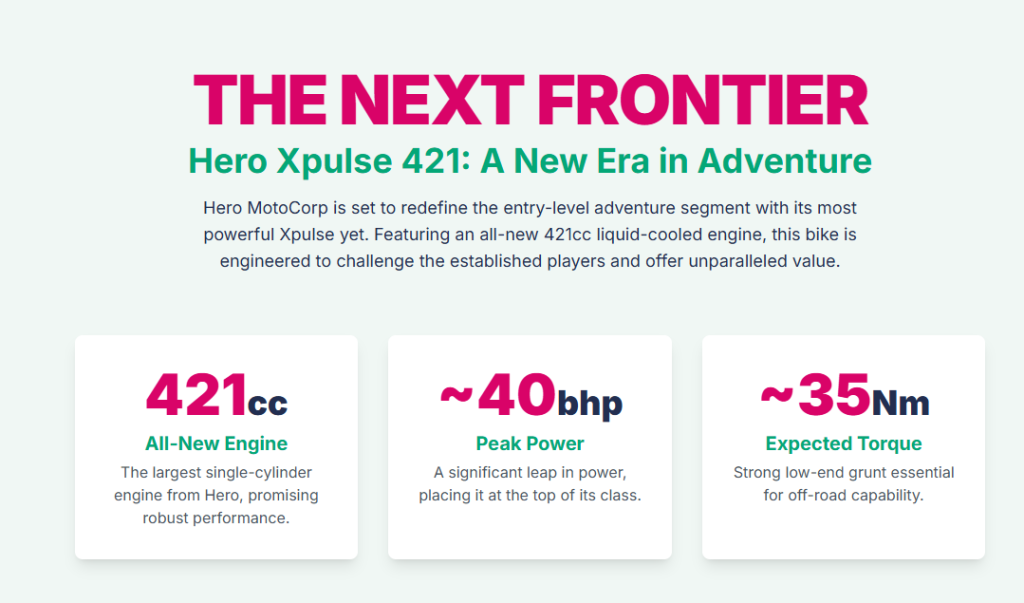
Crucially, the performance metrics selected for the Xpulse 421 appear to be guided by international regulatory standards. The consistently projected power output of 40 to 45 HP 5 is likely a deliberate engineering choice to ensure the motorcycle complies with the power limits of the European A2 motorcycle license, which restricts output to 35 kW (approximately 47 HP).6 For a company prioritizing market access in key European export regions such as Italy, Germany, and the UK 3, adhering to A2 license requirements is paramount. This regulatory constraint provides a clear explanation for why the engine output is specified in the 40–45 HP bracket, foregoing maximum peak performance (which might push close to or breach the 50 HP rumored figure 7) in favor of ensuring universal eligibility for the vast European new rider market.
II. The New Core: Powertrain Architecture and Performance Analysis
A. Engine Blueprint: Scalability and Technology Transfer
The driving force behind the Xpulse 421 is an entirely newly developed, single-cylinder, liquid-cooled engine with a displacement of 421 cubic centimeters.5 The engine’s technical architecture confirms Hero MotoCorp’s commitment to modern, performance-oriented design, featuring a Double Overhead Camshaft (DOHC) layout and a 4-valve system.5 This configuration is standard for high-performance single-cylinder engines, designed to maximize volumetric efficiency and sustain high-revving power delivery, aligning the 421’s engineering philosophy with modern rally-inspired machines.
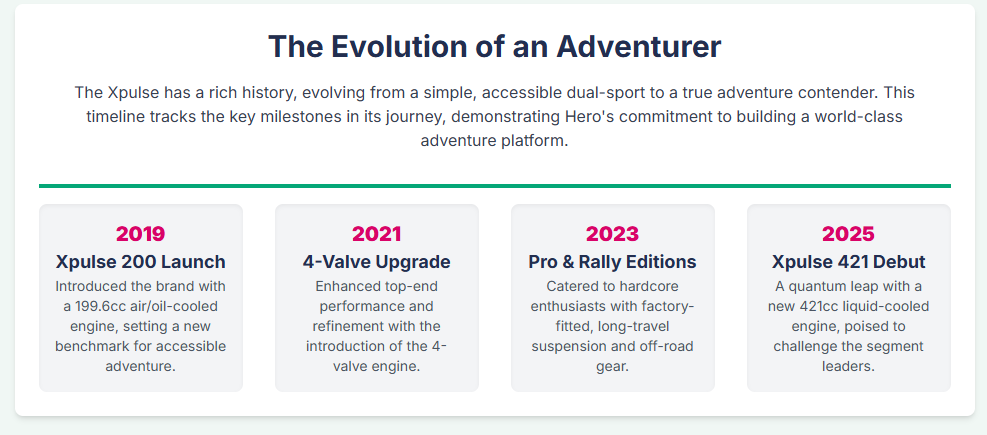
The foundation for this new 421cc unit is the platform initially introduced in the 210cc Karizma XMR sportbike.1 The Karizma XMR represented Hero’s initial foray into liquid-cooled DOHC architecture, producing approximately 25 HP.9 The process of scaling this successful, in-house developed platform upwards to 421cc provides a pathway for the projected power outputs while leveraging proven structural and thermal management solutions. This strategic scaling reduces the developmental risks associated with an entirely blank-sheet design and demonstrates a deliberate effort to create a flexible, modular engine platform that can underpin multiple future premium models, including potential variants of the Karizma itself.1
B. Performance Metrics and Delivery Strategy
Performance estimates consistently place the Xpulse 421’s output around 40 to 45 HP (or 40-45 PS), coupled with a peak torque figure ranging from 40 to 45 Nm.5 This output profile is intentionally engineered to place the Xpulse 421 on level footing with its primary liquid-cooled competitor, the Royal Enfield Himalayan 450, which produces 39.5 HP and 40 Nm of torque.11 The competitive focus is evident in the emphasis placed by internal planning on generating robust low- and mid-range torque 2, a characteristic vital for effective technical off-road riding, navigating steep inclines, and maintaining momentum during high-altitude touring, where older, naturally aspirated engines often struggle.13
Power transfer is managed through a confirmed 6-speed gearbox.5 This transmission is expected to incorporate a slipper and assist clutch mechanism, a critical modern feature that minimizes rear wheel hop during aggressive downshifts, enhances rider comfort, and reduces the effort required at the clutch lever—all significant factors in improving rider endurance during long-distance adventure travel.
The operational design extends beyond mere performance figures to include touring endurance. Reports suggest an optimistic mileage estimate of approximately 45 kmpl, which, when paired with the large 15-liter fuel tank, projects a substantial touring range exceeding 600 kilometers.5 Such range capability establishes the Xpulse 421 as a viable long-haul touring machine, competitive against the range offerings of its rivals.
C. Analysis of the Power-to-Weight Advantage and Reliability Risk
The tactical engineering of the Xpulse 421 is revealed when comparing its performance output to its anticipated mass. By targeting a power band similar to the 452cc Himalayan 450 (40-45 HP vs 39.5 HP), but doing so with an estimated kerb weight between 175 kg and 185 kg 15, the Xpulse 421 achieves a superior power-to-weight ratio compared to the Himalayan 450, which weighs approximately 196 kg.15 This lower mass translates directly into greater agility, improved handling responsiveness, and easier maneuvering, particularly when navigating technical or difficult terrain. This approach positions the Xpulse 421 as the more “spirited” and agile choice in the mid-capacity ADV segment, appealing specifically to riders who value responsive handling and high performance over sheer mass and touring bulk.
However, the strategic introduction of this new, complex liquid-cooled DOHC platform introduces an inherent level of risk, particularly regarding initial reliability and quality control. For Hero MotoCorp, whose traditional expertise lies in simpler engines, this 421cc unit represents a significant leap in internal complexity.5 Early adopters frequently function as “beta testers” for entirely new platforms.6 To mitigate the reputation damage that could arise from initial mechanical or electronic issues, Hero must commit substantial resources to rigorous pre-launch durability testing, possibly utilizing insights gained from their established rally program, and ensuring a robust, rapid-response post-sales infrastructure. The ability to quickly resolve any unforeseen issues will be paramount to safeguarding the reputation of this crucial premium platform before its widespread international deployment.
III. Rally DNA: Chassis, Dynamics, and Off-Road Capability
A. Frame and Construction Philosophy
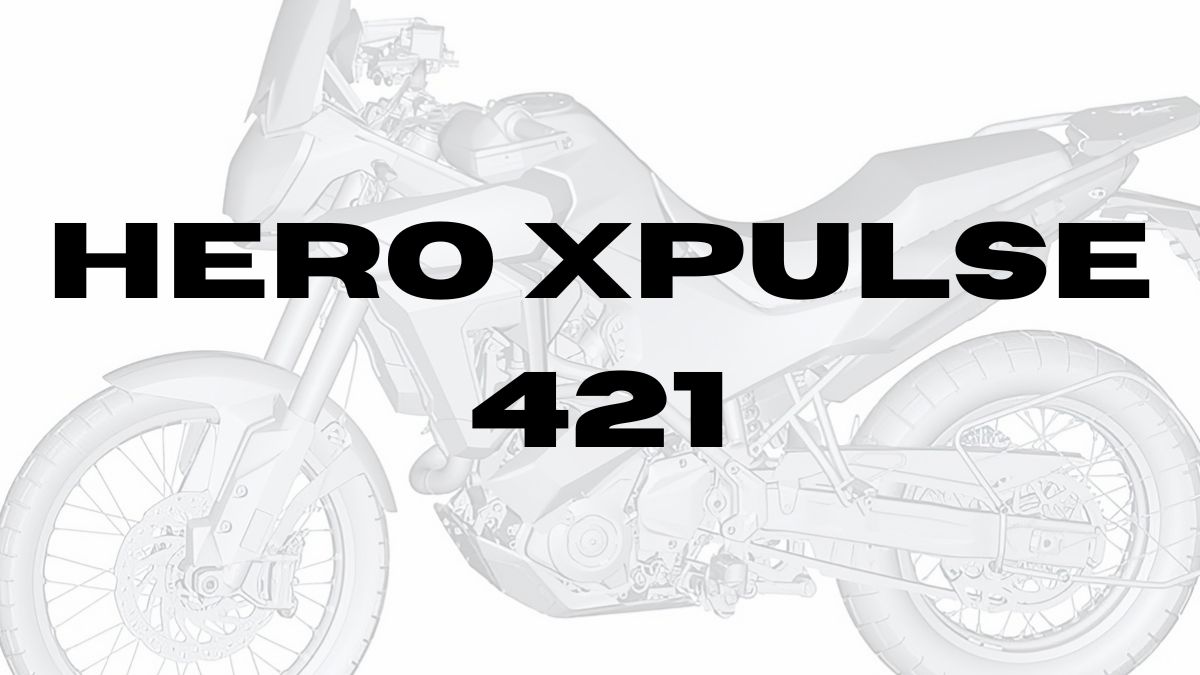
The chassis architecture of the Xpulse 421 is designed to support the bike’s high-performance rally aspirations, drawing conceptual inspiration from Hero MotoCorp’s Dakar 450 Rally racing machine.1 At its core, the motorcycle utilizes a newly engineered tubular-trellis frame, complemented by an aluminum-alloy swingarm.1 The trellis frame configuration is highly valued in performance motorcycle design for its intrinsic rigidity and favorable weight characteristics, which contributes significantly to the bike’s overall low estimated kerb weight.
The design philosophy is distinctly modern and aggressive, visually separating the 421 from the retro-modern aesthetic embraced by some competitors.1 Key styling features evident in trademark filings and concepts include a modern flat headlamp assembly, aggressive radiator shrouds surrounding a tall fuel tank, and utilitarian design elements such as a robust metallic bash plate for engine protection and a sleek single-piece seat.8 This design language emphasizes functionality and raw adventure capability, echoing the visual cues of high-end rally and adventure machines.19
B. Suspension and Off-Road Geometry
The Xpulse 421 is equipped with premium cycle parts necessary for serious adventure use. The motorcycle is confirmed to utilize Upside-Down (USD) front forks—a substantial upgrade over the conventional telescopic forks used in earlier Xpulse models—paired with a rear monoshock featuring preload adjustment capability.1 The use of USD forks enhances the bike’s structural stiffness and improves damping control, which is essential for stable high-speed riding and absorbing large impacts during off-road excursions.1
The bike is guaranteed to feature long travel suspension, a non-negotiable requirement for an off-road-focused ADV.14 While specific travel distances (in millimeters) remain unconfirmed for the 421, the Xpulse DNA suggests ground clearance will be generous, potentially exceeding the 220 mm offered by the current Xpulse 200.21 This high ground clearance, combined with the upswept exhaust pipe, ensures excellent obstacle clearance and deep water-wading capability.19 The motorcycle maintains the archetypal adventure wheel configuration: wire-spoke wheels measuring 21 inches at the front and 18 inches at the rear, necessary for optimal off-road handling characteristics and stability over uneven surfaces.2 Stopping power is provided by disc brakes on both axles, including a front petal disc with a radial-mount, four-pot caliper.17
C. Strategic Differentiation through Agility and Weight
The targeted kerb weight, estimated conservatively between 175 kg and 185 kg 15, is a primary strategic differentiator. This estimated weight is considerably lower than the Himalayan 450’s 196 kg.15 This mass differential is not merely a technical specification but a market segmentation tool. While the Himalayan 450 is often associated with rugged touring endurance afforded by its heavier, more robust structure, the Xpulse 421, by contrast, is engineered to be significantly lighter and more agile. This design choice strategically positions the 421 as the more capable, performance-focused, and accessible off-road motorcycle in the segment, catering to experienced trail riders and younger adventurers who prefer ease of handling in challenging conditions.
The issue of tire specification, however, reflects a crucial internal compromise to meet the aggressive price point. Adventure riders widely demand tubeless tires for their convenience in roadside puncture repair.24 While the base Xpulse 421 is expected to use tubed tires 2, the demand for tubeless functionality has been noted.5 The company is addressing this market requirement by likely planning for an optional offering of tubeless spoke rims, perhaps within an up-spec “Pro” or “Rally” variant. This allows Hero to retain the highly aggressive estimated starting price of ₹2.40 Lakhs for the base model by avoiding the cost of complex, sealed tubeless wire-spoke rims, while simultaneously providing a path for customers seeking the premium feature through accessory or variant purchase.
IV. Advanced Rider Technology (ART) and Safety Systems
The Hero Xpulse 421 is set to redefine the feature-to-price ratio in the mid-capacity ADV segment by integrating a comprehensive suite of advanced rider technology typically found in much more expensive motorcycles. This strategic use of electronics is central to the bike’s disruptive value proposition.25
A. Digital Interface and Connectivity
The rider interface centers around a full-color TFT digital display, projected to be around 4.2-inches in size.5 This instrument cluster will incorporate modern connectivity features, including Bluetooth integration for linking with a smartphone.26 This integration enables essential touring conveniences such as notification alerts (calls/SMS) and turn-by-turn navigation prompts directly displayed on the screen.18 Furthermore, the bike is expected to feature a full LED lighting package, which includes projector headlamps, enhancing visibility and safety during nighttime riding.18
B. Electronic Rider Aids and Performance Management
The Xpulse 421 is engineered with a core set of sophisticated electronic aids starting with the integration of a Ride-by-Wire (RbW) throttle system.26 RbW is fundamental, as it allows for precise, instantaneous electronic control over engine parameters, which in turn enables user-selectable riding modes.5 Industry anticipation suggests the inclusion of multiple dedicated modes—potentially Rain, Urban, and Off-road—each optimizing throttle sensitivity, power delivery mapping, and safety system intervention levels to suit the terrain and conditions.5
In terms of active safety, the Xpulse 421 is poised to surpass its primary competitor, the Royal Enfield Himalayan 450, by integrating Switchable Traction Control (TC).5 TC is a major selling point, providing enhanced stability and safety, particularly in low-traction environments or dynamic on-road riding. The brake system features dual-channel ABS, which is anticipated to include the crucial ability to deactivate the ABS function on the rear wheel.5 This feature is non-negotiable for serious off-road riders, providing the necessary control to lock the rear wheel for steering inputs on dirt and loose surfaces, achieving feature parity with the Himalayan 450’s off-road braking capability.28
Beyond mandatory systems, the Xpulse 421 may incorporate luxury touring enhancements such as a Quick-shifter (for clutchless gear changes) and Cruise Control.5 These features, previously confined almost exclusively to the high-end KTM 390 Adventure segment 29, emphasize Hero’s intention to offer a fully featured, ready-to-tour machine straight out of the showroom.
C. The Strategic Use of Advanced Electronics
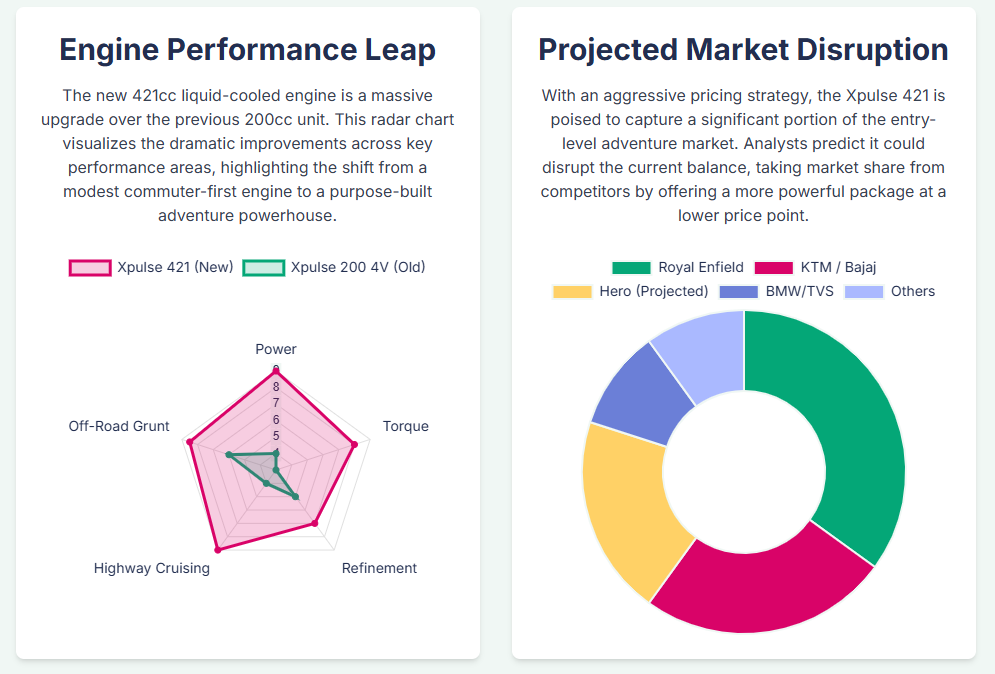
The decision to equip the Xpulse 421 with this high level of electronic sophistication is a potent market disruption strategy. The Himalayan 450 offers switchable engine modes (Performance/ECO) and rear ABS deactivation 28, but it lacks systems like Traction Control and Cruise Control.15 Conversely, the KTM 390 Adventure offers robust electronics but starts at a significantly higher price.11 By offering the technology package typically associated with the premium KTM (including TC and potentially CC) but anchoring the starting price at an ultra-aggressive ₹2.40 Lakhs 30, Hero is aggressively weaponizing advanced features as its core value differentiator. This strategy targets the technologically demanding, budget-conscious customer who previously had to choose between affordability (Himalayan) and advanced features (KTM). The Xpulse 421 aims to satisfy both requirements simultaneously, effectively creating a new, highly competitive performance-value segment.
V. Competitive Benchmarking: Defining the Mid-Capacity ADV Hierarchy
The entry of the Xpulse 421 forces a restructuring of the mid-capacity adventure touring segment, challenging established market leaders based on price, weight, and electronic integration.
A. Head-to-Head: Hero Xpulse 421 vs. Royal Enfield Himalayan 450
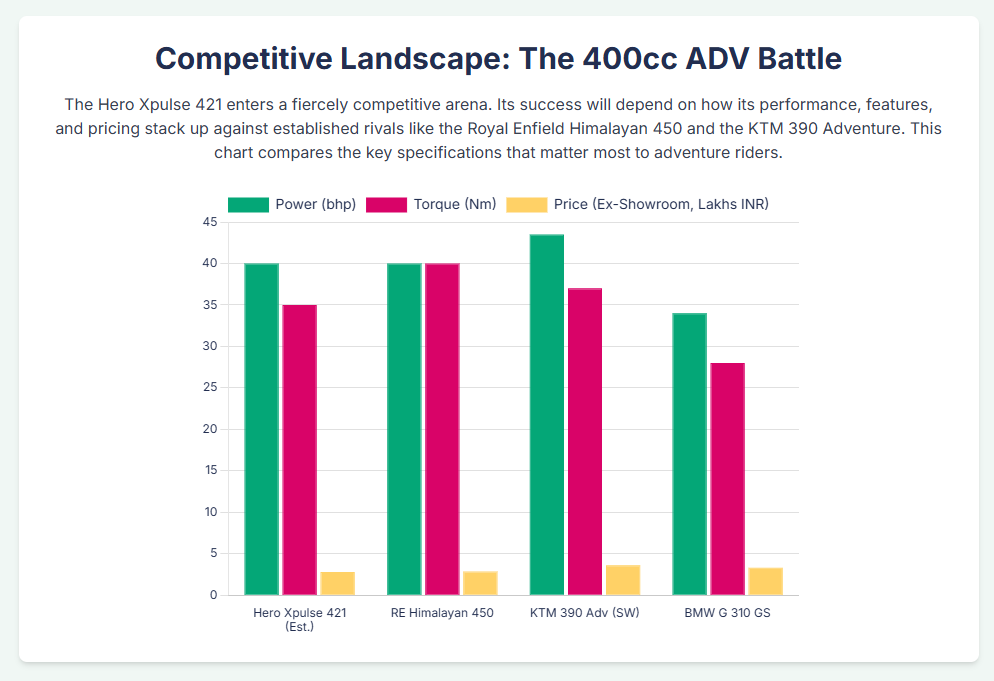
The Royal Enfield Himalayan 450 is the Xpulse 421’s most direct and significant rival. Both motorcycles utilize liquid-cooled engines designed for performance touring, with similar target outputs. The Himalayan 450’s 452cc engine produces 39.5 HP and 40 Nm 11, closely matched by the Xpulse 421’s estimated 40–45 HP and 40–45 Nm.5 This performance parity confirms both manufacturers are moving toward modern engine architectures required for high-speed highway cruising and sustained performance.
However, the differences in chassis and technology offer distinct user propositions. The Xpulse 421’s projected kerb weight (175–185 kg) provides a substantial weight advantage of 11 to 21 kg over the Himalayan 450 (196 kg).15 This lower mass translates into superior off-road handling agility and a lower likelihood of rider fatigue, positioning the Hero as the choice for highly technical riding. Furthermore, the Xpulse 421 is expected to offer crucial electronic aids such as Traction Control and potentially Cruise Control that the Himalayan 450 currently does not.5
The ultimate point of differentiation is the pricing gulf. The Xpulse 421’s estimated ex-showroom starting price of ₹2.40 Lakhs 30 substantially undercuts the Himalayan 450, which begins around ₹2.69 Lakhs and ranges up to ₹3.05 Lakhs depending on the variant and color.11 This price delta, coupled with the projected feature superiority, presents a serious disruptive challenge to Royal Enfield’s market dominance.
B. The Performance Alternative: Hero Xpulse 421 vs. KTM 390 Adventure
Compared to the KTM 390 Adventure, the Xpulse 421 offers a larger displacement engine (421cc vs 373.3cc).11 While the KTM remains the peak horsepower leader in this category (42.9 HP), the Xpulse 421 compensates by generating superior estimated torque (40–45 Nm vs KTM’s 37 Nm).5 This focus on torque delivery suggests the Xpulse 421 will feel more responsive at lower engine speeds, favoring tractable off-road grunt over the high-revving nature of the KTM engine.
The most aggressive element of the Xpulse 421’s strategy is its feature-matching ability at a lower cost. By including features like RbW, switchable Traction Control, Quick-shifter, and Cruise Control 5, the 421 directly competes with the KTM’s historically superior electronics package.29 Yet, the KTM 390 Adventure commands a significantly higher price, with variants starting around ₹2.81 Lakhs and extending up to ₹3.61 Lakhs.11 The Xpulse 421 aims to deliver a comparable, if not technically superior, feature set for a considerable discount.
C. Segment Redefinition and Value Convergence
The Hero Xpulse 421’s aggressive positioning is anticipated to redefine the mid-capacity ADV market. Previously, the segment was dichotomous: affordable utility (like the older Himalayan 411) versus expensive technological prowess (KTM).11 The Xpulse 421 merges these two offerings by utilizing Hero’s core competency in value engineering (affordability) with globally mandated premium components (DOHC liquid-cooled engine, USD forks, and KTM-level electronics).5 This convergence creates a new standard where consumers expect sophisticated electronics and high-end componentry as standard features at a sub-₹2.5 Lakh price point. This paradigm shift will exert immense competitive pressure on rivals, particularly those in the 250cc-400cc segments (such as the Suzuki V-Strom SX or TVS Apache RTX 300), compelling them to rapidly integrate similar advanced features or face competitive obsolescence.33
Table V.1: Competitive Specification Benchmarking (Mid-Capacity ADV Segment)
| Specification | Hero Xpulse 421 (Est.) | RE Himalayan 450 | KTM 390 Adventure (Base) | BMW G 310 GS |
| Displacement (cc) | 421 5 | 452 11 | 373.3 11 | 313 35 |
| Max Power (HP/BHP) | 40–45 HP 5 | 39.5 HP 11 | 42.9 HP 11 | 33.5 HP 35 |
| Max Torque (Nm) | 40–45 Nm 5 | 40 Nm 11 | 37 Nm 11 | 28 Nm (Est.) |
| Kerb Weight (kg) | 175–185 (Est.) 15 | 196 15 | ~177 (Est.) | 175 (Est.) |
| Front Suspension | USD Forks 2 | USD Forks (Showa) 15 | USD Forks (WP) 29 | USD Forks |
| Traction Control (TC) | Expected 5 | No | Yes (Advanced) | No |
| Cruise Control (CC) | Expected 5 | No | Yes | No |
| Est. Ex-Showroom Price (INR Lakhs) | ₹2.40 30 | ₹2.69 – ₹3.05 11 | ₹2.81 – ₹3.61 11 | ₹3.25 – ₹3.36 11 |
VI. Launch Strategy, Market Outlook, and Risk Assessment
A. Launch Timeline and Pricing Strategy
The timeline for the Xpulse 421 has been clearly laid out through official teasers and regulatory filings. The motorcycle was first showcased in concept/sketch form at the EICMA 2024 show in Milan, marking its international significance.1 Subsequently, design trademarks were officially filed in India.2 The production-ready version is anticipated to debut by late 2025, with sales tentatively commencing in the Indian and global markets in early 2026, specifically citing February 2026 as an expected launch month.14
The cornerstone of the market entry strategy is its extremely aggressive pricing. Industry consensus places the estimated ex-showroom price consistently at ₹2.40 Lakhs across major metropolitan centers (including Pune, Mumbai, Delhi, and Chennai).30 This price point serves a dual purpose: it aims to maximize the value quotient for domestic riders by offering premium specifications at an accessible rate, and critically, it establishes the Xpulse 421 as the most competitively priced, feature-rich motorcycle in the 400cc ADV segment, drastically undercutting the Himalayan 450.31
B. The Global Expansion Pivot
The Xpulse 421 is deeply integrated into Hero MotoCorp’s overarching strategy for global diversification and premium market entry. As one of the world’s largest motorcycle manufacturers by volume, Hero’s focus has historically been confined to Asia, Africa, and South America.1 The 421 is intended to be the standard-bearer for the push into the technologically demanding and high-income markets of Europe and the UK, with this expansion expected to commence in the second half of 2025.1
The company is actively securing its distribution infrastructure across key target regions. Distribution agreements are already established or underway in Italy (via Pelpi International S.r.l.), Germany, France, and Spain.3 The credibility required to succeed in these performance-conscious markets is partially drawn from Hero’s significant involvement in the Dakar Rally, providing the 421 with a genuine rally-inspired design lineage and engineering pedigree.1
The utilization of a globally compliant platform, mandated by the European export strategy, dictates the inclusion of premium components such as the DOHC liquid-cooled engine, USD forks, and advanced electronics (Traction Control, RbW).17 These features are inherently costlier than those found on Hero’s traditional lineup. However, the analysis suggests that the aggressive domestic pricing (estimated at ₹2.40 Lakhs) is a direct consequence of Hero leveraging its enormous global manufacturing scale and standardized production methods. By building the Xpulse 421 to a high, global technical standard required for export and applying this manufacturing efficiency to the domestic supply chain, Hero can minimize per-unit costs and offer an unprecedented feature-to-price ratio in India. This move positions the Indian price as a strategic, aggressive value anchor aimed at rapidly gaining domestic volume and market disruption, regardless of initial margin profiles. The objective is clear: establish the Xpulse 421 as the value benchmark both at home and as Hero expands its international footprint.
Table VI.1: Hero MotoCorp’s Strategic Transition
| Strategic Pillar | Current State (Pre-421) | Future State (Post-421 Launch) | Key Driver/Implication |
| Domestic Focus | Small-capacity, air-cooled volume leader (5.9M units/yr) 1 | Diversification into mid-capacity, high-margin premium segment. | Establish credibility in the 400cc+ performance category. |
| Export Strategy | Primarily South Asia, Africa, Latin America (5.7% revenue contribution) 38 | Aggressive entry into demanding European markets (Germany, UK, Italy) starting 2H 2025. | Xpulse 421 is the globally compliant standard-bearer (A2 license). |
| Technical Standard | Older generation, air-cooled, simple engines (e.g., Mavrick 440) 1 | Adoption of modern liquid-cooled DOHC architectures and advanced rider aids (RbW, TC, Cruise Control). | Eliminating the feature gap against global competitors (KTM, BMW). |
| Pricing Strategy | Value and affordability in commuter segment. | Aggressive value disruption in the premium segment (₹2.40 Lakhs estimated base price). | Undercutting rivals to achieve rapid volume and market disruption. |
C. Risk Assessment and Mitigation
Despite the promising technical package and strategic pricing, the launch of the Xpulse 421 faces two principal risks related to operational execution and brand perception.
First, the Technical Reliability Risk is inherent when introducing an entirely new, complex liquid-cooled DOHC engine platform. As discussed, the high-stress, high-performance nature of this design, a significant departure from Hero’s historical expertise, elevates the possibility of initial production or engineering issues, a phenomenon often described as the “beta tester” syndrome for early customers.6 Mitigation requires an unwavering dedication to quality control and highly rigorous pre-launch validation processes.
Second, the Service Network Competence Risk poses a major operational challenge. Hero MotoCorp possesses an unrivaled, expansive domestic service network, but its personnel are extensively trained for the relative mechanical simplicity of low-complexity, air-cooled motorcycles. The rapid training and deployment of technical expertise required to reliably diagnose and repair complex systems—including liquid-cooled engines, ride-by-wire throttles, and sophisticated electronic rider aids (Traction Control, Cruise Control, TFT displays)—across thousands of touchpoints in India will be an immense logistical and financial undertaking.6 Failure to rapidly scale this technical competence risks undermining the quality perception of the premium product, jeopardizing Hero’s ability to transition its brand image from a budget commuter manufacturer to a credible global ADV player.17
VII. Conclusion: The Market Disruptor
The Hero Xpulse 421 represents Hero MotoCorp’s most ambitious and meticulously engineered challenge yet to the mid-capacity adventure motorcycle segment. Strategically, the motorcycle is engineered for global competitiveness, leveraging a lighter, rally-inspired chassis built around a new 421cc liquid-cooled DOHC engine platform delivering a projected 40–45 HP.1 This technical foundation is overlaid with an unexpectedly comprehensive suite of advanced electronics, including Traction Control and Ride-by-Wire, which effectively match the technology offered by high-performance rivals like KTM.5
The confluence of sophisticated engineering and Hero’s manufacturing scale has culminated in the aggressive estimated ex-showroom price of ₹2.40 Lakhs.30 This strategic pricing aims to disrupt the existing segment hierarchy by delivering a lighter, more agile, and technologically superior package than the Royal Enfield Himalayan 450, at a substantially lower cost.
Ultimately, the successful launch and sustained market performance of the Xpulse 421 will be the definitive barometer for Hero MotoCorp’s future success in the premium, global motorcycle segments. If the company effectively mitigates the operational risks associated with launching a new engine platform and successfully scales its service network to handle advanced technology, the Xpulse 421’s unique combination of aggressive value and premium feature content is poised to redefine the segment standard for years to come.
Sources
- Hero XPulse 421 on Its Way | Cycle World, accessed on October 20, 2025, https://www.cycleworld.com/motorcycle-news/hero-xpulse-421-coming-soon/
- Hero Xpulse 421, Expected Price Rs. 2,40,000, Launch Date & More Updates – BikeWale, accessed on October 20, 2025, https://www.bikewale.com/hero-bikes/xpulse-421/
- Hero To Enter UK & Europe In Q2 FY26 – MotorBeam, accessed on October 20, 2025, https://www.motorbeam.com/hero-to-enter-uk-europe-in-q2-fy26/
- This Adventure Bike Could Be The Royal Enfield Himalayan’s Biggest Nemesis – Top Speed, accessed on October 20, 2025, https://www.topspeed.com/hero-xpulse-421-patented/
- Hero Xpulse 421 Confirmed Specs: 421cc Engine, Price & Launch Timeline, accessed on October 20, 2025, https://karavaliinstituteoftechnology.com/hero-xpulse-421-confirmed-specs-421cc-engine-price-launch-timeline/
- Should i wait or should i go for the himalayan 450 : r/indianbikes – Reddit, accessed on October 20, 2025, https://www.reddit.com/r/indianbikes/comments/1i9l0eq/should_i_wait_or_should_i_go_for_the_himalayan_450/
- 2025 Hero XPulse 421 Specifications and Expected Price in India – Maxabout Cars, accessed on October 20, 2025, https://autos.maxabout.com/bikes/hero/xpulse/xpulse-400
- Hero XPulse 421 design trademarked ahead of global unveil. Check details | HT Auto, accessed on October 20, 2025, https://auto.hindustantimes.com/auto/two-wheelers/hero-xpulse-421-design-trademarked-ahead-of-global-unveil-check-specs-features-price-on-road-price-launch-41735448020198.html
- Hero MotoCorp Karizma XMR Review – Team-BHP, accessed on October 20, 2025, https://www.team-bhp.com/forum/motorbikes/270280-hero-motocorp-karizma-xmr-review.html
- Hero’s new motorcycle’s design patented. Is this the Karizma 421? – HT Auto, accessed on October 20, 2025, https://auto.hindustantimes.com/auto/two-wheelers/heros-new-motorcycles-design-patented-is-this-the-karizma-421-41735616844627.html
- Royal Enfield Himalayan 450 vs KTM 390 Adventure vs BMW G 310 GS: Specs, price compared – The Times of India, accessed on October 20, 2025, https://timesofindia.indiatimes.com/auto/bikes/royal-enfield-himalayan-450-vs-ktm-390-adventure-vs-bmw-g-310-gs-specs-price-compared/articleshow/105580499.cms
- Hero Xpulse 421 Sketch Officially Revealed – KTM 390, Himalayan 450 Rival – RushLane, accessed on October 20, 2025, https://www.rushlane.com/hero-xpulse-421-sketch-revealed-features-new-engine-12511091.html
- Riding the New Himalayan 450: A First-Gen Owner’s Impressions – ADV Pulse, accessed on October 20, 2025, https://www.advpulse.com/adv-news/exploring-utah-royal-enfield-himalayan-450/
- Hero XPulse 421 Specifications, Features, Mileage, Weight, Tyre Size – BikeDekho, accessed on October 20, 2025, https://www.bikedekho.com/hero/450-adv/specifications
- Hero XPulse 421 vs Royal Enfield Himalayan 450: Which Adventure Bike Reigns Supreme?, accessed on October 20, 2025, https://www.drivio.in/reviews/hero-xpulse-421-vs-royal-enfield-himalayan-450-which-adventure-bike-reigns-supreme
- Hero Xpulse 421 Design Trademark Filed – carandbike, accessed on October 20, 2025, https://www.carandbike.com/news/hero-xpulse-421-design-trademark-filed-3215596
- Hero XPulse 421 designs revealed – Australian Motorcycle News, accessed on October 20, 2025, https://amcn.com.au/editorial/hero-xpulse-421-designs-revealed/
- Hero Xpulse 421 To Rival Royal Enfield Himalayan 450 And KTM Adventure 390: Patent Images Surface – Cartoq, accessed on October 20, 2025, https://www.cartoq.com/bike-news/hero-xpulse-421-patent-images-surface-rivaling-royal-enfield-himalayan-450-ktm-adventure-390/
- Could The Upcoming Hero XPulse 421 Become Harley’s Baby Pan America?, accessed on October 20, 2025, https://windburnedeyes.com/could-the-hero-xpulse-421-become-a-harley/
- Hero XPulse Updates – Maxabout Cars, accessed on October 20, 2025, https://autos.maxabout.com/bikes/hero/xpulse/updates
- Hero Xpulse 200 4V vs Hero Xpulse 421 – Know Which Is Better! – BikeWale, accessed on October 20, 2025, https://www.bikewale.com/compare-bikes/hero-xpulse-200-4v-vs-hero-xpulse-421/
- Xpulse 200’s High Ground Clearance and Adventure Suspension for Filipino Explorers, accessed on October 20, 2025, https://www.heromotocorp.com/en-ph/blogs/xpulse-200s-high-ground-clearance-and-adventure-suspension-for-filipino-explorers.html
- 2026 Hero Xpulse 421 Rendered Based On Leaked Patent – New Colours – RushLane, accessed on October 20, 2025, https://www.rushlane.com/2026-hero-xpulse-421-rendered-based-on-leaked-patent-12519990.html
- Xpulse 421 : r/indianbikes – Reddit, accessed on October 20, 2025, https://www.reddit.com/r/indianbikes/comments/1jewnx6/xpulse_421/
- “2026 Hero XPulse 421 – Specs, Features, Launch Date & Price!” – YouTube, accessed on October 20, 2025, https://www.youtube.com/watch?v=60uaB7gcQBk
- Hero Xpulse 421 – What do we know so far? – BikeWale, accessed on October 20, 2025, https://www.bikewale.com/news/hero-xpulse-421-what-do-we-know-so-far/
- Explore More with the Festive Offer on Xpulse 200 4V – Hero MotoCorp, accessed on October 20, 2025, https://www.heromotocorp.com/en-in/motorcycles/performance/xpulse-200-4v.html
- Himalayan 450 Bike Features Guide – Rider Assist | Royal Enfield India, accessed on October 20, 2025, https://www.royalenfield.com/uk/en/after-sales/digital-quickstart/new-himalayan/rider-assist/
- KTM 390 Adventure vs Royal Enfield Himalayan 450 – Know Which Is Better! – BikeWale, accessed on October 20, 2025, https://www.bikewale.com/compare-bikes/ktm-390-adventure-vs-royalenfield-himalayan/
- Hero Xpulse 421 On Road Price in Pune – BikeWale, accessed on October 20, 2025, https://www.bikewale.com/hero-bikes/xpulse-421/price-in-pune/
- Hero Xpulse 421 vs Royal Enfield Himalayan 450 – Know Which Is Better! – BikeWale, accessed on October 20, 2025, https://www.bikewale.com/compare-bikes/hero-xpulse-421-vs-royalenfield-himalayan/
- 2025 KTM 390 Adventure X vs BMW G 310 GS vs Royal Enfield Himalayan 450: specifications compared – Autocar India, accessed on October 20, 2025, https://www.autocarindia.com/auto-features/2025-ktm-390-adventure-x-vs-bmw-g-310-gs-vs-royal-enfield-himalayan-450-specifications-compared-434506
- Hero XPulse 421, Estimated Price Rs 2.40 Lakh, Launch Date 2025, Specs, Images, News, Mileage @ ZigWheels, accessed on October 20, 2025, https://www.zigwheels.com/hero-bikes/450-adv
- Hero XPulse 421 Expected Price (2.4 Lakhs), Launch Date, Booking Details – HT Auto, accessed on October 20, 2025, https://auto.hindustantimes.com/new-bikes/hero/xpulse-421
- BMW G 310 GS vs Royal Enfield Himalayan 450 – Know Which Is Better! – BikeWale, accessed on October 20, 2025, https://www.bikewale.com/compare-bikes/bmw-g-310-gs-vs-royalenfield-himalayan/
- Hero XPulse 421 Price in Pune Starts at INR 2,40,000 – BikeDekho, accessed on October 20, 2025, https://www.bikedekho.com/hero/450-adv/price-in-pune
- Hero MotoCorp Enters Italy with Pelpi International – Rediff Money, accessed on October 20, 2025, https://money.rediff.com/news/market/hero-motocorp-enters-italy-with-pelpi-international/35244320251013
- Hero MotoCorp Set to Enter UK & Europe with Electric Push – HDFC Ergo, accessed on October 20, 2025, https://www.hdfcergo.com/news/two-wheeler-insurance/hero-motocorp-set-to-enter-uk-europe-with-electric-push
Our Social Media Handles
- Instagram : LivingWithGravity
- Medium : Akash Dolas
- YouTube Channel : Gear and Shutter
- Facebook : LivingWithGravity