








Strategic Market Analysis: The 2026 Kawasaki Z900 – Price Stabilization and Sustained Performance in the Indian Middleweight Segment
I. Executive Summary: The Strategic Repositioning of the 2026 Z900
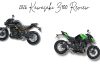
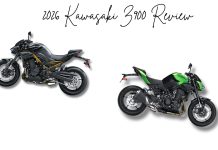
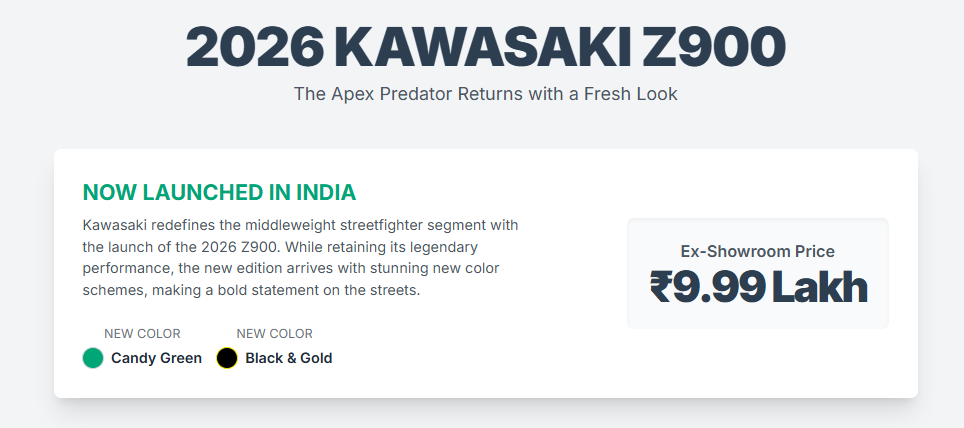
The launch of the 2026 Kawasaki Z900 in the Indian market represents a highly focused commercial strategy rather than a mechanical overhaul. The middleweight streetfighter is positioned at an aggressive ex-showroom price of ₹9.99 Lakh.1 Crucially, the motorcycle remains fundamentally unchanged from its predecessor, carrying forward the same engine, mechanical architecture, and comprehensive electronic package introduced in the heavily updated 2025 model year.1 The differentiation for MY2026 is confined entirely to aesthetics, with the introduction of two new color schemes: Candy Green, and Black featuring a distinctive Gold frame.1
I.A. Core Launch Metrics and Continuity
The 2026 Z900 maintains its established identity in the market. The continuity of the mechanical and electronic specifications signifies that the platform, having received a substantial technology injection in 2025 (including an IMU, ride-by-wire, and a bi-directional quickshifter), is deemed mature and competitive for the current market cycle.1 This approach minimizes re-homologation and R&D costs, allowing the brand to focus on pricing optimization.
The new visual treatments, particularly the resurrection of the iconic Candy Lime Green and the highly contrasted Black with Gold frame, serve to refresh the model’s appeal and differentiate new inventory.4 In a segment where visual impact is a key purchase driver, this tactic enables Kawasaki to generate renewed interest without altering the underlying core product that has proven popular globally.
I.B. Analysis of the Price Reset Strategy (The Sub-₹10 Lakh Barrier)
The most significant aspect of the 2026 Z900 launch is its strategic pricing at ₹9.99 Lakh (ex-showroom). This price is not merely a number but a calculated market defense maneuver. Analysis of recent price movements indicates that the price had previously climbed to ₹10.18 Lakh.6 This previous increase was a direct consequence of the revised Goods and Services Tax (GST 2.0) structure in India, which mandated higher tax rates for motorcycles exceeding 350cc displacement, pushing the applicable tax bracket from 31 percent to 40 percent.7
Kawasaki’s decision to launch the 2026 model at ₹9.99 Lakh—representing a decrease of ₹19,000 compared to the previously inflated price—is a clear commitment to maintaining the motorcycle’s perceived value-for-money (VFM) leadership.6 By actively working to bring the Z900 back under the critical ₹10 Lakh psychological threshold, the company mitigates potential customer resistance that often accompanies prices entering the higher tier of the premium segment. This strategic choice underlines the importance of the Z900 as one of Kawasaki’s bestselling models in India, suggesting a preference for maximizing accessible market volume and defending the segment leadership rather than attempting to maximize marginal profit per unit.6
I.C. Z900’s Foundational Value Proposition
The Z900’s underlying value proposition remains robust. It offers the largest engine capacity (948cc) and the highest torque output (98.6 Nm) in its immediate price band, challenging rivals that often rely on smaller displacement engines.8 Furthermore, the retention of the sophisticated electronic package—including the Inertial Measurement Unit (IMU), Cruise Control, and the bi-directional quickshifter—ensures that the Z900 offers technological parity, or even superiority, when compared to equally priced or marginally more expensive naked motorcycles from competitors like Triumph and Ducati, which feature similar IMU-based safety aids.1 This blend of powerful, large-capacity engine and modern electronics is the cornerstone of its market dominance.
II. Product Deep Dive: Engine Performance and Chassis Integrity
The mechanical composition of the 2026 Z900 is built upon a proven and critically acclaimed foundation, meaning the absence of mechanical updates is not a limitation but rather a validation of the existing design’s efficacy.
II.A. Engine Architecture and Smooth Power Delivery
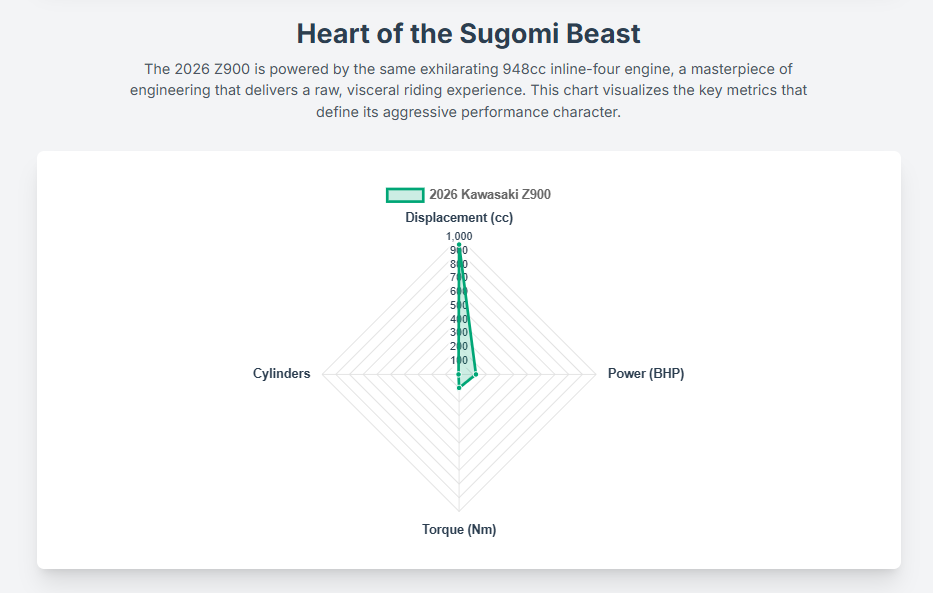
The Z900 continues to be powered by the renowned 948cc, liquid-cooled, inline 4-cylinder engine.1 This unit is factory-rated to produce 125 PS (123 BHP) at 9,500 rpm and a substantial 98.6 Nm of torque delivered at 7,700 rpm, paired with a 6-speed gearbox.1
The engine’s inherent character is a significant differentiating factor. The inline-four configuration provides a uniquely smooth and highly linear delivery of power throughout the entire rev range.12 This smoothness enhances everyday rideability, as evidenced by owner feedback confirming the bike is comfortable cruising in sixth gear at speeds as low as 55 km/h, offering a high degree of flexibility that is beneficial in congested urban environments.14 This refined, progressive thrust contrasts markedly with the explosive, often described as “brutal,” torque characteristics of triple-cylinder alternatives, providing an approachable yet exhilarating power delivery that is highly valued by many enthusiasts.13
The engine’s underlying technology was refined in 2025 to meet stringent Euro 5 emissions standards, incorporating a ride-by-wire system.3 This technological inclusion reportedly contributed to an impressive 16 percent reduction in fuel consumption under controlled test environments.12 However, practical, real-world mileage reported by owners generally falls between 17 to 22 kmpl, or 6.0 to 6.5 litres per 100 km, reflecting the aggressive riding patterns often employed by owners of such performance machinery.12
II.B. Chassis, Suspension, and Braking Systems
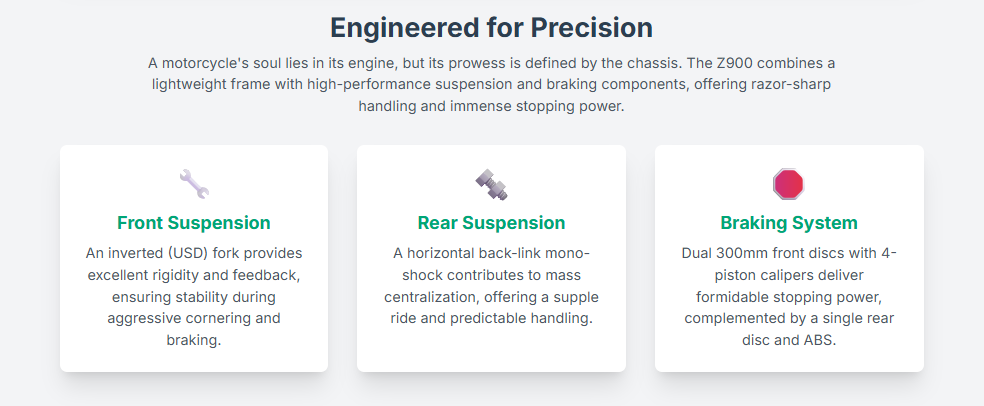
The chassis architecture, built around a high-tensile steel trellis frame 4, is designed for easy maneuverability and high stability.16 Suspension components carried over include the USD (Upside Down) fork at the front and a gas-charged mono-shock at the rear, offering adjustability to tailor the ride characteristics.4 While the bike is generally praised for its stable and communicative handling, reviewers have noted that the base model’s suspension setup can feel “a little stiff on poor asphalt,” suggesting that riders frequently navigating rough Indian roads might desire further adjustment or component upgrades to optimize comfort.12
The braking system comprises an upgraded setup of dual 300 mm front discs managed by 4-piston calipers and a single rear disc.1 The stock Nissin calipers provide “more than adequate” stopping power for typical street use.5 For owners seeking incremental performance enhancements, particularly for track usage, the Z900 platform is notably adaptable. Enthusiast communities confirm that high-performance Brembo calipers can be directly bolted onto the stock mounts without requiring modifications or causing adverse effects on the vehicle’s sophisticated ABS or Electronic Power Steering (EPS) systems, offering a clear pathway for performance customization.5
II.C. Aesthetic and Color Strategy (MY2026 Differentiation)
Since the mechanical package is unchanged, visual differentiation becomes the primary marketing tool for the 2026 model year. Kawasaki has introduced two fresh liveries: Candy Lime Green with Metallic Carbon Grey, and Metallic Matte Graphene Steel Grey with Metallic Flat Spark Black.2 The latter is often recognized by owners as the “Black with a Gold frame” option referenced in the initial query, due to the distinctive brass or gold highlights on the trellis frame.5
The reintroduction of the vibrant Candy Lime Green is significant, as this signature Kawasaki shade was absent from the prior year’s lineup.4 By leveraging these new color schemes, particularly the eye-catching green and the contrasted gold-on-black theme, Kawasaki effectively revitalizes the model’s presence in showrooms. This approach allows the brand to manage the residual value of existing MY2025 stock while providing a compelling new aesthetic reason for customers to choose the MY2026 iteration, achieving market refreshment with minimal investment.4
III. Electronic Suite Analysis: The 2025 Technology Foundation
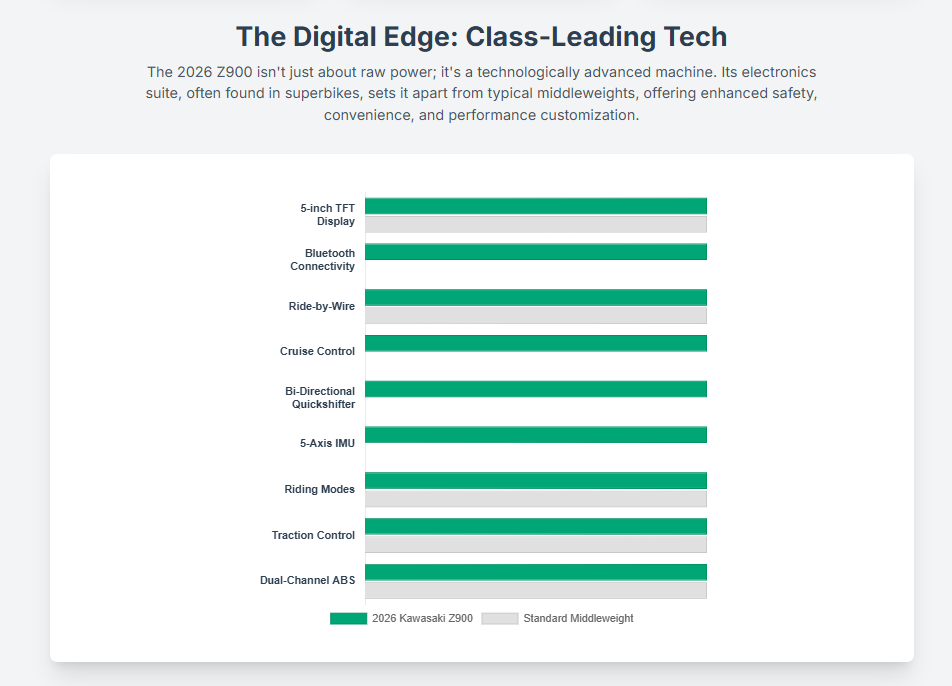
The integration of a sophisticated electronic package, adopted during the 2025 update, remains the Z900’s primary technological defense against competitors. The full suite of aids is carried over for 2026, offering riders a comprehensive array of safety and convenience features uncommon for a motorcycle at this price point.
III.A. IMU-Based Control Systems
The 2026 Z900 features a 5-axis Inertial Measurement Unit (IMU), which measures the motorcycle’s real-time position, acceleration, and lean angle in space.1 This technology is foundational for enabling lean-sensitive safety features, specifically Cornering ABS and switchable Optimized Cornering Traction Control (KTRC).1
Performance evaluations of the IMU systems highlight their effectiveness. The Traction Control system is specifically designed to keep the motorcycle highly stable and “very planted during hard acceleration,” reducing the tendency for aggressive wheelies in controlled modes.19 Furthermore, the ABS implementation is critically praised for its non-conservative tuning. Unlike some systems that intervene too early and compromise stopping distance, the Z900’s ABS builds up substantial braking force, offering robust deceleration and excellent stopping power under dynamic conditions.20 This high level of electronic integration provides a significant enhancement in safety and ride confidence, especially when navigating unexpected road conditions.
III.B. Ride Modes and Throttle Management
The Z900’s electronic control unit provides four distinct Riding Modes: Sport, Road, Rain, and a fully customizable Rider mode. These modes are complemented by two Power Modes (Low and Full).21 This functionality is facilitated by the introduction of the ride-by-wire (RBW) throttle system.1
The transition to RBW, necessary for the implementation of cruise control and multiple power maps, marked a crucial modernization of the platform. Although some enthusiasts prefer the ultra-direct tactile feedback of a traditional throttle cable 22, the current RBW system in the Z900 is noted for having “excellent throttle response” and minimal delay.12 This balance ensures the bike remains highly manageable while unlocking the potential for advanced electronic governance.
III.C. Bi-Directional Quickshifter and Cruise Control
Standard equipment on the 2026 Z900 includes a bi-directional quickshifter (QS), which incorporates a blipper function for clutchless upshifts and downshifts.1 The quickshifter has been positively reviewed, consistently described as “precise and smooth,” operating harmoniously across both partial and full throttle applications.12 A minor operational detail noted during testing is the requirement for the throttle to be fully closed during downshifts.12
Equally significant for everyday usability is the inclusion of Cruise Control (CC).1 The demand for this feature had been growing among owners, particularly those who use the Z900 for long-distance touring, and its inclusion in the 2025 model (and carried over to 2026) significantly enhances the motorcycle’s overall touring versatility and comfort.23
IV. Competitive Landscape: Power, Price, and Features Benchmarking
The Kawasaki Z900 is strategically positioned in a highly contested segment, often referred to as the premium middleweight naked class. Its positioning is defined by its substantial engine capacity and high power output, offered at a price point that aggressively challenges smaller-capacity rivals.
IV.A. Segment Overview and Pricing Hierarchy
The Z900 competes directly against models such as the Triumph Street Triple 765, the Honda CB650R, and the Ducati Monster. The decision to reset the Z900’s ex-showroom price to ₹9.99 Lakh ensures it remains competitive by undercutting or closely matching its main rivals, while offering a considerable advantage in engine capacity and peak torque.9
For context, the Triumph Street Triple 765 R is priced slightly higher, around ₹10.17 Lakh ex-showroom.24 The Honda CB650R, though offering a unique E-Clutch technology in its latest variant, is priced at ₹9.60 Lakh ex-showroom for that variant, demonstrating a close pricing battle where the Kawasaki offers a vast advantage in power and torque for a marginal difference in cost.8 Ducati’s offering, the Monster (937cc), begins at a significantly higher entry price point, often exceeding ₹12.50 Lakh.26
IV.B. Technical Head-to-Head Comparison
While the Z900 boasts superior peak power (125 PS) and torque (98.6 Nm) due to its larger 948cc engine, the analysis of power-to-weight metrics introduces complexity. The Triumph Street Triple R, despite its smaller 765cc engine and lower peak outputs (120 PS and 80 Nm), is notably lighter. This difference results in the Triumph achieving a superior power-to-weight ratio of 634 hp/tonne, compared to the Z900’s 586 hp/tonne.9 For pure, explosive agility and handling, the lighter, Moto2-derived triple-cylinder may appeal more to performance-focused riders.
However, the Z900’s inclusion of the IMU in its electronic suite effectively closed a major technological gap that previously favored premium European manufacturers.10 The Z900 now offers cornering safety aids, matching the technology found in the Triumph Street Triple and Ducati Monster.10 In contrast, the Honda CB650R lacks IMU-based cornering capabilities, positioning it as the least electronically advanced option regarding fundamental safety aids within this group.25
Table 4: Competitive Benchmarking: Key Technical Specifications (India Market)
| Model | Engine Configuration | Displacement (cc) | Power (PS/HP) | Torque (Nm) | IMU/QS | Ex-Showroom Price (INR) |
| Kawasaki Z900 (2026) | Inline-4 | 948 | 125 PS | 98.6 | Yes (5-axis/Bi-QS) | 9,99,000 |
| Triumph Street Triple R | Inline-3 | 765 | 120 PS | 80.0 | Yes (IMU/Bi-QS) | ~10,17,000 |
| Honda CB650R (E-Clutch) | Inline-4 | 649 | 95 PS | 63.0 | No IMU/E-Clutch option | ~9,60,000 |
| Ducati Monster | V-Twin | 937 | 111 HP | 93.0 | Yes (IMU/QS) | ~12,50,000+ |
V. Ownership Economics and Maintenance Viability in India
The cost of motorcycle ownership in India extends significantly beyond the ex-showroom price, influenced heavily by regulatory fees and maintenance expenses typical of large-capacity imported motorcycles (CKD/CBU). A thorough understanding of these figures is necessary for prospective buyers.
V.A. Total On-Road Price Decomposition
The strategic ex-showroom price of ₹9.99 Lakh serves as the foundational anchor for marketing, but the final transactional cost for the consumer is considerably higher. Regulatory costs, particularly the Road Transport Office (RTO) charges, which often comprise a high percentage of the base cost for superbikes, move the final price point well outside the sub-₹10 Lakh bracket.
For instance, using data from the Pune market, the final estimated on-road price for the Z900 reaches ₹11,52,396.27 This figure is comprised of the ex-showroom price, an RTO charge of approximately ₹1,19,880, and comprehensive insurance estimated at ₹33,516.27 This decomposition demonstrates that while Kawasaki can control the initial price to meet a psychological barrier, the high state taxation is the predominant factor driving the final cost to the consumer. Based on this on-road price, the estimated Equated Monthly Installment (EMI) for a standard 36-month tenure in Pune is approximately ₹31,560.27
Table 5: 2026 Kawasaki Z900: Pricing and Estimated On-Road Cost Breakdown (Pune Example)
| Component | Price (INR) | Context/Notes |
| Ex-Showroom Price | 9,99,000 | Strategic price point under ₹10 Lakh barrier 27 |
| RTO (Registration & Taxes) | 1,19,880 | Based on Pune data (approx. 12%) 27 |
| Insurance (Comprehensive) | 33,516 | Estimate based on Pune data 27 |
| Estimated On-Road Price | 11,52,396 | Price in Pune, subject to local taxes and dealer charges 27 |
| Estimated EMI (36 Months) | ₹31,560 | Calculated based on Pune On-Road Price 27 |
V.B. Warranty and Service Structure
To enhance buyer confidence in a premium CKD motorcycle, Kawasaki India has recently standardized its warranty coverage. All road-legal models, including the Z900, now come with a standard warranty of 3 years or 36,000 km, representing an extension from the previous 2-year period.28 This improved warranty package adds significant perceived value to the purchase.
Regarding service, official guidelines in India mandate relatively frequent attention. The established service interval for the Z900 in India is 6 months or 6,000 km, even though official international manuals might suggest a longer interval of 12,000 km.30 This conservative local schedule, often necessitated by concerns regarding fuel quality or harsh operating environments, means higher frequency of dealership visits. Routine service, including oil and filter changes and general checks, is estimated to cost between ₹9,000 and ₹11,000.32 Beyond servicing, annual recurring costs include insurance (typically ₹25,000 to ₹30,000 for comprehensive coverage) and consumables like tires, which, depending on riding style, can cost upwards of ₹20,000 and may require replacement after only 12,000 km.33 Total annual maintenance costs, excluding major component failure, are projected to fall between ₹60,000 and ₹80,000, aligning closely with similar rivals like the Street Triple 765 R.33
V.C. Acquisition Timeline and Booking
The availability of the 2026 Z900 is set for immediate commencement, with deliveries officially scheduled to begin in late October 2025.34 Given the Z900’s perennial popularity, prospective buyers are strongly advised to contact their nearest Kawasaki dealership immediately, as the model’s demand often results in fluctuating waiting periods, a trend noted in previous launch cycles.35
VI. Market Reception, Owner Feedback, and Strategic Conclusion
Market reception to the Z900 platform, particularly since the 2025 electronic overhaul, has been overwhelmingly positive, focusing on its high performance and compelling price proposition.
VI.A. Enthusiast Reaction to VFM and Lack of Updates
The middleweight naked is frequently cited by enthusiasts as the “sensible thrill machine,” offering a nearly perfect balance of performance, value, and practicality.37 The inclusion of features such as cruise control in the latest iteration was especially well-received, addressing a significant deficiency for touring enthusiasts.23 The new aesthetic choices for the 2026 model, particularly the black livery accented with the gold trellis frame, have been praised by the community for their visual appeal.5
However, owner feedback collected over the years reveals several consistent points of friction, primarily concerning ergonomic and quality issues that Kawasaki has yet to resolve in this new model year:
- Ergonomics and Comfort: The stock rider seat is widely described as hard and too low, causing discomfort after relatively short rides (as little as 70 km).14 Taller riders, in particular, often consider the expensive Kawasaki Tall Seat accessory (costing approximately ₹14,800) a necessity rather than an option to comfortably undertake long journeys.14
- Vibration Issues: During sustained high-speed freeway riding (lasting an hour or more), discernible vibration through the clip-ons is a frequent complaint, leading to hand numbness for some riders.38
- Component Fragility: A persistent quality control issue cited by long-term owners is the fragility of the stock indicators, often necessitating expensive replacement, sometimes with aftermarket or non-OEM parts.14
VI.B. Strategic Implications of MY2026
The decision to limit the 2026 update strictly to cosmetic changes while executing an aggressive price reset is a highly sophisticated strategic maneuver centered on product stability and optimized cost control. By relying on the substantial mechanical and electronic investments made in the 2025 model year, Kawasaki avoids the expenditure and delays associated with new R&D, component sourcing changes, and regulatory re-homologation.7
This stable platform allows the brand to direct resources toward market positioning, specifically countering the adverse effects of India’s recent tax structure changes. The net result is a highly effective, high-volume model that uses its superior engine capacity and comprehensive electronics (IMU, Quickshifter) as a baseline competitive advantage for the next sales cycle. This strategy applies significant pricing pressure on its rivals, compelling them to either drop their own prices, which compromises their margins, or rely on offering highly superior components, such as the premium suspension and brakes found on higher-spec variants like the Triumph Street Triple RS, to justify their premium positioning over the Z900’s unparalleled power-to-price ratio.
VII. Conclusion
The 2026 Kawasaki Z900 launch in India is a masterclass in tactical market maintenance. By introducing fresh aesthetics and, more critically, strategically resetting the ex-showroom price back beneath the ₹10 Lakh barrier, Kawasaki successfully neutralizes the inflationary impact of the GST 2.0 tax hike, reaffirming the Z900’s established position as the undisputed value-for-money champion in the premium middleweight naked segment.
The motorcycle remains technologically current, leveraging the full IMU-based electronic suite, cruise control, and bi-directional quickshifter introduced in 2025. While mechanical and electronic continuity means the bike lacks new features, its core proposition—the unique blend of a silky, powerful 948cc inline-four engine and comprehensive rider aids at a highly competitive price—remains unmatched.
Kawasaki’s strategy confirms a commitment to volume dominance in India. For prospective buyers, the Z900 offers the most engine and technology for the price, provided they are prepared to address the well-documented minor ergonomic shortcomings through potential aftermarket accessories like a comfort seat. The combination of high performance, strong electronic safety governance, and a favorable three-year standard warranty positions the 2026 Z900 for continued success in a market defined by its sensitivity to both price and prestige.
Sources
- 2026 Kawasaki Z900 launched at Rs 9.99 lakh – Team-BHP, accessed October 18, 2025, https://www.team-bhp.com/news/2026-kawasaki-z900-launched-rs-999-lakh
- 2026 Kawasaki Z900 Launched In India – New Prices & Updates | Bike News – Times Now, accessed October 18, 2025, https://www.timesnownews.com/auto/bike-news/2026-kawasaki-z900-launched-in-india-new-prices-updates-article-153014867
- 2025 Kawasaki Z900 ABS and Z900 SE ABS First Look – Cycle World, accessed October 18, 2025, https://www.cycleworld.com/bikes/kawasaki-z900-first-look/
- 2026 Kawasaki Z900 launched at ₹9.99 lakh: Here’s what’s new | Hindustan Times, accessed October 18, 2025, https://www.hindustantimes.com/car-bike/2026-kawasaki-z900-launched-in-india-at-rs-9-99-lakh-check-price-specs-and-features-101760707749834.html
- 2026 Kawasaki Z900 launched at Rs 9.99 lakh – Team-BHP, accessed October 18, 2025, https://www.team-bhp.com/forum/superbikes-imports/300634-2026-kawasaki-z900-launched-rs-9-99-lakh.html
- 2026 Kawasaki Z900 launched at Rs 9.99 lakh – Autocar India, accessed October 18, 2025, https://www.autocarindia.com/bike-news/2026-kawasaki-z900-launched-at-rs-999-lakh-437892
- 2026 Kawasaki Z900 Launched In India: Price, Features, Specifications – ETV Bharat, accessed October 18, 2025, https://www.etvbharat.com/en/technology/2026-kawasaki-z900-launched-in-india-price-features-specifications-enn25101802272
- 2023 Kawasaki Z900 vs rivals: Price, specs comparison – Bike News | The Financial Express, accessed October 18, 2025, https://www.financialexpress.com/auto/bike-news/2023-kawasaki-z900-vs-rivals-price-specs-comparison/2671494/
- 2025 Kawasaki Z900 vs rivals: price and specifications compared – Autocar India, accessed October 18, 2025, https://www.autocarindia.com/auto-features/2025-kawasaki-z900-vs-rivals-price-and-specifications-compared-435578
- Street Triple 765 R Model | For the Ride – Triumph Motorcycles, accessed October 18, 2025, https://www.triumphmotorcycles.com/motorcycles/roadsters/street-triple-765/street-triple-765-r-2023
- Ducati Monster SP – Mad for Fun, accessed October 18, 2025, https://www.ducati.com/ww/en/bikes/monster/monster-sp
- Kawasaki Z900 2025 Review – Performance and Features – 1000PS.com, accessed October 18, 2025, https://www.1000ps.com/en-gb/article/3012291/kawasaki-z900-2025-review
- What do you think of the z900? : r/Kawasaki – Reddit, accessed October 18, 2025, https://www.reddit.com/r/Kawasaki/comments/1akpl0c/what_do_you_think_of_the_z900/
- 3 years of owning & maintaining a Kawasaki Z900: Likes & dislikes – Team-BHP, accessed October 18, 2025, https://www.team-bhp.com/news/3-years-owning-maintaining-kawasaki-z900-likes-dislikes
- Why is the Z900 overlooked? : r/SuggestAMotorcycle – Reddit, accessed October 18, 2025, https://www.reddit.com/r/SuggestAMotorcycle/comments/1aol2i8/why_is_the_z900_overlooked/
- Kawasaki Z900 ABS | Naked Motorcycle | Sugomi™ meets performance, accessed October 18, 2025, https://www.kawasaki.com/en-us/motorcycle/z/supernaked/z900
- Electronics Ducati Streetfighter V2, accessed October 18, 2025, https://www.ducati.com/in/en/bikes/streetfighter/streetfighter-v2/electronics
- Ducati Monster MY25 – Features & Insights, accessed October 18, 2025, https://www.ducati.com/us/en/bikes/monster/monster-937/insights
- 2025 Z900 – IMU/TCS = ‘Wheelie Assist/Control’?! : r/OnlyZ900 – Reddit, accessed October 18, 2025, https://www.reddit.com/r/OnlyZ900/comments/1khodyt/2025_z900_imutcs_wheelie_assistcontrol/
- Review Kawasaki Z900 SE 2025: Real Talk from 6 different riders – YouTube, accessed October 18, 2025, https://www.youtube.com/watch?v=pFlIpJsotsE
- 2026 Kawasaki Z900 Launched: What All Has Changed? – 91Wheels, accessed October 18, 2025, https://www.91wheels.com/news/2026-kawasaki-z900-launched-what-all-has-changed
- Z900 update for next year : r/OnlyZ900 – Reddit, accessed October 18, 2025, https://www.reddit.com/r/OnlyZ900/comments/1e5p51h/z900_update_for_next_year/
- Z900(2025) launched @ 9.52L, Thoughts? : r/indianbikes – Reddit, accessed October 18, 2025, https://www.reddit.com/r/indianbikes/comments/1l1i5t9/z9002025_launched_952l_thoughts/
- Kawasaki Z900 Comparisons – Compare Z900 with Street Triple 765, CBR650R and Other Similar Bikes @ ZigWheels, accessed October 18, 2025, https://www.zigwheels.com/kawasaki-bikes/z900/comparisons
- Honda CB650R, CBR650R With E-Clutch Tech Launched In India – carandbike, accessed October 18, 2025, https://www.carandbike.com/news/honda-cb650r-cbr650r-with-eclutch-tech-launched-in-india-3216979
- Ducati Streetfighter V2 On road Price, Mileage, Weight, Images – BikeDekho, accessed October 18, 2025, https://www.bikedekho.com/ducati/streetfighter-v2
- Kawasaki Z900 Price in Pune – BikeDekho, accessed October 18, 2025, https://www.bikedekho.com/kawasaki/z900/price-in-pune
- Kawasaki now offers 3 year warranty on all bikes – Autocar India, accessed October 18, 2025, https://www.autocarindia.com/bike-news/kawasaki-now-offers-3-year-warranty-on-all-bikes-431239
- accessed October 18, 2025, https://www.financialexpress.com/auto/bike-news/kawasaki-now-offers-3-year-standard-warranty-across-all-models/3461241/#:~:text=Kawasaki%20is%20now%20offering%20a,standard%20warranty%20of%202%20years.
- Why Z900 still in 2025 models require 2 services per year or every 6K KM’s? I don’t see any other Japanese manufacturer recommended 2 services per year in 2025 for above 500 cc bikes : r/OnlyZ900 – Reddit, accessed October 18, 2025, https://www.reddit.com/r/OnlyZ900/comments/1m2wejc/why_z900_still_in_2025_models_require_2_services/
- Service interval for 2025 Z900 in India : r/OnlyZ900 – Reddit, accessed October 18, 2025, https://www.reddit.com/r/OnlyZ900/comments/1mx9nil/service_interval_for_2025_z900_in_india/
- Cost of servicing of z900 in India? : r/Kawasaki – Reddit, accessed October 18, 2025, https://www.reddit.com/r/Kawasaki/comments/18tw5o5/cost_of_servicing_of_z900_in_india/
- What is the cost of maintaining a z900? : r/indianbikes – Reddit, accessed October 18, 2025, https://www.reddit.com/r/indianbikes/comments/1f6g7nw/what_is_the_cost_of_maintaining_a_z900/
- 2026 Kawasaki Z900 Launched in India at Rs 9.99 lakhs – GaadiKey, accessed October 18, 2025, https://blog.gaadikey.com/2026-kawasaki-z900-launched-in-india-at-rs-9-99-lakhs/
- What is the waiting period for Kawasaki Z900? – 91Wheels, accessed October 18, 2025, https://www.91wheels.com/bikes/qna/what-is-the-waiting-period-for-kawasaki-z900/188264
- Kawasaki Z900 unveiled. EDIT: Launched at Rs 9 lakhs (with accessories) and 7.68 lakhs (without) – Team-BHP, accessed October 18, 2025, https://www.team-bhp.com/forum/superbikes-imports/181610-kawasaki-z900-unveiled-edit-launched-rs-9-lakhs-accessories-7-68-lakhs-without-14.html
- 2025 Kawasaki Z900 Launched in India: Sharper, Smarter, and Still a Powerhouse, accessed October 18, 2025, https://www.topgearmag.in/news/bikes/2025-kawasaki-z900-launched-in-india-sharper-smarter-and-still-a-powerhouse
- Kawasaki Z900 ABS owner review – Oleg Ignat, accessed October 18, 2025, https://olegignat.com/z900-owner-review/
Our Social Media Handles
- Instagram : LivingWithGravity
- Medium : Akash Dolas
- YouTube Channel : Gear and Shutter
- Facebook : LivingWithGravity