







Executive Summary: The Dawn of a New Era
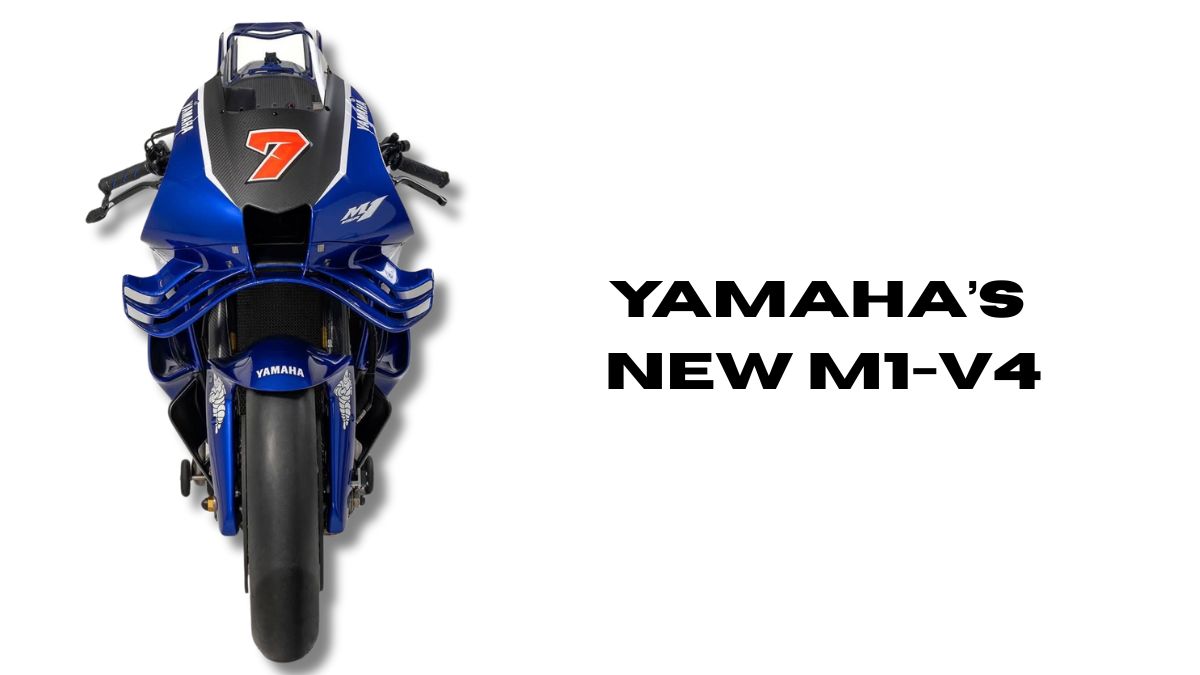
The unveiling of Yamaha’s new V4-powered YZR-M1 prototype at the Misano World Circuit Marco Simoncelli marks a profound and necessary strategic pivot for the manufacturer. This report provides a comprehensive analysis of the factors compelling this shift, the technical advancements it represents, and the long-term implications for Yamaha’s future in motorcycle racing.
For over two decades, Yamaha has been synonymous with its inline-four engine, a configuration that delivered eight riders’ titles and 125 Grand Prix wins.1 However, a widening competitive gap, evidenced by a slide to a “D ranking” in the constructors’ standings and a two-year winless streak, has rendered the traditional inline-four platform unsustainable.1
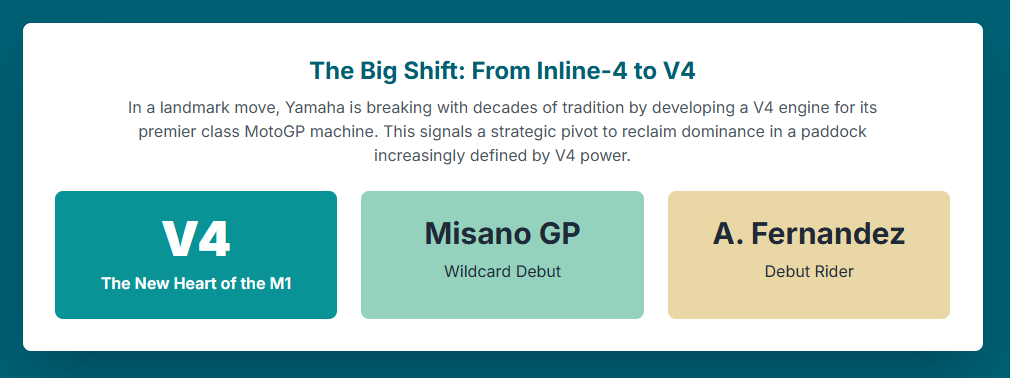
Yamaha’s response, an ambitious initiative internally referred to as “Plan V,” is not a minor update but a complete technical overhaul.3 The V4 architecture, dominant across the MotoGP grid, provides inherent advantages in chassis packaging and rotational dynamics that directly address the inline-four’s fundamental limitations in rear grip and aerodynamic efficiency.4 The decision to debut the new machine as a wildcard entry at the San Marino Grand Prix is a highly calculated “stress test” for operational data gathering, rather than a pursuit of results.5
This approach shrewdly leverages Yamaha’s concessionary status, which grants them development freedoms not available to their more successful rivals.2 This is a dual-track effort, with the 1000cc V4 serving as a proving ground for the impending 2027 850cc regulations. The success of this project is paramount for Yamaha’s return to competitive form, for securing the commitment of key riders like Fabio Quartararo, and for establishing a new technical foundation for both its racing and commercial products.7
1. The End of a Legacy: Yamaha’s Inline-Four and the Competitive Imperative
1.1. A Storied History and Recent Decline
For decades, the inline-four engine has been the heart of Yamaha’s racing legacy in the premier class. Since the four-stroke era began in 2002, this engine configuration has powered the YZR-M1 to a celebrated history, securing eight riders’ championships and an impressive 125 Grand Prix victories.1 The unique crossplane crankshaft, a Yamaha innovation, was instrumental in its success, providing a power pulse that enhanced rear tire grip, a key advantage in a previous era of racing.4
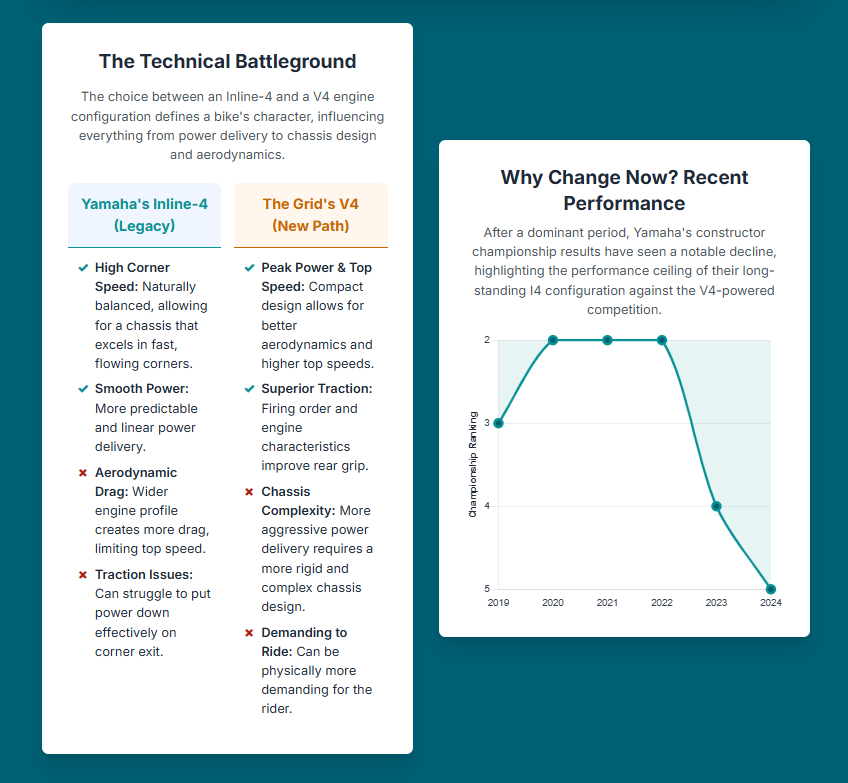
However, the efficacy of this design has waned in the face of evolving regulations and heightened competition. The last victory for the inline-four M1 was at the Sachsenring in 2022, and the team’s competitive standing has since deteriorated significantly.1 This decline is empirically documented in the 2024 MotoGP season, where Yamaha finished with only 124 constructor points, a stark contrast to Ducati’s dominant 722 points, and a significant margin behind KTM (327 points) and Aprilia (302 points).2 This performance deficit resulted in Yamaha being relegated to a “D ranking” within the FIM’s concession points system, a classification shared only with Honda and reserved for manufacturers that have not achieved significant success.2 This demotion from the top tier of constructors serves as a quantifiable marker of a non-conquering manufacturer and provides the context for Yamaha’s fundamental strategic change.
1.2. The Competitive Landscape and the Strategic Shift
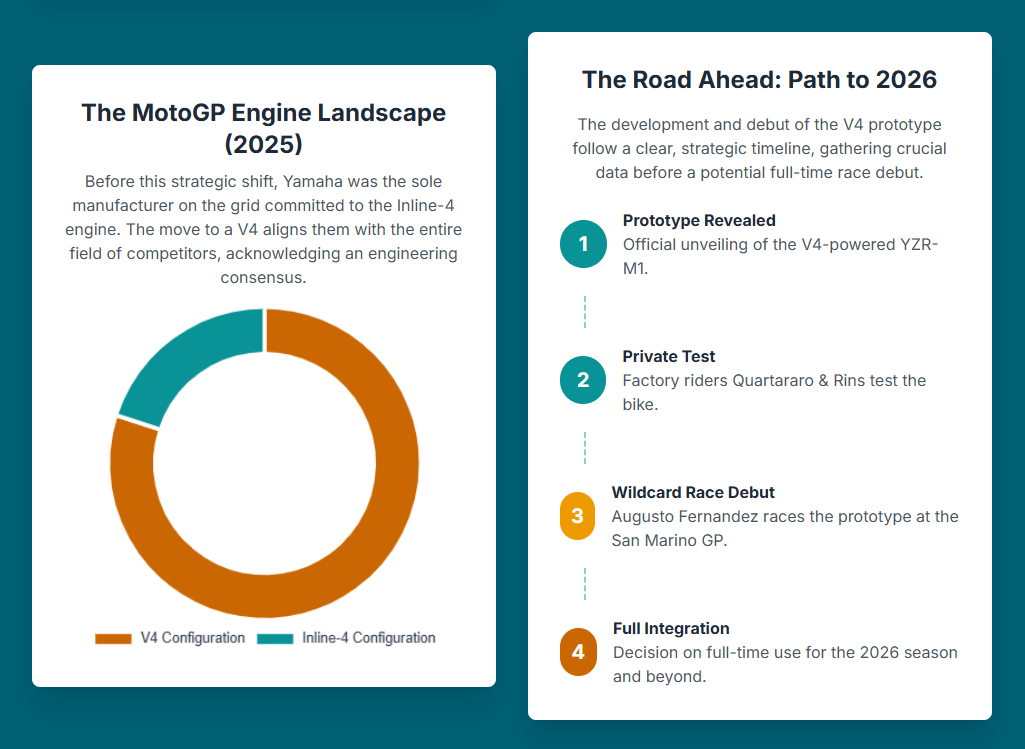
The current MotoGP grid is overwhelmingly a V4 domain. For the 2025 season, the grid features 18 V4-powered machines against just four inline-fours, all of which are Yamahas.2 This stark numerical imbalance is not coincidental; it is a clear indicator of the V4’s competitive superiority in the modern era. The performance data from 2024 demonstrates a direct cause-and-effect relationship between the engine configuration and on-track success, as all three of the top-performing manufacturers—Ducati, KTM, and Aprilia—field V4-powered bikes.2
Yamaha’s own technical leadership has acknowledged that the inline-four’s inherent limitations can no longer be “ridden around”.4 These weaknesses, including a lack of rear grip under acceleration and braking, have become a persistent handicap that no amount of incremental development on the existing platform could resolve.7 Consequently, the development of the V4 is a direct and necessary response to this reality. By transitioning to this architecture, Yamaha is aligning its technical platform with every other front-running team on the grid, signaling a “more aggressive approach” to bike development that breaks from its long-standing tradition.10 The decision to invest in a completely new engine and bike demonstrates that Yamaha has recognized the inline-four’s terminal decline and is committed to a fundamental realignment with the dominant technical paradigm in order to return to winning ways.1
2. A Technical Deep Dive: Inline-Four vs. V4 Dynamics
2.1. The Engine Architecture Explained
The fundamental differences between inline-four and V4 engines extend far beyond sound and aesthetic. An inline-four engine, with its cylinders arranged in a single row, utilizes a longer crankshaft.2 This longer design contributes to greater stability for the motorcycle, which can aid handling, but it also creates packaging and inertia challenges.2 Historically, Yamaha attempted to overcome some of the inline-four’s drawbacks with its crossplane crankshaft, which provided an uneven firing order to improve rear grip, an advantage that has now been surpassed by modern V4 designs.4
Conversely, the V4 engine, with its cylinders arranged in two banks forming a “V,” features a shorter, more rigid crankshaft.2 This design reduces rotational inertia, which allows for quicker changes in direction and improved turn-in during cornering.2 The V4 also lends itself to higher engine RPMs and, as a result, can produce greater horsepower, a critical advantage for straight-line speed.2 The V4 architecture offers engineers a high degree of flexibility to alter engine parameters, such as the bank angle, to fine-tune power delivery and other characteristics, which is a key competitive advantage that the inline-four lacks.13
2.2. The Critical Role of Packaging and Aerodynamics
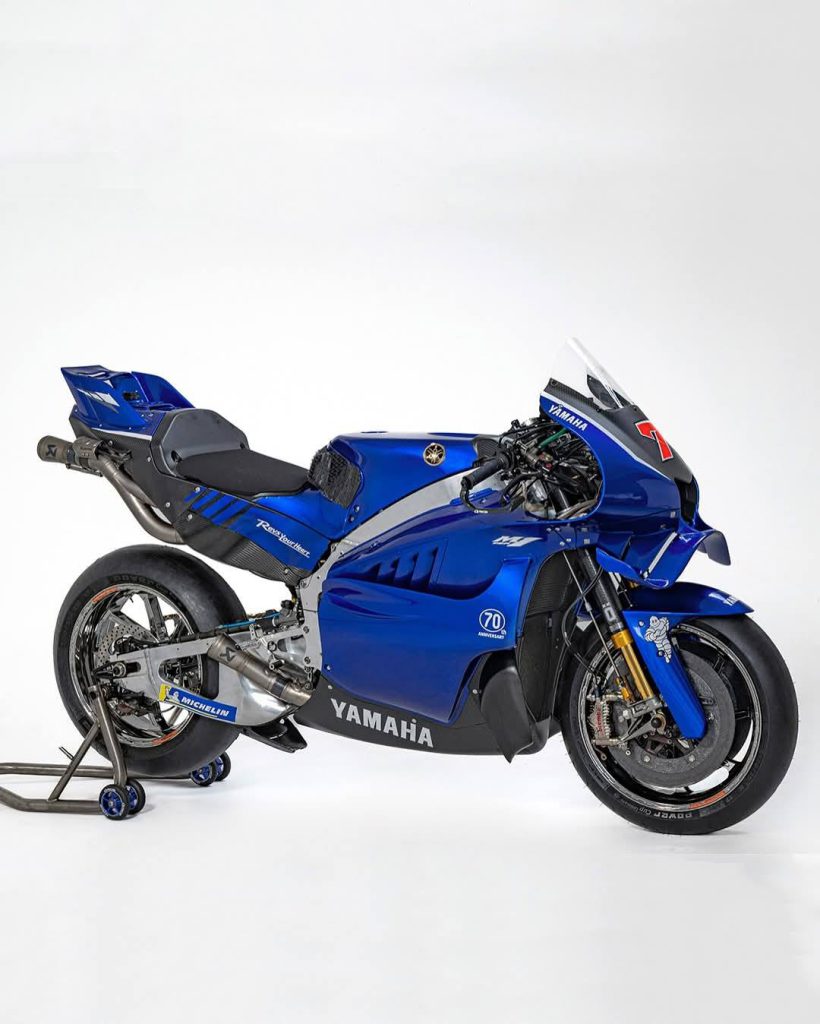
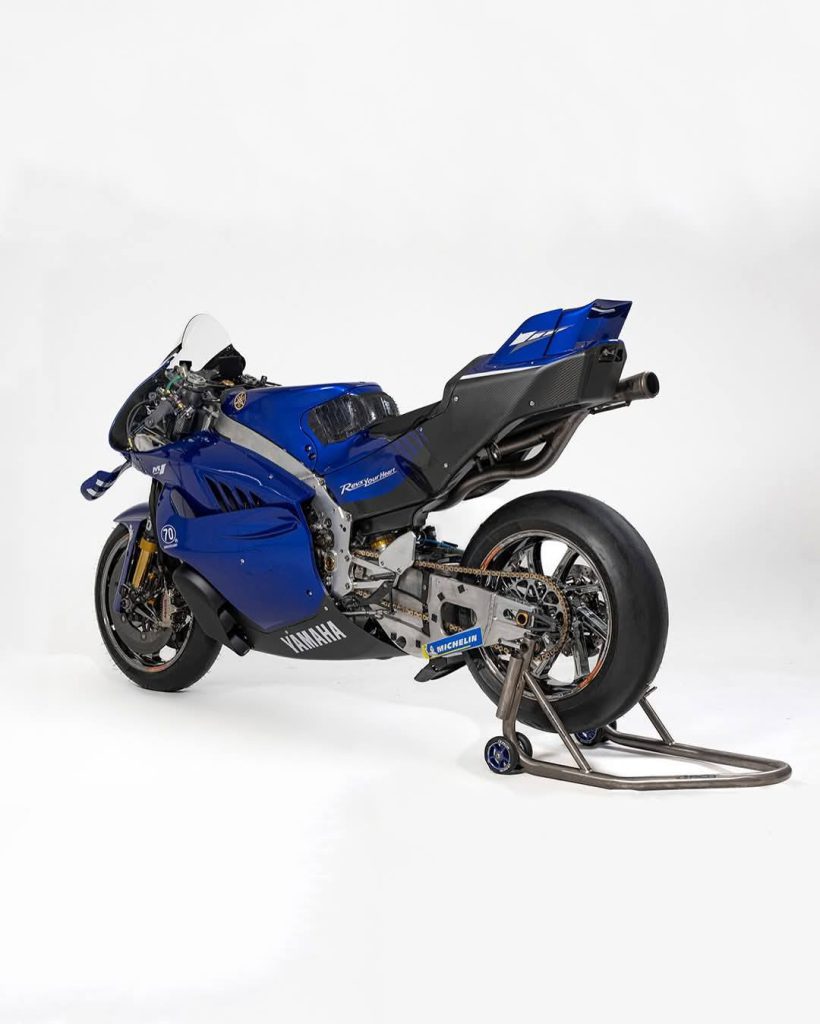
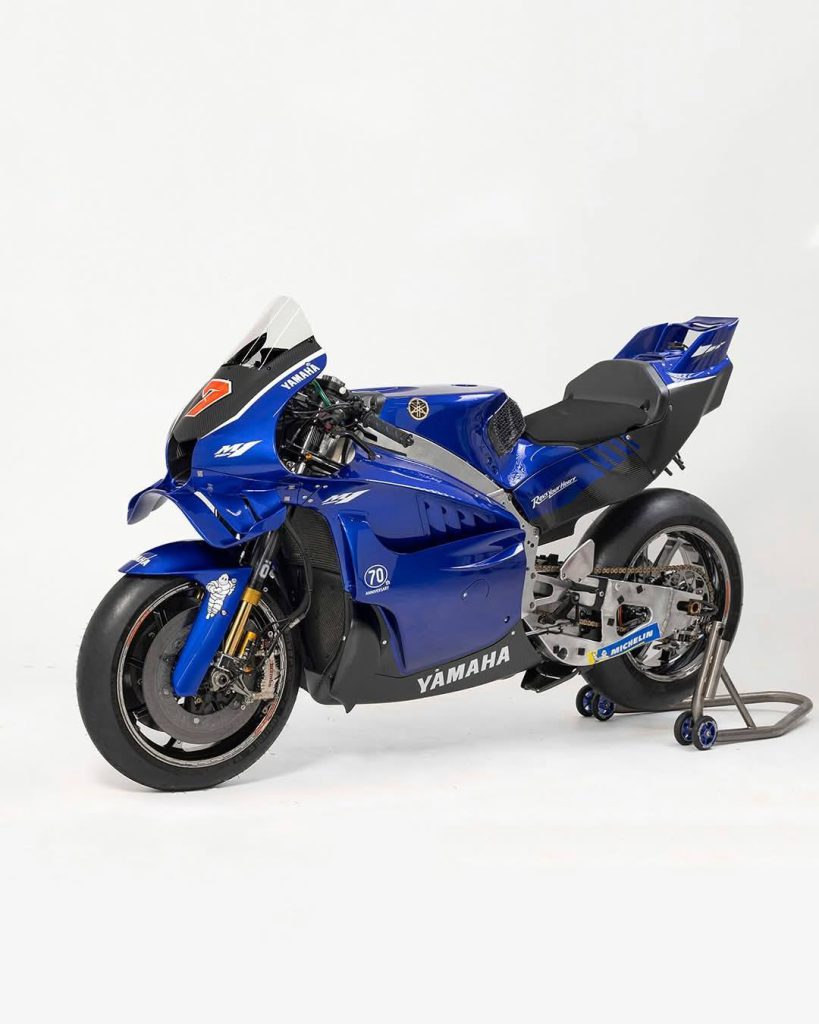
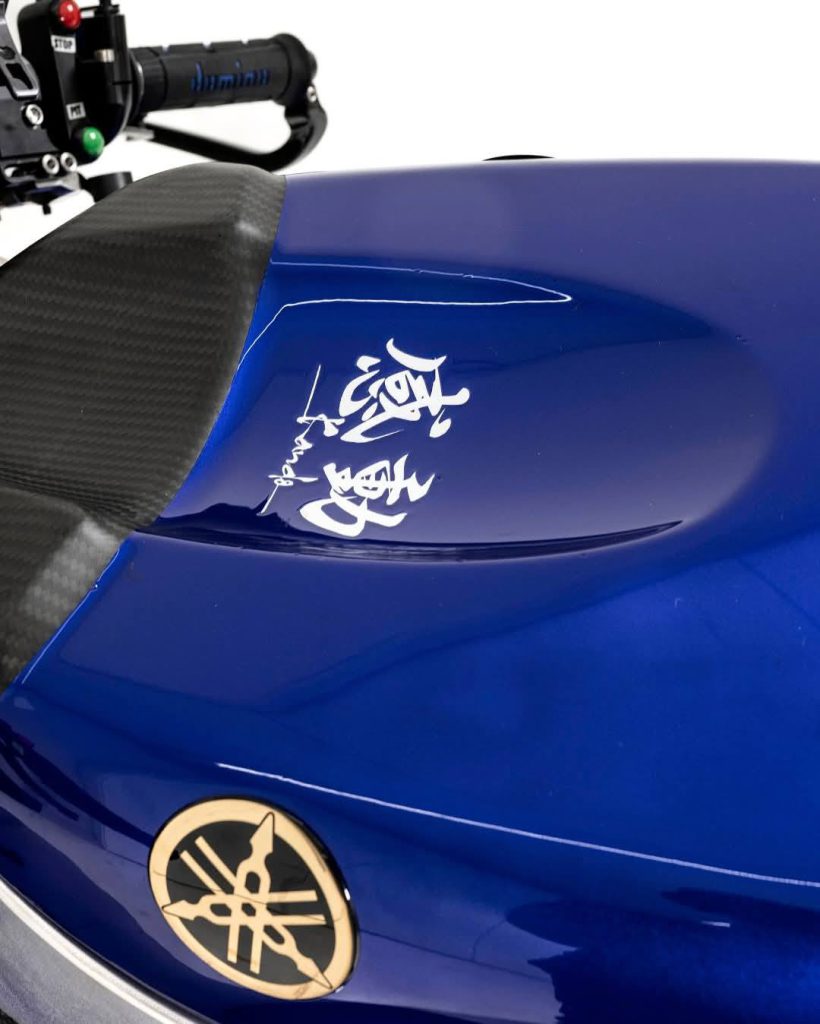
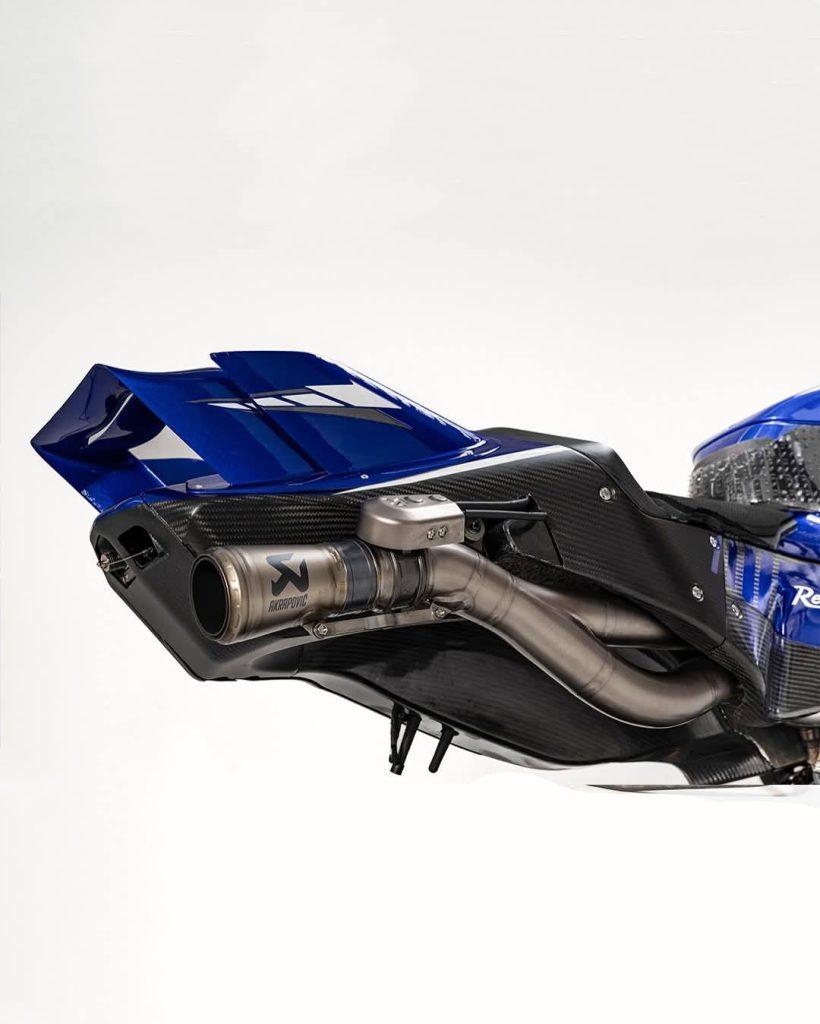
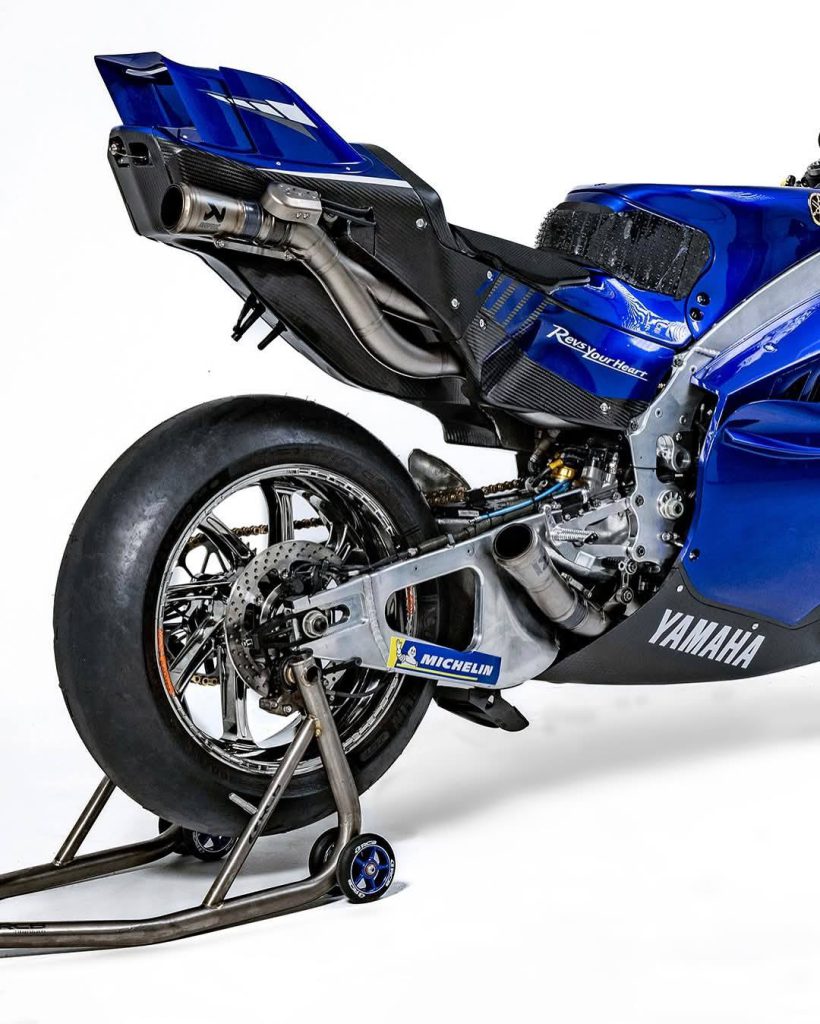
While the horsepower gap has been a point of discussion, the V4’s most profound advantage lies in its superior packaging. The narrower, more compact profile of the V4 engine allows for a slimmer overall motorcycle design.4 This, in turn, provides greater flexibility and more available space for sophisticated aerodynamic elements, which are now a critical performance differentiator in MotoGP.4 Yamaha’s new V4 prototype visually reflects this new design philosophy. The bike features a redesigned tail section, new side aero elements, a bellypan that curves upward, and repositioned gill-shaped vents to improve airflow to the rear cylinder bank.11
This isn’t merely an engine swap; it’s a fundamental reimagining of the entire motorcycle. Yamaha’s leadership has confirmed the new V4 prototype is a “coherent package” where power delivery, chassis balance, and aerodynamics have all been “tuned as a system”.6 The inherent design of the V4, with its ability to shift weight distribution more toward the rear tire, directly addresses the inline-four’s persistent issues with converting power into effective traction and acceleration.1 This integrated approach is a direct acknowledgment that modern MotoGP success is not based on a single element but on the seamless synergy between the engine, chassis, and aerodynamic package. The V4 is the foundational architecture that makes this “coherent package” possible.
Table 1: Key Technical Differences: Inline-Four vs. V4 MotoGP Engines
| Characteristic | Inline-Four Engine | V4 Engine |
| Crankshaft | Longer crankshaft 2 | Shorter, stiffer crankshaft 2 |
| Inertia | Higher rotational inertia 13 | Less rotational inertia 13 |
| Aerodynamic Profile | Wider, less agile 4 | Narrower, more compact 4 |
| Handling | Greater stability mid-corner 2 | Better turn-in, more agile 13 |
| Performance | Known for high corner speeds 2 | Faster down the straights, higher RPMs 2 |
| Power Delivery | Distinctive crossplane firing order for grip 4 | Flexible firing order, better traction on corner exit 4 |
3. The Genesis of a Prototype: Yamaha’s “Plan V” Development Program
3.1. An Ambitious and Integrated Project
Yamaha’s V4 development initiative, an ambitious undertaking, is a testament to the company’s commitment to reclaiming its competitive edge.6 This effort, referred to as “Plan V,” is more than just a new engine; it is a company-wide endeavor to build both a new engine and an entirely new bike simultaneously.3 It represents a significant departure from Yamaha’s previous, more conservative approach to development, with Takahiro Sumi, General Manager of the Motor Sports Development Division, describing it as a high-stakes project that requires a “company effort”.10 This new collaborative model integrates expertise from teams in both Japan and Europe, aiming to accelerate the development timeline and ensure the project’s success.1
The development has followed a “structured, phased plan” to ensure no detail is overlooked.6 The initial stages involved dyno testing to validate core engine performance, followed by track correlation to ensure real-world application of the data. The wildcard debut at Misano represents the final, crucial phase of this initial development cycle—a “stress test” under the demanding, high-pressure conditions of a real Grand Prix weekend.6
3.2. The Pivotal Role of the Test Team and Wildcard Debut
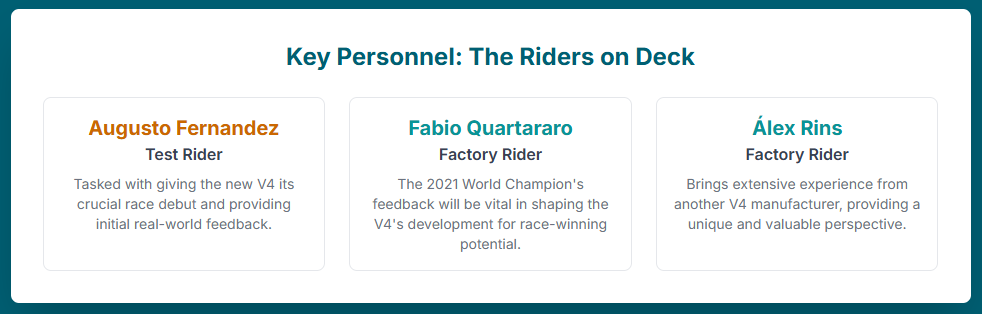
A critical component of this program has been the collaboration between test riders Augusto Fernandez and Andrea Dovizioso.5 The synergy between the two has been described as a “cohesive and highly effective team”.5 As a recent full-time MotoGP rider, Fernandez provides crucial contemporary competitive feedback, making him the ideal asset for the “stress-testing” phase of the project.3 His feedback is instrumental in refining the team’s understanding of the V4’s performance indicators and competitive positioning.3
The Misano wildcard debut is a direct exploitation of Yamaha’s “D-ranking” and the associated concessions.2 These FIM rules provide a critical strategic advantage, allowing Yamaha to engage in unlimited private testing and use more engines per season than their rivals.2 The Misano entry is a direct manifestation of this strategic freedom. Its “sole purpose is data gathering,” providing “operational learning under real-world MotoGP Grand Prix conditions” that would be impossible for top-tier manufacturers.5 This is not a race for a podium finish but a sophisticated, data-driven exercise that turns a competitive weakness (the D-ranking) into a strategic strength, providing invaluable information that will inform the next stages of development.5
Table 2: MotoGP Constructors and Engine Configurations (2025)
| Manufacturer | Engine Configuration | 2024 Constructor Points | 2025 Concession Ranking |
| Ducati | V4 | 722 2 | A 2 |
| KTM | V4 | 327 2 | C 2 |
| Aprilia | V4 | 302 2 | C 2 |
| Yamaha | Inline-four | 124 2 | D 2 |
| Honda | V4 | 75 2 | D 2 |
Table 3: Yamaha V4 Prototype: A Phased Development Timeline
| Phase / Milestone | Approximate Date | Key Activities | Strategic Objective |
| Initial Development | September 2024 | V4 engine concept confirmed and dyno testing begins 9 | Preliminary validation of core engine performance 6 |
| Private Track Testing | Early 2025 | Track correlation with test riders Andrea Dovizioso and Augusto Fernandez at multiple circuits 1 | Assess engine-chassis synergy and gather initial rider feedback 5 |
| Misano Wildcard Debut | September 2025 | Augusto Fernandez races the prototype in a Grand Prix weekend 10 | Conduct a “stress test” for operational learning and data gathering 5 |
| Post-Race IRTA Test | September 2025 | Fabio Quartararo and Álex Rins test the prototype publicly 10 | Gather feedback from factory riders and compare performance metrics 17 |
| Future Testing | Late 2025 | Further testing at Sepang and Valencia 15 | Inform the final development of the 2026 and 2027 platforms 6 |
4. Initial Performance and Rider Assessment
4.1. Preliminary Test Data and Unofficial Feedback
Yamaha has maintained a strict policy of not releasing official lap times from its private V4 tests, but unofficial reports and leaked data offer a preliminary glimpse into the prototype’s performance. During a rain-interrupted test in Barcelona, Fabio Quartararo reportedly posted a lap time approximately 1.5 seconds slower than his best Sprint time on the inline-four.1 Earlier unverified reports suggested the V4 was as much as two seconds slower than the current machine at a previous test.18
Despite these early figures, the feedback from test riders has been consistently encouraging. Augusto Fernandez expressed “very positive feelings” from the very first outing and has consistently “sensed great potential” in the new bike.5 This positive sentiment suggests that while the raw performance may not yet be on par with the developed inline-four, the fundamental characteristics and potential of the V4 platform are promising.
4.2. Factory Rider Expectations and Public Debut
The true measure of the V4’s success will be the feedback from factory riders Fabio Quartararo and Álex Rins. Quartararo, in particular, has set a clear and quantifiable benchmark for the bike’s viability: he believes the V4 will be ready to replace the current M1 if he can lap within half a second of his existing bike during the Misano test.17 This is a significant performance target given the V4’s early stage of development and highlights the palpable tension between the project’s long-term strategic goals and the short-term performance demands of its most critical rider.
Quartararo’s decision to remain with Yamaha was largely contingent on the brand’s commitment to this “bold new approach” to development.7 He has made it clear that while handling is important, a MotoGP bike must be a “fighting bike” with the necessary engine power to execute overtakes.17 The Misano wildcard with Fernandez will be followed by a public test on Monday where Quartararo and Rins will get their first taste of the new machine in a live setting, an event that will provide the first public data on the bike’s competitive readiness.10 The success of this project hinges on satisfying Quartararo’s performance metric, proving that the V4’s theoretical potential can translate into tangible, race-winning speed.
5. Strategic Horizons: Navigating the Future of MotoGP
5.1. The Dual-Track Development Plan
Yamaha’s V4 project is a sophisticated strategic play designed to navigate two distinct but interconnected timelines in MotoGP. The new 1000cc V4 is being developed with the primary goal of making a full-season debut in 2026, aiming to close the competitive gap to the rest of the grid.11 Concurrently, this ambitious program serves as a critical proving ground for the impending 2027 regulation changes, which will see engine displacement reduced to 850cc and a new maximum bore of 75mm.2
The “more aggressive approach” to the 1000cc V4 is a masterstroke that leverages a unique regulatory opportunity. As a D-ranked manufacturer, Yamaha is exempt from the engine development freeze imposed on top-tier teams for the 2025 and 2026 seasons.2 While manufacturers like Ducati and Aprilia must homologate their 2025 engines and use them for two full seasons, Yamaha is free to continue developing and racing its new V4.2 This allows them to gather a full year of live, on-track data with a completely new engine concept, a significant advantage that will position them to be ahead of the curve when the 850cc regulations take effect in 2027. This move transforms a competitive weakness into a strategic strength, demonstrating a forward-looking vision that extends well beyond the current season.
5.2. A Long-Term Investment
Beyond its immediate racing ambitions, the V4 project represents a long-term investment in Yamaha’s broader corporate strategy. The technology and engineering lessons learned from developing the V4 M1 are expected to have a “trickle-down effect” on the brand’s consumer-level road bikes.8 This mirrors the approach of other manufacturers like Ducati, where racing innovations directly inform the design of production models, ensuring the brand’s performance pedigree is reflected in its commercial offerings.8
Furthermore, the project is critical for retaining top talent. The commitment to a radical new development path was a key factor in securing Fabio Quartararo’s contract extension, a move that would have been unlikely without a clear sign of renewed ambition from the manufacturer.7 Similarly, the project’s scope and potential have convinced test riders Augusto Fernandez and Andrea Dovizioso to extend their contracts through 2027.3 Their continued involvement underscores the perceived importance and viability of “Plan V” and ensures continuity in the development of both the 1000cc V4 and the future 850cc platform.
6. Conclusion and Strategic Outlook
The unveiling of Yamaha’s V4 YZR-M1 prototype is a definitive and critical moment for the manufacturer’s future in MotoGP. This is a move of necessity, not choice, born from the realization that the long-reigning inline-four platform could no longer compete with the superior technical and aerodynamic advantages offered by the V4 configuration. The project, officially dubbed “Plan V,” is an integrated, company-wide effort that has been strategically phased, culminating in the Misano wildcard debut, which is primarily an operational learning exercise.
For the V4 project to be deemed a success, it must:
- Validate its potential under race conditions: The positive feelings and potential demonstrated in private tests must translate into quantifiable performance under the pressure of a Grand Prix weekend.
- Deliver on its holistic design philosophy: The true test will be whether the new bike functions as a “coherent package” of engine, chassis, and aerodynamics, addressing the inherent limitations of its predecessor.
- Capitalize on its concessionary advantage: The project must leverage the freedom granted by the D-ranking to accelerate the development of the 850cc platform and arrive in 2027 with a clear competitive edge over rivals who have been constrained by the engine freeze.
The V4 is more than a new motorcycle; it is a profound commitment to innovation and racing excellence. Its success will not only determine Yamaha’s trajectory in the premier class but also lay the technical foundation for its next generation of high-performance motorcycles.
Sources
- PICTURES: Yamaha unveils V4 MotoGP prototype at Misano …, accessed on September 12, 2025, https://www.crash.net/motogp/news/1081546/1/pictures-yamaha-unveils-v4-motogp-prototype-misano
- The Ultimate Guide to MotoGP Engines: Everything You Need to Know, accessed on September 12, 2025, https://www.intentsgp.com/ultimate-guide-motogp-engines/
- Augusto Fernandez extends Yamaha MotoGP deal: “Pivotal to ‘Plan V’” | Crash.net, accessed on September 12, 2025, https://www.crash.net/motogp/news/1081557/1/augusto-fernandez-extends-yamaha-motogp-deal-pivotal-plan-v
- Yamaha V4 vs inline-4, what’s everyone thought? : r/motogp – Reddit, accessed on September 12, 2025, https://www.reddit.com/r/motogp/comments/1kcavth/yamaha_v4_vs_inline4_whats_everyone_thought/
- Yamaha Factory Racing, accessed on September 12, 2025, https://www.yamahamotogp.com/2025/newsletter/yfrt/en/250910164414570/11-09-2025-the-start-of-a-new-era-yamaha-unveil-v4-powered-yzr-m1-in-misano
- The Start of a New Era: Yamaha Unveil V4-Powered YZR-M1 in …, accessed on September 12, 2025, https://www.yamaha-racing.com/news/motogp/the-start-of-a-new-era-yamaha-unveil-v4-powered-yzr-m1-in-misano/
- Yamaha’s Racing Its V4 At Misano MotoGP | Motorcycle.com, accessed on September 12, 2025, https://www.motorcycle.com/bikes/news/yamaha-s-racing-its-v4-at-misano-motogp-44647456
- What we know about Yamaha and its new V4 engine | Visordown, accessed on September 12, 2025, https://www.visordown.com/features/what-we-know-about-yamaha-and-its-new-v4-engine
- Fabio Quartararo pushes for Yamaha V4, blames gap to rivals on engine – Motorsport.com, accessed on September 12, 2025, https://www.motorsport.com/motogp/news/quartararo-yamaha-v4-gap-rivals-engine/10748919/
- The Start of a New Era:
Yamaha Unveil V4-Powered YZR-M1 in Misano, accessed on September 12, 2025, https://www.yamahamotogp.com/news/11-09-2025-the-start-of-a-new-era-yamaha-unveil-v4-powered-yzr-m1-in-misano - V4-Powered Yamaha YZR-M1 Revealed | Motorcycle.com, accessed on September 12, 2025, https://www.motorcycle.com/bikes/news/v4-powered-yamaha-yzr-m1-revealed-44648806
- I4 vs V4 engine? : r/motorcycle – Reddit, accessed on September 12, 2025, https://www.reddit.com/r/motorcycle/comments/17wfdei/i4_vs_v4_engine/
- Why Yamaha changes to V4 engine! – MotoGP EXPLAINED – YouTube, accessed on September 12, 2025, https://www.youtube.com/watch?v=SpfEHiqZS8Y
- Fabio’s Yamaha V4 test today : r/motogp – Reddit, accessed on September 12, 2025, https://www.reddit.com/r/motogp/comments/1nbmbk5/fabios_yamaha_v4_test_today/
- Yamaha unveils V4 MotoGP prototype ahead of the San Marino Grand Prix, accessed on September 12, 2025, https://bikesportnews.com/motogp/yamaha-unveils-v4-motogp-prototype-ahead-of-the-san-marino-grand-prix/
- Augusto Fernandez re-signs as Yamaha’s MotoGP Test Rider for two more years, accessed on September 12, 2025, https://bikesportnews.com/motogp/augusto-fernandez-re-signs-as-yamahas-motogp-test-rider-for-two-more-years/
- Fabio Quartararo sets lap time target for Yamaha V4 – Crash.net, accessed on September 12, 2025, https://www.crash.net/motogp/news/1080078/1/fabio-quartararo-sets-lap-time-target-yamaha-v4-motogp-debut-misano-test
- Yamaha plans to race the new V4 with Augusto Fernandez at Misano : r/motogp – Reddit, accessed on September 12, 2025, https://www.reddit.com/r/motogp/comments/1mzpusv/yamaha_plans_to_race_the_new_v4_with_augusto/
- Yamaha showcases V4-powered MotoGP bike ahead of race debut – Motorsport.com, accessed on September 12, 2025, https://www.motorsport.com/motogp/news/yamaha-showcases-v4-powered-motogp-bike-ahead-of-race-debut/10758547/
Our Social Media Handles
- Instagram : LivingWithGravity
- Medium : Akash Dolas
- YouTube Channel : Gear and Shutter
- Facebook : LivingWithGravity