







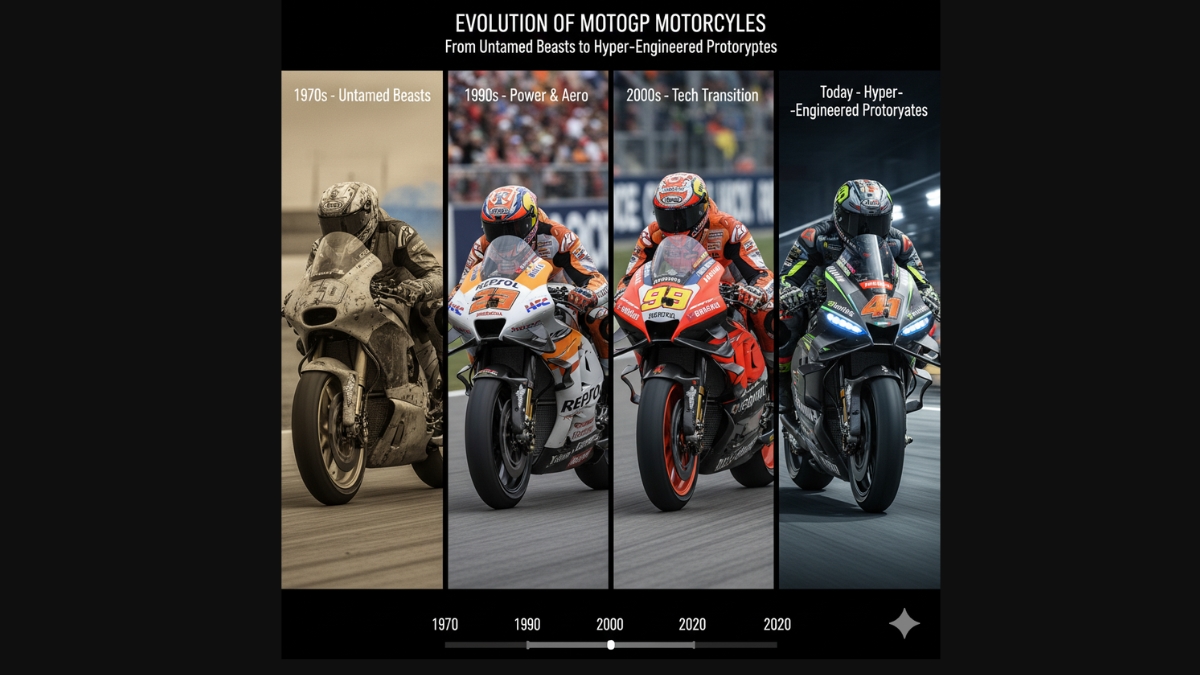
Executive Summary: From Untamed Beasts to Hyper-Engineered Prototypes
The evolution of MotoGP bikes is a complex narrative defined by the dynamic interplay between technological innovation, human skill, and stringent regulatory oversight. Beginning in 1949, the championship was initially dominated by a diverse range of four-stroke machines from Italian and English manufacturers, before a revolution in engine design led to the ascendance of the two-stroke. This shift from the predictable four-stroke to the violently powerful two-stroke era fundamentally changed the nature of racing, prioritizing a rider’s raw instinct and courage over mechanical efficiency. The machines of this era were lightweight “monsters” that were notoriously difficult to control, earning them the moniker “unrideables.”
This paradigm was shattered in 2002 with the introduction of the four-stroke MotoGP class, initiating a new era of engineering philosophy. Instead of focusing on raw, unmanaged power, engineers began to harness and control immense horsepower through sophisticated electronic systems. This shift enabled unprecedented gains in speed, safety, and lap times, but it also redefined the role of the rider, transforming them from a “tamer” of a mechanical beast into a conductor of a highly-tuned electronic and mechatronic symphony. The ensuing technological arms race, fueled by advances in electronics, chassis materials, braking systems, and radical aerodynamics, has consistently pushed the boundaries of performance.
The sport’s governing bodies, Dorna and the FIM, have consistently responded to these escalating performance levels and costs with a reactive and increasingly prescriptive rulebook. The upcoming 2027 regulations represent the most significant philosophical change yet, actively legislating against the very technologies that have defined the last decade of the sport. The new rules, including a reduced engine capacity, a ban on mechatronic aids, and tighter control over aerodynamics, are designed to re-center the sport on rider skill, foster competitive parity, and align with a future of environmental sustainability. This report will analyze these distinct eras, detailing the key technological milestones and their far-reaching consequences on the machines, the sport, and the very definition of a world-class rider.
1. The Foundational Era: The Rise and Fall of the Two-Stroke (1949-2001)
1.1. Pre-1970s: Four-Stroke Dominance and the Ascendancy of European Marques
Grand Prix motorcycle racing began its world championship in 1949, featuring five distinct categories for solo machines: 125cc, 250cc, 350cc, 500cc, and 600cc sidecars.1 In these early years, the premier 500cc class was an arena for technical ingenuity, dominated by four-stroke engines from prestigious Italian and British manufacturers. Brands such as Gilera, Mondial, Moto Guzzi, and MV Agusta carried legendary riders like Giacomo Agostini, John Surtees, and Mike Hailwood to championship victories.1 Japanese manufacturers began their foray into the sport with Honda’s first entry in the Isle of Man TT in 1959.1 While Italian brands remained dominant in the premier class for a significant period, with 24 out of 26 titles between 1950 and 1975, Japanese teams like Honda, Suzuki, and Yamaha were already making their presence felt in the smaller categories.3 A crucial turning point came in 1966 when Honda won the constructors’ championship in all five solo classes, with Jim Redman securing the factory’s first 500cc victory at Hockenheim, marking the first premier-class win for a Japanese factory.1
1.2. The Two-Stroke Revolution: Raw Power and Brutality
The technological landscape of motorcycle racing underwent a radical transformation in the 1960s with the rise of the two-stroke engine, which began to take hold in the smaller classes.1 Unlike four-stroke engines, which require two full rotations of the crankshaft (four strokes of the piston) to produce a power stroke, a two-stroke engine generates a power stroke every single rotation (two strokes of the piston).4 This inherent design advantage meant two-strokes could produce significantly more power for their displacement and weight, creating a superior power-to-weight ratio.5 The shift to two-strokes in the premier class was formalized in 1971 when Jack Findlay rode a Suzuki TR500 to the first-ever 500cc class victory for a two-stroke machine.1 The era of four-stroke dominance ended in 1974 when Yamaha became the first Japanese brand to win the constructors’ title with a two-stroke, followed by Giacomo Agostini’s 500cc riders’ championship on a Yamaha in 1975, marking the first premier-class championship for a two-stroke engine and a non-European brand.1
The bikes of this era were described as “monsters” that were “not easy to tame” and required immense skill and courage to ride.6 These machines were lightweight, weighing closer to 300 pounds than 500 pounds 5, and their power delivery was notoriously brutal, often described as “like switches”.7 They lacked the modern electronic aids common today, forcing riders to rely on “throttle, clutch, and pure feel” to manage the bike’s explosive horsepower and propensity for wheelies and slides.7 Without electronics, the back wheel would slide and the front would lift, creating a high-risk environment with “tiny margins for error”.7 The lack of engine braking in a two-stroke meant riders had to completely re-learn the corner entry phase, as they could not use the engine to help slow the bike down as a four-stroke rider would.8
1.3. A Comparison of Eras: The “Unrideables” vs. Modern Prototypes
The transition from the four-stroke to the two-stroke era was not merely a change in engine type; it represented a fundamental shift in engineering philosophy. The two-stroke era focused on a single-minded pursuit of raw output, maximizing horsepower and RPMs with little consideration for power delivery or rider management.9 Engineers aimed to create the most powerful engine possible, leaving the rider to manage the violent, “switch-like” powerband.4 This required a specific, high-risk riding style that emphasized courage and instinct. In contrast, the modern four-stroke era has shifted its focus to the managed application of immense power through electronics, achieving smoother, more consistent delivery that allows riders to apply power earlier and more aggressively out of corners.10
The consequence of this shift is a profound redefinition of the rider’s role. The 500cc machines were so difficult that newcomers would often mark horrible times and feel the bike was “far beyond anything they could control or handle”.12 The best riders of that era were considered to have a “true gift” and “sheer courage”.12 While some purists argue that the 500cc era was the “cream of the crop” and more about “true grit” 12, the quantitative data supports the technological superiority of the modern bikes. For example, at Mugello, the fastest lap set by a 500cc bike in 1995 was 1:54.381, while a modern MotoGP bike’s record is a staggering 1:47.639, a 6.7-second improvement.13 The qualitative difference is perhaps even more telling. In the two-stroke era, a rider’s limit was dictated by their ability to tame an unruly machine; in the modern era, the bike’s limit is pushed to the absolute electronic edge, with the rider trusting the systems to keep the chaos in check.12
| Characteristic | Late-Era 500cc Bike (e.g., Honda NSR500) | Modern MotoGP Prototype (e.g., Honda RC213V) |
| Engine Type | Two-stroke, V4 15 | Four-stroke, V4 15 |
| Displacement | 499cc 15 | 1000cc 15 |
| Horsepower | ~190hp 6 | >250hp 6 |
| RPMs | ~12,000 15 | >17,000 15 |
| Power Delivery | Brutal, “switch-like,” with a narrow powerband 4 | Smooth, linear, and managed by electronics 10 |
| Engine Braking | Minimal to none, requiring riders to re-learn corner entry 8 | Significant, used by riders to help pull the bike into a corner 8 |
| Key Electronics | None 7 | Ride-by-Wire, Traction Control, Anti-Wheelie, Engine Braking Control 16 |
| Gearbox | Conventional with quickshifter 15 | Seamless gearbox, for clutchless upshifts and downshifts 15 |
2. The MotoGP Paradigm Shift: From 990cc to 1000cc
2.1. The 990cc Era (2002-2006): The Birth of Modern MotoGP
The year 2002 marked the official beginning of the MotoGP era, a direct replacement for the 500cc class.2 This was a strategic move by the FIM to align the championship with the new millennium by introducing four-stroke engines.2 The new premier class allowed for four-stroke engines up to a maximum displacement of 990cc and an unrestricted number of cylinders.2 This shift immediately injected a new level of power into the championship. The last 500cc two-strokes were producing around 190 horsepower, but by 2002, manufacturers were already extracting close to 230 horsepower from the new four-stroke machines.6 The early days of MotoGP were dominated by Valentino Rossi, who won four titles between 2002 and 2005 on both Honda and Yamaha machines.2 By the end of this era, new electronic systems like electronic engine braking and anti-wheelie technology were becoming increasingly common, further boosting performance.6
2.2. The 800cc Interlude (2007-2011): The Quest for Safety and Its Unintended Consequences
In 2007, the FIM reduced the engine capacity to 800cc, primarily for safety reasons, with the goal of reducing the bikes’ top speeds.6 However, this regulatory change set off an intense technological arms race that had unintended consequences. Instead of curbing speed, manufacturers were forced to find new ways to extract performance from the smaller engines. The competitive battlefield shifted from raw engine output to the intricate world of electronics.6
Manufacturers developed sophisticated, bespoke electronics units from scratch, managed by large teams of engineers.6 While the overall horsepower was lower, the bikes became faster through the corners. The pursuit of higher engine speeds and shorter bore sizes made the bikes “squirm” and consumed tires rapidly, leading to what many recall as a less-than-thrilling era of racing.19 This period demonstrates a recurring pattern in the sport’s history: a simple, logical regulatory change can fail to address the complex, underlying challenges of modern engineering. The 800cc rule, intended to reduce costs and enhance safety, instead funneled resources into an even more expensive and secretive area of development, making the sport more prohibitive for some manufacturers and creating a competitive imbalance.
2.3. The 1000cc Era (2012-Present): The Return to Power and the Rise of Rider Aids
The displacement was increased back to 1000cc in 2012 with the aim of providing more power and torque, which was believed to make overtaking easier and improve the overall quality of racing.6 This era has been defined by the maturation and integration of rider aids, mechatronics, and aerodynamics. While the bikes were already incredibly powerful, new technologies allowed riders to put that power to the ground more effectively. The result has been record-breaking lap times across the board. At Jerez, for instance, a 1995 fastest lap of 1:44.995 was eclipsed by a modern record of 1:38.735, a staggering 6.26-second improvement.13 At Phillip Island, lap times have improved by over six seconds since 1997.13 The rulebook, once a mere 18 pages in 1999, has swelled to an astounding 183 pages in 2025.18 This expansion is a direct reflection of the FIM’s and Dorna’s continuous, reactive struggle to control the runaway cost and performance of the technology. The governing bodies are in a constant state of adjustment, with concessions and other rules evolving in response to the latest competitive imbalances. The sport’s survival hinges on its ability to manage this constant push-and-pull between human-centric racing and the relentless march of technological progress.
3. The Arms Race in Technology and Materials
3.1. Chassis and Structure: From Aluminum to Composite Experimentation
The chassis is the central nervous system of a racing motorcycle, providing the structural integrity to manage the immense forces of acceleration, braking, and cornering.15 For decades, aluminum has been the material of choice, and its strength-to-weight properties have made it a cornerstone of racing bike design. Honda’s iconic NSR500 and its modern successor, the RC213V, both utilized a double-beam aluminum chassis.15 However, in recent years, manufacturers have looked to other materials to gain a competitive edge. Carbon fiber, the standard for Formula 1 car chassis for over 40 years, has emerged as a compelling, albeit controversial, alternative.20 Ducati and KTM have experimented with carbon frames, while Aprilia has been particularly committed to its development.20 Aprilia’s patent for a composite chassis that combines carbon fiber and aluminum using glue, not bolts, reveals a strategic focus on weight reduction and aerodynamics.20 This approach allows for a structural carbon front section with an aerodynamic oval shape and wide openings to feed air to the engine.20 While Aprilia’s 2025 race bike still uses an aluminum chassis, the company’s ongoing research and the adoption of an all-carbon swingarm suggest that the full-carbon frame may soon become a reality if it proves to be fruitful.20
3.2. Braking Systems: The Necessity of Carbon Discs
As engines became more powerful, bikes became faster, and the need for more effective braking became critical. Conventional steel brakes could not withstand the immense heat generated by aggressive deceleration, which would cause the discs to warp.22 The solution was found in the aviation sector, where Dunlop had developed carbon-reinforced brakes for the supersonic Concorde airliner, which required them to stop at high speeds without melting.22 These brakes made their way into Formula One in 1976 and into the 500cc Grand Prix class in 1988.22
Carbon brakes operate on a principle that is the direct opposite of steel brakes: they need to generate and retain heat to function optimally.22 Their ideal operating temperature is a massive 200°C to 800°C.22 This heat-dependent nature makes them impractical for road use but perfect for the extreme demands of MotoGP. The latest systems are so effective they can slow a bike from 355 km/h to 90 km/h in less than 5 seconds.22 The move to carbon brakes was a direct consequence of escalating engine power and top speeds. In turn, their adoption enabled riders to brake “even later and harder,” shifting the competitive focus to the bike’s dynamic behavior under extreme deceleration.22 This technological evolution underscores how a breakthrough in one area of the bike’s design creates new challenges and opportunities in others.
3.3. Tire Technology: The Backbone of Grip and the Single Supplier Model
Tires are arguably the single most critical component on a MotoGP bike, serving as the sole point of contact with the track. Michelin has been a key innovator in the sport, introducing radial construction in 1984 and multi-compound tires in 1994, which allowed for a harder compound in the center of the tire for stability on straights and a softer compound on the edges for grip while cornering.24 The company’s dominance was immense, with a rider on Michelins winning the world championship every year from 1993 to 2006.24 However, this tire-based arms race created competitive imbalances. After Casey Stoner won the 2007 title on Bridgestone tires, riders like Valentino Rossi complained that Michelins were inferior.24 This, combined with safety concerns, led the FIM to announce a single-tire supplier rule for the 2009 season, a strategic decision to control costs and level the playing field.24 Michelin did not bid, ending their participation until they returned as the sole supplier in 2016.18
The shift to a single tire supplier did not stifle innovation but rather redirected it. Once all teams had the same tires, the competitive advantage shifted to who could best tune their bike’s chassis, electronics, and aerodynamics to extract maximum performance from that specific rubber. Today’s tires are no longer just rubber; they are “smart systems” equipped with embedded sensors that track real-time pressure, temperature, and wear rates.25 Some prototypes are even being tested to communicate with the ECU to adjust throttle response mid-race based on tire health.25 This exemplifies how a regulatory decision to standardize one component created a cascade of innovation in all other areas of the bike.
4. The Era of Electronic and Mechatronic Control
4.1. The Digital Revolution: Ride-by-Wire, Traction Control, and Anti-Wheelie
In the two-stroke era, a rider’s twist of the throttle was directly and mechanically linked to the engine’s intake.26 The digital revolution in MotoGP changed this completely. Ride-by-wire technology replaced the physical throttle cable with a sensor and an electric wire that sends a signal to the bike’s ECU.17 This allows the ECU to act as an intermediary, modulating the rider’s requested power based on a complex web of sensor data, including engine speed, gear, wheel speed, and lean angle.26 This is the foundation for a suite of sophisticated rider aids, including Traction Control (TCS) and Anti-Wheelie (AW).
TCS prevents the rear wheel from spinning out of control under hard acceleration, and AW manages the bike’s tendency to lift its front wheel.16 The AW system works by using sensors that measure front-wheel speed, fork travel, and machine pitch.16 When the system detects a wheelie, it requests a reduction in torque from the ECU, preventing a significant lift without the rider having to back off the throttle.16 This allows riders to maintain a more aggressive, consistent acceleration profile. The introduction of these systems fundamentally altered the rider-bike relationship. In the 500cc era, the rider was the primary control system, managing an unassisted machine.7 In the modern era, the rider is in a constant “dance of algorithms,” a partnership with the electronics to push the machine to its absolute performance limit.14 This has elevated the rider’s skill set to a new level, where they must not only have exceptional physical talent but also a deep understanding of their bike’s electronic systems.10
4.2. Mechatronics on the Start Line: The Holeshot and Ride-Height Devices
Inspired by a primitive motocross innovation, MotoGP engineers developed “holeshot” devices to give riders an unfair advantage at the start of a race.27 The system mechanically compresses the front suspension, lowering the bike’s center of gravity and reducing the tendency to wheelie under maximum acceleration.27 This technology was so effective that it was soon applied to the rear suspension as well, giving riders an immense advantage on corner exits, where they could lower the bike to improve traction and acceleration.27 These systems are a prime example of mechatronics, a blend of mechanical and electronic engineering. The rider can engage the system with a button, and the bike is “slammed into the ground”.28 The system then releases when the rider first applies the brakes at the end of the straight.27
The evolution of these systems highlights a deeper theme in the sport: the constant search for marginal gains. While electronics provide a software-based solution to managing power, mechatronic devices offer a mechanical solution. The holeshot device physically counters the wheelie effect, allowing the electronics to deliver full power without intervention, leading to faster acceleration.16 The existence of such a system for managing wheelies, a problem that electronics already manage, demonstrates the intensity of the competitive environment. The 2027 rules will ban all ride-height and holeshot devices 18, a clear regulatory signal to re-emphasize rider skill in these critical moments of the race and to level the playing field.19
5. The Aerodynamic Imperative
5.1. A Brief History of Aero: From Drag Reduction to Downforce Generation
Early aerodynamic efforts in motorcycle racing were focused on reducing drag, with “dustbin” fairings being used in the 1950s to create a bullet-shaped nose to slip through the air.30 These fairings were banned in 1957 for safety reasons, as they created instability in crosswinds.30 For decades, aerodynamic development was limited to refining fairings and optimizing rider positioning to reduce drag.31 The modern aero war began in earnest in 2015 when Ducati introduced prominent winglets on its GP15.30
5.2. The Modern Aero War: Function, Controversy, and Regulatory Constraints
The modern use of winglets is not about drag reduction; it is about creating downforce.30 Their primary function is to keep the front wheel on the ground under hard acceleration, thereby reducing the need for the anti-wheelie electronics to cut power.16 This provides a more efficient, less intrusive way to manage wheelies, allowing the rider to put more power to the ground more of the time.16 This aerodynamic approach is a mechanical solution to a problem that was once handled exclusively by electronics. Manufacturers have also developed brake ducts, fin-like protrusions, and “under-swingarm spoilers” to manage brake temperatures, smooth airflow, and generate additional downforce at various points on the track.30
The aerodynamic arms race has not been without controversy. Some have criticized the “ugly” appearance of the winglets and the “dirty air” they create, which makes it more difficult for a following rider to get close and attempt an overtake.29 The 2027 regulations are a direct response to this issue, as they will tightly control aerodynamics by reducing the width of the front fairing and limiting updates to the tail aero.29 These rules demonstrate a clear effort by the governing bodies to re-balance the sport, proving that even a technological solution to one problem can create a new sporting problem that requires regulatory intervention.
6. The Regulatory Hand: Dorna, FIM, and the Rulebook
The evolution of MotoGP is intrinsically linked to the actions of its governing bodies. The FIM and Dorna have consistently used the rulebook as a tool to navigate the complexities of cost, safety, and competitive balance. The technical regulations section of the rulebook has grown from a concise 18 pages in 1999 to a sprawling 183 pages in 2025, a 1000% increase that reflects the sport’s growing complexity and the reactive nature of its governance.18 The major drivers behind this rapid evolution were two significant crises: the tobacco sponsorship ban in 2006 and the Global Financial Crisis of 2008.18 These events led to a significant decrease in the money flowing into the championship and a subsequent need for drastic measures to reduce costs and prevent teams from quitting.18
| Year | Key Technical Rule Change | Driving Factor |
| 1949-2001 | 500cc engine capacity 18 | Foundational era, a variety of classes |
| 2002 | Class change: 990cc four-stroke engines 2 | “Fit for the new millennium,” increase horsepower 2 |
| 2007 | Engine capacity reduced to 800cc 6 | Safety, to reduce top speeds 6 |
| 2009 | Single-make tire rule (Bridgestone) 18 | Cost reduction, competitive parity, safety concerns 24 |
| 2012 | Engine capacity increased to 1000cc 6 | Improve racing, make overtaking easier 6 |
| 2016 | Single-make tire rule (Michelin) 18 | New supplier after Bridgestone’s withdrawal 24 |
| 2017 | Aerodynamics homologation 18 | Cost control, competitive balance 18 |
| 2023 | Common TPMS mandated, Sprint Races introduced 18 | Enforce tire pressure rules, increase spectacle 18 |
| 2024 | 40% non-fossil fuel 18 | Sustainability, environmental goals 33 |
| 2027 | Engine capacity reduced to 850cc, ride-height/holeshot devices banned, aero reduced 18 | Sustainability, safety, competitive parity 19 |
The concession system is a particularly telling example of the rulebook’s strategic role.18 Introduced to help poorer-performing manufacturers catch up, it grants them more engines, more testing, and more aero updates.18 The fact that this system is being “wiped clean” in 2027 with a reset for all manufacturers indicates a concerted effort to proactively manage the competitive balance from a new starting point.29 These regulations are not arbitrary; they are a living, reactive document that reflects the sport’s ongoing struggle for financial health and competitive balance.
7. Performance Metrics: The Quantitative and Qualitative Shift
7.1. A Quantitative Comparison of Eras
The dramatic evolution of MotoGP motorcycles has led to undeniable and significant gains in performance. A comparison of lap times between the two-stroke and four-stroke eras reveals just how much faster the modern machines are. At the Mugello circuit, which has a long straightaway that highlights top speed, the fastest lap set by a 500cc machine in 1995 was 1:54.381, a time that has been reduced by 6.7 seconds with the current record of 1:47.639.13 The duration of a full race has also decreased dramatically. At Mugello, a 23-lap race in 1995 was won in 44 minutes and 20.790 seconds; today, that same race length is completed in 41 minutes and 43.230 seconds, a full two minutes and 37.560 seconds faster.13 Similarly, at Phillip Island, lap times have improved by over six seconds since 1997.13
| Circuit | 500cc Era (1995-1997) | Modern MotoGP Era (2013-2017) |
| Mugello | Fastest Lap: 1:54.381 (Mick Doohan, 1995) 13 | Fastest Lap: 1:47.639 (Marc Márquez, 2013) 13 |
| Race Duration: 44m, 20.790s (Mick Doohan) 13 | Race Duration: 41m, 43.230s (Jorge Lorenzo, 2018) 13 | |
| Phillip Island | Fastest Lap: 1:34.113 (Mick Doohan, 1997) 13 | Fastest Lap: 1:28.108 (Marc Márquez, 2013) 13 |
| Race Duration: 42m, 53.362s (Álex Crivillé) 13 | Race Duration: 40m, 49.772s (Marc Márquez, 2017) 13 | |
| Jerez | Fastest Lap: 1:44.995 (Alberto Puig, 1995) 13 | Fastest Lap: 1:38.735 (Jorge Lorenzo, 2015) 13 |
| Race Duration: 47m, 45.72s (Alberto Puig) 13 | Race Duration: 45m, 26.827s (Dani Pedrosa, 2017) 13 |
7.2. The Qualitative Shift in Skill
Despite the bikes being objectively faster, the debate over which era required more “courage” or “talent” continues.12 In the two-stroke era, a rider’s survival depended on their ability to manage a bike with a hair-trigger powerband and no electronic assistance.7 A mistake could result in a violent “highside” that could “bite most on the arse”.10 In this environment, the rider was the ultimate control system, taming a wild, mechanical beast.
The modern era, by contrast, has shifted the nature of risk. The electronics and advanced aerodynamics act as a “safety net,” allowing riders to push the bike to a limit that would be impossible to manage with human skill alone.10 This has created a new kind of challenge: the rider must now be a “master of a complex system” and trust the “dance of algorithms” to stay on the razor’s edge of performance.14 The risk has not been eliminated but has been transformed from sudden mechanical failure to the more subtle and complex challenge of managing a machine that is perpetually on the brink of its capabilities.12 Some veterans of the sport, like Wayne Rainey, have noted that while the new bikes are “better,” the sport has become “too professional” and has lost some of the “true grit” that defined the 500cc era.12
8. The Future: An Analysis of the 2027 Regulations
8.1. Performance and Sustainability: The 850cc Engine and Non-Fossil Fuels
The 2027 regulations represent the most significant philosophical shift in MotoGP since the move to four-strokes. The rules will mandate a reduction in engine capacity from 1000cc to 850cc, with a maximum bore of 75mm, a significant decrease from the current 81mm.18 This is a strategic move to decrease top speeds and increase mileage, making the bikes more efficient and the sport more sustainable.34 In a clear alignment with global environmental goals, bikes will also run on 100% non-fossil fuel 18, which will be derived from a carbon capture scheme or non-food biomass.33 The fuel tank capacity will also be reduced to 20 liters for races and 11 liters for sprints.29 These changes position MotoGP at the forefront of a major industry shift, proving that internal combustion engines can evolve to be environmentally responsible and still provide the thrilling “symphony” of sound and speed that fans love.14
8.2. The Return to Skill: Banning Mechatronic Aids and Reducing Aero
The new regulations aim to restore the primacy of the rider by banning some of the most advanced, and controversial, technologies. All ride-height and holeshot devices will be banned in 2027.18 This is intended to place more emphasis on a rider’s skill during starts and corner exits.29 The outright ban is a direct response to the “spaceship-like systems” that have made getting off the line more about the bike than the rider.19 Aerodynamics will also be more tightly controlled, with a reduction in the front fairing width and a more limited number of aero updates per season.29 These changes are intended to minimize the “dirty air” effect, thereby promoting closer racing and more overtaking.29
8.3. Data Transparency: Leveling the Playing Field
The new rules also include a radical and unprecedented measure: all GPS rider data will be available to all teams after every session.18 This is a forward-thinking response to the extreme cost of research and development, as it allows struggling manufacturers and teams to see exactly where they are losing time compared to their rivals.29 The goal is to level the playing field and foster a more equitable competitive environment at a controlled cost.29 This move signals a proactive effort by the sport’s governing bodies to prioritize competitive balance and accessibility over the total freedom of technological development, a significant pivot that will shape the sport for decades to come.
9. Conclusion: The Relentless March of Innovation
The evolution of MotoGP bikes is a relentless narrative of innovation, regulation, and human adaptation. From the rugged, unassisted four-strokes of the foundational era to the brutally powerful two-strokes that required a rider’s pure instinct to survive, the bikes have always been a mirror of the era’s engineering ambitions. The modern MotoGP prototype, a marvel of managed power and electronic precision, represents the pinnacle of this journey. The transition to the four-stroke era was not just a change in engine type; it was a fundamental shift in philosophy, from a singular focus on raw power to a nuanced approach of applying that power effectively through sophisticated systems.
The governing bodies’ role has evolved from simple rule-making to a complex, reactive, and now proactive, strategic function. The ever-expanding rulebook and the introduction of systems like concessions are a testament to the ongoing struggle to control the runaway costs and performance of technology while maintaining competitive balance. As the sport moves towards 2027, it is not abandoning innovation but is channeling it toward a new set of values: sustainability, parity, and a renewed emphasis on the human element at the core of the sport. The bans on mechatronic aids and the reduction in aerodynamics are not a step backward but a calculated reset designed to ensure the sport’s long-term health and appeal. The bikes may have changed dramatically, but the spirit of the challenge—the enduring tension between the machine’s capabilities and the rider’s mastery—endures.
Sources
- Grand Prix motorcycle racing – Wikipedia, accessed September 16, 2025, https://en.wikipedia.org/wiki/Grand_Prix_motorcycle_racing
- The History of MotoGP: Origins to Modern-day Racing – Red Bull, accessed September 16, 2025, https://www.redbull.com/us-en/motogp-history
- History of MotoGP: An interactive look at its evolution – Red Bull, accessed September 16, 2025, https://www.redbull.com/us-en/illustrated-history-of-70-years-of-motogp
- How a two stroke vs a four stroke engine works : r/mechanical_gifs – Reddit, accessed September 16, 2025, https://www.reddit.com/r/mechanical_gifs/comments/fncx7l/how_a_two_stroke_vs_a_four_stroke_engine_works/
- Can anyone explain to me how these 2t motorcycles are that fast with such cc compared to the 4t ? I’m amazed how fast they are how is it posible? – Reddit, accessed September 16, 2025, https://www.reddit.com/r/motorcycles/comments/18lqluj/can_anyone_explain_to_me_how_these_2t_motorcycles/
- What is MotoGP™ Engine Displacement?, accessed September 16, 2025, https://www.motogp.com/en/news/2025/06/02/what-is-motogp-engine-displacement/751342
- MotoGP’s Deadliest Era: The Two-Stroke Revolution – YouTube, accessed September 16, 2025, https://www.youtube.com/watch?v=_Pbz3SZ1nsI
- During the 2 Stroke days was there the same level of discussion of superbike riders adapting to 500cc bike as there is today? : r/motogp – Reddit, accessed September 16, 2025, https://www.reddit.com/r/motogp/comments/zjj3lk/during_the_2_stroke_days_was_there_the_same_level/
- Chapter V: Initiatives to Expand Joy Section 1: Motor Sports Part 1: Road Racing World Championship | 75 Years of Honda History, accessed September 16, 2025, https://global.honda/en/about/history-digest/75years-history/chapter5/section1_1/
- Modern GP Bikes vs. 500cc 2 stroke un-ridables GP bikes of the 80’s – Aprilia Forum, accessed September 16, 2025, https://www.apriliaforum.com/forums/showthread.php?280460-Modern-GP-Bikes-vs-500cc-2-stroke-un-ridables-GP-bikes-of-the-80-s
- How MotoGP Engines Evolved From Two-Stroke Engines | Cycle …, accessed September 16, 2025, https://www.cycleworld.com/how-motogp-engines-have-evolved-from-two-strokes-motorcycle-engine/
- Is Modern MotoGP better than the 500cc GP Championships of the 70’s/80’s ? – Page 2, accessed September 16, 2025, https://forum.piboso.com/index.php?topic=156.15
- How have lap times changed from 500cc to MotoGP? – Box Repsol, accessed September 16, 2025, https://www.boxrepsol.com/en/motogp-en/how-have-lap-times-changed-from-500cc-to-motogp/
- Inside MotoGP Electronics: Launch Control, Traction & Anti-Wheelie …, accessed September 16, 2025, https://www.youtube.com/watch?v=gPF6K4q-n4k
- NSR500 and RC213V: Champions of Champions – Box Repsol, accessed September 16, 2025, https://www.boxrepsol.com/en/motogp-en/honda-nsr500-vs-rc213v/
- How MotoGP anti-wheelie works – Motor Sport Magazine, accessed September 16, 2025, https://www.motorsportmagazine.com/articles/motorcycles/motogp/how-motogp-anti-wheelie-works/
- Special Feature: Throttle by Wire- Technological Motorcycling Trends on CycleWorld.com, accessed September 16, 2025, https://www.cycleworld.com/2010/07/23/special-feature-throttle-by-wire/
- Twenty years of MotoGP tech rule changes – where has it got us …, accessed September 16, 2025, https://www.motorsportmagazine.com/articles/motorcycles/motogp/twenty-years-of-motogp-tech-rule-changes-where-has-it-got-us/
- Smaller engines, less aero, better racing? MotoGP’s 2027 rule changes explained, accessed September 16, 2025, https://www.topgear.com/car-news/bikes/smaller-engines-less-aero-better-racing-motogps-2027-rule-changes-explained
- Aprilia patent shows carbon commitment – Australian Motorcycle News, accessed September 16, 2025, https://amcn.com.au/editorial/aprilia-patent-shows-carbon-commitment/
- Aprilia Racing presents the RSV4 X-GP: MotoGP-level power and …, accessed September 16, 2025, https://www.aprilia.com/en_EN/aprilia-world/racing/aprilia-rsv4x-gp/
- Why are Carbon Brakes only in MotoGP – BikesRepublic.com, accessed September 16, 2025, https://www.bikesrepublic.com/english/why-are-carbon-brakes-only-in-motogp/
- How MotoGP brakes work: Secrets of stopping a 220mph bike – Motorsport.com, accessed September 16, 2025, https://www.motorsport.com/motogp/news/how-motogp-brakes-work-secrets-220mph-bike/10599851/
- Michelin – Wikipedia, accessed September 16, 2025, https://en.wikipedia.org/wiki/Michelin
- How Motorcycle Racing Slicks Changed Everything! – YouTube, accessed September 16, 2025, https://www.youtube.com/watch?v=IG8tfUvFl5A
- Ride By Wire: What Is It And How It Improves Motorcycle Performance – TVS Motor, accessed September 16, 2025, https://www.tvsmotor.com/media/blog/ride-by-wire-what-is-it-and-how-it-improves-motorcycle-performance
- How does the MotoGP holeshot device work? – Box Repsol, accessed September 16, 2025, https://www.boxrepsol.com/en/motogp-en/how-does-the-motogp-holeshot-device-work/
- The Evolution of MotoGP Bikes Explained in 15 Minutes – YouTube, accessed September 16, 2025, https://www.youtube.com/watch?v=0J9frWrfzzw
- MotoGP updates 2027 technical regulations for safety and sustainability – RevZilla, accessed September 16, 2025, https://www.revzilla.com/common-tread/motogp-updates-2027-technical-regulations-for-safety-and-sustainability
- MOTOGP TECH – AERODYNAMICS – Australian Motorcycle News, accessed September 16, 2025, https://amcn.com.au/editorial/gp-tech-aerodynamics/
- The secrets behind MotoGP aerodynamics – AirShaper, accessed September 16, 2025, https://airshaper.com/blog/the-secrets-behind-motogp-aerodynamics
- The Evolution of Aprilia’s Aerodynamic Winglets – 2Wheels Hero, accessed September 16, 2025, https://2wheelshero.com/blogs/2wheels-hero-shop-news/the-evolution-of-aprilia-s-aerodynamic-winglets
- Racing towards the fuel of the future – MotoGP, accessed September 16, 2025, https://www.motogp.com/en/racing-for-the-future/fuel-future
- What are the MotoGP™ Rules? – A complete overview, accessed September 16, 2025, https://www.motogp.com/en/news/2025/03/11/what-are-the-motogp-rules-a-complete-overview/521386
Our Social Media Handles
- Instagram : LivingWithGravity
- Medium : Akash Dolas
- YouTube Channel : Gear and Shutter
- Facebook : LivingWithGravity