







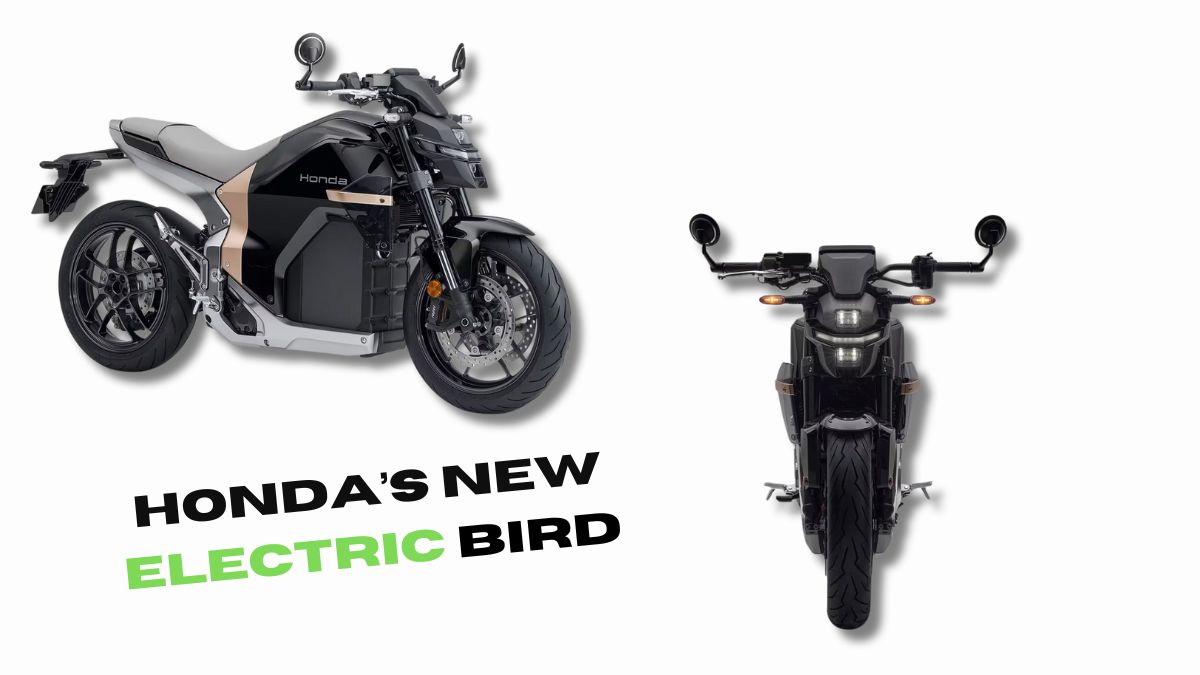
I. The Quiet Revolution: Honda’s Strategic Entry into the Electric Fun Segment
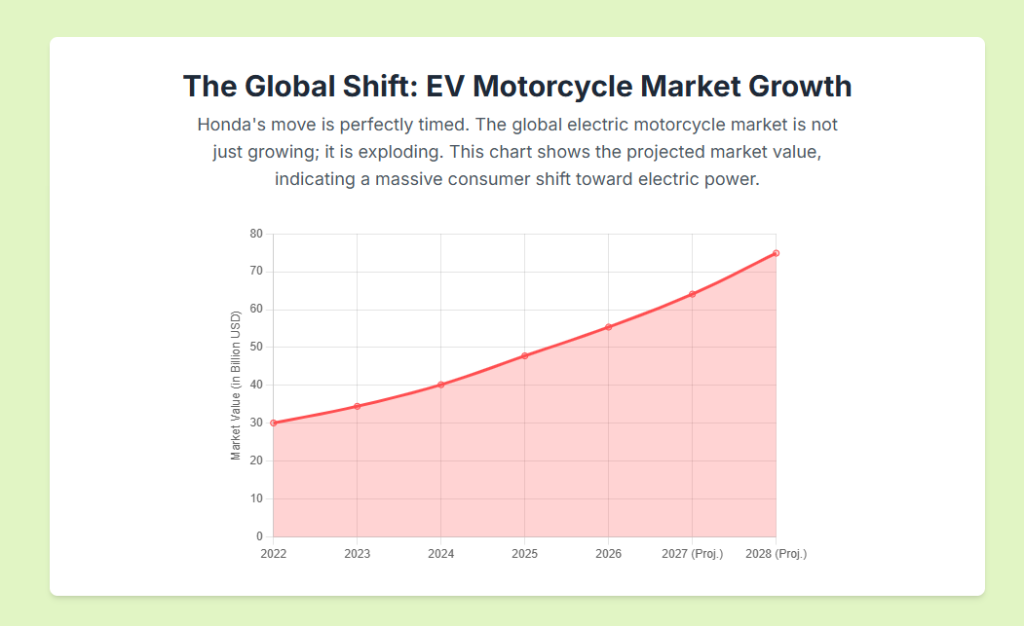
The entry of Honda, the world’s largest motorcycle manufacturer, into the full-size electric vehicle (EV) market for Europe with the new WN7 model is a momentous occasion, signaling a critical pivot for the entire industry.1 This machine arrives carrying the weight of decades of engineering excellence, and its launch is intrinsically linked to the manufacturer’s future environmental commitments. Honda has explicitly positioned motorcycle electrification as a core pillar of its strategy toward achieving carbon neutrality 1, confirming that the WN7 represents much more than a mere technological experiment; it is fundamental to the company’s long-term corporate path.
However, the manner of the WN7’s unveiling has generated significant discussion among industry observers. Honda chose to launch the product with highly selective specifications, revealing phenomenal torque figures while leaving the essential battery capacity (kWh) undisclosed.2 For a machine set for mass production and launch on November 4th, 2025 1, and with full specifications slated for the EICMA 2025 show 3, this limited data package suggests two possibilities. Either the manufacturer is intentionally under-promising to set the stage for a positive performance shock when the full details drop next year, or, alternatively, it points to a struggle where the underlying technology—specifically battery energy density and efficient weight management—failed to meet internal targets. If the latter holds true, it suggests that the commitment to a specific launch timeline superseded the ability to achieve optimal product excellence.
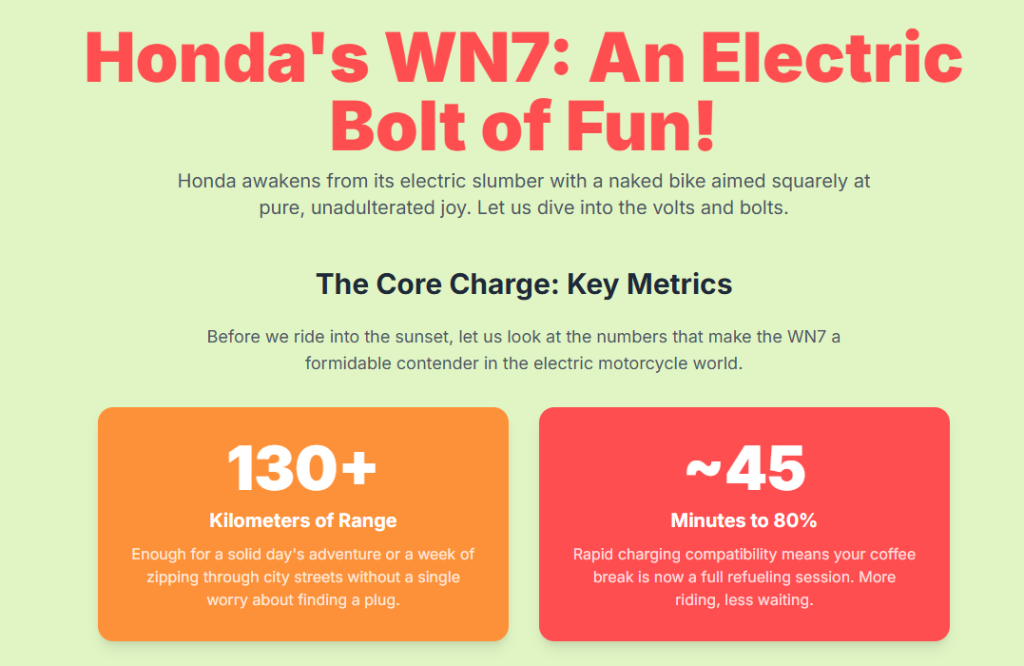
1.2 Decoding the Designation: Be the Wind, Naked, and the Number Seven
The designation “W.N.7” is steeped in marketing ethos. The ‘W’ is drawn from the foundational development slogan “Be the Wind” 2, intended to evoke a feeling of lightness and effortless motion. The ‘N’ simply stands for Naked, reflecting the popular streetfighter format, and the ‘7’ indicates the output class, strategically positioning the bike against established middleweight machines like the Yamaha MT-07.4 This nomenclature attempts to place the WN7 squarely within the highly profitable “Fun segment” 3, a categorization that attempts to define the machine as a recreational toy rather than a utilitarian commuter, conveniently excusing the limited estimated range of just over 130 km.3
This naming convention, however, creates an immediate contradiction when juxtaposed with the specification sheet. While the ‘7’ class suggests the agility and lightness typical of middleweight machines, the WN7’s confirmed curb mass stands at a substantial 217 kg (478 pounds).2 This figure is notably heavy for the category and, critically, outweighs its modern ICE counterpart, the Honda CB750 Hornet, by a considerable 25 kg (55 lbs).7 The heavy nature of the WN7 suggests that the “Be the Wind” motto becomes slightly ironic, as the manufacturer grappled with the immense challenge of efficiently packaging the fixed lithium-ion battery and its associated liquid-cooling systems while trying to meet the weight expectations associated with the middleweight naked category.
II. Engineering Paradox: Deconstructing the WN7’s Technical Specifications
2.1 The Contradictory Power Narrative: Torque vs. Horsepower
The WN7 is defined by a significant engineering tension between low-end performance and sustained output. The headlining feature is the instant, liquid-cooled electric motor torque, which delivers a phenomenal 100 Nm (74 lb-ft) from zero RPM.3 This figure has been highlighted by Honda as equivalent to the torque output of a 1,000cc combustion engine.7 This level of instantaneous power ensures thrilling, neck-snapping acceleration from a standstill, more than fulfilling the requirements of the “Fun segment” in an urban environment.
Yet, a closer look at the power rating reveals a critical constraint. The motor’s continuous output is rated at just 18 kW, which translates to a surprisingly meager 24 horsepower.4 While the motor can reach a peak output of 67 hp (50 kW) 7, a figure comparable to a 600cc ICE motorcycle 2, the enormous disparity between the high torque, the low continuous power, and the peak figure implies thermal and battery management limits. This means the high-performance numbers are unsustainable, and the output must be rapidly tapered to manage heat and preserve the battery. The WN7 is therefore engineered to excel during the first few seconds of acceleration—a perfect
urban stoplight racer—but its low continuous 24 hp rating severely limits its utility for sustained high-speed cruising on European motorways or prolonged spirited riding where consistent power delivery is essential. This compromise ultimately defines the WN7 as an excitement device rather than a truly versatile, performance-oriented motorcycle.
2.2 The Weighty Matter: Curb Mass and Energy Density
The 217 kg (478 lbs) curb mass is perhaps the most scrutinized specification of the WN7.2 This substantial weight places the machine at a distinct disadvantage compared to its traditional middleweight rivals and brings it uncomfortably close to much higher-performing EV competitors that boast significantly better battery capacity and range.2
Compounding this issue is the unfavorable range-to-weight trade-off. Despite carrying this significant weight, the claimed electric range is only 130 km (81 miles).2 Critics argue that this combination of substantial inertia and limited endurance results in a range-to-weight ratio that appears mediocre for a product from the world’s largest manufacturer.2 A further difficulty for market analysts stems from Honda’s deliberate omission of the battery’s overall capacity (kWh).2 This strategic silence hides the true energy density and efficiency metrics, forcing analysts to rely on speculative reviewer estimates, which sometimes cite an 18 kWh pack.8 The high mass negatively impacts handling, requires increased braking effort, and raises concerns about overall component wear.9 Combining this substantial inertia with a restrictive 81-mile range severely limits the machine’s real-world touring appeal, suggesting that the necessary compromise made in battery packaging sacrifices the expected nimbleness of a naked streetfighter. For strictly urban use, some observers contend that cheaper, lighter e-mopeds continue to offer a more sensible ratio of cost to practicality.8
2.3 Rapid Recharge, Real Advantage: The CCS2 Standard
Despite the range and weight concerns, the WN7 features one standout strategic advantage: the integration of CCS2 rapid charging compatibility.2 This is an automotive-grade charging standard and represents a major technological differentiator in the current EV motorcycle market. Honda reports that the fixed lithium-ion battery can recharge from 20% to 80% in just 30 minutes using this CCS2 rapid charging protocol.1 For routine use, home charging from 0% to 100% via a 6kVA wall box takes under three hours.2
This choice of CCS2 grants Honda a crucial strategic lead over established EV rivals, such as Zero Motorcycles, which often utilize slower, less universally accepted charging systems.10 By enabling access to the growing European automotive fast-charging infrastructure, Honda possesses a powerful selling point. The manufacturer has correctly identified that a limited 81-mile range creates significant rider anxiety. By implementing CCS2, Honda strategically utilizes infrastructure access to compensate for the limited battery size. A half-hour top-up transforms the WN7 from a strictly limited urban vehicle into one capable of extended recreational loops, minimizing the critical downtime often associated with early electric models. This feature is likely the most persuasive technical justification for the WN7’s premium market placement, mitigating a key historical weakness of first-generation EV motorcycles.
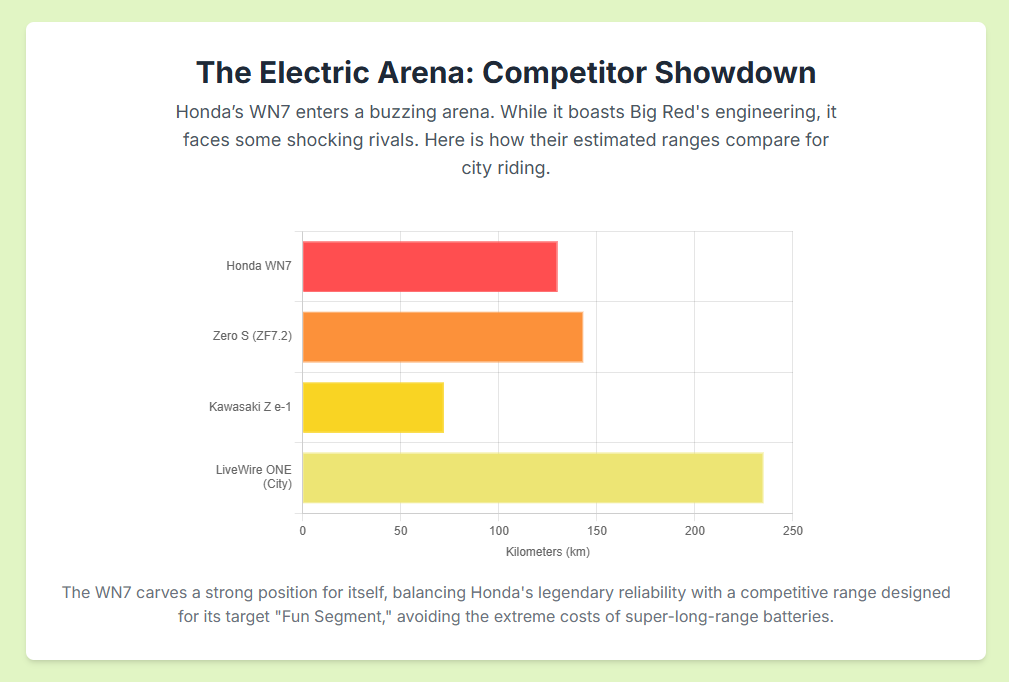
III. Market Positioning and Pricing Strategy: The Premium Dilemma
3.1 The Sticker Shock: Justifying the Price Tag
The WN7 is positioned firmly in the premium segment, evidenced by its launch price set at £12,999 in the UK, which translates to approximately $17,500 at prevailing exchange rates.3 This pricing strategy immediately places the electric model far above its conventional engine counterparts. The WN7 costs roughly 75 percent more than the ICE Honda CB750 Hornet, forcing the bike to compete on price with powerful, long-range combustion machines while offering limited utility in terms of range.7
This pricing creates a severe value gap. The WN7 is priced similarly to high-end, long-range EV competitors (Zero and LiveWire) but currently delivers entry-level EV range and continuous power. This demands that consumers accept a substantial “Early Adopter Tax,” paid primarily for the assurance of the Honda brand, the convenience of CCS2 rapid charging, and the promise of low maintenance. The return on investment must be realized through long-term savings on fuel and traditional upkeep, a calculation that becomes complex when comparing the initial outlay against high-performance alternatives.10 Interestingly, Honda sweetened the initial deal by offering a complimentary seat bag for customers who placed pre-orders before November 4th.3 This aggressive pre-order tactic suggests Honda aims to secure customer commitment prior to the full specification reveal at EICMA 2025, strategically minimizing the risk that potentially disappointing final performance metrics deter prospective sales.4
3.2 Connectivity, Features, and the Rider Experience
Beyond the raw performance metrics, the WN7 offers a suite of modern amenities designed to enhance the rider experience and justify its premium status. The cockpit features a five-inch TFT display, complete with Honda’s RoadSync connectivity for smartphone integration and exclusive menus dedicated to EV operation.2
Perhaps more important for its target demographic is the commitment to minimal maintenance. The propulsion system uses a belt drive.10 This strategic choice, combined with the electric motor, creates an almost maintenance-free ownership experience, serving as a powerful magnet for the convenience-focused rider or the individual who humorously admits they are “lazy and dislike maintaining their stuff”.10 The collective feature set—high price point, virtually zero maintenance needs, and rapid charging capability—establishes a clear target demographic: the affluent, urban European rider. This consumer segment prioritizes convenience and prestige, viewing the WN7 as a reliable, high-tech alternative to an upscale scooter or a second vehicle for short, high-fun commutes, where proximity to public CCS2 chargers or home wall boxes minimizes range anxiety.
IV. Competitive Crucible: Benchmarking Against the Electric Elite
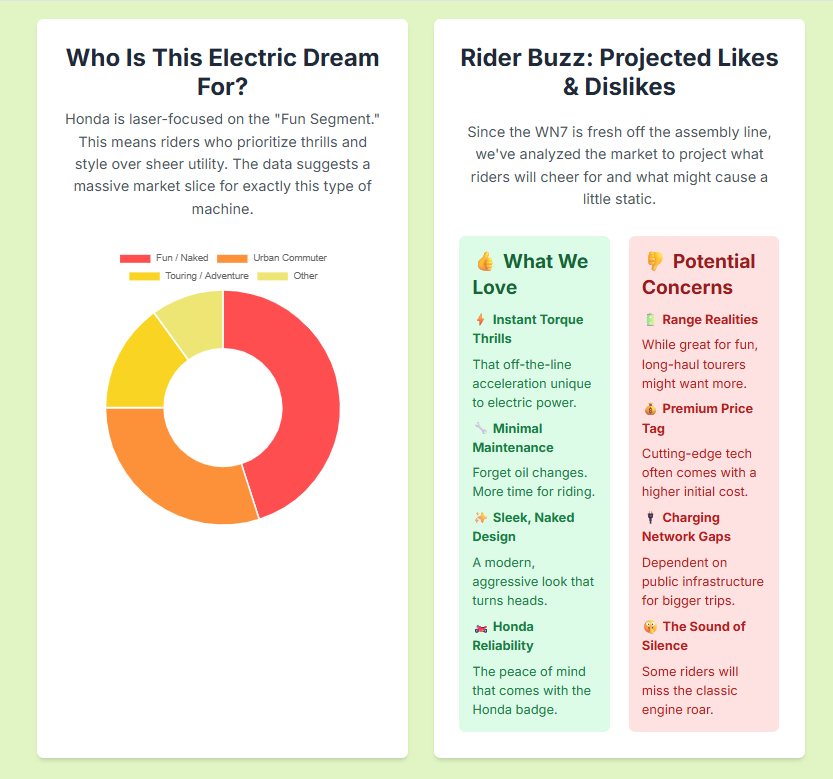
The WN7 enters a fiercely competitive segment, facing established, premium EV rivals like Zero Motorcycles and LiveWire (a spin-off of Harley-Davidson). The following comparison illustrates the WN7’s strategic position: a leader in charging infrastructure but a laggard in raw battery endurance and power output.
Electric Naked Mid-Market Showdown (Preliminary Data)
| Model | Price (Approx. £/$) | Claimed Range (km/mi) | Peak HP (Approx.) | Weight (kg/lbs) | Charging Standard |
| Honda WN7 | £12,999 / $17,500 3 | 130 km (81 mi) 3 | 67 hp 7 | 217 kg (478 lbs) 2 | CCS2 (Rapid) 2 |
| Zero SR/S (Base) | ~$20,995 (Higher spec) 9 | ~200+ km (124+ mi) 11 | ~110 hp 9 | ~235 kg (518 lbs) 9 | J-1772 (Slower) 10 |
| LiveWire ONE | ~$22,799 (Est. Premium) | ~235 km (146 mi) 10 | 101 hp 12 | ~255 kg (562 lbs) | CCS1 (Rapid) 10 |
4.1 Comparison with the American Titans: Zero and LiveWire
The analysis of preliminary data reveals that the WN7 trails significantly in endurance. Both the Zero SR/S and the LiveWire ONE offer combined ranges that comfortably exceed the WN7’s estimated 130 km.10 In the case of the LiveWire ONE, its range approaches double that of the new Honda. This range disparity immediately disqualifies the WN7 for long-distance commuters or high-mileage recreational riders who frequently venture outside urban centers.
Furthermore, the Honda’s peak 67 hp is substantially lower than its premium-priced rivals, which generally offer outputs of 101 hp to 110 hp.9 To compound the issue, the WN7’s 217 kg weight is remarkably close to the heavier, yet longer-range, rivals 2, underscoring its comparatively poorer power-to-weight ratio and limited energy efficiency.
4.2 The Charging Standard Advantage: CCS2 vs. The Rest
The clearest path to market differentiation for Honda lies in its charging technology. The manufacturer’s commitment to the CCS2 standard provides a clear competitive tool, positioning it ahead of established players like Zero, which historically rely on slower charging protocols.10 The inclusion of this expensive, high-performance CCS2 hardware partially justifies the premium price tag.
Honda asks consumers to prioritize charging speed (infrastructure access) over raw battery capacity (range). While the WN7’s capacity remains disappointing, the 30-minute charge time makes its effective range far more usable than that of a rival offering superior mileage but requiring several hours to recharge on the road. This rapid charging capability serves as a critical competitive shield against rivals with slower recharge times, mitigating the primary customer pain point of extended charging stops and making the WN7’s limited range substantially more viable for recreational use.
V. Likes, Dislikes, and the Unfiltered Review: The Rider’s Verdict
5.1 The Thrills (Likes): Unpacking the WN7’s Strengths
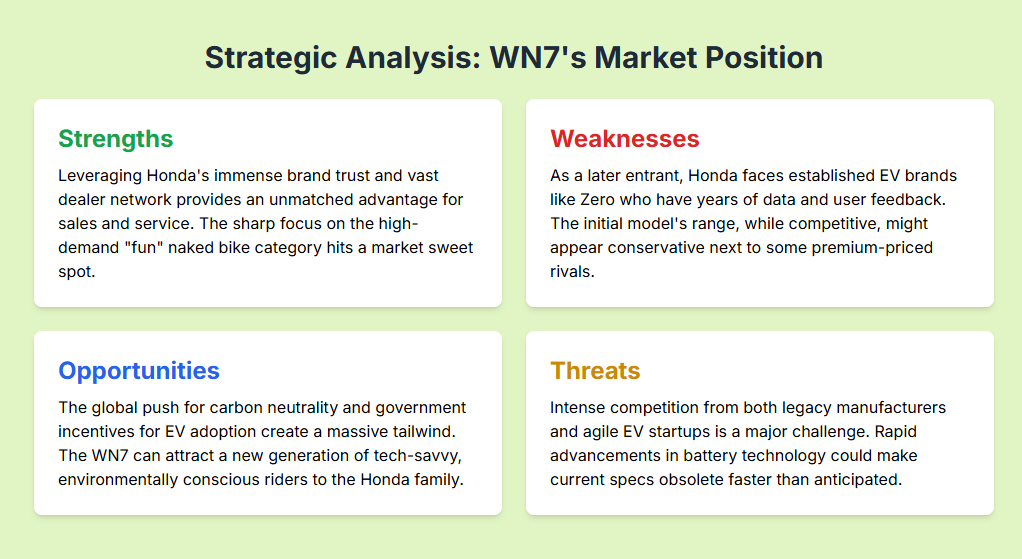
Despite the criticism regarding range and weight, the WN7 possesses genuine strengths that resonate with certain segments of the market. Foremost among these is the instantaneous performance derived from the 100 Nm torque.3 This ensures that the bike feels incredibly responsive and provides a genuine element of fun and excitement, particularly in the urban environment it appears designed for.
Another highly attractive factor is the machine’s potential for low maintenance. The decision to combine an electric motor with a belt drive system results in an experience that is virtually maintenance-free, a major draw for the convenience-focused rider.10 Finally, the combination of CCS2 compatibility and the perceived quality assurance provided by Honda’s extensive dealer network and brand reliability are strong arguments for adoption.2 This brand assurance offsets the risks often associated with adopting products from EV startups.
5.2 The Flaws (Dislikes): Why Critics are Underwhelmed
The WN7 faces significant criticism surrounding its core specifications, which reviewers have consistently characterized as “underwhelming” or “mediocre”.8 The primary point of contention is the triple threat of high weight (217 kg), the low 24 hp continuous output, and the restrictive 81-mile real-world range.8
Further exasperating observers is the price mismatch. The £12,999 price is deemed excessive for the performance delivered, leading to forum discussions concluding that, for pure city commuting, electric mopeds offer superior practicality at a fraction of the cost.8 Perhaps the most damaging criticism suggests that the WN7 fails to be the necessary technical leap expected from the world’s largest motorcycle manufacturer, concluding that it is simply “another electric motorcycle with mediocre specs and range”.8 This disappointment risks eroding the brand’s premium status. The approach appears risk-averse, prioritizing thermal safety and battery longevity (evidenced by the low continuous power rating) over raw performance, a decision that clashes directly with the advertised “Fun segment” marketing strategy.
VI. Strategic Outlook and Recommendations
6.1 Market Penetration Strategy: Leveraging the Advantages
To maximize the WN7’s commercial success, Honda must immediately reframe its marketing message to accentuate its key advantages, rather than defend its limited range. The company should strategically cease marketing based on the raw 130 km range figure and focus entirely on the convenience of CCS2 charging and the thrill of 100 Nm of torque. The core communication must shift to: “The WN7 delivers liter-bike fun and recharges faster than your lunch break.”
Targeted campaigns must also highlight the exceptional low-maintenance aspects, emphasizing the belt drive and the inherent reliability of the Honda brand to capture the affluent, time-poor European consumer seeking a zero-stress riding solution.10 Crucially, the confirmed 11kW version for European A1 license holders 2 provides a vital opportunity to leverage the premium brand experience to capture new and younger riders early in their riding lifecycle.
6.2 Forecasting the Competitive Response and The Future of Fun
The competitive response to the WN7 is predictable: rivals such as Zero and LiveWire are expected to counter by highlighting their superior range and power metrics. However, the true strategic battleground remains infrastructure. These competitors will likely accelerate efforts to upgrade their own charging infrastructure to match the critical CCS2 advantage established by Honda.10 The full specifications revealed at EICMA 2025 must deliver exceptional performance figures or provide a comprehensive technological explanation that fundamentally justifies the current weight and price point to effectively silence the current wave of critical commentary.4
A fundamental aspect of Honda’s long-term play resides in the decision to utilize a fixed lithium-ion battery.2 While this enables compatibility with high-power CCS2 charging, it also intentionally prevents the WN7 from participating in the emerging, high-convenience battery-swapping ecosystems currently being explored by other Asian OEMs. Honda’s adherence to the fixed battery and the CCS standard reflects a clear, high-stakes commitment to the global
automotive charging paradigm. This signals the manufacturer’s belief that riders will ultimately adapt to utilizing established infrastructure charging stops rather than requiring operational flexibility via future battery swapping stations.
Conclusions
The Honda WN7 enters the European market with an ambiguous proposition. It successfully packages instantaneous torque and an industry-leading CCS2 charging solution within a reputable framework of low maintenance and guaranteed quality. These features establish a compelling offering for the affluent urban rider seeking convenience and short bursts of excitement.
However, the motorcycle struggles under the burden of its heavy 217 kg curb weight and disappointing 130 km range, exacerbated by a high price tag relative to its meager 24 hp continuous output. The strategic challenge for Honda involves persuading consumers that the convenience of a 30-minute recharge outweighs the significant range deficit compared to its primary EV competitors. The WN7 is undeniably a statement of intent regarding Honda’s carbon-neutral commitment, but it is one that currently prioritizes infrastructure compatibility and safety over delivering the groundbreaking performance expected from a market leader. Its ultimate success hinges on whether the market will accept a premium price for a fundamentally compromised range in exchange for supreme charging speed and Honda’s unparalleled reliability.
Source URLs
3
https://www.autoevolution.com/moto/honda-wn7-2025.html
2
1
5
2
8
10
11
9
6
4
7
10
12
8
Works cited
- Honda unveils first full-size electric motorcycle for Europe – electrive.com, accessed on September 27, 2025, https://www.electrive.com/2025/09/19/honda-unveils-first-full-size-electric-motorcycle-for-europe/
- 2026 Honda WN7 first look: Big Red’s first-ever electric motorcycle – RevZilla, accessed on September 27, 2025, https://www.revzilla.com/common-tread/2026-honda-wn7-first-look-big-reds-first-ever-electric-motorcycle
- 2026 Honda WN7 Specs, Performance & Photos – autoevolution, accessed on September 27, 2025, https://www.autoevolution.com/moto/honda-wn7-2025.html
- Honda WN7 EV Ready for Production | Cycle World, accessed on September 27, 2025, https://www.cycleworld.com/motorcycle-news/honda-wn7-ev-ready-for-production/
- accessed on September 27, 2025, https://auto.hindustantimes.com/auto/electric-vehicles/honda-wn7-marks-brands-entry-into-electric-bike-segment-what-makes-it-special-41758176533009.html#:~:text=The%20’W’%20in%20its%20name,2%20Honda%20WN7%3A%20Features
- Honda’s First Electric Motorcycle to be Called the WN7, accessed on September 27, 2025, https://www.motorcycle.com/bikes/news/honda-s-first-electric-motorcycle-to-be-called-the-wn7-44649391
- Honda Builds An Electric Bike For Grown Ups But The Charge Feels Wrong | Carscoops, accessed on September 27, 2025, https://www.carscoops.com/2025/09/honda-builds-an-electric-bike-for-grown-ups-but-the-charge-feels-wrong/
- Honda WN7 Is a BIG Disappointment. Here’s why.. – YouTube, accessed on September 27, 2025, https://www.youtube.com/watch?v=LN3Ay42YmbA
- 2025 Zero Motorcycles SR/S Review – Motorcyclist, accessed on September 27, 2025, https://www.motorcyclistonline.com/reviews/zero-motorcycles-srs-review/
- Honda has unveiled its first electric motorcycle, “Honda WN7,” in Europe. – Reddit, accessed on September 27, 2025, https://www.reddit.com/r/motorcycles/comments/1nifrev/honda_has_unveiled_its_first_electric_motorcycle/
- Honda WN7 Electric Bike 2025 – Futuristic Two-Wheeler Offering Bold Styling, Smart Technology, And Supreme Comfort Built For Eco-Friendly Riders – mipscollege.in, accessed on September 27, 2025, https://mipscollege.in/honda-wn7-electric-bike-2025/
- ‘LiveWire One’ gets power boost over Harley LiveWire – Bennetts Insurance, accessed on September 27, 2025, https://www.bennetts.co.uk/bikesocial/news-and-views/news/2021/june/livewire-one-power-boost-harley
Our Social Media Handles
- Instagram : LivingWithGravity
- Medium : Akash Dolas
- YouTube Channel : Gear and Shutter
- Facebook : LivingWithGravity