










Executive Summary: Suzuki’s Strategic Re-ignition of the GSX-R Legacy
Suzuki is strategically leveraging the 40th anniversary of its iconic GSX-R series, which commenced with the groundbreaking GSX-R750 in 1985, as a pivotal moment to reassert its presence in the high-performance motorcycle segment. The launch of a special commemorative website, replete with suspenseful messaging and a precisely timed announcement for July 31st, indicates a meticulously orchestrated campaign designed to generate significant anticipation. This is not merely a nostalgic look back at a celebrated history but a forward-looking initiative signaling a deliberate strategic shift to re-engage with a critical, albeit challenging, market segment.

The strong emphasis on the Suzuka Circuit in teaser materials and the timing of the announcement—just prior to the Suzuka 8 Hours Endurance Race—powerfully suggests the unveiling of a revitalized flagship model. All indications point to a new GSX-R1000, which would serve as a cornerstone of Suzuki’s future supersport strategy. This strategic move aims to capitalize on the brand’s rich racing heritage and engineering prowess, while also highlighting its commitment to innovation and sustainability, as demonstrated through its ongoing racing efforts with sustainable fuels and materials. This anniversary thus marks a crucial juncture for Suzuki, positioning the brand for a renewed direction in high-performance motorcycling that balances legacy with future-oriented advancements.
The GSX-R Series: A 40-Year Icon of Performance and Innovation
The Suzuki GSX-R series has carved out an indelible legacy over four decades, establishing itself as a benchmark for performance and technological innovation in the supersport category. From its revolutionary inception to its current global footprint, the series embodies a relentless pursuit of speed, agility, and durability.
Commemorating a Milestone: The Special Website and its Purpose
Suzuki officially launched a special website on July 25th, 2025, to commemorate the 40th anniversary of the GSX-R series, a lineage that began with the pioneering first-generation GSX-R750 in 1985.1 This website launch serves as the initial public phase of a multi-stage commemorative campaign. The site features a compelling design, including a timeline that showcases historical vehicles. Notably, on the domestic version of the site, the entry for “2025: 40th anniversary of the GSX-R series” displays only text, conspicuously lacking a photo. This deliberate visual void creates a palpable sense of anticipation, hinting at something yet to be revealed [User Query].
Further amplifying this suspense, the global site prominently displays the text “31st July 16:00 JST / 9:00 CEST” alongside explicit calls to action such as “Save the date” and “Special Video is Coming soon” [User Query]. This precise timing and explicit suggestion of an imminent video release strongly indicate a significant announcement is forthcoming, moving beyond mere historical reflection.3 The deliberate design of the website, particularly the “missing” 2025 photo and the explicit “Save the date” for July 31st, indicates a carefully orchestrated, multi-stage reveal strategy. This approach suggests that the anniversary is not simply a nostalgic look back but a forward-looking marketing campaign designed to build suspense and generate maximum impact for a future product announcement. The “foreboding” text described in the user query is an integral part of this strategic suspense-building, aiming to heighten interest.
The stated purpose of the special website is to showcase the “spirit of the GSX-R series that has been passed down for 40 years,” promising content such as interviews with past developers and information on upcoming events, with sequential updates planned.1 This strategic use of its heritage aims to build excitement for its future. This level of strategic marketing for the GSX-R series suggests that whatever is being announced on July 31st is of significant importance to Suzuki’s global motorcycle strategy, aiming to capture attention beyond just existing enthusiasts.
The Genesis: Revolutionary Impact of the 1985 GSX-R750
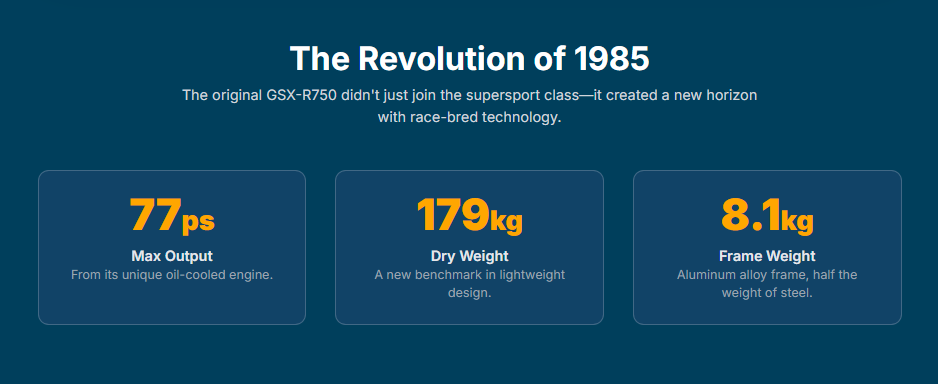
The first GSX-R750, introduced in 1985, was a truly groundbreaking model that directly incorporated technology cultivated in demanding races such as the World Endurance Championship, embodying a genuine “Race-to-Road” philosophy.1 It was equipped with Suzuki’s innovative oil-cooled engine, a proprietary design that achieved a remarkable balance of light weight and high durability, delivering a maximum output of 77 PS.1
A defining innovation was the adoption of an aluminum alloy multi-rib square frame, weighing a mere 8.1kg – less than half the weight of conventional steel frames of the era. This contributed to an astonishingly low dry weight of just 179kg, fundamentally redefining the performance benchmarks for large-displacement super sports bikes.1 This unprecedented combination of high power, lightweight construction, and robust durability “opened up a new horizon for large-displacement super sports bikes,” setting a new standard for the segment.1 The original GSX-R750 was not just a new model but a paradigm shift in motorcycle design, directly influencing the philosophy of modern sports bikes like the Fireblade and R1.4 Its success was rooted in a direct transfer of race-bred technology to production models, a principle Suzuki appears keen to re-emphasize with the Suzuka 8 Hours connection.
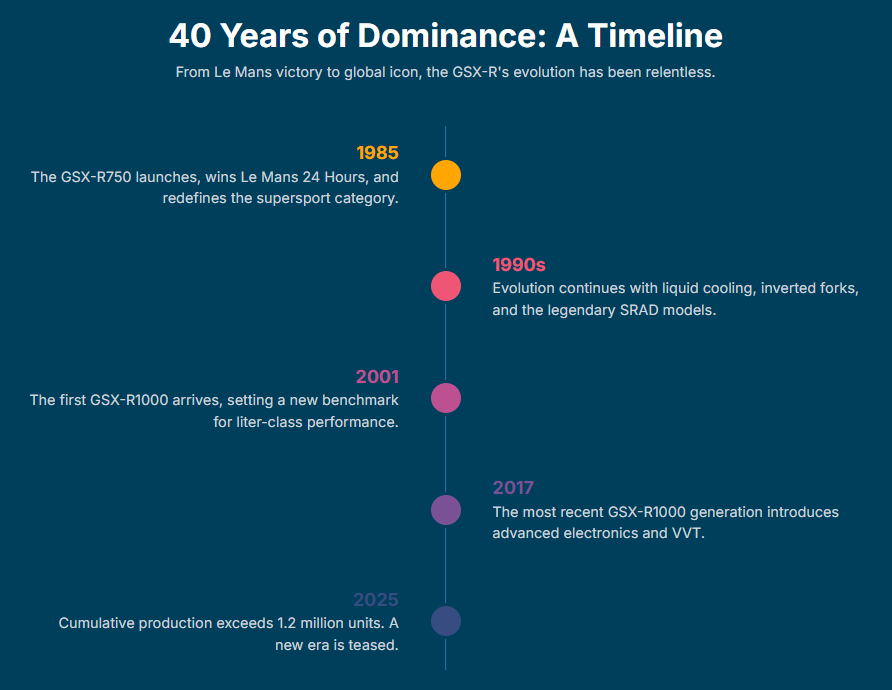
The GSX-R750 made an immediate impact, making its racing debut and securing a victory in the prestigious 24 Hours of Le Mans Endurance Race in the very same year of its release (1985), unequivocally solidifying its racing pedigree and performance capabilities.1 Suzuki’s emphasis on these historical facts serves to remind the market of its past leadership in innovation and performance. By highlighting the direct link between racing technology and production models, Suzuki is setting the stage to imply a similar, groundbreaking approach for its future products, particularly if a new GSX-R1000 is revealed with race-derived features. This reinforces the brand’s core identity and builds credibility and excitement for the upcoming announcement, suggesting that the “new” will be as impactful as the “original.”
Evolution Through Decades: Key Technological Advancements and Racing Heritage
Over the past four decades, the GSX-R series has consistently maintained its reputation and market support as a super sports bike with inherent race-winning potential, a testament to its foundational design and continuous refinement.1 The series has achieved an impressive cumulative production exceeding 1.2 million units across its various displacements, including the GSX-R1100, 1000, 750, 600, 150, and 125 models, as of the end of June 2025. This significant volume underscores its global appeal and market penetration over time.1
Throughout its evolution, the GSX-R lineup has introduced numerous significant advancements. These include the prominent display of aluminum frames, innovative air intakes for enhanced engine performance, the widespread adoption of 17-inch wheels, the development of “slingshot” carbs, the integration of inverted front forks, the transition to liquid cooling for improved thermal management, the implementation of electronically controlled secondary throttle valves for precise power delivery, the introduction of S-DMS (Suzuki Drive Mode Selector) for customizable riding experiences, multi-hole fuel injectors for optimized combustion, and the debut of electronic steering dampers for enhanced stability.4 The GSX-R750, in particular, underwent multiple comprehensive redesigns, consistently prioritizing weight reduction and power increases, even as it transitioned to more complex systems like liquid cooling, demonstrating Suzuki’s unwavering commitment to its core performance philosophy.4
The consistent evolution of the GSX-R series, marked by continuous technological refinement and a relentless pursuit of performance and weight reduction, underscores Suzuki’s long-standing engineering prowess. The 1.2 million unit production figure is a testament to its global appeal and market penetration, providing a strong foundation for future models despite current market challenges. This deep history of innovation and market success provides Suzuki with significant brand equity and a strong narrative for any new product launch. This suggests that while Suzuki might appear conservative in recent years, it possesses the engineering capability and historical precedent to deliver cutting-edge products when it chooses to. This historical context positions any new GSX-R model not as a desperate attempt to re-enter a declining market, but as the continuation of a legacy of engineering excellence and market leadership, potentially attracting both long-time enthusiasts and new buyers.
Global Footprint: Cumulative Production and Market Presence
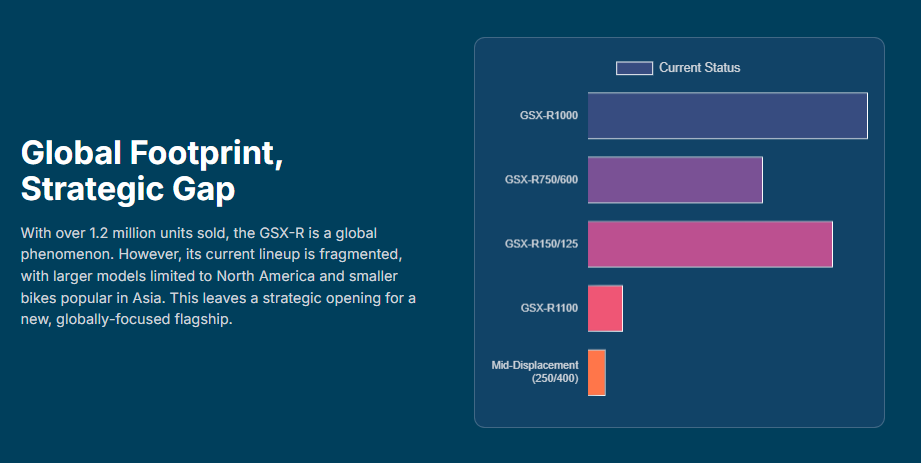
The GSX-R series has achieved an impressive cumulative production of over 1.2 million units across its diverse range of displacements (GSX-R1100/1000/750/600/150/125) as of the end of June 2025, highlighting its widespread adoption and enduring popularity over four decades.1 However, the current market presence of the series is notably fragmented. The larger displacement GSX-R750 and GSX-R600 models primarily survive in North American specifications, with 2026 models recently announced for that specific market. In contrast, the smaller displacement GSX-R150 and GSX-R125 models enjoy considerable popularity in Asian markets and other regions [User Query].
Currently, there are no 250cc or 400cc class models listed within the GSX-R lineup, indicating a gap in Suzuki’s mid-range supersport offerings [User Query]. While the cumulative production figure is historically impressive, the current fragmented market presence of the GSX-R lineup highlights a strategic challenge. A new flagship model would likely aim to unify and invigorate the global lineup, projecting a consistent brand image across diverse markets. The 1.2 million units indicate a strong brand foundation, but the current lineup’s limited global availability in key segments underscores the need for a strategic refresh.
This segmentation suggests that Suzuki has been cautious or reactive in certain markets, possibly due to emissions regulations or shifting consumer preferences. A new, globally relevant flagship model (like a GSX-R1000) would serve to re-establish a unified, high-performance image worldwide, bridging the gaps in its current lineup and signaling a renewed global commitment to the supersport segment. It would act as a halo product to uplift the entire series. The launch of a new, globally compliant GSX-R1000 would not only address the high-performance segment but also act as a powerful marketing tool to reinforce Suzuki’s engineering capabilities and racing heritage across all markets, potentially boosting sales of other models by association.
The following table summarizes key milestones and innovations throughout the GSX-R series’ history:
Table 1: Key Milestones and Innovations of the GSX-R Series (1985-2025)
| Year/Period | Model/Generation | Key Innovation / Milestone | Snippet Reference |
| 1985 | GSX-R750 (First Gen) | Launch of revolutionary superbike; oil-cooled engine; aluminum multi-rib square frame (179kg dry weight, 77ps); Le Mans 24-hour win | 1 |
| 1986 | GSX-R750 (Limited Edition) | Limited production (500 units); steering damper, dry clutch, radial tires | 4 |
| Early Redesign | GSX-R750 | Exposed aluminum frame; new air intakes; first to use 17-inch wheels; “slingshot” carbs | 4 |
| Third Generation | GSX-R750 | Increased power/torque; inverted front forks; fully adjustable rear suspension; liquid-cooled engine introduced | 4 |
| Modern Era (Post-2000) | GSX-R750 | Electronically controlled secondary throttle valves; lighter chassis (lost 29 lbs); power ~140hp | 4 |
| Further Refinement | GSX-R750 | Weight reduction (lost 7 lbs); increased power (gained 7 hp); radially mounted front calipers | 4 |
| Eighth/Ninth Gen | GSX-R750 | S-DMS (Suzuki Drive Mode Selector); multi-hole fuel injectors; electronic steering damper | 4 |
| 2011 | GSX-R750 (Tenth Gen) | Significant weight reduction (17.6 lbs); wheelbase cut (0.6 inches) | 4 |
| End of June 2025 | GSX-R Series (Cumulative) | Cumulative production exceeds 1.2 million units globally | 1 |
| July 25, 2025 | GSX-R 40th Anniversary | Special commemorative website launched globally | 1 |
| 2024-Present | GSX-R1000 (Race) | “Team SUZUKI CN Challenge” in Suzuka 8 Hours; focus on sustainable fuels and materials | 1 |
| July 31, 2025 | GSX-R 40th Anniversary | Anticipated “special news” and “Special Video” release | 3 |
Decoding the “Foreboding” Announcement: The Future of GSX-R
The subtle yet impactful messaging on Suzuki’s 40th-anniversary website, described as “foreboding,” sets the stage for a significant unveiling. The strategic timing and content strongly point towards a major product announcement that will redefine Suzuki’s position in the supersport market.
The July 31st Reveal: Anticipating a Flagship Model Introduction
The special website explicitly sets a precise date and time for “special news” and a “Special Video”: July 31st, 16:00 JST / 9:00 CEST [User Query]. This highly specific timing suggests a significant, pre-planned unveiling. It is important to clarify a distinction that some automated responses might miss: while the website itself launched on July 25th, 2025, it explicitly teases a news release on July 31st.3 This discrepancy highlights a critical point: Suzuki is orchestrating a multi-stage announcement. The website launch is merely the first step, designed to build anticipation for the main event on July 31st. This layered approach signifies the magnitude of the impending news, which is highly likely to be a product reveal rather than just an event update.
Given the context of the 40th anniversary and the current lineup’s limited global availability in key performance segments, the strong implication is that this announcement will involve the introduction of new models, with the GSX-R1000 being the most probable candidate for a flagship refresh [User Query]. This phased approach is typically reserved for major product introductions, not minor updates or event announcements. The “foreboding” tone aligns with the suspense built for a significant reveal. This strategic rollout suggests that Suzuki is confident in the impact of its upcoming announcement, aiming to maximize media attention and consumer excitement. It is a clear signal of a significant product investment and a renewed focus on its high-performance segment.
Strategic Timing: Suzuka 8 Hours and the Race-to-Road Connection
The official teaser video for the 40th anniversary prominently includes glimpses of “SUZUKA CIRCUIT” branding, explicitly linking the anniversary celebration to this iconic racing venue.6 The special news is strategically scheduled for July 31st, which is the day immediately preceding the start of the Suzuka 8 Hours Endurance Road Race (August 1-3, 2025).5 This precise timing is highly indicative of a direct connection between the announcement and the race.
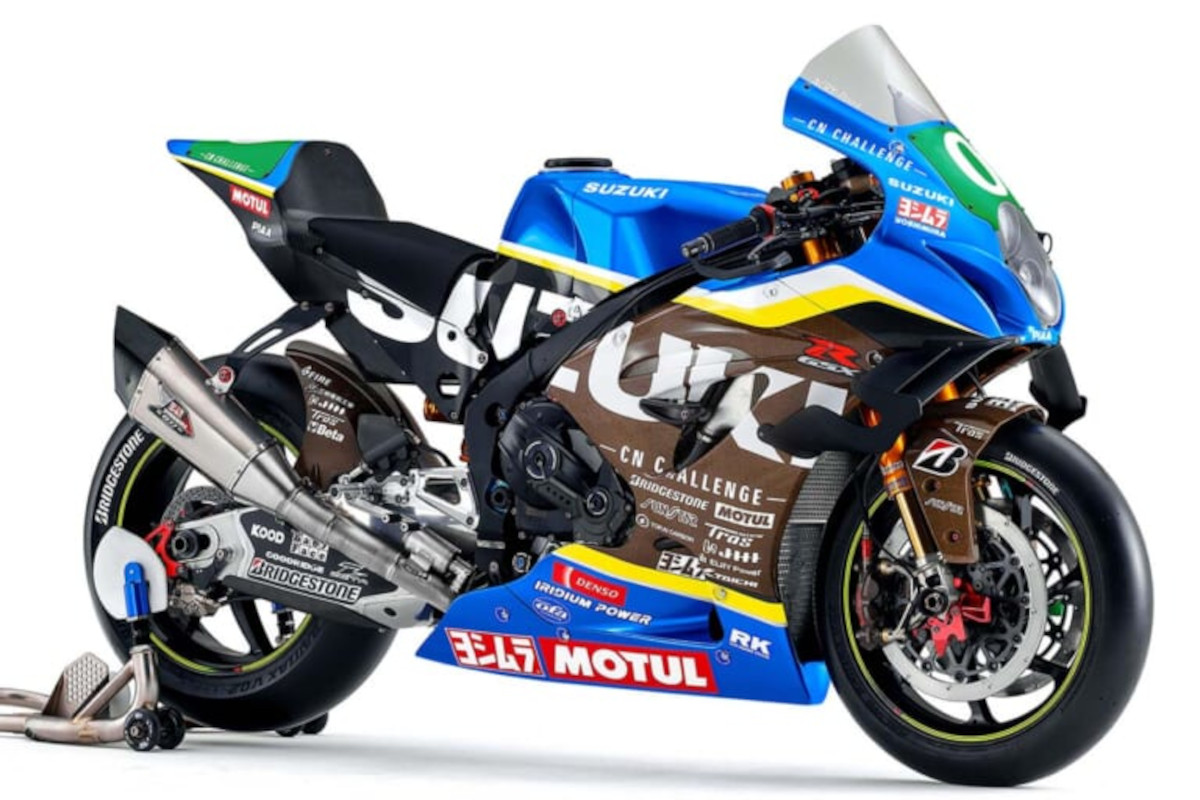
Suzuki has been actively competing in the Suzuka 8 Hours since 2024 as “Team Suzuki CN Challenge,” utilizing a machine based on the GSX-R1000. This participation is not merely for competition but is explicitly focused on testing and developing environmental performance technologies using sustainable items, with the stated goal of feeding back these technical insights into future production products.1 For the 2025 Suzuka 8 Hours race, the “Team Suzuki CN Challenge” GSX-R1000R will notably run on 100% sustainable fuel (Excellium Racing 100 from TotalEnergies) and incorporate greener components such as bodywork made from recycled carbon fiber and racing tires with a higher proportion of recycled and recyclable materials.5
The undeniable link between the July 31st announcement, the “SUZUKA CIRCUIT” branding, and the Suzuka 8 Hours race is a powerful strategic alignment. It strongly suggests that the impending announcement is directly related to a new flagship supersport model, most logically a GSX-R1000, that embodies Suzuki’s commitment to racing heritage, performance, and increasingly, sustainable technology. This timing allows Suzuki to leverage the high visibility of the race to showcase its latest developments. This is a classic “Race-to-Road” strategy.
By announcing a new model (likely the GSX-R1000) just before the Suzuka 8 Hours, Suzuki can immediately demonstrate its real-world performance and technological advancements in a highly competitive environment. Furthermore, the focus on sustainable fuel and materials in the race bike suggests that environmental performance and future-proofing will be key themes for the new production model, aligning with broader industry trends and regulatory pressures. This strategic timing and thematic integration aim to position Suzuki not just as a traditional performance brand, but as a forward-thinking innovator capable of meeting future challenges while retaining its racing DNA.
Analyzing the Current GSX-R Lineup: Gaps and Opportunities
A review of the current GSX-R series listed on the global website reveals a diverse but somewhat fragmented lineup, including the GSX-R750, GSX-R1100 (whose lineage has been discontinued), GSX-R600, GSX-R1000, GSX-R150, and GSX-R125 [User Query]. The GSX-R750 and GSX-R600 models are currently limited in availability, primarily surviving in North American specifications, with 2026 models having just been announced for that market. This indicates a reduced global presence for these once-dominant middleweight supersports [User Query].
The smaller displacement GSX-R150 and GSX-R125 models, while popular in Asian markets and elsewhere, are not considered significant enough in terms of global impact or technological breakthrough to constitute the “special news” anticipated for a 40th-anniversary commemoration of this magnitude [User Query]. Notably absent from the current global lineup are any models in the 250cc or 400cc classes, leaving a significant gap in Suzuki’s entry-to-mid-level supersport offerings [User Query].
Given the current state of the lineup, the GSX-R1000 emerges as the sole remaining flagship model that has not received a significant update in recent years, making it the prime and most logical candidate for a refresh or entirely new generation to headline the 40th-anniversary celebrations.7 While there is some speculation regarding a new GSX-R750 8, the overwhelming evidence, particularly the strong ties to the Suzuka 8 Hours endurance race, points much more definitively towards a liter-class machine as the focus of the impending announcement [User Query].
The current state of the GSX-R lineup reveals significant gaps and a lack of global competitiveness, particularly in the crucial liter-bike segment where the GSX-R1000 has been “dormant”.7 This fragmented and somewhat outdated lineup creates a clear strategic imperative for Suzuki to introduce a new, globally relevant flagship model to re-energize the series and compete effectively with modern rivals. The strategic opportunity lies in revitalizing the GSX-R1000. Its dormancy and the limited global availability of other larger GSX-R models create a vacuum that a new, technologically advanced liter-bike can fill.
This new model would not only address the high-performance segment but also act as a halo product, signaling Suzuki’s renewed commitment to performance and potentially paving the way for future mid-range or globally compliant models. The user query’s observation that “the only thing left is the GSX-R1000” represents a sound analytical conclusion based on the current product portfolio and the scale of the anniversary. A successful launch of a cutting-edge GSX-R1000 could reverse the perception of Suzuki being slow to innovate in the supersport category, attracting new customers and strengthening dealer networks globally. It is a high-stakes move to reclaim market share and prestige.
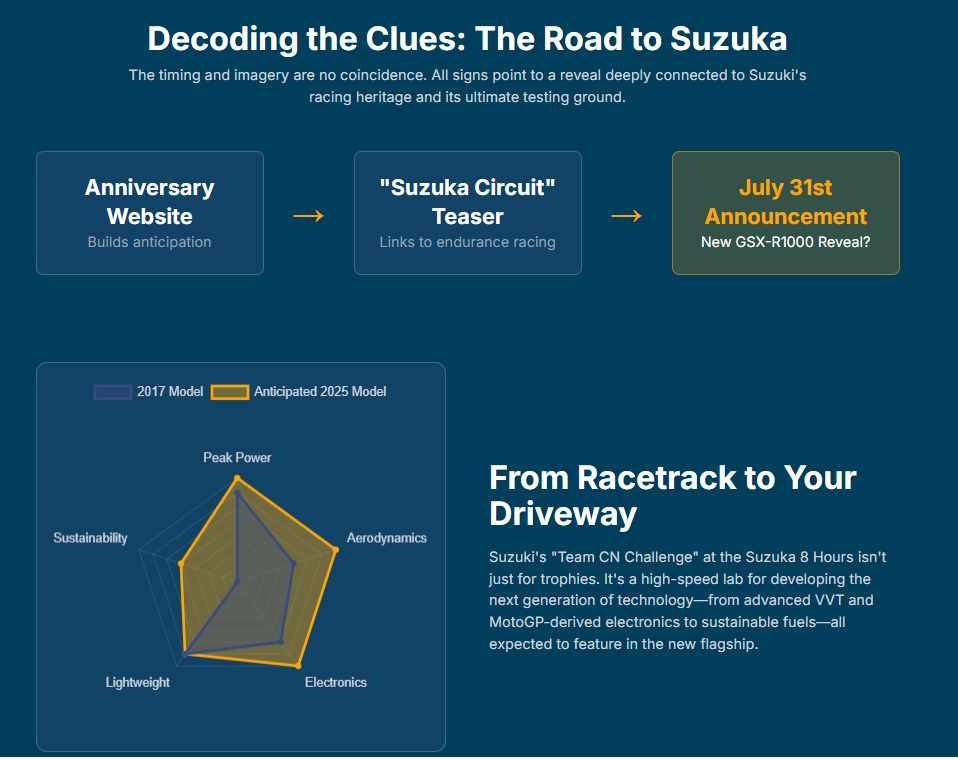
The Next Generation GSX-R1000: Insights from Patents and Industry Signals
Industry signals, particularly patent filings, provide a compelling preview of the technological advancements expected in the next-generation GSX-R1000. These advancements indicate Suzuki’s intent to position this model competitively at the forefront of the supersport category.
Advanced Aerodynamics and Design Innovations
Patent filings strongly indicate that a new GSX-R1000 will feature significantly advanced aerodynamics. This includes a unique front fairing meticulously carved to optimize airflow, specifically designed to direct more air to the radiator for improved cooling efficiency and simultaneously reduce overall drag.7 A particularly innovative and “segment-first feature” detailed in the patents involves a clever solution to prevent air from being sucked into the inevitable gap between the headlight and steering head. This design ensures highly efficient airflow directly to the radiator, a crucial aspect for high-performance engines.7
The new aerodynamic package is described as extending comprehensively from the nose of the fairing right to the lower engine fairing, appearing notably longer than the aero elements found on key rivals such as the BMW S 1000 RR and considerably larger than those on the Ducati Panigale V4.7 While the primary focus is on the GSX-R1000, parallel speculation for a new GSX-R750 also suggests the incorporation of modern aerodynamic touches and slim fairings, indicating a broader design philosophy across the supersport range.8
Suzuki is clearly investing in cutting-edge aerodynamic solutions, moving beyond conventional winglets to integrate airflow management directly into the fairing design. This focus on aerodynamic efficiency, particularly for cooling and drag reduction, suggests a performance-first approach aimed at maximizing track capability and potentially setting new benchmarks in the liter-bike class. This focus on integrated, functional aerodynamics, rather than just bolt-on winglets, indicates a holistic design philosophy aimed at optimizing performance for both track and potentially road use.
The “segment-first” claim suggests a desire to differentiate and lead in this area, potentially addressing a long-standing challenge in faired motorcycle design. This also aligns with the “Race-to-Road” narrative, as efficient cooling and reduced drag are paramount in racing. If these patented features translate effectively to the production model, the new GSX-R1000 could offer a significant competitive advantage in terms of stability, cooling efficiency, and top-end performance, appealing to serious track riders and performance enthusiasts who value engineering over mere aesthetics.
Engine Evolution: Variable Valve Timing and Performance Enhancements
The next-generation GSX-R1000 is widely expected to boast an updated 999cc inline-four powerhouse, featuring a sophisticated hydraulic variable valve timing (VVT) system.7 This hydraulic VVT system is a significant upgrade, noted for being more versatile and capable than the outgoing model’s all-mechanical, centrifugal system, which was derived from MotoGP (where electronic VVT is prohibited).7 A crucial benefit of this advanced VVT system is its role in enabling the motorcycle to meet stringent Euro 5 emission norms – a standard that the previous liter-bike model never achieved during its lifecycle.7
Alongside emissions compliance, a “decent gain in peak output” is highly anticipated. The new model is expected to decisively breach the 200 horsepower barrier, building upon the previous iteration’s already impressive 199 horsepower. This projected power output will position it competitively against leading rivals such as the 201-hp Kawasaki Ninja ZX-10R and potentially challenge the 210-hp BMW S 1000 RR.7 The adoption of hydraulic VVT is a critical technological leap for the GSX-R1000, enabling it to meet stringent Euro 5 emissions while simultaneously enhancing performance. This demonstrates Suzuki’s commitment to both regulatory compliance and competitive power output, leveraging advanced engine technology to overcome the traditional trade-off between environmental standards and raw performance.
The move from a mechanical to a hydraulic VVT system signifies a significant investment in engine development. This is not just about meeting regulations; it is about optimizing the engine’s power delivery across the rev range, offering a more flexible and potent powerplant. The ability to breach 200hp while meeting Euro 5 suggests a highly efficient and advanced engine design, positioning it as a serious contender against the segment’s leaders. This also implies Suzuki is addressing a key competitive disadvantage. This engine upgrade signals Suzuki’s intent to remain competitive in the high-performance segment by embracing advanced technologies that balance environmental responsibility with uncompromised performance, potentially setting a new standard for future supersport engines.
Integrated Electronics and Rider Aids
The electronics package of the next-gen GSX-R1000 is slated for a comprehensive overhaul and significant enhancement. While the 2017 Gixxer was considered advanced for its time, featuring three power modes, 10-level traction control, rear lift mitigation, an Inertial Measurement Unit (IMU), and cornering ABS, the new model is anticipated to integrate even more sophisticated rider aids.7 Expected additions include dedicated wheelie control, engine brake control, and slide control, all of which are crucial for maximizing performance and safety in a modern supersport context.7 These new, advanced features are highly likely to be derived directly from Suzuki’s extensive learnings and technological developments from its now-abandoned MotoGP efforts, representing a direct transfer of race-bred technology to the production model.7
Another notable update will be a new instrument cluster, which is expected to be the same large, full-color TFT display already found on the GSX-S1000, offering enhanced readability and connectivity.7 The comprehensive overhaul of the electronics suite, particularly the addition of advanced rider aids like wheelie, engine brake, and slide control, indicates Suzuki’s commitment to bringing its flagship model up to par with, or even exceeding, current industry standards. Leveraging MotoGP learnings is a direct application of race technology, enhancing both safety and performance for riders of varying skill levels.
The integration of MotoGP-derived electronics is a strong selling point, directly connecting the production bike to Suzuki’s racing pedigree. These advanced rider aids not only improve safety and control but also allow riders to extract more performance from the bike in various conditions, making it more accessible and versatile. The TFT display is a necessary modern upgrade for user interface and connectivity. A state-of-the-art electronics package will be crucial for the new GSX-R1000 to compete effectively in a segment where rider aids are now expected. It positions the bike as technologically advanced and rider-friendly, appealing to a wider audience than just hardcore racers.
Meeting Modern Standards: Emissions Compliance and Sustainable Technologies
The new hydraulic VVT system is explicitly highlighted as a key technological advancement that will enable the next-generation GSX-R1000 to meet the stringent Euro 5 emission norms, addressing a critical regulatory requirement that the previous model did not fully achieve.7 Suzuki’s commitment to environmental responsibility extends beyond compliance, as evidenced by its “Team SUZUKI CN Challenge” participation in the Suzuka 8 Hours. This race effort features a GSX-R1000R utilizing 100% sustainable fuel (Excellium Racing 100) and incorporating components made from recycled materials, such as recycled carbon fiber for bodywork and recycled tires.5
The overarching goal of this racing initiative is clearly stated: to “accelerate the development of environmental performance technologies by using sustainable items,” with the explicit intention of feeding back these technical insights into the design and production of future products.1 This signifies a proactive and integrated approach to sustainability. Suzuki is clearly integrating sustainability into its core product development strategy for high-performance motorcycles. The Suzuka 8 Hours project is a tangible demonstration of this commitment, suggesting that future GSX-R models will not only be powerful but also embody a greater degree of environmental responsibility, potentially setting a new industry benchmark for “green performance.”
By actively testing and promoting sustainable fuels and materials in a high-profile endurance race, Suzuki is signaling that these technologies are not just theoretical but practical and performance-capable. This proactive stance on sustainability differentiates Suzuki in a segment often criticized for its environmental impact. It suggests that the new GSX-R1000, while a performance machine, will likely incorporate elements or principles derived from these sustainable efforts, or at least be positioned within this broader environmental commitment. This strategic emphasis on sustainability could attract a new demographic of environmentally conscious consumers to the performance segment, and potentially influence future industry standards and regulations towards greener racing and production. It positions Suzuki as a responsible innovator.
Market Implications and Strategic Outlook for Suzuki
Suzuki’s strategic maneuvers surrounding the 40th anniversary of the GSX-R series, particularly the anticipated launch of a new GSX-R1000, carry significant market implications and signal a clear strategic outlook for the brand in the powersports industry.
Re-establishing Dominance in the Supersport Segment
The GSX-R1000 has been described as “dormant for over six years,” indicating a significant period without major updates, which has allowed competitors to advance their offerings.7 Furthermore, its absence from the 2024 Suzuki USA model lineup strongly hints at an impending new model.7 The market for track-focused 1000cc+ sports bikes is acknowledged as challenging, with many manufacturers pivoting towards more road-focused sports bikes.6 However, it is important to note that premium, highly capable models like the Ducati Panigale and BMW S 1000 RR continue to achieve strong sales, indicating a persistent demand for top-tier performance machines.6 The GSX-R750, despite its profound historical significance and unique blend of a 600’s lightness with a larger engine’s torque, is currently perceived as an “odd man out” due to Suzuki’s broader strategic focus on twin-cylinder models and racing initiatives that increasingly support these newer layouts and displacements.4
The launch of a new GSX-R1000 would represent Suzuki’s bold re-entry into a highly competitive and somewhat shrinking, yet prestigious, segment. It is a strategic move to reclaim its position among the elite supersport manufacturers, leveraging its heritage and new technology to differentiate itself from competitors who have continuously updated their flagship models. Suzuki is not just updating a model; it is making a statement about its commitment to the high-performance segment. Given the challenging market, this move is less about volume sales and more about brand image, technological showcase, and demonstrating continued engineering capability. It aims to put Suzuki back on the map for performance enthusiasts and signal that it can compete with the best from Europe and Japan. The success of premium rivals suggests there is still a market for truly cutting-edge machines, which Suzuki aims to tap into. This re-establishment of dominance in the supersport segment could have a ripple effect across Suzuki’s entire motorcycle lineup, enhancing brand perception and potentially driving sales in other, more volume-oriented segments by association with its high-performance halo product.
Leveraging Racing for Product Development and Brand Image
Suzuki’s active participation in the Suzuka 8 Hours with the “Team SUZUKI CN Challenge” GSX-R1000, particularly its focus on utilizing sustainable fuels and materials, is explicitly stated as a means to generate “technical feedback for future products”.1 This underscores a practical, R&D-driven approach to racing. The foundational principle of the GSX-R series itself traces back to the original GSX-R750, which was a direct result of technology and lessons cultivated in demanding endurance races, establishing a strong “Race-to-Road” heritage.1 Furthermore, the anticipated advanced electronics suite for the new GSX-R1000 is expected to be directly derived from Suzuki’s invaluable learnings and developments acquired during its extensive MotoGP efforts, providing a clear lineage of high-performance technology transfer.7
Suzuki is returning to its roots by re-emphasizing the direct link between racing and production. The Suzuka 8 Hours initiative is not just a marketing exercise but a genuine R&D platform for future technologies, particularly in sustainability. This strategy reinforces the “Race-to-Road” narrative, building credibility for the performance and durability of its production models. The Suzuka 8 Hours project with sustainable fuels and materials is a strategic move to address future environmental challenges while maintaining performance. This is not just about winning races; it is about developing and validating technologies that will be crucial for the next generation of road bikes. By linking the new GSX-R1000 to these efforts, Suzuki can claim a direct lineage of innovation and performance derived from the most demanding environments. This also helps to justify the investment in a segment that faces market headwinds. This renewed commitment to racing, particularly with a focus on sustainability, positions Suzuki as a forward-thinking brand that is actively shaping the future of motorcycling, rather than just reacting to market trends. It strengthens the brand’s image as an innovator and a performance leader.
The Role of Sustainability in Future Product Offerings
The “Team SUZUKI CN Challenge” is explicitly designed to “accelerate the development of environmental performance technologies by using sustainable items,” signifying a clear strategic imperative beyond mere competition.1 The race bike itself serves as a tangible demonstration of this commitment, utilizing 100% sustainable fuel (Excellium Racing 100) and incorporating recycled materials in critical components such as carbon fiber bodywork and racing tires.5 Suzuki’s overarching goal with these efforts is to “achieve both environmental load reduction and performance at a higher level,” indicating a holistic approach where sustainability does not compromise, but rather enhances, performance.5
Suzuki is clearly integrating sustainability into its core product development strategy for high-performance motorcycles. The Suzuka 8 Hours project is a tangible demonstration of this commitment, suggesting that future GSX-R models will not only be powerful but also embody a greater degree of environmental responsibility, potentially setting a new industry benchmark for “green performance.” By actively testing and promoting sustainable fuels and materials in a high-profile racing series, Suzuki is signaling that these technologies are not just theoretical but practical and performance-capable. This proactive stance on sustainability differentiates Suzuki in a segment often criticized for its environmental impact. It suggests that the new GSX-R1000, while a performance machine, will likely incorporate elements or principles derived from these sustainable efforts, or at least be positioned within this broader environmental commitment. This strategic emphasis on sustainability could attract a new demographic of environmentally conscious consumers to the performance segment, and potentially influence future industry standards and regulations towards greener racing and production. It positions Suzuki as a responsible innovator.
Conclusion: Charting the Course for Suzuki’s Supersport Future
The 40th-anniversary celebration of the Suzuki GSX-R series is far more than a commemorative event; it represents a pivotal moment for Suzuki to reassert its leadership in the supersport category. The meticulously orchestrated reveal on July 31st, strategically timed with the Suzuka 8 Hours Endurance Race and underscored by the “foreboding” messaging on its special website, strongly indicates the imminent launch of a new flagship model, most likely a revitalized GSX-R1000.
This anticipated model is poised to integrate advanced aerodynamics, including segment-first airflow management solutions, a sophisticated hydraulic variable valve timing engine designed for both enhanced performance (exceeding 200hp) and Euro 5 compliance, and a comprehensive suite of MotoGP-derived electronics. These technological advancements, coupled with Suzuki’s explicit commitment to leveraging racing as a testbed for sustainable technologies, position the new GSX-R not merely as a competitive update but as a symbol of the brand’s forward-thinking approach.
By re-emphasizing its “Race-to-Road” heritage and actively demonstrating its dedication to environmental responsibility through its Suzuka 8 Hours efforts, Suzuki aims to overcome recent periods of perceived dormancy in the supersport segment. The new GSX-R1000 is expected to serve as a halo product, reinforcing Suzuki’s engineering prowess, attracting new customers, and strengthening its global market presence. This strategic re-engagement signals Suzuki’s unwavering commitment to performance, innovation, and environmental responsibility, charting a course for the next generation of its iconic supersport lineage.
Sources
- Suzuki celebrates 40th anniversary of the GSX-R series | GLOBAL NEWS, accessed July 26, 2025, https://www.globalsuzuki.com/globalnews/2025/0725.html
- スズキ、「GSX-R」シリーズが発売40周年, accessed July 26, 2025, https://www.suzuki.co.jp/release/b/2025/0725/
- GSX-R 40TH ANNIVERSARY | SUZUKI MOTORCYCLE GLOBAL …, accessed July 26, 2025, https://www.globalsuzuki.com/motorcycle/smgs/products/gsx-r_40th_anniversary/
- Suzuki GSX-R750: 40 Years Of The Most Capable Supersport – Top Speed, accessed July 26, 2025, https://www.topspeed.com/suzuki-gsx-r750-40-years-of-the-most-capable-supersport/
- Suzuki’s green revolution hits the track with bio-fueled superbike – New Atlas, accessed July 26, 2025, https://newatlas.com/motorcycles/suzuki-100-percent-sustainable-fuel/
- Suzuki teaser video could relate to new GSX-R1000R model | Visordown, accessed July 26, 2025, https://www.visordown.com/news/suzuki-teaser-video-could-relate-new-gsx-r1000r-model
- Gixxer Fans Rejoice, A New Suzuki GSX-R1000 Is Coming For 2024 – Top Speed, accessed July 26, 2025, https://www.topspeed.com/gixxer-fans-rejoice-a-new-suzuki-gsx-r1000-is-around-the-corner/
- 2026 NEW SUZUKI GSX-R 750 R REVEALED!! – YouTube, accessed July 26, 2025, https://www.youtube.com/watch?v=tIrmYRwYAjU
Our Social Media Handles
- Instagram : LivingWithGravity
- Medium : Akash Dolas
- YouTube Channel : Gear and Shutter