





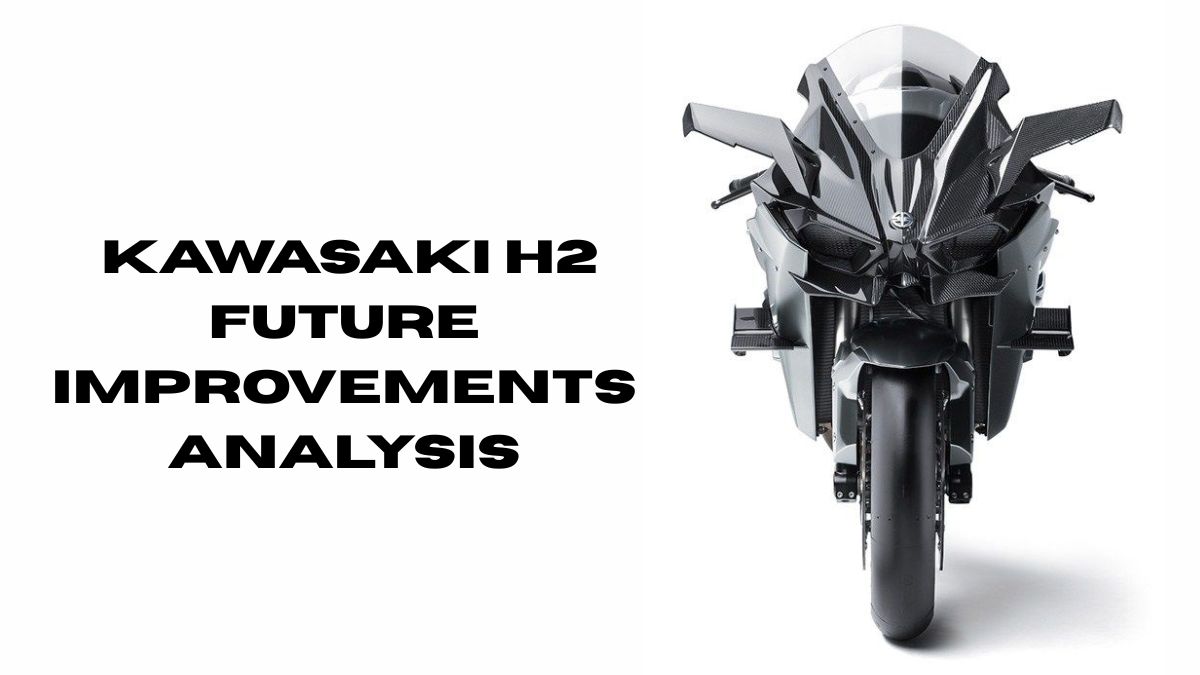
The Supercharged Hybrid Imperative
I. Strategic Context and Technological Drivers for a New Generation H2
The Kawasaki Ninja H2, since its introduction, has been positioned as the technical flagship for the Kawasaki Heavy Industries (KHI) Group, demonstrating engineering capabilities through its proprietary forced-induction architecture. Analysis of current technological trends and pending regulatory mandates strongly suggests that the 2027 or 2028 model year will necessitate the most radical architectural shift in the H2 platform’s history, moving decisively toward a Supercharged Hybrid Electric Vehicle (SHEV) configuration.
I.A. The Ninja H2 Legacy and Competitive Baseline Analysis
The current H2 lineage utilizes a sophisticated but established architecture. The engine core is a liquid-cooled, DOHC, 998cc inline-four featuring a supercharger (two-speed centrifugal type) with a low compression ratio of 8.5:1.1 This platform currently achieves staggering performance figures, with the street-legal Ninja H2 (post-2019) delivering approximately 228 horsepower (claimed) and the track-only Ninja H2R reaching 322 horsepower.3 These models employ a highly durable dog-ring six-speed transmission and a unique steel trellis frame designed for high-speed stability.2
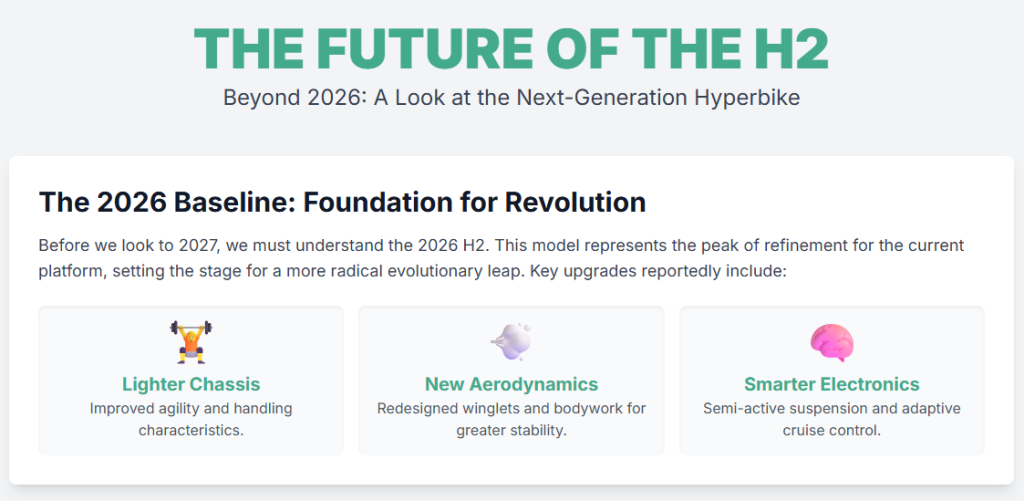
The electronics suite is already highly advanced, featuring Kawasaki Cornering Management Function (KCMF), Kawasaki TRaction Control (KTRC), Kawasaki Intelligent anti-lock Brake System (KIBS), and the Kawasaki Quick Shifter (KQS) for both upshifts and downshifts.4 The 2026 model year has been confirmed by Kawasaki to return as a limited-production run, retaining this core architecture, including the lightweight trellis frame, carbon fiber upper cowl on the Carbon model, and high-spec Brembo Stylema calipers.3
The confirmation of the core S-ICE architecture continuing through the 2026 model year strongly implies that KHI is preparing for a major generational discontinuity. Developing a vehicle of the H2’s complexity, particularly one integrating a performance hybrid system, requires several years of R&D and validation. The sustained production of the Gen 1.0 platform indicates that the 2027 or 2028 model release is strategically timed to debut a comprehensively redesigned Gen 2.0. This timing aligns with the maturation and commercialization of Kawasaki’s hybrid technology, which the company has publicly committed to expanding by 2025.7
I.B. The Regulatory Imperative: Navigating Euro 6/7 Compliance
The primary driver for the profound architectural change in the H2 is environmental legislation, specifically the impending and highly restrictive European emission standards. While current new motorcycles must adhere to Euro 5 limits, the future motorcycle ‘Euro 6’ standard is projected to align with the stringent Euro 7 framework established for cars.8 The Euro 7 rules, agreed upon in 2024 and scheduled for phasing in from 2026 for cars, impose several critical constraints on high-performance Internal Combustion Engines (ICEs).8
The most significant changes include standardizing emission limits across petrol and diesel engines and mandating a halving of carbon monoxide (CO) limits for petrol engines, reducing them from 1 gram per kilometer to 0.5 grams per kilometer.8 Furthermore, Euro 7 mandates vehicle compliance until 200,000 kilometers and 10 years of service, doubling the longevity requirement compared to previous standards.8
For a high-power, forced-induction engine like the H2’s 998cc unit, meeting such dramatically stricter CO limits and demonstrating robust, decade-long emissions compliance is technically prohibitive without major modifications. Forced-induction engines, particularly when targeting extreme power outputs, rely on sophisticated thermal and combustion strategies that often result in elevated NOx and CO emissions, especially during transient acceleration or cold-start conditions. To overcome this technical compliance challenge, the engine must adopt advanced emission control technologies, such as Direct Injection (DI) combined with Petrol Particulate Filters (PPF).9
The conclusion drawn from these regulatory pressures is that compliance is the essential factor dictating the shift to SHEV. To ensure the combustion engine remains clean over 10 years and 200,000 km, it must operate within a highly optimized, narrow efficiency band. The electric motor becomes indispensable, providing essential supplemental torque at low speeds and managing the peak transient power demanded by the rider. This electric torque fill prevents the need for the combustion engine to operate inefficiently or with high emission profiles during critical acceleration phases, thereby validating the Supercharged Hybrid Electric Vehicle (SHEV) architecture as the only viable path to maintain the H2’s performance dominance under Euro 7 constraints.
I.C. Kawasaki’s Decarbonization Roadmap: Laying the Foundation for SHEV
The strategic direction of KHI supports the predicted move to SHEV. Kawasaki Motors has publicly committed to introducing more than 10 electric (Battery EV and Hybrid EV) motorcycles and five electric four-wheeled vehicles by 2025.7 This commitment demonstrates a group-wide effort to leverage technologies across the conglomerate to achieve carbon neutrality goals.7
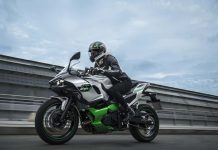
The foundation for the H2’s hybrid system is already established. Kawasaki successfully launched the Ninja 7 Hybrid and Z7 Hybrid, which are recognized as the world’s first strong hybrid motorcycles from a major manufacturer.7 These mid-capacity hybrids utilize an integrated electric motor alongside a 451cc twin engine.10 Crucially, they feature an “e-boost” function which temporarily increases overall output, enabling the Ninja 7 Hybrid to initially out-accelerate a 1,000cc-class machine, such as the Ninja ZX-10R, from a standing start under certain conditions.11
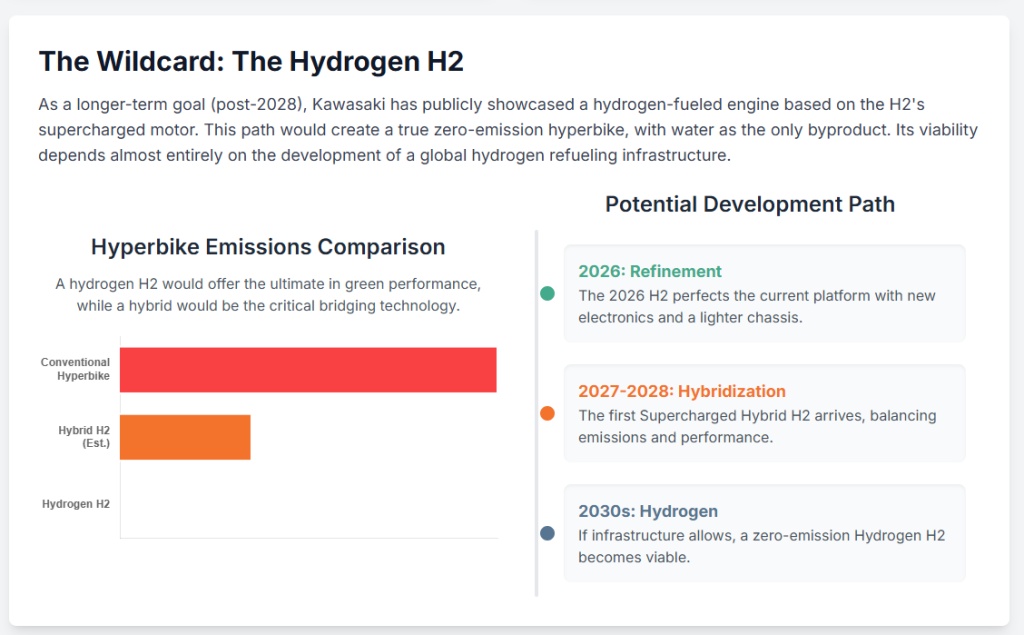
Furthermore, Kawasaki’s commitment extends beyond pure electric solutions. The company is actively researching alternative carbon-neutral fuels, including hydrogen ICE technology, e-fuels, and biofuels.7 The public demonstration of a hydrogen ICE motorcycle, based on a modified version of the 998cc supercharged engine found in the Ninja H2, took place in July 2024.13 This development, aiming for realization in the early 2030s 13, involved fitting the engine with direct hydrogen injection and designing a chassis to accommodate fuel canisters.13
The 2027 H2 is thus not merely a new model, but a critical transitional platform. It is designed to act as the flagship demonstration of the SHEV technology, ensuring the legendary “Fun to Ride” philosophy is retained while adhering to the most stringent global standards. By adopting advanced fuel systems and potentially fortified internal components for the SHEV, the platform simultaneously serves as a high-performance testbed, proving components that could be adapted for future hydrogen or e-fuel variants, bridging the technology gap to the early 2030s carbon-neutral goals.15
II. Supercharged Hybrid Electric Vehicle (SHEV) Powertrain Architecture (H2 Gen 2.0)
The implementation of a Supercharged Hybrid Electric Vehicle (SHEV) powertrain represents the most significant improvement for the 2027/2028 Ninja H2, fundamentally altering the bike’s power delivery and thermal management profile.
II.A. SHEV System Integration and Performance Mapping
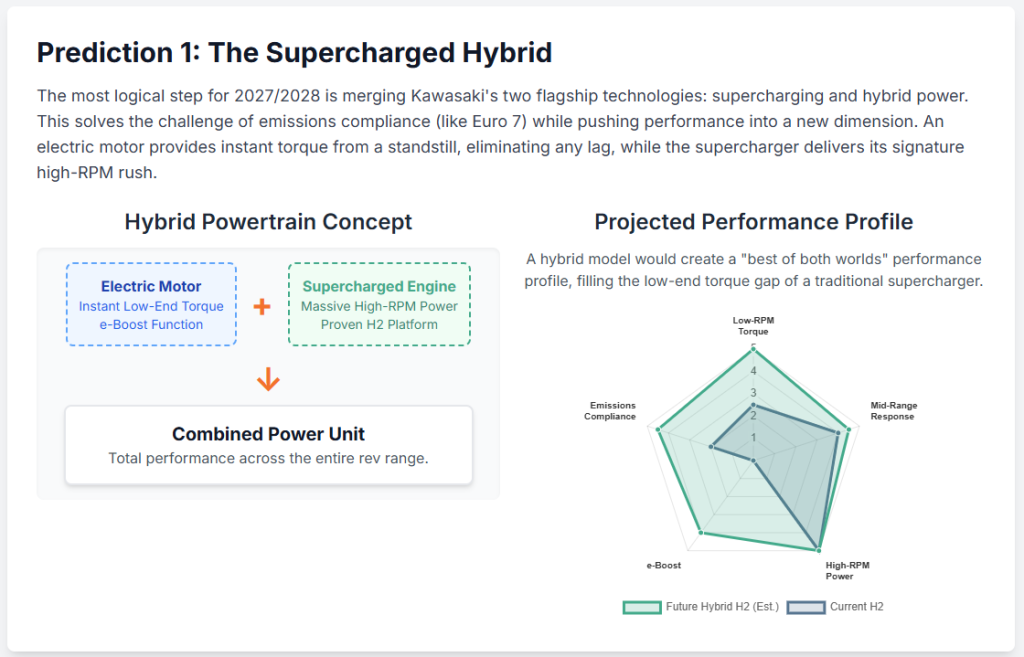
The Gen 2.0 H2 will retain the high-revving 998cc inline-four combustion engine 1 but integrate a robust Motor/Generator Unit (MGU), likely coupled to the crankshaft or the dog-ring transmission.4 This configuration allows for comprehensive energy management, including sophisticated Kinetic Energy Recovery System (KERS) blending during deceleration.
The integration of electric power dramatically alters the performance envelope. While the current street H2 delivers around 230 HP, industry expectations for the new generation suggest the street model will produce 250+ HP, with the track-only H2R variant potentially achieving peak outputs in excess of 350 horsepower.16 This augmented power is achieved because the MGU provides instantaneous, high-torque assistance that bypasses the volumetric efficiency limitations of the centrifugal supercharger at lower engine speeds.
The H2 SHEV will leverage an aggressive, enhanced e-boost function far superior to the 5-second limit imposed on the Ninja 7 Hybrid.11 This extended electric boost provides two key performance advantages: first, it guarantees lag-free acceleration from a standing start, enabling the bike to surpass competitors like the ZX-10R in initial sprint speed 11; second, it compensates for the centrifugal supercharger’s lower effectiveness at low RPMs, ensuring that riders experience immense, linear power delivery across the entire rev range. The combined output of the S-ICE and MGU is essential for reaching the projected 350+ horsepower ceiling while meeting durability and emission requirements.
II.B. Supercharger and Advanced Thermal Management
The implementation of the SHEV system necessitates a refinement of the existing supercharger technology. The centrifugal supercharger can be optimized to maximize compression efficiency within a narrower, high-RPM operational band, thereby reducing parasitic power loss and excessive heat generation.17 The MGU assumes primary responsibility for delivering torque outside this high-efficiency window.
A critical limitation of the current H2 motorcycle is the absence of an intercooler, which was omitted due to restrictions on mounting space and mass. While Kawasaki achieved high efficiency on the current model by focusing on supercharger impeller and housing shape optimization 17, sustaining 350+ horsepower output and meeting the rigorous thermal stability demands imposed by Euro 7 requires greater thermal management capacity.
The development of the supercharged 998cc engine for the Project H2 SxS (side-by-side) utility vehicle confirms KHI’s capability and intent regarding thermal management, as this engine features both an intercooler and dual fuel injectors per cylinder.18 For the 2027/2028 H2 SHEV, a compact, liquid-to-air intercooler must be engineered and integrated. This integration is feasible because the SHEV architecture already requires expanded liquid cooling capacity for the battery pack and MGU, providing the necessary heat dissipation infrastructure. The addition of intercooling allows for sustained, higher boost pressure, mitigating the risk of engine knock and directly enabling the projected increase in peak horsepower.17
The combustion system will also advance, utilizing DFI® (Direct Fuel Injection) with dual injectors, echoing the strategy seen in the UTV development.4 This dual-injection system improves fuel atomization and leverages the cooling effect of direct injection, crucial for maximizing performance under high boost and meeting the precise fuel metering standards necessary for Euro 7 compliance, particularly when incorporating a required Petrol Particulate Filter (PPF).
The table below summarizes the projected architectural shift in the H2 powertrain:
Predicted Powertrain Architecture Comparison: 2024 H2 vs. 2027/2028 H2 SHEV
| Characteristic | 2024 Ninja H2 (Baseline) | 2027/2028 Ninja H2 SHEV (Projected) | Driver/Constraint |
| Engine Type | Supercharged ICE (998cc) | Supercharged HEV (998cc + Integrated Electric Motor) | Euro 7 Compliance; Performance Augmentation 8 |
| Peak Power (Claimed) | 230 HP (Street) / 322 HP (R) 3 | 250+ HP (Street) / 350+ HP (R) (Combined Output) | Competitive Pressure; Extended E-boost 16 |
| Aspiration/Boost | Centrifugal Supercharger (Non-Intercooled) 17 | Centrifugal Supercharger + MGU + Liquid-to-Air Intercooler | Thermal Management & Efficiency 17 |
| Fuel System | EFI w/ 50 mm Throttle Bodies 1 | DFI® with Dual Injection + Petrol Particulate Filter (PPF) | Efficiency & Emission Control 9 |
| Emission Standard | Euro 5 | Projected Euro 6/7-aligned | Regulatory Mandate 8 |
III. Advanced Chassis, Mass Centralization, and Adaptive Aerodynamics
The addition of the SHEV components, including the electric motor, battery pack, and associated cooling systems, introduces an inevitable weight penalty to the H2 platform.20 To ensure that the bike’s high-speed handling and agility—a hallmark of the H2—are preserved, the 2027 generation must implement radical weight reduction strategies in the chassis and leverage advanced dynamic controls.
III.A. Structural Material Science and Weight Offset Strategy
The current H2 uses a steel trellis frame.2 To offset the hybrid system’s mass, the next generation will transition to a Hybrid Trellis Frame architecture that strategically incorporates advanced manufacturing techniques. This involves using Additive Manufacturing (AM), specifically 3D-printing technologies like Selective Laser Melting (SLM) for high-strength steel components.21
Research into 3D-printed metal frames has demonstrated that hollow-tubed steel structures can be produced with extremely thin wall thicknesses (between 0.8mm and 1mm), achieving superior stiffness and density optimization.21 This allows a 3D-printed steel frame to weigh as little as 3.8 kg, compared to 6 to 7 kg for a conventional steel frame, or 5 kg for a high-quality aluminum frame.21 Kawasaki, which is already exploring 3D-printed components for prototypes 22, can apply this technology to manufacture critical, complex nodes, pivot points, and structural connectors in the H2 chassis. By integrating these optimized, 3D-printed steel components with conventionally drawn tubing, the structure maximizes rigidity while minimizing weight, centralizing mass, and effectively counteracting the weight increase from the hybrid battery and motor.
Furthermore, material optimization will extend to unsprung mass reduction. The existing H2 Carbon features a carbon fiber upper cowl.5 The 2027 H2 Carbon will expand the use of composites to include carbon fiber subframes (ideal for housing ARAS sensor electronics), lightweight wheels, and composite single-sided swingarms, enhancing responsiveness and stability necessary for managing extreme speeds and the forces generated by the SHEV system.23
III.B. Active and Adaptive Aerodynamics (AAA)
With the projected power increase to 350+ horsepower for the track-only variant and expected top speeds exceeding 420 kilometers per hour 16, fixed aerodynamic winglets are insufficient to maintain optimal stability and downforce across all riding conditions.
The 2027 H2 will feature Adaptive Aerodynamics (AAA). This system incorporates electronically actuated, composite winglets or ducts that dynamically adjust their profile in real-time based on input from the Inertial Measurement Unit (IMU), speed sensors, and rider demands (such as during Launch Control Mode activation).4 Kawasaki’s exploration of adaptive fairing components is evident in patent activity, which seeks to generate weighted aerodynamic forces on the rear wheel by adjusting airflow over the spoiler and through aerodynamic channels.25
The AAA system provides a critical, third layer of dynamic control, alongside traction control and suspension. It allows the motorcycle to achieve maximum straight-line downforce during aggressive acceleration—mitigating lift and wheelie tendency generated by the immense SHEV e-boost—and subsequently minimizes drag during high-speed velocity runs. This ability to dynamically control downforce and drag provides a significant competitive advantage in managing the bike’s stability and efficiency across its vast speed range.
IV. Intelligent Dynamics Control, Sensor Fusion, and Rider Interface
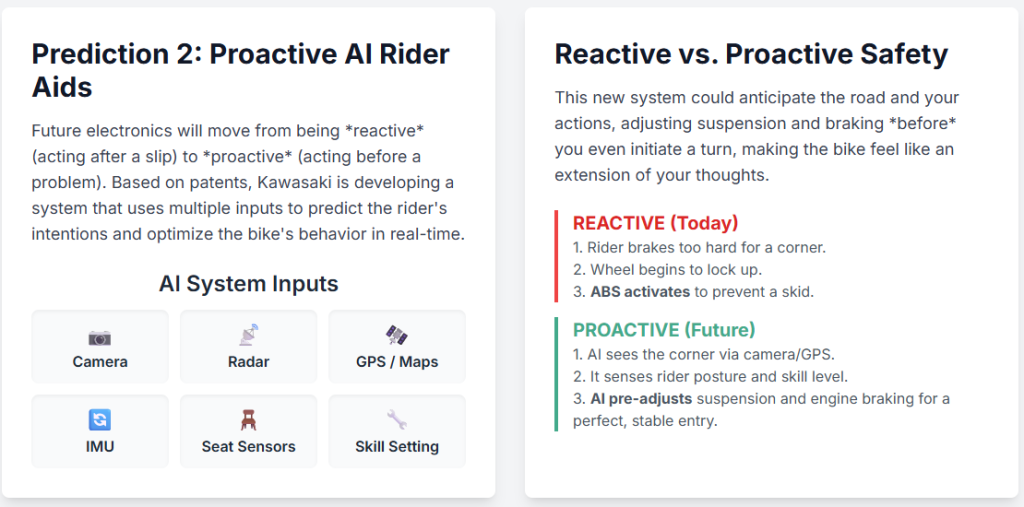
The next generation H2 will transition from using electronic systems for assistance and reaction to employing predictive control systems based on sophisticated sensor fusion and artificial intelligence.
IV.A. Second-Generation Advanced Rider Assistance Systems (ARAS)
Kawasaki was the first Japanese manufacturer to adopt Bosch’s radar-based Advanced Rider Assistance Systems (ARAS), beginning in 2021.26 This existing suite includes Adaptive Cruise Control (ACC), Forward Collision Warning (FCW), and Blind Spot Detection (BSD).26 Given that the global motorcycle ADAS market is projected to grow significantly through 2027 27, the H2 Gen 2.0 will integrate the next generation of these systems.
The 2027 model is expected to utilize Bosch’s new generation of mid-range radar sensors (both front and rear) that offer superior fidelity and range, enabling more complex decision-making algorithms.28 This advancement allows for Level 2+ ARAS functionality, enhancing safety and convenience:
- Full-Speed Range ACC with Traffic Stop/Go: The ACC system will extend its functionality beyond highway cruising to manage speed and distance in urban environments, incorporating traffic stop/go capability.
- Intersection Movement Assist (IMA): New radar processing capabilities will enable the detection and warning of potential collisions at junctions, particularly with approaching vehicles, addressing a crucial area of motorcycle safety.22
- Adaptive and Predictive Braking: The KIBS system will integrate directly with radar data to establish a predictive collision risk assessment. This allows the system to pre-charge or modulate braking pressure milliseconds before a human might react, reducing accident risk. Accident research estimates that radar-based assistance systems could prevent one in six motorcycle accidents.28
IV.B. Predictive Dynamics Modeling: AI-Supported Suspension (ASS)
The evolution of suspension technology in the H2 represents a significant leap from current reactive semi-active systems.29 The 2027 model will feature AI-Powered Predictive Semi-Active Suspension (ASS), building upon industry research into utilizing Machine Learning (ML) for anticipatory damping control.30
This predictive dynamic system leverages the bike’s high-fidelity sensor data, including radar, IMU, GPS, and possibly stored riding history via the RIDEOLOGY platform. The ML model is trained to anticipate necessary adjustments in damping and rebound. For example, the system can use navigation data to recognize an impending series of tight corners or utilize front-facing radar to detect a severe undulation in the road surface.31
By predicting these dynamic events—such as preemptively adjusting the electronic damping of the Öhlins-derived components before the wheel encounters a bump or before maximum cornering forces are exerted—the ASS eliminates the inherent latency found in traditional semi-active setups.23 This level of anticipatory control is crucial for maintaining handling precision, particularly when managing the increased mass of the hybrid system under the high dynamic forces generated by 350+ horsepower.
IV.C. Human-Machine Interface (HMI) and Digital Ecosystem Integration
The vehicle’s digital interface and connectivity suite will necessarily advance to manage the complexity of the SHEV and ARAS systems. The TFT color instrumentation, already standard on the H2 3, will be upgraded to handle sophisticated data streams. Key new HMI features will include:
- Hybrid Energy Display: Detailed real-time visualization of the battery State-of-Charge (SoC), KERS energy recovery rates, and MGU power deployment during e-boost activation.
- RIDEOLOGY THE APP+: Enhanced smartphone connectivity for telemetry, diagnostics, and customized AI suspension profile adjustments.
- Environmental Vehicle Passport (EVP) Integration: In line with upcoming Euro 7 mandates, the H2’s electronics package will be designed to support the Environmental Vehicle Passport (EVP).32 This electronic document will store data regarding pollutant levels, CO_2 emissions, fuel consumption, and battery durability information. Integrating the EVP framework into the HMI and vehicle architecture positions Kawasaki to meet the unprecedented long-term monitoring and data requirements of the stringent Euro 7 longevity standards.
The transition to a highly intelligent platform is summarized below:
Advanced Rider Assistance System (ARAS) and Dynamics Evolution
| System Category | Current H2 (Post-2021 ARAS) | 2027/2028 H2 (Projected) | Technological Leap |
| Cruise Control | Adaptive Cruise Control (ACC) 26 | Full-Speed Range ACC with Curve Negotiation Assistance | Enhanced Radar/IMU Integration 28 |
| Suspension Control | Öhlins Electronic Steering Damper 4 | AI-Powered Predictive Semi-Active Suspension (ASS) | Sensor Fusion & Machine Learning 29 |
| Aerodynamics | Fixed Winglets (H2R) 2 | Adaptive Aerodynamics (AAA) | Real-time Downforce Control 25 |
| Connectivity & Compliance | Smartphone Connectivity (RIDEOLOGY) 3 | Environmental Vehicle Passport (EVP) Integration; V2V Readiness | Digital Regulatory Compliance & Safety Networking 23 |
V. Market Positioning and Final Projections (2027/2028)
V.A. Competitive Landscape Analysis (2027)
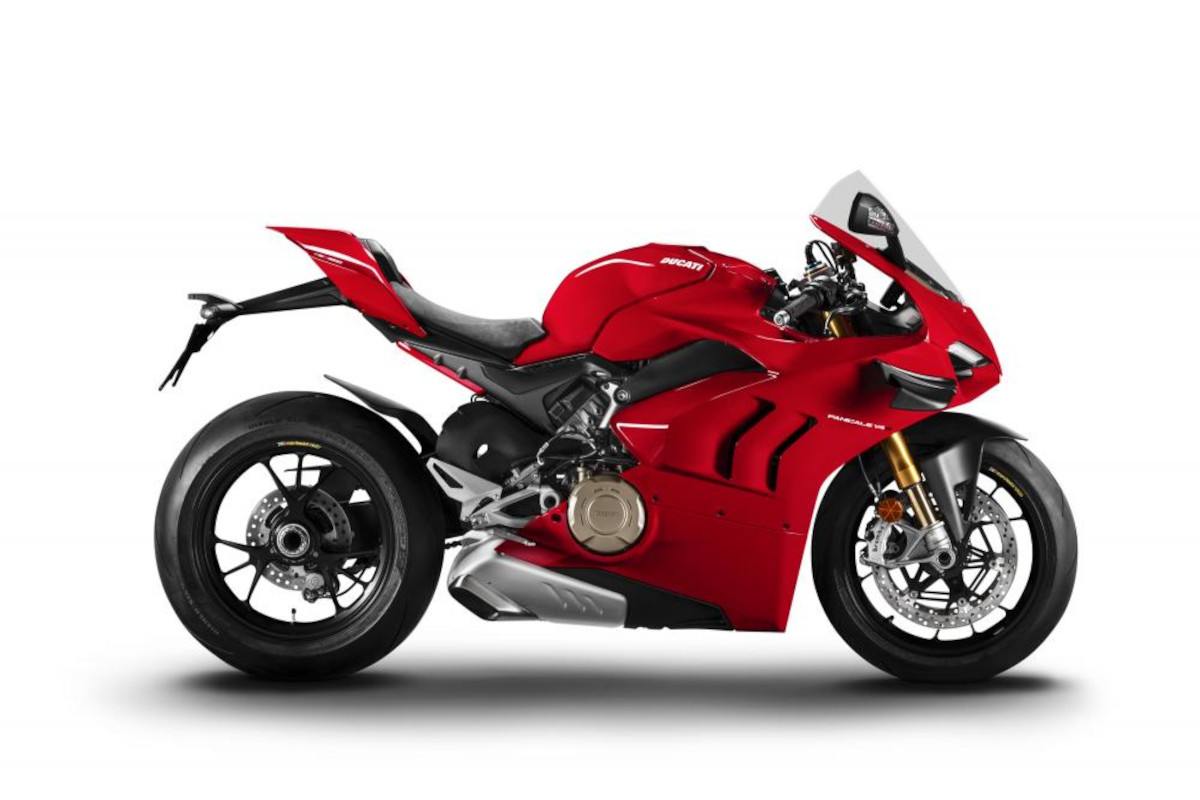
By the 2027/2028 timeframe, the hyperbike market will be segmented by technological strategy. Competitors such as Ducati (Panigale V4 series) 33 and Suzuki (GSX-R 40th Anniversary models) 35 will likely continue to optimize their naturally aspirated V4 and inline-four platforms for lightweight track dynamics and Euro 5+ compliance.
Kawasaki’s H2 SHEV will occupy a unique, technologically dominant segment. Its strategy is to utilize hybridization not primarily as a compliance mechanism, but as an enabling technology that allows the engine to operate cleanly within Euro 7 limits while simultaneously providing an instantaneous surge of electric torque that pushes the combined performance envelope well beyond the ceiling of conventional ICE superbikes. The projected 350+ horsepower output, coupled with Level 2+ ARAS and predictive dynamic control, creates a comprehensive performance and safety envelope that no non-SHEV rival can match.
V.B. Projected 2027/2028 H2 Model Lineup and Future Trajectory
The anticipated improvements and strategic goals suggest a refined H2 lineup for the 2027/2028 model years:
- The Base Ninja H2 SHEV: This core model will debut the SHEV powertrain, demonstrating full Euro 7 compliance with a sustained combined power output exceeding 250 horsepower. It will feature the hybrid trellis frame and the foundation of the second-generation ARAS suite.
- The Ninja H2 Carbon SHEV: Positioned as the premium street model, this variant will maximize weight savings through extensive carbon fiber components and composite structures. It will include the full suite of advanced dynamics, including Predictive Semi-Active Suspension and Adaptive Aerodynamics.
- The Ninja H2R (Track-Only) SHEV/H2 ICE: Retained as the pinnacle performance machine, targeting 350+ horsepower. Notably, the H2R platform carries dual strategic significance: it maximizes the SHEV performance for track dominance and serves as a highly adaptable testbed. Given Kawasaki’s commitment to realizing a functional hydrogen ICE motorcycle in the early 2030s, and the fact that its hydrogen R&D is already based on this specific 998cc engine 13, the H2R platform is likely to act as a crucial, flexible platform for testing components required for the transition to hydrogen combustion between 2027 and 2030.
VI. Conclusion
The 2027 or 2028 Kawasaki Ninja H2 will represent a monumental shift in hyperbike engineering, driven by the unavoidable convergence of performance ambition and regulatory necessity. The primary improvement defining this new generation will be the adoption of the Supercharged Hybrid Electric Vehicle (SHEV) powertrain architecture.
This hybridization is necessary to achieve regulatory alignment with stringent Euro 7 standards, specifically by leveraging electric torque fill to enable the supercharged engine to operate efficiently and cleanly within the new CO and longevity mandates. Simultaneously, this architecture unlocks a higher performance ceiling, projecting combined outputs of up to 350+ horsepower for the H2R variant, maintaining the H2’s position as the absolute power leader.
These extreme performance metrics mandate concomitant advances in chassis dynamics. The H2 Gen 2.0 will introduce radical weight offset measures through Hybrid Chassis Materials, integrating Additive Manufacturing (3D-printed steel nodes) to ensure the mass increase from the battery and motor does not compromise handling. Furthermore, sophisticated AI-Powered Predictive Dynamics, including Adaptive Aerodynamics and ML-supported semi-active suspension, will move the motorcycle from reactive assistance to anticipatory control, crucial for safely managing the immense power output and maintaining stability at hyperspeeds.
The resultant 2027/2028 Ninja H2 SHEV will be defined by its seamless fusion of forced induction and electric power, setting a new global benchmark for speed, technological sophistication, and emissions compliance in the hyperbike segment.
Sources
- 2024 Kawasaki H2 ABS Buyer’s Guide: Specs, Photos, Price | Cycle World, accessed October 27, 2025, https://www.cycleworld.com/kawasaki/ninja-h2-abs/
- Kawasaki Ninja H2 – Wikipedia, accessed October 27, 2025, https://en.wikipedia.org/wiki/Kawasaki_Ninja_H2
- 2026 KAWASAKI HYPERSPORT MOTORCYCLE LINEUP, accessed October 27, 2025, https://content2.kawasaki.com/ContentStorage/KMC/PressReleases/820/e0d447c4-16e5-4a0b-8833-fec84a6f3060.pdf
- 2026 Kawasaki Ninja H2®R ABS | Closed-Course Hypersport Motorcycle, accessed October 27, 2025, https://www.kawasaki.com/en-us/motorcycle/ninja/hypersport/ninja-h2r/2026-ninja-h2r-abs
- 2025 Kawasaki Ninja H2® Carbon ABS | Hypersport Motorcycle | Incredible Power, accessed October 27, 2025, https://www.kawasaki.com/en-us/motorcycle/ninja/hypersport/ninja-h2/2025-ninja-h2-carbon-abs
- 2026 Kawasaki Ninja H2® Carbon ABS | Hypersport Motorcycle | Incredible Power, accessed October 27, 2025, https://www.kawasaki.com/en-us/motorcycle/ninja/hypersport/ninja-h2/2026-ninja-h2-carbon-abs
- Rolling into the future | Kawasaki Motors, Ltd., accessed October 27, 2025, https://www.global-kawasaki-motors.com/en/future/
- New car emissions limits hint at future for bikes – Bennetts Insurance, accessed October 27, 2025, https://www.bennetts.co.uk/bikesocial/news-and-views/news/2022/november/new-car-emissions-limits-hint-at-future-for-bikes
- European emission standards – Wikipedia, accessed October 27, 2025, https://en.wikipedia.org/wiki/European_emission_standards
- Technology Development Strategies in the Powersports and Power Unit Areas -To Become the Top Brand, accessed October 27, 2025, https://global.kawasaki.com/en/corp/rd/magazine/186/pdf/n186en02.pdf
- Kawasaki Ninja 7 Hybrid | Change the Game | A New Era in Riding Experience, accessed October 27, 2025, https://www.kawasaki.ca/en-ca/motorcycle/hybrid-and-electric/hev/ninja-7-hybrid
- Kawasaki Ninja® 7 Hybrid ABS | Hybrid Motorcycle | Versatile Power, accessed October 27, 2025, https://www.kawasaki.com/en-us/motorcycle/ninja/sport/ninja-7-hybrid
- World’s First Public Demonstration Run of a Hydrogen Engine Motorcycle by a Mass-Production Motorcycle Manufacturer – Kawasaki Heavy Industries, accessed October 27, 2025, https://global.kawasaki.com/en/corp/newsroom/news/detail/?f=20240722_6039
- HySE-X1 -Retracing the Tracks of the 2024 Dakar Rally- | ANSWERS | Kawasaki’s Solutions for the Future, accessed October 27, 2025, https://answers.khi.co.jp/en/special/hyse_x-1_dakar2024/
- February H2IQ Hour: Overview of Hydrogen Internal Combustion Engine (H2ICE) Technologies – Department of Energy, accessed October 27, 2025, https://www.energy.gov/sites/default/files/2023-03/h2iqhour-02222023.pdf
- The 2026 Kawasaki Ninja H2R Is Here Faster and More Extreme Than Ever!, accessed October 27, 2025, https://marketriders.in/the-2026-kawasaki-ninja-h2r-is-here/
- Development of Supercharged Motorcycle Engines, accessed October 27, 2025, https://global.kawasaki.com/en/corp/rd/magazine/180/pdf/n180en04.pdf
- New Kawasaki Patents Detail Supercharged 250-hp Engine – UTV Driver, accessed October 27, 2025, https://www.utvdriver.com/utv-news/kawasaki-supercharged-250-hp-engine-patent-details/
- Status of Euro 7 – AECC, accessed October 27, 2025, https://www.aecc.eu/status-of-euro-7/
- Why has no manufacturer made a hybrid motorcycle/scooter in this way? – Reddit, accessed October 27, 2025, https://www.reddit.com/r/motorcycles/comments/1nplm8t/why_has_no_manufacturer_made_a_hybrid/
- Lightweight 3D-Printed Steel Frame Produced in Spain – Top Speed, accessed October 27, 2025, https://www.topspeed.com/motorcycles/motorcycle-news/lightweight-3d-printed-steel-frame-produced-in-spain/
- Innovation | BMW Motorrad, accessed October 27, 2025, https://www.bmwmotorcycles.com/en/engineering/innovation-overview/innovation.html
- Top Innovations in Motorcycle Suspension Technology – MotoDeal, accessed October 27, 2025, https://motodeal.racing/blogs/motodeal-shop-news/top-innovations-in-motorcycle-suspension-technology
- Design and Development of Chassis Frame Using Trellis Structure for an Electric Motorcycle, accessed October 27, 2025, https://journal.esrgroups.org/jes/article/view/5858
- WO2023228143A1 – Motorcycle with improved aerodynamics – Google Patents, accessed October 27, 2025, https://patents.google.com/patent/WO2023228143A1/en
- Kawasaki to be First Japanese Motorcycle Manufacturer to Include Bosch’s Advanced Rider Assistance Systems, accessed October 27, 2025, https://global.kawasaki.com/en/corp/newsroom/news/detail/?f=20191105_6327
- Global Motorcycle ADAS Market Size, Growth, Trend & Forecast 2027 – TechSci Research, accessed October 27, 2025, https://www.techsciresearch.com/report/global-motorcycle-adas-advanced-driver-assistance-system-market/1385.html
- Advanced rider assistance systems – Bosch Mobility, accessed October 27, 2025, https://www.bosch-mobility.com/en/solutions/assistance-systems/advanced-rider-assistance-systems-2w/
- Strategic Drivers and Barriers in Global Motorcycle Semi-active Suspension System Market Market 2025-2033 – Market Insights Report, accessed October 27, 2025, https://www.marketreportanalytics.com/reports/global-motorcycle-semi-active-suspension-system-market-5375
- (PDF) Artificial intelligence supported semi-active suspension system design for motorcycles, accessed October 27, 2025, https://www.researchgate.net/publication/396181901_ARTIFICIAL_INTELLIGENCE_SUPPORTED_SEMI-ACTIVE_SUSPENSION_SYSTEM_DESIGN_FOR_MOTORCYCLES
- Honda patents artificial intelligence suspension – webBikeWorld, accessed October 27, 2025, https://www.webbikeworld.com/honda-patents-artificial-intelligence-suspension/
- Euro 7: The new emission standard for light- and heavy-duty vehicles in the European Union – International Council on Clean Transportation, accessed October 27, 2025, https://theicct.org/wp-content/uploads/2024/03/ID-116-%E2%80%93-Euro-7-standard_final.pdf
- New Panigale V4 – Wonder. Engineered. – Ducati, accessed October 27, 2025, https://www.ducati.com/ww/en/bikes/panigale/panigale-v4
- New 2026 Ducati Panigale V4 R – Ultimate Superbike Unleashed, accessed October 27, 2025, https://www.ducati.com/us/en/bikes/panigale/panigale-v4-r
- 2027 GSX-R1000R 40th Edition – The King of Superbikes Returns!@MaxPowerMotors 89, accessed October 27, 2025, https://www.youtube.com/watch?v=Taokjo06X-g
Our Social Media Handles
- Instagram : LivingWithGravity
- Medium : Akash Dolas
- YouTube Channel : Gear and Shutter
- Facebook : LivingWithGravity