






Executive Summary: The Changing of the Guard
The recent, near-simultaneous announcements of six-time World Champion Jonathan Rea’s retirement and Iker Lecuona’s signing with Aruba.it Racing Ducati mark a seismic shift for the FIM Superbike World Championship. This report posits that these events are not isolated news items but rather the culmination of a complex “silly season” domino effect that is fundamentally reshaping the sport. Rea’s departure signals the end of an era of unprecedented individual dominance, while Ducati’s strategic decision to bring in Lecuona reflects a forward-looking approach focused on developing new talent and ensuring long-term financial stability. The confluence of these factors is ushering in a new, and potentially unpredictable, era for WSBK.
Part I: The End of an Era: Jonathan Rea’s Retirement and Unbreakable Legacy
The FIM Superbike World Championship, for over a decade, has been largely defined by three names: Jonathan Rea, Toprak Razgatlioglu, and Álvaro Bautista. Rea’s decision to retire from full-time racing at the end of the 2025 season is a pivotal moment, closing the book on a career distinguished by an unparalleled statistical legacy and a relentless drive for victory.
Section 1.1: A Career Defined by Unprecedented Dominance
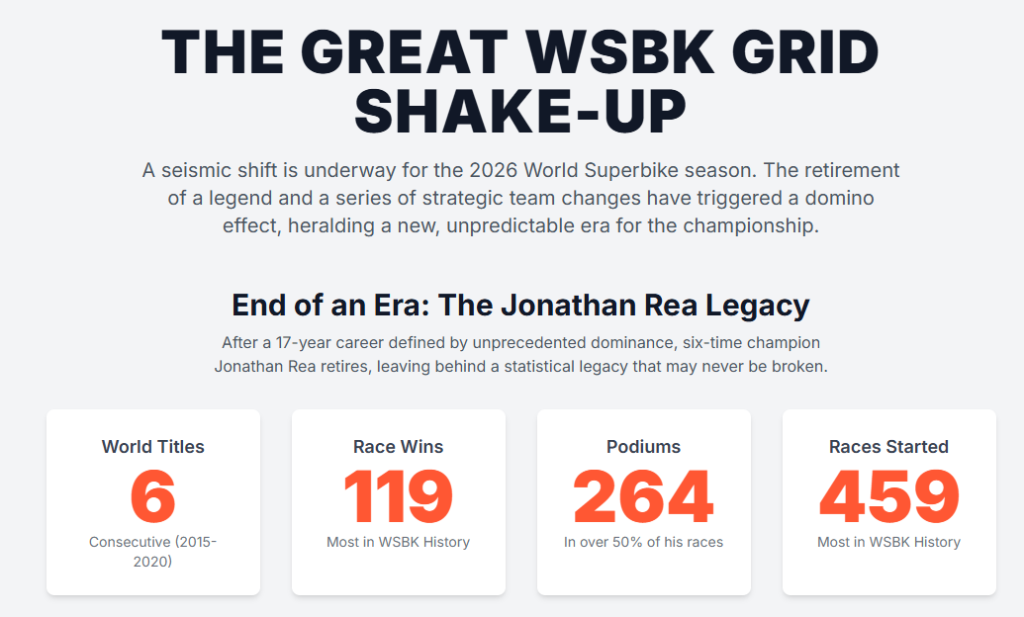
Jonathan Rea’s career is a testament to a singular mentality: “to race to be the best”. His own retirement statement makes it clear that if he “can’t race to win, then it’s time to step away”. His legacy is built on a foundation of historical statistics, meticulously documented across his 17-year career at the highest level of production racing. He is the most successful rider in WorldSBK history, holding records that are expected to stand for a considerable time.
The raw numbers are staggering and paint a picture of extraordinary success. Rea won six consecutive World Superbike titles from 2015 to 2020, a feat unmatched by any other rider. He has secured 119 race wins, more than a century and 43 clear of his closest rival, and has amassed 264 podium finishes, standing on the rostrum in over half of his races. He has started more races (459), led more laps (over 2,000), and accumulated more career points (6,336.5) than anyone else in the championship’s history.
What makes these records truly remarkable is the context behind them. During his period of peak dominance with Kawasaki, from 2015 to 2020, Rea’s performance transcended mere victory. He won 84 of the 164 races he started in that period, an astonishing 51% win rate. When his podium finishes are included, that percentage climbs to 87%, with only eight retirements and a lowest finish of sixth when he took the checkered flag. This level of consistent performance and statistical supremacy is a rarity in modern motorsports and established Rea’s status as the “GOAT” (Greatest of All Time) of WorldSBK, a view widely shared by fans and pundits.
While he consistently outperformed his teammates like Tom Sykes, Alex Lowes, and Leon Haslam, the true measure of his greatness came from the challenges posed by his key rivals. The arrival of former MotoGP rider Álvaro Bautista in 2019 and the emergence of Toprak Razgatlioglu in subsequent seasons forced Rea to elevate his game. His battles with Bautista and Razgatlioglu from 2019 to 2023 are widely considered to be “amazing” and “one for the ages,” creating high-stakes rivalries that fueled fan engagement and pushed the sport to new heights. Rea’s statement acknowledges this, thanking his rivals for “making my dig deep,” an admission that they were a crucial part of his success.
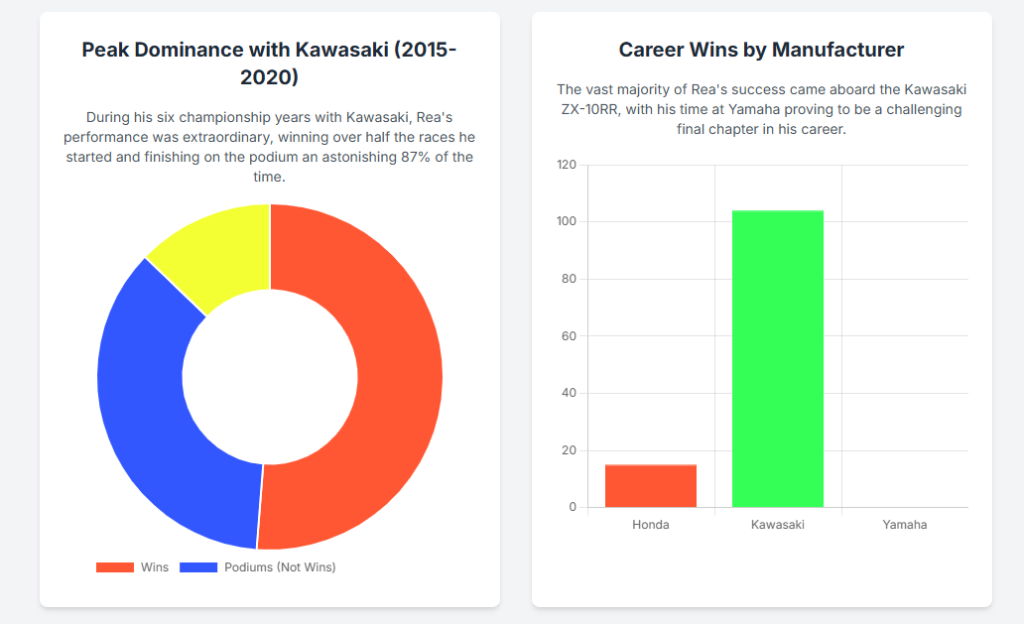
The following table provides a quantitative overview of his achievements, highlighting the sheer scale of his success during his tenure with Kawasaki.
| Statistic | Overall Career | With Honda | With Kawasaki | With Yamaha |
| World Titles | 6 (2015-2020) | 0 | 6 | 0 |
| Race Wins | 119 | 15 | 104 | 0 |
| Podiums | 264 | 42 | 221 | 1 |
| Fastest Laps | 104 | – | – | – |
| Pole Positions | 44 | – | – | 1 |
| Races Started | 459 | – | – | – |
| Championship Points | 6,336.5 | – | – | – |
Export to Sheets
Section 1.2: The Tumultuous Yamaha Chapter: A Strategic Misstep?
Rea’s departure from Kawasaki and his move to the Yamaha factory team for the 2024 season was a “bombshell move” that followed Razgatlioglu’s own shock departure to BMW. It was a quest for a new challenge, a final chapter in his illustrious career. However, his two seasons on the Yamaha R1 were characterized as “tumultuous” and “hampered by injury and misfortune”. A significant foot injury sustained at the start of the 2025 season put him on the “back foot,” requiring surgery and forcing him to miss the second round. The highlights of his time in blue were limited to a wet pole position at Assen and a third-place podium at Donington Park.
The challenges at Yamaha were not solely due to bad luck. A deeper analysis suggests a fundamental failure of synergy between the rider and the machine. While he was accustomed to a more compliant bike at Kawasaki, Rea’s aggressive riding style and his inability to “make everything click” on the Yamaha R1 proved to be a persistent issue. This struggle was particularly noted by fans who viewed the bike as a “disaster” and a poor fit for his style. One online commenter astutely suggested that Rea “thought Toprak was only beating him because of the Yamaha. He thought wrong,” implying a technical mismatch that Rea was unable to overcome. This situation has been compared to other high-profile failures of rider-bike harmony, such as Valentino Rossi’s difficult tenure at Ducati, where a legendary talent struggled to adapt to new machinery. Ultimately, the move that was meant to be a crowning achievement became a challenging epilogue, leading him to a retirement that, while personally chosen, was also heavily influenced by external factors.
Section 1.3: The Unforgiving Calculus of Retirement
The timing of Jonathan Rea’s retirement announcement provides critical context for his decision. It came on August 25, 2025, just 90 minutes after Iker Lecuona was officially confirmed as Álvaro Bautista’s replacement at the factory Aruba.it Racing Ducati squad. While his retirement statement focuses on a personal decision to step away when he could no longer win, the events of that day tell a more complex story about the unforgiving realities of the rider market.
Reports from various media outlets indicate that Rea was actively looking for a seat for the 2026 season. His options, however, were dwindling rapidly. It was reported that he had been “rejected by the factory Ducati and Honda teams” and was not a high priority for BMW. His negotiations with the Barni Spark Racing Team also “failed” due to a reported “language barrier”. The final blow came with Lecuona’s signing for the factory Ducati team and the subsequent rumors linking Bautista, a two-time champion, to the independent Barni seat. This effectively closed the door on the last remaining top-tier opportunities for Rea. The factory Ducati team was reportedly seeking a young rider “without a massive salary” to partner with their established star, Nicolo Bulega, a criterion that Rea, with his high profile and high financial value, did not meet.
Therefore, while Rea’s statement frames his retirement as a decision to stop racing when he couldn’t win, the timing suggests it was a strategic withdrawal from a market that had passed him by. The confluence of his recent performance struggles, his foot injury, and his high financial demands made him a less attractive prospect for teams looking to build for the future. The two announcements on that Monday in August represent the final pieces of a puzzle, with Lecuona’s move effectively sealing Rea’s fate.
Part II: A New Chapter for Ducati: The Rise of Iker Lecuona
The signing of Iker Lecuona by Aruba.it Racing Ducati to replace two-time World Champion Álvaro Bautista is a defining moment for the Italian manufacturer. It represents a pivot from a strategy focused on proven, veteran talent to one that takes a calculated risk on a younger rider with significant, but unfulfilled, potential.
Section 2.1: From MotoGP to a Factory Superbike Seat
Iker Lecuona’s career path has been a journey through some of the most competitive motorcycle racing championships in the world. He began in Moto2 before moving up to a two-year stint in MotoGP with the Tech3 KTM team. Following the loss of his MotoGP seat, Lecuona transitioned to WorldSBK in 2022, joining the factory Honda team alongside rookie Xavi Vierge.
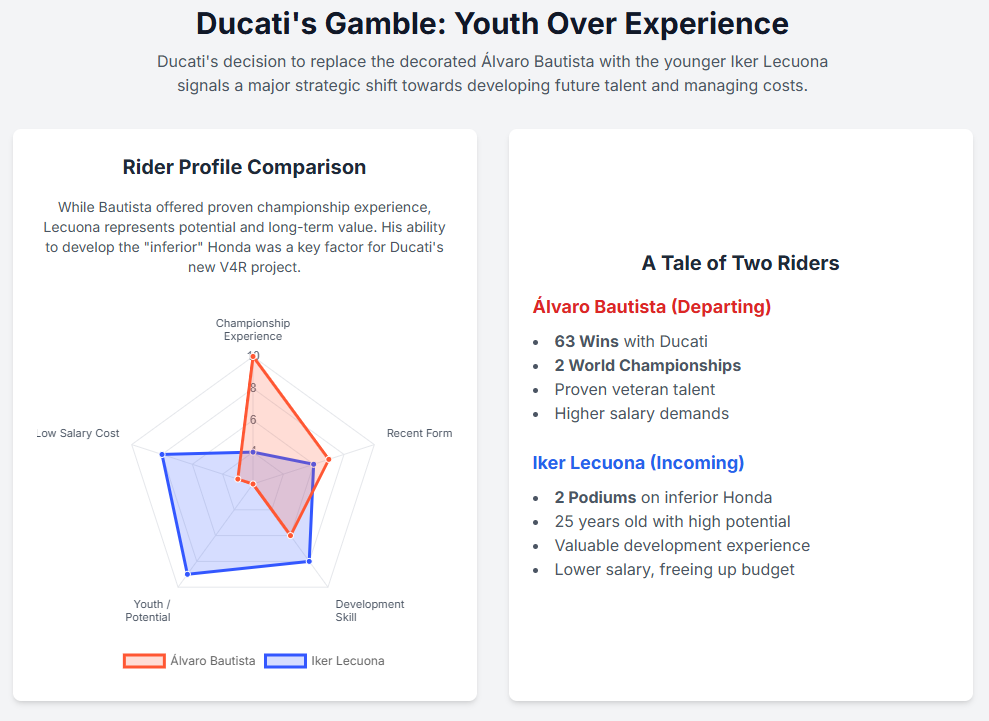
His four campaigns with Honda HRC yielded two podiums and one pole position in 113 races, a record that on the surface appears modest. However, to properly evaluate this performance, one must consider the machinery he was riding. The Honda CBR1000RR-R was widely regarded as an “inferior machine” compared to its rivals. The fact that he was able to consistently fight inside the top ten on this bike, while battling a series of injuries that led to self-doubt, speaks to a high level of talent and resilience. Furthermore, Lecuona was a trusted asset for Honda, representing the manufacturer as a replacement rider in several MotoGP rounds and as part of their triumphant Suzuka 8 Hours endurance team. These opportunities demonstrate that the manufacturer placed a high degree of confidence in his ability and professionalism. Ducati’s decision, therefore, seems to be based on an appreciation for Lecuona’s underlying skill and dedication, rather than just his raw statistics.
Section 2.2: Ducati’s Strategic Vision: A Gamble on Youth and Potential
Ducati’s decision to part ways with Álvaro Bautista, despite his overwhelming success—63 wins and two World Championships with the team—was a significant statement. While the team’s official statement thanks Bautista for his “extraordinary results,” reports suggest the departure was not mutual. Bautista himself stated that Ducati did not take up his contract option, with his form reportedly declining due to new weight rules. The team’s choice of Lecuona, a 25-year-old rider with untapped potential, over a more experienced—and more expensive—option like Jonathan Rea, reveals a clear strategic shift.
This move suggests that Ducati is now pursuing a two-tiered factory strategy. With Nicolo Bulega already established as a championship contender and secured with a long-term contract, the team no longer requires two top-tier riders to challenge for titles. The addition of Lecuona, with his lower salary, allows Ducati to maintain a strong presence while also investing in a younger rider who can be developed over the long term. This aligns with a broader trend in the paddock, where teams like Yamaha are also prioritizing the promotion of young talent from within their racing programs. The decision to opt for a rider with a smaller salary also frees up resources that can be funneled into other areas, such as the development of the new 2026 Ducati Panigale V4R.
Section 2.3: On the New Machine: Analyzing Lecuona’s Fit
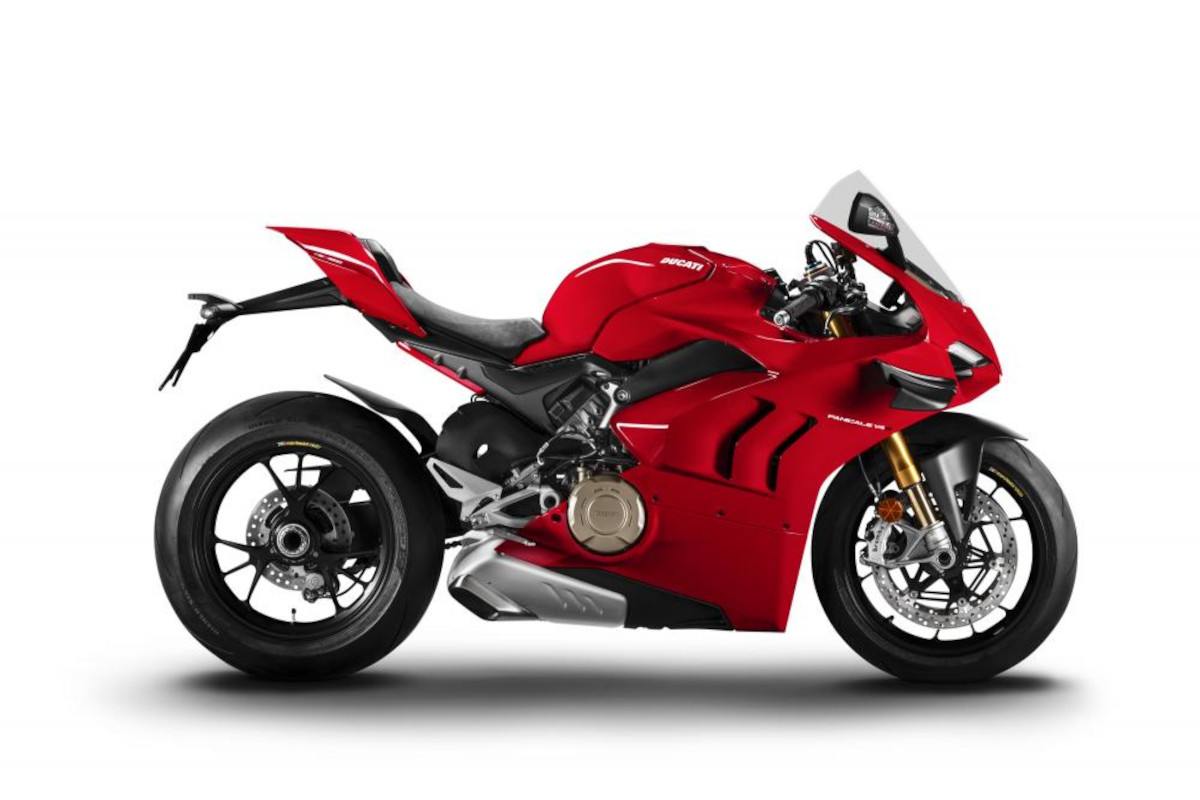
Iker Lecuona’s transition to the new Ducati Panigale V4R for the 2026 season is a critical aspect of this move. The Panigale is “widely regarded as the strongest package” on the grid , a stark contrast to the Honda he has been riding for the past four years. Lecuona’s riding style, which is described as “aggressive and angular,” with a distinctive body position, could be a perfect match for the powerful and stable V4R.
The strategic synergy extends beyond just riding style. Lecuona’s experience in developing the Honda, a bike that has struggled for pace, means he brings valuable technical feedback to the team. His ability to work with engineers to improve a sub-par package will be a considerable asset as Ducati introduces an all-new machine for the 2026 season. This dual role, as both a competitor and a valuable development rider, makes him a calculated, and potentially very rewarding, acquisition for the Italian manufacturer.
Part III: The 2026 Grid Shake-Up: A World Championship in Flux
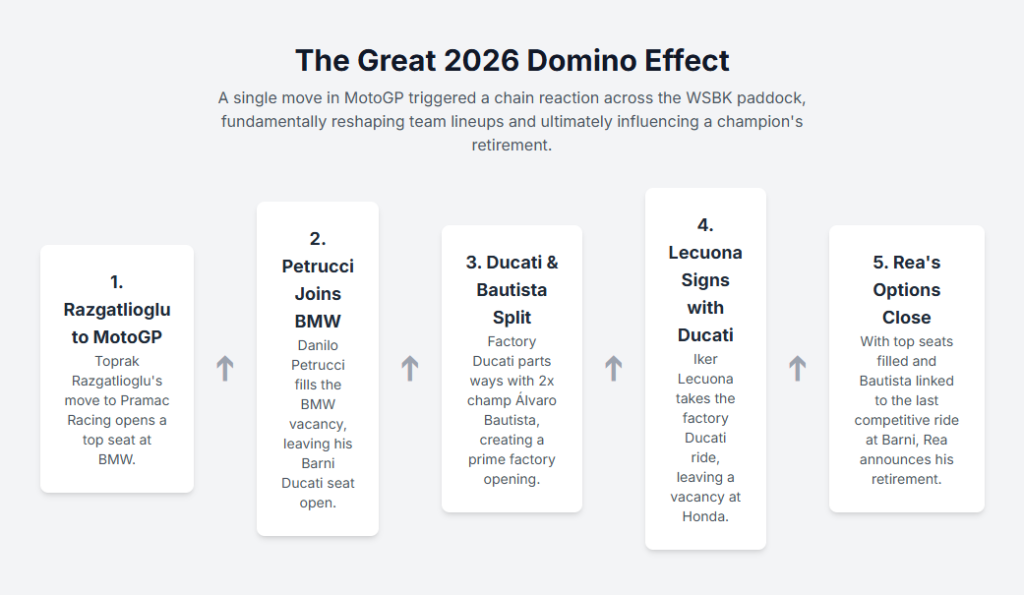
The events of August 25, 2025, were the final, most dramatic pieces of a complex and far-reaching “silly season” that is fundamentally altering the landscape of the World Superbike Championship. This reshuffling of the grid is a precise example of a domino effect, where each decision has a direct consequence on the opportunities available to other riders.
Section 3.1: The Great Domino Effect
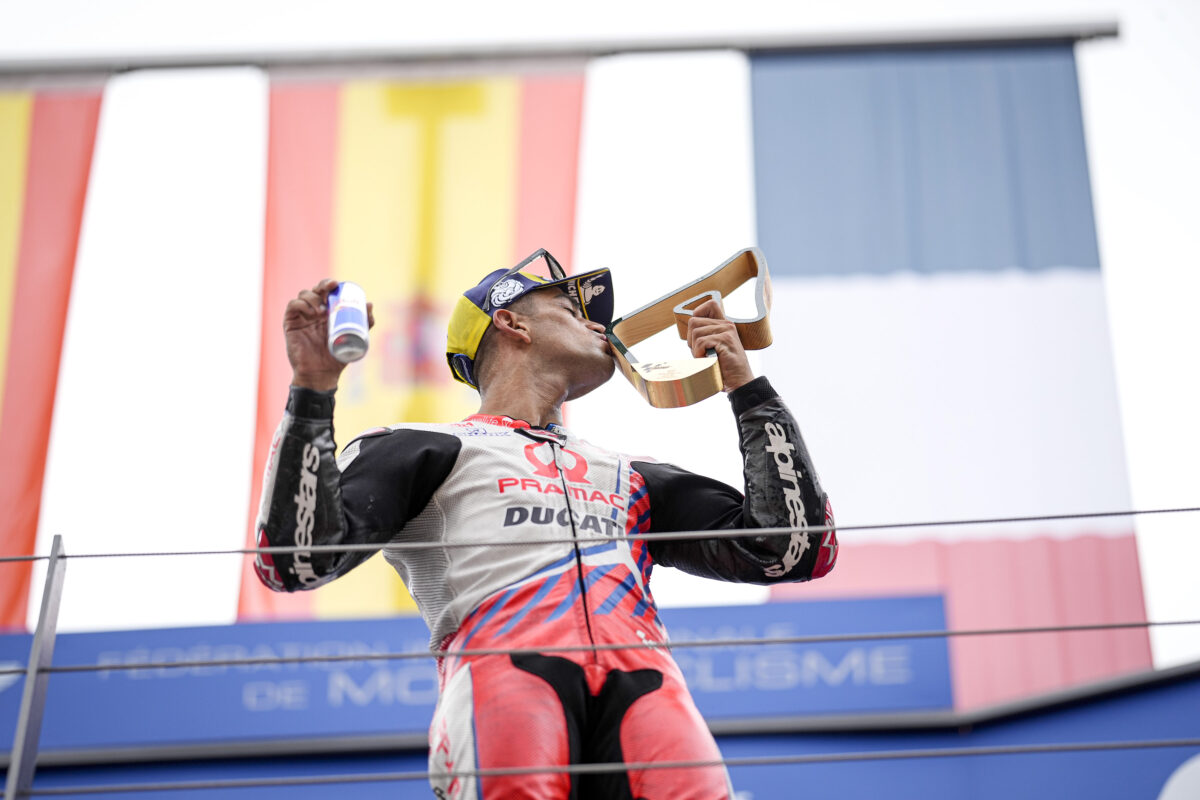
The initial catalyst for the 2026 grid shake-up was Toprak Razgatlioglu’s surprise decision to move to MotoGP with Pramac Racing. This created a critical vacancy at the factory ROKiT BMW Motorrad WorldSBK Team, a seat that was subsequently filled by the reigning Independent Riders’ title winner, Danilo Petrucci. Petrucci’s departure from the Barni Spark Racing Team, an independent Ducati squad, then created a highly desirable seat on a podium-contending machine.
Simultaneously, the surprising split between the factory Aruba.it Racing Ducati team and two-time champion Álvaro Bautista opened a factory seat on the strongest bike on the grid. Ducati’s search for a replacement culminated in the signing of Iker Lecuona, a move that immediately left a new vacancy at the factory Honda team. The final piece of the puzzle, and a direct factor in Rea’s retirement, was the reported link between the now-unemployed Bautista and the open Barni Ducati seat. This sequence demonstrates the interconnected nature of the paddock and how a single decision in MotoGP could ultimately lead to the retirement of a six-time champion in WorldSBK.
Section 3.2: The Future of Key Players and Vacant Seats
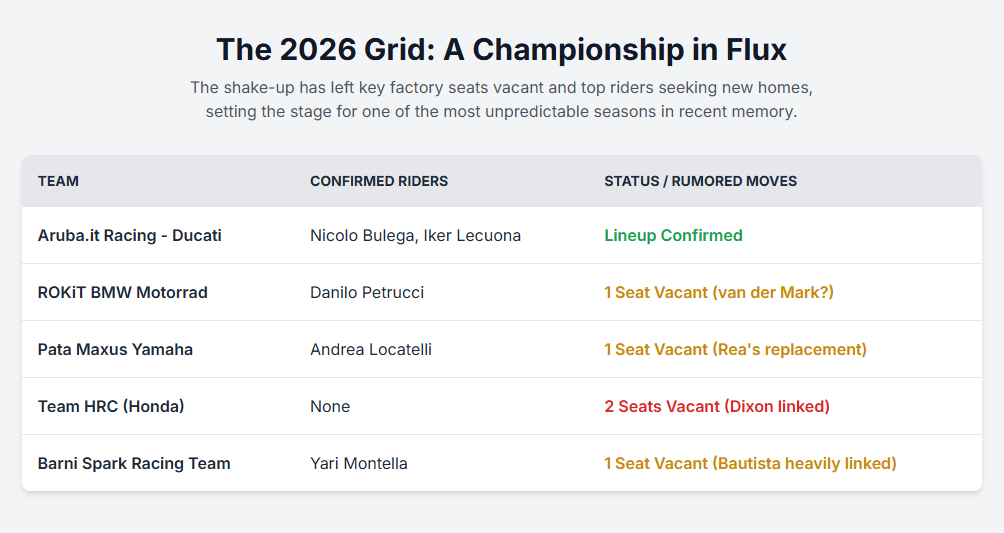
The cascade of transfers has left several key positions open on the 2026 grid, with a number of riders now searching for new homes.
| Team | Confirmed Riders | Rumored/Vacant Seats |
| Aruba.it Racing – Ducati | Nicolo Bulega, Iker Lecuona | None |
| ROKiT BMW Motorrad WorldSBK Team | Danilo Petrucci | One vacant seat (Michael van der Mark) |
| Pata Maxus Yamaha | Andrea Locatelli | One vacant seat (Jonathan Rea) |
| Team HRC | None | Two vacant seats |
| Barni Spark Racing Team | Yari Montella | One vacant seat (Danilo Petrucci) |
| Bimota by Kawasaki Racing Team | Alex Lowes, Axel Bassani | None |
| GYTR GRT Yamaha WorldSBK Team | Remy Gardner, Stefano Manzi | None |
The most significant consequence of the shake-up is the rise of independent teams. Álvaro Bautista, the most successful Ducati rider in history in terms of race wins, is now “heavily linked” to a move to the Barni Spark Racing Team. This would allow him to stay on Ducati machinery and provides the Barni team with a championship-winning talent. The potential for a satellite team to field a two-time champion on a race-winning machine could significantly raise the overall competitiveness of the grid and the level of independent teams.
The vacant seats at Yamaha and Honda are now the focus of the “silly season.” Yamaha’s factory seat, left open by Jonathan Rea’s retirement, could be filled by a WorldSSP rider like Stefano Manzi, or by a return of Michael van der Mark. The two vacant seats at Honda could be filled by a number of riders, with Moto2’s Jake Dixon reportedly a likely candidate.
Section 3.3: A Look Ahead: Star Power and the Post-Rea WSBK Landscape
The departure of Jonathan Rea, following the moves of Álvaro Bautista and Toprak Razgatlioglu, presents a critical challenge for the World Superbike Championship. These three riders have been the central figures and drivers of narrative for a decade, and their fierce, long-running rivalries have been the sport’s lifeblood. As one analytical piece notes, the series risks “fading from the spotlight” without high-profile personalities, which can impact fan engagement, manufacturer marketing, and the “Win on Sunday, sell on Monday” paradigm that is so crucial to the sport’s business model.
The ultimate test for WorldSBK is whether it can “rebuild with fresh faces” and create new, compelling rivalries to capture the attention of a global audience. The onus is now on a new generation of riders, including Nicolo Bulega, Andrea Locatelli, and Iker Lecuona, to step up and forge the narratives that will define the next era of the sport. Their success will determine whether the championship can thrive in the absence of the icons who have so powerfully shaped its recent history. This period of transition is a profound moment for the championship, and the coming seasons will be a definitive test of its ability to adapt and build a compelling future
Our Social Media Handles
- Instagram : LivingWithGravity
- Medium : Akash Dolas
- YouTube Channel : Gear and Shutter