











I. Executive Summary: The Policy Shock and the Pivotal Market Contraction
The Vietnamese motorcycle market, one of the world’s largest, experienced a sharp and specific contraction in the traditional Internal Combustion Engine (ICE) segment during the third quarter of 2025. Sales reported by the Vietnam Association of Motorcycle Manufacturers (VAMM), representing the five major players (Honda, Yamaha, Piaggio, Suzuki, and SYM), totaled just under 622,000 units for July through September 2025, marking a nearly 9.4% decline year-on-year.1
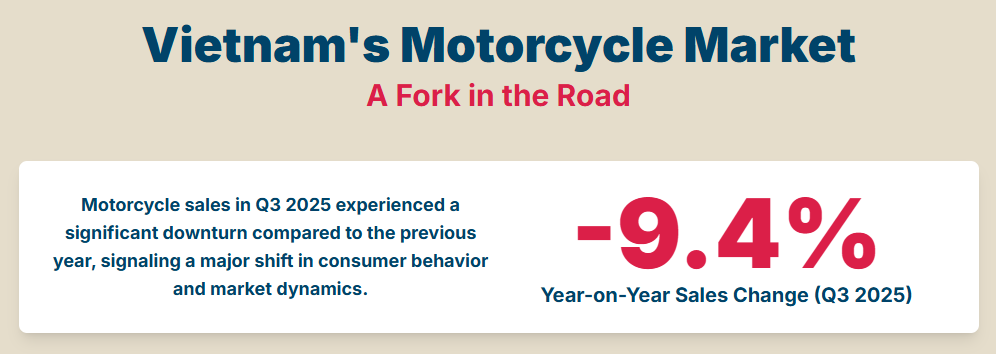
This decline is highly anomalous, occurring despite exceptional national macroeconomic performance. The country’s GDP grew robustly at 8.23% year-on-year in Q3 2025, alongside strong foreign direct investment (FDI) disbursement growth of 15.2%.2 Furthermore, Vietnamese consumers maintain the highest optimism in the ASEAN region, with a consumer sentiment index score of 67.3 This suggests the market contraction is not related to a liquidity crisis or waning economic confidence, but rather represents a structural shock driven by aggressive government policy mandates issued in July 2025.
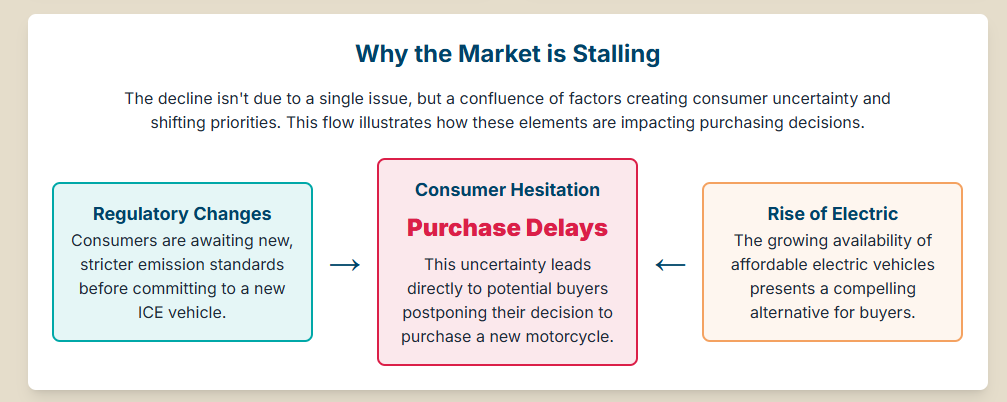
The primary cause of the market pause is policy-induced uncertainty: consumers are delaying purchases while awaiting implementation details for new nationwide emission standards and definitive timelines for the transition to electric vehicles (EVs).1 This hesitation is most pronounced in the highly profitable urban mid-range scooter segment.1 The traditional dominance of VAMM members, particularly Honda (which commands approximately 80% market share 1), is now structurally challenged. The rapid expansion of domestic EV champions like VinFast, combined with proposed government subsidies, is closing the Total Cost of Ownership (TCO) gap between ICE and EV models rapidly, signaling that the market inflection point for mass electrification is imminent, likely accelerating from 2026 to 2027.
II. The Q3 2025 Market Contraction: Symptom of Structural Change
2.1. Quantification of the ICE Decline: VAMM Sales Data Analysis
The market trajectory observed in Q3 2025 represents a violent reversal of prior performance throughout the year. The Vietnamese motorcycle market had been growing robustly through the first half, demonstrating strong underlying consumer demand. Q1 2025 sales reached 673,055 units, marking an 11.48% year-on-year increase.5 Q2 2025 continued with a modest growth of 1.3% year-on-year, totaling 611,236 units.6 Cumulatively, Year-to-Date sales through August 2025 stood at 2.08 million units, an impressive 15.2% increase compared to the previous year.8
The introduction of new regulatory directives in July 2025 immediately triggered an acute sales slump. The VAMM combined sales figure for the critical July-September 2025 period fell by 9.4%.1 This contraction signals a rapid adjustment as consumers began to absorb the risks associated with long-term ICE ownership. The incumbents were highly vulnerable; Honda, the market leader with an overwhelming share, reported a September 2025 sales decline of 11.4% year-on-year, selling almost 164,000 motorcycles that month.1
Table 1: Vietnam Two-Wheeler Sales Performance (VAMM Members) Q1-Q3 2025
| Metric | Q1 2025 Sales (Units) | Q2 2025 Sales (Units) | Q3 2025 Sales (Units) | Q3 YoY Change |
| Total VAMM Sales | 673,055 5 | 611,236 6 | < 622,000 1 | -9.4% 1 |
| Honda September Sales | N/A | N/A | 164,000 1 | -11.4% 1 |
2.2. The Anomalous Slowdown: Reconciling the Decline with Macroeconomic Resilience
The Q3 market contraction cannot be explained by macroeconomic weakness. The simultaneous growth of 8.23% in Q3 GDP 2 and the rise in consumer confidence contradicts the notion of a demand-side failure rooted in financial distress. Vietnam leads the ASEAN region in consumer sentiment with a score of 67, expressing high confidence in economic (83%) and political stability (82%).3 Furthermore, inflationary pressures, while present, remain moderate, with the Consumer Price Index (CPI) rising by 3.27% year-on-year in Q3 2025.2
The immediate drop in sales following months of robust growth proves that the policy risk associated with future vehicle obsolescence rapidly outweighed the positive economic indicators driving consumer spending. The market pause is explicitly a regulatory shock absorption rather than an organic market cooling. This conclusion is reinforced by the manufacturing sector’s continuing high output; domestic production remained high in August 2025, estimated at 310,700 units.10 This ample inventory, coupled with falling sales, is expected to compel manufacturers and dealers to adjust prices downward to stimulate demand.10 This inventory build-up confirms that the hesitation is driven by consumer purchase intent, not supply constraints or a macroeconomic slump.
2.3. Segment Vulnerability: Why Mid-Range Scooters are Bearing the Brunt
Reports from distributors indicate that the sharpest declines in sales are specifically concentrated in the mid-range scooter segment.1 This segment is crucial, often targeting urban middle-income consumers who use the bikes for daily commuting in major cities like Hanoi and Ho Chi Minh City. These consumers, who typically purchase models such as the Honda Air Blade (rolling price in Hanoi ranging from 50 million to 68.5 million VND 11), are now the most sensitive to future policy changes regarding urban access and long-term resale value.
The urban, affluent customer base is exhibiting a “wait-and-see” approach, delaying purchases due to uncertainty.1 They are actively assessing whether purchasing a new petrol vehicle will lead to future restrictions, or if it is more prudent to wait until electric alternatives become more affordable and infrastructure more reliable.1 Because mid-range scooters are a core profit driver for VAMM members, especially Honda, the regulatory shock has directly threatened the financial stability and market dominance of these traditional players by freezing demand in their high-value segment.

III. The Policy Shock: Regulatory Timelines and Consumer Uncertainty
The market paralysis stems from the combined effect of two primary regulatory tracks: immediate urban restrictions (bans) and longer-term, nationwide technical mandates (emission standards).
3.1. The Immediate Pressure: Analyzing Directive No. 20 and the Hanoi Ban
The single most disruptive factor in Q3 2025 was Prime Minister Directive No. 20, issued in July 2025, which mandates Hanoi authorities to ban fossil fuel-powered motorbikes within Ring Road 1 starting July 1, 2026.1 The ban is set to expand to Ring Roads 1 and 2 by 2028 and Ring Road 3 by 2030.1 This directive, which affects the inner city core—including the Old Quarter and government areas 15—created an immediate purchase delay for urban residents who now face the risk of their newly purchased ICE assets becoming obsolete or inaccessible within 12 months.
3.1.1. Feasibility Assessment and Socio-Economic Impact
Hanoi’s population of 8.5 million owns nearly 7 million motorbikes.16 The sudden timeline poses an immense logistical and socio-economic challenge. The ban threatens the livelihoods of countless individuals reliant on motorbikes for income, such as ride-hailing and delivery drivers.16 Critics of the policy point out that the public transport infrastructure—while slated for expansion with small electric buses and shuttles 13—is currently inadequate to absorb the shift of millions of commuters.16 Furthermore, without robust financial incentives and trade-in programs, the policy risks leading to “gas bike dumping” in rural areas, effectively shifting, rather than eliminating, the pollution problem and creating significant mechanical waste.18
The industry’s response reflects the policy’s disruptive speed. Traditional manufacturers, including VAMM members, have petitioned the government, warning that the 2026 restriction in Hanoi is too aggressive.1 Honda and other manufacturers have criticized the timeline as “not possible to be realized”.8 This political pushback, coupled with the reliance on underdeveloped public transit, suggests a significant possibility that the 2026 urban ban deadline may be delayed or implemented selectively. However, the government’s overall commitment to electrification and pollution control remains firm, ensuring long-term policy risk for ICE assets.
3.2. The Technical Mandate: Progressive Emission Standards for New and Existing Fleets
Beyond the immediate urban ban, two regulatory measures are structuring the market shift by increasing the TCO of ICE vehicles:
First, new vehicle standards are tightening. Prime Minister Decision 19/2024/QD-TTg mandates that new imported or manufactured two-wheeled motorcycles must comply with Level 2 (Euro 2 equivalent) standards from January 1, 2025, and escalate to Level 4 (Euro 4 equivalent) from July 1, 2027.21 This regulatory advancement compels VAMM manufacturers to invest heavily in engine technology updates, increasing production costs and complicating long-term product planning for ICE models.
Second, mandatory emission testing for the existing, aging fleet is set to begin. Starting July 1, 2027, Hanoi and Ho Chi Minh City will lead the phased rollout of mandatory emission checks, expanding nationwide by 2030.23 This affects tens of millions of vehicles; Hanoi alone has 7.5 million motorcycles, nearly 60% of which are over 10 years old.24 These older vehicles, many of which emit high levels of toxic smoke, face “very high, even unfeasible” maintenance costs to meet new emission standards.25
The simultaneous introduction of immediate urban access restrictions (Hanoi 2026) and the high cost of maintaining existing vehicles (2027 TCO pressure) creates a twin incentive structure that maximizes risk across the entire ICE market. Consumers considering a new mid-range scooter face the risk of a ban, while owners of old bikes face the looming cost of mandatory scrapping or expensive repairs.25 This maximized policy risk forces a critical decision point for consumers: they must either buy an EV now or delay purchasing any two-wheeler until EV affordability improves and the regulatory landscape stabilizes.
Table 2: Key Regulatory Timelines Driving Market Uncertainty
| Regulation/Directive | Scope | Effective Date | Impact on Consumer Behavior |
| New Vehicle Standard: Level 2 (Euro 2 equiv.) | Newly manufactured/imported 2W ICE motorcycles 21 | January 1, 2025 21 | Increases manufacturer costs; potentially deters new ICE development. |
| Directive 20/2024 (Hanoi Ban) | Restrict fossil-fueled motorbikes inside Ring Road 1 1 | July 1, 2026 13 | Triggers immediate purchase delay/shift to EV for urban residents. |
| Mandatory Emission Testing (Existing Fleet) | Older motorcycles (pre-2017) in Hanoi/HCMC 23 | July 1, 2027 23 | Incentivizes scrapping of old bikes, driving replacement demand to the new market. |
IV. The Acceleration of Electric Mobility: Competitive Dynamics and Infrastructure
The structural paralysis of the ICE market segment has created a massive opportunity for the rapid expansion of electric two-wheelers (E2Ws).
4.1. Vietnam’s Leadership in the Global Electric Two-Wheeler Market
Vietnam has rapidly become a major global player in electric mobility. In the first half of 2025, the country ranked third globally in electric motorbike sales, trailing only China and India, with 209,000 units sold. This represents a doubling of the market size year-on-year.26 Domestic manufacturers hold a decisive advantage, controlling approximately 70% of the EV market share.27 The growth is particularly explosive in the budget segment (L1 category, equivalent to under 50cc), which targets students and homemakers and saw sales surge by 113.1% in H1 2025.26
4.2. Competitive Analysis: Traditional Dominance vs. Domestic EV Challengers
The market shift is characterized by the dichotomy between the slow pivot of the incumbents and the aggressive expansion of the domestic challengers.
Traditional VAMM giants like Honda and Yamaha have been slow to adapt, offering only one EV model each, with minimal sales volume.26 Honda, caught off guard by the speed of the government’s July directive 15, is now forced to rapidly accelerate its electrification strategies 1 to defend its 80% market share.
In contrast, non-VAMM players are gaining ground rapidly. VinFast is leading the charge, recording a 447% to 488% increase in sales in the first half of 2025.8 VinFast has now captured enough market share to rank third overall in total two-wheeler sales (ICE + EV combined), behind only Honda and Yamaha.27 Other domestic challengers such as Yadea and Dat Bike are also growing rapidly.1 Dat Bike, for example, has responded by initiating trade-in campaigns and offering discounts to encourage the shift from gasoline to electric models.28
4.3. Electrification Economics: Bridging the Total Cost of Ownership (TCO) Gap
The main impediment to mass EV adoption has historically been the high upfront cost, driven primarily by the inclusion of Li-ion batteries.29 While electric vehicles offer significantly lower operating costs (fuel and maintenance) than ICE models, these savings often require a longer ownership period to fully offset the initial purchase price differential.30
The rolling price for a new mid-range ICE scooter, such as the Honda Air Blade 160 ABS, ranges from 64.8 to 68.5 million VND.11 Meanwhile, the average upfront cost for a mass-market EV scooter ranges from 20 million to 40 million VND ($850–1,700).31 VinFast’s affordable Evo 200 model, offering a 203 km range and 70 km/h top speed, is listed at 18 million VND (excluding battery costs/rental).32
To eliminate this cost barrier, particularly for low-income populations facing mandatory scrapping of older, high-polluting ICE vehicles, Ho Chi Minh City has proposed aggressive financial incentives.33 Proposed subsidies include covering 10% of conversion costs (up to 5 million VND) for regular households, and up to 100% of conversion costs (maximum 20 million VND) for poor households.33
If adopted, a subsidy of 20 million VND would effectively cover the entire upfront cost of an entry-level EV like the VinFast Evo 200. This targeted financial assistance dramatically alters the TCO calculation, making the EV option the most economically secure and viable replacement choice, bypassing the affordability gap that often plagues green transitions.25 Additional incentives proposed include a 50% reduction in vehicle registration and license plate fees, and subsidized interest rates for EV loans.33
Table 3: Comparative Economics: Mid-Range ICE Scooter vs. Leading Affordable EV (2025 Prices)
| Model | Propulsion Type | Upfront Rolling Price (VND Million) | Key Cost Driver | Impact of HCMC Subsidy (Max 20M VND) |
| Honda Air Blade 160 ABS | ICE | 64.8 – 68.5 11 | N/A | No Impact on price/cost of ownership |
| VinFast Evo 200 | EV | ~18 (Excl. Battery) 32 | Battery cost/rental | Potential 100% elimination of upfront cost for low-income buyers 33 |
4.4. Infrastructure as a Catalyst: Battery Swapping Networks
The successful mass adoption of E2Ws requires overcoming range anxiety, which is currently hindered by Vietnam’s limited public charging infrastructure (fewer than 1,000 public stations).31 Domestic manufacturers are deploying proprietary solutions to address this gap.
V-Green Global Charging Station Development Company (VinFast related) plans to install 150,000 battery swapping cabinets in urban areas nationwide.35 The strategic partnership between V-Green and Viettel Post, announced in September 2025, will see approximately 3,000 charging stations and battery-swapping cabinets installed at Viettel Post locations.37 This rapid, proprietary infrastructure deployment leverages established logistical networks to accelerate scale, mitigating a core consumer fear regarding vehicle usability.38
The vertical integration achieved by VinFast—controlling manufacturing, sales, battery technology, and the proprietary charging infrastructure—creates a strategic ecosystem lock-in that provides a significant market advantage. For the consumer, the existence of a robust, OEM-led battery swapping network ensures that purchasing an EV is a practical long-term investment, further amplifying the impact of government subsidies by stabilizing the ownership experience.
V. Strategic Outlook and Forward Forecast (2026-2030)
5.1. Market Trajectory Scenario Planning
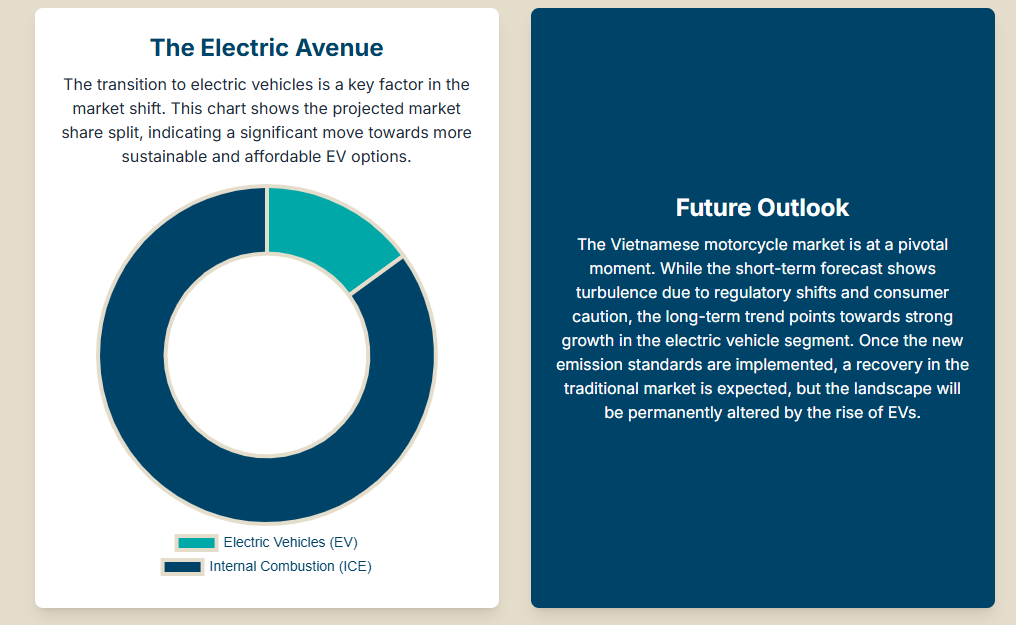
The market pause observed in Q3 2025 is expected to stabilize from the second half of 2026 onward 1, as policy details crystalize and the market adjusts to the new normal. The overall Vietnamese two-wheeler market size is projected to expand significantly, rising from $4.55 billion in 2025 to $6.01 billion by 2030, representing a Compound Annual Growth Rate (CAGR) of 5.74%.36
Electric models are forecast to be the dominant driver of this growth, with the EV segment expanding at the fastest pace, an 11.41% CAGR between 2025 and 2030.36 The disruption to the ICE scooter market is predicted to directly accelerate the growth of the E-scooter category, which was already projected to grow at a 7.63% CAGR due to trends in urbanization and female ridership.36
Geographically, Southern Vietnam, led by Ho Chi Minh City, is projected to record the highest growth (7.82% CAGR through 2030).36 This rapid growth projection is directly linked to HCMC’s aggressive focus on electrification, including proposed high subsidies for households 33 and specific incentives for commercial fleet operators (delivery and app-based transport).13 Fleet and delivery services are forecast to register a high CAGR of 9.65% through 2030, driven by commercial conversion mandates and incentives.13
5.2. Export Potential: Vietnam as a Regional EV Manufacturing Hub
Vietnam’s rapid commitment to electrification, moving faster than some regional neighbors, positions it for significant export opportunities. Domestic manufacturers like VinFast and Pega already possess production capacity that exceeds current local demand, giving them the capability to export E2Ws to other ASEAN markets.39 As regional demand for EVs grows, fueled by incentives in countries like Indonesia 39, Vietnam’s pioneering policy environment and localized supply chain (with domestic content exceeding 90% in many components 36) create a foundation for establishing the country as a pivotal regional EV manufacturing and supply hub.
5.3. Investment Opportunities in Component and Service Ecosystems
The policy shift creates critical investment opportunities in supporting industries. The strong localization of the supply chain, which already produces frames, plastics, and wiring harnesses domestically, reduces lead times and hedges against currency risk for assemblers.36 This environment is attractive for manufacturers specializing in advanced EV components, such as battery management systems, thermal management solutions, and high-efficiency electric motors.
Furthermore, the 2027 mandatory emission inspection regime for existing vehicles 23 generates a new, regulated revenue stream in the maintenance and service sector. This necessitates the rapid establishment of an inspection network capable of servicing both aging ICE vehicles (repairing them to meet standards) and providing specialized maintenance and diagnostics for the rapidly expanding EV fleet, particularly concerning battery health and swapping logistics.25
VI. Strategic Recommendations
The Q3 2025 market contraction is a clear indication that traditional business models are now unsustainable in Vietnam’s two-wheeler market. Strategic responses must reflect the speed and permanence of the government’s green policy mandate.
6.1. Recommendations for Traditional ICE Manufacturers (VAMM Members)
The analysis dictates that VAMM members must execute an immediate and comprehensive pivot:
- Decisive EV Portfolio Launch: Traditional manufacturers must rapidly launch competitive, mid-to-high-range EV scooter models (priced in the 40 million to 60 million VND segment) to retain their core urban, middle-class customers who are currently delaying purchases.1
- Utilize Dealer Network for Transition: Leverage existing, highly trusted distribution networks (responsible for 70% of total sales 5) to aggressively promote comprehensive EV trade-in programs, attractive financing, and certified EV maintenance services.
- Engage in Policy Advocacy for Standards: Actively participate in discussions regarding battery standards and infrastructure access to ensure that proprietary systems (such as V-Green’s) do not create an unassailable barrier to entry for new EV competitors.
6.2. Recommendations for EV Manufacturers and Investors
EV manufacturers, particularly domestic leaders, must capitalize on the policy environment to secure long-term dominance:
- Targeted Subsidy Marketing: Aggressively market entry-level EV models (e.g., VinFast Evo 200) directly to low-income and fleet segments in cities like HCMC, emphasizing the economic certainty provided by the proposed subsidies (up to 20 million VND) and eliminating the high TCO of repairing old ICE vehicles.25
- Prioritize Infrastructure Expansion: Maintain rapid deployment of proprietary infrastructure (V-Green’s 150,000 swapping cabinets) 35, focusing deployment first on high-traffic commercial and urban delivery routes, ensuring functional superiority over ICE vehicles in critical areas.
- Secure Fleet Contracts: Focus sales efforts on commercial transport and delivery platforms (Grab, ShopeeFood) who are heavily incentivized by the government (e.g., 100% registration fee exemption) to transition their fleets.33
6.3. Recommendations for Policy Makers
To minimize socio-economic friction and ensure a successful transition, policy execution requires refinement:
- Refine Urban Restriction Timelines: The July 2026 Hanoi ban (Ring Road 1) poses significant feasibility risks due to inadequate public transport alternatives.16 Authorities should consider modifying the immediate ban into an immediate high-emission fee/charge system to target the most polluting vehicles first, thereby achieving environmental goals while mitigating the political and economic disruption of a blanket ban.
- Standardize Scrappage Incentives: Standardize and nationalize the HCMC subsidy model, creating a clear, generous trade-in mechanism specifically for the oldest, highest-polluting ICE vehicles (pre-2008 models) to incentivize scrapping and guarantee stable replacement demand for affordable EVs.25
- Socialize Inspection Network: Provide strong support and regulatory clarity for the privatization (“socialization”) of the mandatory emission inspection network to ensure sufficient capacity is ready before the July 2027 deadline for existing vehicles.23
Sources
- Vietnam motorcycle market slows amid transition, accessed October 14, 2025, https://vir.com.vn/vietnam-motorcycle-market-slows-amid-transition-138533.html
- Vietnam’s GDP grows 7.85% in nine months, near growth target – VietNamNet, accessed October 14, 2025, https://vietnamnet.vn/en/vietnam-s-gdp-grows-7-85-in-nine-months-near-growth-target-2449617.html
- Vietnam tops ASEAN in consumer sentiment: UOB report, accessed October 14, 2025, https://vietnamlawmagazine.vn/vietnam-tops-asean-in-consumer-sentiment-uob-report-75130.html
- Rising Confidence: Vietnam Tops ASEAN in Consumer Sentiment, accessed October 14, 2025, https://www.vietnam-briefing.com/news/rising-confidence-vietnam-tops-asean-in-consumer-sentiment.html/
- Vietnam Motorcycle market in Q1 2025: Strong recovery, driven by electric models and strategic innovation – ASEMCONNECTVIETNAM, accessed October 14, 2025, https://asemconnectvietnam.gov.vn/default.aspx?ZID1=8&ID1=2&ID8=142582
- VAMM reports motorcycle sales in Vietnam at 611236 units in Q2 2025, up 1.3% YoY, accessed October 14, 2025, https://www.marklines.com/en/news/329551
- Nearly 1.3 million motorbikes sold in the market in the first half of 2025 – Vietbao.vn, accessed October 14, 2025, https://vietbao.vn/en/gan-1-3-trieu-xe-may-ban-ra-thi-truong-nua-dau-nam-2025-551011.html
- Vietnam Motorcycles Data & Facts 2025 | MotorcyclesData, accessed October 14, 2025, https://www.motorcyclesdata.com/2025/09/17/vietnam-motorcycles/
- Honda Vietnam sees car, motorcycle sales down in September – The Saigon Times, accessed October 14, 2025, https://english.thesaigontimes.vn/honda-vietnam-sees-car-motorcycle-sales-down-in-september/
- Vietnam’s motorbike production hits new highs ahead of school season – VietNamNet, accessed October 14, 2025, https://vietnamnet.vn/en/vietnam-s-motorbike-production-hits-new-highs-ahead-of-school-season-2440159.html
- Honda Air Blade 2025 price in May 2025 – Vietnam.vn, accessed October 14, 2025, https://www.vietnam.vn/en/gia-xe-honda-air-blade-2025-thang-5-2025
- Honda Air Blade 2025 price in May 2025, accessed October 14, 2025, https://baonghean.vn/en/gia-xe-honda-air-blade-2025-thang-5-2025-10296900.html
- Hanoi to ban ICE motorcycles in the city centre – electrive.com, accessed October 14, 2025, https://www.electrive.com/2025/07/16/hanoi-to-ban-ice-motorcycles-in-the-city-centre/
- Hanoi And Ho Chi Minh City To Ban Gas-Powered Motorbikes: What You Need To Know, accessed October 14, 2025, https://vietcetera.com/en/hanoi-and-ho-chi-minh-city-to-ban-gas-powered-motorbikes-what-you-need-to-know
- Vietnam Shifts To EV Motorcycles – Power Systems Research, accessed October 14, 2025, https://www.powersys.com/2025/08/vietnam-shifts-to-ev-mcs-under-government-leadership/
- Hanoi’s plan to ban petrol bikes by 2026 leaves livelihoods in the dust | The Straits Times, accessed October 14, 2025, https://www.straitstimes.com/asia/se-asia/hanois-plan-to-ban-petrol-bikes-by-2026-leaves-livelihoods-in-the-dust
- Vietnam will ban gasoline-powered motorcycles in central Hanoi – POLITICO Pro, accessed October 14, 2025, https://subscriber.politicopro.com/article/eenews/2025/07/14/vietnam-will-ban-gasoline-powered-motorcycles-in-central-hanoi-00451005
- Hanoi Gas Motorbike Ban 2026 – What Travelers Need to Know for a Sustainable Visit, accessed October 14, 2025, https://www.govietnam.tours/hanoi-gas-motorbike-ban-2026-what-travelers-need-to-know-for-a-sustainable-visit/
- Going green must take social realities into account – Hanoi Times, accessed October 14, 2025, https://hanoitimes.vn/going-green-must-take-social-realities-into-account.772797.html
- Honda’s grip on Vietnam motorbike market looks shaky on EV switch By Reuters, accessed October 14, 2025, https://www.investing.com/news/stock-market-news/hondas-grip-on-vietnam-motorbike-market-looks-shaky-on-ev-switch-4276130
- Premier approves roadmap to apply new emission standards of motor vehicles, accessed October 14, 2025, https://vietnamlawmagazine.vn/premier-approves-roadmap-to-apply-new-emission-standards-of-motor-vehicles-73096.html
- Cubic Instruments Emissions Testing Solutions for Vietnam’s New Motorcycle Emissions Standards, accessed October 14, 2025, https://www.gas-analyzers.com/NEWS/info631/
- New emission standards for motorcycles and mopeds to be introduced – Vietnam News, accessed October 14, 2025, https://vietnamnews.vn/economy/1720934/new-emission-standards-for-motorcycles-and-mopeds-to-be-introduced.html
- Vietnam debates measures for aging motorcycles spewing black smoke – VietNamNet, accessed October 14, 2025, https://vietnamnet.vn/en/millions-of-old-motorcycles-emit-toxic-smoke-ban-or-fine-2450410.html
- Tightening motorcycle emission standards: What impact does it have on people and the market? – Vietnam.vn, accessed October 14, 2025, https://www.vietnam.vn/en/siet-tieu-chuan-khi-thai-xe-may-tac-dong-ra-sao-toi-nguoi-dan-va-thi-truong
- Vietnam ranks 3rd globally in electric motorbike sales – VnExpress International, accessed October 14, 2025, https://e.vnexpress.net/news/business/economy/vietnam-ranks-3rd-globally-in-electric-motorbike-sales-4925715.html
- Vietnamese firms dominate green two-wheeler market – Theinvestor, accessed October 14, 2025, https://theinvestor.vn/vietnamese-firms-dominate-green-two-wheeler-market-d16368.html
- Electric motorbike makers offer discounts as Vietnam moves away from gasoline, accessed October 14, 2025, https://e.vnexpress.net/news/business/companies/electric-motorbike-makers-offer-discounts-as-vietnam-moves-away-from-gasoline-4920380.html
- Total cost of ownership comparison for electric two-wheelers in Vietnam – International Council on Clean Transportation (ICCT), accessed October 14, 2025, https://theicct.org/wp-content/uploads/2023/01/vietnam-E2W-TCO_feb23.pdf
- Total cost of ownership comparison for electric two-wheelers in Vietnam, accessed October 14, 2025, https://theicct.org/publication/asia-pacific-lvs-evs-tco-e2w-vietnam-feb23/
- Vietnam EV Two-Wheeler Fleets Market | 2019–2030 – Ken Research, accessed October 14, 2025, https://www.kenresearch.com/vietnam-ev-two-wheeler-fleets-market
- VinFast Evo200 – Specifications, Price and Latest deals 2025, accessed October 14, 2025, https://shop.vinfastauto.com/vn_en/xe-may-dien-evo200.html
- HCMC proposes subsidies up to VND 20 million to switch to EV two-wheelers, accessed October 14, 2025, https://segmenty.vehicledatasystems.com/GenerateNewsStaticJsps/HCMC_proposes_subsidies_up_to_VND_20_million_to_switch_to_EV_two-wheelers.html
- Families in Ho Chi Minh City may get up to $800 to switch to electric motorbikes, accessed October 14, 2025, https://e.vnexpress.net/news/news/traffic/families-in-ho-chi-minh-city-may-get-up-to-800-to-switch-to-electric-motorbikes-4949292.html
- accessed October 14, 2025, https://vietnamnet.vn/en/vietnam-s-60-billion-ev-challenge-the-cost-of-battery-swapping-transition-2446279.html#:~:text=V%2DGreen%20plans%20to%20install,Summit%202025%20on%20September%2025.
- Vietnam Two Wheeler Market Size, Share & 2030 Trends Report – Mordor Intelligence, accessed October 14, 2025, https://www.mordorintelligence.com/industry-reports/vietnam-two-wheeler-market
- V‑Green, Viettel Post team up to expand charging, battery-swapping network – Theinvestor, accessed October 14, 2025, https://theinvestor.vn/vgreen-viettel-post-team-up-to-expand-charging-battery-swapping-network-d17188.html
- Electric Motorcycles in Southeast Asia: Market Insights and Strategic Opportunities, accessed October 14, 2025, https://www.tmrs.or.th/uploads/TMRS_Insights_Flash_August_2024_ENG.pdf
- Trends in other light-duty electric vehicles – Global EV Outlook 2024 – Analysis – IEA, accessed October 14, 2025, https://www.iea.org/reports/global-ev-outlook-2024/trends-in-other-light-duty-electric-vehicles
Our Social Media Handles
- Instagram : LivingWithGravity
- Medium : Akash Dolas
- YouTube Channel : Gear and Shutter
- Facebook : LivingWithGravity