







Executive Summary: A Resilient Future Forged Through Crisis
The ongoing discussions and market speculation regarding the future of the partnership between Red Bull and KTM in MotoGP beyond 2025 have been largely framed by a narrative of financial uncertainty at KTM’s parent company, Pierer Mobility AG. This report, however, concludes that this narrative is based on an outdated assessment of the company’s financial health. The financial challenges, while significant, have been successfully navigated through a comprehensive restructuring and a strategic capital infusion. This process has not only stabilized the company but has fundamentally strengthened its long-term viability, positioning the Red Bull-KTM alliance for a new, more secure era.
The analysis identifies two primary drivers for this conclusion. First, a successful financial restructuring has effectively eliminated an estimated €2 billion in debt, provided a robust liquidity buffer, and fundamentally changed the company’s risk profile. This turnaround was solidified by the strategic investment from India’s Bajaj Auto, which has transformed the group into a powerful Indo-European entity with a shared vision for global growth. Second, the partnership is set to benefit significantly from the forthcoming 2027 MotoGP regulations. These new rules, which emphasize road-relevant technology and cost efficiency, align perfectly with KTM’s core business model of using motorsports as a proving ground for commercial R&D and a powerful marketing tool. As a result, the partnership is not facing a potential withdrawal but is instead poised to leverage its renewed financial stability to gain a competitive advantage in the sport’s next technical era.
1. The Financial Foundation: Pierer Mobility AG’s Strategic Turnaround
The initial premise of financial instability at KTM and its parent company, Pierer Mobility AG, stemmed from a period of genuine financial distress and subsequent market rumors. A clear and direct analysis of the timeline and outcomes of this crisis reveals not a company in retreat, but one that has executed a decisive and successful turnaround.
1.1. The Crisis: Pre-Restructuring Financial Context
In late 2024, Pierer Mobility AG issued an ad hoc announcement detailing a “far-reaching restructuring and additional liquidity requirement at KTM AG”.1 The company’s financial results for the 2024 fiscal year reflected this challenging environment, with consolidated revenues declining by 29% to €1.879 billion from €2.661 billion the previous year.2 Operating results were substantially negative, with EBITDA at approximately €-481 million and EBIT at a stark €-1.184 billion, which included significant value adjustments and impairments on intangible assets.2 At the time, this severe downturn fueled market speculation. Reports circulated that the company, burdened by nearly $3 billion in debt, might resort to drastic measures, including shutting down its entire MotoGP division—a move that was projected to save an estimated $47.7 million annually.3 This narrative painted a picture of motorsports as a non-essential, expendable cost center, which was highly susceptible to elimination in a crisis.
However, a close examination of the events demonstrates that the company’s actions were driven by a different, more strategic rationale. The rumors of a complete motorsports shutdown were based on a short-term, pre-restructuring perspective. The company’s response was not to abandon its core brand strategy, but to fix the underlying financial issues that made such a scenario a possibility.
1.2. The Resolution: A Successful Restructuring Plan
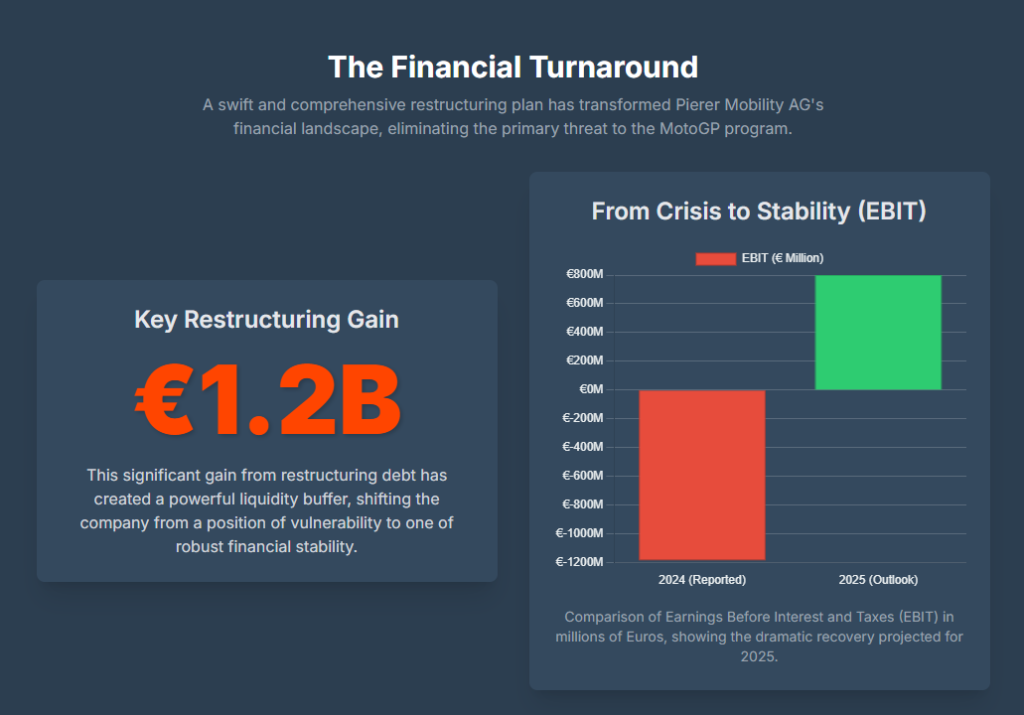
The financial distress was met with a swift and comprehensive restructuring plan that was approved by creditors and confirmed by the court.2 This plan required a cash quota of 30% to be paid on registered creditor claims from three key entities: KTM AG, KTM Components GmbH, and KTM Forschungs & Entwicklungs GmbH.2 The total amount required to fulfill this quota was approximately €600 million, which was secured by Pierer Mobility AG and paid on time by the May 23, 2025 deadline.4 This payment, on an estimated €2 billion of debt, resulted in a significant “restructuring gain” of around €1.2 billion for the group.2
The immediate impact of this turnaround is evident in the company’s financial outlook for the 2025 fiscal year. The restructuring gain is expected to make the group’s EBIT “significantly positive” and restore its equity to a “positive figure in the high triple-digit million range,” creating a stable financial structure.2 The company, which had a negative equity of €-193.7 million at the end of 2024, has now reversed its debt-to-equity ratio, providing it with a powerful liquidity buffer that is a rarity in the current volatile economic landscape.2 This pivot moves KTM from a position of financial vulnerability to one of robust stability, granting it the freedom to invest in strategic areas, including its motorsports programs, without being constrained by debt.
Table 1: Pierer Mobility AG Financial Summary (2024 vs. 2025 Outlook)
| Metric | 2024 (Reported) | 2025 (Outlook) |
| Revenue | €1,879.0 million | Below 2024 level (due to production halts) 2 |
| EBITDA | €-480.8 million | Negative operating result expected 2 |
| EBIT | €-1,184.2 million | Significantly positive (due to restructuring gain) 2 |
| Equity | €-193.7 million | Positive (high triple-digit million range) 2 |
| Restructuring Gain | N/A | approx. €1.2 billion 2 |
1.3. The Strategic Role of Bajaj Auto: A New Powerhouse
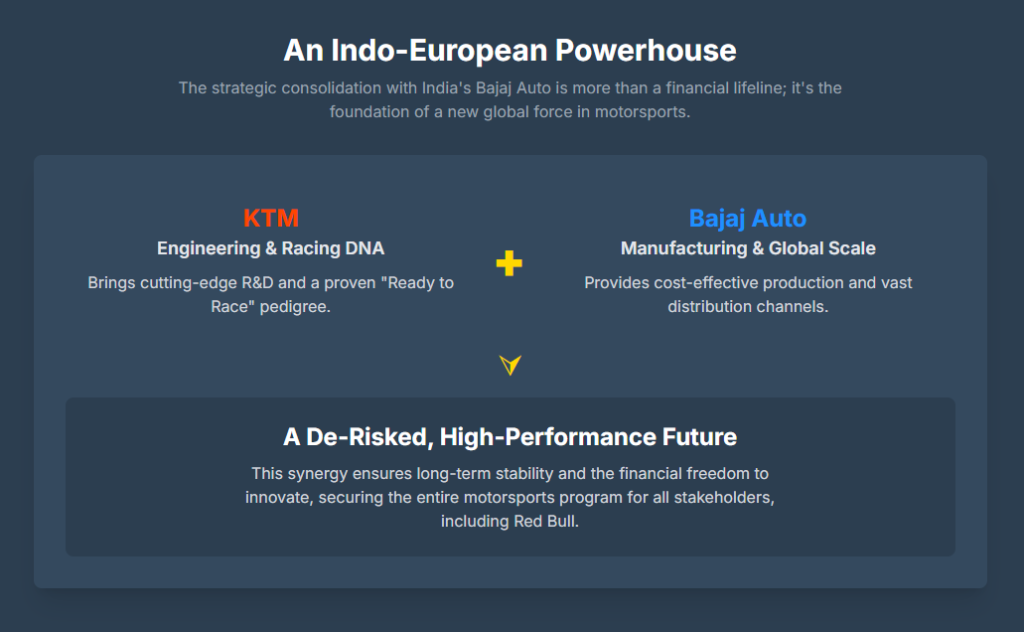
The successful restructuring was underpinned by a strategic investment from Bajaj Auto, which holds a 49.9% stake in Pierer Bajaj AG, the majority owner of Pierer Mobility AG.5 This partnership is far more than a simple financial arrangement; it is a “strategic consolidation” that ensures “long-term stability” for Pierer Mobility AG and its portfolio of brands.7 Bajaj, a global automotive giant with its own vast financial resources, has been a key manufacturing partner for KTM since 2007, producing its small and mid-capacity models.5
The new, deepened alliance leverages the strengths of both companies, combining Bajaj’s cost-effective manufacturing and global distribution with KTM’s engineering prowess and racing pedigree.7 This synergy is symbolized by the appearance of the Bajaj logo alongside the Red Bull and Pierer Mobility graphics on the KTM RC16 machines at Silverstone in 2025.7 This profound shift in power dynamics transforms KTM from an “Austrian underdog” into the “flagship brand of a robust, Indo-European motorsport powerhouse”.7 This new structure de-risks the entire motorsport program for all stakeholders, including Red Bull, by tying KTM’s future success to a global, multi-billion-dollar enterprise.
2. KTM’s Unwavering Commitment: Motorsports as a Strategic Imperative
For KTM, motorsports is not a discretionary expense but a fundamental pillar of its business model. The company’s actions and public statements confirm a deep-seated commitment that has been reinforced, not questioned, by the recent financial restructuring.
2.1. Honor-Bound Commitments for 2026 and Beyond
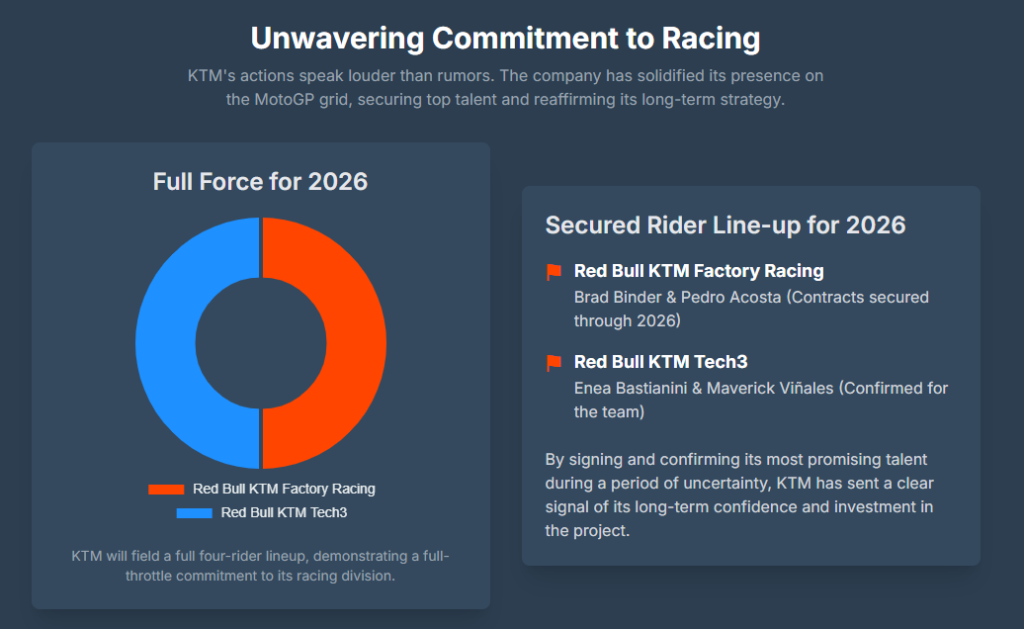
The user’s query specifically referenced a timeframe beyond 2025, a period that begins with the final season of the current MotoGP regulatory cycle. KTM has explicitly stated its commitment to the 2026 season, noting that its contract with MotoGP promoter Dorna Sports runs until the end of that year and that it will “honour” all existing agreements.8 The company’s motorsports director, Pit Beirer, has publicly reinforced this commitment, stating that for 2026, the company will run “four bikes, four riders,” directly countering earlier rumors of a potential scale-back or withdrawal.9
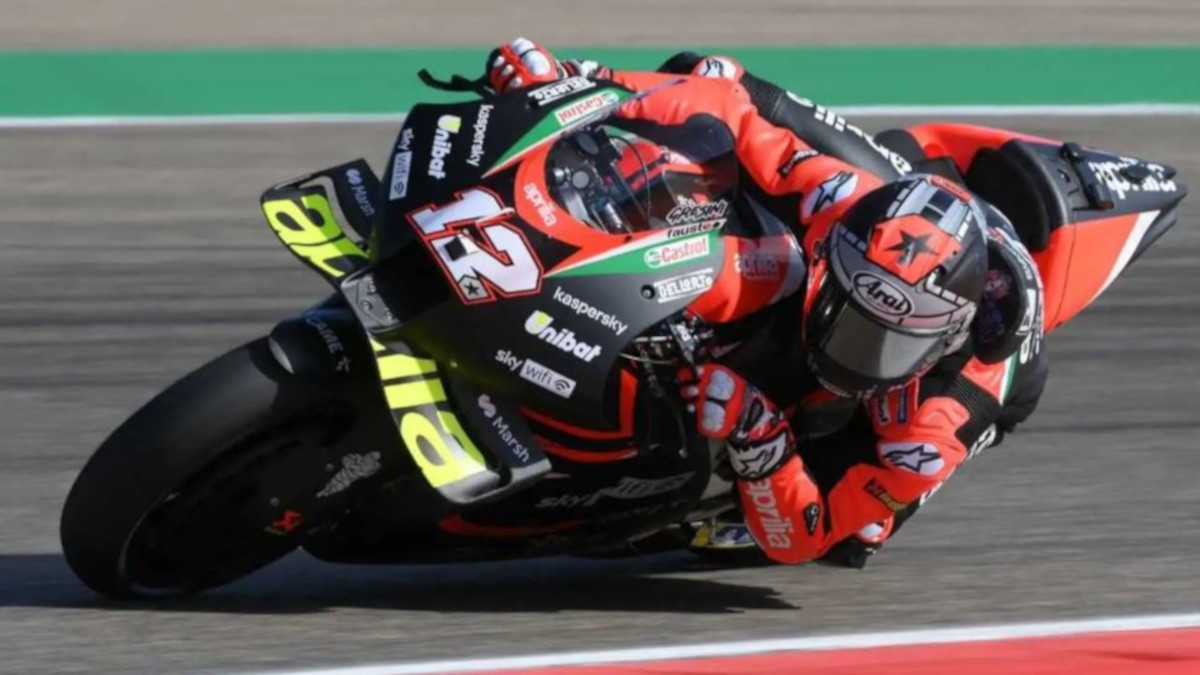
Furthermore, the stability of the rider line-up for 2026 is a definitive indicator of the company’s confidence in its long-term project. The star factory rider, Pedro Acosta, is under a contract that extends through the 2026 season.10 His teammate, Brad Binder, has a long-term contract in place until the end of 2026, a commitment that was signed during a period of considerable financial uncertainty at the company.11 The satellite team, Tech3, will also continue with its new line-up of Enea Bastianini and Maverick Viñales.9 The fact that KTM has re-signed its most promising talent and is publicly reaffirming its long-term presence demonstrates that the financial crisis did not trigger an exit plan, but rather spurred a renewed, full-throttle commitment to its racing division.
Table 2: KTM’s Confirmed MotoGP Rider & Team Line-up (2026)
| Team | Riders | Contract Status (through 2026) |
| Red Bull KTM Factory Racing | Brad Binder | Secured 11 |
| Pedro Acosta | Secured 10 | |
| Red Bull KTM Tech3 | Enea Bastianini | Confirmed 9 |
| Maverick Viñales | Confirmed 9 |
2.2. The Business Case for Racing
KTM’s motorsports division is not a simple marketing exercise; it is a critical R&D and talent development platform. The company’s commitment to its GP Academy model is a testament to this strategy, which cultivates riders from the grassroots Red Bull MotoGP Rookies Cup, through Moto3 and Moto2, all the way to the premier MotoGP class.12 This pipeline provides a consistent supply of home-grown talent and ensures the brand’s long-term competitive viability.
A key element of the new partnership with Bajaj is its explicit role in safeguarding these investments.7 The infusion of capital and strategic support from Bajaj ensures that KTM can “double down on innovation without being hamstrung by financial uncertainty”.7 This means the racing program, from the factory team down to the youth development squads, can continue to thrive. The company’s ability to secure the necessary financing and stabilize its operations proves that motorsports are a core, non-negotiable part of its corporate identity and future.
3. The Symbiotic Partnership: Red Bull and KTM
The partnership between Red Bull and KTM is a deep-seated, multi-disciplinary collaboration that extends far beyond a typical sponsorship agreement. Its resilience is built on a shared strategic vision and a strong brand identity that transcends short-term market fluctuations.
3.1. Red Bull’s Global Motorsports Footprint
Red Bull’s approach to motorsports sponsorship is not transactional; it is a strategic investment in a brand and its ecosystem. While Red Bull has shown a willingness to adapt its partnerships to follow key talent (for example, its sponsorship shift from Repsol Honda to the Tech3 GASGAS team following Marc Marquez’s departure 14), its relationship with KTM is fundamentally different. It is a long-standing, multi-series partnership that spans multiple disciplines, including MotoGP, Motocross, and Supercross, where Red Bull KTM Factory Racing has been a dominant force for years.15
The Red Bull Racing Formula One team provides a telling precedent for this kind of long-term commitment. Red Bull’s partnership with Honda extended beyond the manufacturer’s official withdrawal from the sport, with the team continuing to use Honda engines and technology under the Red Bull Powertrains banner until at least the end of 2025.16 This history demonstrates a willingness to invest in a project’s core technology and competitive potential, a pattern that strongly suggests that as long as KTM remains a top-tier competitor, Red Bull’s commitment will remain steadfast.
3.2. A Brand Synergy Evaluation: Red Bull and KTM
The true durability of the partnership is built on a shared brand identity that has been meticulously cultivated over decades. Both Red Bull and KTM embody a “Ready to Race” ethos, associating their brands with high-performance, daring, and a youthful, adrenaline-fueled image.12 They target a similar demographic and share a philosophy of pushing boundaries. The ongoing promotion of the 2026 Austrian Grand Prix at the Red Bull Ring further highlights the deep-seated, venue-based synergy that exists between the brands.17 With KTM’s financial stability now secured, the single greatest threat to this partnership has been neutralized. This allows both companies to return their focus to their shared core mission: winning races and leveraging that success to reinforce their respective high-performance identities. The partnership’s foundation is a strong cultural fit, ensuring that it is far more than a simple financial arrangement.
4. The Changing Landscape of MotoGP: A Catalyst for Success
The impending technical regulations for the 2027 MotoGP season, far from being an obstacle, present a new and tangible opportunity for KTM to gain a competitive edge. These changes align perfectly with the company’s renewed strategic and financial position.
4.1. The New Technical Era
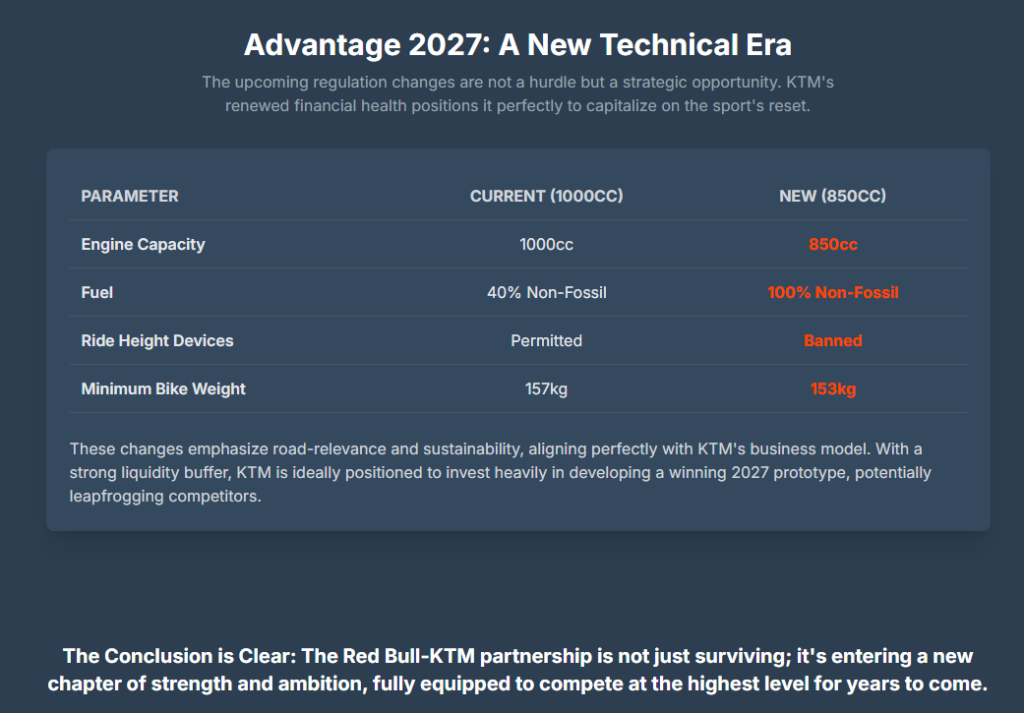
The 2027 regulations will usher in a new era for MotoGP, with a comprehensive overhaul of the technical specifications. The most significant changes include a reduction in engine displacement from 1000cc to 850cc and a move to 100% non-fossil origin fuel.18 Additionally, the rules will ban all ride height devices and impose tighter restrictions on aerodynamics, with a reduction in the maximum width of the front fairing.20 These changes are designed to make the sport safer, more sustainable, and more road-relevant.23 This strategic reset of the sport’s ecosystem is a perfect fit for KTM’s business model.
Table 3: 2027 MotoGP Technical Regulations: A Strategic Overview
| Parameter | Current Regulations (1000cc) | 2027 Regulations (850cc) |
| Engine Capacity | 1000cc | 850cc 18 |
| Fuel | 40% non-fossil components | 100% non-fossil origin 20 |
| Ride Height Devices | Permitted | Banned 20 |
| Minimum Bike Weight | 157kg | 153kg 20 |
| Front Fairing Aero Width | 600mm | 550mm 20 |
| Engine Architecture | Four-stroke, four-cylinder 20 | Four-stroke, four-cylinder 20 |
4.2. KTM’s Development Advantage
The 2027 regulations are a strategic boon for KTM. The focus on sustainability and road relevance, including the use of 100% non-fossil fuels, complements KTM’s broader corporate focus on advanced mobility solutions and electrification.7 The racing program can now serve as an even more effective “lab-to-track” platform, as the technologies developed on the race bike can be more directly applied to consumer motorcycles.7 Furthermore, KTM has already secured a multi-year partnership with ExxonMobil, the parent company of Mobil 1, which has been actively developing the required lower-emission fuels for the current season.24 This pre-existing collaboration gives KTM a significant head start on a crucial aspect of the new regulations.
While the impending changes pose a significant engineering and financial challenge for all manufacturers, KTM’s newly secured financial stability provides it with a powerful advantage. Building a completely new prototype is a multi-million-euro project, and a financially constrained company would be at a severe disadvantage. However, a company with a massive liquidity buffer, having just settled its debts, is perfectly positioned to dedicate the necessary resources to this new challenge.7 This transition period, far from being a liability, is an opportunity for KTM to reset its technical platform, potentially leapfrogging the competition and strengthening its on-track performance, which will only reinforce its value as a partner to Red Bull.
5. Synthesis and Forward-Looking Projections
The various threads of this analysis—the financial restructuring, the strategic partnership with Bajaj, the unwavering commitment to motorsports, the deep-seated brand synergy with Red Bull, and the strategic alignment with the 2027 regulations—converge to a single, consolidated conclusion. The initial premise of the user’s query has been rendered obsolete by recent events. The financial challenges that raised questions about the partnership’s future have been successfully mitigated, and the company is now in a stronger position than it has been in years. The future is not one of uncertainty and potential withdrawal, but of opportunity and sustained growth.
The evidence points to an extremely high probability of the Red Bull-KTM partnership’s continuation well beyond 2026. The financial risk, which was the primary concern, has been addressed decisively. The partnership’s durability is built on a foundation of shared identity and mutual strategic benefit. Both companies are now in a position to capitalize on the next era of MotoGP, with KTM’s renewed stability providing a powerful platform for Red Bull to showcase its brand through a winning, high-performance racing team.
6. Strategic Recommendations and Conclusions
6.1. Recommendations for KTM & Pierer Mobility AG:
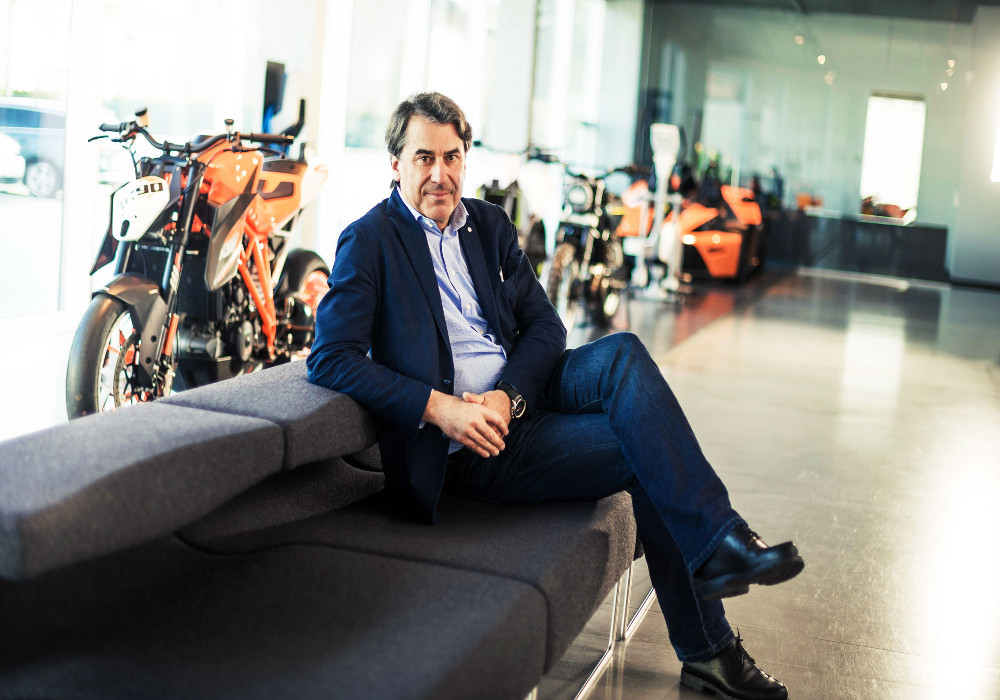
- Publicly Reinforce Stability: Continue to communicate the company’s financial stability through official channels. The public statements from Pit Beirer and Gottfried Neumeister are crucial in shaping the narrative and building confidence among sponsors, investors, and fans.9
- Accelerate R&D for 2027: Leverage the new liquidity provided by the Bajaj partnership to accelerate the development of the 2027 prototype. KTM’s position is unique; while competitors may be constrained by prior investments, KTM has the capital to “double down on innovation” and potentially leapfrog the competition.7
- Leverage Brand Synergy: Work closely with Red Bull to highlight the long-standing, multi-disciplinary nature of the partnership. The “lab-to-track” relationship with partners like ExxonMobil and the strategic fit of the 2027 regulations provide compelling stories that reinforce the value of the partnership.
6.2. Recommendations for Red Bull:
- Capitalize on Partner Reliability: Highlight the renewed stability of the KTM partnership. In a volatile economic landscape, a partner that has successfully navigated a major crisis and emerged stronger is a powerful testament to reliability and long-term vision.
- Showcase Shared Values: Continue to promote the Red Bull-KTM partnership as a symbol of shared loyalty and success. This can serve as a point of contrast to more transactional sponsorships and reinforce the brand’s commitment to excellence and a “Ready to Race” ethos.
6.3. Concluding Remarks:
The future of the Red Bull-KTM partnership in MotoGP is demonstrably secure. The period of financial uncertainty has served not as a prelude to a split, but as a crucible that has forged a stronger, more resilient entity. By successfully navigating a complex restructuring and aligning with a powerful new strategic partner, KTM has mitigated its primary risk and is now poised to capitalize on the opportunities presented by the next era of motorsports. The alliance is not merely surviving; it is entering a new chapter, fully equipped to compete at the highest level for years to come.
Sources
- Far-reaching restructuring and additional liquidity requirement at KTM AG, accessed on August 20, 2025, https://www.pierermobility.com/en/newsroom/eqsfeed/2880675?type=adhoc
- PIERER Mobility AG: Key financial figures for financial year 2024, accessed on August 20, 2025, https://www.pierermobility.com/en/newsroom/eqsfeed/2995290?type=adhoc
- KTM Likely To Leave MotoGP In 2026 If Racing Division Isn’t Sold Off Next Year – Jalopnik, accessed on August 20, 2025, https://www.jalopnik.com/ktm-likely-to-leave-motogp-in-2026-if-racing-division-i-1851730141/
- www.pierermobility.com, accessed on August 20, 2025, https://www.pierermobility.com/en/newsroom/eqsfeed/2944705?type=corporate;presse#:~:text=Restructuring%20plan%20adopted&text=It%20provides%20for%20creditors%20to,am%20grateful%20and%20happy%20today.
- KTM Secures Funding To Pay Off Creditors | Motorcycle.com, accessed on August 20, 2025, https://www.motorcycle.com/bikes/news/ktm-secures-funding-to-pay-off-creditors-44622646
- PIERER Mobility AG: Financing package secured for KTM restructuring, accessed on August 20, 2025, https://www.pierermobility.com/en/newsroom/eqsfeed/2990330?type=adhoc
- MotoGP 2025: A first look at the KTM-Bajaj partnership and how it …, accessed on August 20, 2025, https://www.dive-bomb.com/article/motogp-2025-a-first-look-at-the-ktm-bajaj-partnership-and-how-it-can-fuel-future-success
- KTM will continue with MotoGP in 2027 “if we can afford it”, says CEO – Motorsport.com, accessed on August 20, 2025, https://www.motorsport.com/motogp/news/ktm-will-continue-with-motogp-in-2027-if-we-can-afford-it-says-ceo/10728004/
- KTM clear on 2026 MotoGP line-up: “Four bikes, four riders…” | Crash.net, accessed on August 20, 2025, https://www.crash.net/motogp/news/1077621/1/ktm-clear-2026-motogp-line-four-bikes-four-riders
- www.motogp.com, accessed on August 20, 2025, https://www.motogp.com/en/news/2025/05/15/motogp-silly-season-2025-the-rumour-mill-begins-for-2026-line-up/749299#:~:text=The%20first%20thing%20to%20mention,with%20his%20current%20line%2Dup.
- Binder ties long-term MotoGP™ future to Red Bull KTM, accessed on August 20, 2025, https://www.ktm.com/en-us/racing/racing-news/binder-ties-long-term-motogp–future-to-red-bull-ktm.html
- Revealed: 2025 colours for all four Red Bull KTMs – MotoGP, accessed on August 20, 2025, https://www.motogp.com/en/news/2025/01/30/revealed-2025-colours-for-all-four-red-bull-ktms/517370
- MOTOGP™ | KTM United States, accessed on August 20, 2025, https://www.ktm.com/en-us/racing/road-racing.html
- Red Bull sponsor Tech3 GASGAS team after huge Repsol Honda …, accessed on August 20, 2025, https://www.crash.net/motogp/news/1043227/1/red-bull-set-sponsor-different-motogp-team-after-huge-repsol-honda-decision
- Motocross/Supercross – KTM, accessed on August 20, 2025, https://www.ktm.com/en-int/racing/mx-sx.html
- Red Bull Racing – Wikipedia, accessed on August 20, 2025, https://en.wikipedia.org/wiki/Red_Bull_Racing
- Red Bull Ring MotoGP Austria – all information here!, accessed on August 20, 2025, https://www.redbullring.com/en/events-tickets/moto-gp/
- 2026 MotoGP World Championship – Wikipedia, accessed on August 20, 2025, https://en.wikipedia.org/wiki/2026_MotoGP_World_Championship
- en.wikipedia.org, accessed on August 20, 2025, https://en.wikipedia.org/wiki/2026_MotoGP_World_Championship#:~:text=2026%20is%20expected%20to%20be,from%20the%202027%20season%20onwards.
- Full details of MotoGP’s 2027 technical regulation changes, accessed on August 20, 2025, https://www.motorsport.com/motogp/news/full-details-of-motogps-2027-technical-regulation-changes/10607681/
- The 2027 MotoGP regulations have been announced – 850cc engine capacity – Holeshot/ride-height devices banned – Aerodynamics will be reduced and more tightly controlled from 2027, with the aim of minimising their negative effects. – Reddit, accessed on August 20, 2025, https://www.reddit.com/r/motogp/comments/1clfk7u/the_2027_motogp_regulations_have_been_announced/
- Smaller engines, less aero, better racing? MotoGP’s 2027 rule changes explained, accessed on August 20, 2025, https://www.topgear.com/car-news/bikes/smaller-engines-less-aero-better-racing-motogps-2027-rule-changes-explained
- New 2027 bikes: FAQ! – MotoGP, accessed on August 20, 2025, https://www.motogp.com/en/news/2024/05/11/new-2027-bikes-faq/498028
- Red Bull KTM Factory Racing | ExxonMobil, accessed on August 20, 2025, https://corporate.exxonmobil.com/what-we-do/transforming-transportation/motorsports/from-lab-to-track-red-bull-ktm-factory-racing
- The aim of the Consortium will, therefore, be to define the standardized technical specifications of the swappable battery system for vehicles belonging to the L-category – | PIERER Mobility AG, accessed on August 20, 2025, https://www.pierermobility.com/en/newsroom/eqs-feed?id=2065312&type=presse
- KTM to throttle MotoGP™ future thanks to new Mobil 1™ synergy, accessed on August 20, 2025, https://press.ktm.com/news-ktm-to-throttle-motogp-future-thanks-to-new-mobil-1-synergy?id=171449&menueid=7311&l=international
Our Social Media Handles
- Instagram : LivingWithGravity
- Medium : Akash Dolas
- YouTube Channel : Gear and Shutter