
















Executive Summary
This report provides a comprehensive analysis of the latest developments concerning the Yamaha YZF-R1 superbike, distinguishing between the officially announced updates for the 2025 model year and the strategic implications of recently-leaked patent filings. While the 2025 R1 and R1M models introduce notable, albeit incremental, enhancements—including the addition of fixed carbon fiber winglets and upgraded Brembo braking components—the most significant development is found within a separate patent for an advanced active aerodynamic system. This patented technology signals a fundamental shift in Yamaha’s engineering philosophy, moving away from the static, downforce-focused solutions currently employed by European rivals like Ducati, BMW, and Aprilia toward a dynamic, intelligent system that actively and seamlessly manages airflow.
The patented active aero system represents a multifaceted engineering solution designed to address two distinct, yet interconnected, challenges: the perennial pursuit of peak performance through drag reduction at high speeds and the urgent necessity of complying with stringent global emissions regulations. The patent’s explicit focus on maintaining optimal catalytic converter temperature is a key indicator of Yamaha’s intent to re-engineer the R1 platform to be road-legal in markets like Europe, where the current model is designated as track-only due to its failure to meet Euro5+ standards. The juxtaposition of the 2025 model’s refinements with the promise of this radical new technology reveals a deliberate, two-tiered development strategy: a short-term market refresh to remain competitive, followed by a long-term, foundational overhaul of the flagship platform.
The 2025 Yamaha YZF-R1 and YZF-R1M: A Refined Evolution
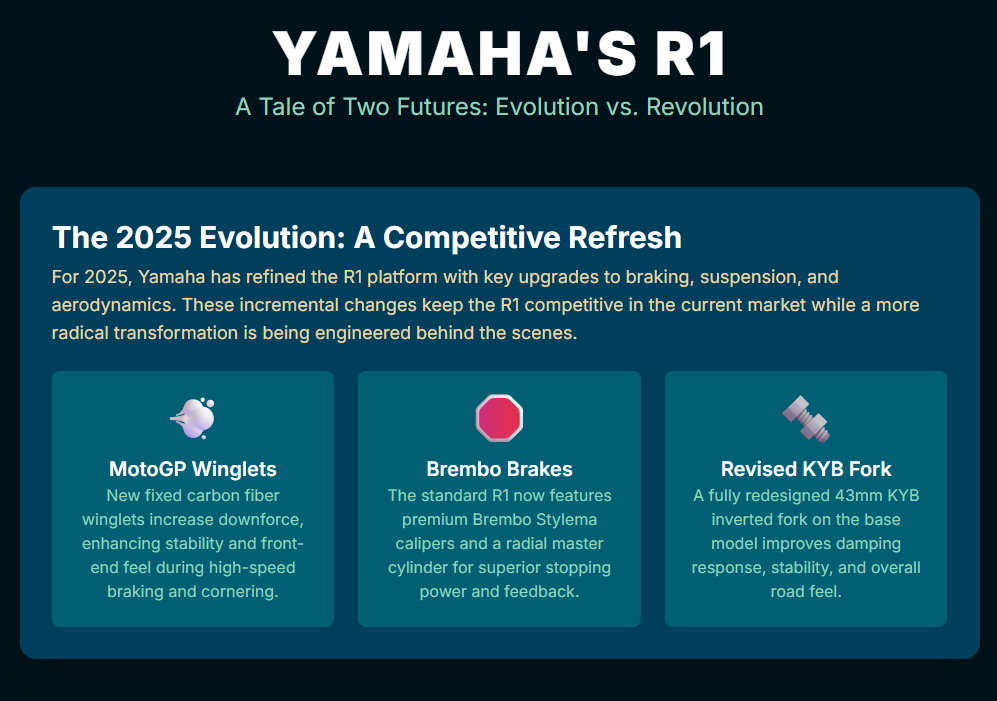
The officially announced 2025 Yamaha YZF-R1 and its higher-specification sibling, the YZF-R1M, represent a calculated evolution of the existing platform rather than a complete generational overhaul. For the American market, these updates are positioned as a significant refresh, though they are distinct from the more advanced technology hinted at in recent patent filings. The most visually apparent update for both models is the introduction of MotoGP-inspired carbon fiber winglets.1 These fixed aerodynamic appendages were developed through extensive on-track and simulator testing to generate additional downforce, which in turn enhances chassis stability and improves the rider’s front-end feel during braking and cornering maneuvers.1
Beyond the new winglets, the 2025 R1 receives substantial upgrades to its chassis components. It is now equipped with new Brembo Stylema monobloc front calipers and a matching Brembo radial master cylinder, a notable improvement over the previous braking hardware.2 The standard model also features a redesigned and fully adjustable 43mm KYB inverted front fork, which Yamaha claims improves damping response, stability, and road feel.2 The R1M, which already came with premium Öhlins Electronic Racing Suspension and braking hardware, receives the new winglets and a new seat cover texture but retains its existing high-specification components.2 This updated seat texture, also applied to the base R1, is designed to balance grip with the ease of rider movement, fostering a better sense of control and connection to the machine.2
This phased approach to product development is a crucial element of Yamaha’s current strategy. The 2025 R1 and R1M models, while receiving these tangible upgrades, are still based on the same 998cc CP4 crossplane engine and lightweight aluminum Deltabox frame as their predecessors.2 This is a critical factor in their market position. The current-generation R1 is no longer sold as a street-legal motorcycle in Europe due to its inability to meet stringent Euro5+ emissions requirements.3 As a result, the new 2025 models are offered as “R1 RACE” track-only machines in that market, while remaining street-legal in the United States and other regions.3 The decision to release a refreshed model with fixed winglets, a technology already prevalent on European superbikes, while simultaneously developing a far more radical active system, points to a multi-stage plan. The 2025 model serves as a short-term solution, allowing Yamaha to remain competitive and visually aligned with its rivals, while the advanced patented technology is still in a more nascent development phase. This confirms that Yamaha is not merely playing catch-up but is instead preparing a major technological breakthrough that will redefine the R1 platform in the future.
Deep Dive into Active Aerodynamics: Yamaha’s Patent
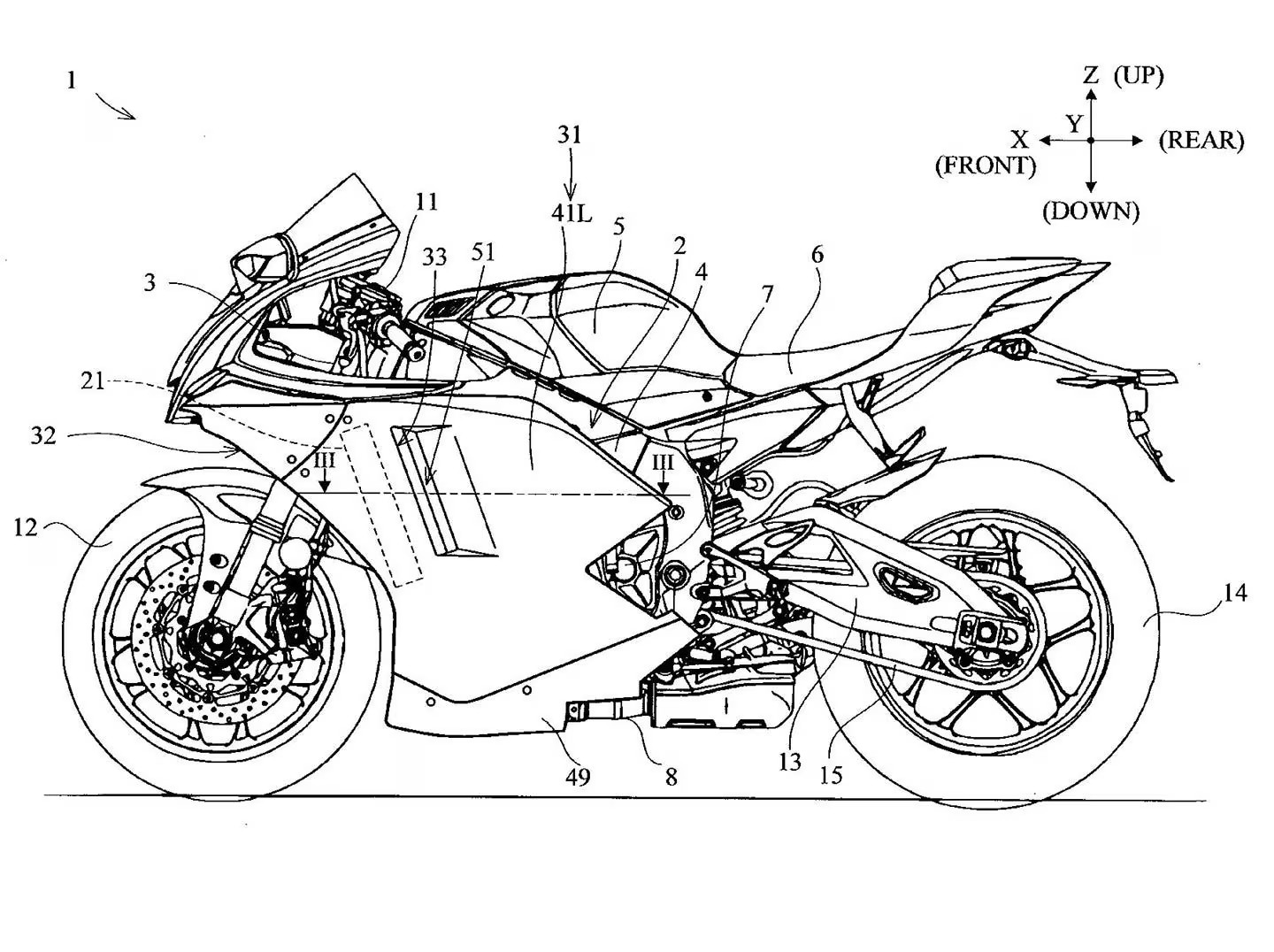
A recently-filed Yamaha patent reveals an advanced aerodynamic and thermal management system that could be the centerpiece of a future R1 model. Unlike the fixed, passive aero solutions seen on the 2025 models and competitor bikes, this patented technology introduces a dynamic, intelligent system that actively adapts to a variety of riding conditions.9 The system centers on a new, more extensive side bodywork that incorporates movable air outlets on the fairings.9 These vents are operated by a straightforward and lightweight mechanism consisting of a simple stepper motor and a belt-drive system, which rotates variable vanes to a desired position as directed by the bike’s computer.9 This design adds minimal bulk or weight, making it a viable solution for a performance-oriented motorcycle.9
The brilliance of this system lies in its dual-purpose functionality, addressing both aerodynamic performance and thermal management simultaneously. When the outlet ducts are closed, the air that would normally pass through the radiator is instead redirected around the fairing.9 This provides two significant aerodynamic benefits. First, it directly reduces wind resistance by minimizing the amount of air that flows through the radiator.9 Second, and equally important, it prevents the release of slow, turbulent hot air from behind the radiator into the fast-moving external airstream.9 This “cleaner” airflow dramatically reduces drag, allowing the bike to achieve higher speeds with less power and improve fuel efficiency.9
The system’s control unit utilizes a variety of real-time data inputs to govern the vane position, including engine temperature, outside air temperature, throttle position, vehicle speed, and, notably, catalytic converter temperature.8 This intelligent management allows the system to dynamically prioritize between cooling and aerodynamics. For instance, at low speeds or in stop-and-go traffic, the vents can open fully to ensure maximum cooling and prevent overheating.9 Conversely, as speed increases or ambient temperature decreases, the ducts can progressively close to improve the bike’s aerodynamic profile.9 The patent even suggests that the system can be programmed to temporarily restrict cooling during full-throttle acceleration to prioritize ultimate performance, with the understanding that the vanes will open again once the rider eases off the throttle.8
The most profound aspect of this patent is its direct link between performance and regulatory compliance. The explicit inclusion of catalytic converter temperature as a control parameter is a pivotal element of the design. A catalytic converter’s efficiency is highly dependent on operating within an optimal temperature range.8 When a motorcycle is not under load—such as in traffic or decelerating—the catalytic converter can cool down, reducing its effectiveness and leading to increased emissions. By using the active aero system to retain heat within the fairings by closing the outlets, Yamaha can ensure the catalytic converter remains hot and efficient. This capability provides a mechanical solution to an emissions problem that has kept the current R1 off European roads since the introduction of the Euro5+ standards.3 This innovative approach links a performance-enhancing feature to a regulatory requirement, making a strong case for a new, street-legal R1 platform that could return to key global markets.
Table: Yamaha Active Aero Patent: Function and Control
| Input Parameter(s) | System Action | Primary Benefit |
| High Speed / Low Ambient Temp | Vanes progressively close. | Reduced drag, improved aerodynamics, increased top speed and efficiency. |
| Low Speed / High Ambient Temp | Vanes open. | Maximum cooling, prevention of engine overheating. |
| Full Throttle Acceleration | Vanes temporarily close. | Prioritizes peak performance by minimizing drag. |
| Catalytic Converter Temp (Low) | Vanes close. | Maintains optimal catalyst temperature, reduces emissions. |
| Coolant Temp (High) | Vanes open. | Disperses heat to prevent engine damage. |
A Philosophical Divergence: The Superbike Aerodynamic Arms Race
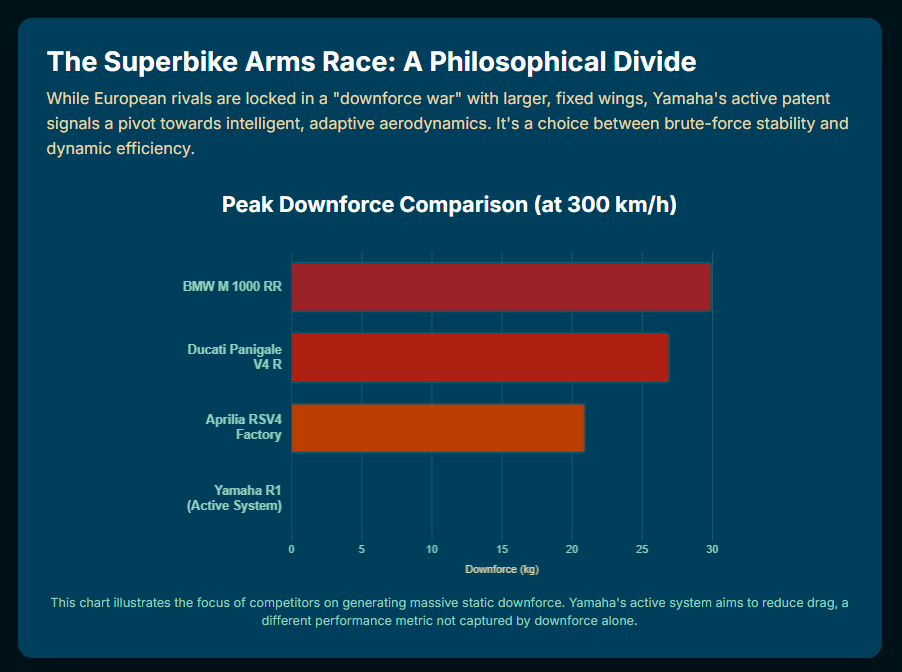
The superbike world is in the midst of an aerodynamic arms race, but Yamaha’s patented technology demonstrates a unique philosophical divergence from its European competitors. The foundational debate in superbike design is the fundamental trade-off between downforce and drag reduction.13 Downforce, an upward force created by airflow, pushes the bike down for improved grip and stability, particularly in corners and under braking. Drag, or air resistance, is the primary force that limits a motorcycle’s top speed and efficiency.13 While fixed aerodynamic aids like wings add downforce, they inevitably come at the cost of increased drag, a permanent compromise.14
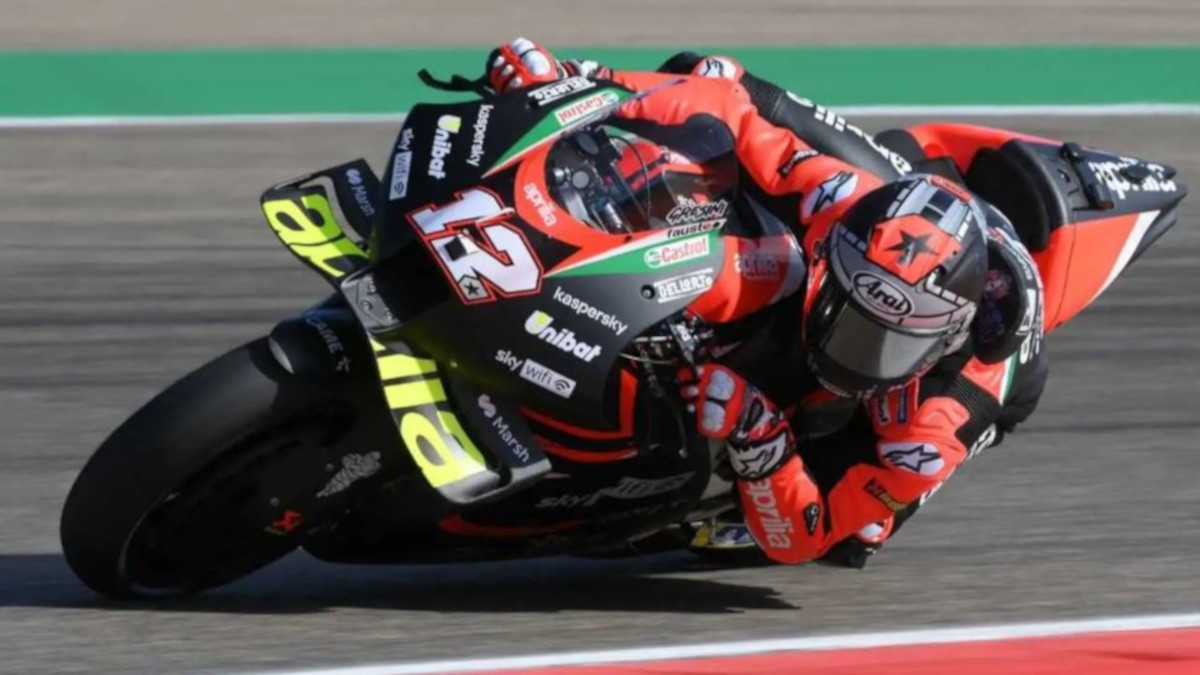
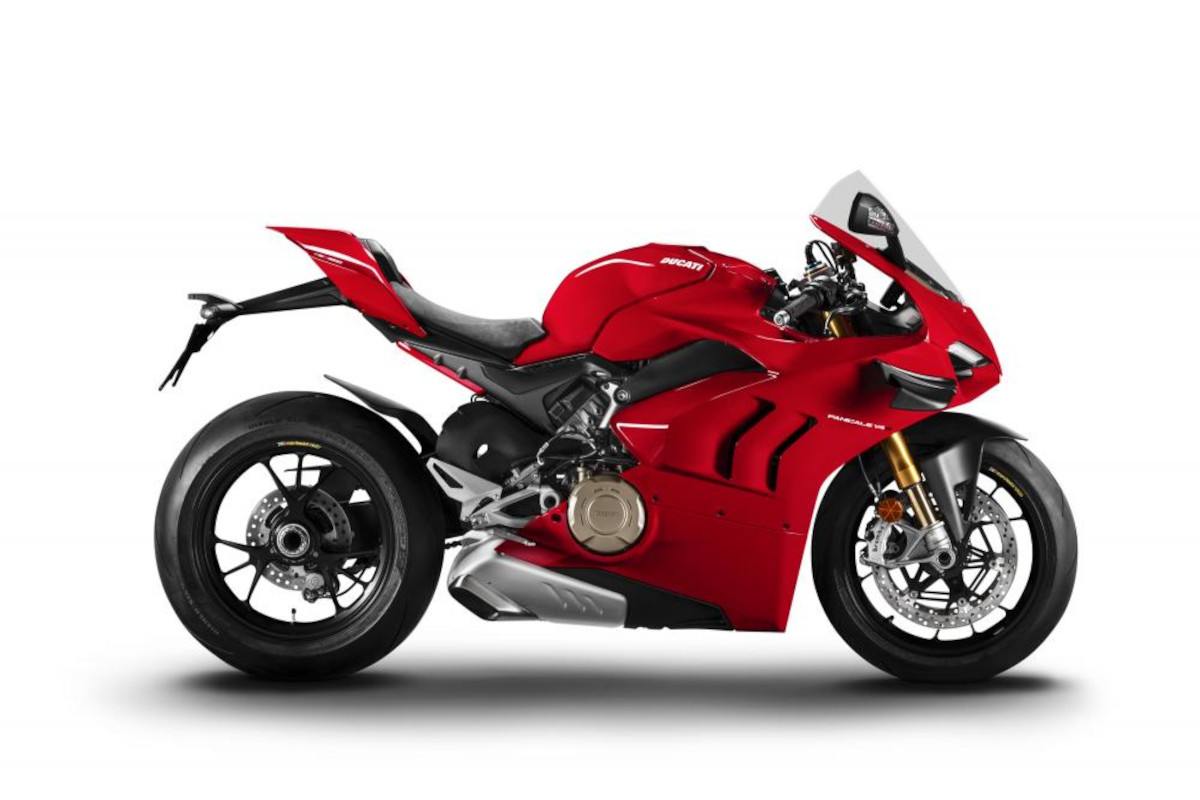
European manufacturers have largely focused on this fixed-aero approach. Ducati, for example, pioneered the use of fixed, double-profile wings on its Panigale V4 R. Their design aims to generate downforce for cornering stability while a revised fairing creates a “bubble of calm air” for the rider, reducing physical effort on straights.15 Similarly, BMW’s M 1000 RR uses aggressive fixed “M Winglets” to produce a substantial amount of downforce—up to 22.6 kg at 300 km/h—with the explicit goal of reducing wheelie tendency and allowing for better acceleration out of corners.17 They have also integrated brake cooling ducts to manage the thermal demands of their high-performance braking systems.18 Aprilia’s RSV4 Factory uses fixed, wind-tunnel-developed wings and integrated aero surfaces that aim to provide a balance between drag reduction and downforce, claiming to reduce the bike’s drag coefficient by 6% and prevent unwanted wheelies by 8%.20

The current industry trend has been a static “downforce arms race,” where manufacturers bolt on increasingly larger wings to achieve more grip. Yamaha’s new patent for an active, dynamic system represents a significant shift in this design philosophy. Rather than settling for a single, fixed compromise between downforce and drag, Yamaha is developing a system that can continuously optimize the bike’s aerodynamic profile for any given situation.9 This active system is a logical extension of Yamaha’s core “Jin-Ki Kanno” development philosophy, which centers on creating a sense of unity between rider and machine.21 A machine that intelligently and seamlessly adapts to the rider’s inputs and the external environment embodies this ideal more fully than one with fixed components. This means that a future R1 would not be limited by a single design; it could be ultra-low-drag on a straightaway for maximum top speed and then adjust its thermal profile to be more efficient at lower speeds. This more complex and sophisticated solution elevates the engineering debate beyond simple wing design, positioning Yamaha as a technological leader in the next phase of superbike innovation.
Table: Comparative Analysis of Superbike Aerodynamic Philosophies
| Manufacturer | Philosophy | Primary Mechanism | Key Benefit |
| Yamaha (Patented) | Active & Intelligent | Movable vanes on fairing outlets. | Dynamic optimization of drag, cooling, and emissions based on real-time data. |
| Ducati | Static Downforce & Rider Protection | Fixed, double-profile wings; revised fairing. | Enhanced stability and front-end grip, rider comfort on straights. |
| BMW | Static Downforce & Wheelie Control | Fixed “M Winglets”; brake ducts. | Massive downforce to prevent wheelies, improve front-end feel, and cool brakes. |
| Aprilia | Static Balanced Aero | Fixed integrated wings and aero surfaces. | Reduced drag, improved wheelie control, and enhanced cornering precision. |
Strategic Implications and Market Outlook
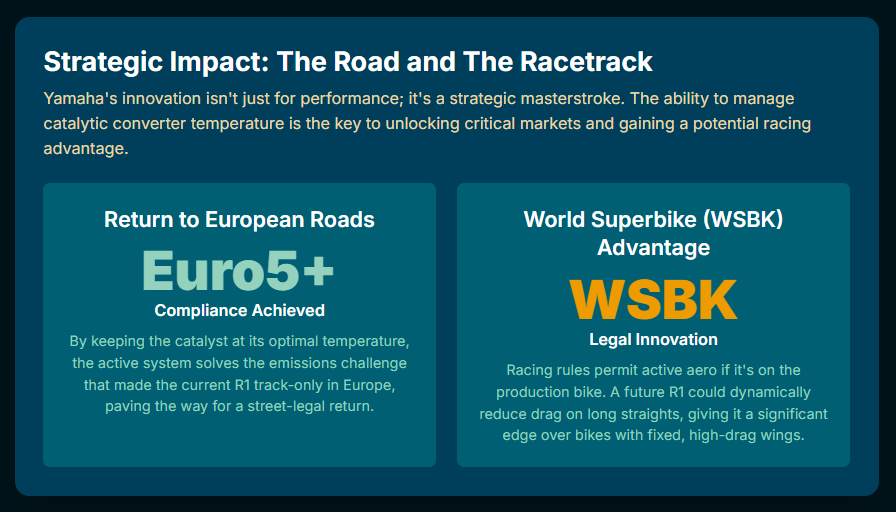
The analysis of Yamaha’s active aero patent reveals a strategic roadmap for the future of the YZF-R1. The technology’s ability to simultaneously address performance and regulatory requirements is its most significant feature. By actively managing airflow to maintain the catalytic converter’s optimal operating temperature, Yamaha has found a potential solution to the Euro5+ emissions challenge that currently limits the R1 to track-only use in Europe.3 If this technology is successfully implemented on a next-generation R1, it would allow Yamaha to re-enter a critical market with a road-legal flagship model, re-establishing its competitive position.
Beyond the road, this technology could also provide a significant competitive advantage in World Superbike (WSBK) racing. Current WSBK regulations permit movable aerodynamic systems if they are fitted as standard on the homologated street-legal version of the race bike.8 An R1 equipped with a production-ready, active aero system could gain a crucial edge on the racetrack by dynamically optimizing drag on straights and thermal management for peak performance.
The new R1 is more than just a new motorcycle; it represents a strategic response to a complex, changing market landscape. The patents suggest that Yamaha is solving for a new variable: the intersection of raw performance, efficiency, and regulation. Rumors of a new “R1V4” model with a V4 engine have been circulating, and it is plausible that the patented aero system is a key component of this future platform.22 A next-generation R1 that incorporates this intelligent technology would not be just another entrant in the horsepower race. Instead, it would be a technological showcase for intelligent engineering that seamlessly integrates performance with regulatory necessity. The R1’s legacy as a flagship model would be redefined, setting a new benchmark for the entire superbike class as a symbol of an era of intelligent, adaptive machines.
Sources
- 2025 YZF-R1M Yamaha Motorsports, USA, accessed on August 23, 2025, https://yamahamotorsports.com/models/yzf-r1m
- Yamaha Introduces 2025 YZF-R1 and YZF-R1M, accessed on August 23, 2025, https://yamahamotorsports.com/Blogs.php?action=blogArticle&blog_id=introducing-yamaha-2025-yzf-r1-and-r1m
- 2025 Yamaha YZF-R1 & YZF-R1M First Look – Cycle World, accessed on August 23, 2025, https://www.cycleworld.com/bikes/yamaha-yzf-r1-and-r1m-first-look/
- 2025 Yamaha YZF-R1 Preview – Motorcyclist, accessed on August 23, 2025, https://www.motorcyclistonline.com/news/yamaha-yzf-r1-preview/
- 2025 YZF-R1 – Key Features | Yamaha Motorsports, USA, accessed on August 23, 2025, https://yamahamotorsports.com/models/yzf-r1/features
- 2025 Yamaha YZF-R1 and YZF-R1M First Look – Motorcycle.com, accessed on August 23, 2025, https://www.motorcycle.com/bikes/new-model-preview/2025-yamaha-yzf-r1-and-yzf-r1m-first-look-44607574
- 2025 YZF-R1 – Specifications | Yamaha Motorsports, USA, accessed on August 23, 2025, https://yamahamotorsports.com/models/yzf-r1/specs
- Updated Yamaha R1 superbike featuring clever aero package teased in new patent images, accessed on August 23, 2025, https://www.motorcyclenews.com/news/new-tech/2025/august/yamaha-r1-new-aero-bodywork-design/
- Yamaha R1 Patent Shows Advanced Aero – Cycle World, accessed on August 23, 2025, https://www.cycleworld.com/motorcycle-news/yamaha-yzf-r1-advanced-aerodynamics-patent/
- Yamaha R1: Patent for active cooling air outlets – New …, accessed on August 23, 2025, https://motorcycles.news/en/yamaha-r1-aktive-aerodynamik-patent/
- Patents Hint At New Yamaha YZF-R1 With Advanced Aero – Top Speed, accessed on August 23, 2025, https://www.topspeed.com/patents-hint-at-new-yamaha-yzf-r1-with-advanced-aero/
- New Yamaha R1 patent shows active aero technology – Autocar India, accessed on August 23, 2025, https://www.autocarindia.com/bike-news/new-yamaha-r1-patent-shows-active-aero-technology-436012
- Motorcycle Aerodynamics Explained: Improve Your Ride With Science – bikerz, accessed on August 23, 2025, https://bikerz.com/en/motorcycle-aerodynamics-explained/
- Is Drag the Enemy? Drag vs. Downforce on a Straight Explained! – YouTube, accessed on August 23, 2025, https://www.youtube.com/watch?v=DTAG9sCKXn0
- Aerodynamics Ducati Panigale V4 – Faster than emotions, accessed on August 23, 2025, https://www.ducati.com/ww/en/bikes/panigale/panigale-v4/aerodynamics
- 2025 Ducati Panigale V4 R Ducati Red | Wheels In Motion | Chatsworth, CA, accessed on August 23, 2025, https://www.wheelsinmotionmc.com/inventory/v1/Current/Ducati/Panigale/Panigale-V4-R
- Why has the M 1000 RR (2023 model year) received new winglets?, accessed on August 23, 2025, https://support.bmw-motorrad.com/s/article/M-1000-RR-2023-new-winglets-emY3r?language=en_GB
- EN_BMW M 1000 RR – BMW Group PressClub, accessed on August 23, 2025, https://www.press.bmwgroup.com/global/article/attachment/T0404215EN/568024
- M 1000 RR | BMW Motorrad, accessed on August 23, 2025, https://www.bmw-motorrad.com.au/en/models/m/m1000rr.html
- 8 Best Superbikes of 2025 | Motorcyclist, accessed on August 23, 2025, https://www.motorcyclistonline.com/news/best-superbike-motorcycles/
- The R-Series Pedigree – Motorcycle | Yamaha Motor Co., Ltd., accessed on August 23, 2025, https://global.yamaha-motor.com/business/mc/lineup/yzf-r/
- 2026 NEW YAMAHA YZF-R1 V4 REVEALED!! – YouTube, accessed on August 23, 2025, https://www.youtube.com/watch?v=nA80RKZOVHY
Our Social Media Handles
- Instagram : LivingWithGravity
- Medium : Akash Dolas
- YouTube Channel : Gear and Shutter