




Executive Summary
Yamaha is at a critical juncture in its engineering and motorsport strategy, pursuing two distinct but equally vital technological paths. The V4 engine project for its MotoGP team represents a fundamental and necessary departure from its long-held inline-four philosophy, a strategic shift driven by the holistic demands of modern racing. Simultaneously, the company’s patent for an “E-Turbo” system signals a forward-looking, consumer-focused initiative aimed at future-proofing internal combustion engines against tightening global environmental regulations. While these projects operate in unrelated domains—a racing-specific pursuit versus a production-oriented development—they collectively demonstrate a unified, adaptive strategy to secure Yamaha’s long-term viability in both the high-stakes world of competition and the evolving consumer market.
Chapter 1: The End of an Era: Yamaha’s Inline-Four in a V4-Dominated World
1.1 A Legacy of Handling and Stability
Yamaha’s history in high-performance motorcycling is deeply rooted in the inline-four (I4) engine. Since the introduction of the FZ750 in 1985 and the iconic YZF-R1 in 1998, the I4 has been the engineering cornerstone of its flagship road bikes.1 This design philosophy was carried over to the YZR-M1 MotoGP bike, which earned a reputation for superior handling and exceptional mid-corner speed.2 This technical prowess allowed legendary riders like Valentino Rossi to clinch multiple world championships and enabled Fabio Quartararo to achieve numerous pole positions, demonstrating the bike’s raw single-lap pace.4
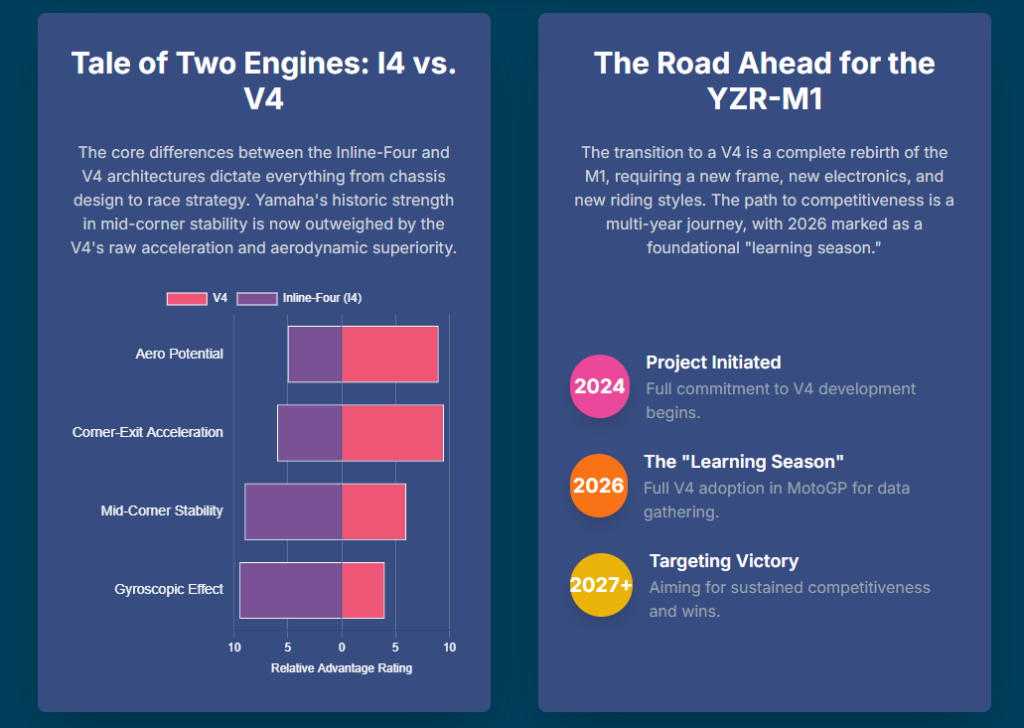
The core engineering principle behind the I4’s celebrated handling is its longer and heavier crankshaft, which generates a significant gyroscopic effect.3 This higher moment of inertia acts like a stabilizing gyroscope, providing resistance against changes in the bike’s lean angle and trajectory. While a V4’s narrower crankshaft allows a rider to tip the bike into corners more easily, the I4 is more difficult to divert from its line once leaned over, which is precisely why it helps the rider maintain his line through the corner.6 This characteristic supports a smoother, high-speed “U-line” through corners, contrasting with the sharper “V-line” of a V4.3 Yamaha had previously attempted to compensate for some of the I4’s weaknesses by pioneering the crossplane crankshaft concept, which aimed to improve traction by mimicking the power pulses of a V4 engine.8
1.2 The Fatal Flaws of a Winning Formula
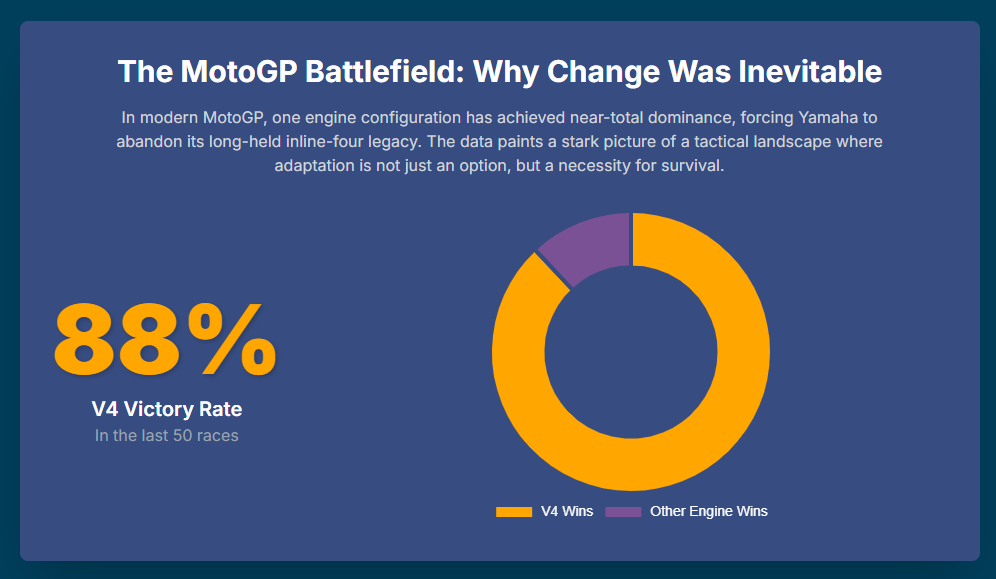
Despite its legacy of success and an inherent ability to perform well over a single lap, the I4 configuration has reached a performance ceiling that has become a critical tactical liability in modern MotoGP.2 The data overwhelmingly supports this conclusion, with V4-powered bikes winning 44 of the last 50 races and topping the speed charts in 47 of those 50 races, a victory rate of 88% and 94% respectively.3 This dominance highlights a clear shift in the sport’s tactical requirements.
The I4’s core disadvantages are both mechanical and tactical. The first is an aerodynamic compromise. The greater width of the inline-four engine makes it difficult to package within the complex, modern aerodynamic fairings that have become essential in MotoGP. In contrast, the V4’s narrower profile allows for superior aero possibilities.2 The second, and more pronounced, disadvantage is the lack of acceleration and top-end speed. The I4 struggles to match the acceleration and top speed advantages of its V4 counterparts, particularly on corner exit.2 This is not simply a power deficit, as some suggest, but a power delivery problem. The I4’s power is less usable, and it lacks sufficient rear grip on corner exit, which is essential for rapid acceleration.5 This is why the M1 often “can’t race” in traffic and struggles to overtake other bikes in a fair fight.2
The consequence of these limitations is a significant tactical dilemma. The only viable winning strategy for an I4 is to “Qualify on Pole, take a bit of tyre gamble, get to the front… and ride off to the sunset”.2 This is a high-risk, single-lap strategy that is unsustainable over a full race season, forcing Yamaha into a strategic “adapt or die” situation.2 The I4’s core architecture, once its greatest strength, has become its defining weakness. The problem is not that the I4 has gotten worse, but that the competition has evolved to render its strengths—mid-corner stability and speed—less valuable in an era defined by extreme horsepower, advanced aerodynamics, and sophisticated electronics. The V4’s “V-line” riding style and superior corner-exit capabilities are simply a more effective formula for modern racing tactics.3 The decision to transition to a V4 is therefore not a simple upgrade but a fundamental paradigm shift and an admission that Yamaha’s long-held, successful philosophy has been strategically outmaneuvered.
| Attribute | Inline-Four (I4) | V4 |
| Crankshaft Inertia | High | Low |
| Gyroscopic Effect | Strong | Weak |
| Engine Width/Packaging | Wide, compromised | Narrow, optimized |
| Aerodynamic Potential | Limited | High |
| Handling Trajectory | “U-Line” (sweeping) | “V-Line” (point-and-shoot) |
| Key Racing Strength | Mid-corner stability/speed | Corner-exit acceleration/top speed |
Chapter 2: The V4 Gamble: A Full-Scale Rebirth of the YZR-M1
2.1 The Technical Blueprint of V4 Dominance
All other manufacturers on the MotoGP grid—Ducati, Honda, KTM, and Aprilia—utilize V4 engines, a configuration that has achieved a near-monopoly on the winner’s circle.3 The V4’s technical superiority in racing is a function of its mechanical properties and packaging. The shorter, more rigid crankshaft of a V4 requires fewer bearings than an I4, which reduces friction and pumping losses, allowing for a more efficient and powerful engine.6 A 90-degree V4, in particular, offers perfect primary balance, enabling designers to push the engine to higher revs for increased horsepower without suffering from excessive vibration.6
From a chassis and handling perspective, the V4’s shorter crankshaft reduces the gyroscopic effect, making the bike more “twitchy and responsive” and allowing the rider to “tip the bike into corners more easily”.4 This characteristic is essential for the “V-line” riding style, which prioritizes aggressive turn-in and rapid corner-exit to exploit the engine’s superior power.3 Crucially, the V4’s design also offers greater flexibility in its firing order. For example, Ducati’s “Twin Pulse” firing order and Aprilia’s “Big Bang” setup create a distinct gap in the power pulses.8 This “long pause” allows the rear tire to recover and regain grip, providing a significant acceleration advantage on corner exit.8
2.2 The State of Development: A Long Road Ahead
Yamaha is “fully committed” to the V4 project, which has been under development since 2024.14 However, the program is still in a nascent phase. Test rider Augusto Fernandez has stated that the V4 is “still not fast enough” 15, and Alex Rins’s observation that it is two seconds a lap slower than the current I4 M1 has been widely reported.4 While this deficit seems substantial, it is considered “super impressive for a completely new concept” and a positive sign of the project’s early potential.4 For now, the focus is on “durability” rather than outright pace, ensuring the engine can last for a race distance before fine-tuning its performance.4
The transition to a V4 is a momentous undertaking that requires a complete re-engineering of the entire motorcycle.4 It is not a simple engine swap; the V4 demands a completely new frame, geometry, weight distribution, and electronics package to take full advantage of its narrower profile.4 This represents a significant challenge because all of Yamaha’s long-standing data on setup, weight distribution, and electronics from the I4 platform is largely rendered obsolete.4 This is a high-risk, high-reward strategy, as evidenced by the struggles other V4 manufacturers have had with their own platforms, such as Aprilia’s heat issues and Honda’s past problems with rear grip.16 Yamaha’s managing director, Paolo Pavesio, has acknowledged the “twin challenges” of matching the current M1’s performance while ensuring a “seamless transition” to the new package.14
2.3 The Human Factor and a “Learning Season”
The human element is a critical variable in this transition. Yamaha’s star rider, Fabio Quartararo, has stated that he will leave the team if the V4 is not a winning bike.5 His adaptation to the new platform will be particularly challenging, as he is the only rider on the grid who has exclusively raced an I4 in his entire MotoGP career.2 The shift in riding style from the smooth, high-speed lines of the I4 to the aggressive “point and shoot” approach of the V4 is a difficult one, as demonstrated by other riders like Viñales and Mir, who took a significant amount of time to adapt.2
The strategic timing for the full V4 adoption in 2026 is critical, providing a preferable alternative to another “season of stagnation” with the outdated M1.2 The 2026 season is expected to be a “throw away learning season” for both the team and its riders.2 This is an intentional part of the long-term plan to gather the critical data and rider feedback needed for sustained competitiveness. The presence of a V4-experienced rider like Jack Miller is therefore a valuable asset, as his background in developing bikes for other OEMs will aid in the transition and provide valuable data for comparison.2
Chapter 3: The E-Turbo Patent: A Revolutionary Approach for Production Models
3.1 The Technical Heart of the E-Turbo
Yamaha’s patent for an “E-Turbo” with electric assistance is a forward-thinking response to the challenges of applying forced induction to motorcycles.17 Historically, turbocharging has been problematic for bikes due to limited space, added weight, and, most notably, turbo lag.19 Yamaha’s patented system addresses these issues by using an electric motor to “pre-spin the turbo,” providing “instant boost response” and eliminating lag before it ever becomes an issue.21 This allows the engine to deliver power at low RPMs, a crucial advantage before exhaust gases are sufficient to spool the turbine.19
The patent filings reveal a unique, streamlined architecture specifically designed for motorcycles. Instead of relying on large, heavy battery packs or complex hybrid systems, the E-Turbo’s electric motor is powered by a generator connected directly to the engine’s crankshaft.19 This approach eliminates the need for substantial battery storage, with the patent suggesting the use of capacitors for short-term energy bursts.18 This clever engineering solution demonstrates Yamaha’s understanding of the specific constraints of motorcycle design, where every gram and millimeter counts.19
3.2 A Dual Mandate: Performance and Environmental Compliance
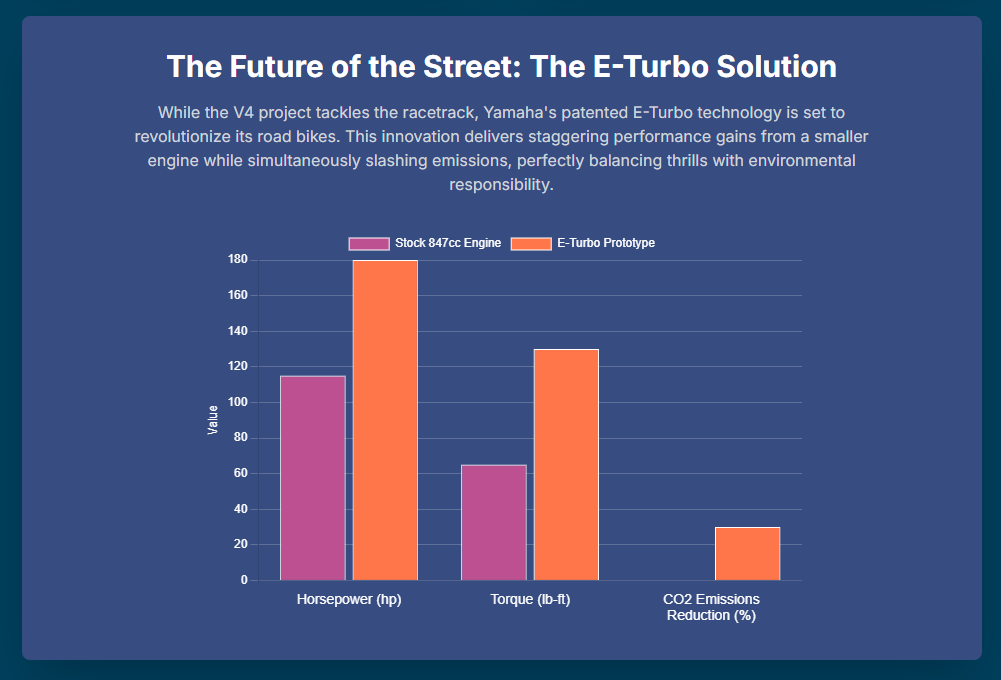
The E-Turbo is a strategic solution with a dual mandate: to enhance performance and to meet increasingly stringent environmental regulations.17 The use of forced induction has become an “inevitable trend” in the automotive industry to meet stricter emissions standards.23 Yamaha is adapting this technology to the two-wheeled world. A 2020 prototype, featuring an E-Turbo on an 847cc triple-cylinder (CP3) engine, demonstrated remarkable gains. It produced 180 horsepower and 130 pound-feet of torque, significant increases over the stock MT-09’s power.19 The prototype also achieved a 30% reduction in
CO2 emissions and substantial cuts in other pollutants.19 This performance shows the technology’s potential to “match the power of larger units” with a smaller, more efficient engine, a key goal in meeting modern environmental mandates.20
| Metric | MT-09 (stock, claimed) 25 | Turbocharged Prototype (2020) 19 |
| Engine Displacement | 847cc | 847cc |
| Power Output | 115 hp | 180 hp |
| Torque Output | 65 lb-ft | 130 lb-ft |
| CO2 Emissions Reduction | N/A | 30% |
Chapter 4: Divergent Paths: The MotoGP V4 and E-Turbo’s Unrelated Trajectories
4.1 The Clear Divide: A Racing Ban and a Production Focus
The analysis indicates no direct link between the MotoGP V4 engine project and the E-Turbo patent.2 This crucial distinction is rooted in the regulatory landscape of motorsport. The Fédération Internationale de Motocyclisme (FIM) banned forced induction from road racing as far back as 1946.26 This long-standing prohibition makes E-Turbo technology completely irrelevant to MotoGP competition. The E-Turbo patent, therefore, is being developed for use on consumer-focused models, specifically showing its application on a CP3 inline-triple road bike platform.19 This is consistent with Yamaha’s long history of V4 engines in production models, such as the V-Max and Venture Royale cruisers 27, which stands in contrast to its limited and early forays into V4 GP racing that were eventually banned due to new rules.29
4.2 A Unified Strategy in Two Domains
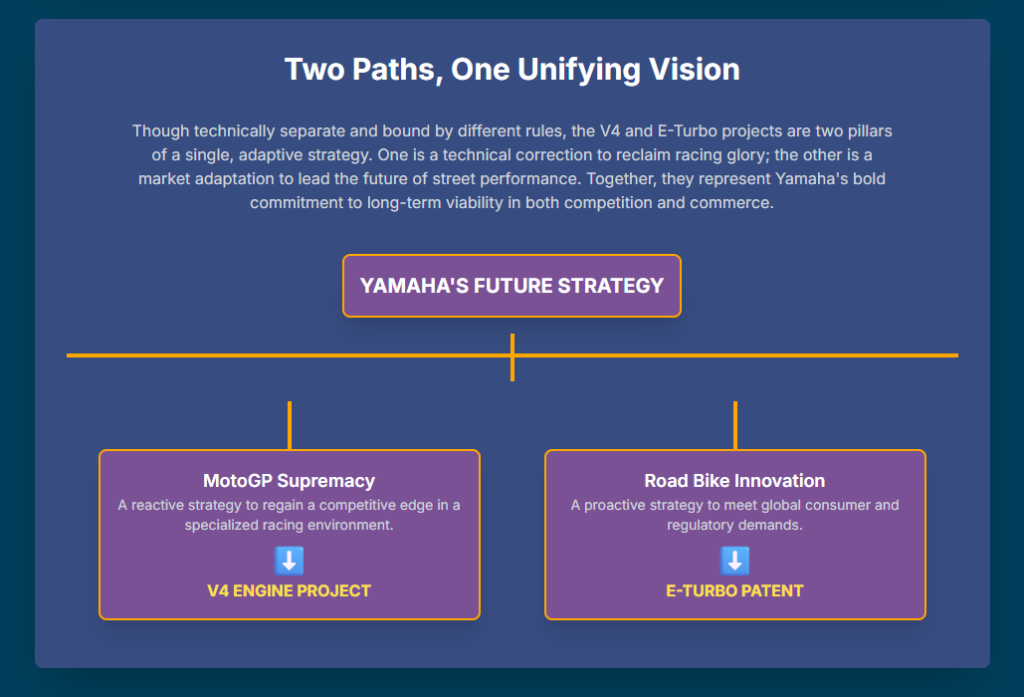
While the V4 and E-Turbo projects are technically unrelated, they are two sides of a single, sophisticated strategic response to an evolving global landscape. The V4 project is a “technical correction” designed to address a specific, competitive disadvantage within a highly specialized racing series. The goal is to regain the brand’s competitive prestige and winning pedigree on the world stage.2 In parallel, the E-Turbo is a long-term “market adaptation” to meet broad regulatory and consumer demands for road-legal vehicles.18 The challenges in a regulated motorsport environment are fundamentally different from those in a global consumer market. A MotoGP bike needs to be the absolute pinnacle of performance within a strict set of rules, where the V4 is the proven, dominant solution. A consumer motorcycle, however, needs to balance performance with increasingly strict emissions and fuel efficiency standards. The E-Turbo is a clever way to meet these demands while retaining the aural and tactile feel of a traditional engine.18 This is not a contradictory approach, but a multi-faceted one. Yamaha is not betting everything on a single technology; instead, it is diversifying its powertrain portfolio to tackle distinct, high-stakes problems in different arenas, ensuring its long-term viability in both competition and commerce.
Chapter 5: Prognosis and Concluding Analysis
5.1 Forecast for the MotoGP V4 Project
The V4 MotoGP project is a high-risk, high-reward endeavor. A challenging initial period is to be expected, with 2026 likely serving as a “learning season”.2 It is plausible that the new V4 package may initially perform worse than the current I4, as the team sorts out the new relationship between the engine, chassis, and electronics.16 If the team and its riders, particularly Fabio Quartararo, can successfully navigate this transitional period, competitiveness could begin to emerge in the 2027 season and beyond.
5.2 Future Outlook for the E-Turbo Technology
Yamaha’s E-Turbo technology represents a strategic “bridge to electrification”.18 It is a tangible commitment to evolving the internal combustion engine rather than abandoning it entirely. A production timeline of “the next couple of years” is a reasonable expectation.19 The technology will likely debut on a high-end, performance-oriented CP3 or another multi-cylinder platform, building on the prototypes that have already demonstrated its potential. This technology could eventually trickle down to other models, offering a compelling alternative to full electrification that blends performance with efficiency and reduced emissions.
5.3 A Bold New Chapter for Yamaha
Yamaha’s decision to pursue these two projects concurrently signals a fundamental shift in corporate philosophy. The company has moved away from its long-standing conservative stance, taking a “hard look in the mirror” to adapt to an evolving world.2 The V4 and E-Turbo projects are not a single solution but two parts of a greater strategy: to re-establish its winning pedigree in racing and to lead the way in the evolution of consumer powertrain technology. This duality is not a sign of confusion, but of a renewed and purposeful engineering vision that will define Yamaha’s identity for the next decade.
Sources
- Yamaha Motor Company – Wikipedia, accessed on August 24, 2025, https://en.wikipedia.org/wiki/Yamaha_Motor_Company
- Yamaha’s V4 journey so far: what we know as testing continues in …, accessed on August 24, 2025, https://www.reddit.com/r/motogp/comments/1l8vapf/yamahas_v4_journey_so_far_what_we_know_as_testing/
- Why inline-four MotoGP bikes handle better than V4 MotoGP bikes – Motor Sport Magazine, accessed on August 24, 2025, https://www.motorsportmagazine.com/articles/motorcycles/motogp/why-inline-four-motogp-bikes-handle-better-than-v4-motogp-bikes/
- Yamaha’s V4 is two seconds a lap slower than current MotoGP bike, says Alex Rins – Reddit, accessed on August 24, 2025, https://www.reddit.com/r/motogp/comments/1lwizma/yamahas_v4_is_two_seconds_a_lap_slower_than/
- CLEAR!!! Yamaha V4 Tested in Brno Circuit #yamaha #yamahav4 …, accessed on August 24, 2025, https://www.youtube.com/watch?v=kwkqiuZ265E
- Why are MotoGP V4s faster than inline-4s? – Motor Sport Magazine, accessed on August 24, 2025, https://www.motorsportmagazine.com/articles/motorcycles/motogp/why-are-motogp-v4s-faster-than-inline-4s/
- Why Yamaha changes to V4 engine! – MotoGP EXPLAINED – YouTube, accessed on August 24, 2025, https://www.youtube.com/watch?v=SpfEHiqZS8Y
- Yamaha V4 vs inline-4, what’s everyone thought? : r/motogp – Reddit, accessed on August 24, 2025, https://www.reddit.com/r/motogp/comments/1kcavth/yamaha_v4_vs_inline4_whats_everyone_thought/
- R1 and Rsv4 firing pattern? : r/motorcycles – Reddit, accessed on August 24, 2025, https://www.reddit.com/r/motorcycles/comments/um9aq2/r1_and_rsv4_firing_pattern/
- To V4 or not to V4 are Yamaha considering a radical change… | Bay Area Riders Forum, accessed on August 24, 2025, https://www.bayarearidersforum.com/forums/threads/to-v4-or-not-to-v4-are-yamaha-considering-a-radical-change.556161/
- Desmosedici Stradale: the heart of Ducati’s supersport bikes, accessed on August 24, 2025, https://www.ducati.com/ww/en/company/innovation/engines/desmosedici-stradale
- Desmosedici Stradale: the new Ducati V4 engine, accessed on August 24, 2025, https://www.ducatidanmark.dk/globalassets/ducati-tekniskdata/2018/produktbeskrivelse.pdf
- Thread: Firing order – Aprilia Forum, accessed on August 24, 2025, https://www.apriliaforum.com/forums/showthread.php?325375-Firing-order
- Yamaha ready to make V4 engine MotoGP race decision – IAMABIKER, accessed on August 24, 2025, https://iamabiker.com/avin/2025/yamaha-ready-to-make-v4-engine-motogp-race-decision/
- Yamaha’s V4 MotoGP engine “not fast enough,” warns Augusto …, accessed on August 24, 2025, https://www.motorsport.com/motogp/news/yamahas-v4-motogp-engine-is-still-not-fast-enough-says-fernandez/10742845/
- Yamaha’s Development Of V4 Engine In Advanced State | Motogp News 2024 – Reddit, accessed on August 24, 2025, https://www.reddit.com/r/motogp/comments/1ff3xnp/yamahas_development_of_v4_engine_in_advanced/
- Yamaha Patent Reveals E-Turbo Model with Electric Assistance …, accessed on August 24, 2025, https://iipla.org/yamaha-patent-reveals-e-turbo-model-with-electric-assistance/
- We could soon see a turbocharged big bike from Yamaha – Ridebuy, accessed on August 24, 2025, https://ridebuy.ph/garage/posts/9234
- Yamaha E-Turbo CP3 bike in the works – Bike Rider Magazine, accessed on August 24, 2025, https://www.brm.co.nz/yamaha-e-turbo-cp3-bike-in-the-works/
- Patents Reveal Yamaha E-Turbo CP3 Bike | Visordown, accessed on August 24, 2025, https://www.visordown.com/news/patents-reveal-yamaha-e-turbo-cp3-bike
- Yamaha’s Experimenting With Electric Turbo Motorcycles, Just Like Honda – RideApart.com, accessed on August 24, 2025, https://www.rideapart.com/news/761183/yamaha-experimenting-electric-turbo-motorcycles/
- What is an Electric Turbocharger? Exploring the Power and Efficiency of Garrett’s E-Turbo, accessed on August 24, 2025, https://www.garrettmotion.com/news/newsroom/article/what-is-an-electric-turbocharger/
- Forced Induction Technologies in an IC Engine: A Review – ResearchGate, accessed on August 24, 2025, https://www.researchgate.net/publication/352778847_Forced_Induction_Technologies_in_an_IC_Engine_A_Review
- Yamaha’s Built a Turbocharged Three-Cylinder Superbike – Cycle World, accessed on August 24, 2025, https://www.cycleworld.com/story/motorcycle-news/yamaha-built-turbocharged-three-cylinder-superbike/
- MT-09 | Hale’s Yamaha, accessed on August 24, 2025, https://halesyamaha.com/showroom/3/yamaha/3/motorcycles/65/1507/mt-09
- Forced induction in motorcycles – Wikipedia, accessed on August 24, 2025, https://en.wikipedia.org/wiki/Forced_induction_in_motorcycles
- Yamaha VMAX – Wikipedia, accessed on August 24, 2025, https://en.wikipedia.org/wiki/Yamaha_VMAX
- Yamaha Venture Royale – Wikipedia, accessed on August 24, 2025, https://en.wikipedia.org/wiki/Yamaha_Venture_Royale
- Challenges Carving Our Name into Racing History – Yamaha Motor Global, accessed on August 24, 2025, https://global.yamaha-motor.com/race/wgp-60th/history/
Our Social Media Handles
- Instagram : LivingWithGravity
- Medium : Akash Dolas
- YouTube Channel : Gear and Shutter