






Executive Summary
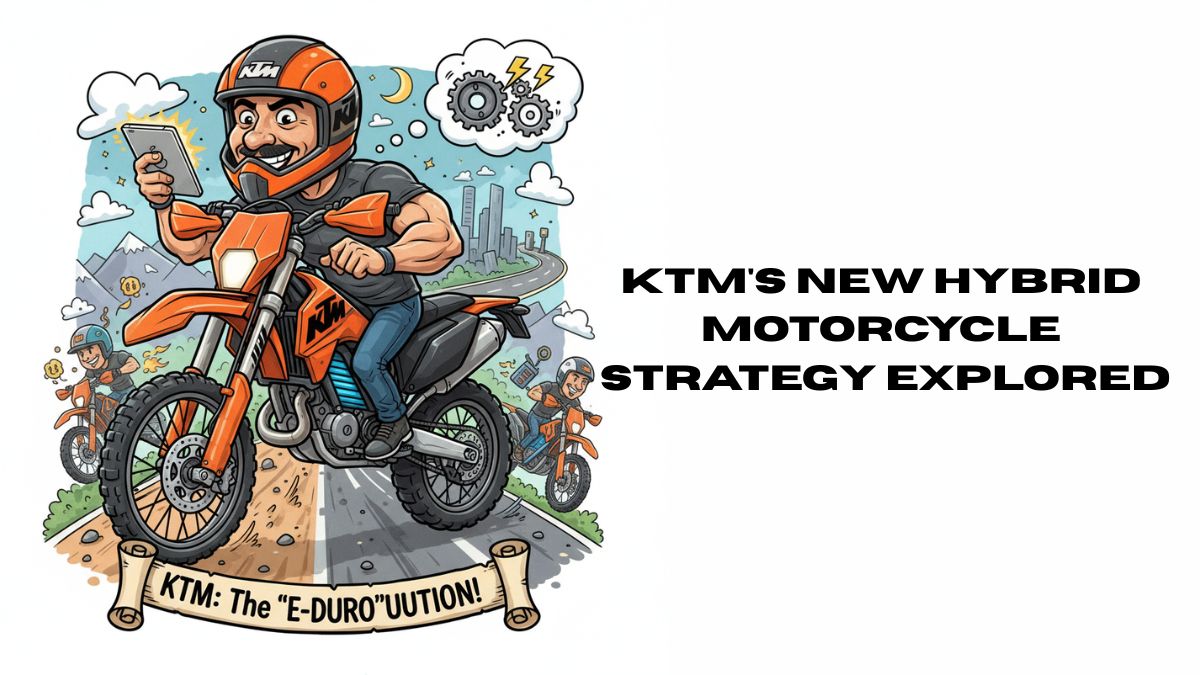
KTM is pursuing a sophisticated, dual-pronged strategic approach to navigate the evolving landscape of the motorcycle industry, which is currently defined by the dual challenges of tightening internal combustion engine (ICE) emission regulations and the persistent limitations of pure electric vehicles (EVs). This report analyzes two key patented technologies that serve as the foundation of this strategy: a hybrid-electric supercharger and a modular EV range extender system.
The analysis reveals that these innovations are not isolated engineering projects but are a direct manifestation of KTM’s recent corporate restructuring and a renewed customer-centric focus. The hybrid-electric supercharger, or H-Supercharger, is designed to enhance the performance and efficiency of traditional ICE powertrains, delivering lag-free power and improved low-end torque without the weight penalty of a large battery. Simultaneously, the modular EV range extender system directly addresses the single largest barrier to EV adoption—range anxiety—by offering a flexible, on-demand solution that allows a lightweight electric base motorcycle to be a viable long-distance machine.
In a market where key rivals are committing to either purely mechanical forced induction (Kawasaki) or fixed-battery EVs (Honda), KTM’s hybrid-forward strategy positions the company as a prudent innovator. It intelligently hedges against the inherent weaknesses of both legacy and emerging technologies. The patents reflect a deep understanding of core rider pain points, a testament to the brand’s new customer-guided development philosophy. This report concludes that by leveraging its heritage in performance with forward-looking, practical solutions, KTM has the potential to set a new benchmark for the industry and attract a broader customer base in the years to come.
1. Introduction: KTM’s Hybrid-Forward Strategy
The global motorcycle market is currently undergoing a significant and turbulent period of transition, driven by converging pressures from regulatory mandates and shifting consumer demands. Europe’s largest manufacturer, KTM, has been at the epicenter of this disruption. A period of considerable turmoil bridging 2024 and 2025, which included a fight against insolvency and the strategic acquisition of a controlling interest by Bajaj, forced a fundamental re-evaluation of the company’s direction.1 This crisis led to the formation of a new corporate strategy centered on stability, quality, and a return to being a consumer-centric brand, as evidenced by the establishment of the “Orange Board,” an advisory panel of loyal customers.2
Against this backdrop, KTM is confronting the motorcycle industry’s central challenge: bridging the divide between conventional ICE and pure electric models. Traditional ICE engines face increasing scrutiny under global emissions standards, while pure electric bikes, despite offering benefits such as instant torque and zero emissions, are hampered by limitations related to range, weight, and charging infrastructure.4 Instead of committing entirely to one path, KTM’s strategic response is to develop innovative hybrid technologies that blend the advantages of both powertrains while mitigating their respective weaknesses. This report examines two of the company’s recently patented solutions—a hybrid-electric supercharger and a modular EV range extender—as a window into this forward-thinking corporate philosophy. The analysis will provide a detailed technical overview of these systems, place them within the broader competitive landscape, and assess their overall viability and alignment with KTM’s long-term corporate vision.
2. KTM’s Dual-Pronged Hybrid Innovation
KTM’s strategic patents reveal a sophisticated, two-part approach to motorcycle development. The first part focuses on enhancing the existing ICE platform with electric assistance, while the second aims to make electric motorcycles a more practical and versatile choice for a wider range of riders.
2.1 The Hybrid-Electric Supercharger: Augmenting Internal Combustion
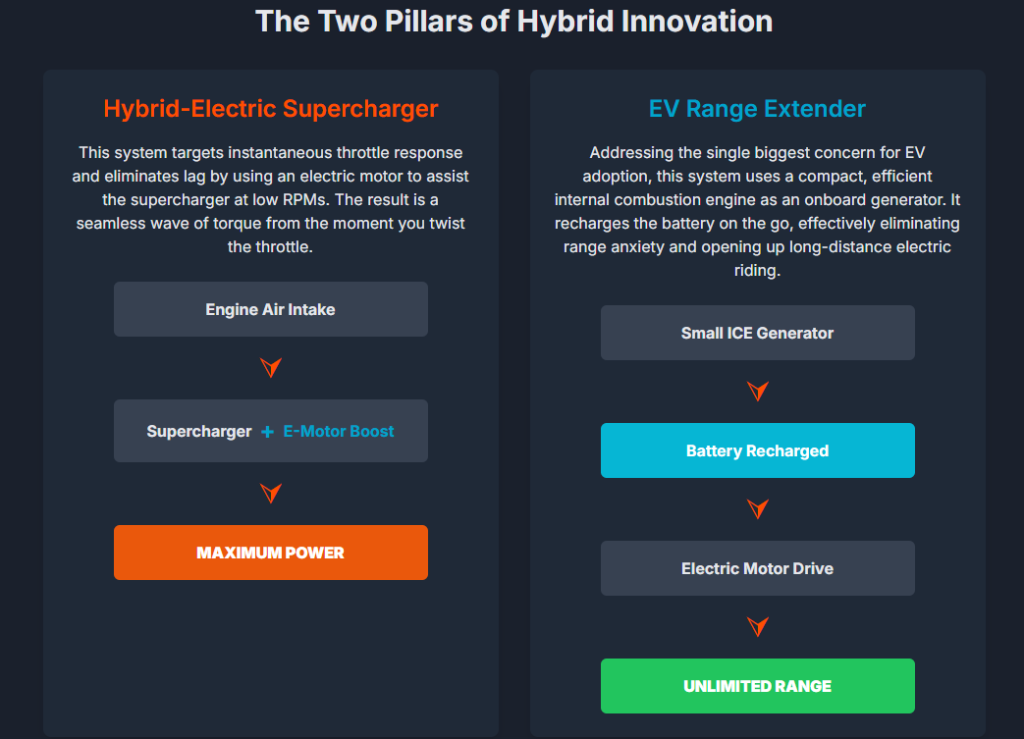
KTM has filed patents for a new hybrid electromechanical supercharger, a system designed to improve performance and efficiency across various engine platforms, from single-cylinder enduro machines to potential street bikes.7 This technology is a direct attempt to solve the traditional trade-offs of forced induction. Conventional superchargers, like the ones used by Kawasaki, are driven directly by the engine’s crankshaft, which ties their boost delivery to engine revs and can limit low-end response. In contrast, all-electric superchargers, such as the one Honda is reportedly developing, use a motor to generate instant boost at any RPM but require a large, heavy battery to function.7
The KTM system intelligently blends these two power sources. The design includes a chain drive (numbered 12 in the patent drawings) that connects to the engine’s output shaft, and a separate electric motor/generator (18). The core of the system is a small, electronically operated clutch (16) that can selectively engage or disengage the mechanical drive.7 This allows for three distinct operational modes:
- Electric-Only Mode: At low engine speeds, the clutch remains open, disconnecting the supercharger from the crankshaft. The electric motor drives the compressor independently, creating boost instantly and providing an immediate, lag-free throttle response that would be impossible with a purely engine-driven system at the same low revs.7
- Mechanical-Only Mode: As the engine’s RPM increases, the clutch engages, and the mechanical drive takes over. The system now functions like a conventional supercharger, using the engine’s power to spin the compressor and reducing the electrical energy drain on the bike’s battery.7
- Hybrid Boost Mode: For maximum power output, the clutch remains closed, and both the engine and the electric motor work together to drive the supercharger.7 This unique, combined-power approach could provide an explosive performance boost on demand.
An additional benefit is the system’s ability to act as a generator. When the rider is not demanding full performance or is off-throttle, the electric motor can convert kinetic energy back into electrical energy, recharging the battery while the mechanical clutch is engaged.7 This closed-loop system is highly efficient, allowing the supercharger to function with a much smaller and lighter battery than an all-electric unit, thereby avoiding a significant weight penalty that plagues many hybrid designs.7
2.2 The Modular EV Range Extender: Solving the Range Anxiety Conundrum
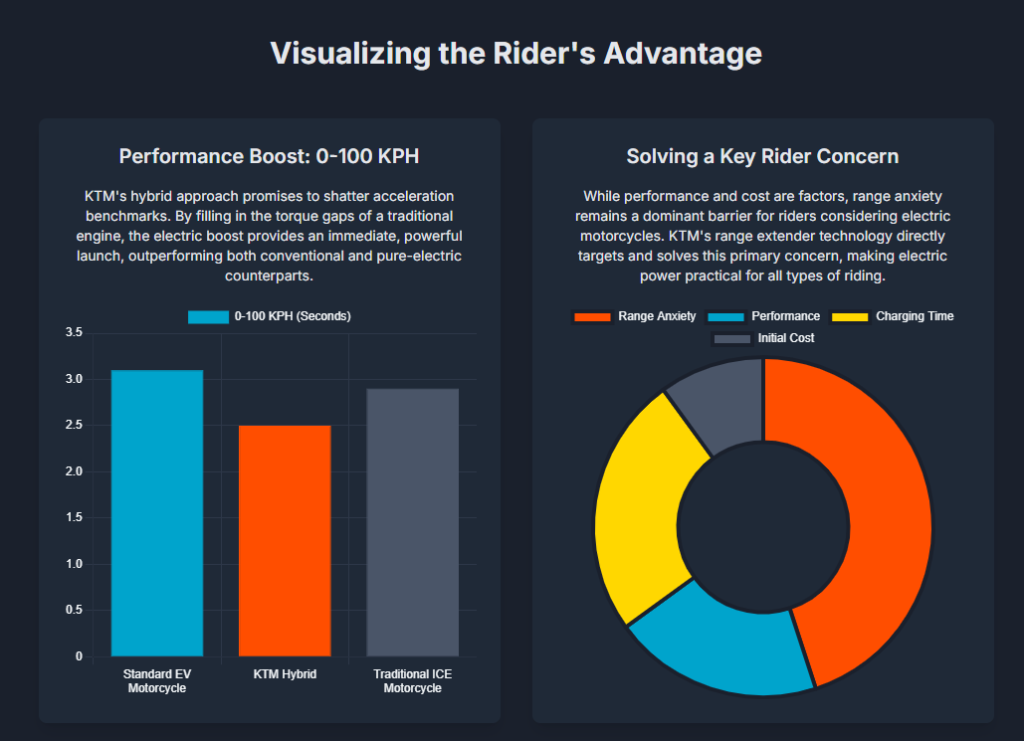
The second component of KTM’s strategy is a forward-thinking solution to the primary obstacle to widespread EV adoption: range anxiety. The company has patented a modular “clip-on” power unit that attaches to the rear of an electric motorcycle like a top case.8 This design philosophy is built on a simple premise: keep the base motorcycle as light and agile as possible for urban commuting and everyday use, and only add the necessary weight and complexity for long-distance trips.
The patents describe three distinct variants of this range extender, each with a different power source:
- Miniature Generator Pack: This is the most immediate and practical variant, a small combustion unit with an integrated generator and fuel tank.9 It operates similarly to extended-range electric vehicles (EREVs) in the automotive sector, generating DC voltage to charge the main battery while the bike is in motion or stationary. This option provides a familiar solution to refueling on long trips, effectively granting the EV the same refueling flexibility as a conventional motorcycle.
- Hydrogen Fuel Cell Pod: A more visionary concept, this variant would use a hydrogen fuel cell to generate electricity, with water as the only by-product.9 While this offers a cleaner energy source, the patents acknowledge that due to the high cost of fuel cells and a lack of hydrogen infrastructure, this technology is currently a long-term prospect and not yet suitable for mass-market adoption.9
- Additional Battery Packs: The simplest of the three options, this variant involves a top case filled with extra battery cells.9 The patent specifies two sub-variants for this design: one with slots for standardized, swappable battery units, which aligns with KTM’s participation in the Swappable Batteries Motorcycle Consortium, and a second with a self-contained battery pack that can be charged at home.9
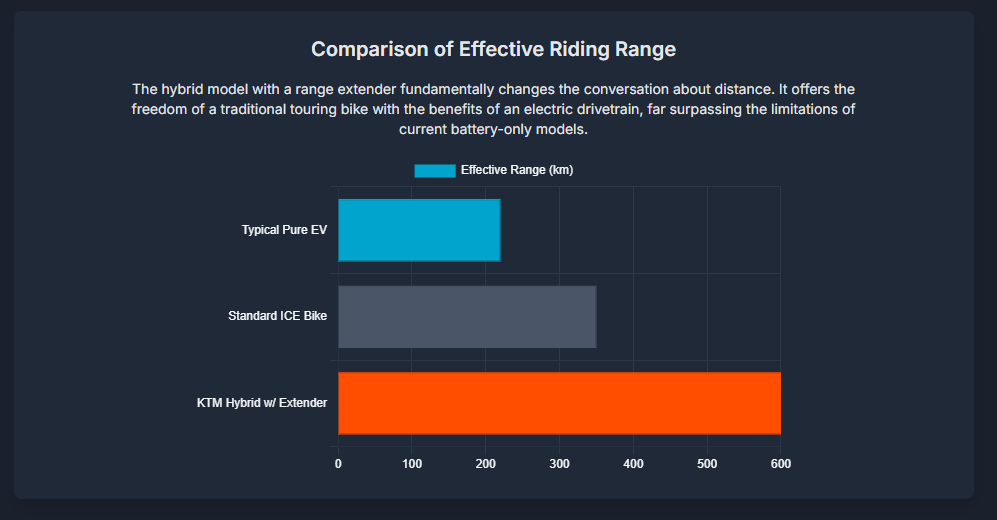
This modular approach addresses the weight-range trade-off of EVs by shifting the burden to an optional accessory. For a rider who only uses their bike for short daily trips, the base EV can remain a lightweight and nimble machine. For a weekend tourer, the clip-on unit can be added to provide the necessary extended range. This flexible, consumer-focused design could significantly increase the everyday usability of electric motorcycles and appeal to new buyer segments.10
3. Competitive and Market Context
KTM’s hybrid innovations must be viewed within the context of its competitors’ strategies. The industry’s approach to forced induction and electric mobility varies widely, and KTM’s patents position the company in a distinct and advantageous middle ground.
3.1 Forced Induction Landscape: A Comparative Analysis
Forced induction in motorcycling has been a niche but important area of innovation. Kawasaki’s Ninja H2 stands as the current benchmark for production supercharging.7 Its purely mechanical system delivers immense power, but because the compressor’s rotational speed is directly tied to engine revs, it can suffer from limited low-speed response.7 Conversely, Honda’s upcoming V3R concept is moving toward an all-electric supercharger, which, while offering instantaneous low-end boost, would require a larger battery to power the system, adding considerable weight to the motorcycle.7
KTM’s hybrid-electric supercharger is a calculated response to the shortcomings of both these approaches. The KTM design marries the mechanical simplicity of Kawasaki’s high-speed drive with the instant, low-end responsiveness of Honda’s electric system.7 This allows KTM to develop a performance-oriented engine that offers both explosive top-end power and superior low-speed tractability, all while minimizing the weight and size penalties that can compromise handling. By not relying on a single power source, the system can dynamically optimize for either efficiency or performance, positioning KTM’s technology as the most balanced and versatile solution to date.
3.2 OEM Hybrid and EV Strategies in Perspective
The broader OEM landscape is marked by diverse approaches to electrification.
- Kawasaki’s Ninja 7 Hybrid: This is the industry’s first mass-production “strong hybrid” motorcycle.4 It combines a 451 cc parallel-twin engine with an electric motor and a 48V lithium-ion battery.12 While it offers multiple ride modes and innovative features like “E-Boost” and an automated manual transmission, reviews have highlighted a significant drawback: its curb weight of 503 pounds, which is approximately 125 pounds heavier than the Ninja 500.13 This real-world example demonstrates the critical challenge of integrating two powertrains and the accompanying weight penalty.
- Honda’s WN7 EV: Honda’s strategy for its “Fun” segment is a direct leap to a fixed-battery EV, the WN7. Designed for urban and “fun” riding, it offers a fixed battery with a range of over 130 km (83 miles) and CCS2 fast charging.14 The design acknowledges the current technological limitations by focusing on a segment where range is less critical.
- Harley-Davidson’s LiveWire: Harley-Davidson has taken a different route by spinning off its electric motorcycle division into a standalone, publicly traded brand.16 LiveWire is positioned as a premium, high-tech brand focused on the urban rider, allowing H-D to explore electric mobility without compromising its core legacy business.17
- Zero Motorcycles: As a dedicated EV specialist since 2006, Zero’s entire business model is built around balancing performance, range, weight, and affordability.18 Its challenge lies in competing with the immense R&D budgets and global dealer networks of legacy OEMs.
The comparison illustrates that while these rivals have adopted either a full-hybrid, a fixed-battery EV, or a standalone brand approach, KTM’s strategy is a more comprehensive hedge. It leverages its existing ICE expertise to innovate with the H-Supercharger while simultaneously using a modular, on-demand solution to overcome EV limitations. This dual-pronged effort aims to capture both the traditional performance market and the emerging electric segment with a single, coherent vision.
4. Viability and Strategic Implications for KTM
The feasibility of KTM’s patented technologies hinges on their ability to overcome the widely recognized challenges of hybrid motorcycles while aligning with the company’s renewed corporate direction.
4.1 Core Challenges of Hybrid Motorcycles: A KTM-Specific Analysis
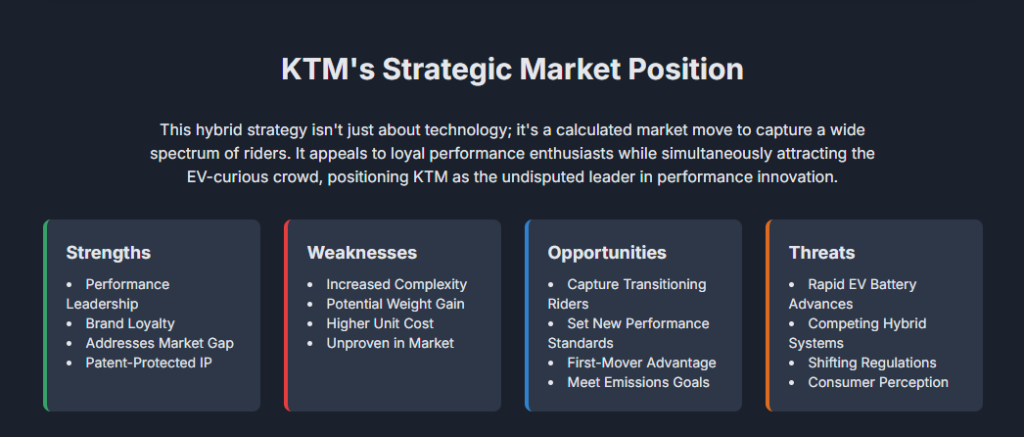
Hybrid motorcycles have historically been difficult to bring to market due to a combination of higher initial cost, added weight, and mechanical complexity.4 KTM’s patents appear to be a deliberate attempt to directly address these historical hurdles.
The H-Supercharger, for instance, uses a small, optimized battery that can be recharged on the move, a design that avoids the substantial weight and cost of a large-capacity battery.7 In contrast to the Kawasaki Ninja 7 Hybrid’s 503 pound curb weight, KTM’s supercharger could offer a similar performance boost with a far smaller mass penalty, potentially preserving the agile handling for which the brand is known.13
Similarly, the modular range extender system is a direct solution to the trade-off between range and weight. Instead of forcing a rider to carry a heavy battery for every journey, KTM’s concept allows the base EV to be a lightweight, urban-focused machine, with the option to “clip on” the extra weight and range for a longer trip.8 This elegant solution mitigates the cost and complexity by making the system an optional accessory, thereby keeping the entry price for the core EV model more accessible.
4.2 Alignment with Corporate Strategy and Brand Identity
KTM’s recent corporate shift, including a renewed focus on customer-centricity, is the driving force behind these innovations. The “Orange Board,” a group of 15 riders chosen from a pool of over 5,000 applicants, provides direct, honest feedback on everything from prototype models to future concepts.3 The patented technologies are a logical response to the core concerns of the rider community, specifically the desire for more power and efficiency in ICE bikes and a practical solution to the range limitations of EVs.
This strategic alignment ensures that KTM is not pursuing technology for its own sake, but as a means to serve its customers better. The H-Supercharger aligns perfectly with KTM’s “Ready to Race” ethos, offering a performance advantage that is core to the brand’s heritage.2 Concurrently, the modular range extender directly addresses the needs of the “Ready to Roam” and Adventure segments, where long-distance capability is paramount.3 This dual-pronged, rider-informed approach allows KTM to reinforce its brand identity across its entire product range while positioning itself as a leader in a dynamic market.
5. Strategic Recommendations and Conclusion
5.1 Strategic Recommendations for KTM
To capitalize on the innovation demonstrated in its patents, KTM should consider the following strategic actions:
- Accelerate the H-Supercharger to Production: The hybrid-electric supercharger offers a clear, tangible performance advantage over existing forced-induction technologies. KTM should prioritize the development and integration of this system into a new high-performance street or enduro model to cement its reputation as a leader in engine technology. This would be a powerful statement that resonates with the brand’s core demographic and offers a superior product to that of its competitors.
- Develop a Clear Product Roadmap for the Modular Range Extender: The modular range extender is a potentially revolutionary product. KTM should focus initial development and marketing efforts on the most viable variant: the battery-booster with swappable packs. This aligns with KTM’s participation in the Swappable Batteries Motorcycle Consortium and positions the company to lead in establishing a new industry ecosystem. The mini-generator and fuel cell variants can be introduced as the market matures and technology costs decline.
- Leverage Customer Feedback in Public Messaging: The story of the “Orange Board” is a powerful narrative tool. KTM should use this to communicate the “why” behind these innovations. By showing that these patents are a direct response to rider needs, KTM can build customer trust and demonstrate that its strategic decisions are genuinely informed by the riding community, not by corporate trends.
5.2 Conclusion: A New Benchmark for the Motorcycle Industry
KTM’s dual-pronged hybrid strategy is a sophisticated and pragmatic response to the industry’s most pressing challenges. The hybrid-electric supercharger and the modular EV range extender are more than just patents; they are a cohesive plan to solve the fundamental shortcomings of both ICE and EV platforms. By addressing the performance lag of conventional engines and the range anxiety of electric vehicles, KTM is not simply reacting to market forces but actively shaping the future of motorcycling.
This approach, deeply rooted in the company’s recent corporate restructuring and a renewed focus on customer needs, positions KTM as a strategic innovator. While rivals are making singular bets, KTM is intelligently hedging its position, creating a product pipeline that is versatile, practical, and true to its “Ready to Race” and “Ready to Roam” heritage. If successfully brought to market, these technologies have the potential to set a new benchmark for the industry, proving that the future of motorcycling is not about choosing between two technologies, but about a clever fusion of both.
Works cited
- Is KTM Moving More Production to Asia? Ask Its New Owner Bajaj – RideApart.com, accessed September 21, 2025, https://www.rideapart.com/news/772014/ktm-bajaj-production-moving-to-asia-austria-news-interview/
- INTERVIEW | Gottfried Neumeister, CEO of KTM AG – Australian Motorcycle News, accessed September 21, 2025, https://amcn.com.au/editorial/interview-gottfried-neumeister-ceo-of-ktm-ag/
- THE KTM OF TOMORROW: THE STORY OF THE ‘WHO’, ‘WHAT’ AND ‘WHY’ OF THE NEW ORANGE BOARD, accessed September 21, 2025, https://www.ktm.com/en-us/ktm-world/stories/the-ktm-of-tomorrow.html
- What Is a Hybrid Motorcycle? | Progressive, accessed September 21, 2025, https://www.progressive.com/answers/what-is-a-hybrid-motorcycle/
- Hybrid Motorcycles Explained – NavSav Insurance, accessed September 21, 2025, https://navsav.com/blog/motorcycles/
- Why are there no hybrid motorcycles? : r/AskEngineers – Reddit, accessed September 21, 2025, https://www.reddit.com/r/AskEngineers/comments/3pira2/why_are_there_no_hybrid_motorcycles/
- KTM’s Hybrid Electric Supercharger – Cycle World, accessed September 21, 2025, https://www.cycleworld.com/motorcycle-news/ktm-hybrid-electric-supercharger/
- KTM Plans Modular Clip-On Power Packs for Electric Bikes …, accessed September 21, 2025, https://news.imotorbike.com/en/2025/09/ktm-electric-motorcycles-patent/
- KTM Developing EV Range Extender | Cycle World, accessed September 21, 2025, https://www.cycleworld.com/motorcycle-news/ktm-developing-ev-range-extender/
- KTM develops flexible range extender for electric motorcycles, accessed September 21, 2025, https://motorcycles.news/en/ktm-range-extender-electric-motorcycle/
- KTM Builds H-Supercharger! More Power, Less Weight – YouTube, accessed September 21, 2025, https://www.youtube.com/watch?v=NeljESCr5SI
- 2024 Kawasaki Ninja 7 Hybrid Buyer’s Guide: Specs, Photos, Price | Cycle World, accessed September 21, 2025, https://www.cycleworld.com/kawasaki/ninja-7-hybrid/
- A ’round town review of the 2025 Kawasaki Ninja 7 Hybrid – RevZilla, accessed September 21, 2025, https://www.revzilla.com/common-tread/around-town-review-2025-kawasaki-ninja-7-hybrid-motorcycle
- Honda to unveil all-new WN7 electric motorcycle in Europe …, accessed September 21, 2025, https://thepack.news/honda-to-unveil-all-new-wn7-electric-motorcycle-in-europe/
- Honda unveils first full-size electric motorcycle for Europe, accessed September 21, 2025, https://www.electrive.com/2025/09/19/honda-unveils-first-full-size-electric-motorcycle-for-europe/
- Our Strategy – Harley-Davidson, accessed September 21, 2025, https://investor.harley-davidson.com/our-strategy/default.aspx
- Introducing LiveWire ONE™, The First Product From The All-Electric LiveWire™ Brand – Harley-Davidson – Investor Relations, accessed September 21, 2025, https://investor.harley-davidson.com/news/news-details/2021/Introducing-LiveWire-ONE-The-First-Product-From-The-All-Electric-LiveWire-Brand/default.aspx
- About Us – Zero Motorcycles, accessed September 21, 2025, https://zeromotorcycles.com/company
- Welcome To Zero Motorcycles, accessed September 21, 2025, https://zeromotorcycles.com/strategy
Our Social Media Handles
- Instagram : LivingWithGravity
- Medium : Akash Dolas
- YouTube Channel : Gear and Shutter
- Facebook : LivingWithGravity