















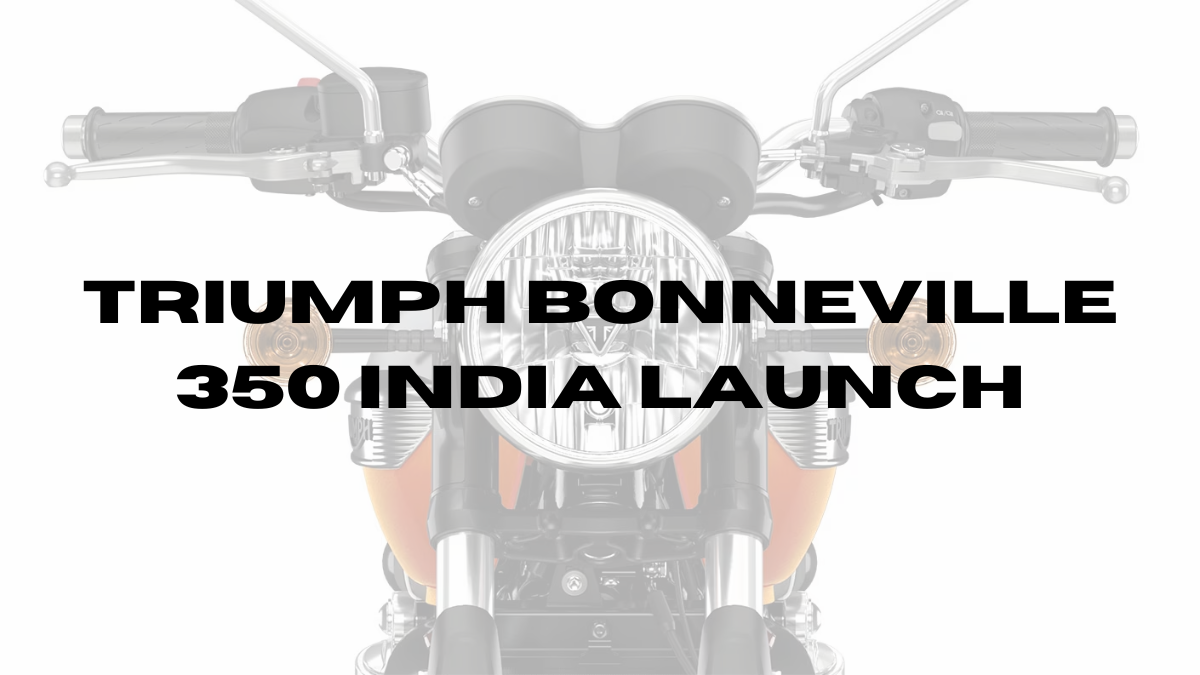
I. Executive Summary: Strategic Imperatives and Market Forecast
The anticipated launch of the Triumph Bonneville 350 in India around mid-2026 is not merely a product expansion but a direct, strategic maneuver dictated by evolving fiscal policy within the Indian two-wheeler market. This model represents the core element of the Triumph-Bajaj alliance’s realignment strategy, shifting focus below the crucial 350cc displacement threshold to maintain competitive pricing and volume viability.

A. Synthesis of Key Findings
The development of the 350cc platform is confirmed to be a reactive measure necessitated by the introduction of “GST 2.0” regulatory changes, which introduced a substantially higher effective tax incidence of 40% on motorcycles exceeding 350cc engine capacity.1 By engineering the engine to displace approximately 349cc, Triumph steers clear of this punitive tax bracket, ensuring a competitive price structure.1
The Bonneville 350 is projected for a launch window around June 2026 4 or August 2026.6 This timeline positions the motorcycle to compete immediately with the segment leader, the Royal Enfield Classic 350. With an aggressive expected ex-showroom price target of ₹1.9 lakh to ₹2.0 lakh 6, Triumph aims for near price parity with Royal Enfield’s mid-range variants, maximizing value perception.
Triumph is expected to leverage its technological superiority, inherited from the 400cc platform, including liquid cooling, advanced chassis components (such as inverted front forks and dual-channel ABS), and premium branding. This combination positions the Bonneville 350 to offer a technically advanced package at the same cost as the rival’s air/oil-cooled architecture.7
B. Market Forecast and Risk Assessment
Industry analysts project that the entry of aggressively priced, technologically aspirational retro models, spearheaded by Triumph and Harley-Davidson, will significantly disrupt Royal Enfield’s historic segment control. Forecasts suggest Royal Enfield’s dominance, currently exceeding 90% in the 250cc-plus segment, could decline to approximately 75%.9 The Bonneville 350 is specifically engineered to target the heart of this segment, challenging the Classic 350, which historically drives high sales volumes (exceeding 26,000 units in July 2025).10
The central challenge for Triumph is the necessity of translating superior technical specifications and international brand value into actual sales volume, given Royal Enfield’s deep-rooted consumer loyalty, expansive service network reach, and established association with authentic retro motorcycling in the Indian market. Overcoming this loyalty remains the primary risk to Triumph’s market penetration success.
II. The Regulatory Forcing Function: India’s GST 2.0 and the 350cc Imperative
The product development strategy for the Triumph Bonneville 350 is a textbook example of regulatory forcing function dictating engineering constraints. The mandate to produce a sub-350cc engine was established solely by the shifting fiscal landscape in India.
A. Analysis of Revised Goods and Services Tax (GST) Structure
In the immediate wake of the GST Council’s 56th meeting, significant tax structure revisions were announced. Motorcycles with engine displacement above 350cc saw a rise in tax incidence from the previous effective rate of 31% (comprising 28% GST plus 3% compensatory cess) to a punitive 40%.3
This revised structure instantly jeopardized Triumph’s initial strategy built around the 400cc platform. Triumph’s existing, highly successful 400cc models—the Speed 400 and Scrambler 400 X 1—retailed efficiently due to their competitive pricing. The resulting cost increase from the 40% tax bracket would likely negate the 400cc models’ initial strategic price advantage over the Royal Enfield Classic 350 and substantially “dent its market demand”.1
Consequently, the sub-350cc segment became the indispensable financial safe harbor. Motorcycles displacing below 350cc either retain the standard 28% GST slab, or, under further proposed “GST 2.0” reforms aimed at simplification, could potentially benefit from a rate reduction to 18%.13 This differential creates a vast fiscal incentive, leading to a 12% to 22% lower tax incidence compared to the 400cc models. This substantial tax differential confirms that the engineering decision to de-bore the engine capacity was not a proactive choice but a necessary reaction to maintain the financial viability of the platform in the world’s largest motorcycle market. The strategic realignment to sit below the 350cc mark was explicitly confirmed by Bajaj Auto Managing Director Rajiv Bajaj, indicating the regulatory constraint was clear and non-negotiable for future product portfolios.2
Table 1: Comparative Tax Incidence on Two-Wheelers in India (Post GST 2.0)
| Engine Capacity (cc) | Base GST Rate | Compensatory Cess | Effective Tax Rate (Approx.) | Target Models | Impact on Price |
| Up to 350 cc | 28% (Current) or 18% (Proposed) 13 | 0% | 18% – 28% | RE Classic 350, Triumph Bonneville 350 (Projected) | Affordable/Competitive 14 |
| Above 350 cc | 28% | 12% | 40% 3 | Triumph 400 Range, RE Himalayan 450 | Significantly Higher Cost 1 |
The timeline for the launch of the 350cc platform underscores this strategic urgency. Upcoming 350cc models, such as the Speed 350 and Scrambler 350, are tentatively scheduled for as early as April 2026.6 The subsequent launch of the Bonneville 350 later that year demonstrates a rapid, parallel development strategy designed to transition the entire small-capacity lineup below the critical GST threshold as quickly as possible, thereby minimizing potential revenue loss associated with the newly handicapped 400cc lineup.

III. Triumph Bonneville 350: Product Profile and Launch Dynamics
The positioning of the Bonneville 350 is characterized by aggressive pricing designed to convert aspirational buyers into owners through the leverage of brand cachet and technological advantage.
A. Launch Timeline and Pricing Strategy
The Indian launch window for the Triumph Bonneville 350 is strongly anticipated for mid-2026, with projections converging around June 2026 4 or August 2026 (tentative).6 This launch follows the phased introduction of other sub-350cc models by the company.
The estimated ex-showroom price is the critical factor in the motorcycle’s competitive stance, set tightly in the range of ₹1.9 lakh to ₹2.2 lakh.6 This pricing is benchmarked precisely against the core competition, the Royal Enfield Classic 350, which starts its ex-showroom price at approximately ₹1.81 lakh for base variants, extending upwards of ₹2.16 lakh for top-end versions.17 The targeted price overlap ensures that the Bonneville 350’s eventual on-road price remains marginally higher than or equivalent to mid-to-high variants of the Classic 350 (for example, the Classic 350 on-road price starts at approximately ₹2.15 lakh in Pune).18
B. Manufacturing Synergy and Brand Value
The Bonneville 350 is a product of the strategic global partnership between Triumph and Bajaj Auto, where the motorcycle will be manufactured in India.19 This alliance provides Triumph access to Bajaj’s formidable scale in manufacturing and its highly cost-efficient supply chain, which is essential for achieving the necessary low retail price.9
The motorcycle is intended to serve as an “affordable path into Triumph ownership” 7, utilizing the powerful, aspirational association with the globally recognized “Bonneville DNA”.7 The strategy is a pure value play: offering a globally premium brand name and advanced, liquid-cooled technology for a price comparable to that of a traditional, air-cooled Royal Enfield. This narrow price differential maximizes the perceived value gap in Triumph’s favor, appealing directly to the specification-aware, but price-sensitive, buyer.
IV. Engine and Mechanical Specifications: An Engineered Solution
The technical development of the Bonneville 350 engine is characterized by clever adaptation of an existing, high-performance architecture to meet regulatory requirements while optimizing the engine’s character for the classic riding segment.

A. Technical Derivation: The De-Boring Strategy
The upcoming 350cc motor is confirmed to be directly adapted from the existing 398cc liquid-cooled, single-cylinder engine used across the successful Triumph 400 range.1 To achieve the required sub-350cc capacity, Triumph engineers are implementing a “de-boring” strategy: reducing the bore size while retaining the stroke length.1
The 398cc engine utilizes a bore of 89mm. Technical estimates suggest that reducing this bore to approximately 83mm, while retaining the original stroke, efficiently reduces the engine capacity to approximately 349cc.1 This method is the most operationally efficient way to meet the stringent GST threshold without requiring a complete engine redesign.
B. Engine Geometry and Performance Profile
This bore reduction fundamentally alters the engine’s geometry. The 400cc platform featured an “over-square” design optimized for high-revving performance, a trait sometimes less desirable for relaxed cruising. The reduced bore creates a “less over-square” configuration, which intrinsically delivers a “friendlier, more usable spread of torque in the low and mid-range”.1
This geometric shift represents an engineering decision that turns a regulatory constraint into a product benefit. By forcing the engine character lower on the rev range, Triumph is inherently giving the Bonneville 350 the tractability and accessible power curve necessary for urban commuting and relaxed cruising—the core dynamic mandated by the Bonneville nameplate.7
While the 400cc unit produces 39.5 bhp, the 350cc version is projected to produce between 24 bhp and 27 bhp.7 Although lower than the 400cc output, this projected figure still represents a substantial performance advantage over the Royal Enfield Classic 350’s 20.2 bhp.17
Table 2: Projected Specifications: Triumph Bonneville 350 Engine Derivation
| Parameter | Triumph Bonneville 350 (Projected) | Triumph 400 Platform (Basis) | Engineering Implication | Source |
| Engine Capacity | ~349 cc | 398 cc | Regulatory Compliance (Sub-350cc) | 1 |
| Cooling System | Liquid-Cooled | Liquid-Cooled | Maintenance of Modern Thermal Efficiency | 8 |
| Bore (Approximate) | ~83 mm (Calculated) | 89 mm | Reduced for displacement 1 | 1 |
| Stroke (Approximate) | Retained | Retained | Maintains engine architecture/character 1 | 1 |
| Max Power (Estimate) | 24–27 bhp | 39.5 bhp | Significant reduction, but competitive in segment | 7 |
| Torque Delivery Focus | Low- and Mid-Range | Peak Performance | Tailored for Classic/Cruiser riding dynamics | 4 |
| Transmission | 5-speed or 6-speed | 6-speed (400 range) | 6-speed likely to leverage existing architecture | 7 |
C. Chassis and Component Analysis
The Bonneville 350 is expected to incorporate high-specification components consistent with Triumph’s global standards. These features include disc brakes and Dual-Channel ABS fitted as standard.7 Given the component set of the existing 400cc platform, the motorcycle is highly likely to feature premium suspension components, such as inverted (USD) front forks and a monoshock rear suspension.23
Crucially, to satisfy the retro aesthetic, the Bonneville 350 will likely feature traditional wire-spoke wheels.4 However, unlike traditional spoke wheels, these are anticipated to be the modern, tubeless cross-spoke type, offering the convenience of tubeless tires without sacrificing the authentic classic look—a feature already utilized on Triumph’s premium offerings.4
V. Design, Aesthetics, and Feature Set
The design mandate for the Bonneville 350 represents a conscious effort to align with the aesthetic values of the core retro buyer, addressing the shortcomings perceived in the existing 400cc range.

A. Addressing the “Visual Bulk” Mandate
Industry feedback regarding the 400cc range highlighted a “lack of visual bulk” as a perceived shortcoming among Indian consumers who favor the imposing presence of traditional cruisers.4 The Bonneville 350 is designed to be an aesthetic “course correction,” aiming to deliver the “chunky bodywork” and timeless classic styling of the larger international Bonneville models.4
Key aesthetic elements that define the Bonneville DNA are employed, including a classic round headlamp, a prominently sculpted fuel tank, chunky fenders, and larger side panels to enhance visual mass.4 A ribbed-pattern flat seat supports the classic look and upright riding posture.4 Achieving this bulk requires structural adaptation, including a potential redesign of the rear sub-frame and possibly a longer swingarm to accommodate the required bodywork.4
The emphasis on enhanced visual bulk confirms that the Triumph-Bajaj team thoroughly understands the psychographic profile of the target consumer. In this segment, the motorcycle’s presence, perceived weight, and metal-intensive aesthetic are often prioritized over compact, modern, sporty design principles. By investing in dedicated bodywork and a revised subframe, Triumph signals its commitment to competing with Royal Enfield specifically on the emotional, heritage-based appeal.
B. Premium Feature Analysis
Despite its value-driven pricing, the Bonneville 350 will maintain a premium component feel. The aesthetics feature intricate finishing, such as chrome accents, blacked-out engine casing with exposed fin detailing, and a high-quality stitched single-piece seat.7
The motorcycle is expected to utilize all-LED lighting 23 and a sophisticated “digi-analog instrument cluster”.24 This hybrid instrumentation—a round analog dial complemented by a rectangular LCD inset—achieves the necessary balance between traditional looks and modern rider information, providing data points like gear position, distance to empty, and fuel level.24
VI. Competitive Analysis and Segment Benchmarking
The Triumph Bonneville 350 is positioned to compete directly on technology and brand value, challenging the Royal Enfield Classic 350’s established character advantage.
A. Direct Benchmark: Triumph Bonneville 350 vs. Royal Enfield Classic 350
The Triumph Bonneville 350 seeks to establish a new technological baseline for the segment. While the Royal Enfield Classic 350 relies on a time-tested, simple air/oil-cooled engine and conventional telescopic forks, the Triumph is expected to introduce modern liquid cooling and inverted (USD) forks at a comparable price point.8
This technological parity pricing creates a clear competitive advantage in terms of raw specifications. The projected 24–27 bhp output of the Bonneville 350 offers a substantial power margin of 20% or more over the Classic 350’s 20.2 bhp.7 Moreover, the utilization of USD forks promises superior handling dynamics, chassis rigidity, and stability compared to the telescopic unit used by Royal Enfield.23
Table 3: Competitive Benchmarking: Triumph Bonneville 350 vs. Royal Enfield Classic 350
| Parameter | Triumph Bonneville 350 (Est.) | Royal Enfield Classic 350 | Strategic Advantage for Triumph | Source |
| Engine Capacity (cc) | ~349 cc | 349 cc | Regulatory Compliance Parity | 1 |
| Cooling System | Liquid-Cooled | Air/Oil-Cooled | Superior thermal efficiency and performance ceiling | 8 |
| Max Power (Est./Claimed) | 24–27 bhp (Projected) | 20.2 bhp @ 6100 rpm | Significant power advantage (+20% or more) | 7 |
| Front Suspension | USD Forks (Likely) | Telescopic Forks (41mm) | Superior handling, modern dynamics | 23 |
| Kerb Weight (kg) | Estimated lower than 195 kg | 195 kg | Better power-to-weight ratio for city agility | 26 |
| Starting Ex-Showroom Price (Est.) | ₹1.90 – ₹2.00 Lakh | ₹1.81 Lakh (Redditch) | Premium brand/tech offered at near price parity | 6 |
B. Secondary Competitive Landscape
Beyond the direct rivalry with the Classic 350, the Bonneville 350 will face competition from other modern retro entrants:
- Honda CB350 H’ness/RS: This platform offers a refined air-cooled engine producing 20.7 bhp. Its key strength is segment-leading torque delivery of 29.4 Nm, achieved at an extremely low 3000 rpm, which provides exceptional low-end tractability and a distinct feel, positioned at a highly comparable price point (starting around ₹1.83 lakh ex-showroom).22
- Jawa 350: The updated Jawa utilizes a liquid-cooled engine, generating 22.2 bhp from 334cc.22 While it incorporates liquid cooling, its torque curve is often described as peakier compared to the Honda or Royal Enfield, resulting in a different ride character.
Triumph’s core challenge is overcoming the market’s preference for Royal Enfield’s unique character. Royal Enfield’s decades of dominance are rooted in selling nostalgia and a distinct riding soul—characterized by the heavy, thumping engine feel and low-rev torque.29 The liquid-cooled, higher-revving nature of the Triumph engine means the company must successfully engineer a “soulful riding character” 7 to lure buyers away from the established, visceral experience of the J-platform motor.
VII. Market Penetration Strategy and Sales Forecast
The strategic goal for the Bonneville 350 is nothing short of disrupting the structure of India’s mid-capacity market and reclaiming market share lost due to the GST differential.
A. Royal Enfield’s Dominance and Vulnerabilities
Royal Enfield currently maintains overwhelming segment control, commanding over 82% of the market share in the 350cc–450cc bracket.30 The Classic 350 is the segment’s undisputed volume leader, selling 26,516 units in July 2025.10
However, this dominance is vulnerable to aspirational, technologically superior competition. Even before the 350cc platform was initiated, the Triumph 400 range successfully carved out a volume, selling 3,538 units in July 2025.10 Analysts project that the introduction of high-value, aggressively priced models like the Bonneville 350 could immediately reduce Royal Enfield’s overall segment share to approximately 75%.9
B. Triumph’s Strategy: Aspirational Branding and Market Disruption
Triumph’s strategy centers on utilizing its global aspirational status to maximize the impact of its narrow price overlap with Royal Enfield. By offering the Bonneville name at price parity, Triumph positions itself as the technologically advanced, international alternative.9
The target audience for the Bonneville 350 includes:
- Aspirational Upgrade Buyers: Consumers who previously desired the premium performance of the 400cc range but were dissuaded by its price, particularly after the application of the 40% GST.1
- RE Switchers: The large contingent of existing Classic 350 riders or prospective buyers who prioritize modern technology, liquid cooling, and superior handling (USD forks) over the traditional, simpler engineering of the Royal Enfield platform.
- Urban Commuters: The specifically tuned engine, emphasizing smooth low- and mid-range power, is ideal for city use and relaxed touring, matching the requirements of the core lifestyle rider.7
The technological compliance forced by the GST changes—namely, the ability to build a sub-350cc engine platform while maintaining high-end components like liquid cooling—establishes a new standard of luxury in the mass-market 350cc category. The price savings achieved by avoiding the 40% tax incidence allow Triumph to absorb the cost of these superior components, effectively turning a regulatory constraint into a competitive edge that pressures rivals to rapidly upgrade their technology.
A successful launch for the Bonneville 350 would be characterized by Triumph’s overall 350cc-400cc monthly sales figures rising significantly beyond the 3,500 units currently achieved by the 400 range.10 If the Bonneville 350 can consistently achieve monthly sales exceeding 5,000 units, it would signal effective penetration and direct volume capture from Royal Enfield’s highly lucrative core segment.
VIII. Conclusions and Strategic Recommendations
The Triumph Bonneville 350 is strategically paramount for the Bajaj-Triumph joint venture, representing a highly calculated response to a challenging fiscal environment and a direct assault on the dominant market segment.

A. Key Takeaways and Actionable Strategy
- Prioritization of Engine Character: The engineering team must ensure the final tune of the 350cc engine delivers accessible, low-end torque that resonates with the relaxed, characteristic demands of the retro segment. The user experience derived from engine sound and feel is more critical for segment success than achieving maximum performance figures.
- Accelerated Network Scaling: Royal Enfield’s greatest advantage lies in its vast, deep service and sales network. Triumph/Bajaj must aggressively scale its dedicated dealership presence and ensure robust, responsive after-sales support to alleviate potential buyer concerns regarding parts availability and long-term maintenance costs, which often deter switchers from established brands.
- Strict Price Adherence: Maintaining the aspirational yet accessible price point of ₹1.9 lakh to ₹2.0 lakh (ex-showroom) is non-negotiable. Any increase above this ceiling risks diluting the motorcycle’s critical value proposition, placing it too close to the GST-inflated 400cc range and making the more affordable Royal Enfield Hunter 350 (starting at ₹1.38 lakh ex-showroom) appear more financially sensible.27
B. Strategic Outlook
The Bonneville 350 is positioned to be the definitive technological disruptor in India’s retro-classic segment by mid-2026. Born out of regulatory necessity, the product maximizes the competitive advantage gained from GST compliance by combining high-spec components (liquid cooling, USD forks) and global brand appeal with price parity. Should Triumph successfully integrate the aesthetic bulk and soulful character required by the Indian retro buyer with its superior performance platform, the Bonneville 350 possesses the necessary leverage to significantly restructure the 350cc market dynamics, capturing substantial volume from Royal Enfield.
Sources
- EXCLUSIVE: Triumph to Launch 350cc Motorcycles Soon – BikeWale, accessed on September 27, 2025, https://www.bikewale.com/news/triumph-to-launch-350cc-motorcycles-soon/
- New Bajaj Triumph 350cc Bikes Might Launch In A Year – RushLane, accessed on September 27, 2025, https://www.rushlane.com/new-bajaj-triumph-350cc-bikes-might-launch-in-a-year-12530692.html
- Here’s How New GST Slabs Affect Motorcycle Prices In India – NDTV, accessed on September 27, 2025, https://www.ndtv.com/auto/gst-council-meeting-bikes-above-350cc-to-attract-40-gst-9217946
- EXCLUSIVE: Triumph Bonneville 350 in Works: Launch Soon …, accessed on September 27, 2025, https://www.bikewale.com/news/exclusive-triumph-bonneville-350-in-works-launch-soon/
- accessed on September 27, 2025, https://www.bikewale.com/news/exclusive-triumph-bonneville-350-in-works-launch-soon/#:~:text=We%20expect%20the%20Bonnie%20350,in%20India%20around%20June%202026.
- Triumph Bonneville 350 – BikeWale, accessed on September 27, 2025, https://www.bikewale.com/triumph-bikes/bonneville-350/
- Triumph Bonneville 350 Coming Soon: Will It Redefine the Retro Classic Segment, accessed on September 27, 2025, https://www.alaguthangamtravels.com/triumph-bonneville-350-coming-soon/
- New Triumph Bonneville with 350cc Engine in Works – Details – BikeAdvice, accessed on September 27, 2025, https://bikeadvice.in/new-triumph-bonneville-with-350cc-engine-in-works-details/
- Harley-Davidson, Triumph in first gear of challenge to Royal Enfield’s India reign By Reuters, accessed on September 27, 2025, https://www.investing.com/news/stock-market-news/analysisharleydavidson-triumph-in-first-gear-of-challenge-to-royal-enfields-india-reign-3131639
- 350cc to 450cc Motorcycle Sales July 2025 – Royal Enfield, Triumph, Honda, Jawa, KTM, Bajaj, Harley – RushLane, accessed on September 27, 2025, https://www.rushlane.com/350cc-to-450cc-motorcycle-sales-july-2025-royal-enfield-triumph-honda-12529131.html
- GST on Bikes/Two Wheelers 2025 – Groww, accessed on September 27, 2025, https://groww.in/p/tax/gst-on-bikes
- Motorcycles Above 350CC May Attract 40% Tax – Angel One, accessed on September 27, 2025, https://www.angelone.in/news/taxation/motorcycles-above-350cc-may-attract-40-percent-tax
- Big bikes above 350cc may be costlier under GST overhaul, smaller bikes get relief, accessed on September 27, 2025, https://a2ztaxcorp.net/big-bikes-above-350cc-may-be-costlier-under-gst-overhaul-smaller-bikes-get-relief/
- Royal Enfield bikes’ new prices after GST 2.0: Which get cheaper and which get costlier, check full list | – The Times of India, accessed on September 27, 2025, https://timesofindia.indiatimes.com/auto/bikes/royal-enfield-bikes-new-prices-after-gst-2-0-which-get-cheaper-and-which-get-costlier-check-full-list/articleshow/123736641.cms
- Triumph is reported to be launching new 350cc models for India – Visordown, accessed on September 27, 2025, https://www.visordown.com/news/new-triumph-and-bajaj-350-models-rumoured-2026
- Triumph Bonneville 350 Expected Price (1.98 Lakhs), Launch Date, Booking Details, accessed on September 27, 2025, https://auto.hindustantimes.com/new-bikes/triumph/bonneville350
- Royal Enfield Bullet 350 vs Royal Enfield Classic 350 – Know Which Is Better! – BikeWale, accessed on September 27, 2025, https://www.bikewale.com/compare-bikes/royalenfield-bullet-vs-royalenfield-classic-350/
- Royal Enfield Classic 350 On Road Price in Pune (After GST Cut) – RTO, Insurance & EMI, accessed on September 27, 2025, https://www.zigwheels.com/royal-enfield-bikes/classic-350/on-road-price-pune
- Triumph Soon Launch 350cc Motorcycles at Affordable Price & Premium Look, accessed on September 27, 2025, https://www.alaguthangamtravels.com/triumph-350cc-motorcycles/
- TRIUMPH AND BAJAJ GLOBAL PARTNERSHIP COMMENCES, accessed on September 27, 2025, https://triumph-mediakits.com/en/news-articles/triumph-and-bajaj-global-partnership-commences.html
- Triumph Bonneville 350 in Works: Launch Soon : r/indianbikes – Reddit, accessed on September 27, 2025, https://www.reddit.com/r/indianbikes/comments/1npy9ei/triumph_bonneville_350_in_works_launch_soon/
- RE Classic 350 vs Honda CB350 vs Jawa 350 – Spec comparison – ACKO Drive, accessed on September 27, 2025, https://ackodrive.com/news/re-classic-350-vs-honda-cb350-vs-jawa-350-spec-comparison/
- EXCLUSIVE SPY SHOTS OF THE ALL NEW TRIUMPH BONNEVILLE FAMILY WITH A 500CC ENGINE RANGE – YouTube, accessed on September 27, 2025, https://www.youtube.com/watch?v=PT6ZJZ_jrMg
- Latest Spy Shots Of Triumph’s 350cc Scrambler Reveal Juicy Details – Top Speed, accessed on September 27, 2025, https://www.topspeed.com/latest-spy-shots-of-triumphs-baby-scrambler-reveal-juicy-details/
- Royal Enfield Goan Classic 350 Motorcycle Price & Colours in USA, accessed on September 27, 2025, https://www.royalenfield.com/us/en/motorcycles/goan-classic-350/
- Royal Enfield Classic 350 Specifications, Features, Mileage, Weight, Tyre Size – BikeDekho, accessed on September 27, 2025, https://www.bikedekho.com/royal-enfield/classic-350/specifications
- Royal Enfield Classic 350 Comparisons – Compare Classic 350 with Bullet 350, Hunter 350 and Other Similar Bikes @ ZigWheels, accessed on September 27, 2025, https://www.zigwheels.com/royal-enfield-bikes/classic-350/comparisons
- Honda CB350 vs Jawa 350 – Know Which Is Better! – BikeWale, accessed on September 27, 2025, https://www.bikewale.com/compare-bikes/honda-cb350-vs-jawa-350/
- Triumph T120 vs Royal Enfield Classic 350: Which is Best for the Backroads? – YouTube, accessed on September 27, 2025, https://www.youtube.com/watch?v=9XyxBRHNs0U
- 350cc To 450cc Motorcycle Sales April 2025 – RE 350, Triumph 400, KTM 390 – RushLane, accessed on September 27, 2025, https://www.rushlane.com/350cc-to-450cc-motorcycle-sales-april-2025-re-350-triumph-400-ktm-390-12523749.html
Our Social Media Handles
- Instagram : LivingWithGravity
- Medium : Akash Dolas
- YouTube Channel : Gear and Shutter
- Facebook : LivingWithGravity