








Moto Morini 300cc Platform: Strategic Intent, Technical Interpretation, and Competitive Threat Assessment
I. Executive Summary: Strategic Imperatives and Core Findings
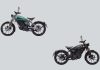
The analysis of recent European design registrations confirms that the storied Italian manufacturer, Moto Morini, is executing a decisive high-efficiency platform strategy to penetrate the globally critical small-displacement segment (approximately 300cc). This strategy, enabled by its Chinese ownership, Zhejiang Morini Vehicle Co. Ltd. 1, involves the simultaneous development of two closely related single-cylinder off-road motorcycles: a dedicated Adventure touring model and a lighter, more focused Enduro-styled model.1 This dual segmentation is designed to maximize market penetration across distinct demographics—from off-road enthusiasts to entry-level adventure riders—while capitalizing on shared engineering and minimized development costs.1
Key findings derived from the engineering filings indicate that Moto Morini is not targeting parity with existing segment leaders, but rather aiming for a performance benchmark. The anticipated 292cc single-cylinder engine is projected to deliver a substantial “near-30-horsepower output” 3, which is markedly superior to the 22–23 horsepower typically found in current Japanese 300cc dual-sports, such as the Kawasaki KLX300.4 Furthermore, the platform incorporates premium componentry generally absent in this price class, including an inverted front fork, a steel-tube frame paired with an aluminum swingarm, and a rising-rate monoshock linkage.2
The strategic decision to file design patents in Europe actively reinforces the perception of Italian design heritage and engineering quality 1, a necessary step to justify a performance-based price premium over generic budget offerings. This aggressive positioning suggests Moto Morini is poised to become the new performance leader in the entry-level dual-sport and lightweight adventure categories by 2026 1, necessitating a rapid and concerted response from established competing original equipment manufacturers (OEMs).
II. The Strategic Rationale: Moto Morini’s Necessary Shift to Small Displacement
2.1. The Global Market Imperative: Growth of the A2-Compatible Segment
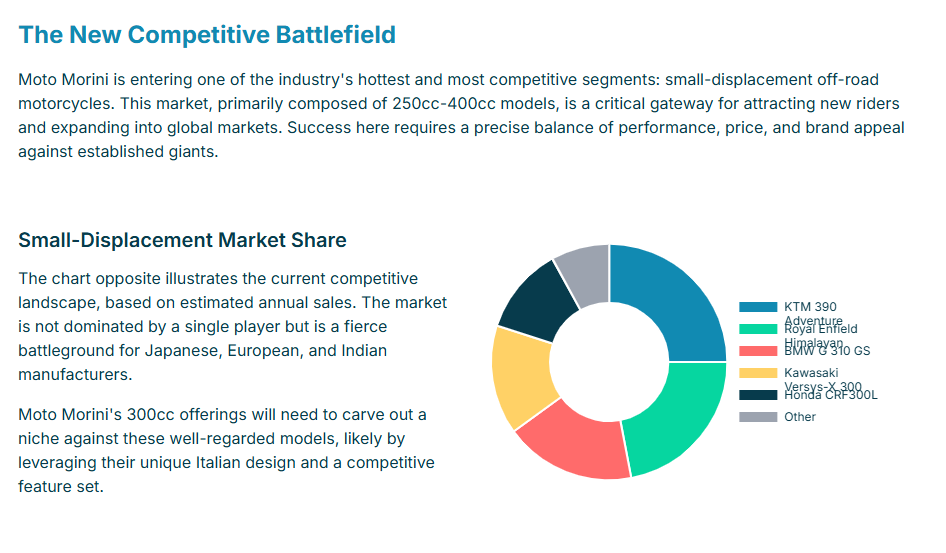
The global motorcycle market is undergoing a significant structural shift, driven by sustained growth in the entry-level and middleweight classes, particularly within the 300cc to 500cc displacement range.3 This segment, critical for attracting new and younger riders, is expanding unlike any other, forcing manufacturers historically reliant on large-displacement or heavyweight models—including brands like Harley-Davidson, Triumph, and BMW—to invest heavily in smaller offerings.3
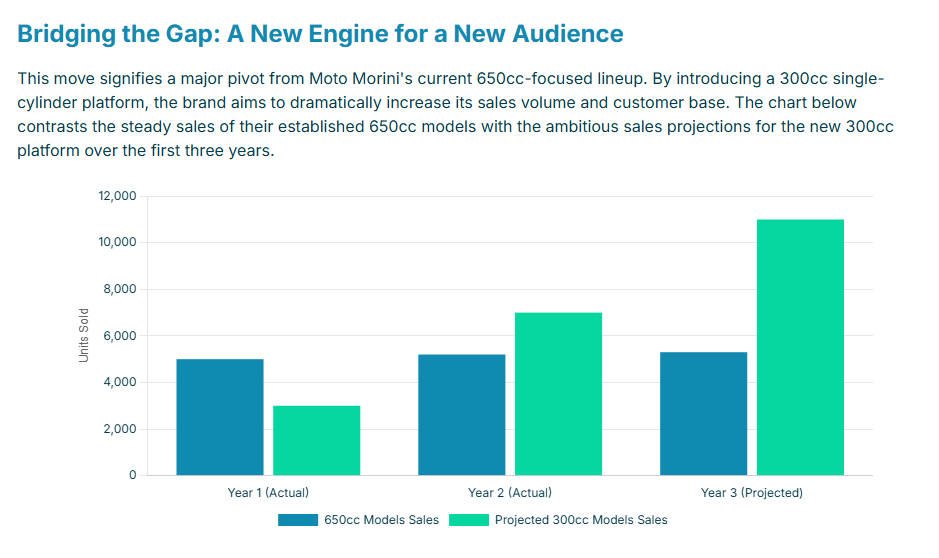
Moto Morini’s current portfolio is concentrated in the middleweight range, notably featuring the 650cc X-Cape adventure touring model and the 700cc Calibro cruiser.6 While these models establish Morini as a competitor in the $7,000 to $10,000 price band (the X-Cape SE starts at $9,799 in the US 6, while other models start as low as $6,899 6 and the US price low point for the brand is $8,299 7), this focus leaves a substantial, high-volume gap at the entry level. The introduction of a dedicated 300cc platform is mandatory for Moto Morini to secure market share and maintain competitive relevance in a rapidly evolving global environment.
Crucially, the 300cc displacement is specifically engineered for compliance with the A2 European license class requirements.3 This explicit regulatory optimization ensures immediate and high market relevance across vital European territories, where entry-level riders are legally restricted in power output. By securing A2 compliance, Morini establishes a direct pipeline to the most important entry-rider demographic in high-value Western markets.
2.2. The China-Italy Nexus: Balancing Heritage, Cost, and Scale
Since 2018, the historic Italian marque Moto Morini has operated under the ownership of Zhejiang Morini Vehicle Co. Ltd. (China).1 This corporate structure is pivotal, as it provides the necessary capital infusion and access to scalable, cost-efficient global manufacturing required to develop and produce two competitive models simultaneously.8
A careful analysis of the design registration locations reveals a calculated marketing and brand positioning maneuver. The new 300cc designs were registered in European filings, rather than domestically in China.1 This choice is highly significant. By ensuring that the intellectual property is recorded and publicly associated with Europe, Moto Morini strategically ties the product to Italian engineering and design standards. This effort is critical for maintaining the brand’s premium perception and counteracting any potential consumer skepticism in Western markets regarding the quality or performance of Chinese-backed manufacturing.2 This approach allows the manufacturer to attract European consumers who seek performance and heritage and are willing to pay a justified premium over purely Asian-sourced budget motorcycles.
The design philosophy underpinning the new range further highlights efficiency. Both the Enduro and Adventure models are designed around a single, shared chassis and powertrain.1 This inherent platform efficiency significantly reduces the expenditure required for development, tooling, and manufacturing complexity, which is fundamental to maximizing the return on investment. This strategy allows Moto Morini to offer two highly specialized products for the price of developing one full platform.
III. Technical and Design Deep Dive: Interpreting the Filings
3.1. Engine Specification Projection and Performance Metrics
The central component of these new offerings is a liquid-cooled, single-cylinder engine with an approximate displacement in the 300cc class.3 The industry consensus suggests the unit will be the 292cc DOHC motor, or a highly related derivative, found in the successful Kawasaki KLX300.3 This engine architecture typically features a four-valve head and liquid cooling.
Specific dimensional projections align closely with the Kawasaki unit, featuring a 78 mm bore and a 61.2 mm stroke.3 Furthermore, the patent illustrations reveal a sophisticated cooling system employing dual high-mounted radiators.2 Positioning the radiators high and out of the way is a crucial engineering detail for serious off-road machinery, protecting the system from trail debris and maximizing cooling capacity under sustained high-load conditions typical of adventure or enduro riding.
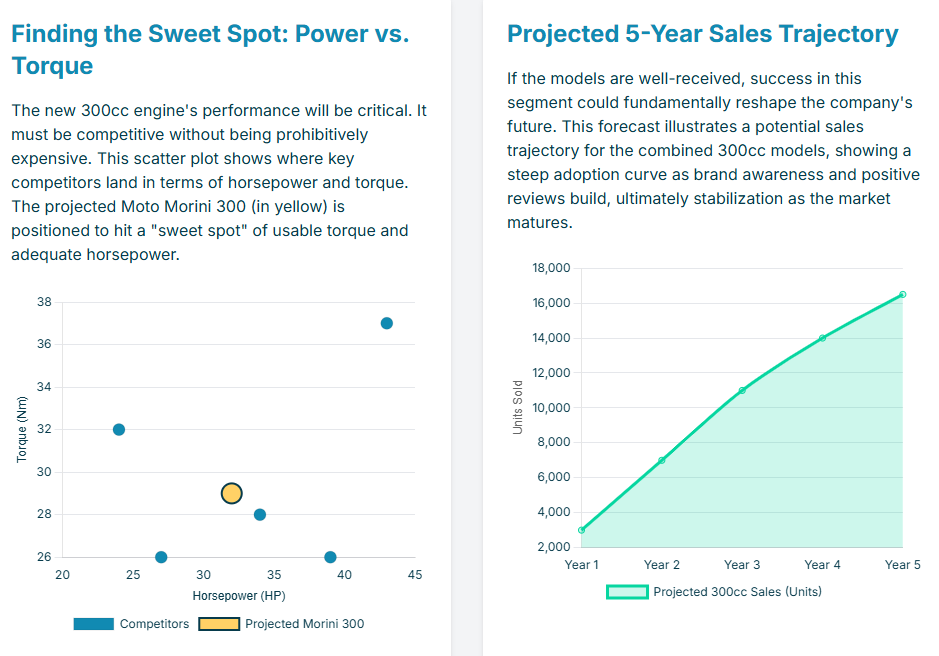
The most critical distinction, however, lies in the anticipated performance figures. While the benchmark KLX300 produces a tested maximum power output of 23.0 horsepower 4, the Moto Morini single-cylinder engine is projected to deliver output approaching 30 horsepower.3 This is an increase of nearly 30 percent over key rivals. Such a substantial performance differential cannot be achieved by minor mapping changes alone. It suggests comprehensive performance tuning, which may include a higher compression ratio (the KLX operates at 11.1:1 4), optimized cam profiles, and superior airflow management. This aggressive horsepower target demonstrates a calculated move to establish the Morini 300cc models as the undisputed performance leaders in the lightweight dual-sport class, justifying a higher price point and immediately differentiating the products from the segment’s reliable but less exciting Japanese incumbents.
3.2. Chassis, Suspension, and Dedicated Off-Road Componentry
The chassis architecture shared by both the Enduro and Adventure models utilizes a straightforward, robust steel-tube frame.1 The frame is coupled with a key component upgrade that underscores the platform’s performance intent: an aluminum swingarm.1 The choice of aluminum over the standard steel swingarms often found on budget dual-sports minimizes unsprung weight, significantly improving suspension response, traction, and overall handling agility.2
Suspension hardware appears high-spec for this segment, featuring an inverted front fork and a rear monoshock assembly.2 The rear shock is mounted via a rising-rate linkage system 2, a design choice that is essential for achieving progressive damping and superior control over varying off-road terrain, providing a notable handling advantage over bikes utilizing a non-linkage, direct-mount system.
The motorcycles are depicted with spoked wheels, which are preferred for durability and resilience in off-road environments.3 The configuration is likely the industry standard for serious dual-sports and lightweight ADV bikes: a large 21-inch front wheel paired with a 17-inch rear wheel.3 Braking is handled by petal-style discs at both ends, equipped with visible ABS sensor rings.2 Furthermore, the ergonomic design has been optimized for aggressive off-road riding. The fuel tank possesses a notably low-profile design, permitting the rally-style seat to stretch far forward.1 This ergonomic layout is crucial for facilitating the aggressive weight transfer and standing posture required for effective motocross-style control.1
3.3. Platform Differentiation: Adventure vs. Enduro Configuration
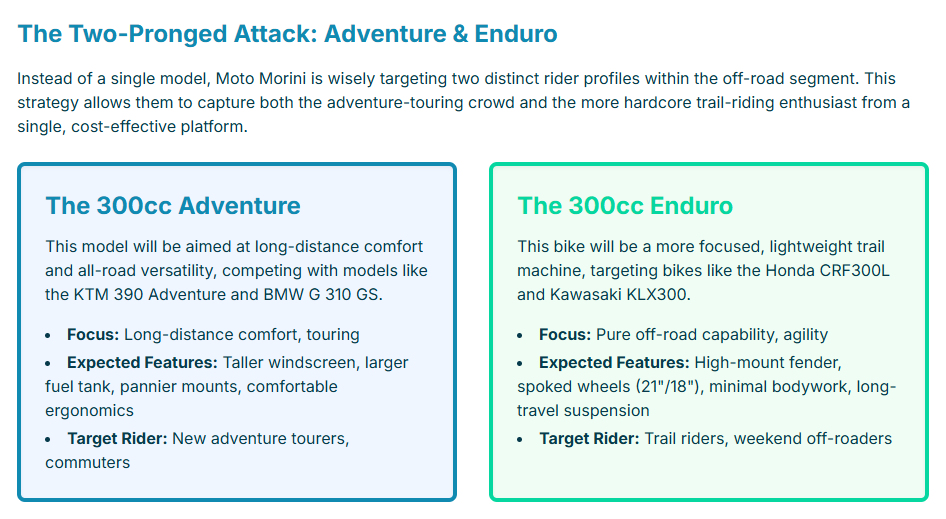
The platform strategy relies on successfully generating two visually and functionally distinct models from the same core mechanical components. The two variations are meticulously tailored to specific usage profiles.1
3.3.1. The Enduro-Style Model
This variant is designed to be road-legal but heavily skewed toward lightweight agility and off-road performance, similar in concept to the Kawasaki KLX300.1 Its aesthetic features include a high-mounted front fender to maximize clearance in mud and tight terrain, and a small headlight assembly that turns with the handlebars, set within a nose cowl that deliberately mimics the appearance of a front number board typical of dedicated dirt bikes.1 This configuration prioritizes minimalist protection and maximum maneuverability.
3.3.2. The Adventure Touring Model (ADV)
In contrast, the Adventure model is built for longer-distance capability and improved weather protection, positioning it as a logical, entry-level counterpart to the larger X-Cape 650.6 This version features a fixed front fairing, incorporating extended side cowls for wind protection, a significantly taller windscreen, and a low-mounted front mudguard.1 Despite these stylistic differences, both models share the same distinctive W-shaped headlight signature, maintaining a cohesive family resemblance across the new platform.1
This dual-model approach is a highly efficient operational decision. By tailoring the bodywork, screens, and fenders, Moto Morini effectively captures two adjacent market demographics—the technical off-road rider and the long-distance traveler—without undertaking the costly development of two separate frames or powertrains.
IV. Competitive Threat Analysis and Market Positioning
4.1. Direct Segment Benchmarking: Challenging the Dual-Sport Status Quo
The introduction of the Moto Morini 300cc platform directly challenges the long-standing hegemony of affordable dual-sport machines, primarily represented by models from Kawasaki and Honda. To accurately gauge the competitive threat, it is essential to position the new Morini models against their intended rivals based on specification and market position.
Table 1: Competitive Specification and Performance Comparison (Lightweight Off-Road Segment)
| Model | Engine Displacement (cc) | Max Power (hp, Est.) | Weight (kg, Est.) | US MSRP (Approx. USD) | Performance & Component Assessment |
| Moto Morini 300 (Est.) | 292 | ~29 3 | 150-155 9 | N/A (Est. $6,000–$6,500) | Highest projected stock power, premium chassis (Aluminum swingarm, inverted fork) 2 |
| Kawasaki KLX300 | 292 4 | 23.0 4 | N/A | $5,599 – $5,799 4 | Reliable platform, competitive pricing, lower power output |
| Honda CRF300L | 286 4 | 22.1 4 | N/A | $5,249 4 | Lowest entry price, fundamental componentry |
| Voge 300 DS | ~292 | 29 10 | 155 9 | N/A (Emerging Market Focus) | Chinese-backed rival with comparable high HP output |
| KTM 390 Adventure | 373 | 42.9 10 | 162 10 | N/A (Higher Tier) | Highest power, heavier, higher complexity and cost |
Moto Morini is strategically targeting the significant performance disparity that exists between the low-powered, budget-focused Japanese dual-sports (producing 22–23 hp) and the larger, heavier, and more expensive 390cc adventure touring motorcycles (producing 43 hp).4 For the performance-oriented enthusiast who seeks a highly capable, trail-ready machine without the weight penalty of the 390cc class, the Morini 300 platform provides a compelling value proposition by offering stock horsepower approaching that of competitive 400cc machines, combined with higher-spec suspension components.2
This competitive strategy poses a severe market threat to the Japanese leaders. If the Morini models are priced competitively, they will immediately capture market share from buyers currently underserved by the performance stagnation in the sub-300cc dual-sport category.
4.2. Pricing Strategy and Value Proposition
The anticipated superior componentry, including the aluminum swingarm and inverted forks, coupled with the Italian heritage branding and high projected engine output, necessitates that the Moto Morini 300 models be priced above the current Japanese base models.2
For Western markets (North America and Europe), the strategic pricing sweet spot is projected to be in the $6,000 to $6,500 USD equivalent range. This segmentation places them as the premium-specification option within the 300cc dual-sport class, providing a performance advantage over the KLX300 and CRF300L 4 for a modest increase in investment. Critically, this price range maintains a clear delineation from Morini’s larger 650cc platforms, which start at higher price points (e.g., X-Cape starting near $8,299 in the US 6).
In high-volume Asian markets, where price sensitivity is extreme and local competition (such as the KTM 390 series) is fiercely established 5, Moto Morini must leverage its cost-efficient manufacturing to deliver an aggressive price point. Given that Moto Morini models currently start around Rs 4.29 Lakh in India (approximately $5,150 USD equivalent) 11, the 300cc models will likely need to be positioned near or below this threshold to compete effectively as volume drivers.
4.3. Next-Tier Competition and the Emerging Manufacturing Landscape
Moto Morini must also contend with the burgeoning competition from other successful Chinese-European ventures, such as Voge, which already offers a 300cc platform with claimed 29 horsepower and competitive curb weight (155 kg).9
The brand’s success hinges on successfully translating its Italian lineage into a tangible competitive advantage over these rivals. The deliberate strategy of emphasizing European design and utilizing higher-tier components (like the aluminum swingarm 2) is intended to solidify the perception that the Morini 300 models represent premium quality and performance, distinguishing them from comparable platforms sourced exclusively from Asia. The Italian badge 8, supported by rigorous engineering documentation (European filings 2), provides the necessary validation for the expected price premium.
V. Launch Strategy and Market Outlook
5.1. Anticipated Debut and Production Timeline
The expansion of Moto Morini into the 300cc segment aligns with the company’s continuous introduction of new models, specifically targeting a production and sales timeline that extends into 2026.1 The official public debut of the prototypes for these two platforms is highly anticipated to take place at the upcoming EICMA motorcycle show in Milan.2 EICMA serves as the optimal venue to leverage the brand’s Italian identity and maximize international exposure, mirroring the successful strategy used for previous model introductions, such as the Alltrhike.3 Following a late 2025 unveiling, full market rollout across key regions is projected for 2026.
5.2. Geographic Market Prioritization
Geographic market prioritization reflects the platform’s dual design mandate:
- Europe: This market is primary due to the explicit optimization for the A2 license demographic.3 Initial regulatory efforts and prioritized dealer stock allocation will focus on European distribution to capture the critical entry-level riders who are license-restricted.
- Asia: Given the inherent simplicity and cost-effectiveness of the 300cc single-cylinder design, Asia represents the crucial volume driver for the platform.5 Success in markets like India will depend heavily on aggressive and flexible pricing strategies designed to compete with established local and global brands.11
- North America: The US market presents a challenge of perception, where Morini must effectively compete against the established reliability of the Kawasaki KLX and Honda CRF.4 The brand’s ability to sell the Italian performance proposition (high HP, aluminum swingarm) will determine its penetration in a segment where price and dependability are paramount.
5.3. Competitive Implications and Future Platform Evolution
The strategic decision by Moto Morini to launch a 300cc dual-sport platform with superior component specifications and market-leading power output fundamentally disrupts the lightweight off-road category.
For the past several years, Japanese OEMs have maintained their market leadership in the sub-300cc dual-sport segment by emphasizing reliability and minimizing manufacturing costs. This focus, however, has led to technological stagnation, often resulting in platforms utilizing basic components like steel swingarms and non-linkage rear suspension. The aggressive component specification of the Moto Morini 300—featuring inverted forks, an aluminum swingarm, and linkage suspension 2—creates a new performance standard. The success of the Morini platform will compel established competitors to initiate mandatory, costly upgrades to their own aging platforms to restore technical parity, or risk conceding the performance-focused buyer segment entirely. This raises the overall technological investment threshold for participating in the lightweight dual-sport market globally.
Furthermore, the robust and efficient 300cc engine and chassis architecture represents a highly modular platform for future expansion. The success of the off-road twins could easily pave the way for Moto Morini to introduce subsequent small-displacement variants, such as a 300cc naked street bike or a small scrambler version, further maximizing the return on the initial engineering investment across multiple product lines.7
VI. Conclusion and Strategic Recommendations
The Moto Morini 300cc expansion is not merely a segment entry; it is a calculated strategic thrust designed to reshape the performance expectations of the lightweight off-road category. The combination of efficient manufacturing resources provided by Zhejiang Morini Vehicle Co. Ltd. and the critical leveraging of Italian design heritage and premium component selection establishes a highly competitive value proposition. By targeting the performance gap left open by decades of incremental evolution among Japanese competitors, Morini is poised to claim the mantle of performance leadership in the 300cc segment by 2026.
Strategic Recommendation 1 (For Competing OEMs)
Established OEMs must cease treating the 300cc dual-sport segment as a low-investment, legacy platform. Immediate strategic action is required to review and upgrade current dual-sport architectures. Specific focus must be placed on adopting premium suspension components, such as inverted forks and aluminum swingarms, to align with the new market standard set by Morini. Furthermore, engine performance must be analyzed for cost-effective tuning or component changes required to meet or exceed the projected 30-horsepower output. Pricing strategies must be adjusted to account for the emergence of a new “premium dual-sport” sub-segment that Morini is successfully carving out.
Strategic Recommendation 2 (For Automotive Investors)
The success of the 300cc platform represents the single most important litmus test for the long-term viability and global market penetration strategy of Moto Morini under Chinese ownership. Investors should closely monitor early sales performance, particularly within the A2-focused European market, as a gauge of both product quality execution and brand perception acceptance. If the 300cc bikes successfully deliver the promised performance advantage while maintaining operational cost efficiencies, the brand’s global sales volumes and overall valuation will experience a significant upward revision.
Sources
- Moto Morini Reveals Enduro and Adventure Singles – Cycle World, accessed October 23, 2025, https://www.cycleworld.com/motorcycle-news/moto-morini-single-cylinder-enduro-adventure-bikes/
- Moto Morini patents two new motorcycle designs – Bike Rider Magazine, accessed October 23, 2025, https://www.brm.co.nz/moto-morini-patents-two-new-motorcycle-designs/
- Moto Morini reportedly working on a pair of 300cc off-road singles – New Atlas, accessed October 23, 2025, https://newatlas.com/motorcycles/moto-morini-300cc-singles/
- Showdown: 2021 Honda CRF300L Vs 2021 Kawasaki KLX300 | Motorcycle.com, accessed October 23, 2025, https://www.motorcycle.com/shoot-outs/showdown-2021-honda-crf300l-vs-2021-kawasaki-klx300
- 2025 Hot Selling Moto 400cc Bikes: Top Models & Market Trends – Accio, accessed October 23, 2025, https://www.accio.com/business/hotsellingmoto400ccbikes
- 2025 Moto Morini Models – Cycle News, accessed October 23, 2025, https://www.cyclenews.com/2024/05/article/2025-moto-morini-models/
- MOTO MORINI USA | motomoriniusa | 220 Goddard, Irvine, CA, USA, accessed October 23, 2025, https://www.motomoriniusa.com/
- This New Small ADV Bike Looks Seriously Capable, Just Don’t Overthink Its Name, accessed October 23, 2025, https://www.rideapart.com/news/765854/moto-morini-alltrhike-new-small-adventure-bike/
- KTM 390 Adventure (2024) VS Voge 300DS (Oct 2025) – BikeBD, accessed October 23, 2025, https://www.bikebd.com/bike-compare/ktm-390-adventure-2024/vs/voge-300ds
- Voge 300RR Vs KTM 390 Adventure X Comparison – MotorcycleValley, accessed October 23, 2025, https://www.motorcyclevalley.com/compare/voge-300rr-vs-ktm-390-adventure/
- Moto Morini Bikes Price in India – New Moto Morini Models 2025, Images & Specs – BikeWale, accessed October 23, 2025, https://www.bikewale.com/motomorini-bikes/
- Moto Morini Bikes Price 2025 – Check Images, Showrooms & Specs in India – BikeDekho, accessed October 23, 2025, https://www.bikedekho.com/moto-morini-bikes
Our Social Media Handles
- Instagram : LivingWithGravity
- Medium : Akash Dolas
- YouTube Channel : Gear and Shutter
- Facebook : LivingWithGravity