



The Tuning Fork’s Pivot: A Technical and Strategic Analysis of Yamaha’s V4 YZR-M1 Shift
I. Executive Summary: The Strategic Imperative and Competitive Context
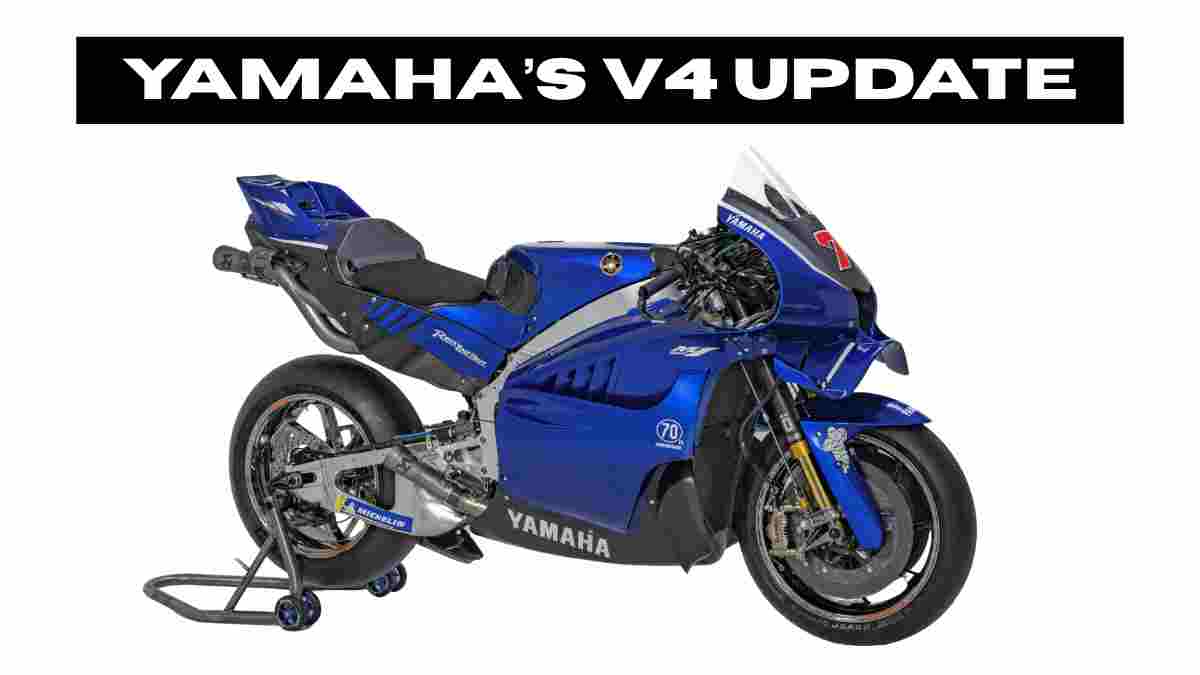
The decision by Yamaha Motor Co., Ltd. to abandon its long-standing reliance on the inline-four (I4) engine configuration for the YZR-M1 MotoGP machine marks one of the most significant strategic and engineering pivots in modern motorcycle racing history. This shift, culminating in the public unveiling of a V4-powered prototype in Misano in September 2025 1, represents a necessary organizational adaptation to the prevailing technical direction of the premier class.2
The Competitive Crisis Requiring Radical Change
Yamaha’s inline-four engine, historically revered for its rider-friendly handling characteristics and chassis agility, reached a critical competitive crossroads following the 2021 championship season.3 Since 2022, the I4 architecture has demonstrated an increasing inability to compete with rival European V4 machinery, struggling persistently with low top-end power and a chronic shortfall of rear tire grip.2 The M1’s performance has visibly declined on top speed charts, signaling that the platform’s once-lauded chassis dynamics could no longer compensate for its mechanical and aerodynamic deficits.2
Acknowledging this competitive failure, Yamaha quietly initiated parallel development of a V4 prototype alongside the existing I4 program, thereby breaking two decades of dedicated tradition.2 This aggressive move is not merely an engine swap; it signifies a total organizational restructuring and a commitment to a new “more aggressive approach” to motorcycle innovation.1 The prototype’s early debut at Round 16 of the 2025 MotoGP World Championship reflects Yamaha’s profound long-term commitment, explicitly targeting competitive relevance in the 2026 and 2027 seasons.1

Summary of V4 Technical Advantages Sought
The adoption of the V4 configuration is a foundational engineering response intended to solve the I4’s principal competitive deficiencies. The V4 offers inherent advantages in three critical areas: longitudinal compactness, a narrower frontal profile, and superior power pulse management.7
The fundamental competitive deficiency of the I4 M1 was its inability to effectively manage the dynamic interaction between engine torque, chassis flex, and modern Michelin tire slip requirements.3 The shift to the V4 architecture facilitates an essential adjustment in how power is delivered to the track surface. While the I4’s characteristic provided a long, continuous application of torque, which complicated the management of sliding friction, the V4 configuration is inherently better suited for tailoring short, intense power pulses (often called Big Bang or Twin Pulse firing orders).10 This specialized delivery mechanism introduces longer, torque-free intervals, allowing the rear tire sufficient time to transition back to the higher coefficient of static friction before the next powerful pulse begins.
This optimized power management capability is the cornerstone of achieving superior corner-exit acceleration and drive, an attribute exemplified by rival manufacturers who have utilized the V4 for over a decade.9 The V4 is therefore strategically employed as a compliance mechanism, enabling advanced electronic control and maximizing tire performance, which the I4 platform could not effectively achieve within the current regulatory and aerodynamic framework.
II. The Crossplane Conundrum: Physics and Packaging Limitations of the I4 M1
The competitive obsolescence of the Yamaha YZR-M1’s inline-four (I4) configuration stems from fundamental physics-based constraints related to crankshaft architecture and engine packaging. Even the introduction of the acclaimed Crossplane Crankshaft (CP4) design proved insufficient to overcome these inherent limitations in the context of modern MotoGP demands.
The Inertial and Gyroscopic Penalty
A crucial differentiator between the I4 and the V4 is the crankshaft architecture. The conventional I4, even with a crossplane design, employs a substantially longer crankshaft that requires five main bearings to maintain stability.3 In contrast, the V4 engine is typically designed with a shorter, stiffer crankshaft utilizing only three main bearings.3
The physical length and corresponding mass of the I4’s crankshaft contribute to a significantly higher moment of inertia and a greater gyroscopic moment.11 While this effect historically provided a distinct advantage, enhancing mid-corner stability and facilitating the high-flowing, stable riding style perfected by riders like Jorge Lorenzo 4, it is inherently detrimental to the agility required for modern, rapid directional changes. The I4’s high gyroscopic forces actively resist the fast turn-in and quick left-right transition maneuvers necessary in high-speed chicanes, effectively sacrificing the dynamic agility required to maximize corner exit speed.11
Furthermore, the operational dynamics of the I4 engine introduce an unfavorable characteristic known as piston inertia torque. In a flat-crank I4, all pistons halt simultaneously at Top Dead Center (TDC) and Bottom Dead Center (BDC). This massive exchange of kinetic energy must be absorbed by the crankshaft and transmitted through the chassis.3 This requirement imposes constraints on engine braking consistency and the bike’s ability to “turn” under heavy trail braking, a technique essential to maximizing corner entry speed in contemporary MotoGP.3 The V4 design, particularly in a 90-degree configuration, manages this energy exchange more efficiently by allowing pistons to exchange kinetic energy with each other, minimizing the forces transmitted to the chassis.3
The Failure of the Crossplane Solution
The introduction of the Crossplane Crank (CP4) design—derived from earlier MotoGP technology and adopted for production models like the R1 starting in 2009 12—was Yamaha’s sophisticated attempt to mitigate the I4’s shortcomings. The CP4 aimed to mimic the superior power pulse interval quality of a V-engine, distributing torque delivery more effectively to enhance traction (the “Big Bang” effect).9
However, despite the CP4’s success in improving torque quality, the M1 platform remained constrained by the insurmountable physical size of the I4 configuration. The core geometric issue is the engine width; the I4 is physically “twice as wide across the front of the bike” compared to a V4.13 In an era where competitive parity is defined by sophisticated aerodynamics and straight-line speed, this wide frontal area creates excessive drag. This configuration serves as a significant aerodynamic handicap, resulting in the widely reported, consistent top speed deficit that Yamaha struggled to eliminate.2
Analysis of the competitive environment demonstrates a clear outcome: even as Yamaha engineers succeeded in improving the I4’s peak power output 3, the benefit of those power increases was negated by the engine’s inherent width, rendering the power inefficient compared to the aerodynamic advantage provided by the narrower V4 architecture.13 This physical dimension constraint ultimately proved the limiting factor for the I4’s continued viability in the premier class. The technical analysis confirms that the I4’s glory days in the world of racing are “well and truly behind it”.7
Chronic Rear Grip Deficiency
Underlying all performance metrics was the M1’s consistent, central problem: a “shortfall of rear tire grip,” particularly when accelerating out of corners.3 The inertial properties and mass distribution of the I4 prevented the chassis from optimally transferring engine power to the rear tire during aggressive acceleration.9 The physical limitations of the I4 configuration, coupled with the inability to produce the necessary torque pulses to manage tire slip effectively, resulted in reduced drive and increased tire wear compared to V4 rivals.
The confluence of these factors—high inertial penalties, significant aerodynamic drag, and poor rear grip management—created an inescapable causality chain: the I4’s inherent width and long crankshaft led to compromised agility and suboptimal power pulse management, which culminated in the chronic grip deficit. This systemic failure mandated a transition to the V4, the only architecture capable of addressing these multi-faceted performance inhibitors simultaneously.

III. The V4 Architecture: Engineering Advantages and Design Philosophy
Yamaha’s adoption of the V4 engine configuration, as evidenced by the YZR-M1 prototype, is predicated on achieving superior geometric packaging and optimizing power delivery dynamics—two areas where the I4 platform failed to keep pace with modern competitive requirements.
Geometric and Packaging Superiority
The V4’s key structural advantage is its physical orientation. Being fundamentally narrower than an inline-four, the V4 allows for superior integration with contemporary aerodynamic solutions, enabling manufacturers to minimize the frontal area of the motorcycle.8 This reduction in drag is vital for eliminating the historical top speed deficit and maximizing straight-line performance.
Additionally, the V4 configuration is shorter in the longitudinal axis compared to the I4, providing enhanced compactness. This feature offers engineers significantly greater freedom in engine placement within the twin-spar aluminium Deltabox frame.14 The ability to reposition the engine allows for precise tuning of the center of gravity (CG) and optimal weight distribution.8 Renowned engineer Julius Bernardelle notes that the evolution of modern MotoGP chassis, which feature longer wheelbases, accommodates the V4 engine without the handling drawbacks that might have characterized earlier designs, making the benefits of narrowness and CG placement paramount.8 Furthermore, modern V4 designs, like those utilized by leading competitors, integrate the engine as a highly stressed structural member of the frame.17 This integration increases overall rigidity and contributes to the machine’s handling precision, a concept Yamaha has utilized historically with its Deltabox frame designs.19
Optimized Power Pulse Delivery and Traction Control
The V4 configuration facilitates the most potent and controllable method of power delivery in contemporary MotoGP: the Big Bang or Twin Pulse firing order. The V4 design allows engineers to cluster the ignition events closely together, followed by a substantial, torque-free interval. For instance, a common Big Bang arrangement fires all four cylinders within approximately 68 crank degrees, followed by a long interval of 292 crank degrees during which no engine torque is applied to the drivetrain.10
This long ‘downtime’ period is critical for maximizing rear tire traction. It permits the tire to relax, cool marginally, and regain the significantly higher coefficient of static friction, rather than maintaining continuous sliding friction.9 The subsequent short, powerful burst of torque is then applied to this reestablished grip, resulting in vastly superior corner exit acceleration and drive compared to the I4’s continuous delivery. The ability to manage power in discrete bursts also aids in preserving tire life over race distance.9
Further mechanical advantages arise from the V4’s robust design. The short and stiff V4 crankshaft is torsionally stable up to extreme rotational speeds, often exceeding 18,000 RPM, providing a margin of reliability that the longer I4 crank cannot match.3 The V4 also benefits from having fewer main bearings than the I4, reducing internal mechanical losses and maximizing the engine’s mechanical efficiency.8 The analysis strongly suggests that Yamaha is moving toward the 90-degree V angle, which is the industry standard due to its capacity for ideal primary balance and optimized torque distribution when paired with a specific crankpin timing (e.g., approximately 70 degrees).8
Historical Context of Yamaha V4 Engines
While Yamaha’s recent MotoGP history has been defined by the I4, the company has a substantial engineering heritage with the V4 layout. In Grand Prix racing, the 500cc YZR500 (0W81) utilized a liquid-cooled, 2-stroke V4 engine in the mid-1980s.20 Notably, this machine employed a unique twin-shaft crank design where the front and rear shafts revolved in opposite directions, specifically engineered to mitigate the negative effects of the gyroscopic moment on handling stability.17 This successful platform powered Eddie Lawson to the 500cc World Championship title in 1986.17 Outside of racing, the iconic V-Max muscle bike, introduced in 1985, also featured a tuned, liquid-cooled V4 derived from Yamaha’s luxury touring models, underscoring the company’s long-standing proficiency in designing and producing high-performance V4 powerplants.21
V4 Disadvantages and Mitigation Strategies
The transition to the V4 layout is not without its technical drawbacks, primarily centered on heat management, complexity, and cost.7 V4 engines are known to generate substantial heat, particularly from the rear bank of cylinders, which are positioned directly beneath the rider.7 This necessitates sophisticated thermal management solutions. Engineers must integrate efficient cooling systems and aerodynamic features designed not only to reduce drag but also to manage the exit airflow effectively, ensuring the intense heat does not compromise tire performance or rider comfort.3
Furthermore, V4 engines are intrinsically more complex and expensive to produce and maintain than the simpler I4 design.23 However, given the competitive necessity in a cost-insensitive environment like MotoGP, this added expense is considered an acceptable requirement for achieving competitive parity. The appointment of Massimo Bartolini, formerly a key technical director at Ducati, early in 2024 6 strongly suggests Yamaha is adopting the proven design philosophies and implementation strategies of the V4 leader, accelerating the learning curve necessary to mitigate the complexity inherent in this engine architecture.
IV. Developmental Timeline and Organizational Restructuring (2024–2026)
The development of the V4 YZR-M1 has followed an expedited timeline, marked by key organizational changes and a decisive acceleration of the project lifecycle.
The Covert Development and Strategic Hiring
The genesis of the V4 M1 was characterized by covert development, where the V4 prototype program ran parallel to the mainline I4 effort.2 Initial intentions may have been directed toward the 2027 technical regulation changes (850cc formula), but persistent performance shortfalls dictated an acceleration of the project.3
The strategic shift was formally underpinned by a reorganization of the racing division. Yamaha Motor Company’s General Manager of Motor Sports Development Division, Takahiro Sumi, and Yamaha Motor Racing Managing Director, Paolo Pavesio, have publicly emphasized a new structure and a “more aggressive approach” to bike development.1 Crucially, this new mindset was complemented by the recruitment of specialized external expertise, most notably Max Bartolini, a former technical director at Ducati, whose presence reinforces the commitment to a complete technical overhaul informed by rival V4 success.6
Key Development Milestones (2025)
The V4 prototype underwent extensive private validation prior to its public debut. Test Rider and Rider Performance Advisor Andrea Dovizioso, alongside Official MotoGP Test Rider Augusto Fernández, were key contributors to the V4 project.1 Dovizioso’s early feedback was notably encouraging, stating that upon first trying the prototype, he “liked it straight away” and consistently sensed “great potential”.24 Fernández was subsequently signed to continue as an Official Test Rider through 2027, demonstrating Yamaha’s long-term commitment to the personnel driving this transition.6
The project reached a critical inflection point with its public presentation and debut:
- Official Unveiling (September 11, 2025): The V4-powered YZR-M1 prototype was officially unveiled at the Misano World Circuit Marco Simoncelli, signaling a “historic shift in the firm’s MotoGP direction”.1
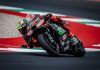
- Competitive Debut (San Marino GP, September 2025): Augusto Fernández piloted the V4 prototype as a wild card entry during the Grand Prix of San Marino.1 Management stressed that the sole purpose of this wild card entry was essential data gathering in a race-weekend environment, rather than immediate competitive results.6
- Post-Race Testing: Full-time factory riders Fabio Quartararo and Álex Rins subsequently had the opportunity to publicly test the new machine during the post-race San Marino MotoGP Test.1
Table IV.A summarizes the critical milestones of this accelerated transition.
Table IV.A: Timeline of Yamaha’s V4 Prototype Deployment
| Date/Period | Event/Phase | Key Development Status | Source |
| Pre-2025 Season | Covert Development | V4 prototype developed parallel to I4 program, possibly accelerated from 2027 concept | 2 |
| Early 2025 | Organizational Shift | Max Bartolini appointed Technical Director; new ‘aggressive approach’ declared | 5 |
| Q3 2025 | Private Testing/Validation | Extensive running by Dovizioso & Fernández; Dovizioso reports “great potential” | 6 |
| Sept 11, 2025 (Round 16) | Official Unveiling | V4-powered YZR-M1 prototype publicly presented at Misano | 1 |
| Sept 2025 (Race Weekend) | Wildcard Debut | Augusto Fernández races V4 prototype; sole purpose is data gathering | 6 |
| Post-Misano GP | Race Rider Testing | Full-time riders test V4; Quartararo expresses muted first verdict | 28 |
| 2026 Season | Target Implementation | Full shift to V4 platform and associated chassis package | 30 |
Regulatory Constraints on Immediate Deployment
Despite benefiting from the full extent of MotoGP’s concession perks, which normally permit flexible engine specification changes, Yamaha’s full-time race riders are legally prohibited from racing the new V4 prototype for the remainder of the 2025 season.26
This restriction is not rooted in engine homologation, as concession rules allow for new engine specifications to be introduced, but rather in gearbox regulation. According to item 2.4.3.9 of the MotoGP rulebook, all gear ratios must be declared and homologated before the first race of the season.26 A V4 engine platform, with its fundamentally different power delivery curve and optimal operating range compared to the I4, requires an entirely new set of optimized gear ratios. Because the factory race team is locked into the I4’s gearbox ratios for the season, the V4 engine cannot be deployed in race spec without incurring substantial penalties.26 This regulatory hurdle underscores the comprehensive nature of the V4 project, confirming the statement from Yamaha management that this is “an entire bike, not just an engine”.30 Therefore, the 2026 season remains the necessary target for the competitive integration of the V4 platform.
V. Prototype Analysis and Immediate Technical Hurdles
The early competitive exposure of the V4 prototype has yielded valuable data but highlighted significant developmental challenges that must be addressed before the machine can fulfill its potential.
Misano Competitive Debut Review
Augusto Fernández’s wild card appearance at the San Marino Grand Prix provided the first competitive stress test for the V4 M1. The weekend proved challenging, with the performance falling “below expectations”.27 Fernández finished 18th in the sprint race (28 seconds behind the winner) and finished 14th in the main race, 61.5 seconds off the lead.3 While the initial practice sessions showed fleeting promise (lapping six tenths off Fabio Quartararo’s I4 pace) 27, the extended race distance exposed significant developmental gaps. The measured results confirm the project is still at a nascent stage, focused strictly on data acquisition rather than race optimization.6
The Rider Feedback Contradiction: Potential vs. Reality
One of the most informative outcomes of the Misano test was the contradictory feedback provided by Yamaha’s riders, which helps precisely pinpoint the current stage of development.
On one hand, Test Rider Andrea Dovizioso, whose role centers on developmental discipline and assessing platform potential, reported immediate affinity for the new machine, stating he “liked it straight away” and consistently sensed “great potential”.24 This positive assessment validates that the core mechanical shift—the V4 engine itself—is moving in the correct theoretical direction and possesses the desirable characteristics (e.g., responsive power delivery, better inertial behavior) sought by the engineers.
On the other hand, Fabio Quartararo, the team’s championship-winning reference rider, delivered a muted first verdict, admitting he felt “worse” on the V4 prototype than on his current I4 M1.28 Crucially, Quartararo asserted that the V4 machine suffers from the “same problems” as the inline-four.3
This apparent contradiction is highly instructive. It implies that the engineering challenge is no longer primarily engine performance, but rather the highly complex task of chassis-engine integration. The raw potential of the V4 engine is present (as noted by Dovizioso), but the overall machine package—including geometry, electronics mapping, and suspension kinematics—remains unoptimized. The prototype may currently be housed in a frame that retains stiffness properties or inertial biases designed for the long I4 engine, preventing the V4’s low inertia and favorable mass centralization from translating into tangible lap time improvements or solving the historical rear grip issues.18 Quartararo’s feedback signals that the primary hurdle has shifted from a raw power deficit to a dynamic setup and calibration challenge, demanding exhaustive focus on chassis design and electronic synergy moving forward.
Engineering Challenges: Chassis Rigidity and Packaging
The transition requires a complete reassessment of the motorcycle’s architecture. The V4 is utilized as a structural member, necessitating a redesigned Deltabox frame to capitalize on its rigidity and compactness.1 Engineers must manage the complex task of optimizing chassis geometry, stiffness, and balance around the new center of mass provided by the V4.18
Furthermore, the shift fundamentally alters the packaging of ancillary components. The relocation of items such as the airbox, cooling systems, and the fuel tank (which is often positioned lower and toward the rear in V4 designs to reduce CG) introduces complex thermal and logistical constraints.13 Effective thermal management is critical due to the heat generated by the rear V-bank.7 The team director for Pramac Yamaha (a potential partner team) noted during testing that while they found strong points, they affirmed that there is “still a lot to do” to refine the overall package.31
The shift highlights the definitive performance differences between the two layouts, as summarized in the comparison below.
Table V.A: Technical Comparison: I4 (Crossplane) vs. Modern MotoGP V4
| Technical Parameter | Yamaha Inline-Four (M1) | Modern MotoGP V4 (Target) | Performance Impact / Rationale for V4 Shift |
| Engine Width / Packaging | Wide (Aerodynamic disadvantage) | Narrower, optimizing frontal area | Reduced drag, superior top speed, and improved aero integration 8 |
| Crankshaft Length | Long (5 Main Bearings) | Short (3 Main Bearings typical) | Higher torsional stiffness, lower internal losses, capacity for higher RPMs 3 |
| Engine Inertia | High Inertia/Gyroscopic Moment | Lower Inertia/Gyroscopic Moment | I4 favors stability; V4 favors agility, faster acceleration, and quick direction changes 11 |
| Power Pulse Delivery | CP4 attempts V4 pulses but limited by inertia/crank length | Easily tailored (Big Bang/Twin Pulse) for long torque-free intervals | V4 maximizes rear tire static friction and corner exit drive 9 |
| Mass Centralization (CG) | High (due to I4 height) | Lower CG achievable (especially with 90° V angle) | Enhanced handling, quicker transitions, better feel for grip limits 16 |
| Development Cost/Complexity | Lower production cost, easier maintenance | Higher production cost, complex maintenance, heat management critical | 7 |
VI. Strategic Roadmap and Future Competitive Edge (2026/2027 Outlook)
Yamaha’s V4 project is a massive strategic and financial investment designed for competitive longevity. The roadmap centers on intensive refinement to fully leverage the V4’s inherent engineering superiority.

The 2026 Full Deployment Target
Yamaha management has been clear that a switch to the V4 platform in the 2025 season is “unrealistic”.30 The current focus is strictly developmental, ensuring that the V4 package is demonstrably superior to the current I4 M1 before any full deployment. The 2026 season represents the critical target for full competitive integration, which includes the necessary changes to the gearbox and aerodynamic package.6
The long-term nature of this commitment is confirmed by the extended contracts for key test riders Andrea Dovizioso and Augusto Fernández, who are slated to continue their pivotal roles in the V4 project through 2026 and 2027.6 This stability in the testing team ensures continuous, high-quality feedback necessary for fine-tuning the complex new platform.
Maximizing the V4’s Competitive Edge
The immediate post-prototype goals are focused on translating the V4’s theoretical engine advantages into measurable lap time gains through chassis and electronics optimization.
- Traction Management Refinement: The foremost priority is the complete resolution of the rear grip deficiency that plagued the I4. The V4’s capacity for tailored power pulses must be fully utilized by fine-tuning the firing order and optimizing the sophisticated Marelli ECU electronics. This involves precisely managing the torque delivery bursts to maximize the period when the rear tire recovers static grip, thereby achieving superior corner-exit drive.9
- Aerodynamic Exploitation: The narrower V4 profile must be leveraged to its maximum potential. Future development must focus on aggressive aerodynamic solutions to minimize drag and enhance downforce, permanently eliminating the historical disadvantage on top speed charts.8
- Chassis Geometry Finalization: Addressing Quartararo’s feedback requires intensive engineering effort to recalibrate chassis stiffness, swingarm geometry, and weight bias to synchronize with the V4’s low inertia and centralized mass distribution.18 The experience gained from the hiring of technical personnel like Bartolini will be invaluable in adopting successful engine-chassis integration models utilized by rivals.
Strategic Implications and Projections
The decision to adopt the V4 architecture represents a fundamental philosophical shift for Yamaha in MotoGP. The racing strategy is pivoting away from maximizing mid-corner speed (the strength of the highly stable I4) toward maximizing corner exit acceleration and drive (the strength of the V4, aligned with modern braking-and-acceleration riding styles).
This comprehensive investment validates the technical assessment that the I4 platform was competitively non-viable for sustained success at the highest level.2 The divergence in rider feedback—Dovizioso validating the engine’s raw potential, and Quartararo identifying persistent systemic flaws—provides a clear development roadmap. It confirms that the engine architecture is sound, but the entire motorcycle system (chassis, swingarm, and electronics synergy) requires complete recalibration to fully exploit the V4’s dynamic benefits.24
A successful transition is projected to deliver competitive parity in top speed, significantly superior corner exit drive, and enhanced tire longevity due to the improved management of the power pulse delivery.9 This alignment with the industry-standard architecture is the necessary step for Yamaha to reestablish itself among the leading factory teams in the 2026 and 2027 seasons.
Sources
- The Start of a New Era: Yamaha Unveil V4-Powered YZR-M1 in Misano – Racing Information, accessed October 30, 2025, https://global.yamaha-motor.com/race/release/2025/023/
- HUGE NEWS: Yamaha’s V4 MotoGP BEAST Finally Revealed! – YouTube, accessed October 30, 2025, https://www.youtube.com/watch?v=lEce7Nnd_Po
- Will the V4 YZR-M1 Solve Yamaha’s MotoGP Problems? – Cycle World, accessed October 30, 2025, https://www.cycleworld.com/blogs/ask-kevin/yamaha-v4-yzr-m1-motogp-racer-unveiled-misano/
- Why inline-four MotoGP bikes handle better than V4 MotoGP bikes – Motor Sport Magazine, accessed October 30, 2025, https://www.motorsportmagazine.com/articles/motorcycles/motogp/why-inline-four-motogp-bikes-handle-better-than-v4-motogp-bikes/
- Yamaha Motor Co., Ltd. unveiled its V4-powered YZR-M1 today in Misano. The presentation of the prototype so early in the 2025 season underlines Yamaha’s bold new approach to bike development. The V4 prototype will be seen in action around the Misano World Circuit Marco Simoncelli this weekend, piloted by Yamaha Factory Racing Test Team’s Augusto Fernández, who enters the Grand Prix of San Marino as a wild card. Fabio Quartararo and Álex Rins will also have a chance to ride the new prototype again, this time in public during Monday’s San Marino MotoGP Test. – Monster Energy Yamaha MotoGP, accessed October 30, 2025, https://www.yamahamotogp.com/2025/newsletter/yfrt/en/250910164414570/11-09-2025-the-start-of-a-new-era-yamaha-unveil-v4-powered-yzr-m1-in-misano
- The Start of a New Era:
Yamaha Unveil V4-Powered YZR-M1 in Misano, accessed October 30, 2025, https://www.yamahamotogp.com/news/11-09-2025-the-start-of-a-new-era-yamaha-unveil-v4-powered-yzr-m1-in-misano - Inline-four versus V4 – What’s the difference? – MotoDeal, accessed October 30, 2025, https://www.motodeal.com.ph/articles/motorcycle-features/inline-four-versus-v4-whats-difference
- MotoGP: Why Yamaha would have finally chosen the V4? The advantages explained, accessed October 30, 2025, https://www.paddock-gp.com/en/motogp-pourquoi-yamaha-aurait-finalement-choisi-le-v4-les-avantages-expliques/
- How does one motor accelerates faster than the other one out of the corner? : r/motogp, accessed October 30, 2025, https://www.reddit.com/r/motogp/comments/1npemm6/how_does_one_motor_accelerates_faster_than_the/
- What Is Big Bang Firing Order? | Cycle World, accessed October 30, 2025, https://www.cycleworld.com/blogs/ask-kevin/motorcycle-big-bang-firing-order-explained/
- I4 vs V4? : r/motogp – Reddit, accessed October 30, 2025, https://www.reddit.com/r/motogp/comments/r0su0b/i4_vs_v4/
- History of Yamaha in MotoGP | Models, liveries, riders & more – Bennetts Insurance, accessed October 30, 2025, https://www.bennetts.co.uk/bikesocial/news-and-views/features/racing/history-yamaha-motogp
- Why have Yamaha persisted with the inline 4-cylinder? : r/motogp – Reddit, accessed October 30, 2025, https://www.reddit.com/r/motogp/comments/17pxiyl/why_have_yamaha_persisted_with_the_inline/
- Yamaha YZR-M1 – Wikipedia, accessed October 30, 2025, https://en.wikipedia.org/wiki/Yamaha_YZR-M1
- Thoughts on Yamaha using a VR4 setup? : r/motogp – Reddit, accessed October 30, 2025, https://www.reddit.com/r/motogp/comments/1fsjrmh/thoughts_on_yamaha_using_a_vr4_setup/
- The real reasons Yamaha built a V4 MotoGP bike – Motor Sport Magazine, accessed October 30, 2025, https://www.motorsportmagazine.com/articles/motorcycles/motogp/the-real-reasons-yamaha-built-a-v4-motogp-bike/
- YZR500(0W81) – Racing Information | Yamaha Motor Co., Ltd., accessed October 30, 2025, https://global.yamaha-motor.com/race/wgp-50th/race_archive/machines/yzr500_0w81/
- Yamaha’s V4 is two seconds a lap slower than current MotoGP bike, says Alex Rins – Reddit, accessed October 30, 2025, https://www.reddit.com/r/motogp/comments/1lwizma/yamahas_v4_is_two_seconds_a_lap_slower_than/
- Frame Technology Christened in Salzburg – Yamaha Motor Co., Ltd., accessed October 30, 2025, https://global.yamaha-motor.com/design_technology/technology/chassis_hulls/001/
- 1986 YZR500 (0W81) – Communication Plaza | Yamaha Motor Co., Ltd., accessed October 30, 2025, https://global.yamaha-motor.com/showroom/cp/collection/racing_yzr500_0w81_2/
- Yamaha’s V-Max was the motorcycle that thought it was a muscle car | Hagerty UK, accessed October 30, 2025, https://www.hagerty.co.uk/articles/motorcycles/yamahas-v-max-was-the-motorcycle-that-thought-it-was-a-muscle-car/
- Yamaha VMAX – Wikipedia, accessed October 30, 2025, https://en.wikipedia.org/wiki/Yamaha_VMAX
- Is the V4 engine only for racing? | V4 Disadvantages | Inline-Four vs V4 #ducati #motogp #racing – YouTube, accessed October 30, 2025, https://www.youtube.com/watch?v=RztLHVeUKn0
- Yamaha Enters Its V-4 MotoGP Era With New YZR-M1 – Motorcyclist, accessed October 30, 2025, https://www.motorcyclistonline.com/news/yamaha-yzr-m1-v-4-engine-testing-at-misano/
- V4-Powered Yamaha YZR-M1 Revealed – Motorcycle.com, accessed October 30, 2025, https://www.motorcycle.com/bikes/news/v4-powered-yamaha-yzr-m1-revealed-44648806
- Why Yamaha’s main riders can’t race its new V4 MotoGP bike this year, accessed October 30, 2025, https://www.the-race.com/motogp/why-yamahas-main-riders-cant-race-its-new-v4-motogp-bike-this-year/
- Setback for Yamaha as Augusto Fernandez endures “long, hard” day on V4-powered M1, accessed October 30, 2025, https://www.motorsport.com/motogp/news/setback-for-yamaha-as-augusto-fernandez-endures-long-hard-day-on-v4-powered-m1/10759205/
- Where Yamaha’s new V4 MotoGP bike really stands – YouTube, accessed October 30, 2025, https://www.youtube.com/watch?v=byj-856rAVA
- Fabio Quartararo feeling “worse” on Yamaha’s V4 MotoGP bike: It won’t solve all our issues, accessed October 30, 2025, https://www.motorsport.com/motogp/news/fabio-quartararo-feeling-worse-on-yamahas-v4-motogp-bike-it-wont-solve-all-our-issues/10759653/
- Yamaha: “Unrealistic” to think about V4 engine switch in 2025 – Motorsport.com, accessed October 30, 2025, https://www.motorsport.com/motogp/news/yamaha-unrealistic-to-think-about-v4-engine-switch-in-2025/10697771/
- First Laps, New Era: Jack Miller Tests Yamaha’s YZR-M1 V4 Prototype at Misano, accessed October 30, 2025, https://www.yamaha-racing.com/news/motogp/first-laps-new-era-jack-miller-tests-yamahas-yzr-m1-v4-prototype-at-misano/
- Why are MotoGP V4s faster than inline-4s? – Motor Sport Magazine – Reddit, accessed October 30, 2025, https://www.reddit.com/r/motogp/comments/es147i/why_are_motogp_v4s_faster_than_inline4s_motor/
Our Social Media Handles
- Instagram : LivingWithGravity
- Medium : Akash Dolas
- YouTube Channel : Gear and Shutter
- Facebook : LivingWithGravity