








I. Executive Summary: The Definitive Shift in Control and Strategic Mandate
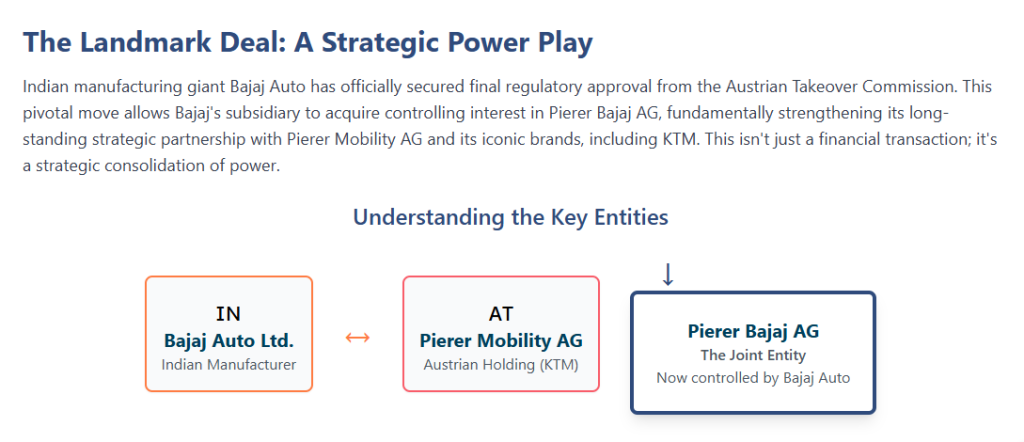
The strategic partnership between Indian motorcycle manufacturer Bajaj Auto Limited and Austrian premium giant PIERER Mobility AG (PMAG), the corporate entity behind the KTM, Husqvarna, and GasGas brands, has entered a decisive phase. Bajaj Auto International Holdings B.V. (BAIH), a wholly-owned subsidiary of Bajaj Auto, secured the critical restructuring privilege confirmation from the Austrian Takeover Commission (OTC) on October 23, 2025.1 This regulatory milestone eliminates the primary barrier to BAIH acquiring sole control over Pierer Bajaj AG (PBAG) and, by extension, establishing definitive operational stewardship over the entire PIERER Mobility Group.3
This successful acquisition of regulatory clearance is the critical culmination of a substantial financial rescue effort, necessitated by the severe financial instability facing the KTM group. The intervention required a significant capital injection, estimated at €600 million, to settle outstanding creditor debt and prevent the insolvency or liquidation of the core motorcycle brands.5 The OTC ruling is predicated on this rescue context, granting a specific exemption that removes the legal obligation for BAIH to make a costly and complex mandatory takeover bid to the minority shareholders of the publicly traded PIERER Mobility AG.6
The strategic outcome is a profound transformation of the nearly two-decade-old relationship. Bajaj Auto is transitioning from being a high-volume manufacturing partner and a minority financial investor to assuming full corporate stewardship, dictating global strategic policy, capital allocation, and product roadmaps for one of Europe’s largest premium motorcycle conglomerates. This decisive action aligns with Bajaj’s objective of expanding its access to developed markets, protecting its significant existing investment, and leveraging deep synergies across R&D and manufacturing.7
II. Historical Foundation: The Bajaj-KTM Partnership (2007-2024)
The Genesis of the Collaboration and Operational Symbiosis
The strategic cooperation between Bajaj Auto and KTM began in the mid-2000s, rooted in a shared vision for joint development and manufacturing.8 This relationship quickly evolved into a powerful operational symbiosis. Bajaj Auto’s manufacturing prowess, particularly from its Pune-based facilities, became instrumental in enabling KTM to penetrate and dominate the crucial small-displacement, high-volume segments globally.
From 2012 onward, the partnership successfully focused on developing, producing, and exporting bikes for Europe and the Far East, specifically models such as the KTM 125, 200, and 390 Duke and Adventure machines.8 This collaboration allowed KTM to efficiently scale production in segments where European manufacturing was prohibitively expensive, simultaneously providing Bajaj Auto access to KTM’s advanced Research and Development (R&D) know-how for its own motorcycle developments.9
The Evolution of Ownership and Structural Complexity
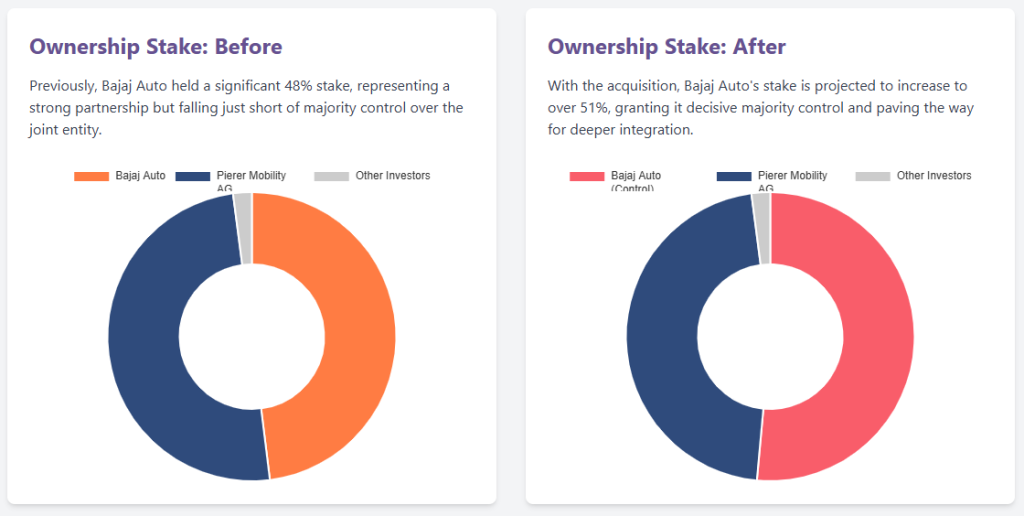
Prior to the current simplification, the ownership structure was complex and tiered. By 2020, Bajaj Auto International Holdings B.V. (BAIH) held a significant, yet non-controlling, stake of approximately 48% in the operating entity, KTM AG.11 Meanwhile, Pierer Industrie AG held the controlling majority (more than 60%) of the listed entity, PIERER Mobility AG (PMAG), which in turn held approximately 51.7% of the operating KTM AG.11
In late 2020, discussions began to simplify this structure by transferring Bajaj’s 48% stake in the operating KTM AG to the listed PIERER Mobility AG. Had this initial proposal been fully executed, PMAG’s stake in KTM AG would have increased from 51.7% to approximately 99.7%.11 However, the structure underpinning the current acquisition involves an intermediary holding company: Pierer Bajaj AG (PBAG). Pre-acquisition, Bajaj held 49.9% of PBAG, with the remaining 51.1% held by Pierer Industrie AG. Since PBAG holds a nearly 75% stake in PIERER Mobility AG (PMAG), Bajaj effectively had a 37.5% interest in PMAG and the KTM Group.1
For nearly two decades, Bajaj operated as the operational partner and a powerful minority investor.5 The strategic decision to acquire controlling interest in 2025 represents a fundamental pivot from this historical symbiotic joint venture relationship, which was primarily focused on market growth, to assuming full corporate stewardship. This pivot is centered on providing financial stability and dictating strategic policy, product roadmapping, and capital allocation for the entire KTM Group, signaling an end to the previous shared-control model.
III. The Context of Crisis: KTM’s Financial Stabilization Mandate
Analysis of Financial Distress and Insolvency Risk
The definitive move by Bajaj Auto to acquire control occurred amidst significant financial distress at PIERER Mobility AG. The Austrian group was undergoing a “self-administration” insolvency process 9, requiring aggressive restructuring efforts, including leadership changes, workforce reductions, and supply chain reorganization.12
The gravity of the situation was underscored by pointed criticism from Bajaj Auto’s Managing Director, Rajiv Bajaj, who attributed KTM’s financial troubles to severe strategic missteps by previous leadership. These errors included premature and costly diversification, specifically mentioning the entry into the electric bicycle business. Furthermore, he highlighted detrimental overproduction, which led to excessive dealer inventory (estimated at over a year’s worth of stock), and an overarching strategy that focused excessively on increasing company valuation rather than sustainable operational growth.12
The Debt Restructuring Requirement and Financial Intervention
The crisis reached a critical juncture requiring immediate and substantial external funding. A court-mandated order specified that KTM must settle 30% of outstanding creditor claims by May 23, 2025, to avoid the dire consequence of full insolvency and liquidation.5
To meet this non-negotiable deadline, Bajaj Auto executed a crucial financial intervention. The company injected a critical €600 million just days before the settlement deadline, which was instrumental in ensuring the survival and operational continuity of KTM, Husqvarna, and GasGas.5 This funding was facilitated by Bajaj Auto International Holdings B.V. (BAIH) securing an unsecured, one-year loan totaling €566 million from a consortium of international banks, including JPMorgan Chase, DBS Bank, and Citigroup Global Markets Asia.9 This initial injection was part of a larger, comprehensive funding strategy that included €200 million already made available, signaling a total recapitalization effort of approximately €800 million.1
The rationale for this substantial financial commitment was clear: safeguarding Bajaj Auto’s existing significant investment in KTM, which carried a substantial carrying value of ₹4,820.00 crore as of March 31, 2024.7
The causal relationship between this imminent financial collapse and the subsequent regulatory decision by the OTC is fundamental. The Austrian regulators recognized that the acquisition of control was essentially a rescue mission. Had the OTC enforced the traditional requirement for a costly and time-consuming mandatory takeover bid, it would have seriously undermined the necessary financial stabilization and delayed the injection of essential capital required to settle creditor debts. The decision to grant the restructuring privilege confirms that the acquisition was framed and executed as a vital financial stabilization measure, thereby legitimizing the avoidance of a payout to the remaining PIERER Mobility AG minority shareholders under the Austrian Takeover Act (ÜbG).
IV. Deconstructing the Corporate Action (Q2-Q4 2025)
The Ownership Pyramid: Mapping Control Pre- and Post-Transaction
The current transaction focuses on securing control of the holding company, Pierer Bajaj AG (PBAG), which acts as the direct controlling shareholder of the listed PIERER Mobility AG (PMAG).
Before the transaction, control of PBAG was split: Pierer Industrie AG, owned by Stefan Pierer, held 51.1%, granting it control. Bajaj Auto International Holdings B.V. (BAIH) held the minority stake of 49.9%.1 Since PBAG holds a nearly 75% stake in PMAG, control over PBAG dictates operational control over the entire group.1
The mechanism for the shift involves BAIH exercising a call option agreement dated May 22, 2025, to acquire the 50,100 shares (the 51.1% controlling interest) held by Pierer Industrie AG in PBAG.1 This move is supported by a prior investment decision by Bajaj Auto’s board in February 2025, which approved an investment of up to €150 million (₹1,364 crore) for investment opportunities, to be delivered in tranches.13
Upon completion, BAIH will hold 100% of PBAG.14 This absolute ownership of the controlling shareholder (PBAG) grants BAIH sole operational control of the KTM Group, including the KTM, Husqvarna, and GasGas brands.9
Bajaj Auto anticipates that the final conditions precedent will be satisfied by November 10, 2025, enabling BAIH to exercise the call option and finalize the control acquisition.3
The dramatic shift in corporate power structure can be precisely mapped by focusing on the PBAG holding company:
Table 1: Corporate Ownership Structure: Pre- and Post-Acquisition of Pierer Bajaj AG
| Entity | Stakeholder | Pre-Acquisition Stake in PBAG | Post-Acquisition Stake in PBAG | Effective Control over PMAG/KTM |
| Pierer Bajaj AG (PBAG) | Pierer Industrie AG | ~51.1% | 0% | Loss of Control |
| Pierer Bajaj AG (PBAG) | Bajaj Auto International Holdings B.V. (BAIH) | 49.9% | 100% | Gain of Sole Control |
| PIERER Mobility AG (PMAG) | Pierer Bajaj AG (PBAG) | ~75% | ~75% (Bajaj Controlled) | Sole Operational Control |
V. Regulatory Architecture and Compliance Deep Dive
The Restructuring Privilege under Austrian Law
The cornerstone of this transaction is the confirmation of the restructuring privilege by the Austrian Takeover Commission (OTC) on October 23, 2025.1 This ruling is an application of Section 25 para 2 of the Austrian Takeover Act (ÜbG), which allows for an exemption from the mandatory takeover bid rules (Section 22) in situations where control is acquired as part of a restructuring plan.6
The confirmation stipulates that BAIH is not obligated to make a mandatory takeover bid to the publicly listed shareholders of PIERER Mobility AG.6 This exemption is crucial, significantly streamlining the financial cost and administrative complexity associated with the acquisition. The privilege, however, is conditional upon the full exercise of the call option agreement within 20 trading days following two specific events: the non-prohibition of the merger under EU regulations and the fulfillment of all conditions precedent of the call option agreement.3
Global Regulatory Clearance
The acquisition required extensive clearance across multiple global jurisdictions, reflecting the widespread operational footprint of the KTM Group. Bajaj Auto successfully secured all necessary merger control approvals across key markets before approaching the OTC.2
Key approvals included: competition clearance from the Bundeswettbewerbsbehörde (BWB) in Austria (July 7, 2025), Polish Competition Authority (PCA) (July 16, 2025), US Federal Trade Commission (August 29, 2025), and authorities in Colombia, Saudi Arabia, and Turkey.3 Additionally, clearance under the Austrian Foreign Investment Control was granted by the Federal Ministry for the Economy, Energy and Tourism (July 30, 2025).3
The complexity and global reach of these regulatory requirements underscore the scale of the strategic shift that is occurring, validating the global market significance of the PMAG brands.
Table 2: Key Regulatory Approvals Secured for BAIH’s Acquisition of Control
| Regulatory Authority | Jurisdiction | Approval Type/Focus | Approval Date | Significance |
| Austrian Takeover Commission | Austria | Confirmation of Restructuring Privilege | October 23, 2025 | Exempts mandatory takeover bid for PMAG shareholders |
| Austrian Federal Ministry for the Economy, Energy and Tourism | Austria | Foreign Investment Control (FIC) | July 30, 2025 | Clearance under Austrian national security/investment review |
| Bundeswettbewerbsbehörde (BWB) | Austria | Merger Control | July 7, 2025 | Competition clearance in the primary operating market |
| Federal Trade Commission | U.S.A. | Merger Control | August 29, 2025 | Clearance for North American market presence |
| Superintendencia de Industria Comercio | Colombia | Merger Control | July 18, 2025 | Clearance for Latin American operations |
| Saudi General Authority for Competition (GAC) | Saudi Arabia | Merger Control | August 8, 2025 | Clearance for Middle Eastern markets |
| Turkish Competition Board | Turkey | Merger Control | September 18, 2025 | Clearance for key Eurasian markets |
The Critical Remaining Hurdle: EU Third Country Subsidies Regulation
Despite having secured standard merger control approvals worldwide, the final, critical condition precedent for closing the transaction is the non-prohibition of the merger pursuant to the European Union’s Third Country Subsidies Regulation (EU 2022/2560).3
This regulation introduces a unique geo-economic consideration into the closing process. The European Commission must scrutinize the significant financial support provided by BAIH, specifically the €600 million rescue loan and investment, to ensure that no distortive, unfair non-EU state subsidies were involved. This regulatory requirement is designed to protect the integrity of the European Single Market by preventing foreign entities, leveraging potential state support, from gaining undue competitive advantage over EU-based manufacturers, such as BMW Motorrad or Piaggio. The decision from the EU’s Directorate-General for Competition is therefore the penultimate step; upon receipt of the non-prohibition decision, BAIH will have 20 trading days to exercise the call option and formally complete the control acquisition.3
VI. Legal and Reporting Obligations Imposed by the Commission
The Austrian Takeover Commission, while granting the restructuring privilege, imposed several stringent conditions and requirements under Section 25 para 2 of the ÜbG, specifically designed to protect the financial interests of PIERER Mobility AG’s minority shareholders.6
Mandatory Transparency and Financial Disclosure
Upon finalizing the transaction, BAIH must immediately inform the OTC of the non-prohibition of the merger under the EU regulation and the fulfillment of all conditions precedent. Simultaneously, BAIH is obligated to immediately publish the change of control at PIERER Mobility AG.6 This ensures instant market transparency regarding the decisive shift in ultimate corporate power.
Furthermore, specific financial reporting is mandated regarding certain asset transactions. BAIH must report to the General Meeting of PIERER Mobility AG, following any possible acquisition of shares in MR IMMOREAL GmbH by KTM AG, detailing the terms and conditions of the acquisition, especially the purchase price.6 This measure prevents undisclosed valuation transfers or favorable side deals involving the company’s assets that could benefit previous controlling parties at the expense of PMAG shareholders.
Governing Economically Related Agreements
The most rigorous condition imposed for governance oversight is the reporting obligation regarding economically related agreements. BAIH and all legal entities acting in concert with it must report to the Takeover Commission and the General Meetings of PIERER Mobility AG on all agreements or legal transactions deemed economically related to the acquisition of control. This requirement applies to transactions concluded between BAIH/Bajaj and Dipl. Ing. Stefan Pierer or legal entities acting in concert with him, and extends up to and including December 31, 2026.6
This two-year reporting mandate establishes a powerful governance constraint. It is intended to prevent the departing majority shareholder (Pierer Industrie AG, controlled by Stefan Pierer) from securing hidden compensation or undisclosed financial benefits tied to the transfer of operational control, which would otherwise unfairly dilute the residual value held by remaining minority PMAG shareholders. This strict requirement ensures a clean and transparent exit process for the founder, mitigating potential conflicts of interest post-acquisition.
Table 3: Conditions Imposed by the Austrian Takeover Commission (ÜbG Section 25)
| Condition Category | Requirement Detail | Deadline/Trigger | Purpose (Minority Protection) |
| Mandatory Bid Exemption | Exercise the call option for 50,100 shares in PBAG in full. | Within 20 trading days following EU non-prohibition decision. | Formalizes the acquisition under the restructuring privilege; validates exemption. |
| Publication Obligation | Immediately inform the Commission and publish the change of control at PMAG. | Immediately following EU non-prohibition and fulfillment of conditions precedent. | Ensures immediate market transparency regarding the ultimate shift of power. |
| Reporting on MR IMMOREAL GmbH | Report terms (especially purchase price) of KTM AG’s possible acquisition of shares in MR IMMOREAL GmbH. | General Meeting of PIERER Mobility AG (following acquisition). | Prevents undisclosed valuation transfers or favorable deals involving company assets. |
| Economically Related Agreements | Report all economically related agreements between BAIH/Bajaj and Dipl. Ing. Stefan Pierer/Pierer Industrie AG. | Immediately after conclusion/execution; reporting to PMAG General Meetings. | Up to December 31, 2026 |
VII. Strategic Implications: Synergies and Market Positioning
R&D and Operational Synergies Post-Consolidation
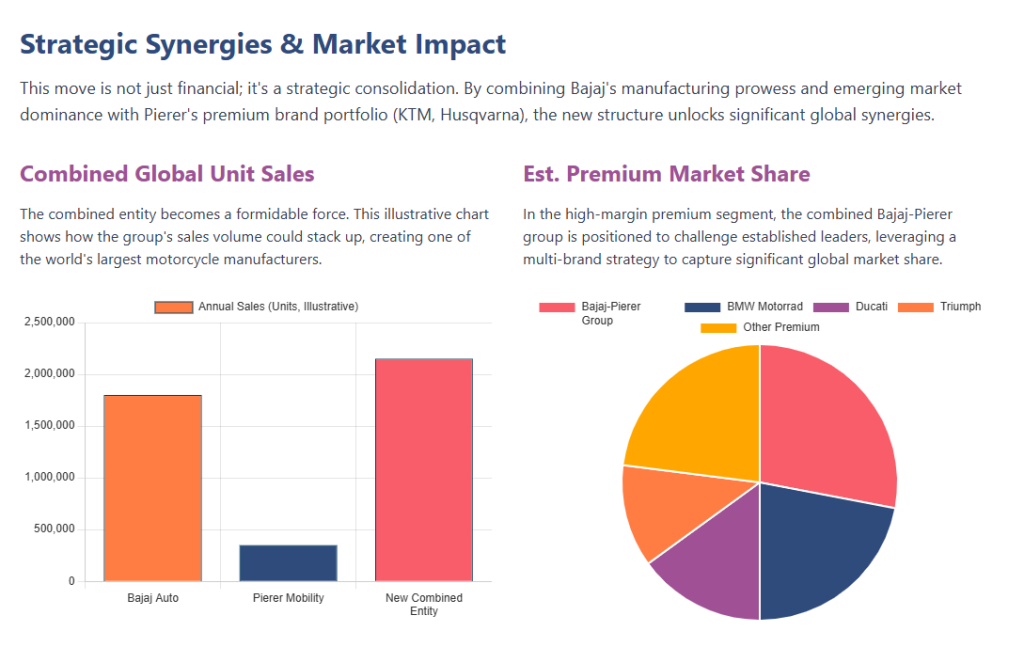
Gaining sole control allows Bajaj Auto to comprehensively integrate the operations of the KTM Group, maximizing the extraction of anticipated synergies across Research and Development (R&D), manufacturing, and sourcing.7 The overarching strategy is to widen the remit of the existing joint development program.5
Operationally, Bajaj Auto, which has historically manufactured the small-displacement, high-volume models 9, now achieves complete control over the entire supply chain, component sourcing, and production planning for both the high-volume and premium segments. This integration is designed to reduce costs through economies of scale and accelerate product development cycles by centralizing R&D policy between India and Austria. The financial stabilization, provided by the €600 million cash injection, directly facilitates the resumption of manufacturing and the stabilization of global supply chain operations.5
Global Market Access and Segmentation Strategy
The acquisition strengthens Bajaj’s strategic presence in two critical market dimensions. First, it solidifies its foothold in developed Western markets through the powerful premium brands of KTM, Husqvarna, and GasGas.3 Second, it leverages KTM’s premium image and technology transfer capabilities to enhance Bajaj’s position in high-growth emerging markets.
The Indian market, despite global economic challenges, has seen strong performance from KTM, reporting 70% year-on-year sales growth.12 Bajaj is capitalizing on this trend by launching KTM’s full global high-performance range in India, including motorcycles up to 1390cc.10 This action reinforces the commitment to nurture a vibrant community of biking enthusiasts and meet the rising domestic demand for high-performance motorcycles.10
Focus on Premiumization and New Product Roadmap
The success of Bajaj’s stewardship will depend on its ability to maintain KTM’s brand integrity as a premium, high-performance European manufacturer while simultaneously driving down costs. Financial stabilization has been immediately directed towards restarting production for the high-displacement, high-margin product roadmap.
Confirmed production schedules indicate a firm commitment to the premium identity, transitioning affected models from the 2025 to the 2026 model year following revised timelines.15 New premium models, such as the KTM 990 RC R, and the KTM 1390 Super Adventure S and R series, are confirmed to begin production in late Fall 2025 and Early Spring 2026.15 The timeline rationalization includes postponing the production of the KTM 1390 Super Duke GT to 2027.16
The strategic direction is fundamentally defined by a dual mandate: using Bajaj’s expertise to gain cost efficiency and scalability in low-displacement and electric vehicle (EV) platforms, while ensuring the timely, high-quality delivery of the confirmed premium, technologically innovative European models that are vital for maintaining the brand’s competitive advantage.
VIII. Accelerating the E-Mobility Roadmap
Strengthening E-Mobility Cooperation and Scale
A core component of the strengthened strategic cooperation is the development of electric products in the two-wheeler sector to capitalize on the growing global demand for innovative e-mobility concepts.17
The renewed strategy centers on jointly developing common electric platforms.17 This platform-sharing approach is crucial for achieving significant economies of scale across critical components, allowing both PIERER Mobility AG and Bajaj Auto to rapidly and effectively adapt to evolving customer needs worldwide.17 The technology focus includes an open approach to all battery opportunities, enabling the parallel deployment of both fixed and swappable battery solutions.17 The initial rollout of vehicles based on these shared platforms was targeted for the beginning of 2022.17
The future product strategy is aimed squarely at the light electric vehicle segment, focusing on urban settings and dense metropolitan areas.17 This focus leverages Bajaj’s extensive experience in high-volume, cost-effective manufacturing essential for scaling EV production.
De-Risking EV Investment through Stabilization
The financial stability provided by Bajaj’s acquisition is crucial for the success of this joint electric strategy. Previous leadership decisions, particularly the diversification into adjacent sectors like e-bicycles, were cited as contributors to the company’s recent financial turmoil.12 With Bajaj establishing control and injecting necessary capital, the EV initiative is de-risked and centralized. The strategy shifts from potentially haphazard, capital-draining diversification to a focused, scaled platform approach that utilizes Indian manufacturing capability for rapid global deployment in the mass-market EV space.
IX. Governance and Future Leadership
The change in control triggers significant and immediate shifts in corporate governance. A defining feature of the transition is the definitive departure of Dipl. Ing. Stefan Pierer, the individual largely credited with KTM’s growth over the past three decades. He is scheduled to step down from the executive board of Pierer Mobility once the restructuring process is completed, thus ensuring his full separation from the operational control of the KTM, Husqvarna, and GasGas brands.18
The current executive board leadership remains stable, led by CEO Gottfried Neumeister, who is focused on navigating the restructuring and implementing the turnaround strategy. This team is supported by the newly appointed Chief Legal Officer, Verena Schneglberger-Grossmann.18
Crucially, the acquisition of 100% control of the holding company, PBAG, provides BAIH with complete operational control. This grants BAIH the authority to dictate strategic decision-making, capital investment, and risk management across PIERER Mobility AG and all its subsidiaries (KTM AG, Husqvarna, GasGas), effectively concluding the former shared control dynamic.14
X. Conclusion and Recommendations for Stakeholders
Summary of Strategic Achievements
Bajaj Auto’s strategic decision to acquire definitive control over PIERER Mobility AG is a landmark move that capitalizes on a financial crisis to reshape the global competitive landscape of the premium motorcycle sector. By leveraging the urgent need for financial stabilization, Bajaj successfully navigated complex regulatory hurdles, securing the “restructuring privilege” from the Austrian Takeover Commission. This outcome is highly favorable, as it allows BAIH to transition from a powerful minority partner to a sole controlling owner without incurring the financial burden and timeline delays of a mandatory takeover bid for PMAG’s publicly traded shares.
The transaction is fundamentally a transformation from a high-trust manufacturing and R&D joint venture into a full vertical integration model. This integration is designed to safeguard Bajaj’s substantial historical investment while providing unfettered access to developed markets and advanced European engineering technologies.7
Outlook and Value Creation
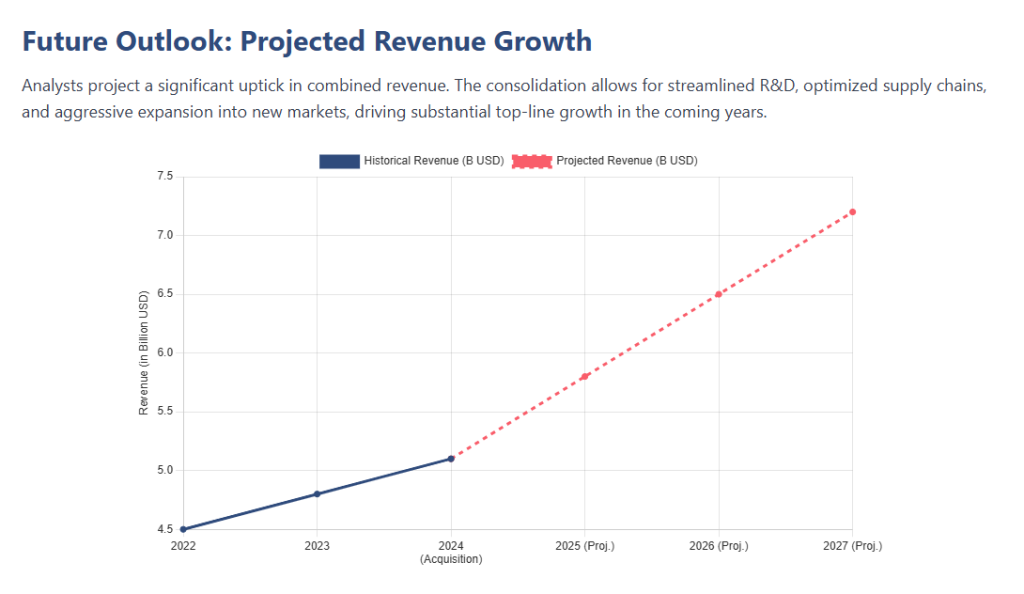
Long-term value creation for the combined entity rests on the successful execution of two distinct strategic pillars. Firstly, rapid operational improvements are expected through the implementation of cost and efficiency synergies across the R&D and supply chains, heavily utilizing Bajaj’s capacity for high-volume manufacturing of small-displacement and EV platforms. Secondly, profitability depends critically on maintaining the premium identity and technological leadership of the KTM, Husqvarna, and GasGas brands, ensuring that the integration process does not compromise the quality or market positioning of the high-margin 2026 model year products now slated for production restart.
Risk Assessment and Recommendations
For institutional stakeholders and investors, the following risks require careful monitoring:
- Regulatory Closing Risk (High Immediacy): The immediate, remaining hurdle is securing the non-prohibition decision from the European Commission under the Third Country Subsidies Regulation (EU 2022/2560).3 Any delays or prohibitions could jeopardize the final execution of the call option and the control transfer timeline.
- Integration and Cultural Risk (High Long-Term): The challenge of integrating an Indian volume manufacturer’s philosophy with a European premium engineering house’s ethos is substantial. Successful execution requires sensitive brand management to realize efficiency gains without diluting the core premium “Ready to Race” identity of KTM.
- Governance Transparency Risk (Moderate Oversight): While the OTC imposed strict two-year reporting requirements on all economically related agreements involving Dipl. Ing. Stefan Pierer 6, stakeholders must actively monitor these disclosures until December 31, 2026, to ensure complete governance integrity and confirm that no conflicts of interest arise that could prejudice PMAG’s minority shareholders.
The overall recommendation is that this acquisition provides the necessary financial stability and a clear mandate for operational efficiency that PIERER Mobility AG desperately required. The success of this corporate alignment hinges on Bajaj Auto’s ability to execute its dual strategy: simultaneously scaling its EV and small-displacement manufacturing while flawlessly sustaining the premium engineering and product fulfillment of KTM’s high-performance motorcycles.
Source
- Bajaj Auto unit gets regulatory nod in Austria to control Pierer Mobility – Business Standard, accessed October 26, 2025, https://www.business-standard.com/companies/news/bajaj-auto-unit-gets-regulatory-nod-in-austria-to-control-pierer-mobility-125102400797_1.html
- EQS-Adhoc: PIERER Mobility AG: Takeover Commission confirms restructuring privilege for acquisition of control by Bajaj Auto International Holdings B.V. – APA-OTS, accessed October 26, 2025, https://www.ots.at/presseaussendung/EQS_20251023_EQS0008/eqs-adhoc-pierer-mobility-ag-takeover-commission-confirms-restructuring-privilege-for-acquisition-of-control-by-bajaj-auto-international-holdings-bv
- Bajaj Auto Secures Austrian Regulatory Approval for Pierer Bajaj AG Control, accessed October 26, 2025, https://scanx.trade/stock-market-news/corporate-actions/bajaj-auto-secures-austrian-regulatory-approval-for-pierer-bajaj-ag-control/22843572
- Bajaj Auto unit gets regulatory nod in Austria to take control over Pierer Mobility AG, accessed October 26, 2025, https://m.economictimes.com/industry/auto/auto-news/bajaj-auto-unit-gets-regulatory-nod-in-austria-to-take-control-over-pierer-mobility-ag/articleshow/124784195.cms
- Bajaj Takes Majority Control Of KTM, Saves Brand From the Brink …, accessed October 26, 2025, https://www.advpulse.com/adv-news/bajaj-takes-majority-control-of-ktm-saves-brand-from-the-brink/
- PIERER Mobility AG: Takeover Commission confirms restructuring …, accessed October 26, 2025, https://www.pierermobility.com/en/newsroom/eqsfeed/1089309111?type=adhoc
- Bajaj Auto Injects ₹7,200 Crore into KTM, Reviving Austrian Production – ScanX, accessed October 26, 2025, https://scanx.trade/stock-market-news/orders-deals/bajaj-auto-injects-7-200-crore-into-ktm-reviving-austrian-production/15243316
- KTM – Wikipedia, accessed October 26, 2025, https://en.wikipedia.org/wiki/KTM
- Bajaj Saves KTM | Cycle World, accessed October 26, 2025, https://www.cycleworld.com/motorcycle-news/ktm-restructuring-to-avoid-bankruptcy/
- KTM Launches its International Range of High-Performance Motorcycles, up-to 1390cc In India – Bajaj Auto, accessed October 26, 2025, https://www.bajajauto.com/corporate/media-centre/press-releases/ktm-launches-its-international-range-of-high-performance-motorcycles-up-to-1390cc-in-india
- PIERER Mobility AG: Simplification of the shareholding structure with Bajaj Auto, accessed October 26, 2025, https://www.pierermobility.com/en/newsroom/eqsfeed/2047290?type=adhoc
- Bajaj Auto Seeks Controlling Stake in KTM Amid Financial Turmoil – ScanX, accessed October 26, 2025, https://scanx.trade/stock-market-news/corporate-actions/bajaj-auto-seeks-controlling-stake-in-ktm-amid-financial-turmoil/22253176
- Bajaj Auto gets Austrian nod to take management control of KTM AG, accessed October 26, 2025, https://auto.economictimes.indiatimes.com/news/two-wheelers/bajaj-auto-acquires-management-control-of-ktm-ag/124785426
- Bajaj Auto Receives Austrian Approval to Take Full Ownership of Pierer Bajaj AG Without Mandatory Offer – HDFC Sky, accessed October 26, 2025, https://hdfcsky.com/news/bajaj-auto-receives-austrian-approval-to-take-full-ownership-of-pierer-bajaj
- KTM RELEASE PRODUCTION UPDATE ON NEW GENERATION STREET AND ADVENTURE MODEL LINE UP, accessed October 26, 2025, https://www.ktm.com/en-us/ktm-world/news/ktm-release-production-update.html
- KTM Confirms Production Timeline Shift for Next-Gen 2026 Street & Adventure Models, accessed October 26, 2025, https://www.ktm-motorcycles.hr/en/news/street-and-adventure-production
- PIERER Mobility and Bajaj Auto strengthen its … – PIERER Mobility AG, accessed October 26, 2025, https://www.pierermobility.com/en/newsroom/eqsfeed/2071218?type=corporate
- Bajaj to Acquire KTM | Motorcycle.com, accessed October 26, 2025, https://www.motorcycle.com/bikes/news/bajaj-to-acquire-ktm-44622745
Our Social Media Handles
- Instagram : LivingWithGravity
- Medium : Akash Dolas
- YouTube Channel : Gear and Shutter
- Facebook : LivingWithGravity