






I. Executive Summary: The Dawn of Ducati’s ‘RS’ V4 Era
1.1 The Strategic Pivot to Desmosedici Stradale Engines
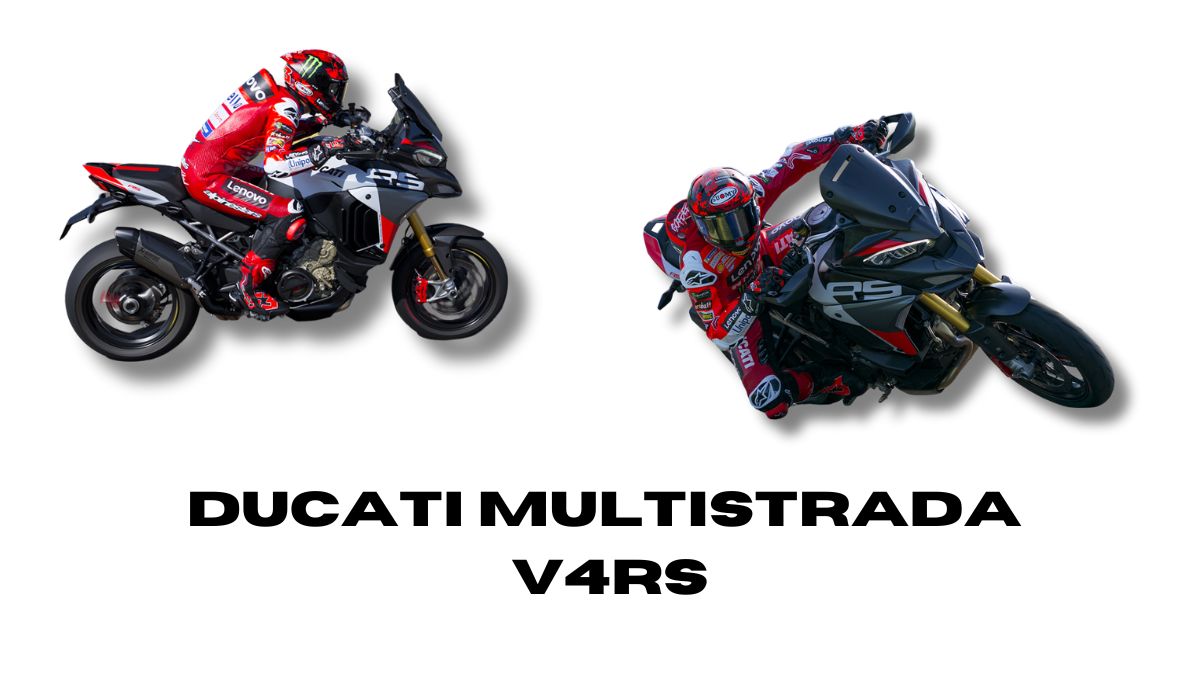
The recent unveilings of the Multistrada V4 RS and the Diavel V4 RS represent a pivotal moment in Ducati’s product strategy. The company is now extending its flagship Desmosedici Stradale V4 engine, the technological heart of its most potent superbikes, into two fundamentally different motorcycle platforms. This is a calculated evolution beyond mere component sharing; it is a declaration of intent to inject pure, uncompromising racing DNA into segments traditionally defined by a balance of power and practicality.
This strategic maneuver is designed to capture a new class of rider who demands the visceral thrill and extreme performance of a track-bred machine without forgoing the inherent utility of a sport-tourer or a power cruiser. By creating these “RS” variants, Ducati is not simply offering an upgrade; it is establishing a new, ultra-premium tier of performance within its own model families.
1.2 Key Findings
This report’s analysis reveals a clear pattern of targeted, high-performance engineering in both new models. The Multistrada V4 RS has been transformed from a versatile adventure-tourer into a class-leading sport-touring machine with a track pedigree previously unseen in the segment. Its transition is marked by a comprehensive suite of hardware changes, including a superbike-derived engine, a lighter chassis, and a re-engineered front end for enhanced road dynamics. The Diavel V4 RS, in turn, has transcended its “power cruiser” designation to become a “hyper-muscle” bike. Its adoption of the Desmosedici Stradale engine, coupled with a bespoke chassis and suspension setup, has yielded a machine with a verified claim to being the fastest accelerating production motorcycle to ever roll out of the Bologna factory.1 This dual unveiling underscores a cohesive strategy to create halo models that push the boundaries of performance and exclusivity in their respective categories.
1.3 The “Most Exciting Multistrada” Claim
Ducati’s declaration that the Multistrada V4 RS is the “most exciting Multistrada ever” is a subjective assertion, but it is one supported by a compelling confluence of engineering choices. The engine itself provides a significant leap in raw power and aural feedback. The inclusion of the iconic dry clutch, with its distinctive mechanical sound, provides an unparalleled sensory connection to Ducati’s racing heritage. The shift to a fully sport-oriented chassis, including 17-inch forged wheels and a re-geared drivetrain, fundamentally alters the bike’s dynamic feel, making it far more responsive and aggressive than its stablemates. While the standard Multistrada V4 offers a broader spectrum of utility, the V4 RS unapologetically sacrifices some of that versatility for maximum sport performance and visceral engagement. The collective effect of these changes creates an experience that is demonstrably more intense, precise, and emotionally charged, thereby lending considerable weight to Ducati’s marketing claim.3
II. The Multistrada V4 RS: Re-engineering the Sport-Touring Paradigm
2.1 Core Identity and Market Positioning
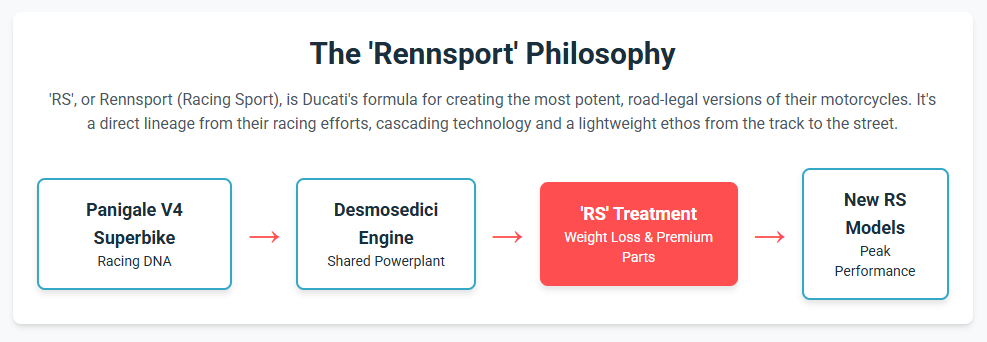
The Multistrada V4 RS is positioned as the zenith of the Multistrada lineup, a numbered-series, exclusive model designed for the most discerning and performance-oriented riders.5 Its aesthetic retains the elegant and familiar Multistrada silhouette while seamlessly integrating technical features and stylistic cues from Ducati’s racing division. The “RS” designation itself is a deliberate choice, intended to evoke a connection to a specific lineage of high-performance models within the brand’s history, most notably the Monster S4 RS.5 This is not simply a minor update; it is a clear philosophical statement. Just as the Monster S4 RS melded a superbike engine with a naked chassis, the Multistrada V4 RS fuses the engine of a superbike with a sport-touring platform. This approach signals a repeatable brand strategy focused on creating an ultimate, no-compromise halo product within each model family, appealing to a clientele that prioritizes unadulterated performance and exclusivity.5
2.2 Drivetrain and Performance Profile
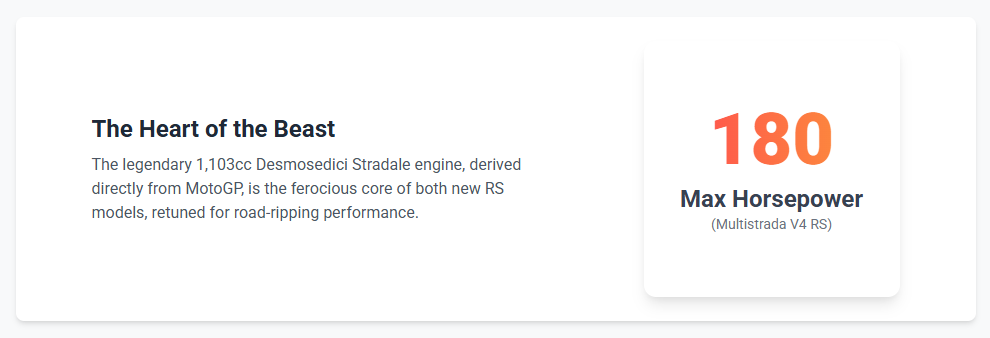
The heart of the V4 RS is the 1,103 cc Desmosedici Stradale engine, which is a significant departure from the V4 Granturismo engine found in the standard Multistrada.3 In its Euro 5+ configuration, this liquid-cooled, 90° V4 powerhouse produces a claimed 180 hp at 12,250 rpm and 87 lb-ft of torque at 9,500 rpm.6 This engine retains the signature counter-rotating crankshaft and twin-pulse firing order, which contribute to its unique sound and dynamic character.
The shift in engine philosophy brings with it a fundamental change in the bike’s maintenance requirements and aural signature. The V4 RS is equipped with an STM-EVO SBK dry clutch, a component that has historically been an icon of Ducati’s superbike heritage.2 Beyond its functional purpose of providing smoother downshifts and improved durability, the dry clutch produces a distinctive mechanical rattle, which has been described as “like a toolbox being thrown down a stairwell… but in a good way”.3 This is a clear instance of engineering a component for both function and feeling, targeting a passionate, brand-loyal demographic with a sound that connects this new model to a long line of legendary superbikes. However, this high-performance choice comes with a deliberate compromise: while the V4 Granturismo engine in the standard Multistrada features conventional valve springs that allow for an exceptional 37,000-mile valve clearance check interval, the Desmosedici Stradale engine with its desmodromic timing has a more traditional 18,000-mile valve adjustment interval.2 This demonstrates a clear engineering philosophy where some of the standard Multistrada’s long-term practicality is exchanged for maximum performance and visceral engagement.
Further enhancing the drivetrain’s sporty character are a shortened final drive ratio for enhanced acceleration and a type-approved Akrapovič titanium muffler, which contributes to the bike’s aggressive soundtrack.3 The six-speed transmission is mated to Ducati’s Quick Shift (DQS) up/down 2.0 system, ensuring seamless gear changes.6
2.3 Chassis, Suspension, and Handling Dynamics
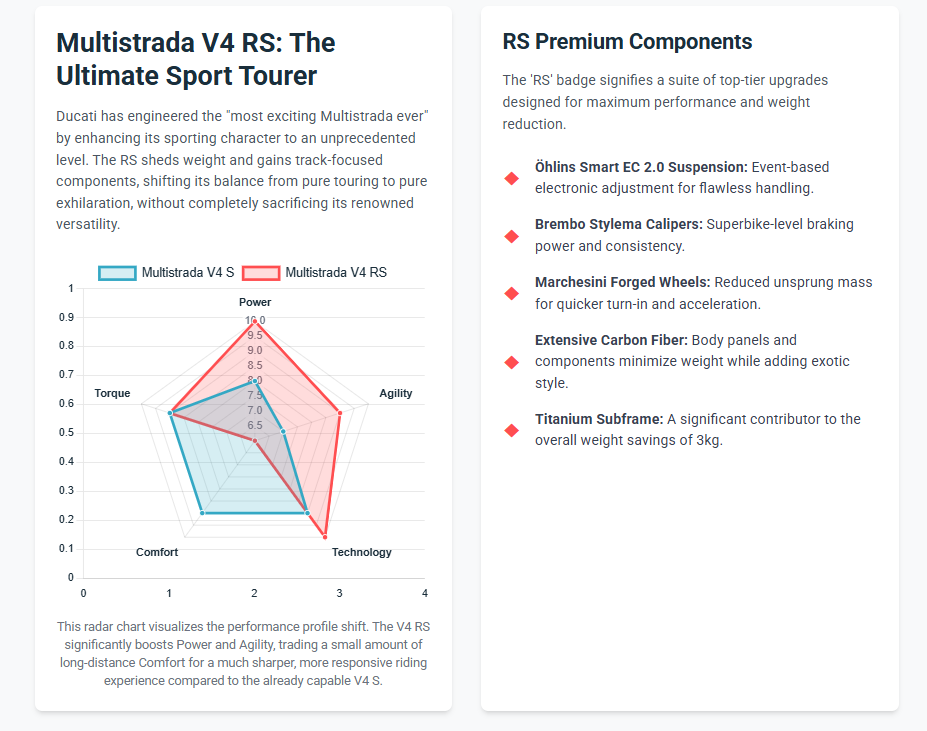
The Multistrada V4 RS builds upon an aluminum monocoque frame, a design element carried over from the previous RS model.6 The chassis, however, is significantly optimized for a performance-oriented role. The most notable change is the titanium rear subframe, which results in a weight saving of 5.5 lb (2.5 kg) compared to the standard one.3 This exotic component not only accentuates its sporty nature but also has been redesigned to accommodate a top box, a reminder of its touring aspirations.6 These weight savings, along with a lightweight lithium-ion battery, contribute to a claimed wet weight of 496 pounds (with no fuel).6
The chassis’s kinematic geometry has been fundamentally re-engineered for sport riding. The bike is now equipped with new 17-inch Marchesini forged aluminum wheels, which are approximately 6 lbs (2.7 kg) lighter than the cast rims of the Multistrada V4 S.3 This pivot from the standard Multistrada’s 19-inch front wheel is a critical design choice, fundamentally altering the bike’s handling. The smaller, lighter front wheel, combined with a dedicated single-sided swingarm that accommodates a wider 190-section rear tire (compared to the 170-section tire on the V4 S), makes the bike more responsive, agile, and planted in corners.4 This shift sacrifices some of the light off-road or trail capability for superior on-road and track performance, effectively transforming the bike from a versatile adventurer into a refined supermotard-style sport-tourer.4 The wheels are shod in Pirelli Diablo Rosso IV Corsa tires, selected for their excellent grip during acceleration and cornering.3
The suspension system consists of the Öhlins Smart EC 2.0 event-based electronic system.6 While not the latest 3.0 system found on the newest Panigale and Streetfighter V4s, Ducati has updated the suspension strategies and calibration to align with the bike’s new performance profile.6 The braking system is equally impressive, directly derived from the Panigale V4.4 It features twin 330 mm semi-floating discs with radially mounted Brembo Stylema monobloc calipers at the front and a larger 280 mm disc at the rear, an increase from the previous 265 mm rotor.6 This powerful system is managed by the Bosch-Brembo 10.3ME Cornering ABS for optimal safety and control, even when leaned over.3
2.4 The Technological Ecosystem
The Multistrada V4 RS is a rolling testament to advanced electronics. It retains the comprehensive front and rear radar suite, which provides Adaptive Cruise Control (ACC) and Blind Spot Detection (BSD).6 This technology, developed in collaboration with Bosch, marks a new level of excellence in riding comfort and assistance, particularly on long journeys.8
A significant update for the 2026 model year is the integration of the Ducati Vehicle Observer (DVO) algorithm.6 This system, which originated in Ducati’s MotoGP program, simulates the data from 70 sensors to fine-tune rider aids like ABS, traction control, and wheelie control with unprecedented precision.3 The bike’s electronic suite also includes a full complement of other safety and convenience features, such as multiple Riding Modes and Power Modes, Ducati Cornering Light, and Vehicle Hold Control.6 It also offers a new ‘Full Power’ option in Race and Sport modes, which unleashes the engine’s full 180 hp output in all gears with a dedicated throttle response.7 The rider interacts with these systems via a 6.5-inch TFT dashboard with dedicated RS graphics.3
III. The Diavel V4 RS: The New King of Acceleration
3.1 Strategic Repositioning: From Power Cruiser to Hyper-Muscle
The unveiling of the Diavel V4 RS signals a fundamental reclassification of the model from a conventional power cruiser to a definitive hyper-muscle machine. This new designation is validated by Ducati’s bold claim that the Diavel V4 RS is the “fastest accelerating production motorcycle” it has ever produced.1 This is not a hollow marketing statement; it is backed by a verifiable benchmark. In the hands of MotoGP rider Marc Marquez, the Diavel V4 RS achieved a 0 to 60 mph time of just 2.43 seconds (0 to 100 kph in 2.52 seconds).1 This benchmark was a performance value previously only met by the company’s prototype racers.2
The decision to use a high-profile, world-class professional rider to establish this benchmark is a deliberate strategic choice. It provides irrefutable validation of the “fastest accelerating” claim from a source with immense credibility, effectively linking the Diavel directly to the pinnacle of motorcycle racing. This marketing approach successfully elevates the Diavel V4 RS beyond a mere performance cruiser and positions it within the rarefied atmosphere of elite, track-validated performance vehicles.
3.2 The Drivetrain: The Engine of a Superbike in a Cruiser
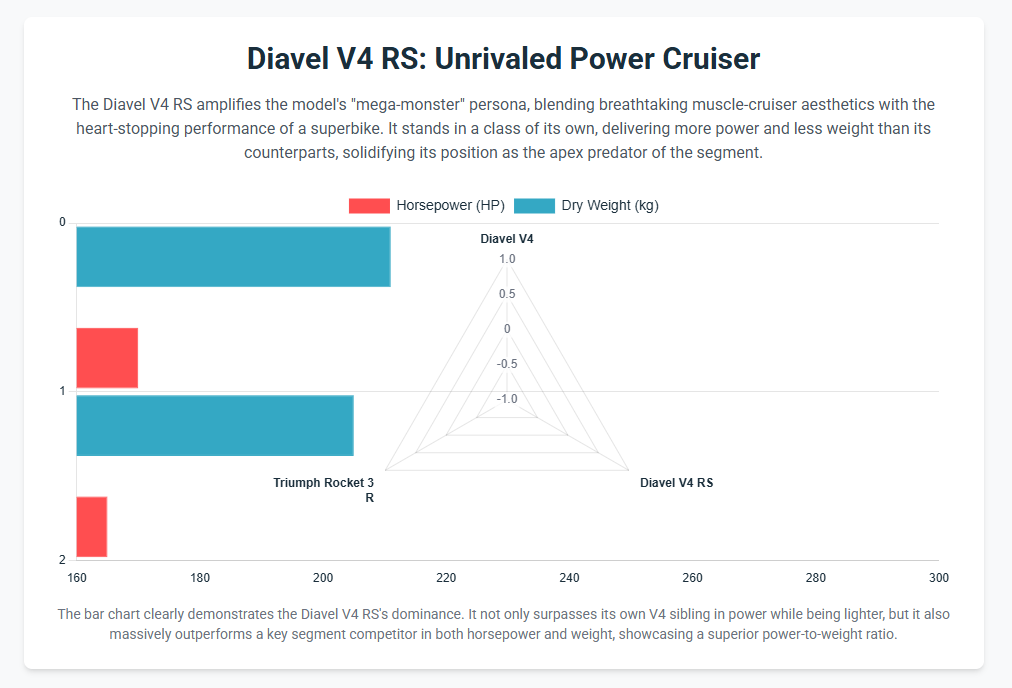
The radical performance leap of the Diavel V4 RS is a direct result of its engine swap. The bike replaces the standard Diavel V4’s V4 Granturismo engine with the Desmosedici Stradale motor from the Panigale V4 lineup.1 This transition results in a significant increase in peak horsepower, from the standard model’s 168 hp to a claimed 182 hp.1 While the peak torque figure is slightly lower than the standard model’s 93 lb-ft, the V4 RS’s torque is delivered at a higher rpm (89 lb-ft at 9,500 rpm versus 93 lb-ft at 7,500 rpm).1 This re-tuning for a higher-revving power delivery profile, combined with revised gearing for stronger acceleration in lower ratios, is key to the bike’s explosive standing-start performance.2
Like its Multistrada counterpart, the Diavel V4 RS is equipped with an STM EVO dry clutch, a nod to Ducati’s racing heritage.2 The liquid-cooled 90° V4 also gains a new high-flow air filter and a raised rev ceiling, reaching 13,500 rpm in all gears and a blistering 14,000 rpm in first gear.2 The six-speed gearbox features Ducati’s latest quickshifter, which uses a drum position sensor for more accurate and precise gear selection.2
3.3 Chassis and Ergonomics: Taming the Beast
Ducati has made significant changes to the Diavel’s chassis to manage the immense power of the Desmosedici Stradale engine. The new model is 3 kg (or 7 lb) lighter than the standard Diavel, with a claimed wet weight of 485 pounds.1 This weight reduction is achieved through extensive use of carbon fiber components, including the front and rear fenders, fuel tank side covers, flyscreen, and tail unit, as well as titanium exhaust tips and a lightweight lithium-ion battery.1
The suspension system has been entirely upgraded with fully adjustable Öhlins units, consisting of a 48 mm NIX30 fork at the front and an STX46 shock at the rear.2 This firmer calibration is specifically designed to reduce load transfer during hard acceleration and braking while providing improved feedback to the rider when cornering.2 This engineering choice addresses a central paradox: the need to create a chassis capable of handling superbike-level power while retaining the long wheelbase and massive 240/45 Pirelli Diablo Rosso IV rear tire that are hallmarks of the Diavel’s cruiser identity.1 The firmer suspension and track-level braking are engineered to counteract the inherent dynamics of a long, heavy-tired machine, effectively taming the power for controlled acceleration and handling.
The braking system is also a performance upgrade, featuring a pair of 330 mm discs with Brembo Stylema monobloc calipers at the front.2 Ducati claims a peak deceleration figure of 11.5 m/s², a value usually reserved for dedicated track-focused motorcycles.2
3.4 Rider Aids and Interface
The Diavel V4 RS is equipped with a comprehensive electronics suite to manage its prodigious output. In addition to standard rider aids like Cornering ABS, Traction Control, and Wheelie Control, the bike features a new Race mode for the first time on a Diavel model.1 It also includes Ducati’s latest launch control (DPL) system with three selectable levels, which helps riders achieve maximum acceleration from a standing start by intelligently managing torque delivery.2 Information is displayed via a TFT dash with new, RS-specific graphics and a Panigale-style ‘track’ layout that prominently shows rider aid settings when in Race mode.2
IV. Cross-Platform Analysis and Strategic Implications
4.1 The Desmosedici Stradale Engine: A Tale of Two Tunings
The Multistrada V4 RS and Diavel V4 RS share the same 1,103 cc Desmosedici Stradale engine, but with subtle variations in tuning that reflect their intended purpose. The Diavel V4 RS claims a peak output of 182 hp 1, while the Multistrada V4 RS claims a slightly lower 180 hp.3 This minor power differential is likely a deliberate engineering choice, as the Multistrada’s design must still accommodate a degree of touring and long-distance comfort, whereas the Diavel’s tuning is singularly focused on explosive, low-ratio acceleration.
A shared and critically important component is the STM EVO dry clutch. The dry clutch is more than a technical specification; it is a piece of deliberate “emotional engineering.” The distinct “rattle” is a hallmark of Ducati’s racing legacy, providing a sensory link to legendary models of the past.2 This choice signifies a conscious effort to target a highly passionate and brand-loyal clientele by reintroducing an iconic aural signature that links these new models to a long line of classic Ducati superbikes. This is a clear instance of engineering a component for both function and feeling, targeting a highly passionate and brand-loyal demographic. The decision to use a dry clutch and a counter-rotating crankshaft on both bikes reinforces the idea that the “RS” sub-brand is defined by a raw, uncompromised, and visceral performance standard.
4.2 Technical Specifications: A Head-to-Head Review
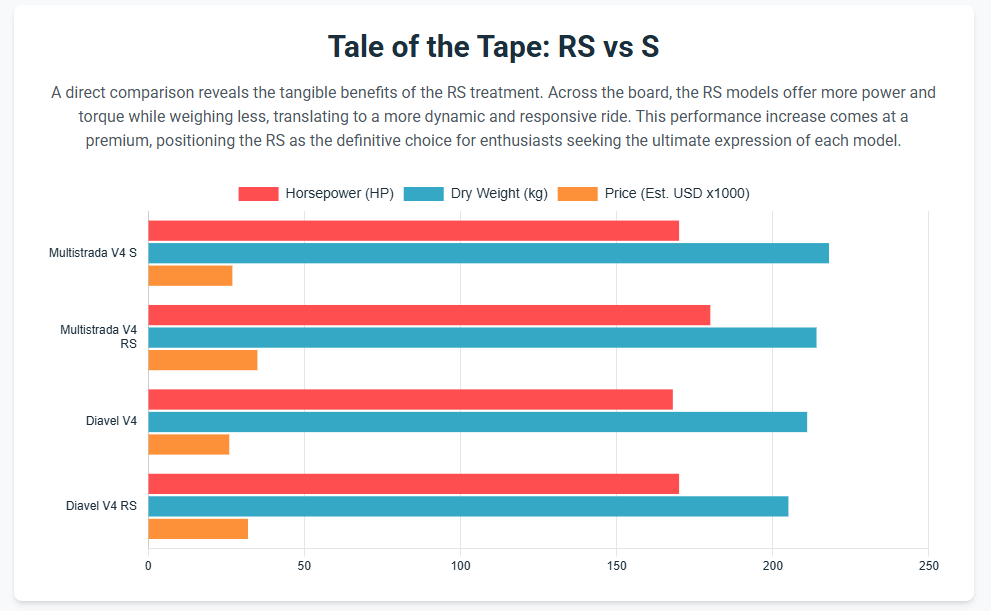
To fully appreciate the engineering distinctions of the new RS models, a direct comparison with their standard counterparts is essential. The following tables provide a granular, side-by-side technical review that highlights the specific components and performance trade-offs inherent in the “RS” transformation.
Table 1: Ducati Multistrada V4 Lineup: Technical Specification Comparison
| Feature | Multistrada V4 RS | Multistrada V4 S (Pikes Peak) |
| Engine | Desmosedici Stradale, 1,103cc 6 | V4 Granturismo, 1,158cc |
| Power (claimed) | 180 hp at 12,250 rpm 6 | 170 hp at 10,500 rpm |
| Torque (claimed) | 87 lb-ft at 9,500 rpm 6 | 92 lb-ft at 8,750 rpm |
| Clutch | Multiplate dry clutch 6 | Multiplate wet clutch |
| Weight (claimed) | 496 lb wet (no fuel) 6 | 518 lb wet (no fuel) |
| Subframe | Titanium 5 | Steel |
| Rear Tire | 190/55 ZR17 6 | 170/60 ZR17 |
| Wheels | Forged aluminum, 17-inch 3 | Cast aluminum, 17-inch |
| Front Wheel | Marchesini, 3.5″ x 17″ 6 | Cast, 3.5″ x 17″ |
| Rear Brake Disc | 280 mm 6 | 265 mm |
| Valve Service | 18,000 miles 6 | 37,000 miles |
Table 2: Ducati Diavel V4 Lineup: Technical Specification Comparison
| Feature | Diavel V4 RS | Diavel V4 |
| Engine | Desmosedici Stradale, 1,103cc 1 | V4 Granturismo, 1,158cc |
| Power (claimed) | 182 hp at 12,250 rpm 1 | 168 hp at 10,750 rpm 1 |
| Torque (claimed) | 89 lb-ft at 9,500 rpm 1 | 93 lb-ft at 7,500 rpm 1 |
| Clutch | Multiplate dry clutch 1 | Multiplate wet clutch |
| Weight (claimed) | 485 lb wet (no fuel) 1 | 492 lb wet (no fuel) 1 |
| Rear Tire | 240/45 ZR17 1 | 240/45 ZR17 1 |
| Wheels | Forged 1 | Cast |
| Front Suspension | 48 mm Öhlins fork 1 | 50 mm Marzocchi fork 1 |
| Rear Suspension | Öhlins monoshock 1 | Fully adjustable shock absorber |
| Riding Modes | Sport, Touring, Wet, Race 1 | Sport, Touring, Wet |
4.3 Market Positioning and the ‘RS’ Brand
Both the Multistrada V4 RS and the Diavel V4 RS share a high MSRP of $39,995.1 This uniform price point, combined with their production as a numbered series, signals a new, shared “RS” brand philosophy centered on exclusivity and maximum performance.5 Both models feature an extensive use of premium materials such as carbon fiber for bodywork and titanium for subframes, which not only contribute to weight savings but also project a sense of high-end craftsmanship.2 The shared core technologies—the Desmosedici Stradale engine, a dry clutch, and sophisticated Öhlins suspension—link these two disparate platforms, establishing the “RS” moniker as a symbol of the ultimate expression of sportiness within the Ducati family. This strategy aims to create halo models that appeal to a select clientele who are willing to pay a premium for a machine that prioritizes uncompromised performance and a distinct, visceral riding experience over the all-around versatility of its standard counterparts.
V. Conclusion: The V4 RS Legacy and Future Outlook
5.1 Synthesis of Findings
The analysis of the Multistrada V4 RS and Diavel V4 RS confirms that these are not merely upgraded versions of existing models. They are fundamentally re-engineered machines built around a singular objective: to push the boundaries of performance within their respective segments. The Multistrada V4 RS successfully redefines the sport-touring category by blending the practicality of long-distance travel with the dynamic and aural intensity of a superbike. Its chassis and engine are a clear statement of purpose, sacrificing some all-around utility for a sharp, focused, and exhilarating road experience. The Diavel V4 RS, in its quest for ultimate acceleration, transcends the power cruiser segment to become a purebred performance vehicle, a technical marvel that harnesses immense power within a unique and visually striking chassis.
5.2 Final Verdict on the “Most Exciting” Claim
Ducati’s claim that the Multistrada V4 RS is the “most exciting Multistrada ever” is a subjective judgment that can be substantiated through an examination of its technical and experiential characteristics. The sheer power of the Desmosedici Stradale engine, the distinct sound and feel of the dry clutch, and the dynamic agility imparted by the re-engineered chassis and 17-inch forged wheels combine to create a riding experience that is markedly more intense and engaging than any previous model. The bike successfully marries the convenience and technological sophistication of a modern tourer—complete with radar and a refined electronic suite—with the unadulterated performance and emotional feedback of a race-bred machine. The term “exciting” applies to not only its speed but also the multifaceted sensory experience it provides, from the aural signature of its dry clutch to the precision of its handling.
5.3 Future Outlook
The introduction of the V4 RS sub-brand across two different motorcycle families suggests a new, repeatable strategy for Ducati. This strategy could signal a future where other high-performance, Desmosedici Stradale-powered models are unveiled, each meticulously engineered to lead its segment in performance and exclusivity. This approach reinforces Ducati’s position as a leader in both racing-derived technology and brand exclusivity, creating a distinct product line for riders who desire a machine that is the pinnacle of its class. The success of these two new models will serve as a key indicator for whether this “RS” strategy will become a permanent fixture in the company’s long-term product development roadmap, solidifying its legacy as a manufacturer of the world’s most passionate and performance-focused motorcycles.
Sources
- 2026 Ducati Diavel V4 RS – First Look | Motorcycle.com, accessed on September 13, 2025, https://www.motorcycle.com/bikes/new-model-preview/2026-ducati-diavel-v4-rs-first-look-44648950
- Ducati debut Diavel V4 RS with 180bhp superbike powerplant, accessed on September 13, 2025, https://www.motorcyclenews.com/news/new-bikes/2025/september/ducati-diavel-v4-rs/
- 2026 Ducati Multistrada V4 RS: sportiest tourer ever updated, accessed on September 13, 2025, https://www.bennetts.co.uk/bikesocial/news-and-views/news/2025/2026-ducati-multistrada-updated
- New Multistrada V4 RS – Track performance, Multistrada soul. – Ducati, accessed on September 13, 2025, https://www.ducati.com/us/en/bikes/multistrada/multistrada-v4-rs
- Ducati Multistrada V4 RS, when Superbike meets touring, accessed on September 13, 2025, https://www.ducati.com/us/en/news/ducati-multistrada-v4-rs-when-superbike-meets-touring
- 2026 Ducati Multistrada V4 RS – First Look | Motorcycle.com, accessed on September 13, 2025, https://www.motorcycle.com/bikes/new-model-preview/2026-ducati-multistrada-v4-rs-first-look-44648947
- 2026 Ducati Multistrada V4 RS First Look and Specs – Cycle News, accessed on September 13, 2025, https://www.cyclenews.com/2025/09/article/2026-ducati-multistrada-v4-rs-first-look-and-specs/
- Ducati announces the entry into production of the world’s first motorcycle equipped with front and rear radar technology: the new Multistrada V4, accessed on September 13, 2025, https://www.ducati.com/us/en/news/ducati-announces-the-entry-into-production-of-the-world-s-first-motorcycle-equipped-with-front-and-rear-radar-technology-the-new-multistrada-v4
Our Social Media Handles
- Instagram : LivingWithGravity
- Medium : Akash Dolas
- YouTube Channel : Gear and Shutter
- Facebook : LivingWithGravity