



I. Executive Summary: The Defining Narratives of 2025
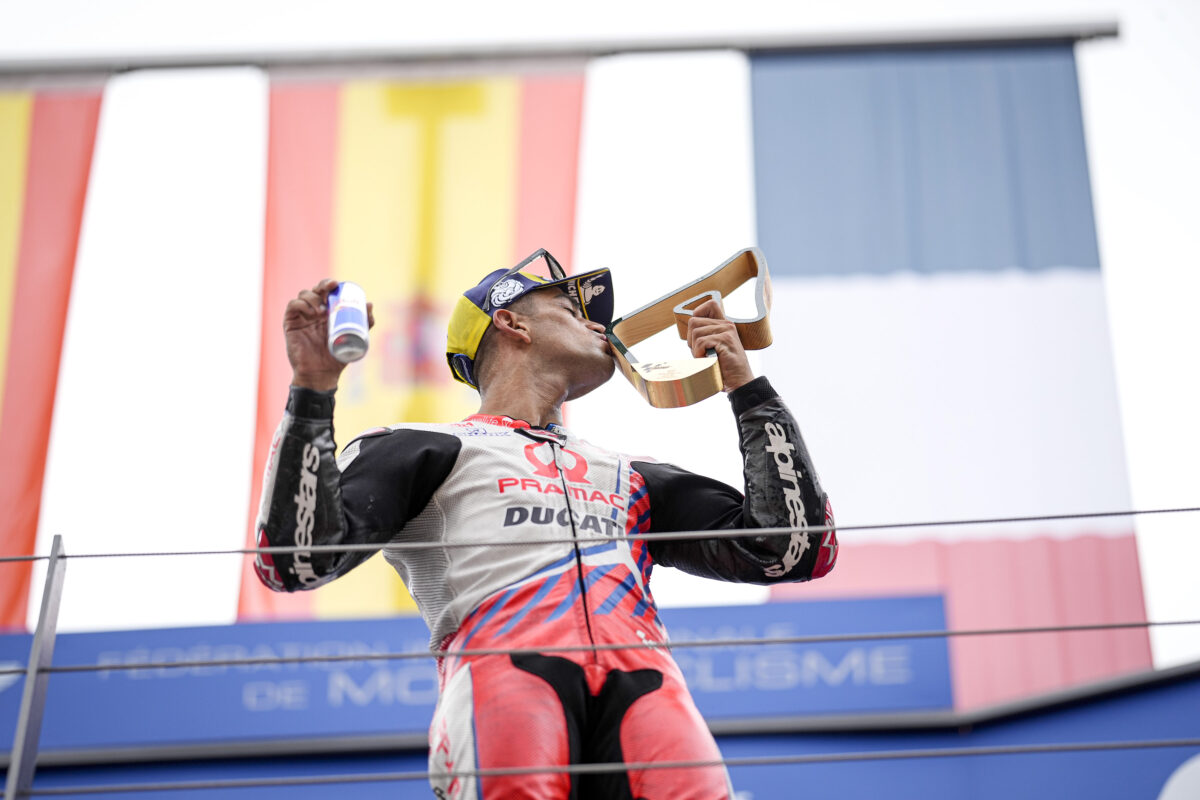
The 2025 FIM MotoGP World Championship, the premier class of the 77th FIM Road Racing World Championship season, culminated in one of the most significant sporting comebacks in recent history. Marc Márquez secured his seventh premier class world title and ninth overall, ending a title drought that had persisted since 2019.1 This six-year gap marks the longest duration a rider has ever waited between premier class championships.1 The sheer magnitude of this achievement, secured while riding for the Factory Ducati team, has been compared to the triumphs over adversity experienced by global sporting luminaries such as Michael Jordan and Tiger Woods.2
Ducati successfully defended its status as the technical benchmark of the paddock, securing the 2025 Constructors’ Championship.3 However, the season demonstrated a profound shift in competitive dynamics. The year was fundamentally defined by Márquez’s unprecedented ability to immediately adapt and maximize performance on the Ducati Desmosedici GP25, particularly by mastering the Sprint Race format, which proved critical for accumulating points. This adaptation delivered a level of consistency unparalleled by his nearest rivals.
From a technical and regulatory perspective, the 2025 season acted as a critical bridge. Although the technical regulations surrounding aerodynamics remained largely stable for the year 4, the revised Concession system demonstrated its efficacy, providing crucial development latitude to Japanese manufacturers Honda and Yamaha.5 Strategically, the immediate impact of the 2026 engine freeze—a mandate preventing performance-based mechanical evolution for the following year—forced manufacturers into an early pivot, redirecting engineering resources toward the radical 2027 850cc prototype design.7 This strategic realignment resulted in an unusually stable and early conclusion to the 2026 rider market, underscoring the priority of securing personnel stability ahead of major technical discontinuity.8
II. Championship Results and the Rise of the Hybrid Dominator
2.1. The Riders’ Crown: Marc Márquez’s Seventh Premier Class Title
Marc Márquez delivered a campaign of relentless dominance, clinching the Riders’ World Championship after the 17th round of the season.1 His championship was mathematically secured at the Japanese Grand Prix at Motegi, marking the earliest a rider has attained the title under the current points structure.2 He amassed the most points ever recorded in a single season, a testament to his exceptional run.2 The final standings reflect the scale of his achievement.
Table 1: 2025 FIM MotoGP Riders’ World Championship Final Standings (Top 5)
| Position | Rider | Team | Constructor | Total Points |
| 1 | Marc Márquez | Ducati Lenovo Team | Ducati | 545 9 |
| 2 | Álex Márquez | Gresini Racing MotoGP | Ducati | 362 9 |
| 3 | Francesco Bagnaia | Ducati Lenovo Team | Ducati | 274 9 |
| 4 | Marco Bezzecchi | Aprilia Racing | Aprilia | 254 9 |
| 5 | Pedro Acosta | Red Bull KTM Factory Racing | KTM | TBC (Top 5 Confirmed) |
The significant 183-point gap between Márquez and the runner-up, his brother Álex Márquez, quantitatively confirms the statistical domination achieved during the year.9 Crucially, the outcome confirms the enduring competitive edge of the Ducati machinery, with three of the top five places occupied by riders utilizing the Desmosedici platform.9
The Quantitative Argument for 2025 Dominance (Normalized Data)
The introduction of the Sprint Race format fundamentally altered the metrics of competitive superiority in MotoGP. To accurately assess Márquez’s 2025 season against his historical benchmark, specifically his near-perfect 2019 season, it is necessary to normalize performance efficiency based on the available points per weekend. By the summer break (after 12 rounds, corresponding to 444 maximum possible points), Márquez’s rate of converting available points into earned points surpassed his legendary 2019 run.
Table 2: Marc Márquez Dominance Comparison: 2019 vs. 2025 (First 12 Rounds)
| Metric | 2019 Season (Main Races Only) | 2025 Season (Main + Sprint Races) |
| Max Possible Points (12 Rounds) | 300 (12 x 25) | 444 (12 x 37) |
| Points Earned (12 Rounds) | 250 | 381 |
| Dominance Score (Points/Max %) | 83.3% | 85.8% |
| Championship Lead (Points) | 78 points (over Dovizioso) | 120 points (over Álex Márquez) |
The comparison reveals that, despite his 2019 season being visually relentless—where he finished 1st or 2nd in every race except one DNF—his 2025 campaign yielded a higher percentage efficiency (85.8% versus 83.3%).10 This demonstrates that the ability to convert the short-format, high-value Sprint Races (12 points available) was the definitive factor in generating the title-winning margin. Márquez capitalized aggressively, achieving 11 Sprint wins by mid-season.11 This tactical mastery of short-distance tire management and aggressive race starts validated the Sprint format as the ultimate point multiplier under the current regulations.10
2.2. The Campaign’s Turning Points and Critical Battles
The opening phase of the 2025 season was marked by the exceptional unity and performance of the Márquez brothers. Marc and Álex Márquez shared the top two podium positions in the first ten consecutive Sprint Races, establishing an immediate and massive points haul that put them out of reach of most contenders.1 Marc Márquez secured six crucial Grand Prix victories throughout the season, including dominant performances in Thailand, Argentina, Qatar, Aragon, Italy, and the Netherlands.1 His performance at the Italian Grand Prix (Mugello) was widely cited as a masterclass demonstrating his control over the field.12
A critical, yet external, turning point early in the season was the misfortune of the defending world champion, Jorge Martín. Martín suffered a wrist injury during pre-season testing.1 Upon his debut with Aprilia at the Qatar Grand Prix, a crash on lap 14 resulted in fractured ribs and a pneumothorax after being struck by another motorcycle, sidelining him indefinitely until his return at the Czech Grand Prix.1 The immediate absence of the primary established title contender significantly reduced the competitive resistance in the initial, high-value rounds, allowing Márquez to solidify his substantial points lead rapidly, a crucial element in his championship success.
The season also featured major talent breakthroughs, notably at the Indonesian Grand Prix. Rookie Fermín Aldeguer, riding for Gresini Racing, claimed his maiden MotoGP victory, becoming the second-youngest winner in the class’s history.14 This dramatic race saw the newly crowned champion, Marc Márquez, crash out on the opening lap following a collision with Marco Bezzecchi.14 Aldeguer’s win, achieved after passing early leader Pedro Acosta, affirmed the effectiveness of the satellite teams in developing future elite talent.14
2.3. Contenders and Consistency: A Review of the Top 5
The field struggled to mount a consistent challenge against Marc Márquez. Runner-up Álex Márquez utilized the high-performance Gresini Ducati package effectively, demonstrating high consistency, particularly in the Sprint format, which placed him statistically ahead of historical championship runners-up like Andrea Dovizioso in 2019.10
Francesco Bagnaia, Márquez’s factory teammate and two-time former champion, finished third.9 While his base performance level remained similar to previous years, he lost critical championship position.17 Bagnaia publicly acknowledged difficulties with the GP25 machine 11, creating an interesting internal dynamic where one factory rider dominated while the other struggled for consistent comfort, emphasizing the specialized nature of the 2025 prototype.
Pedro Acosta, riding for Red Bull KTM Factory Racing, concluded the season as a perennial top-five threat.9 His ability to fight at the front, including a second-place finish in the Indonesian Grand Prix 14, solidified his position as the most promising young talent in the class and validated KTM’s strategy of aggressive talent promotion. Marco Bezzecchi (Aprilia Racing) finished fourth, demonstrating the growing competitive strength of the Aprilia platform.9
III. Technical Evolution and Manufacturer Competitiveness
3.1. The Ducati Platform: Sustaining Advantage Through Dispersed Excellence
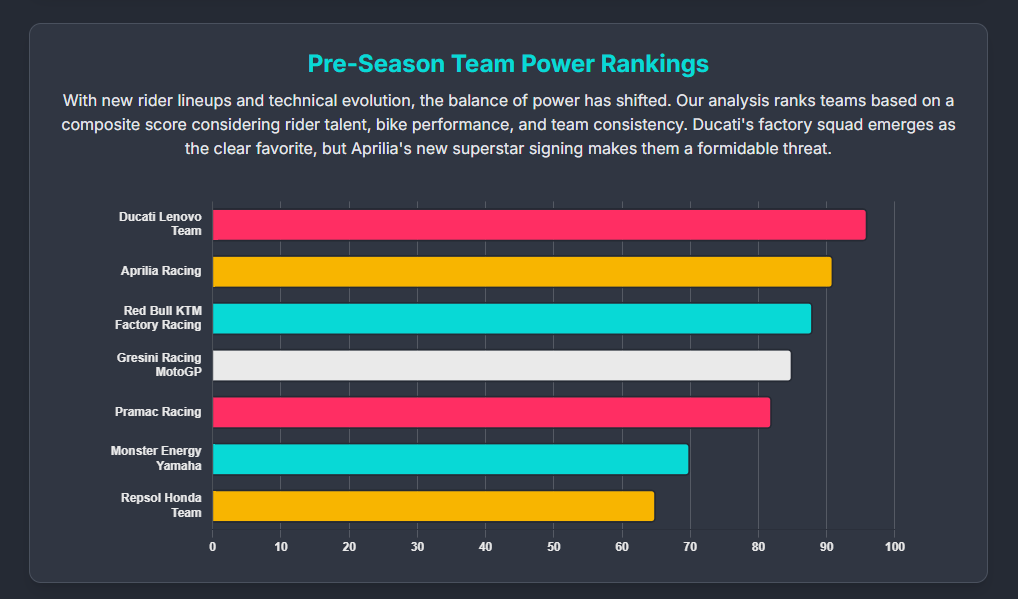
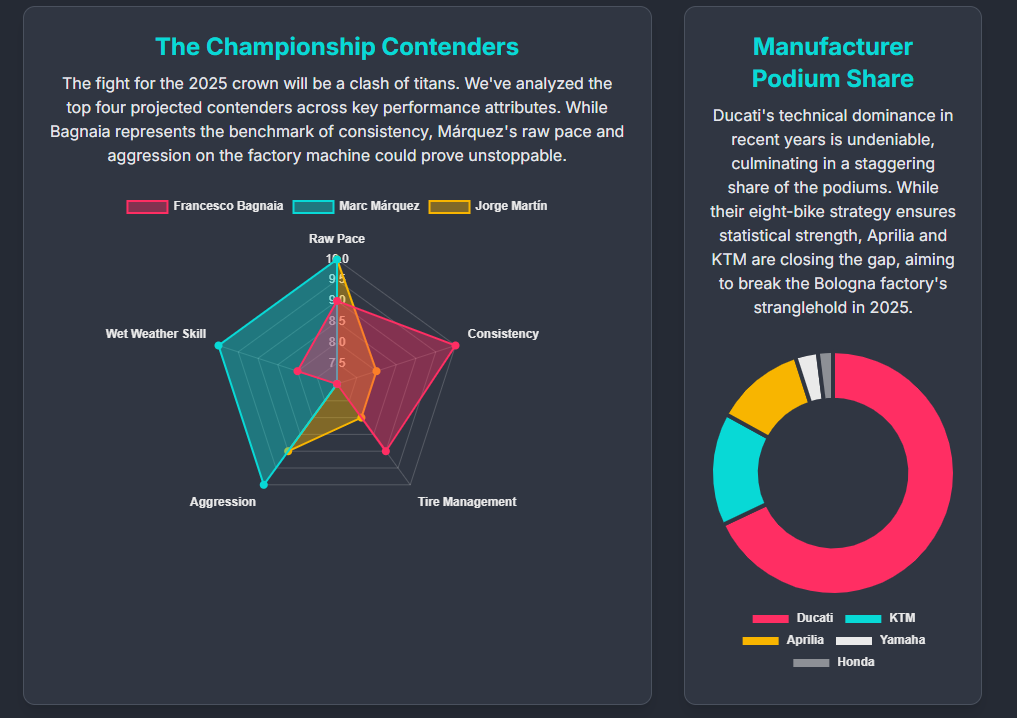
Ducati maintained its competitive edge, culminating in the 2025 Constructors’ Championship.3 However, the season signaled a possible plateau in their absolute technical superiority. While Márquez dominated on the GP25, the aforementioned struggles faced by Bagnaia suggest that the machine required highly specific setup parameters or riding styles to unlock its full potential, leading to “mixed reviews” across the Ducati stable.11
Furthermore, the competitive gap narrowed perceptibly in 2025. This was demonstrated most clearly at the Czech MotoGP, where Ducati only managed to place two motorcycles within the top ten results.5 For a manufacturer that has historically monopolized the upper echelons of the standings, this occurrence marked the first time in 66 races that their presence in the top tier was so diluted.5 This decline in widespread domination, coupled with the reduction in the total number of Ducatis on the grid (two fewer motorcycles fielded in 2025), is a crucial indicator that rival manufacturers successfully optimized their own packages, effectively closing the performance gap.
3.2. Concessions: The Catalyst for Japanese Recovery
The revised MotoGP concession system was strategically impactful in 2025, providing a necessary lifeline for manufacturers lagging in development. The framework grants additional development allowances—including extra test days, more authorized test riders, and greater freedom for mechanical and aerodynamic updates—to teams ranking lower in constructor points.6
Both Honda and Yamaha were placed in D-rank concessions.6 This ranking permitted their official team riders (not just test riders) to participate in scheduled tests, substantially accelerating their research and development cycles and dramatically increasing the volume of real-world data collection.6 Analysts noted that both Japanese factories made “major steps forward from the doldrums they were recently in”.5
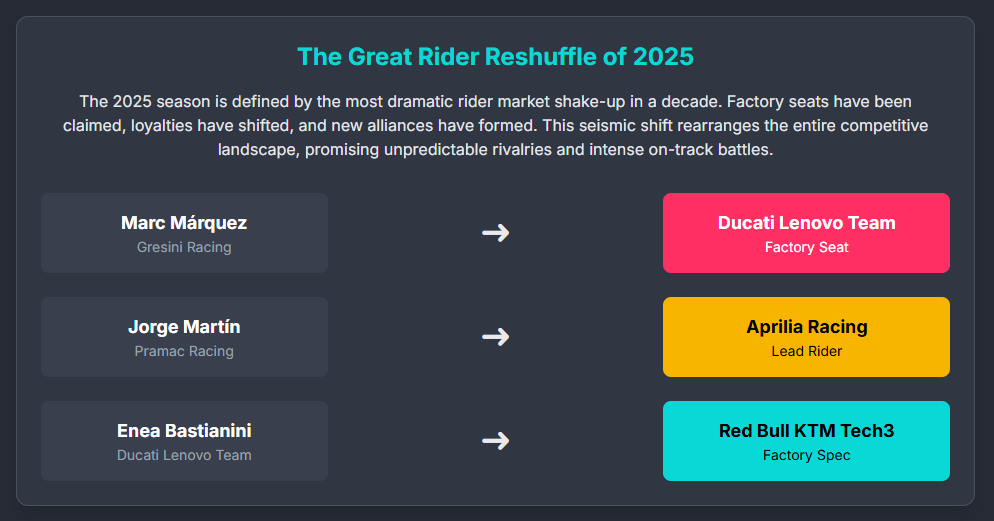
Yamaha executed a highly significant strategic move by securing Prima Pramac Racing, the former championship-winning Ducati satellite team, as its new independent partner.18 This transition provides Yamaha with four motorcycles on the grid, maximizing the data pool and development capacity, which is essential for improving the YZR-M1.18 Meanwhile, Honda opted for personnel stability, retaining Joan Mir and Luca Marini in their factory seats to ensure continuity during this crucial development phase, benefiting from the D-rank allowances.8
European constructors also exhibited progress. KTM recorded their best round at Brno, confirming the maturation of the RC16 platform, while Aprilia achieved a Grand Prix victory at Silverstone.5 Aprilia also demonstrated innovative technical attention to rider experience and safety, incorporating internal changes like five-element grilles designed to direct heat away from the rider’s body, indicating a holistic approach to prototype optimization.19
3.3. Regulation Lock-Down: The Precursor to 2027
The 2025 season operated within a state of aerodynamic stability, as the FIM implemented no major changes to the winglet or fairing rules for the year.4 This stability permitted fine-tuning of existing packages but effectively capped radical aero innovation until 2027.4
The most strategically significant regulation change impacting the competitive calendar was the ruling by the Grand Prix Commission to freeze all 2025 engine specifications for the entire 2026 season.7 While minor changes are permitted for safety or reliability, performance-enhancing mechanical evolutions are explicitly prohibited.7
The consequence of this hard engine freeze is a mandatory shift in resource allocation across all factories. With the primary performance variable (the engine) locked down, engineering effort for 2026 must concentrate solely on chassis refinement, setup optimization, and potentially permissible non-performance aerodynamic development. More critically, this measure necessitates that the bulk of high-level R&D resources be immediately diverted toward the 2027 technical revolution. That revolution will see engine displacement reduced to 850cc, the maximum bore dropped to 75mm, stricter aero restrictions (including a 150mm reduction in front fairing width), and the critical total ban of all ride height and holeshot devices.4 The 2026 season is thus functionally an operational year, with the true competitive battle taking place in the secretive R&D labs developing the next-generation 850cc prototype.
IV. Independent Team Performance and Future Grid Structure
4.1. Independent Team Ascendancy and Talent Pipeline
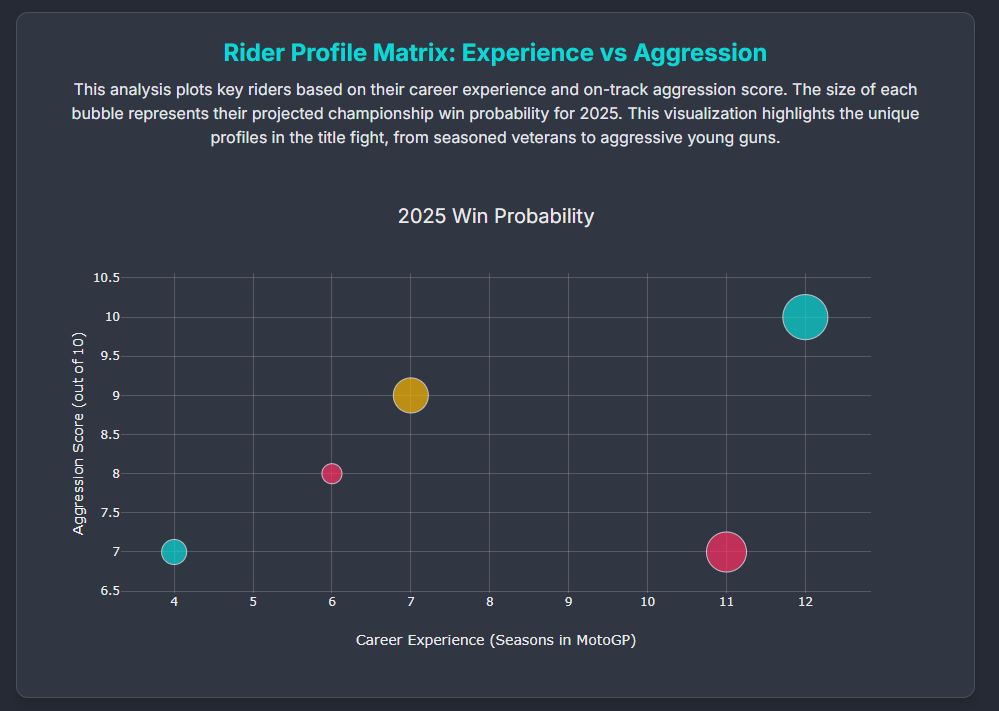
The performance of independent (satellite) teams in 2025 emphasized their critical role in both competing for podiums and serving as high-efficiency talent development hubs. Gresini Racing MotoGP was exceptionally successful, securing the championship runner-up position with Álex Márquez 9 and providing the platform for Fermín Aldeguer’s breakthrough. Aldeguer’s maiden victory at the Indonesian Grand Prix confirmed his potential, making him the second-youngest MotoGP race winner in history.14 The speed and success of young riders on customer machinery underscore the high competitive standard of the independent teams in the modern era, mirroring Jorge Martín’s 2024 championship success on a satellite bike.18
The structural reorganization involving Prima Pramac Racing and Yamaha constitutes a major competitive shift. Pramac, following its departure from Ducati after a championship-winning partnership, became the new Yamaha satellite team.18 This move immediately bolsters Yamaha’s capacity for gathering development data and sets the stage for a new competitive alignment. This strategic transition was immediately followed by significant rider market activity.
4.2. The 2026 Rider Market: Stability and Key Transfers
The engine freeze for 2026 and the radical technical changes impending in 2027 led to a rapid stabilization of the rider market in late 2025. Manufacturers prioritized certainty and continuity ahead of the engineering overhaul, resulting in nearly all major factory and satellite seats being confirmed unusually early.20 This focus on locking down established talent reflects the recognition that adapting to the 850cc configuration and the removal of complex electronic ride-height systems will require experienced riders capable of providing sophisticated development feedback during the crucial 2026 R&D phase.
Confirmed Factory Lineups (Through 2026):
- Ducati: Francesco Bagnaia and Marc Márquez.8
- KTM: Brad Binder and Pedro Acosta (Factory), with Enea Bastianini and Maverick Viñales contracted at the Tech3 team.8
- Yamaha: Fabio Quartararo and Álex Rins.8
- Honda: Joan Mir and Luca Marini remain on factory contracts.8
Key Independent Announcements:
The new Prima Pramac Yamaha structure confirmed a high-profile signing: two-time Superbike World Champion Toprak Razgatlıoğlu was signed on a multi-year contract to make his MotoGP debut in 2026.8 Alongside Razgatlıoğlu, Jack Miller renewed his contract with Pramac Yamaha through 2026, solidifying the team’s lineup.20 In parallel, Pertamina Enduro VR46 Racing Team confirmed the retention of Franco Morbidelli, who remains with the outfit alongside Fabio di Giannantonio through the 2026 season.8 The rapid resolution of the rider market by September 2025 minimized competitive variables for the forthcoming stable 2026 season and allowed teams to fully focus on the complex, long-lead development cycles required for 2027.
V. Strategic Conclusion and Recommendations
The 2025 FIM MotoGP World Championship served as a profound testament to the power of elite talent maximizing a superior technical platform, specifically within the new hybrid points structure. Marc Márquez’s performance established a new standard for championship dominance, demonstrating that consistency across both the traditional Grand Prix and the tactical Sprint format is the essential strategic blueprint for success.
The season also highlighted the impending structural shift. The relative convergence of manufacturer performance, evidenced by Ducati’s slight reduction in grid-wide dominance, proves that the concession system is effectively aiding the recovery of Honda and Yamaha. This closing gap, combined with the hard regulatory freeze on engine development for 2026, dictates that the competitive focus for all manufacturers must now pivot sharply.
The 2026 season is effectively a development hiatus regarding engine performance, ensuring that the competitive hierarchy will remain largely stable throughout that year, unless a manufacturer finds a breakthrough in chassis or aerodynamic optimization. The true strategic imperative lies in the preparation for the 2027 technical reset.
Recommendations for 2026-2027 Focus
Based on the analysis of the 2025 season results and the governing body’s future technical mandates, the following strategic imperatives are recommended for executive prioritization:
- Prioritize 850cc Prototype Development: Engineering resources must be overwhelmingly dedicated to the 2027 850cc prototype. The mandate to reduce displacement, bore size, and, most significantly, the total prohibition of ride height and holeshot devices demands a clean-sheet approach to chassis and weight distribution design. The fundamental physics of wheelie control and cornering grip must be solved mechanically, shifting the competitive advantage away from complex electronics and hydraulic systems. The urgency of this technical pivot cannot be overstated.
- Maximize Concession Utilization (Honda and Yamaha): For D-rank manufacturers, the 2026 season must be treated as a dedicated 2027 prototype test campaign. Honda and Yamaha must relentlessly utilize their expanded allowances for test riders, test days, and tire allocation.6 The acquisition of the Prima Pramac satellite team by Yamaha must be fully leveraged to accelerate data acquisition under race conditions for the M1’s chassis and aerodynamic improvements, ensuring the 2027 package is competitive immediately.
- Secure and Integrate Next-Generation Development Talent: The success of rookies like Aldeguer and the high-value acquisition of Razgatlıoğlu by Pramac Yamaha demonstrate the crucial role of adaptable talent. Future-proofing the factory lineup requires aggressively identifying and integrating Moto2 talent with proven ability to provide precise technical feedback. The post-2027 machinery, being fundamentally different due to the regulatory changes, will require riders who can quickly adapt to the new handling characteristics and contribute effectively to the development of a highly divergent technical platform.
Sources
- 2025 MotoGP World Championship – Wikipedia, accessed October 14, 2025, https://en.wikipedia.org/wiki/2025_MotoGP_World_Championship
- Worst to first: Marquez’s magnificent seven MotoGP titles, ranked, accessed October 14, 2025, https://www.foxsports.com.au/motorsport/moto-gp/worst-to-first-marquezs-magnificent-seven-motogp-titles-ranked/news-story/5e5732c42738c479c150b338d196f664
- Grand Prix motorcycle racing – Wikipedia, accessed October 14, 2025, https://en.wikipedia.org/wiki/Grand_Prix_motorcycle_racing
- Aerodynamics and Winglets in MotoGP – What You Need To Know – intentsGP, accessed October 14, 2025, https://www.intentsgp.com/aerodynamics-and-winglets-in-motogp-what-you-need-to-know/
- Zero doubt as experts pick MotoGP manufacturer who have nailed development path, accessed October 14, 2025, https://www.crash.net/motogp/feature/1078365/1/zero-doubt-experts-pick-motogp-manufacturer-who-have-nailed-development
- MotoGP Testing Explained For 2025 – intentsGP, accessed October 14, 2025, https://www.intentsgp.com/motogp-testing-explained/
- The technical regulation of MotoGP engines 2025 – 2026 – RTR Sports Marketing, accessed October 14, 2025, https://rtrsports.com/en/blog/motori-motogp-2025-2026-2/
- 2026 MotoGP rider line-up: The grid so far, and all the rumours | Crash.net, accessed October 14, 2025, https://www.crash.net/motogp/feature/1062005/1/2026-motogp-rider-line-grid-so-far
- MotoGP standings: Riders and Constructors – Ducati, accessed October 14, 2025, https://www.ducati.com/ww/en/racing/motogp/standings
- I compared Marquez’ 2019 and 2025 seasons to determine which was more dominant, the results might surprise you : r/motogp – Reddit, accessed October 14, 2025, https://www.reddit.com/r/motogp/comments/1m8uhqs/i_compared_marquez_2019_and_2025_seasons_to/
- What the 2025 MotoGP Season Has Taught Us So Far | Silverstone, accessed October 14, 2025, https://www.silverstone.co.uk/news/what-2025-motogp-season-has-taught-us-so-far
- Best MotoGP™ Moments | 2025 Japanese GP – YouTube, accessed October 14, 2025, https://www.youtube.com/watch?v=yKzEZsyVjjo
- Best MotoGP™ Moments | 2025 Czech GP – YouTube, accessed October 14, 2025, https://www.youtube.com/watch?v=0dWdNAnlMq8
- MotoGP Indonesia: Aldeguer wins first race as Marquez injured on lap 1 – Al Jazeera, accessed October 14, 2025, https://www.aljazeera.com/sports/2025/10/5/motogp-indonesia-aldeguer-wins-first-race-as-marquez-bezzecchi-crash-out
- Fermin Aldeguer – MotoGP™ Riders | Profiles | Stats & Results, accessed October 14, 2025, https://www.motogp.com/en/riders/fermin-aldeguer/71052114-5bce-4307-908c-4cc2bd387aac
- MotoGP Indonesian GP: Fermin Aldeguer dominates as Marc Marquez crashes, accessed October 14, 2025, https://www.motorsport.com/motogp/news/motogp-indonesian-gp-aldeguer-win-bezzecchi-marquez-crash/10765216/
- Top 6 riders comparison between 2024 and 2025 after 4 rounds : r/motogp – Reddit, accessed October 14, 2025, https://www.reddit.com/r/motogp/comments/1k0o37z/top_6_riders_comparison_between_2024_and_2025/
- MotoGP Satellite vs Factory Teams: all you need to know for 2025 – intentsGP, accessed October 14, 2025, https://www.intentsgp.com/satellite-vs-factory-teams-motogp/
- Tech analysis: The secrets behind Aprilia’s 2025 MotoGP bike – Motorsport.com, accessed October 14, 2025, https://www.motorsport.com/motogp/news/tech-analysis-the-secrets-behind-aprilias-2025-motogp-prototype/10690784/
- MotoGP silly season 2025: only one seat to be decided!, accessed October 14, 2025, https://www.motogp.com/en/news/2025/09/02/motogp-silly-season-2025-only-one-seat-to-be-decided/749299
- What’s new in MotoGP? A First Trip to Balaton Park, Impressive Riding in Moto2, and New Contracts Signed | Silverstone, accessed October 14, 2025, https://www.silverstone.co.uk/news/whats-new-motogp-first-trip-balaton-park-impressive-riding-moto2-and-new-contracts-signed
- Yamaha Motor Co., Ltd. Announce Jack Miller Contract Renewal for 2026, accessed October 14, 2025, https://www.yamahamotogp.com/news/04-09-2025-yamaha-motor-co-ltd-announce-jack-miller-contract-renewal-for-2026
Our Social Media Handles
- Instagram : LivingWithGravity
- Medium : Akash Dolas
- YouTube Channel : Gear and Shutter
- Facebook : LivingWithGravity