




Introduction: The Uncrated Icon
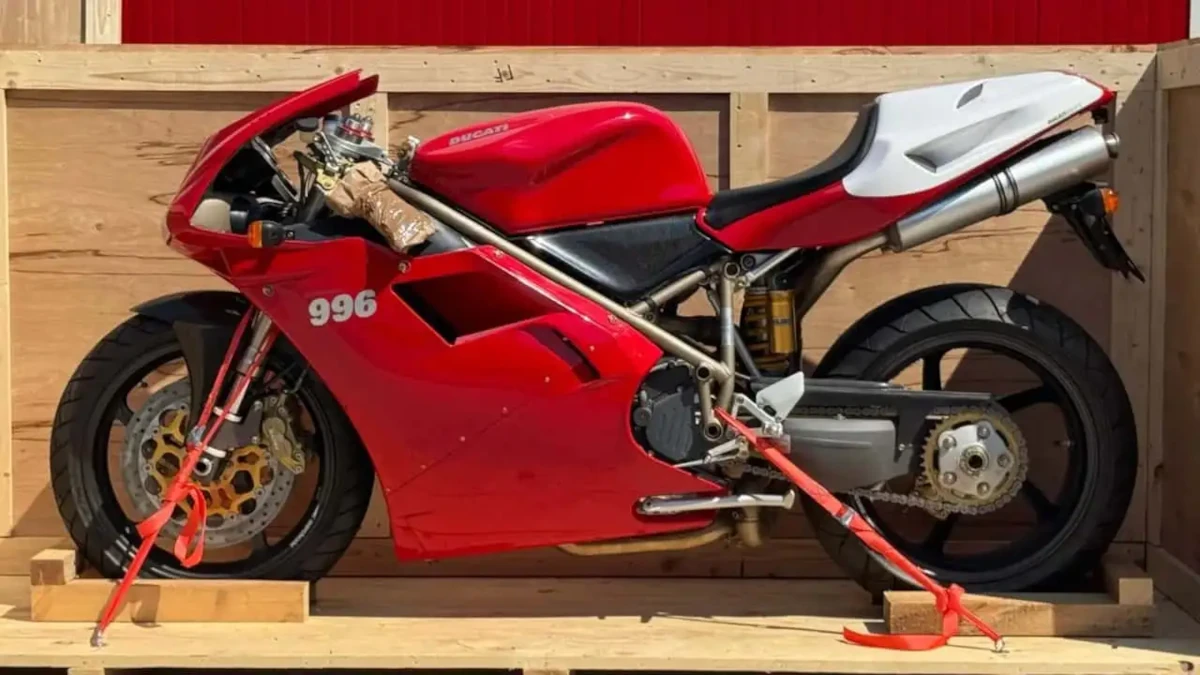
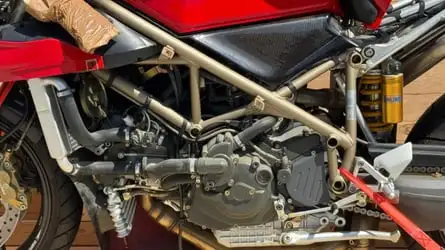
The recent discovery of a 1999 Ducati 996 SPS, still preserved in its original factory crate and untouched for over two decades, has captivated enthusiasts worldwide. This extraordinary find, described as having a mere “two klicks on the clock” and being entirely free of modifications, mileage, road grime, or stone chips, immediately establishes its unique status . The pristine condition of its components, from the gleaming Öhlins shock to the immaculate carbon-fiber airbox and Termignoni pipes, elevates this motorcycle from a mere collectible to a rare historical artifact . This state of perfect preservation sets the stage for a comprehensive examination of its profound significance.
This particular Ducati 996 SPS is far more than just a motorcycle; it embodies a unique confluence of design artistry, formidable performance, extreme rarity, and deep emotional resonance. The universal admiration for the “916–998 bloodline” as “perfection in red” and Massimo Tamburini’s design as a “sculpture” underscores the profound aesthetic and artistic dimensions of this machine. Furthermore, its explicit identification as a “homologation special” and a “sharpened, limited-edition weapon bred for the sole purpose of winning in World Superbike” immediately signals its high-performance pedigree and direct lineage to motorsports dominance . The staggering auction price of €63,000, translating to over $68,000, for this crated example highlights its exceptional market value, necessitating a detailed analysis of its unparalleled rarity and historical context .
The “new in crate” condition of this motorcycle is not merely a detail; it is a pivotal factor in its outlier valuation. A 1999 Ducati 996 SPS with “2 km (1 mi)” on the odometer recently sold for €63,000 ($73,060), marking the highest recorded sale for any Ducati 996.1 This price dramatically surpasses the average sale price of $16,190 for a typical 996 or even the $18,190 for a used 2000 996 SPS.1 The specific bike in question, number 181 of the SPS batch for its model year, benefits immensely from this untouched state.3 This pristine, zero-mileage condition elevates a rare collectible into an ultra-rare artifact, commanding a disproportionate premium.
It effectively shifts the bike from a “used collectible” category to an “investment-grade historical artifact,” appealing to a distinct tier of collector who prioritizes preservation and historical integrity over operational utility. This phenomenon suggests a significant and growing trend in the classic vehicle market where provenance and untouched originality, particularly “new old stock” or “time capsule” examples, are increasingly valued above even significant mileage or minor modifications. It reflects a shift in collector psychology towards preserving tangible history rather than merely owning a functional classic.
Chapter 1: The Tamburini Masterpiece – A Legacy of Design Perfection
The Ducati 916, the progenitor of the 996 SPS, was conceived by Massimo Tamburini and Sergio Robbiano at the Cagiva Research Centre and is widely celebrated as Tamburini’s “masterpiece”.4 Its timeless beauty led Motorcycle News magazine in 2014 to declare it “the most beautiful bike of the last 50 years”.4 Tamburini’s design philosophy was deeply rooted in achieving a perfect balance of elegance, rationality, and exhilarating performance, meticulously stripping away any superfluous elements.4 His guiding principle was to engineer a lightweight, yet powerful machine, famously articulating his goal as creating “a 750 cc motorcycle with the power of a 1000 and a weight of a 500”.4
The 916 seamlessly integrated innovative technical features into its striking design. For instance, the iconic single-sided swingarm was not merely an aesthetic choice but was engineered for faster wheel changes during races.5 Similarly, the distinctive underseat exhausts were designed to improve aerodynamic performance while contributing to the bike’s exceptionally clean lines.5 The patented adjustable steering further underscored its performance-oriented design.5 Tamburini’s unique design process, treating the motorcycle as a sculpture, involved riding prototypes in the rain between San Marino and Rimini. This unconventional method allowed him to observe water flow and precisely optimize the aerodynamics of each element, a testament to his artistic approach to engineering.4 Upon its debut at the Milan Motorcycle Show in October 1993, the 916 instantly became an “icon of Ducati style” and was hailed as “Motorcycle of the Year” by nearly every specialized magazine, solidifying its status as an “instant classic”.7
The 916 was succeeded by the 996 in 1999, which in turn was followed by the 998. This entire “bloodline” maintained a consistent design aesthetic while incorporating revised engines and increased power.5 This deliberate continuity ensured that the core visual identity established by Tamburini remained intact. The 996 retained the signature elements of the 916, including the single-sided swingarm and underseat exhausts, which became synonymous with the series’ iconic status.5 Despite the introduction of later models, such as the 999, which represented a stylistic departure, the 916-series (encompassing the 996 and 998) is still widely regarded by enthusiasts as the “high watermark of Ducati design in the ‘plastic’ era onward”.10 This validates the sentiment regarding its “perfection in red.”
The 996 SPS (Sport Production Special) stands as the pinnacle of this design era. It represented the “ultimate expression of the model,” essentially serving as a road-going version of Ducati’s World Superbike Championship contender.9 This direct lineage meant it inherited and further refined the aesthetic and performance principles developed for peak racing performance. Subtle yet significant updates, such as the transition from three-spoke to lighter five-spoke Marchesini wheels 9 and the introduction of titanium nitrided front forks in later versions 11, were not merely performance enhancements but also contributed to its refined and purposeful aesthetic. The 996 SPS, building on the “unmistakable design” and “innovative technical features” of the 916, continued to garner critical acclaim, contributing to the series being named “Motorcycle of the Year” by numerous specialized magazines.7
The enduring appeal of the 916-998 series, and particularly the 996 SPS, lies in its seamless fusion of form and function. Tamburini’s design process, which included real-world testing in the rain to optimize aerodynamics 4, and the integration of features like the single-sided swingarm for rapid wheel changes and underseat exhausts for aerodynamic efficiency 5, clearly illustrates that the 916/996 design was not merely about visual appeal. It was a highly functional sculpture, as the aptly notes, Tamburini “created a sculpture that just so happened to lap racetracks faster than anything else.” This “design as performance” philosophy is a core component of its iconic status and high collectibility. Aesthetic choices, such as the distinctive underseat exhausts and single-sided swingarm, directly contributed to aerodynamic and functional benefits, which in turn contributed to racing success and critical acclaim. This positive feedback loop solidified its reputation as both a beautiful machine and a formidable performer, enhancing its legendary status.
The consistent design language maintained across the 916-998 series fostered a strong, recognizable brand identity that deeply resonated with enthusiasts. This “bloodline” concept signifies a deliberate, evolutionary design strategy rather than radical stylistic shifts, cultivating a sense of continuity and refinement that appeals strongly to purists and collectors. This successful design continuity significantly contributed to Ducati’s brand image as a producer of high-performance, aesthetically exceptional sportbikes, distinguishing them from competitors who might prioritize technological novelty over design heritage. It also explains why subsequent models like the 999, which deviated from this established aesthetic, were less universally embraced by the core enthusiast community.10
Chapter 2: Bred for Battle – The 996 SPS as a Homologation Special
The “SPS” suffix proudly designates a ‘Sport Production Special’.11 This nomenclature signifies its role as a homologation special, a limited-production model specifically developed to meet the stringent regulations for racing in the World Superbike Championship. The 996 SPS was “basically a road-going version of the bike competing in the World Superbike Championship”.9 This direct link to racing underscores its primary purpose: to provide Ducati with a competitive edge on the track, fulfilling its design as a “weapon bred for the sole purpose of winning in World Superbike” .
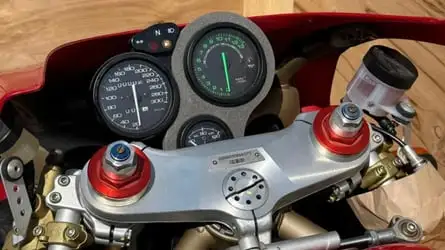
The 996 SPS featured significant technical enhancements over the standard 996, making it a formidable machine. Its engine produced approximately 92.4 kW (124 bhp), a notable increase over the standard 996’s 83.5 kW (112.0 hp).9 These performance gains were achieved through internal engine modifications, including titanium connecting rods, upgraded cams, and a lightened crankshaft.9 The SPS engine also incorporated a bigger generator and Termignoni pipes.9 Its overall strength was such that it was considered “much stronger than anything that Ducati or any other manufacturer at the time had produced for the track”.11
To further enhance its track capabilities, Ducati designed a “much higher specification chassis for the SPS”.11 The “stunning” tubular steel trellis frame was a testament to this commitment.12 For the 2000 model year, the chassis received “major attention,” contributing to the 2000 SPS being recognized as the “finest version of its genre”.9 A lighter aluminum rear subframe was also introduced, saving 0.5kg.9 The 1999 996 SPS was equipped with high-quality Öhlins rear shocks and Showa front forks.11 For the 2000 model, Öhlins front forks were added, featuring a titanium nitride coating to minimize friction.9 An Öhlins steering damper was also standard, providing enhanced stability.12 Lighter five-spoke Marchesini wheels were a key upgrade, replacing the heavier three-spoke design found on the 916 and early 996 models.9
The braking system was also improved over the 916, featuring enhanced calipers, discs, and pads.11 Brembo Gold Series brake calipers were standard, ensuring excellent stopping power.12 Weight reduction was achieved through the incorporation of various titanium and carbon fiber components.11 The crated bike’s carbon-fiber airbox and Termignoni pipes were noted as pristine , and a carbon front mudguard was standard equipment.13 Due to its race-focused nature and non-compliance with certain EPA regulations, the SPS was “only road legal in Europe.” In the US, Ducati marketed it as a ‘track-only’ bike, requiring buyers to sign a waiver acknowledging its intended use.9 This further underscores its direct connection to competitive racing.
Homologation specials like the 996 SPS represent a unique pinnacle in motorcycle engineering, where direct racing technology is made accessible to the public, albeit in limited numbers. The 996 SPS was designed as a “road-going version of the bike competing in WSBK” 9 and built “for the sole purpose of winning” . This required Ducati to meticulously balance road legality (even if limited to Europe) with cutting-edge race technology. The extensive list of high-performance components—including titanium con-rods, upgraded cams, a lighter crankshaft, Öhlins suspension, Marchesini wheels, and a high-spec chassis 9—demonstrates a no-compromise approach to performance while still making it available to the public.
This direct lineage to the race track significantly enhances its desirability and historical importance, as it offers enthusiasts a tangible piece of competitive racing history. This practice of creating homologation specials not only fueled Ducati’s racing success but also served as a powerful marketing tool, elevating the entire brand’s image. It forged a direct and compelling link between Ducati’s dominance on the track and the perceived performance and exclusivity of its road bikes, fostering deep brand loyalty among performance enthusiasts.
Ducati’s commitment to the SPS was not static; they continually refined the model year-over-year, even with subtle changes like suspension upgrades and weight reduction. The research reveals a pattern of continuous improvement within the SPS lineage. The 1999 SPS featured Showa forks with an Öhlins rear shock 11, while the 2000 SPS received full Öhlins front forks and a lighter aluminum subframe.9 The 2000 model is explicitly lauded as the “finest example yet of its genre” and “arguably offered the best sporting performance”.9 Even within the 1999 model year, later examples incorporated “different cylinder heads manufactured for WSBK homologation requirements”.14
This iterative pursuit of performance and competitive advantage in WSBK highlights Ducati’s dedication to engineering excellence and makes even slight variations between model years significant for discerning collectors. The intense competition in the World Superbike Championship 15 directly propelled Ducati’s continuous engineering improvements for the SPS models. These refinements, in turn, enhanced the bike’s performance, contributing to its racing success and solidifying its reputation as a top-tier sportbike, which then translates to higher collector value for later, more refined versions like the 2000 SPS.
Table 1: Ducati 996 SPS (1999) Key Technical Specifications
| Feature | Specification | Source |
| Engine | 996 cc (61 cu in), 90° L-twin, fuel injected, 4 valve per cylinder desmodromic, liquid cooled | 11 |
| Power | 124 bhp (92.4 kW) @ 8500 rpm | 9 |
| Torque | 93 Nm (9.5 kg-m) @ 8000 rpm | 11 |
| Top Speed | 259 km/h (161 mph) | 11 |
| Transmission | 6 speed, chain drive | 11 |
| Frame Type | Tubular steel trellis frame | 11 |
| Front Suspension | Showa with TiN upside-down fork fully adjustable, 127 mm (5.0 in) wheel travel (1999 model) | 11 |
| Rear Suspension | Öhlins progressive cantilever linkage with adjustable monoshock, 130 mm (5.1 in) wheel travel | 11 |
| Front Brakes | 2 x 320 mm discs, 4 piston calipers (Brembo Gold Series) | 11 |
| Rear Brakes | Single 220 mm disc, 2 piston caliper (Brembo Gold Series) | 11 |
| Tires | Front: 120/70 ZR17, Rear: 190/50 ZR17 | 11 |
| Dry Weight | 198 kg (437 lb) | 11 |
| Standard SPS Features | Termignoni Carbon Exhausts, Marchesini 5 Spoke Wheels, Carbon Front Mudguard, Adjustable Steering Head, Ohlins Steering Damper, Carbon Fibre/Titanium parts | 11 |
Chapter 3: Dominance on the Track – The World Superbike Legacy
The Ducati 916 and its subsequent 996/998 derivatives achieved unparalleled success in the World Superbike Championship, securing “no less than six WSB titles over a glorious eight-year run”.16 Throughout the 916/996 Desmoquattro era (1990-2000), these machines amassed a staggering eight World Superbike Championships.17 This period witnessed Ducati bikes winning 163 World Superbike races, resulting in an “astonishing winning ratio of 52 per cent”.17 The 916’s “incredible performance left the competition scrambling to catch up,” leading to “three consecutive World Superbike titles” for Ducati.15 The 996 SPS, being the “road-going version of the bike competing in the World Superbike Championship” 9, is directly linked to these triumphant racing efforts.
Key riders played an instrumental role in forging this legacy. Carl Fogarty, affectionately known as “King Carl,” is a legendary figure who clinched four Superbike World Championships for Ducati, notably in 1995, 1998, and 1999.9 It emphasizes that the 996 SPS was “bred for the sole purpose of winning,” a purpose Fogarty emphatically fulfilled with the 996 in his 1999 championship.15 His victories were often characterized by “nail-biting” finishes and intense “emotional” moments.18 Troy Corser also made significant contributions to Ducati’s success, securing race wins on the 916/996, including triumphs at Phillip Island, Misano, and Valencia in the 2000 season.20
He famously won the 1996 WSBK championship on a Ducati 916. Troy Bayliss’s career is deeply interwoven with Ducati’s racing heritage. He achieved his first SBK World Championship race win in Hockenheim in 2000 on a 996R.21 He went on to clinch the 2001 World Championship on the 996R.21 Across his illustrious career, Bayliss won three WSBK titles (2001, 2006, 2008) and a MotoGP race, all with Ducati.22 His 52 World Superbike victories place him fourth all-time in the championship’s history.22 Other notable riders who contributed to this era of dominance include Doug Polen 17 and Noriyuki Haga.20
The 996 SPS holds a direct connection to these racing triumphs. It was essentially the production version of the bikes that were dominating the World Superbike Championship. Its engine was engineered to be “much stronger than anything that Ducati or any other manufacturer at the time had produced for the track”.11 The “racing DNA is unmistakable” in these machines.16 The 996 SPS, with its “highly tuned and blueprinted engine that pushes out over 140 hp at the rear wheel” 23 and optimized suspension, brakes, and aerodynamics, was explicitly built for “maximum track performance”.23 Aaccurately identifies the 996 SPS as the “homologation special” and a “weapon bred for the sole purpose of winning in World Superbike,” directly linking it to the unparalleled racing success of its era.
The sustained dominance in World Superbike, marked by numerous championships and race wins accumulated by the 916/996/998 series 16 and piloted by iconic riders like Fogarty and Bayliss 9, created an unparalleled racing pedigree. The 996 SPS was the direct road-legal beneficiary of this intensive racing development.9 This proven racing success is a fundamental pillar of its collectibility, as it represents a tangible, championship-winning lineage. This directly results in a powerful “halo effect” for Ducati, imbuing their road-going homologation specials like the 996 SPS with an aura of invincibility and exclusivity. This enhanced brand reputation and desirability of homologation models, in turn, leads to increased collector interest and market value. The emotional connection for enthusiasts is significantly amplified by the knowledge that their bike is a direct descendant of a champion.
While the 996 SPS was an engineering marvel, the names of Carl Fogarty and Troy Bayliss are repeatedly highlighted in connection with championships and race victories.9 Fogarty’s wins were described as “nail-biting” and “emotional” 19, and Bayliss earned a “special place in the hearts of all his fans”.21 The legendary status of the 996 SPS is not solely attributable to its engineering prowess; it is inextricably linked to the charismatic and highly successful riders who piloted it to victory. These riders became synonymous with the bike, amplifying its appeal and creating a compelling narrative of heroism and triumph that profoundly resonates with fans and collectors. This highlights the crucial importance of the human element in motorsports. The “personality” of the riders, their intense rivalries (e.g., Bayliss vs. Edwards 21), and their dramatic victories contribute significantly to the cultural memory and enduring desirability of the machines they rode, transforming them into “objects of irrational desire” .
Chapter 4: Rarity and Resurrection – The Market Value of a Crated Unicorn
The Ducati 996 SPS was produced for a limited period, specifically between 1998 and 2001.14 In total, only 1,780 units of the 996 SPS were produced for worldwide distribution across the 1999 and 2000 model years, available in three distinct versions.13 For the 1999 model year, which includes the featured bike, 808 SPS models were manufactured with Showa front forks.13 The specific bike highlighted in the picture is number 181 of the SPS batch built for that particular model year.3 To underscore its extreme rarity, it is noted that Vincent, a manufacturer of highly sought-after classic motorcycles, produced
more Black Shadows than Ducati made 996 SPSs.13 This comparison vividly illustrates the inherent exclusivity of the 996 SPS. Further emphasizing its limited availability, only 40 genuine UK specification bikes were officially imported in 1999.13
The bike represents an extraordinary anomaly: it “somehow stayed cocooned in a wooden crate in Sweden for a quarter of a century”.3 Its odometer reads “two klicks on the clock”, a detail corroborated by a similar sale of a 1999 SPS with “2 km (1 mi)”.1 This effectively means the bike is in “as-delivered” condition. The condition is described as “untouched since it left the Borgo Panigale factory,” with components like the Öhlins shock, carbon-fiber airbox, and Termignoni pipes remaining pristine, and the desmo L-twin engine “still, for all intents and purposes, new”. This “time capsule” status is the paramount factor in its unique valuation, placing it among “the lowest mileage SPS in the world”.9
The crated 1999 Ducati 996 SPS achieved a sale price of €63,000 (over $68K) at auction . This figure is confirmed by research, which lists it as $73,060 (likely including buyer’s premium and currency conversion) and identifies it as the “highest recorded sale” for any Ducati 996.1 The data unequivocally demonstrates a massive disparity between the crated SPS’s sale price and the typical range for other 996 SPS models ($13,115 – $22,100).1 This is not merely a higher price; it represents an order-of-magnitude difference. The defining characteristics are the “two klicks on the clock” and its status as “untouched since it left the factory” .
Table 2: Select Ducati 996 SPS Auction Results
| Year & Model | Condition / Mileage | Sale Price (USD) | Notes | Source |
| 1999 Ducati 996 SPS | Crated, 2 km (1 mi) | $73,060 | Highest Recorded Sale for Ducati 996 | 1 |
| 1999 Ducati 996 SPS | 41k km (25k mi) | $13,115 | Used, higher mileage example | 1 |
| 2000 Ducati 996 SPS (#1496) | Used, mileage not specified | $18,190 | Example of a used SPS sale | 2 |
| 2000 Ducati 996S | 132 mi | $22,100 | Low mileage, but not “new in crate” | 1 |
| Average Ducati 996 Sale Price | – | $16,190 | Overall average for the 996 model line | 1 |
| Lowest Ducati 996 Biposto Sale Price | – | $5,000 | Entry-level 996 variant | 1 |
The €63,000 price is characterized as “hyperbike money,” an accurate assessment given it far surpasses typical market values for even highly desirable 996 SPS models. This extraordinary premium is directly attributable to its “new in crate” condition and ultra-low mileage, making it a truly unique offering. The urhetorical question, “But is it surprising? Not really,” acknowledges the market’s increasing appreciation for such exceptionally preserved artifacts.
The “new in crate” condition acts as an exponential value multiplier for highly desirable classic vehicles. It transcends conventional collector metrics like mileage or operational condition, creating a unique sub-market for “as-delivered” historical artifacts. The value here is not about riding the bike, but about owning a perfectly preserved piece of history. This extreme rarity combined with perfect, untouched originality leads to outlier auction results and the establishment of new market benchmarks. This phenomenon is driven by the emotional desire to possess a truly unique, unblemished piece of automotive history, reflecting a shift towards appreciating vehicles as static art or historical preservation items.
The price of €63,000, described as “hyperbike money”, suggests that the buyer is not just a passionate fan but potentially an investor. The dramatic difference from the average 996 price 1 indicates this is not a typical enthusiast transaction. The statement, “With the world shifting toward electrification and screens slowly replacing soul, bikes like the 996 SPS aren’t just rare, they’re relics from an era when performance had personality” , hints at a broader market trend. The sale of this crated 996 SPS signifies a maturation of the classic motorcycle market, where certain highly desirable models, especially in exceptional condition, are transitioning from enthusiast collectibles to investment-grade assets, akin to fine art or classic cars.
This shift is fueled by nostalgia for a “soulful” mechanical era and the finite supply of such pristine examples. As modern vehicles become increasingly digitized, standardized, and less mechanically engaging, the appeal of analog, characterful machines from past eras intensifies. This creates a strong demand for “relics” that offer a tangible connection to a perceived golden age of motorcycling, driving up values for truly exceptional examples. This trend is likely to continue as the supply of such vehicles dwindles and the appreciation for mechanical authenticity grows.
Chapter 5: Soul vs. Silicon – The Enduring Allure in a Modern World
The 996 SPS serves as a potent symbol of an era defined by raw performance, mechanical personality, and profound sensory engagement. It articulates this sentiment perfectly, describing the 996 SPS as a “relic from an era when performance had personality. When engines roared and rattled instead of whirred and hummed. That sound. That shape. That dry clutch clatter. It all represents something we’re steadily losing” . Ducati motorcycles of this period are renowned for their distinctive characteristics, including powerful L-twin engines, trellis frames, desmodromic valve control systems, and an undeniable Italian flair.24 The auditory experience of the 996 SPS, particularly its V-twin engine sound channeled through Termignoni exhausts, is consistently described as “magical”.12
The 916/996/998 series is lauded for its unique blend of “character, modernity and sheer pin-point brilliance”.16 These bikes are celebrated for being “as exciting to ride as it is gratifying to look at” 16, offering a visceral connection to the machine. The 996’s “allure was as visceral as anything else on two wheels” 9, with riders appreciating how “dense, taut and compact it feels,” and how its “rhythms and sonorous tones get inside your brain”.9 This emphasizes a deeply engaging, sensory-rich riding experience.
This raw, mechanical nature of the 996 SPS stands in stark contrast with contemporary sportbike technology. It explicitly highlights a world “shifting toward electrification and screens slowly replacing soul” . Modern sportbikes are characterized by an array of advanced electronic systems.25 These include Electronic Fuel Injection (EFI) for precise fuel-air mixture control, Anti-lock Braking Systems (ABS) that prevent wheel lock-up (now often including Cornering ABS that accounts for lean angle), and Traction Control Systems (TCS) to prevent rear wheel grip loss.25 Ride-by-Wire throttle systems replace mechanical cables, enabling smoother response and integration with multiple electronic riding modes that adjust engine power delivery, ABS, and TCS settings.25
Modern machines also feature electronic suspension adjustment, quick shifters and auto-blippers for clutchless gear changes, and Motorcycle Stability Control (MSC) for overall stability.25 Furthermore, LED lighting, digital dashboards with connectivity features, and advanced CAN bus wiring systems are standard.25 The emergence of electric motorcycles represents a significant shift towards instant torque and simplified, quiet mechanics.26 Some high-end models even include adaptive cruise control and collision avoidance systems.26
In contrast, the 916/996 models featured the “desmoquattro engine,” which was noted as “a little harder to service the valves and had the rocker issues”.10 While later 996R and 998 models adopted the “first generation testastretta” engine, which was “much more representative of a modern Ducati” and rectified rocker issues 10, the 996 SPS represents a more raw, mechanically engaging experience, largely devoid of the extensive electronic overlays of contemporary bikes. Its power delivery was described as a “smooth, progressive crescendo of acceleration” 15, indicating a more analog, less electronically managed interaction.
The user profoundly states bikes like the 996 SPS “become more than machines. They turn into dreams, benchmarks, objects of irrational desire”. The 916, the progenitor of the 996, is recognized as representing “the very essence of Ducati DNA” and a “true work of art”.7 Its iconic status is further solidified by its inclusion in the Guggenheim’s “Art of the Motorcycle” exhibit in 1998.8 The 916/996/998 family are widely considered “arguably the most desirable Italian modern classics” 16, indicating their continued high regard among collectors and enthusiasts. Even modern Ducati models, such as the Panigale V4 SP2 30° Anniversario 916, explicitly pay homage to the 916’s legacy, being described as a “meeting point between the two most successful families in Ducati superbike history” and embodying the “past, present and future of Ducati”.7 This demonstrates that Ducati itself acknowledges the enduring benchmark status and cultural impact of the 916 series.
The 996 SPS embodies a visceral, unmediated riding experience that is increasingly rare in the age of advanced electronics and electrification. Its distinctive mechanical sounds, direct throttle response (without ride-by-wire), and relative lack of extensive rider aids represent a purity of interaction between rider and machine that profoundly appeals to enthusiasts seeking an “analog soul.” This creates a strong emotional attachment that transcends mere performance metrics. This growing appreciation for “analog” experiences in an increasingly digital world is a significant cultural trend, extending beyond motorcycles to various collectibles such as manual transmission cars, mechanical watches, and vinyl records. It suggests that as technology advances, the market for simpler, more tactile, and characterful machines will continue to strengthen, driven by nostalgia and a desire for authenticity and direct engagement.
The 996 SPS, as a key part of the iconic 916-998 series, established an enduring benchmark for superbike design and performance. The user explicitly calls the 996 SPS a “benchmark.” Ducati’s own heritage narrative refers to the 916 as the “ultimate expression” of Ducati DNA, where “Style, Sophistication and Performance were perfectly blended”.7 The 996 SPS, as the “ultimate expression of the model” 9, naturally inherits this status. The fact that even modern Ducatis, like the Panigale V4 SP2 30° Anniversario 916, explicitly link back to the 916’s legacy 7 underscores its enduring influence. This standard continues to influence Ducati’s modern offerings and remains a yardstick for enthusiasts, who often implicitly judge other sportbikes, even contemporary ones, in terms of their “soul” and “character” against this classic. Its balanced blend of aesthetics and raw performance created a timeless ideal. The 916/996’s initial groundbreaking design and unparalleled racing success established it as a cultural and performance benchmark, which in turn fuels its continued desirability and high market value as a “dream” object, even decades later. This benchmark status ensures its relevance and value far beyond its original production run.
Conclusion: A Timeless Icon’s Place in History
The 1999 Ducati 996 SPS stands as a profound testament to a golden era of motorcycling, embodying a unique confluence of factors that elevate it beyond a mere machine. It is a design masterpiece, a direct result of Massimo Tamburini’s sculptural approach to engineering, where form and function were inextricably linked. It is a true homologation special, a street-legal weapon directly derived from the bikes that dominated the World Superbike Championship. Its racing legacy is undeniable, forged by legendary riders like Carl Fogarty and Troy Bayliss, who piloted its lineage to multiple championships. Finally, its extreme rarity, particularly in “new in crate” condition, positions it as an ultra-rare collectible, commanding exceptional market value. The enduring appeal of the 996 SPS lies in the harmonious interplay of these elements: its breathtaking aesthetics, its uncompromising performance pedigree, its limited production, and the profound emotional resonance it evokes as a symbol of a more analog, visceral riding experience.
The 916-998 series, with the 996 SPS as a pinnacle, profoundly influenced motorcycle design globally, setting a new standard for superbike aesthetics and performance that continues to inspire. Its iconic lines and innovative features remain a benchmark for the industry. Its unparalleled racing legacy cemented Ducati’s position as a dominant force in World Superbike, creating a powerful brand identity synonymous with performance and victory. This heritage continues to be a cornerstone of Ducati’s appeal. The extraordinary market response to the crated 996 SPS signifies a broader, evolving trend in collector culture. It highlights a growing appreciation for authenticity, provenance, and the intangible “soul” of mechanical objects from a perceived bygone era. As modern vehicles become increasingly digital and standardized, the allure of these characterful machines intensifies.
The profound statement of “enough emotional horsepower to knock the wind out of my lungs” upon seeing the crated bike, and concludes with references to “objects of irrational desire” and “collective awe” . This consistent emphasis on emotional connection is a key theme throughout the reflection. The preceding analysis has meticulously detailed how the bike’s design, racing history, and extreme rarity all contribute to this deep emotional impact. Beyond quantifiable technical specifications and objective market data, the ultimate value and iconic status of the 996 SPS are profoundly driven by an intangible quality: “emotional horsepower.”
This quality, stemming from its inherent beauty, its history of racing triumphs, and its representation of a beloved, more analog era of motorcycling, creates a deep, almost spiritual connection for enthusiasts and collectors. This connection elevates it beyond a mere vehicle to the status of a cultural artifact. This observation underscores a critical aspect of the high-end collectible market: rational economic factors are often secondary to emotional drivers. The capacity of an object to evoke strong feelings, nostalgia, and a sense of shared history can command prices and generate demand that purely utilitarian or performance-based metrics cannot explain. This emotional dimension is a crucial element for understanding the enduring appeal and escalating value of classic vehicles, particularly those that embody a significant cultural or technological moment.
The 996 SPS is more than just a motorcycle; it is a powerful symbol of passion, engineering artistry, and a tangible reminder of motorcycling’s golden age. It continues to inspire “irrational desire” and “collective awe”, ensuring its place as a timeless icon in history.
Sources
- Ducati 996 Market – CLASSIC.COM, accessed on July 22, 2025, https://www.classic.com/m/ducati/996/
- No Reserve – 2000 Ducati 996 SPS #1496 – Iconic Motorbike Auctions, accessed on July 22, 2025, https://iconicmotorbikeauctions.com/auction/2000-ducati-996-sps-1496-2/
- This Factory-Fresh 1999 Ducati 996 SPS Just Sold At Auction For $68K – RideApart.com, accessed on July 22, 2025, https://www.rideapart.com/news/766275/pristine-ducati-996-sps-68k-auction/
- 916 | Heritage – update Pan Ann – Ducati, accessed on July 22, 2025, https://www.ducati.com/ww/en/heritage/bikes/916
- Ducati 916 – Wikipedia, accessed on July 22, 2025, https://en.wikipedia.org/wiki/Ducati_916
- Massimo Tamburini – The Legendary Designer Who Revolutionized Ducati Motorcycles, accessed on July 22, 2025, https://www.ducati.com/us/en/heritage/characters/massimo-tamburini
- Ducati 916 Heritage – Celebrating the Legend of Ducati Motorcycles’ Iconic Superbiker, accessed on July 22, 2025, https://www.ducati.com/us/en/heritage/bikes/916
- The Ducati 916 is 25 and still amazing after all these years – RevZilla, accessed on July 22, 2025, https://www.revzilla.com/common-tread/the-ducati-916-is-25-and-still-amazing-after-all-these-years
- Double Aught Duc: ’00 Ducati 996 SPS – BikeBound, accessed on July 22, 2025, https://www.bikebound.com/2024/04/18/ducati-996sps/
- Alright, talk me into getting a 916/996/998… : r/Ducati – Reddit, accessed on July 22, 2025, https://www.reddit.com/r/Ducati/comments/qommwk/alright_talk_me_into_getting_a_916996998/
- Ducati 996 – Wikipedia, accessed on July 22, 2025, https://en.wikipedia.org/wiki/Ducati_996
- Ducati 996 SPS // Bike No.15 Of World Wide Production of 1780 Bikes // 1 Of Only 40 Official UK Bikes In 1999, accessed on July 22, 2025, https://www.vibed.co.uk/car/48/ducati-996-sps-1999-no-15-1-of-40-official-uk-bikes-foggy-rep-paint-scheme-from-new-documented-history
- Ducati 996 SPS // Bike No.15 Of World Wide Production of 1780 Bikes // 1 Of Only 40 Official UK Bikes In 1999, accessed on July 22, 2025, https://www.vibed.co.uk/car/48/ducati-996-sps-bike-no-15-of-world-wide-production-of-1780-bikes-1-of-only-40-official-uk-bikes-in-1999
- Ducati 996 | The Bike Specialists | South Yorkshire, accessed on July 22, 2025, https://www.thebikespecialists.com/vehicle/ducati-996-sps-excellent-final-series-edition-only-4950-miles-used-in-sheffield-12c9cce6-42f4-44af-834e-9eefc53ecec9
- SR Archive: Flogging Carl Fogarty’s Ducati 996 Superbike at Italy’s Mugello Circuit, accessed on July 22, 2025, https://www.cycleworld.com/sport-rider/sr-archive-flogging-carl-fogartys-ducati-996-superbike-at-italys-mugello-circuit/
- Ducati 916/996/998 (1994-2003): [Review & Buying Guide] – Bennetts Insurance, accessed on July 22, 2025, https://www.bennetts.co.uk/bikesocial/reviews/bikes/ducati/916-996-998-1994-review-used
- Ducati 996 SPS Pista – AllMoto’s Motorcycle Investor mag, accessed on July 22, 2025, https://www.allmoto.com/ducati996spspista.htm
- Foggy’s first World Superbike championship, 30 years on | Classic Racer Magazine, accessed on July 22, 2025, https://www.classicracer.com/foggys-first-world-superbike-championship-30-years-on/
- Carl Fogarty commentates on historic win at Monza in Race 2, 1999! – YouTube, accessed on July 22, 2025, https://www.youtube.com/watch?v=65ViI_fJ0mk
- 2000 Superbike World Championship – Wikipedia, accessed on July 22, 2025, https://en.wikipedia.org/wiki/2000_Superbike_World_Championship
- Troy Bayliss | Ducati Heritage | Ducati Characters, accessed on July 22, 2025, https://www.ducati.com/ww/en/heritage/characters/troy-bayliss
- Troy Bayliss – Wikipedia, accessed on July 22, 2025, https://en.wikipedia.org/wiki/Troy_Bayliss
- ducatibournemouth.co.uk, accessed on July 22, 2025, https://ducatibournemouth.co.uk/used-bikes/ducati/superbike/1999-996-sps-track-bike#:~:text=The%20heart%20of%20this%20Ducati,to%20ride%20on%20the%20circuit.
- What makes Ducati Motorcycles Special, accessed on July 22, 2025, https://www.ffunmotorcycles.com/blog/what-makes-ducati-motorcycles-special–57829
- 2024 GSX-8R – Suzuki Cycles, accessed on July 22, 2025, https://suzukicycles.com/street/2024/gsx-8r
- Electronic Rider Aids – Their Limitations And Should They Be Used in Racing, accessed on July 22, 2025, https://georgeleesye.com/electronic-rider-aids-their-limitations-and-should-they-be-used-in-racing/
Our Social Media Handles
- Instagram : LivingWithGravity
- Medium : Akash Dolas
- YouTube Channel : Gear and Shutter